REVIEW 5 major objections 5 minor 49 references
Rethinking Contrastive Learning in Session-based Recommendation
T0 review · 5 major / 5 minor · reviewed 2026-08-07 · deepseek-v4-flash
Pith's one-line read Session-based recommendation improves when contrastive learning augments item images and text rather than scrambling item IDs, and when each contrastive signal is weighted by its learned utility, as shown by the MACL framework on three…
desk verdict Useful method paper with a clear contribution, but the missing multi-modal baseline from the authors' own prior work leaves the superiority claim unproven. read the letter →
The pith
A machine-rendered reading of the paper's core claim, the machinery that carries it, and where it could break.
The reading
What carries the argument
The key mechanism is a multi-modal augmentation pool A, a set of nine image and text operations that the paper asserts preserve item semantics; applying one of these operations to an item's image or description yields a positive view while applying the same operation to other items yields negatives, and applying a single operation uniformly across a session yields a positive session. The second mechanism is the adaptive contrastive loss: instead of summing unweighted log-ratios as in standard contrastive losses, MACL multiplies each term by a scalar alpha_i (for items) or beta_i (for sessions) produced by an MLP on the concatenated anchor, positive, and mean negative embeddings. The learned weights are intended to emphasize informative signal sets and suppress uninformative ones during self-supervised training.
What would settle it
Hold out 1,000 items and have human annotators flag each augmentation output that changes the product's semantic category; then train a version of MACL that discards those flagged positive pairs. If performance does not drop, the semantic-preservation assumption is not doing the work.
Extended reading notes
Core claim
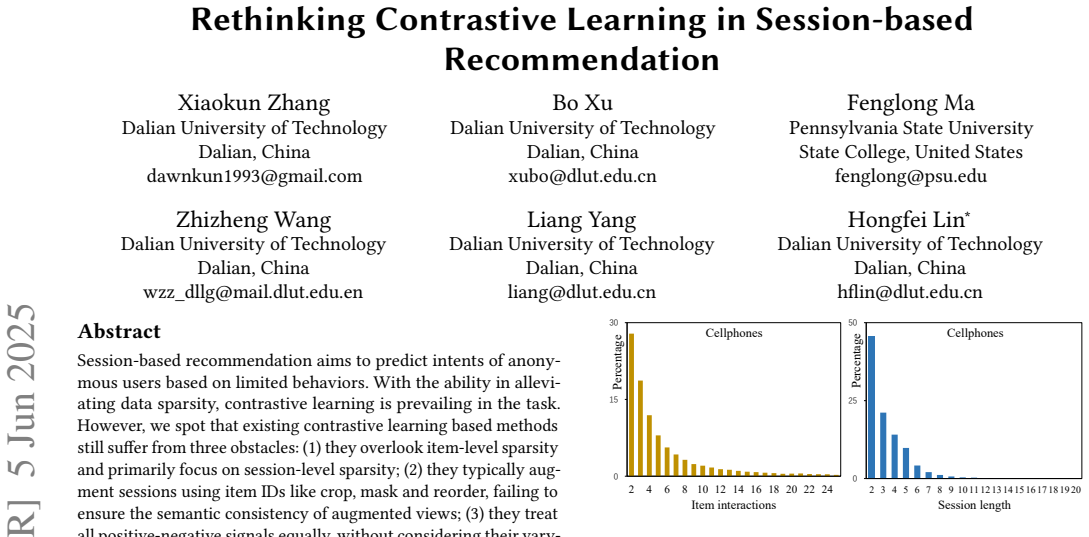
The paper's central claim is that the utility of a contrastive view in session-based recommendation is determined by whether the augmentation preserves the item's meaning, and that both item-level and session-level sparsity can be mitigated by augmenting an item's image and text rather than its ID. MACL maintains a pool A of nine operations (Hflip, Cropping, Gaussian Noise, Gaussian Blur, Max Pooling for images; Swap, Deletion, Substitution, Insertion for text). For each anchor item, one operation is randomly chosen and applied to its image or text to create the positive view; the same operation is applied to other items to form negatives. For a session, the chosen operation is applied to every item in the session to create a positive session, and other sessions in the batch are transformed similarly as negatives. The item-level and session-level contrastive losses are then each reweighted by scalar weights produced by a two-layer MLP from the anchor, positive, and mean negative embeddings. The paper demonstrates that this design outperforms ten baselines on three datasets and that item-level contrastive learning alone yields larger gains than session-level contrastive learning, suggesting that long-tail item sparsity is the more binding constraint.
Load-bearing premise
The load-bearing premise is that the nine augmentation operations preserve the semantic meaning of an item, so an augmented image or text still describes the same product; if a horizontal flip, crop, blur, or word substitution alters what the item actually is, the contrastive objective aligns views that no longer share the same intent.
Editorial extensions
If this is right
- If MACL is correct, contrastive learning for session-based recommendation should move away from item-ID perturbations and toward augmenting item features that carry meaning, such as images and text.
- Because item-level contrastive learning produced larger gains than session-level in the paper's ablations, future methods should explicitly target long-tail item sparsity rather than focusing only on short-session augmentation.
- The adaptive contrastive loss is a drop-in modification that could be applied to other self-supervised learning settings where the usefulness of positive–negative pairs varies, such as graph or multi-modal representation learning.
- The reported MRR improvements (up to 25.8%) imply that the target item appears much higher in the recommendation list, which is the metric that matters most for user-facing ranking.
- The dependency on pre-trained image and text encoders means that MACL's approach is most actionable in domains where such features already exist or can be cheaply obtained.
Reading between the lines
- The paper asserts but does not verify semantic preservation for each of the nine augmentations; measuring the semantic drift of positive pairs and correlating it with the learned adaptive weights would directly test the stated mechanism.
- The adaptive weight is computed from anchor, positive, and mean negative embeddings; this could be a form of hardness weighting, and a simpler heuristic (e.g., weighting by cosine similarity between anchor and positive minus anchor and mean negative) might achieve comparable performance without training an MLP.
- Since the encoders are frozen, the reported gains may partly reflect the quality of pre-trained image and text features rather than the augmentation logic; a test that unfreezes the encoders or uses randomly initialized encoders would separate these effects.
- In settings without rich multi-modal features, one could approximate the method by treating embeddings from a co-occurrence-based model as a pseudo-modality and applying dropout-style augmentations to them, but the semantic-consistency advantage would likely weaken.
Editorial analysis
A structured set of objections, weighed in public.
Referee Report
Summary. The paper proposes MACL, a multi-modal adaptive contrastive learning framework for session-based recommendation. MACL augments items and sessions using image and text features rather than item IDs, and introduces an adaptive contrastive loss in which per-signal weights α_i and β_i are produced by small MLPs. The method is evaluated on Cellphones, Grocery, and Instacart, with reported improvements over ID-only supervised and self-supervised baselines. The paper claims that MACL achieves consistent superiority over all baselines on all metrics and datasets, and that it specifically improves handling of item-level long-tail and session-level short-session sparsity.
Significance. If the reported results hold, the paper makes a useful contribution by demonstrating that multi-modal features can serve as a source of semantically consistent augmentations for contrastive session-based recommendation, and by proposing a signal-adaptive reweighting of contrastive terms. The release of source code, the ablations isolating item- and session-level augmentation, and the explicit study of long-tail and short-session scenarios are strengths. However, the absence of strong multi-modal baselines and the underspecified and potentially ill-conditioned adaptive loss leave the central claims not fully established.
major comments (5)
- [Section 5.4, Table 2] The baseline set omits 'Beyond Co-occurrence: Multi-modal Session-based Recommendation' (Ref. [39]), a directly relevant multi-modal SBR method from the same group, as well as the related multi-modal method in Ref. [40]. Because MACL's main design elements are the incorporation of image/text features and their use for augmentation, the observed gains over ID-only baselines (e.g., SASRec, CL4SRec) could be attributable to the extra modalities alone. The ablation MACL_com in Section 6.2 does not isolate this effect, since it removes both the multi-modal fusion of Eq. (5) and the multi-modal augmentation. Please add these baselines, or explicitly justify their exclusion and provide a variant that uses ID-based augmentation with the same fusion network to separate the modality effect from the augmentation effect.
- [Eq. (14) (and Eq. (1), Eq. (16))] The contrastive loss is not fully specified. It is written as -Σ α_i <e_i,e_i^+>/Σ_k <e_i,e_{i,k}^->, with no logarithm, no temperature, and no explicit normalization; Section 4.3 refers to 'cosine distance' as the similarity function, which is ambiguous between distance and similarity. More importantly, α_i is the raw output of an MLP with no constraints or regularization, so the objective is not bounded below: scaling α_i can arbitrarily reduce the loss, and the MLP could minimize the loss without learning meaningful signal utility. The claim that the network 'evaluates the contribution of each signal' therefore needs a constraint discussion (e.g., non-negativity, normalization, or a bounded range) and a clear statement of how gradients flow through α_i.
- [Table 2] The paper states that MACL's improvements over the best baseline are significant by a t-test at p<0.01, but no standard deviations, confidence intervals, or number of independent runs are provided. Without these, the significance claim and the 'consistent superiority' assertion in Section 6.1 cannot be verified. Please report mean±std over multiple seeds and describe the exact t-test procedure used.
- [Section 4.2.2, Eq. (13)] For session-level augmentation, the positive session embedding s^+ is computed from single-modality embeddings (imgEmb(·) or txtEmb(·)) of the augmented items, whereas the anchor session embedding s uses the fused multi-modal item embeddings from Eq. (5). The same asymmetry appears at item level between Eq. (12) and Eq. (5). The paper does not explain why the positive view is uni-modal while the anchor is multi-modal; this makes the claimed 'semantic consistency' of the augmented views with the anchor less direct and may cause the contrastive loss to align different representation spaces. Please clarify the design or use the fused representation for the augmented views as well.
- [Section 4.2.1] The paper claims that the selected augmentations 'preserve an item's original semantics' and 'guarantee semantic consistency', but this is asserted without validation. Operations such as Gaussian Noise, Max Pooling, Deletion, Substitution, and Insertion can plausibly change an item's meaning (for example, deleting a color or brand word from the text). Please provide a quantitative or qualitative validation of semantic preservation (e.g., whether the original item can be retrieved from the augmented view) or temper the guarantee.
minor comments (5)
- [Table 2 caption] The caption says 'over four datasets' but only three datasets are reported in the table; please correct this.
- [Eqs. (10)-(11)] The probability y_i is defined as softmax(e_i s), but the loss L_rec is written as binary cross-entropy over items. Please clarify whether a sigmoid and negative sampling are intended, or use the standard cross-entropy with softmax.
- [Figures 5-7] The sub-figures in Figure 5, Figure 6, and Figure 7 are very small and the text and numbers are nearly illegible in the provided PDF; please enlarge them and increase the font size.
- [Throughout] There are several typos and grammatical issues, e.g., 'duo to' should be 'due to' in Section 2.1, and 'scratched' should be 'scraped' in Section 5.2. A careful proofread is needed.
- [Table 4] The runtime comparison reports only MACL and MACL-adp; to put the efficiency claim in context, please also report the training/inference time of the most competitive baselines.
Circularity Check
No significant circularity: the paper's claims are empirical and its design components are tested against external baselines and ablations.
full rationale
MACL makes no first-principles prediction or derived law; its central claim (Section 6.1) is an empirical superiority result over external baselines on three public datasets. The multi-modal augmentation and adaptive contrastive loss are model components, not quantities fitted to the target metric and then re-reported as predictions. The adaptive weights alpha_i and beta_i (Eqs. 15 and 17) are learned inside the same contrastive objective, and the paper's wording that they 'evaluate the contribution' of signals is an interpretive gloss rather than a fitted-input-called-prediction; the claimed benefit is independently tested by the MACL-adp ablation in Section 6.3. The semantics-preservation claim for the augmentation pool (Section 4.2.1) is an assumption about the chosen CV/NLP operations, not a conclusion obtained by substituting the target result into its own definition, so it is an empirical-risk concern rather than circularity. Self-citations appear (e.g., Refs. [36], [37], [39] in Section 4.1.1) but only support the background premise that multi-modal features matter; no load-bearing derived result or uniqueness theorem is imported from the authors' prior work. The omission of Ref. [39] from the baseline set is a baseline-completeness / correctness concern, not a circularity.
Assumptions & free parameters
free parameters (6)
- lambda (contrastive loss weight) =
0.01
- M (number of item-level negatives) =
100
- N (batch size) =
100
- d (embedding size) =
100
- learning rate =
0.001
- MLP hidden sizes for alpha/beta =
not reported
assumptions (5)
- domain assumption Pre-trained GoogLeNet and BERT embeddings preserve item semantics from images and text.
- domain assumption The selected CV and NLP augmentations (Hflip, Gaussian noise, Gaussian blur, cropping, max pooling, swap, deletion, substitution, insertion) preserve the original item semantics.
- ad hoc to paper The MLP output alpha_i is a valid measure of contrastive-signal utility.
- domain assumption SASRec is a suitable sequence encoder for session intent modeling.
- domain assumption The ground-truth label for each session is the last item, and p_i is one-hot.
Cite this review
Pith. "Pith review of Rethinking Contrastive Learning in Session-based Recommendation." pith.science (2026). https://pith.science/paper/AYLAN3FE
@misc{pith2026250605044,
  author       = {Pith},
  title        = {Pith review of: Rethinking Contrastive Learning in Session-based Recommendation},
  year         = {2026},
  howpublished = {\url{https://pith.science/paper/AYLAN3FE}},
  note         = {Machine review of arXiv:2506.05044}
}
read the original abstract
Session-based recommendation aims to predict intents of anonymous users based on limited behaviors. With the ability in alleviating data sparsity, contrastive learning is prevailing in the task. However, we spot that existing contrastive learning based methods still suffer from three obstacles: (1) they overlook item-level sparsity and primarily focus on session-level sparsity; (2) they typically augment sessions using item IDs like crop, mask and reorder, failing to ensure the semantic consistency of augmented views; (3) they treat all positive-negative signals equally, without considering their varying utility. To this end, we propose a novel multi-modal adaptive contrastive learning framework called MACL for session-based recommendation. In MACL, a multi-modal augmentation is devised to generate semantically consistent views at both item and session levels by leveraging item multi-modal features. Besides, we present an adaptive contrastive loss that distinguishes varying contributions of positive-negative signals to improve self-supervised learning. Extensive experiments on three real-world datasets demonstrate the superiority of MACL over state-of-the-art methods.
Figures


Figures from the paper (4 more)


Reference graph
Works this paper leans on
-
[39]
Xiaokun Zhang, Bo Xu, Fenglong Ma, Chenliang Li, Liang Yang, and Hongfei Lin. 2023. Beyond Co-occurrence: Multi-modal Session-based Recommendation. IEEE Transactions on Knowledge and Data Engineering(2023)
work page 2023
-
[40]
Xiaokun Zhang, Bo Xu, Chenliang Li, Bowei He, Hongfei Lin, Chen Ma, and Fenglong Ma. 2025. A Survey on Side Information-driven Session-based Recom- mendation: From a Data-centric Perspective.IEEE Transactions on Knowledge and Data Engineering(2025), 1–20
work page 2025
-
[1]
Renqin Cai, Jibang Wu, Aidan San, Chong Wang, and Hongning Wang. 2021. Category-aware Collaborative Sequential Recommendation. InSIGIR. 388–397
work page 2021
-
[2]
Ting Chen, Simon Kornblith, Mohammad Norouzi, and Geoffrey E. Hinton. 2020. A Simple Framework for Contrastive Learning of Visual Representations. In Proceedings of the 37th International Conference on Machine Learning. 1597–1607
work page 2020
-
[3]
Yongjun Chen, Zhiwei Liu, Jia Li, Julian J. McAuley, and Caiming Xiong. 2022. Intent Contrastive Learning for Sequential Recommendation. InThe ACM Web Conference. 2172–2182
work page 2022
-
[4]
Ziqiang Cui, Yunpeng Weng, Xing Tang, Xiaokun Zhang, Dugang Liu, Shiwei Li, Peiyang Liu, Bowei He, Weihong Luo, Xiuqiang He, and Chen Ma. 2025. Semantic Retrieval Augmented Contrastive Learning for Sequential Recommendation. CoRR(2025)
work page 2025
-
[5]
Jacob Devlin, Ming-Wei Chang, Kenton Lee, and Kristina Toutanova. 2019. BERT: Pre-training of Deep Bidirectional Transformers for Language Understanding. In NAACL-HLT. 4171–4186
2019
-
[6]
Sheng, Yanchi Liu, Guanfeng Liu, and Lei Zhao
Hanwen Du, Hui Shi, Pengpeng Zhao, Deqing Wang, Victor S. Sheng, Yanchi Liu, Guanfeng Liu, and Lei Zhao. 2022. Contrastive Learning with Bidirectional Transformers for Sequential Recommendation. InThe 31th ACM International Conference on Information and Knowledge Management. 396–405
work page 2022
Show all 49 references
-
[7]
Yongjing Hao, Jun Ma, Pengpeng Zhao, Guanfeng Liu, Xuefeng Xian, Lei Zhao, and Victor S. Sheng. 2023. Multi-dimensional Graph Neural Network for Sequen- tial Recommendation.Pattern Recognit.139 (2023), 109504
2023
-
[8]
Balázs Hidasi, Alexandros Karatzoglou, Linas Baltrunas, and Domonkos Tikk
-
[9]
Yupeng Hou, Shanlei Mu, Wayne Xin Zhao, Yaliang Li, Bolin Ding, and Ji-Rong Wen. 2022. Towards Universal Sequence Representation Learning for Recom- mender Systems. InKDD. 585–593
2022
-
[10]
Wang-Cheng Kang and Julian J. McAuley. 2018. Self-Attentive Sequential Rec- ommendation. InICDM. 197–206
2018
-
[11]
Prannay Khosla, Piotr Teterwak, Chen Wang, Aaron Sarna, Yonglong Tian, Phillip Isola, Aaron Maschinot, Ce Liu, and Dilip Krishnan. 2020. Supervised Contrastive Learning. InAnnual Conference on Neural Information Processing Systems 2020, NeurIPS 2020
2020
-
[12]
Kibum Kim, Dongmin Hyun, Sukwon Yun, and Chanyoung Park. 2023. MELT: Mutual Enhancement of Long-Tailed User and Item for Sequential Recommenda- tion. InSIGIR. 68–77
2023
-
[13]
Jing Li, Pengjie Ren, Zhumin Chen, Zhaochun Ren, Tao Lian, and Jun Ma. 2017. Neural Attentive Session-based Recommendation. InCIKM. ACM, 1419–1428
2017
-
[14]
Xuewei Li, Aitong Sun, Mankun Zhao, Jian Yu, Kun Zhu, Di Jin, Mei Yu, and Ruiguo Yu. 2023. Multi-Intention Oriented Contrastive Learning for Sequential Recommendation. InProceedings of the Sixteenth ACM International Conference on Web Search and Data Mining. 411–419
2023
-
[15]
McAuley, and Guandong Xu
Zihao Li, Xianzhi Wang, Chao Yang, Lina Yao, Julian J. McAuley, and Guandong Xu. 2023. Exploiting Explicit and Implicit Item relationships for Session-based Recommendation. InProceedings of the Sixteenth ACM International Conference on Web Search and Data Mining. 553–561
2023
-
[16]
Qiao Liu, Yifu Zeng, Refuoe Mokhosi, and Haibin Zhang. 2018. STAMP: Short- Term Attention/Memory Priority Model for Session-based Recommendation. In KDD. ACM, 1831–1839
2018
-
[17]
Yu, Julian J
Zhiwei Liu, Yongjun Chen, Jia Li, Philip S. Yu, Julian J. McAuley, and Caiming Xiong. 2021. Contrastive Self-supervised Sequential Recommendation with Robust Augmentation.CoRR(2021)
2021
-
[18]
Yuqi Qin, Pengfei Wang, and Chenliang Li. 2021. The World is Binary: Contrastive Learning for Denoising Next Basket Recommendation. InThe 44th International ACM SIGIR Conference on Research and Development in Information Retrieval. 859–868
2021
-
[19]
Ruihong Qiu, Zi Huang, Hongzhi Yin, and Zijian Wang. 2022. Contrastive Learn- ing for Representation Degeneration Problem in Sequential Recommendation. InThe Fifteenth ACM International Conference on Web Search and Data Mining. 813–823
2022
-
[20]
Jiayu Song, Jiajie Xu, Rui Zhou, Lu Chen, Jianxin Li, and Chengfei Liu. 2021. CBML: A Cluster-based Meta-learning Model for Session-based Recommendation. InCIKM. 1713–1722
2021
-
[21]
Wenzhuo Song, Shoujin Wang, Yan Wang, Kunpeng Liu, Xueyan Liu, and Ming- hao Yin. 2023. A Counterfactual Collaborative Session-based Recommender System. InProceedings of the ACM Web Conference. 971–982
2023
-
[22]
Fei Sun, Jun Liu, Jian Wu, Changhua Pei, Xiao Lin, Wenwu Ou, and Peng Jiang
-
[23]
Reed, Dragomir Anguelov, Dumitru Erhan, Vincent Vanhoucke, and Andrew Rabi- novich
Christian Szegedy, Wei Liu, Yangqing Jia, Pierre Sermanet, Scott E. Reed, Dragomir Anguelov, Dumitru Erhan, Vincent Vanhoucke, and Andrew Rabi- novich. 2015. Going deeper with convolutions. InIEEE Conference on Computer Vision and Pattern Recognition. 1–9
2015
-
[24]
Lei Wang, Ee-Peng Lim, Zhiwei Liu, and Tianxiang Zhao. 2022. Explanation Guided Contrastive Learning for Sequential Recommendation. InCIKM. 2017– 2027
2022
-
[25]
Ziyang Wang, Huoyu Liu, Wei Wei, Yue Hu, Xian-Ling Mao, Shaojian He, Rui Fang, and Dangyang Chen. 2022. Multi-level Contrastive Learning Framework for Sequential Recommendation. InThe 31th ACM International Conference on Information and Knowledge Management. 2098–2107
2022
-
[26]
Ziyang Wang, Wei Wei, Ding Zou, Yifan Liu, Xiao-Li Li, Xian-Ling Mao, and Minghui Qiu. 2024. Exploring global information for session-based recommen- dation.Pattern Recognit.145 (2024), 109911
2024
-
[27]
Shu Wu, Yuyuan Tang, Yanqiao Zhu, Liang Wang, Xing Xie, and Tieniu Tan
-
[28]
Xin Xia, Hongzhi Yin, Junliang Yu, Yingxia Shao, and Lizhen Cui. 2021. Self- Supervised Graph Co-Training for Session-based Recommendation. InThe 30th ACM International Conference on Information and Knowledge Management. 2180– 2190
2021
-
[29]
Xin Xia, Hongzhi Yin, Junliang Yu, Qinyong Wang, Lizhen Cui, and Xiangliang Zhang. 2021. Self-Supervised Hypergraph Convolutional Networks for Session- based Recommendation. InThirty-Fifth AAAI Conference on Artificial Intelligence. 4503–4511
2021
-
[30]
InThe Thirty-Third AAAI Conference on Artificial Intelligence
Session-Based Recommendation with Graph Neural Networks. InThe Thirty-Third AAAI Conference on Artificial Intelligence. AAAI Press, 346–353
-
[31]
Heeyoon Yang, YunSeok Choi, Gahyung Kim, and Jee-Hyong Lee. 2023. LOAM: Improving Long-tail Session-based Recommendation via Niche Walk Augmenta- tion and Tail Session Mixup. InProceedings of the 46th International ACM SIGIR Conference on Research and Development in Informatio...
2023
-
[32]
Yuhao Yang, Chao Huang, Lianghao Xia, Chunzhen Huang, Da Luo, and Kangyi Lin. 2023. Debiased Contrastive Learning for Sequential Recommendation. In Proceedings of the ACM Web Conference. 1063–1073
2023
-
[33]
Xu Xie, Fei Sun, Zhaoyang Liu, Shiwen Wu, Jinyang Gao, Jiandong Zhang, Bolin Ding, and Bin Cui. 2022. Contrastive Learning for Sequential Recommendation. In38th IEEE International Conference on Data Engineering. 1259–1273. Rethinking Contrastive Learning in Session-based Recom...
2022
-
[34]
Xiaokun Zhang, Hongfei Lin, Bo Xu, Chenliang Li, Yuan Lin, Haifeng Liu, and Fenglong Ma. 2022. Dynamic intent-aware iterative denoising network for session-based recommendation.Inf. Process. Manag.59 (2022), 102936
2022
-
[35]
Xiaokun Zhang, Hongfei Lin, Liang Yang, Bo Xu, Yufeng Diao, and Lu Ren
-
[36]
Peiyan Zhang, Jiayan Guo, Chaozhuo Li, Yueqi Xie, Jaeboum Kim, Yan Zhang, Xing Xie, Haohan Wang, and Sunghun Kim. 2023. Efficiently Leveraging Multi- level User Intent for Session-based Recommendation via Atten-Mixer Network. InWSDM. 168–176
2023
-
[37]
Xiaokun Zhang, Bo Xu, Chenliang Li, Yao Zhou, Liangyue Li, and Hongfei Lin
-
[38]
Xiaokun Zhang, Bo Xu, Fenglong Ma, Chenliang Li, Yuan Lin, and Hongfei Lin. 2024. Bi-preference Learning Heterogeneous Hypergraph Networks for Session-based Recommendation.ACM Trans. Inf. Syst.42, 3 (2024), 68:1–68:28
2024
-
[41]
Xiaokun Zhang, Bo Xu, Youlin Wu, Yuan Zhong, Hongfei Lin, and Fenglong Ma
-
[42]
Xiaokun Zhang, Bo Xu, Liang Yang, Chenliang Li, Fenglong Ma, Haifeng Liu, and Hongfei Lin. 2022. Price DOES Matter!: Modeling Price and Interest Preferences in Session-based Recommendation. InSIGIR. 1684–1693
2022
-
[43]
Kun Zhou, Hui Wang, Wayne Xin Zhao, Yutao Zhu, Sirui Wang, Fuzheng Zhang, Zhongyuan Wang, and Ji-Rong Wen. 2020. S3-Rec: Self-Supervised Learning for Sequential Recommendation with Mutual Information Maximization. InThe 29th ACM International Conference on Information and Know...
2020
-
[45]
Xiaokun Zhang, Bo Xu, Zhaochun Ren, Xiaochen Wang, Hongfei Lin, and Feng- long Ma. 2024. Disentangling ID and Modality Effects for Session-based Recom- mendation. InSIGIR. ACM, 1883–1892
2024
-
[47]
FineRec: Exploring Fine-grained Sequential Recommendation. InSIGIR. ACM, 1599–1608
-
[2016]
Session-based Recommendations with Recurrent Neural Networks. In ICLR
-
[2019]
InProceedings of the 28th ACM International Conference on Information and Knowledge Management
BERT4Rec: Sequential Recommendation with Bidirectional Encoder Rep- resentations from Transformer. InProceedings of the 28th ACM International Conference on Information and Knowledge Management. ACM, 1441–1450
-
[2021]
Neurocomputing440 (2021), 89–100
Dual Part-pooling Attentive Networks for Session-based Recommendation. Neurocomputing440 (2021), 89–100
2021
-
[2024]
Side Information-Driven Session-based Recommendation: A Survey.arXiv (2024)
2024
Reviewed August 7, 2026 · model on record in the stance chip above.
Discussion (0). Sign in to comment.