REVIEW 3 major objections 4 minor 104 references
Evaluating the Evidence of Multipolar Surface Magnetic Field in PSR J0108$-$1431
T0 review · 3 major / 4 minor · reviewed 2026-08-14 · deepseek-v4-flash
Pith's one-line read The radio beam of PSR J0108–1431 leads its X-ray hotspot by roughly 0.4 of a rotation, evidence that the neutron star's surface magnetic field is multipolar, not a simple dipole.
desk verdict A careful re-analysis with an honest presentation, but the headline multipolar claim rests on a prior that practically guarantees the measured offset; worth reviewing, not worth citing as evidence yet. read the letter →
The pith
A machine-rendered reading of the paper's core claim, the machinery that carries it, and where it could break.
The reading
What carries the argument
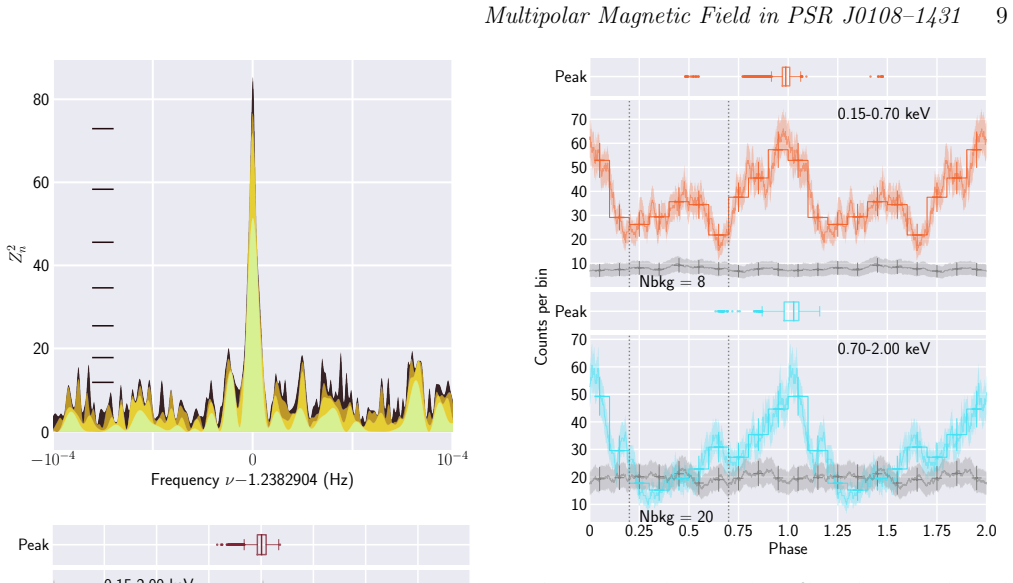
The load-bearing measurement is the X-ray/radio phase offset $\Delta\varphi$, obtained by aligning thermal X-ray and radio times of arrival. The thermal peak is located by fitting a single sinusoid $f(x)=A_0+A\sin[2\pi(x-\varphi_0)]$ to the 0.15–0.7 keV pulse profile over the phase range 0.2–0.7, where phase-separated spectra show the emission is thermal; a prior assigns 98% probability that the sinusoid peak lies in that range. The radio peak is located by fitting the rotating vector model to the 1.37 GHz polarization traverse and estimating an emission height of about 211 km, tying the radio beam to the dipolar field. A combined timing fit with a constant offset parameter between radio and X-ray TOAs fixes the absolute phase alignment. Against this, the paper predicts the dipole-aligned offset from aberration, retardation, and magnetic sweepback ($\Delta\Phi\sim0.004$), so the observed $\Delta\varphi\approx0.4$ is the anomaly that carries the argument.
What would settle it
A high-S/N X-ray observation of PSR J0108–1431 that resolves the soft (0.15–0.7 keV) profile could falsify the claim: if the thermal component's true peak lies within 0.1 in phase of the radio peak, or if the 0.2–0.7 keV bump is found to contain a power-law tail above 1 keV, the sinusoid is not marking a thermal polar cap and the multipolar-field inference collapses.
Extended reading notes
Core claim
For PSR J0108–1431, the paper claims, the thermal polar cap emission peaks at phase $\tilde{\varphi}_{\mathrm{th}}=0.43\pm0.14$, while the radio peak is at $\varphi_r=0.037^{+0.041}_{-0.059}$; the radio peak therefore leads the thermal peak by $\Delta\varphi_{r-\mathrm{th}}\approx0.4$, and there is a 99.7% probability that the offset exceeds 0.1. Because the radio emission is consistent with a purely dipolar open-field-line geometry at a height of roughly 211 km, and because for a rotating dipole aberration, retardation, and magnetic sweepback predict a radio lag of only $\Delta\Phi\sim0.004$, the measured offset is too large by about two orders of magnitude. The paper therefore concludes that the hotspot is displaced from the dipole axis, with a surface shift $S\gtrsim0.8$ km, and that this is best explained by multipolar components of the surface magnetic field. As a prerequisite, the paper establishes that the soft X-ray component in the 0.2–0.7 phase range is genuinely thermal: a power law cannot fit it, while blackbody and neutron-star-atmosphere models both fit acceptably and cannot be distinguished.
Load-bearing premise
The offset is dominated by the thermal peak phase, which is derived by fitting a single sinusoid to the 0.15–0.7 keV profile in the 0.2–0.7 phase range under a prior that the peak lies there; if that soft component is not a compact hotspot with a sinusoidal peak, or is partly non-thermal, the inferred offset is biased.
Editorial extensions
If this is right
- If the central claim is right, PSR J0108–1431's surface field has substantial multipolar components, and its thermal polar cap is displaced roughly 0.8 km from the dipole axis.
- The polar-cap-area method for diagnosing multipolar fields is unreliable for old pulsars with low signal-to-noise spectra; phase-offset measurements should be used instead.
- The presence of multipolar surface fields supports pair-cascade and inner-gap models that need high field-line curvature near the neutron star surface.
- The apparent 0.33 keV absorption feature, if it is proton cyclotron absorption, would independently imply surface field strengths above about $10^{13}$ G, reinforcing the multipolar picture.
Reading between the lines
- Applied to a sample of thermally emitting old pulsars, the offset method could test whether multipolar surface components decay with characteristic age or spin-down power; the paper does not do this.
- A higher-sensitivity X-ray observation could separate the sinusoid hotspot model from a non-thermal interpretation of the 0.2–0.7 keV bump by checking whether the soft profile peak moves with energy; that check is not possible with current data.
- If future radio observations at lower frequency give a different conal classification or emission height for J0108, the predicted dipole offset would shift, directly changing the significance of the measured 0.4 offset.
Signed reviews
Editorial analysis
A structured set of objections, weighed in public.
Referee Report
Summary. The paper reanalyzes archival XMM-Newton observations of the old pulsar PSR J0108-1431 to search for evidence of a multipolar surface magnetic field. The authors find that the phase-integrated spectrum is adequately described by a single power law, but that phase-separated spectra in the ranges 0.2-0.7 and 0.7-0.2 require different models: a blackbody or neutron-star atmosphere for the soft phase, and a power law for the hard phase. They show that blackbody and atmosphere models cannot be distinguished statistically, so polar-cap area estimates are ambiguous. As an alternative diagnostic, they measure the phase offset between the thermal X-ray peak and the radio peak. Using a sinusoid fit to the 0.15-0.7 keV profile in the 0.2-0.7 phase range, they obtain a thermal peak phase of 0.43 ± 0.14, a radio peak phase of about 0.037, and an offset Δφ ≈ 0.4, with a quoted 99.7% probability that the offset exceeds 0.1. They argue that such an offset cannot be produced by a star-centered dipole and therefore constitutes strong evidence for a multipolar surface field. The paper also reports an absorption-like feature near 0.33 keV in the soft-phase spectrum and criticizes earlier polar-cap area estimates in the literature.
Significance. If the measured offset is real, the paper would provide a valuable new observational diagnostic for multipolar surface magnetic fields in old pulsars, sidestepping the model ambiguity that plagues blackbody-area estimates. The authors are careful in several respects: they use Bayesian posterior sampling, propagate the distance uncertainty through the area estimates, explicitly compare blackbody and atmosphere models with DIC, and offer a detailed and useful critique of earlier polar-cap area claims in Section 7. The paper is also explicit about many of its own limitations, such as the low count statistics and the inability to distinguish thermal emission models. However, the central statistical claim for the offset rests on a sinusoid fit whose prior is localized to the same phase window that was selected from the data, and the quoted 99.7% probability is essentially inherited from that prior rather than independently measured. The diagnostic idea is promising, but the evidence as presented does not currently establish the multipolar-field conclusion.
major comments (3)
- [Section 6.2, Eq. (6)] The headline probability that the offset exceeds 0.1 is essentially fixed by the prior, not by the data. The prior assigns 98% probability to φ0 lying in [0.2,0.7], and for the measured radio peak at φr ≈ 0.037, every φ0 in that interval gives Δφ = φ0 − φr > 0.1; the smallest value is about 0.16 when φ0 = 0.2 and φr is near its upper 90% value. A uniform prior on [0.2,0.7] already yields a median φ0 of 0.45 and a 10–90% interval of roughly [0.25,0.65], very close to the reported φth = 0.43 ± 0.14. The reported 99.7% probability for Δφ > 0.1 therefore restates the prior rather than constituting an independent measurement. The authors should refit the thermal peak phase without the restrictive prior (for example, over the full phase range, or with a prior not localized to [0.2,0.7]) and should present a prior-sensitivity analysis. Because this probability is the quantitative basis for the multipolar conclusion in Answer G, the current form of the claim is not supported.
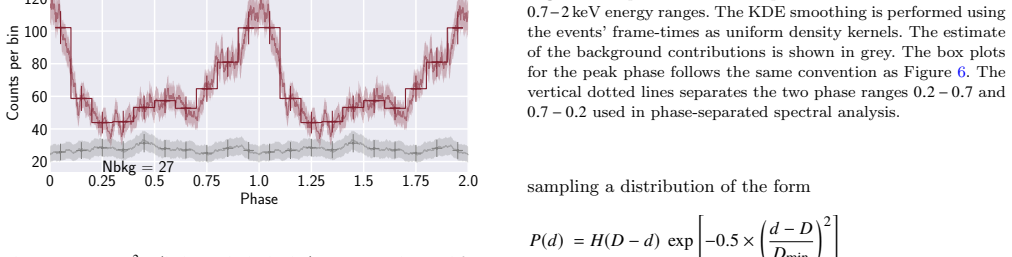
- [Section 4, Section 6.2] The identification of the thermal peak with the maximum of the single sinusoid in Eq. (6) is not well supported by the profile data. The 0.15–0.7 keV profile contains a main peak near phase 0 as well as a secondary bump near phase 0.5, and the Anderson–Darling test in Section 4 does not reject the hypothesis that the soft and hard profiles come from the same distribution. The phase-integrated spectrum (Section 3) is adequately fitted by a single power law, so the soft-band modulation is not independently established to be a clean hot-spot sinusoid. Fitting Eq. (6) only over the pre-selected 0.2–0.7 window forces the peak into that window and ignores the main pulse. At minimum, the authors should fit a model that includes the main pulse and a separate thermal component over the full phase range, and they should demonstrate with an appropriate test that an additional soft component is actually required before assigning the sinusoid maximum to the polar cap center.
- [Section 5.1, Section 6.2] The prior on φ0 is described as informed by the spectral constraint of Section 5.1, but that constraint is not independent of the phase window being tested. The 0.2–0.7 interval was selected from the same data because the pulse profile appeared soft there (opening of Section 5), and the 98% probability that the blackbody area is larger in 0.2–0.7 than in 0.7–0.2 is derived from spectra extracted in these same, data-defined windows. Using this probability as a prior for the location of the sinusoid peak therefore double-counts the data: the posterior for φ0 is not a Bayesian update from external information. The authors need to justify the prior from an independent source or, preferably, estimate φ0 from the full unbinned phase distribution with a model that includes the non-thermal main pulse, and then quote how the offset probability changes with the prior choice.
minor comments (4)
- [Section 7, Answer G] The sentence containing "S∼ 2π Δφ RNS sinα & 820" appears to be missing a unit and a proper inequality symbol; it should likely read "≳ 820 m" or "≥ 0.8 km."
- [Section 6.2, Table 5] The X-ray TOA uncertainty budget is unclear: if each of the eight selected X-ray events is assigned σ = 33 ms, the weighted mean of the X-ray TOAs should have an uncertainty of roughly 12 ms (about 0.014 in phase), yet the JUMP posterior is quoted with an uncertainty of 0.29 ms (0.00036 in phase). This apparent factor-of-40 discrepancy should be explained.
- [Figure 11 caption] The caption refers to "PSR J0108–1436" but the pulsar under study is PSR J0108–1431.
- [Section 1] In the introduction, the surface magnetic field is quoted as "2.3×10^11 erg s^-1"; the unit should be gauss (G), as correctly given in Table 1.
Circularity Check
The 99.7% probability that the X-ray/radio offset exceeds 0.1 is effectively set by the 0.2–0.7 prior placed on the thermal sinusoid peak, not independently measured from the data.
-
fitted input called prediction
[Section 6.2, Eq. (6), and Section 7 (answer G)]
"Our prior for the zero-phase of the sine curve (φ0) is informed by the constraint on the thermal peak obtained from spectral fitting in Section 5.1. ... Hence, we assign a probability of 0.98 that Sine curves peak in the 0.2−0.7 phase range and 0.02 elsewhere. ... We estimate an offset ∆φ≈ 0.4 between the X-ray thermal peak and the leading radio peak, with a 99.7% probability that the offset is greater than 0.1."
The 0.2–0.7 window was selected from the same data as the thermal phase range ('From the pulse profile shapes, we inferred soft emission in the 0.2−0.7 phase range'), and the 98% prior forces the sinusoid peak into that window. Because the radio peak phase is φr ≈ 0.037, any thermal peak in [0.2, 0.7] automatically yields an offset > 0.1 (indeed > 0.16). The quoted 99.7% probability that the offset exceeds 0.1 is therefore essentially the adopted prior restated as a measurement; the posterior median 0.43 is close to the window midpoint 0.45, as expected for a prior-dominated fit. An unrestricted fit over the full 0.15–0.7 keV profile would be needed to separate data information from the prior.
full rationale
The core X-ray/radio offset measurement is not itself derived from multipolarity: the sine fit and radio timing are independent of the multipolar conclusion, and the dipole-alignment expectation uses external aberration/retardation formulas. However, the headline significance claim—99.7% probability that the offset exceeds 0.1—is statistically forced by the prior that places 98% of the sinusoid peak in the 0.2–0.7 phase window. Since any peak in that window gives an offset > 0.1 relative to the radio peak, the significance is a restatement of the prior rather than an independent data constraint. The paper itself notes the Anderson–Darling test did not reject a common profile between the soft and hard bands, so the phase-separated thermal component is not independently secured. Thus the multipolar-field evidence is partially circular in its formal significance, while the existence of a soft X-ray bump near phase 0.5 retains some data-driven content.
Assumptions & free parameters
free parameters (5)
- Thermal peak phase (phi_0, sine fit) =
0.43 +/- 0.14
- Radio peak phase (phi_r) =
0.037 (+0.041, -0.059)
- X-ray profile peak phase used for TOAs =
0.003 (0.040)
- Blackbody emitting area ratio =
0.38 (+0.34, -0.16)
- NSA area ratio =
2.6e-4 (10-90% range)
assumptions (6)
- domain assumption Thermal X-rays originate from the polar cap and non-thermal X-rays from the magnetosphere
- standard math The polar cap area for a magnetic dipole is given by A_d,pc = 2π^2 R_NS^3/(cP) (Eq. 1)
- domain assumption The radio emission arises from open dipolar field lines at a height ~211 km where multipoles have decayed
- domain assumption The Empirical Theory of pulsar beams (core-cone structure, outer cone radius relation) correctly describes J0108
- domain assumption In a rotating dipole, the radio peak lags the thermal X-ray peak by about 0.004 in phase after aberration, retardation and sweepback corrections
- ad hoc to paper The thermal pulse shape is well approximated by a single sinusoid f(x)=A0 + A sin[2π(x-phi0)]
Cite this review
Pith. "Pith review of Evaluating the Evidence of Multipolar Surface Magnetic Field in PSR J0108$-$1431." pith.science (2026). https://pith.science/paper/AZJALTN6
@misc{pith2026190806221,
  author       = {Pith},
  title        = {Pith review of: Evaluating the Evidence of Multipolar Surface Magnetic Field in PSR J0108$-$1431},
  year         = {2026},
  howpublished = {\url{https://pith.science/paper/AZJALTN6}},
  note         = {Machine review of arXiv:1908.06221}
}
abstract
PSR J0108$-$1431 is an old pulsar where the X-ray emission is expected to have a thermal component from the polar cap and a non-thermal component from the magnetosphere. Although the phase-integrated spectra are fit best with a single non-thermal component modeled with a power-law (PL) of photon index $\Gamma=2.9$, the X-ray pulse profiles do show the presence of phase-separated thermal and non-thermal components. The spectrum extracted from half the rotational phase away from the X-ray peak fits well with either a single blackbody (BB) or a neutron star atmosphere (NA) model, whereas, the spectrum from the rest of the phase range is dominated by a PL. From Bayesian analysis, the estimated BB area is smaller than the expected polar cap area for a dipolar magnetic field with a probability of 86% whereas the area estimate from the NA model is larger with a probability of 80%. Due to the ambiguity in the thermal emission model, the polar cap area cannot be reliably estimated and hence cannot be used to understand the nature of the surface magnetic field. Instead, we can infer the presence of multipolar magnetic field from the misalignment between the pulsar's thermal X-ray peak and the radio emission peak. For J0108$-$1431, we estimated a phase-offset $\Delta\phi > 0.1$ between the thermal polar cap emission peak and the radio emission peak and argue that this is best explained by the presence of a multipolar surface magnetic field.
Figures

Figures from the paper (11 more)



Reference graph
Works this paper leans on
-
[1]
Anderson T. W., Darling D. A., 1954, @doi [Journal of the American Statistical Association] 10.1080/01621459.1954.10501232 , 49, 765
arXiv 1954
-
[2]
Arumugasamy P., Kargaltsev O., Posselt B., Pavlov G. G., Hare J., 2018, @doi [ ] 10.3847/1538-4357/aaec69 , https://ui.adsabs.harvard.edu/abs/2018ApJ...869...97A 869, 97
-
[3]
Balucinska-Church M., McCammon D., 1992, @doi [ ] 10.1086/172032 , http://adsabs.harvard.edu/abs/1992ApJ...400..699B 400, 699
doi:10.1086/172032 1992
-
[4]
Baring M. G., Wadiasingh Z., Gonthier P. L., 2011, @doi [ ] 10.1088/0004-637X/733/1/61 , https://ui.adsabs.harvard.edu/abs/2011ApJ...733...61B 733, 61
-
[5]
357, Astrophysics and Space Science Library
Becker W., 2009, in Becker W., ed., Astrophysics and Space Science Library Vol. 357, Astrophysics and Space Science Library. p. 91, @doi 10.1007/978-3-540-76965-1_6
-
[6]
Becker W., Weisskopf M. C., Tennant A. F., Jessner A., Dyks J., Harding A. K., Zhang S. N., 2004, @doi [ ] 10.1086/424498 , http://adsabs.harvard.edu/abs/2004ApJ...615..908B 615, 908
doi:10.1086/424498 2004
-
[7]
Becker W., et al., 2006, @doi [ ] 10.1086/504458 , https://ui.adsabs.harvard.edu/abs/2006ApJ...645.1421B 645, 1421
-
[8]
Blaskiewicz M., Cordes J. M., Wasserman I., 1991, @doi [ ] 10.1086/169850 , https://ui.adsabs.harvard.edu/abs/1991ApJ...370..643B 370, 643
doi:10.1086/169850 1991
Show all 104 references
-
[9]
Bogdanov S., 2013, @doi [ ] 10.1088/0004-637X/762/2/96 , https://ui.adsabs.harvard.edu/abs/2013ApJ...762...96B 762, 96
2013 doi
-
[10]
Borghese A., Rea N., Coti Zelati F., Tiengo A., Turolla R., 2015, @doi [ ] 10.1088/2041-8205/807/1/L20 , http://adsabs.harvard.edu/abs/2015ApJ...807L..20B 807, L20
2015 doi
-
[11]
M., 2017, @doi [ ] 10.1007/s11214-016-0315-7 , https://ui.adsabs.harvard.edu/abs/2017SSRv..207..111C 207, 111
Cerutti B., Beloborodov A. M., 2017, @doi [ ] 10.1007/s11214-016-0315-7 , https://ui.adsabs.harvard.edu/abs/2017SSRv..207..111C 207, 111
2017 doi
-
[12]
F., Ruderman M
Cheng A. F., Ruderman M. A., 1980, @doi [ ] 10.1086/157661 , https://ui.adsabs.harvard.edu/abs/1980ApJ...235..576C 235, 576
1980 doi
-
[13]
Contopoulos I., Kazanas D., Fendt C., 1999, @doi [ ] 10.1086/306652 , https://ui.adsabs.harvard.edu/abs/1999ApJ...511..351C 511, 351
1999 doi
-
[14]
A., Moroni M., Mignani R
De Luca A., Mereghetti S., Caraveo P. A., Moroni M., Mignani R. P., Bignami G. F., 2004, @doi [ ] 10.1051/0004-6361:20031781 , http://adsabs.harvard.edu/abs/2004A
2004 doi
-
[15]
A., Mereghetti S., Negroni M., Bignami G
De Luca A., Caraveo P. A., Mereghetti S., Negroni M., Bignami G. F., 2005, @doi [ ] 10.1086/428567 , http://adsabs.harvard.edu/abs/2005ApJ...623.1051D 623, 1051
2005 doi
-
[16]
T., Tingay S
Deller A. T., Tingay S. J., Bailes M., Reynolds J. E., 2009, @doi [ ] 10.1088/0004-637X/701/2/1243 , http://adsabs.harvard.edu/abs/2009ApJ...701.1243D 701, 1243
2009 doi
-
[17]
K., 2004, @doi [ ] 10.1086/423707 , https://ui.adsabs.harvard.edu/abs/2004ApJ...614..869D 614, 869
Dyks J., Harding A. K., 2004, @doi [ ] 10.1086/423707 , https://ui.adsabs.harvard.edu/abs/2004ApJ...614..869D 614, 869
2004 doi
-
[18]
K., 2004, @doi [ ] 10.1086/383587 , https://ui.adsabs.harvard.edu/abs/2004ApJ...607..939D 607, 939
Dyks J., Rudak B., Harding A. K., 2004, @doi [ ] 10.1086/383587 , https://ui.adsabs.harvard.edu/abs/2004ApJ...607..939D 607, 939
2004 doi
-
[19]
E., Weisberg J
Everett J. E., Weisberg J. M., 2001, @doi [ ] 10.1086/320652 , http://adsabs.harvard.edu/abs/2001ApJ...553..341E 553, 341
2001 doi
-
[20]
D., Babu J
Feigelson E. D., Babu J. G., 2012, Modern Statistical Methods for Astronomy . Cambridge University Press
2012
-
[21]
Chapman & Hall/CRC Texts in Statistical Science, Taylor & Francis, https://books.google.co.in/books?id=TNYhnkXQSjAC
Gelman A., Carlin J., Stern H., Rubin D., 2003, Bayesian Data Analysis, Second Edition. Chapman & Hall/CRC Texts in Statistical Science, Taylor & Francis, https://books.google.co.in/books?id=TNYhnkXQSjAC
2003
-
[22]
Geppert U., 2017, @doi [Journal of Astrophysics and Astronomy] 10.1007/s12036-017-9460-y , http://adsabs.harvard.edu/abs/2017JApA...38...46G 38, 46
2017 doi
-
[23]
Geppert U., K \"u ker M., Page D., 2004, @doi [ ] 10.1051/0004-6361:20040455 , https://ui.adsabs.harvard.edu/abs/2004A
2004 doi
-
[24]
A., Melikidze G
Gil J. A., Melikidze G. I., Mitra D., 2002, @doi [ ] 10.1051/0004-6361:20020473 , https://ui.adsabs.harvard.edu/abs/2002A
2002 doi
-
[25]
G., 2008, @doi [ ] 10.1086/590657 , http://adsabs.harvard.edu/abs/2008ApJ...686..497G 686, 497
Gil J., Haberl F., Melikidze G., Geppert U., Zhang B., Melikidze Jr. G., 2008, @doi [ ] 10.1086/590657 , http://adsabs.harvard.edu/abs/2008ApJ...686..497G 686, 497
2008 doi
-
[26]
Y., Yakovlev D
Gnedin O. Y., Yakovlev D. G., Potekhin A. Y., 2001, @doi [ ] 10.1046/j.1365-8711.2001.04359.x , https://ui.adsabs.harvard.edu/abs/2001MNRAS.324..725G 324, 725
2001
-
[27]
H., 1969, @doi [ ] 10.1086/150119 , http://adsabs.harvard.edu/abs/1969ApJ...157..869G 157, 869
Goldreich P., Julian W. H., 1969, @doi [ ] 10.1086/150119 , http://adsabs.harvard.edu/abs/1969ApJ...157..869G 157, 869
1969 doi
-
[28]
Goodman J., Weare J., 2010, @doi [Communications in Applied Mathematics and Computational Science, Vol. 5, No. 1, p. 65-80, 2010] 10.2140/camcos.2010.5.65 , http://adsabs.harvard.edu/abs/2010CAMCS...5...65G 5, 65
2010 doi
-
[29]
P., Ruderman M., 1993, @doi [ ] 10.1086/173164 , https://ui.adsabs.harvard.edu/abs/1993ApJ...415..286H 415, 286
Halpern J. P., Ruderman M., 1993, @doi [ ] 10.1086/173164 , https://ui.adsabs.harvard.edu/abs/1993ApJ...415..286H 415, 286
1993 doi
-
[30]
K., Muslimov A
Harding A. K., Muslimov A. G., 2001, @doi [ ] 10.1086/321589 , https://ui.adsabs.harvard.edu/abs/2001ApJ...556..987H 556, 987
2001 doi
-
[31]
Hermsen W., et al., 2017, @doi [ ] 10.1093/mnras/stw3135 , https://ui.adsabs.harvard.edu/abs/2017MNRAS.466.1688H 466, 1688
2017 doi
-
[32]
Hermsen W., et al., 2018, @doi [ ] 10.1093/mnras/sty2075 , https://ui.adsabs.harvard.edu/abs/2018MNRAS.480.3655H 480, 3655
2018 doi
-
[33]
B., Edwards R
Hobbs G. B., Edwards R. T., Manchester R. N., 2006, @doi [ ] 10.1111/j.1365-2966.2006.10302.x , http://adsabs.harvard.edu/abs/2006MNRAS.369..655H 369, 655
2006
-
[34]
W., van Straten W., Manchester R
Hotan A. W., van Straten W., Manchester R. N., 2004, @doi [ ] 10.1071/AS04022 , http://adsabs.harvard.edu/abs/2004PASA...21..302H 21, 302
2004 doi
-
[35]
Y., Huang R
Hui C. Y., Huang R. H. H., Trepl L., Tetzlaff N., Takata J., Wu E. M. H., Cheng K. S., 2012, @doi [ ] 10.1088/0004-637X/747/1/74 , http://adsabs.harvard.edu/abs/2012ApJ...747...74H 747, 74
2012 doi
-
[36]
Johnston S., Kerr M., 2018, @doi [ ] 10.1093/mnras/stx3095 , http://adsabs.harvard.edu/abs/2018MNRAS.474.4629J 474, 4629
2018 doi
-
[37]
S., Mitrofanov I
Kardash \"e v N. S., Mitrofanov I. G., Novikov I. D., 1984, , https://ui.adsabs.harvard.edu/abs/1984SvA....28..651K 28, 651
1984
-
[38]
Y., Pavlov G
Kargaltsev O. Y., Pavlov G. G., Zavlin V. E., Romani R. W., 2005, @doi [ ] 10.1086/429368 , http://adsabs.harvard.edu/abs/2005ApJ...625..307K 625, 307
2005 doi
-
[39]
G., 2012, @doi [Science] 10.1126/science.1221378 , http://adsabs.harvard.edu/abs/2012Sci...337..946K 337, 946
Kargaltsev O., Durant M., Misanovic Z., Pavlov G. G., 2012, @doi [Science] 10.1126/science.1221378 , http://adsabs.harvard.edu/abs/2012Sci...337..946K 337, 946
2012 doi
-
[40]
Kargaltsev O., Cerutti B., Lyubarsky Y., Striani E., 2015, @doi [Space Science Reviews] 10.1007/s11214-015-0171-x , 191, 391
2015 doi
-
[41]
Klingler N., et al., 2016, @doi [ ] 10.3847/1538-4357/833/2/253 , https://ui.adsabs.harvard.edu/abs/2016ApJ...833..253K 833, 253
2016 doi
-
[42]
Li X.-H., Lu F.-J., Li Z., 2008, @doi [ ] 10.1086/589495 , https://ui.adsabs.harvard.edu/abs/2008ApJ...682.1166L 682, 1166
2008 doi
-
[43]
Lin L. C. C., et al., 2013, @doi [ ] 10.1088/2041-8205/770/1/L9 , http://adsabs.harvard.edu/abs/2013ApJ...770L...9L 770, L9
2013 doi
-
[44]
Lorimer D., 1994, PhD thesis, The University of Manchester
1994
-
[45]
Lyutikov M., 2013, @doi [Monthly Notices of the Royal Astronomical Society] 10.1093/mnras/stt351 , 431, 2580
2013 doi
-
[46]
N., Hobbs G
Manchester R. N., Hobbs G. B., Teoh A., Hobbs M., 2005, VizieR Online Data Catalog, http://adsabs.harvard.edu/abs/2005yCat.7245....0M 7245
2005
-
[47]
N., et al., 2013, @doi [ ] 10.1017/pasa.2012.017 , http://adsabs.harvard.edu/abs/2013PASA...30...17M 30, e017
Manchester R. N., et al., 2013, @doi [ ] 10.1017/pasa.2012.017 , http://adsabs.harvard.edu/abs/2013PASA...30...17M 30, e017
2013 doi
-
[48]
pp CD337--CD341
Melikidze G., Gil J., Szary A., 2009, in Revista Mexicana de Astronomia y Astrofisica Conference Series. pp CD337--CD341
2009
-
[49]
Mereghetti S., et al., 2016, @doi [ ] 10.3847/0004-637X/831/1/21 , https://ui.adsabs.harvard.edu/abs/2016ApJ...831...21M 831, 21
2016 doi
-
[50]
C., Li H., 1999, @doi [ ] 10.1016/S0370-1573(99)00002-2 , https://ui.adsabs.harvard.edu/abs/1999PhR...318..227M 318, 227
Michel F. C., Li H., 1999, @doi [ ] 10.1016/S0370-1573(99)00002-2 , https://ui.adsabs.harvard.edu/abs/1999PhR...318..227M 318, 227
1999 doi
-
[51]
G., Garmire G
Misanovic Z., Pavlov G. G., Garmire G. P., 2008, @doi [ ] 10.1086/590949 , http://adsabs.harvard.edu/abs/2008ApJ...685.1129M 685, 1129
2008 doi
-
[52]
Mitra D., 2017, @doi [Journal of Astrophysics and Astronomy] 10.1007/s12036-017-9457-6 , https://ui.adsabs.harvard.edu/abs/2017JApA...38...52M 38, 52
2017 doi
-
[53]
H., 2004, @doi [ ] 10.1051/0004-6361:20034094 , http://adsabs.harvard.edu/abs/2004A
Mitra D., Li X. H., 2004, @doi [ ] 10.1051/0004-6361:20034094 , http://adsabs.harvard.edu/abs/2004A
2004 doi
-
[54]
M., 2002, @doi [ ] 10.1086/342136 , http://adsabs.harvard.edu/abs/2002ApJ...577..322M 577, 322
Mitra D., Rankin J. M., 2002, @doi [ ] 10.1086/342136 , http://adsabs.harvard.edu/abs/2002ApJ...577..322M 577, 322
2002 doi
-
[55]
I., Szary A., Krzeszowski K., 2016, @doi [ ] 10.3847/1538-4357/833/1/28 , http://adsabs.harvard.edu/abs/2016ApJ...833...28M 833, 28
Mitra D., Basu R., Maciesiak K., Skrzypczak A., Melikidze G. I., Szary A., Krzeszowski K., 2016, @doi [ ] 10.3847/1538-4357/833/1/28 , http://adsabs.harvard.edu/abs/2016ApJ...833...28M 833, 28
2016 doi
-
[56]
P., 1993, @doi [ ] 10.1086/186952 , https://ui.adsabs.harvard.edu/abs/1993ApJ...413L..31O 413, L31
Oegelman H., Finley J. P., 1993, @doi [ ] 10.1086/186952 , https://ui.adsabs.harvard.edu/abs/1993ApJ...413L..31O 413, L31
1993 doi
-
[57]
Springer Netherlands, Dordrecht, pp 87--100, @doi 10.1007/978-94-011-3536-8_7 , https://doi.org/10.1007/978-94-011-3536-8_7
\"O gelman H., 1991, Thermal Emission of Pulsars. Springer Netherlands, Dordrecht, pp 87--100, @doi 10.1007/978-94-011-3536-8_7 , https://doi.org/10.1007/978-94-011-3536-8_7
1991 doi
-
[58]
A., 2004, @doi [Nuclear Physics B Proceedings Supplements] 10.1016/j.nuclphysbps.2004.04.111 , http://adsabs.harvard.edu/abs/2004NuPhS.132..636O 132, 636
Oosterbroek T., Kennea J., Much R., C \'o rdova F. A., 2004, @doi [Nuclear Physics B Proceedings Supplements] 10.1016/j.nuclphysbps.2004.04.111 , http://adsabs.harvard.edu/abs/2004NuPhS.132..636O 132, 636
2004 doi
-
[59]
Page D., 1995, @doi [ ] 10.1086/175439 , https://ui.adsabs.harvard.edu/abs/1995ApJ...442..273P 442, 273
1995 doi
-
[60]
Page D., Geppert U., Weber F., 2006, @doi [ ] 10.1016/j.nuclphysa.2005.09.019 , https://ui.adsabs.harvard.edu/abs/2006NuPhA.777..497P 777, 497
2006 doi
-
[61]
Pancrazi B., et al., 2012, @doi [ ] 10.1051/0004-6361/201117888 , http://adsabs.harvard.edu/abs/2012A
2012 doi
-
[62]
G., Shibanov I
Pavlov G. G., Shibanov I. A., 1978, , https://ui.adsabs.harvard.edu/abs/1978SvA....22..214P 22, 214
1978
-
[63]
G., Zavlin V
Pavlov G. G., Zavlin V. E., Sanwal D., Burwitz V., Garmire G. P., 2001, @doi [The Astrophysical Journal] 10.1086/320342 , 552, L129
2001 doi
-
[64]
G., Zavlin V
Pavlov G. G., Zavlin V. E., Sanwal D., 2002, in Becker W., Lesch H., Tr \"u mper J., eds, Neutron Stars, Pulsars, and Supernova Remnants. p. 273 ( @eprint astro-ph/0206024 )
2002 arXiv
-
[65]
G., Kargaltsev O., Wong J
Pavlov G. G., Kargaltsev O., Wong J. A., Garmire G. P., 2009, @doi [ ] 10.1088/0004-637X/691/1/458 , http://adsabs.harvard.edu/abs/2009ApJ...691..458P 691, 458
2009 doi
-
[66]
G., Rangelov B., Kargaltsev O., Reisenegger A., Guillot S., Reyes C., 2017, @doi [ ] 10.3847/1538-4357/aa947c , http://adsabs.harvard.edu/abs/2017ApJ...850...79P 850, 79
Pavlov G. G., Rangelov B., Kargaltsev O., Reisenegger A., Guillot S., Reyes C., 2017, @doi [ ] 10.3847/1538-4357/aa947c , http://adsabs.harvard.edu/abs/2017ApJ...850...79P 850, 79
2017 doi
-
[67]
R., Ftaclas C., Cohen J
Pechenick K. R., Ftaclas C., Cohen J. M., 1983, @doi [ ] 10.1086/161498 , https://ui.adsabs.harvard.edu/abs/1983ApJ...274..846P 274, 846
1983 doi
-
[68]
P \'e tri J., 2016, @doi [Journal of Plasma Physics] 10.1017/S0022377816000763 , https://ui.adsabs.harvard.edu/abs/2016JPlPh..82e6302P 82, 635820502
2016 doi
-
[69]
A., Miralles J
Pons J. A., Miralles J. A., Geppert U., 2009, @doi [ ] 10.1051/0004-6361:200811229 , https://ui.adsabs.harvard.edu/abs/2009A
2009 doi
-
[70]
G., Manchester R
Posselt B., Arumugasamy P., Pavlov G. G., Manchester R. N., Shannon R. M., Kargaltsev O., 2012, @doi [ ] 10.1088/0004-637X/761/2/117 , http://adsabs.harvard.edu/abs/2012ApJ...761..117P 761, 117
2012 doi
-
[71]
Possenti A., Mereghetti S., Colpi M., 1996, , https://ui.adsabs.harvard.edu/abs/1996A
1996
-
[72]
J., 1969, , https://ui.adsabs.harvard.edu/abs/1969ApL.....3..225R 3, 225
Radhakrishnan V., Cooke D. J., 1969, , https://ui.adsabs.harvard.edu/abs/1969ApL.....3..225R 3, 225
1969
-
[73]
M., 1990, @doi [ ] 10.1086/168531 , http://adsabs.harvard.edu/abs/1990ApJ...352..258R 352, 258
Radhakrishnan V., Rankin J. M., 1990, @doi [ ] 10.1086/168531 , http://adsabs.harvard.edu/abs/1990ApJ...352..258R 352, 258
1990 doi
-
[74]
M., 1983a, @doi [ ] 10.1086/161450 , http://adsabs.harvard.edu/abs/1983ApJ...274..333R 274, 333
Rankin J. M., 1983a, @doi [ ] 10.1086/161450 , http://adsabs.harvard.edu/abs/1983ApJ...274..333R 274, 333
-
[75]
M., 1983b, @doi [ ] 10.1086/161451 , http://adsabs.harvard.edu/abs/1983ApJ...274..359R 274, 359
Rankin J. M., 1983b, @doi [ ] 10.1086/161451 , http://adsabs.harvard.edu/abs/1983ApJ...274..359R 274, 359
-
[76]
M., 1986, @doi [ ] 10.1086/163955 , http://adsabs.harvard.edu/abs/1986ApJ...301..901R 301, 901
Rankin J. M., 1986, @doi [ ] 10.1086/163955 , http://adsabs.harvard.edu/abs/1986ApJ...301..901R 301, 901
1986 doi
-
[77]
M., 1990, @doi [ ] 10.1086/168530 , http://adsabs.harvard.edu/abs/1990ApJ...352..247R 352, 247
Rankin J. M., 1990, @doi [ ] 10.1086/168530 , http://adsabs.harvard.edu/abs/1990ApJ...352..247R 352, 247
1990 doi
-
[78]
M., 1993, @doi [ ] 10.1086/172361 , http://adsabs.harvard.edu/abs/1993ApJ...405..285R 405, 285
Rankin J. M., 1993, @doi [ ] 10.1086/172361 , http://adsabs.harvard.edu/abs/1993ApJ...405..285R 405, 285
1993 doi
-
[79]
pp 139--145 ( @eprint arXiv 0802.2227 )
Reisenegger A., 2009, in Revista Mexicana de Astronomia y Astrofisica Conference Series. pp 139--145 ( @eprint arXiv 0802.2227 )
2009 arXiv
-
[80]
Rigoselli M., Mereghetti S., 2018, @doi [ ] 10.1051/0004-6361/201732408 , https://ui.adsabs.harvard.edu/abs/2018A&A...615A..73R 615, A73
2018 doi
-
[81]
A., Sutherland P
Ruderman M. A., Sutherland P. G., 1975, @doi [ ] 10.1086/153393 , http://adsabs.harvard.edu/abs/1975ApJ...196...51R 196, 51
1975 doi
-
[82]
G., Zavlin V
Sanwal D., Pavlov G. G., Zavlin V. E., Teter M. A., 2002, @doi [ ] 10.1086/342368 , http://adsabs.harvard.edu/abs/2002ApJ...574L..61S 574, L61
2002 doi
-
[83]
J., Best N
Spiegelhalter D. J., Best N. G., Carlin B. P., Van Der Linde A., 2002, @doi [Journal of the Royal Statistical Society: Series B (Statistical Methodology)] 10.1111/1467-9868.00353 , 64, 583
2002
-
[84]
Spitkovsky A., 2011, @doi [Astrophysics and Space Science Proceedings] 10.1007/978-3-642-17251-9_11 , https://ui.adsabs.harvard.edu/abs/2011ASSP...21..139S 21, 139
2011 doi
-
[85]
J., Dermer C
Sturner S. J., Dermer C. D., Michel F. C., 1995, @doi [ ] 10.1086/175736 , https://ui.adsabs.harvard.edu/abs/1995ApJ...445..736S 445, 736
1995 doi
-
[86]
A., 1971, @doi [ ] 10.1086/150865 , https://ui.adsabs.harvard.edu/abs/1971ApJ...164..529S 164, 529
Sturrock P. A., 1971, @doi [ ] 10.1086/150865 , https://ui.adsabs.harvard.edu/abs/1971ApJ...164..529S 164, 529
1971 doi
-
[87]
I., Gil J., 2015, @doi [ ] 10.1093/mnras/stu2622 , https://ui.adsabs.harvard.edu/abs/2015MNRAS.447.2295S 447, 2295
Szary A., Melikidze G. I., Gil J., 2015, @doi [ ] 10.1093/mnras/stu2622 , https://ui.adsabs.harvard.edu/abs/2015MNRAS.447.2295S 447, 2295
2015 doi
-
[88]
I., Geppert U., Mitra D., Xu R.-X., 2017, @doi [ ] 10.3847/1538-4357/835/2/178 , http://adsabs.harvard.edu/abs/2017ApJ...835..178S 835, 178
Szary A., Gil J., Zhang B., Haberl F., Melikidze G. I., Geppert U., Mitra D., Xu R.-X., 2017, @doi [ ] 10.3847/1538-4357/835/2/178 , http://adsabs.harvard.edu/abs/2017ApJ...835..178S 835, 178
2017 doi
-
[89]
M., et al., 1994, @doi [ ] 10.1086/187391 , http://adsabs.harvard.edu/abs/1994ApJ...428L..53T 428, L53
Tauris T. M., et al., 1994, @doi [ ] 10.1086/187391 , http://adsabs.harvard.edu/abs/1994ApJ...428L..53T 428, L53
1994 doi
-
[90]
H., 1992, @doi [Philosophical Transactions of the Royal Society of London Series A] 10.1098/rsta.1992.0088 , http://adsabs.harvard.edu/abs/1992RSPTA.341..117T 341, 117
Taylor J. H., 1992, @doi [Philosophical Transactions of the Royal Society of London Series A] 10.1098/rsta.1992.0088 , http://adsabs.harvard.edu/abs/1992RSPTA.341..117T 341, 117
1992
-
[91]
Tepedelenl o g lu E., \"O gelman H., 2005, @doi [ ] 10.1086/444360 , http://adsabs.harvard.edu/abs/2005ApJ...630L..57T 630, L57
2005 doi
-
[92]
Tiengo A., et al., 2013, @doi [ ] 10.1038/nature12386 , http://adsabs.harvard.edu/abs/2013Natur.500..312T 500, 312
2013 doi
-
[93]
N., Harding A
Timokhin A. N., Harding A. K., 2019, @doi [ ] 10.3847/1538-4357/aaf050 , https://ui.adsabs.harvard.edu/abs/2019ApJ...871...12T 871, 12
2019 doi
-
[94]
Verbiest J. P. W., Weisberg J. M., Chael A. A., Lee K. J., Lorimer D. R., 2012, @doi [ ] 10.1088/0004-637X/755/1/39 , http://adsabs.harvard.edu/abs/2012ApJ...755...39V 755, 39
2012 doi
-
[95]
Weltevrede P., et al., 2010, @doi [ ] 10.1088/0004-637X/708/2/1426 , http://adsabs.harvard.edu/abs/2010ApJ...708.1426W 708, 1426
2010 doi
-
[96]
Wilms J., Allen A., McCray R., 2000, @doi [ ] 10.1086/317016 , http://adsabs.harvard.edu/abs/2000ApJ...542..914W 542, 914
2000 doi
-
[97]
Yakovlev D., Gnedin O., Gusakov M., Kaminker A., Levenfish K., Potekhin A., 2005, @doi [Nuclear Physics A] https://doi.org/10.1016/j.nuclphysa.2005.02.061 , 752, 590
2005 doi
-
[98]
R., Dalgarno A., 1998, @doi [ ] 10.1086/305420 , http://adsabs.harvard.edu/abs/1998ApJ...496.1044Y 496, 1044
Yan M., Sadeghpour H. R., Dalgarno A., 1998, @doi [ ] 10.1086/305420 , http://adsabs.harvard.edu/abs/1998ApJ...496.1044Y 496, 1044
1998 doi
-
[99]
E., Pavlov G
Zavlin V. E., Pavlov G. G., 2002, in Becker W., Lesch H., Tr \"u mper J., eds, Neutron Stars, Pulsars, and Supernova Remnants. p. 263 ( @eprint astro-ph/0206025 )
2002 arXiv
-
[100]
S., Gil J., 1998, in Chan K
Zhang L., Cheng K. S., Gil J., 1998, in Chan K. L., Cheng K. S., Singh H. P., eds, Astronomical Society of the Pacific Conference Series Vol. 138, 1997 Pacific Rim Conference on Stellar Astrophysics. p. 393
1998
-
[101]
C., 2007, @doi [ ] 10.1086/511950 , https://ui.adsabs.harvard.edu/abs/2007ApJ...658.1177D 658, 1177
de Jager O. C., 2007, @doi [ ] 10.1086/511950 , https://ui.adsabs.harvard.edu/abs/2007ApJ...658.1177D 658, 1177
2007 doi
-
[102]
van Straten W., Demorest P., Oslowski S., 2012, Astronomical Research and Technology, http://adsabs.harvard.edu/abs/2012AR 9, 237
2012
-
[103]
M., 1997, , http://adsabs.harvard.edu/abs/1997A
von Hoensbroech A., Xilouris K. M., 1997, , http://adsabs.harvard.edu/abs/1997A
1997
-
[104]
write newline
" write newline "" before.all 'output.state := FUNCTION fin.entry write newline FUNCTION new.block output.state before.all = 'skip after.block 'output.state := if FUNCTION new.sentence output.state after.block = 'skip output.state before.all = 'skip after.sentence 'output.stat...
Reviewed August 14, 2026 · model on record in the stance chip above.
Discussion (0). Continue with ORCID to comment.