Automated Galerkin time stepping in Irksome
Pith reviewed 2026-06-26 03:11 UTC · model grok-4.3
The pith
Automation now supports discontinuous and continuous Galerkin time stepping for semidiscrete variational problems.
A machine-rendered reading of the paper's core claim, the machinery that carries it, and where it could break.
Core claim
Automation has been added for discontinuous Galerkin and continuous Petrov-Galerkin time stepping of semidiscrete variational problems; the implementation handles auxiliary variables, flexible temporal quadrature, and monolithic algebraic solvers while allowing users to switch between Runge-Kutta and Galerkin-in-time formulations with minimal changes to their code.
What carries the argument
The automated extension of spatial discretization and algebraic solver infrastructure to incorporate temporal degrees of freedom and quadrature rules for Galerkin-in-time schemes.
If this is right
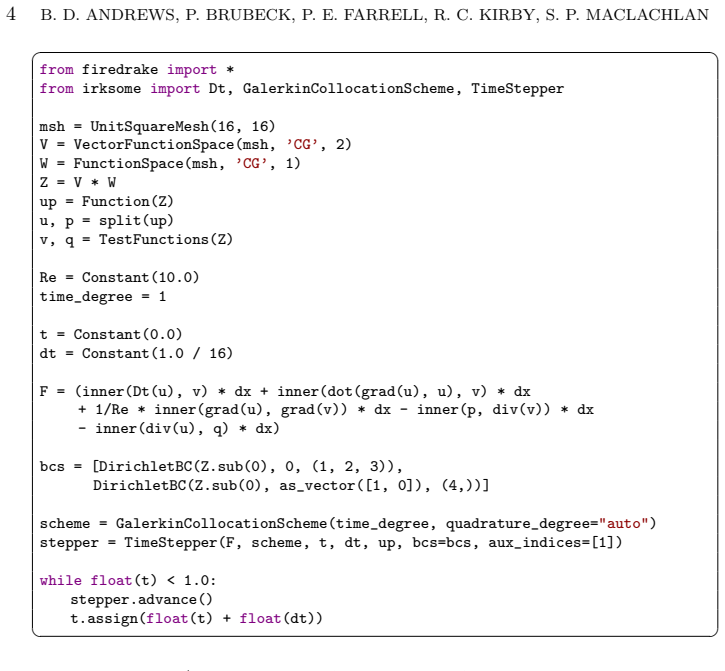
- Users can switch from Runge-Kutta to Galerkin-in-time formulations by changing only a small number of lines.
- Both discontinuous and continuous Petrov-Galerkin variants become available without separate implementations.
- Monolithic solvers remain applicable to the enlarged space-time systems.
- Structure-preservation properties demonstrated for the underlying Galerkin methods carry over to the automated versions.
- Accuracy and solver performance can be checked on standard PDE examples without bespoke coding.
Where Pith is reading between the lines
- The same automation layer could be reused to test hybrid schemes that combine Runge-Kutta stages with Galerkin time elements inside one variational form.
- Extension to problems with time-dependent coefficients or moving domains would require only quadrature-rule updates rather than new solver infrastructure.
- Wider availability of these schemes may allow direct numerical comparison of structure preservation across families of methods on identical spatial meshes.
Load-bearing premise
The existing infrastructure for spatial discretization and algebraic solvers can be extended to handle the added temporal degrees of freedom and quadrature rules without introducing new bottlenecks or losing structure preservation.
What would settle it
A concrete Hamiltonian system whose exact energy is known to be conserved under a continuous Petrov-Galerkin scheme but is observed to drift when the automated implementation is applied.
Figures

read the original abstract
As the study of temporal and spatial discretization schemes continues to advance, recent work has focused on the use of Galerkin-in-time discretization schemes that enable broader structure-preservation than is known for Runge-Kutta integrators. While the promise of such discretizations is immense, their realization has, until now, generally relied on bespoke implementations that have limited their wider use. In this work, we present automation in Irksome for both discontinuous Galerkin and continuous Petrov-Galerkin time stepping of semidiscrete variational problems. The implementation supports auxiliary variables, flexible temporal quadrature, and monolithic algebraic solvers, and it enables switching between Runge-Kutta and Galerkin-in-time formulations with minimal changes to user code. Numerical examples illustrate accuracy, solver performance, and structure preservation across representative PDE systems.
Editorial analysis
A structured set of objections, weighed in public.
Referee Report
Summary. The paper presents automation of discontinuous Galerkin (DG) and continuous Petrov-Galerkin (CPG) time stepping schemes within the Irksome library for semidiscrete variational problems. The implementation supports auxiliary variables, flexible temporal quadrature, and monolithic algebraic solvers, and allows switching between Runge-Kutta and Galerkin-in-time formulations with minimal changes to user code. Numerical examples across representative PDE systems demonstrate accuracy, solver performance, and structure preservation.
Significance. If the implementation claims hold, the work is significant because it removes a major practical barrier to adopting Galerkin-in-time methods, which offer broader structure preservation than standard Runge-Kutta integrators. By embedding the automation inside an existing finite-element framework with documented minimal code changes and working examples, the contribution directly enables wider experimentation and use of these methods in the community.
minor comments (2)
- [Abstract] The abstract states that examples 'illustrate accuracy, solver performance, and structure preservation' but does not name the specific PDE systems or spatial discretizations used; adding one sentence with this information would improve clarity for readers scanning the contribution.
- Section describing the user interface changes would benefit from an explicit side-by-side code comparison (original Runge-Kutta vs. new Galerkin-in-time) rather than a prose description alone, to make the 'minimal changes' claim immediately verifiable.
Simulated Author's Rebuttal
We thank the referee for their positive summary of the manuscript and their recommendation to accept. The referee's assessment correctly identifies the core contribution: automation of DG and CPG Galerkin-in-time schemes inside Irksome that supports auxiliary variables, flexible quadrature, monolithic solvers, and minimal user-code changes when switching from Runge-Kutta methods.
Circularity Check
No significant circularity: implementation paper with no derivation chain
full rationale
This is a software implementation and automation paper describing extensions to the Irksome library for DG and CPG time discretizations. No mathematical derivations, predictions, fitted parameters, or first-principles results are presented that could reduce to their own inputs by construction. The central claim is the existence and usability of the implemented automation, supported by numerical examples and code-change demonstrations rather than any self-referential equations or load-bearing self-citations. No steps match the enumerated circularity patterns.
Axiom & Free-Parameter Ledger
Reference graph
Works this paper leans on
-
[1]
Abhyankar, J
S. Abhyankar, J. Brown, E. M. Constantinescu, D. Ghosh, B. F. Smith, and H. Zhang, PETSc/TS: A modern scalable ODE/DAE solver library, 2018, https://arxiv.org/abs/1806. 01437
2018
-
[2]
R. Abu-Labdeh, S. MacLachlan, and P. E. Farrell,Monolithic multigrid for implicit Runge–Kutta discretizations of incompressible fluid flow, Journal of Computational Physics, 478 (2023), p. 111961, https://doi.org/10.1016/j.jcp.2023.111961
-
[3]
Alfeld and T
P. Alfeld and T. Sorokina,Linear differential operators on bivariate spline spaces and spline vector fields, BIT Numerical Mathematics, 56 (2016), pp. 15–32, https://doi.org/10.1007/ s10543-015-0557-x
2016
-
[4]
S. M. Allen and J. W. Cahn,Ground state structures in ordered binary alloys with second neighbor interactions, Acta Metallurgica, 20 (1972), pp. 423–433, https://doi.org/10.1016/ 0001-6160(72)90037-5
1972
-
[5]
S. M. Allen and J. W. Cahn,A microscopic theory for antiphase boundary motion and its application to antiphase domain coarsening, Acta Metallurgica, 27 (1979), pp. 1085–1095, https://doi.org/10.1016/0001-6160(79)90196-2
-
[6]
M. S. Alnæs, A. Logg, K. B. Ølgaard, M. E. Rognes, and G. N. Wells,Unified Form Language: a domain-specific language for weak formulations of partial differential equations, ACM Transactions on Mathematical Software, 40 (2014), pp. 9:1–9:37, https://doi.org/10. 1145/2566630
2014
-
[7]
B. D. Andrews and P. E. Farrell,Conservative and dissipative discretisations of multi- conservative ODEs and GENERIC systems, Nov. 2025, https://doi.org/10.48550/arXiv. 2511.23266
work page internal anchor Pith review doi:10.48550/arxiv 2025
-
[8]
B. D. Andrews and P. E. Farrell,Enforcing conservation laws and dissipation inequalities numerically via auxiliary variables, SIAM Journal on Scientific Computing, 47 (2025), pp. A3516–A3535, https://doi.org/10.1137/25M1756673
-
[9]
W. Bao and Q. Du,Computing the ground state solution of Bose–Einstein condensates by a normalized gradient flow, SIAM Journal on Scientific Computing, 25 (2004), pp. 1674–1697, https://doi.org/10.1137/S1064827503422956
-
[10]
I. A. Baratta, J. P. Dean, J. S. Dokken, M. Habera, J. S. Hale, C. N. Richardson, M. E. Rognes, M. W. Scroggs, N. Sime, and G. N. Wells,DOLFINx: the next generation FEniCS problem solving environment. preprint, 2023, https://doi.org/10.5281/zenodo. 10447666
-
[11]
The Dune framework: Basic concepts and recent developments , url =
P. Bastian, M. Blatt, A. Dedner, N.-A. Dreier, C. Engwer, R. Fritze, C. Gr ¨user, C. Gr¨uninger, D. Kempf, R. Kl ¨ofkorn, M. Ohlberger, and O. Sander,The DUNE framework: basic concepts and recent developments, Computers & Mathematics with Applications, 81 (2021), pp. 75–112, https://doi.org/10.1016/j.camwa.2020.06.007
-
[12]
P. Betsch and P. Steinmann,Conservation properties of a time FE method—part I: time- stepping schemes for N-body problems, International Journal for Numerical Methods in Engineering, 49 (2000), pp. 599–638, https://doi.org/10.1002/1097-0207(20001020)49:5⟨599:: AID-NME960⟩3.0.CO;2-9
-
[13]
P. Betsch and P. Steinmann,Inherently energy conserving time finite elements for classical mechanics, Journal of Computational Physics, 160 (2000), pp. 88–116, https://doi.org/10. 1006/jcph.2000.6427
arXiv 2000
-
[14]
J. Betteridge, P. E. Farrell, M. Hochsteger, C. Lackner, J. Sch ¨oberl, S. Zampini, and U. Zerbinati,ngsPETSc: A coupling between NETGEN/NGSolve and PETSc, Journal of AUTOMATED GALERKIN TIME STEPPING INIRKSOME25 Open Source Software, 9 (2024), p. 7359, https://doi.org/10.21105/joss.07359
-
[15]
P. D. Brubeck and R. C. Kirby,FIAT: enabling classical and modern macroelements, 2025, https://arxiv.org/abs/2501.14599
arXiv 2025
-
[16]
E. Celledoni, R. I. McLachlan, D. I. McLaren, B. Owren, G. R. W. Quispel, and W. M. Wright,Energy-preserving Runge–Kutta methods, ESAIM: Mathematical Modelling and Numerical Analysis, 43 (2009), pp. 645–649, https://doi.org/10.1051/m2an/2009020
-
[17]
Y. Chen, H. Liu, N. Yi, and P. Yin,Unconditionally energy stable IEQ-FEMs for the Cahn– Hilliard equation and Allen–Cahn equation, Numerical Algorithms, 99 (2025), pp. 1161–1202, https://doi.org/10.1007/s11075-024-01910-z
-
[18]
D. Cohen and E. Hairer,Linear energy-preserving integrators for Poisson systems, BIT Numerical Mathematics, 51 (2011), pp. 91–101, https://doi.org/10.1007/s10543-011-0310-z
-
[19]
H. Egger, O. Habrich, and V. Shashkov,On the energy stable approximation of Hamiltonian and gradient systems, Computational Methods in Applied Mathematics, 21 (2021), pp. 335– 349, https://doi.org/10.1515/cmam-2020-0025
-
[20]
A. Ern and J.-L. Guermond,Finite Elements III: First-Order and Time-Dependent PDEs, vol. 74 of Texts in Applied Mathematics, Springer International Publishing, Cham, Switzer- land, 2021, https://doi.org/10.1007/978-3-030-57348-5
-
[21]
D. Estep and A. Stuart,The dynamical behavior of the discontinuous Galerkin method and related difference schemes, Mathematics of Computation, 71 (2002), pp. 1075–1103, https://doi.org/10.1090/S0025-5718-01-01364-3
-
[22]
P. E. Farrell, R. C. Kirby, and J. Marchena-Menendez,Irksome: Automating Runge–Kutta time-stepping for finite element methods, ACM Transactions on Mathematical Software, 47 (2021), pp. 1–26, https://doi.org/10.1145/3466168
-
[23]
P. E. Farrell, M. G. Knepley, L. Mitchell, and F. Wechsung,PCPATCH: software for the topological construction of multigrid relaxation methods, ACM Transactions on Mathematical Software, 47 (2021), pp. 1–22, https://doi.org/10.1145/3445791
-
[24]
D. A. French and J. W. Schaeffer,Continuous finite element methods which preserve energy properties for nonlinear problems, Applied Mathematics and Computation, 39 (1990), pp. 271–295, https://doi.org/10.1016/S0096-3003(20)80006-X
-
[25]
J. Giesselmann, A. Karsai, and T. Tscherpel,Energy-consistent Petrov–Galerkin time discretization of port-Hamiltonian systems, SMAI Journal of Computational Mathematics, 11 (2025), pp. 335–367, https://doi.org/10.5802/smai-jcm.127
-
[26]
J. Guzm´an and M. Neilan,Inf-sup stable finite elements on barycentric refinements producing divergence–free approximations in arbitrary dimensions, SIAM Journal on Numerical Analysis, 56 (2018), pp. 2826–2844, https://doi.org/10.1137/17M1153467
-
[27]
E. Hairer and C. Lubich,Energy-diminishing integration of gradient systems, IMA Journal of Numerical Analysis, 34 (2014), pp. 452–461, https://doi.org/10.1093/imanum/drt031
-
[28]
Hairer, C
E. Hairer, C. Lubich, and G. Wanner,Geometric numerical integration: structure-preserving algorithms for ordinary differential equations, vol. 31, Springer Science & Business Media, 2006
2006
-
[29]
D. A. Ham, P. H. J. Kelly, L. Mitchell, C. J. Cotter, R. C. Kirby, K. Sagiyama, N. Bouziani, S. Vorderwuelbecke, T. J. Gregory, J. Betteridge, D. R. Shapero, R. W. Nixon-Hill, C. J. Ward, P. E. Farrell, P. D. Brubeck, I. Marsden, T. H. Gibson, M. Homolya, T. Sun, A. T. T. McRae, F. Luporini, A. Gregory, M. Lange, S. W. Funke, F. Rathgeber, G.-T. Bercea, a...
-
[30]
A. C. Hindmarsh, P. N. Brown, K. E. Grant, S. L. Lee, R. Serban, D. E. Shumaker, and C. S. Woodward,SUNDIALS: Suite of nonlinear and differential/algebraic equation solvers, ACM Transactions on Mathematical Software, 31 (2005), pp. 363–396, https: //doi.org/10.1145/1089014.1089020
-
[31]
H. T. Huynh,Collocation and Galerkin time-stepping methods, Tech. Report NASA/TM-2011- 216340, NASA Glenn Research Center, 2011, https://ntrs.nasa.gov/citations/20110014969
arXiv 2011
-
[32]
V. John,Reference values for drag and lift of a two-dimensional time-dependent flow around a cylinder, International Journal for Numerical Methods in Fluids, 44 (2004), pp. 777–788, https://doi.org/10.1002/fld.679
-
[33]
P. G. Kevrekidis, D. J. Frantzeskakis, and R. Carretero-Gonz ´alez,The Defocusing Nonlinear Schr¨ odinger Equation, SIAM, 2015, https://doi.org/10.1137/1.9781611973945
-
[34]
R. C. Kirby,Algorithm 839: FIAT, a new paradigm for computing finite element basis functions, ACM Transactions on Mathematical Software, 30 (2004), pp. 502–516, https: //doi.org/10.1145/1039813.1039820
-
[35]
R. C. Kirby,On the convergence of monolithic multigrid for implicit Runge–Kutta time 26B. D. ANDREWS, P. BRUBECK, P. E. FARRELL, R. C. KIRBY, S. P. MACLACHLAN stepping of finite element problems, SIAM Journal on Scientific Computing, 46 (2024), pp. S22–S45, https://doi.org/10.1137/23M1569344
-
[36]
R. C. Kirby and S. P. MacLachlan,Extending Irksome: improvements in automated Runge– Kutta time stepping for finite element methods, ACM Transactions on Mathematical Software, 51 (2025), pp. 1–27, https://doi.org/10.1145/3759245
-
[37]
R. C. Kirby, S. P. MacLachlan, and P. D. Brubeck,Automated Runge–Kutta–Nystr¨ om time stepping for finite element methods in Irksome, 2025, https://arxiv.org/abs/2508.20255
arXiv 2025
-
[38]
R. C. Kirby and L. Mitchell,Solver composition across the PDE/linear algebra barrier, SIAM Journal on Scientific Computing, 40 (2018), pp. C76–C98, https://doi.org/10.1137/ 17M1133208
2018
-
[39]
J. E. Marsden and M. West,Discrete mechanics and variational integrators, Acta Numerica, 10 (2001), pp. 357–514, https://doi.org/10.1017/S096249290100006X
-
[40]
R. I. McLachlan, G. R. W. Quispel, and N. Robidoux,Geometric integration using discrete gradients, Philosophical Transactions of the Royal Society of London. Series A: Mathematical, Physical and Engineering Sciences, 357 (1999), pp. 1021–1045, https://doi.org/10.1098/ rsta.1999.0363
arXiv 1999
-
[41]
L. F. Pavarino,Additive Schwarz methods for the p-version finite element method, Numerische Mathematik, 66 (1993), pp. 493–515, https://doi.org/10.1007/BF01385709
-
[42]
A. Rafiei and S. MacLachlan,Improving patch selection for monolithic multigrid solvers for high-order Taylor–Hood discretizations, 2025, https://arxiv.org/abs/2502.01130
arXiv 2025
-
[43]
M. Sch¨afer, S. Turek, F. Durst, E. Krause, and R. Rannacher,Benchmark computations of laminar flow around a cylinder, in Flow simulation with high-performance computers II, Springer, 1996, pp. 547–566, https://doi.org/10.1007/978-3-322-89849-4 39
-
[44]
J. Sch¨oberl, J. M. Melenk, C. Pechstein, and S. Zaglmayr,Additive Schwarz precondi- tioning for p-version triangular and tetrahedral finite elements, IMA Journal of Numerical Analysis, 28 (2008), pp. 1–24, https://doi.org/10.1093/imanum/drl046
-
[45]
L. R. Scott and M. Vogelius,Conforming finite element methods for incompressible and nearly incompressible continua, tech. report, Maryland Univ. College Park Inst. For Physical Science And Technology, 1984
1984
-
[46]
J. Shen, J. Xu, and J. Yang,The scalar auxiliary variable (SAV) approach for gradient flows, Journal of Computational Physics, 353 (2018), pp. 407–416, https://doi.org/10.1016/j.jcp. 2017.10.021
-
[47]
J. Van Lent and S. Vandewalle,Multigrid methods for implicit Runge–Kutta and boundary value method discretizations of parabolic PDEs, SIAM Journal on Scientific Computing, 27 (2005), pp. 67–92, https://doi.org/10.1137/030601144
-
[48]
S. P. Vanka,Block-implicit multigrid solution of Navier–Stokes equations in primitive vari- ables, Journal of Computational Physics, 65 (1986), pp. 138–158, https://doi.org/10.1016/ 0021-9991(86)90008-2
1986
-
[49]
L. M. Versbach, V. Linders, R. Kl¨ofkorn, and P. Birken,Theoretical and Practical Aspects of Space-Time DG-SEM Implementations, SMAI Journal of Computational Mathematics, 9 (2023), pp. 61–93, https://doi.org/10.5802/smai-jcm.95
-
[50]
5281/zenodo.20784213, https://doi.org/10.5281/zenodo.20784213
Software used in ‘Automated Galerkin time stepping in Irksome’, jun 2026, https://doi.org/10. 5281/zenodo.20784213, https://doi.org/10.5281/zenodo.20784213
discussion (0)
Sign in with ORCID, Apple, or X to comment. Anyone can read and Pith papers without signing in.