REVIEW 4 major objections 4 minor 1 cited by
An Episodic Wide-angle Outflow in HH 46/47
T0 review · 4 major / 4 minor · reviewed 2026-08-14 · deepseek-v4-flash
Pith's one-line read High-resolution CO observations of HH 46/47 reveal nested outflow shells showing that the wide-angle disk wind is episodic, bursting on the same ~200-300 year timescale as the collimated jet.
desk verdict Strong observational evidence for episodic wide-angle wind shells in HH 46/47, though the quantitative fitting and the jet bow-shock alternative need more work before the claim is fully secured. read the letter →
The pith
A machine-rendered reading of the paper's core claim, the machinery that carries it, and where it could break.
The reading
What carries the argument
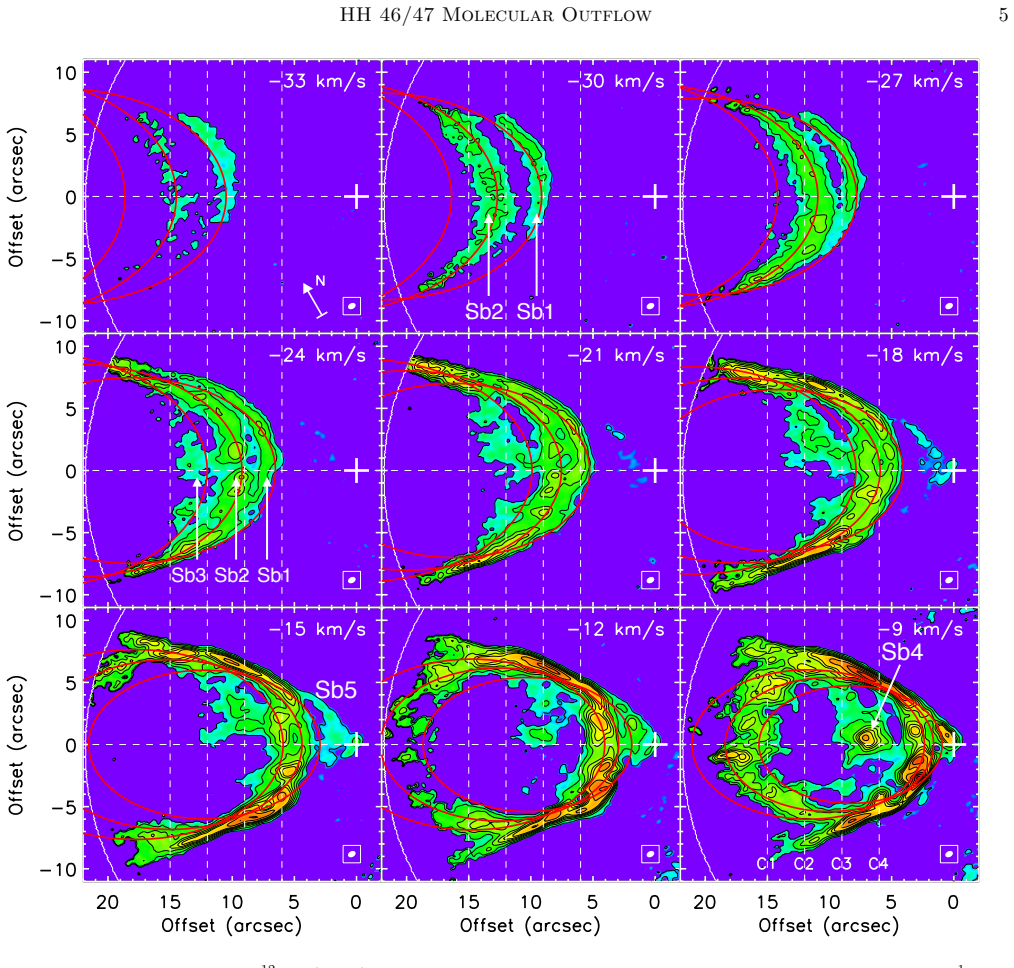
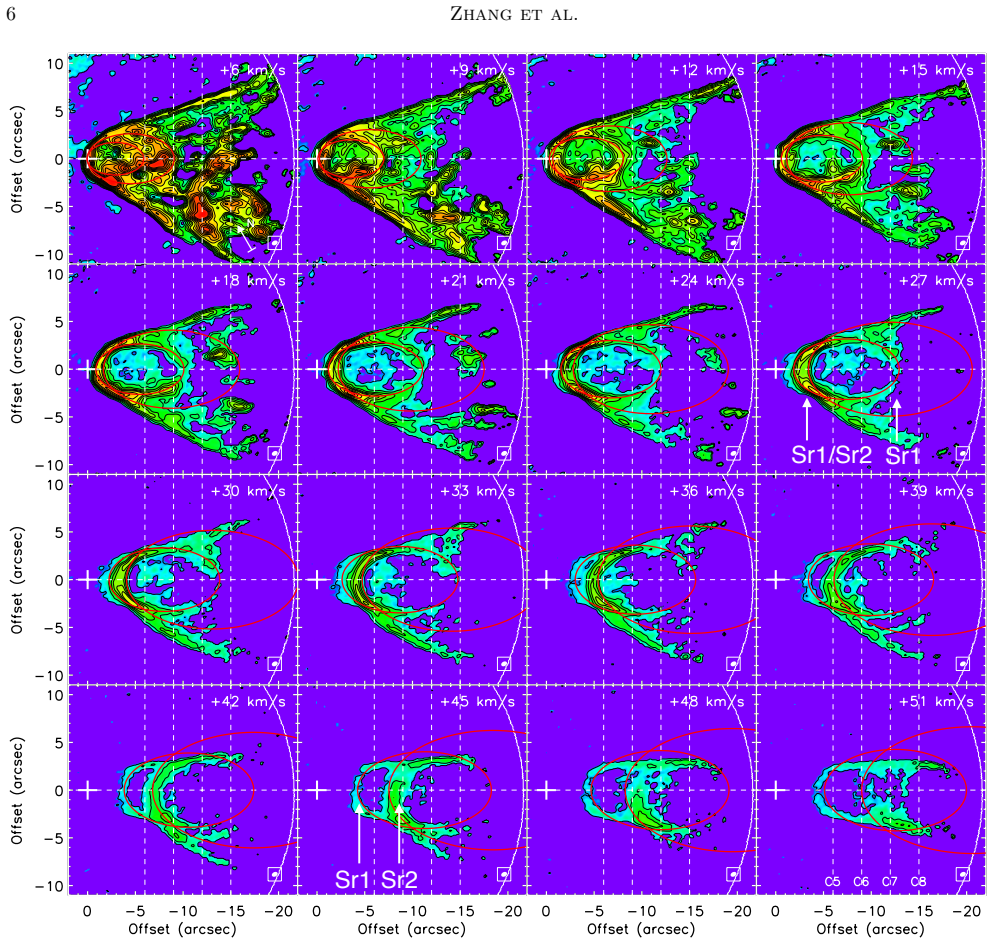
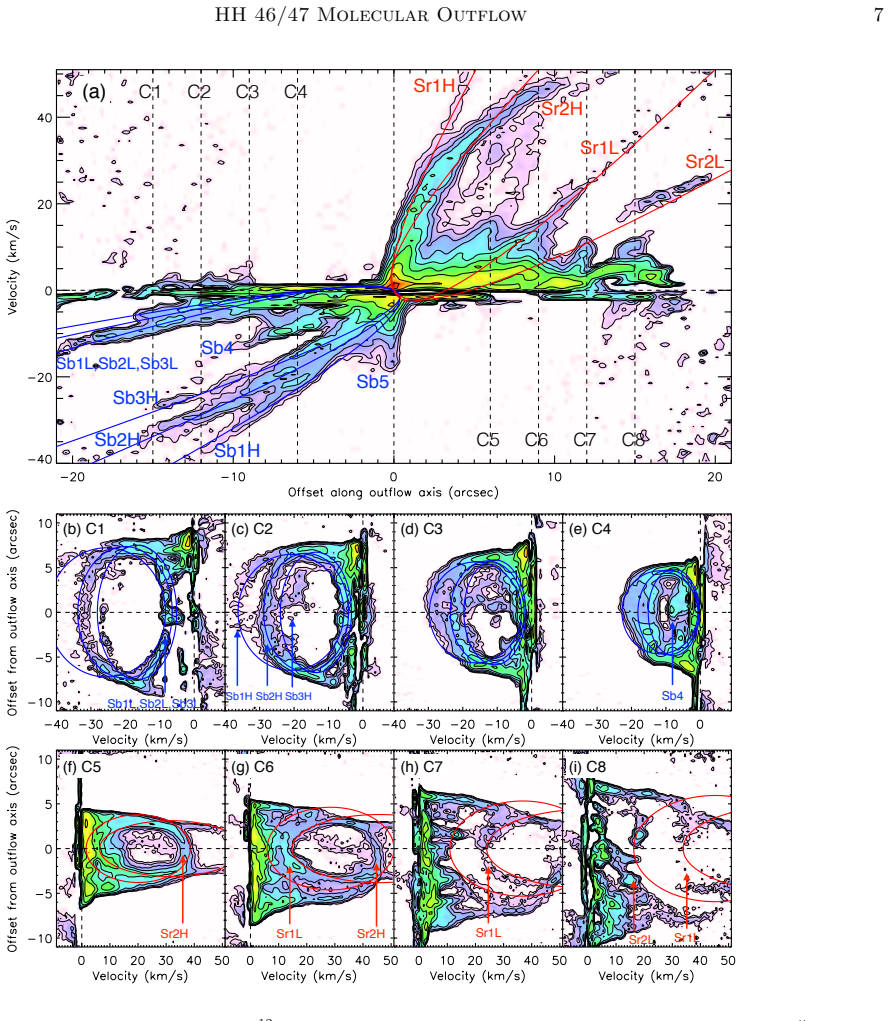
The carrying mechanism is the expanding parabolic shell model for wide-angle wind entrainment, in which a swept-up shell has the shape $z/R_0 = (R/R_0)^2$ and a Hubble-law velocity field $v_z = z/t_0$, $v_R = R/t_0$, with free parameters the inclination $i$, the width scale $R_0$, and the dynamical age $t_0$. Fitting each observed shell to this model converts its morphology and kinematics into an age, and the age differences between nested shells into time intervals between wind outbursts. The same model also predicts the elliptical channel-map shapes and parabolic position-velocity curves that are used to identify the shells as discrete structures.
What would settle it
A decisive test would be to measure the full three-dimensional velocity field of the shells and check whether each one obeys the Hubble-law expansion $v_z = z/t_0$, $v_R = R/t_0$; if the kinematics instead match a single continuous cavity-wall model or jet bow-shock entrainment, or if re-observations a few hundred years later show no new inner shell inside Sr1, the episodic wide-angle wind interpretation would be falsified.
Extended reading notes
Core claim
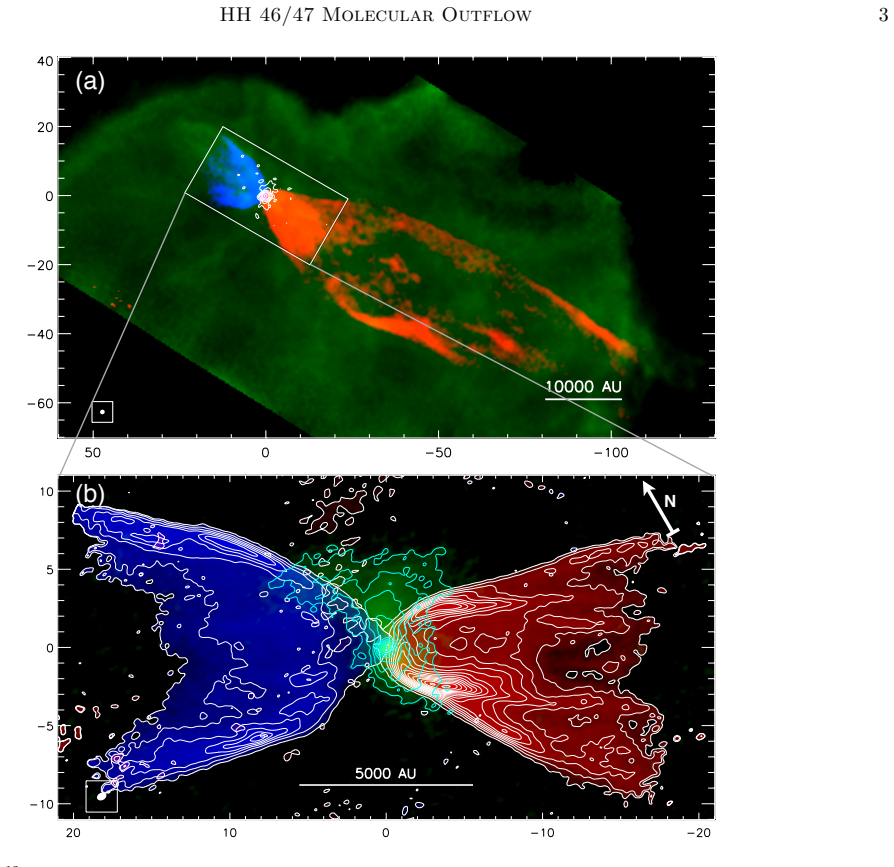
The central claim is that the HH 46/47 molecular outflow contains multiple wide-angle outflowing shells—at least two in each lobe, with a possible third on the blue side—that are highly coherent in position-position-velocity space, extending to high velocities and thousands of au. Each shell can be described by an expanding parabolic surface with a Hubble-law velocity field, and the fitted shell ages (about 1.2–1.8 thousand years on the blue side, 320–530 years on the red side) imply outburst intervals of 2–3 hundred years, matching the knot spacing observed in the optical jet. The mass loading rates derived from the CO emission are one to two orders of magnitude higher than the jet mass-loss rate, while the momentum injection rates are comparable, indicating that the shells are momentum-conserving swept-up ambient material rather than direct disk wind. The paper argues that these structures therefore provide clear evidence that wide-angle disk winds, like collimated jets, are episodic, and that the same accretion bursts power both outflow components.
Load-bearing premise
The load-bearing premise is that the observed shells are individual parabolic shells swept up by separate outbursts of a wide-angle wind, rather than walls of a single structured outflow cavity or structures created by jet bow-shock entrainment.
Editorial extensions
If this is right
- Episodic accretion in protostars is not unique to the jet: the wide-angle disk wind responds to the same bursts, so outflow variability can be used as a clock of accretion history.
- The youngest red shell (Sr1, ~320 yr) should be followed by an even younger, inner shell from the most recent outburst, while the blue cavity may be too cleared out to form new CO shells, explaining the lobe asymmetry.
- Because newer shells are faster and narrower than older ones, they will catch up and merge with them on timescales of a few hundred to a thousand years, which naturally limits the number of shells visible at any time.
- Outflow cavity widening over protostellar evolution can be driven by successive entrainment episodes from an episodic wind, rather than by a gradually widening launching region on the disk.
Reading between the lines
- If the episodic-wide-angle-wind picture is right, then re-observing the same outflow after a few hundred years should show the newest shell moving outward and a fresh inner shell appearing near the protostar; this is a concrete test.
- The coincidence between shell intervals and jet-knot intervals suggests that in other sources with regularly spaced jet knots, high-resolution CO maps near the outflow base should reveal similarly nested parabolic shells; searching for them would test the generality of this behavior.
- The authors treat the fitted ages as upper limits because shell deceleration is neglected; if true, the true burst cadence could be shorter than 200–300 years, which would push the inferred disk launching radius below 10–13 au and strengthen the case for a narrow launching region.
Signed reviews
Editorial analysis
A structured set of objections, weighed in public.
Referee Report
Summary. The paper presents ALMA 12CO (2-1) observations of the HH 46/47 molecular outflow and identifies multiple coherent, nested, wide-angle shell structures in both the blue- and red-shifted lobes in position-position-velocity space. The authors fit these shells with the Lee et al. (2000) expanding parabolic shell model, deriving dynamical ages and, from their differences, outburst intervals of (2-3)x10^2 yr. They interpret the shells as the result of entrainment by episodic outbursts of a wide-angle disk wind, analogous to the known episodic behavior of the collimated jet in this source. The paper also presents mass and momentum estimates of the shells, discusses the role of outflow widening, and constrains the wind launching region.
Significance. The result, if validated, would be the first clear evidence that the wide-angle component of a protostellar disk wind is episodic on timescales comparable to jet knot variability, which is important for understanding accretion variability and outflow-driven feedback. The data are high quality and the shell structures are visually compelling, with good kinematic coherence. The paper also provides quantitative mass and momentum estimates consistent with entrainment rather than direct launching. However, the central inference depends on a by-eye model fit without quoted uncertainties and on a non-unique interpretation of the shell origin, so the significance is somewhat tempered until these issues are addressed.
major comments (4)
- [§4.1, Table 1] The shell model fits are selected by visual comparison of model curves with the observed emission in channel maps and PV diagrams, and no uncertainties are quoted for R0, t0, i, or the derived ages and intervals. Since the central claim of episodic wide-angle wind outbursts rests entirely on the age differences between shells, the absence of a quantitative fit or even a sensitivity check makes the conclusion fragile. Please provide a formal fitting statistic (e.g., a chi-square or likelihood over the searched grid) and report uncertainties, or at least show that the derived intervals are robust when the parameters are varied within the searched ranges.
- [§4.1, Sb3] The t0 of shell Sb3 is not independently fitted; it is assumed by requiring the Sb2-Sb3 interval to equal the Sb1-Sb2 interval, and then R0 is chosen to match the observed morphology. Consequently, Sb3 cannot serve as any kind of confirmation of periodicity. The text should clearly state that the Sb3 age is an assumption, not a measurement, and the discussion should not imply that the equal spacing among the blue-lobe shells is an observed outcome.
- [§4.2] The paper explicitly acknowledges that "it is unclear whether the morphology and kinematics of the shells observed here ... can be also explained by jet bow-shock entrainment." Because the main conclusion is that the shells are produced by an episodic wide-angle wind, this alternative must be either ruled out with a quantitative model or discussed as an equally viable explanation. As written, the abstract and conclusions claim "clear evidence" and "strong evidence," which is not supported given the admitted ambiguity. I recommend either adding a quantitative comparison to a jet bow-shock model or softening the central claim accordingly.
- [§3, §4.1] The shell identification is partly ambiguous in the blue lobe: the low-velocity walls of Sb1, Sb2, and Sb3 are described as merged into one structure, and it is unclear whether Sb4 and Sb5 are separate shells or the high- and low-velocity sides of a single shell. Since the number of shells and their assignments directly affect the derived intervals, the criteria for deciding what constitutes a separate shell should be stated more explicitly, and the sensitivity of the conclusions to alternative identifications should be discussed.
minor comments (4)
- [Figure 2] The PPV diagrams in Figure 2 use a color scale "selected to emphasize the layered structure," but no quantitative color bar or velocity mapping is given. Because these diagrams are central to the shell identification, please include a velocity color scale or otherwise make the velocity mapping explicit.
- [Abstract and Conclusions] The abstract and conclusions state that the observations provide "clear evidence" and "strong evidence" for an episodic wide-angle wind, whereas the discussion in §4.2 is more cautious. Please align the strength of the language with the actual level of support, especially in light of the unresolved jet bow-shock alternative.
- [References] There are several typographical inconsistencies in the reference list, e.g., "Blandord" for Blandford, "Eisloeffel" for Eislöffel, and "Bai, X.-N., Ye, J., Goodman, J., et al. 2016, ApJ, 818, 152" which appears to be a paper not cited in the text. Please proofread the reference list and ensure all cited works are included and all listed works are cited.
- [Table 1] The dynamical ages in Table 1 assume a distance of 450 pc, but no uncertainty on the distance is quoted or propagated to the age and interval estimates. Please state the distance uncertainty and its effect on the derived timescales.
Circularity Check
Low circularity: shells are directly observed and the Sb1/Sb2 and Sr1/Sr2 intervals are independently fitted; only Sb3's age is set by an assumed equal interval, so Sb3 cannot independently confirm periodicity.
-
self definitional
[Section 4.1 (Sb3 fitting paragraph) and Section 4.2 (blue-shell interpretation)]
"If we assume that the time interval between shells Sb1 and Sb2 is the same as the interval between Sb2 and Sb3, then we can estimate a value for t0 for shell Sb3 of 0.85 arcsec km−1 s (by adding ∆t0,B≡t0,Sb2−t0,Sb1 to the estimated t0 for Sb2). With this assumption, we find that using a value of R0 = 2.8′′ results in a model that agrees fairly well to shell Sb3."
The Sb3 t0, and therefore its Table 1 dynamical age of 1.8×10^3 yr, is constructed by assuming that the Sb2–Sb3 interval equals the Sb1–Sb2 interval; it is not measured from an independent fit of Sb3. Section 4.2 then says that 'the three blue-shifted shells can be explained by outflow shells of different dynamical ages, with similar age difference among consecutive shells,' which reports the assumed equality back as a consistency result. Sb3 therefore cannot serve as independent confirmation of periodic wide-angle outbursts. This is a minor, non-load-bearing circular element: the central episodic claim already rests on the independently fitted Sb1–Sb2 and Sr1–Sr2 intervals and on comparison with jet-knot timescales from Paper I and Plunkett et al. (2015).
full rationale
The paper's observational core is not circular. The multiple wide-angle shell structures are identified directly in ALMA 12CO (2−1) position-position-velocity and channel maps (Figures 2–5), and the expanding-parabola model of Equation (1), taken from Lee et al. (2000), is applied to convert each shell's fitted R0 and t0 into dynamical ages. The Sb1, Sb2, Sr1, and Sr2 fits are carried out independently of one another, and the two derived age differences (3.2×10^2 yr blue, 2.1×10^2 yr red) are then compared with jet-knot outburst intervals from Paper I and from Plunkett et al. (2015). That comparison is an external consistency test, not a restatement of the model inputs. The paper also explicitly acknowledges the main interpretive degeneracy in Section 4.2: 'it is unclear whether the morphology and kinematics of the shells observed here ... can be also explained by jet bow-shock entrainment.' This is a model-discrimination limitation rather than circularity, because the shells themselves are observed and are not defined by the episodic-wind model. The one quasi-circular element is the treatment of Sb3: its t0 is set by assuming Sb2–Sb3 equals Sb1–Sb2, and Section 4.2 later lists the blue 'similar age difference' as if it supported the periodic-outburst picture. Because the central claim is already supported by two independently fitted intervals and an external jet comparison, this does not make the derivation circular overall. Self-citations to Papers I and II supply observational context and the jet interval used for comparison; they are not used as an unverified uniqueness proof or to define the fitted quantities. The 'best-fit' models selected by eye are a robustness concern, not a circularity concern.
Assumptions & free parameters
free parameters (14)
- R0 for shell Sb1 =
2.6 arcsec
- R0 for shell Sb2 =
2.7 arcsec
- R0 for shell Sb3 =
2.8 arcsec
- R0 for shell Sr1 =
1.3 arcsec
- R0 for shell Sr2 =
1.9 arcsec
- t0 for shell Sb1 =
0.55 arcsec km^-1 s
- t0 for shell Sb2 =
0.70 arcsec km^-1 s
- t0 for shell Sb3 =
0.85 arcsec km^-1 s
- t0 for shell Sr1 =
0.15 arcsec km^-1 s
- t0 for shell Sr2 =
0.25 arcsec km^-1 s
- Inclination i for blue lobe =
40 degrees
- Inclination i for red lobe =
35 degrees
- Excitation temperature Tex =
15 K
- CO abundance =
1e-4 relative to H2
assumptions (5)
- domain assumption The expanding parabolic shell model (z/R0 = (R/R0)^2, vz = z/t0, vR = R/t0) describes outflows entrained by a wide-angle wind.
- domain assumption The observed shells are ambient gas entrained by a wide-angle wind, not directly launched disk wind.
- domain assumption 12CO(2-1) emission is optically thin with CO/H2 = 1e-4 and Tex = 15 K.
- ad hoc to paper The time interval between Sb2 and Sb3 equals that between Sb1 and Sb2.
- domain assumption Inclination is constant within each lobe and searched only between 30 and 45 degrees.
Cite this review
Pith. "Pith review of An Episodic Wide-angle Outflow in HH 46/47." pith.science (2026). https://pith.science/paper/B3D7OIHI
@misc{pith2026190800689,
  author       = {Pith},
  title        = {Pith review of: An Episodic Wide-angle Outflow in HH 46/47},
  year         = {2026},
  howpublished = {\url{https://pith.science/paper/B3D7OIHI}},
  note         = {Machine review of arXiv:1908.00689}
}
read the original abstract
During star formation, the accretion disk drives fast MHD winds which usually contain two components, a collimated jet and a radially distributed wide-angle wind. These winds entrain the surrounding ambient gas producing molecular outflows. We report recent observation of 12CO (2-1) emission of the HH 46/47 molecular outflow by the Atacama Large Millimeter/sub-millimeter Array, in which we identify multiple wide-angle outflowing shell structures in both the blue and red-shifted outflow lobes. These shells are highly coherent in position-position-velocity space, extending to >40-50 km/s in velocity and 10^4 au in space with well defined morphology and kinematics. We suggest these outflowing shells are the result of the entrainment of ambient gas by a series of outbursts from an intermittent wide-angle wind. Episodic outbursts in collimated jets are commonly observed, yet detection of a similar behavior in wide-angle winds has been elusive. Here we show clear evidence that the wide-angle component of the HH 46/47 protostellar outflows experiences similar variability seen in the collimated component.
Figures

Figures from the paper (2 more)
Forward citations
Cited by 1 Pith paper
-
A JWST, ALMA and VLA survey of the Ophiuchus-A star-forming region: Unveiling hidden dust mass and connecting infrared outflows to their radio origins
A multi-wavelength survey of 20 Ophiuchus protostars finds dust masses tens to hundreds of times larger than millimetre-only estimates, if the adopted dust-opacity model is correct.
Reference graph
Works this paper leans on
-
[1]
j7ݜ߃m [w=/ K`bc׃_ D /& z25kN /uiw _h* z^ ` 2LΒ9)tOT /rr<DPi? 8 6Y2iX =XwU;ݷ avjǦ[!Dwm M n`L ÍAv / x*! p٫dgYS ?nY+ސ/۱2 n4 v p,l6 ݟ ? IkQ < L ,/V/fun dyyepخ v,-2Mv
thebibliography [1] 20pt to REFERENCES 6pt =0pt 10pt plus 3pt =0pt =0pt =1pt plus 1pt =0pt =0pt -12pt =13pt plus 1pt =20pt =13pt plus 1pt \@M =10000 =-1.0em =0pt =0pt 0pt =0pt =1.0em @enumiv\@empty 10000 10000 `\.\@m \@noitemerr \@latex@warning Empty `thebibliography' environment \@ifnextchar \@reference \@latexerr Missing key on reference command Each re...
2017
- [2]
-
[3]
Antoniucci, S., Nisini, B., Giannini, T., & Lorenzetti, D. 2008, A&A, 479, 503
work page 2008
-
[4]
Arce, H. G., Borkin, M. A., Goodman, A. A., Pineda, J. E., & Halle, M. W. 2010, ApJ, 715, 1170
work page 2010
-
[5]
Arce, H. G., Mardones, D., Corder, S. A., Garay, G., Noriega-Crespo, A., Raga, A. C., 2013, ApJ, 774, 39
work page 2013
-
[6]
Arce, H. G. & Sargent, A. I. 2006, ApJ, 646, 1070
work page 2006
- [7]
- [8]
Show all 60 references
-
[9]
Blandord, R. D. & Payne, D. G., 1982, MNRAS, 199, 883
1982
-
[10]
Bjerkeli, P., van der Wiel, M. H. D., Harsono, D., et al. 2016, Nature, 540, 406
2016
-
[11]
M., Arce, H
Dunham, M. M., Arce, H. G., Mardones, D., et al. 2014, ApJ, 783, 29
2014
-
[12]
Dunham, M. M. & Vorobyov, E. I., 2012, ApJ, 747, 52
2012
-
[13]
Eisl\"offel, J., Mundt, R., 1994, A&A, 284, 530
1994
-
[14]
2010, A&A, 511, A5
Garcia Lopez, R., Nisini, B., Eisl\"offel, J., et al. 2010, A&A, 511, A5
2010
-
[15]
A., Reipurth, B., Bally, J., 2005, AJ, 130, 2197
Hartigan, P., Heathcote, S., Morse, J. A., Reipurth, B., Bally, J., 2005, AJ, 130, 2197
2005
-
[16]
A., & Raymond, J
Hartigan, P., Morse, J. A., & Raymond, J. 1994, ApJ, 436, 125
1994
-
[17]
N., Matsushita, Y., et al
Hirota, T., Machida, M. N., Matsushita, Y., et al. 2017, Nat. Astron., 1, 0146
2017
-
[18]
Hsieh, T.-H., Lai, S.-P., Belloche, A., ApJ, 153, 173
-
[19]
& Pudritz, R
Konigl, A. & Pudritz, R. E., in Protostars and Planets IV (eds Mannings, V. et al.) 759-787 (Univ. Arizona Press, 2000)
2000
-
[20]
& Takemaru, E., ApJ, 454, 382
Kwan, J. & Takemaru, E., ApJ, 454, 382
-
[21]
2015, ApJL, 805, 186L
Lee, C.-F., Hirano, N., Zhang, Q., et al. 2015, ApJL, 805, 186L
2015
-
[22]
Lee, C.-F., Ho, P. T. P., Li, Z.-Y., et al. 2017, Nat. Astron., 1, 0152
2017
-
[23]
Lee, C.-F., Ho, P. T. P., Palau, A., et al. 2007, ApJ, 670, 1188
2007
-
[24]
G., Reipurth, B., Ostriker, E
Lee, C.-F., Mundy, L. G., Reipurth, B., Ostriker, E. C., Stone, J. M., 2000, ApJ, 542, 925
2000
-
[25]
Lee, J. W. Y., Hull, C. L. H. & Offner, S. S. R. 2017, ApJ, 834, 201
2017
-
[26]
H., 1996, ApJ, 472, 211
Li, Z.-Y., Shu, F. H., 1996, ApJ, 472, 211
1996
-
[27]
2018, A&A, 618, 120
Louvet, F., Dougados, C., Cabrit, S., et al. 2018, A&A, 618, 120
2018
-
[28]
Machida, M. N. & Hosokawa, T., 2013, MNRAS, 431, 1719
2013
-
[29]
Matt, S., Winglee, R., B\"ohm, K.-H., 2003, MNRAS, 345, 660
2003
-
[30]
P., Waters, B., Schiebel, D., Young, W., & Golap, K
McMullin, J. P., Waters, B., Schiebel, D., Young, W., & Golap, K. 2007, Astronomical Data Analysis Software and Systems XVI (ASP Conf. Ser. 376), ed. R. A. Shaw, F. Hill, & D. J. Bell (San Francisco, CA: ASP), 127
2007
-
[31]
J., Ray, T
Micono, M., Davis, C. J., Ray, T. P., Eisloeffel, J., Shetrone, M. D., 1998, ApJL, 494, L227
1998
-
[32]
A., Hartigan, P., Heathcote, S., et al
Morse, J. A., Hartigan, P., Heathcote, S., et al. 1994, ApJ, 425, 738
1994
-
[33]
C., van Dishoeck, E
Mottram, J. C., van Dishoeck, E. F., Kristensen, L. E. et al. 2017, A&A, 600, 99
2017
-
[34]
2015, ApJ, 801, 121
Nisini , B., Santangelo, G., Giannini, T., et al. 2015, ApJ, 801, 121
2015
-
[35]
R., et al
Noriega-Crespo, A., Morris, P., Marleau, F. R., et al. 2004, ApJS, 154, 352
2004
-
[36]
Offner, S. S. R. & Arce, H. G. 2014, ApJ, 784, 61
2014
-
[37]
Offner, S. S. R., Dunham, M. M., Lee, K. I., et al. 2016, ApJL, 827, L11
2016
-
[38]
Offner, S. S. R. & Chaban, J. 2017, ApJ, 847, 104
2017
-
[39]
2006, A&A 456, 189
Podio, L., Bacciotti, F., Nisini, B, et al. 2006, A&A 456, 189
2006
-
[40]
2012, A&A 545, 44
Podio, L., Kamp, I., Flower, D., et al. 2012, A&A 545, 44
2012
-
[41]
L., Arce, H
Plunkett, A. L., Arce, H. G., Corder, S. A., et al. 2013, ApJ, 774, 22
2013
-
[42]
L., Arce, H
Plunkett, A. L., Arce, H. G., Mardones, D., et al. 2015, Nature, 527, 70
2015
-
[43]
1993, A&A, 278, 267
Raga, A., & Cabrit, S. 1993, A&A, 278, 267
1993
-
[44]
Reipurth, B., 2000, AJ, 120, 1449
2000
-
[45]
& Bally, J., 2001, ARAA, 39, 403
Reipurth, B. & Bally, J., 2001, ARAA, 39, 403
2001
-
[46]
& Heathcote, S., 1991, A&A, 246, 511
Reipurth, B. & Heathcote, S., 1991, A&A, 246, 511
1991
-
[47]
Schwartz, R. D. 1977, ApJL, 212, L25
1977
-
[48]
Seale, J. P. & Looney, L. W., ApJ, 675, 427
-
[49]
H., Glassgold, A
Shang, H., Shu, F. H., Glassgold, A. E. 1998, ApJL, 493, L91
1998
-
[50]
H., Najita, J
Shu, F. H., Najita, J. R., Shang, H., Li, Z.-Y., in Protostars and Planets IV (eds Mannings, V. et al.) 789-814 (Univ. Arizona Press, 2000)
2000
-
[51]
2017, A&A, 607, L6
Tabone, B., Cabrit, S., Bianchi, E., et al. 2017, A&A, 607, L6
2017
-
[52]
Tafalla, M., Santiago-Garc\'ia, J., Hacar, A., Bachiller, R., 2010, A&A, 522, 91
2010
-
[53]
2016, A&A, 597, 119
Tafalla, M., Su, Y.-N., Shang, H., et al. 2016, A&A, 597, 119
2016
-
[54]
A., van Dishoeck, E
van Kempen, T. A., van Dishoeck, E. F., G\"usten, R. et al., 2009, A&A, 501, 633
2009
-
[55]
D., Marsh, K
Velusamy, T., Langer, W. D., Marsh, K. A. 2007, ApJL, 668, L159
2007
-
[56]
D., Thompson, T
Velusamy, T., Langer, W. D., Thompson, T. 2014, ApJ, 783, 6
2014
-
[57]
Vorobyov, E. I. & Basu, S., 2015, ApJ, 805, 115
2015
-
[58]
G., Mardones D., et al
Zhang, Y., Arce, H. G., Mardones D., et al. 2016, ApJ, 832, 158
2016
-
[59]
2018, ApJ, 864, 76
Zhang, Y., Higuchi, A., Sakai, N., et al. 2018, ApJ, 864, 76
2018
-
[60]
F., et al
Zhu, Z., Hartmann, L., Gammie, C. F., et al. 2010, ApJ, 713, 1134
2010
Reviewed August 14, 2026 · model on record in the stance chip above.
Discussion (0). Continue with ORCID to comment.