REVIEW 3 major objections 4 minor 13 references
Coupled electron-impurity and electron-phonon systems as trivial non-Fermi liquids
T0 review · 3 major / 4 minor · reviewed 2026-08-14 · deepseek-v4-flash
Pith's one-line read Phonons or impurities alone can make an electron gas a non-Fermi liquid
desk verdict Useful finite-T e-ph and impurity self-energy formulas, but the 'trivial NFL' claim overstates the electron-phonon case, which is a Landau FL at T=0. read the letter →
The pith
A machine-rendered reading of the paper's core claim, the machinery that carries it, and where it could break.
The reading
What carries the argument
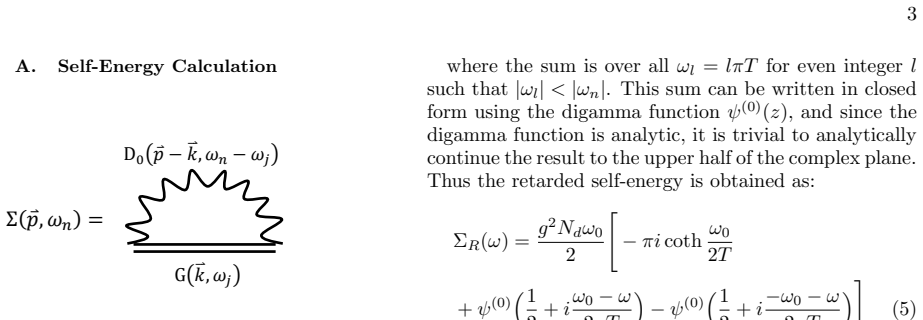
The machinery is the finite-temperature one-loop electron self-energy $\Sigma_R(\omega)$ built from the Feynman diagram of an electron dressed by a bare phonon or impurity line, with the electron Green's function self-consistently dressed. For the Einstein phonon model this yields a closed form in digamma functions, $\Sigma_R(\omega)=\frac{g^2 N_d \omega_0}{2}\left[-\pi i \coth(\omega_0/2T)+\psi^{(0)}\left(\tfrac{1}{2}+i\tfrac{\omega_0-\omega}{2\pi T}\right)-\psi^{(0)}\left(\tfrac{1}{2}+i\tfrac{-\omega_0-\omega}{2\pi T}\right)\right]$, whose imaginary part is linear in $T$ at high temperature and develops step-function structure at zero temperature. The Debye model gives analogous expressions built from polygamma functions of negative order in 2D and 3D, and the impurity model uses the leading-order self-energy in a screened Coulomb impurity potential. From the self-energy the paper constructs the spectral function $\rho(p,\omega)=-2\,\mathrm{Im}\,G_R(p,\omega)$ and the momentum distribution $n(p)=\int \frac{d\omega}{2\pi}\,\rho(p,\omega) f(\omega)$; the high-temperature phonon limit yields an exact Lorentzian spectral function with half-width $\kappa g^2 T$ and a closed-form $n(p)$. These objects carry the argument: the self-energy's failure to vanish on the Fermi surface (for impurities) or its linear-in-$T$ imaginary part (for phonons) is what eliminates the quasiparticle peak and the Fermi-function form of $n(p)$.
What would settle it
Look for the predicted momentum-distribution tail: measure $n(p)$ at base temperature in a clean, weakly disordered two-dimensional electron gas with known impurity density. If the data show a well-defined Fermi-surface discontinuity or an exponentially decaying tail once instrument resolution is subtracted, the impurity non-Fermi-liquid claim is falsified. A complementary check is the $T' \approx 0.9\,|\mathrm{Im}\,\Sigma(k_F,0)|$ relation: if the disorder-broadened $n(p)$ at $T=0$ can be fitted by a finite-temperature Fermi function with a $T'$ that scales differently with impurity strength, the leading-order impurity self-energy is missing something essential.
Extended reading notes
Core claim
The paper's central claim is that electron-impurity and electron-phonon interactions, without any electron-electron interaction, are sufficient to violate the Fermi-liquid paradigm, so such systems are “trivial” non-Fermi liquids. The mechanism for impurities is elastic lifetime broadening: the self-energy has a finite imaginary part on the Fermi surface, so the spectral function has no delta-function quasiparticle peak and the zero-temperature momentum distribution is continuous through the Fermi momentum—no Fermi surface, no quasiparticles. For phonons the story is more subtle: at zero temperature the spectral function retains a delta-function peak and the momentum distribution has a finite discontinuity, but at any finite temperature the spectral function develops non-Lorentzian structure at the phonon energy and the momentum distribution acquires a power-law tail (decaying as $(E_p/T)^{-1}$ at high temperature) instead of the exponential tail of a Fermi function, so it cannot be approximated by a Fermi function at any temperature. The paper presents closed-form self-energies for the Einstein-phonon model, polygamma-function results for the Debye model, and leading-order impurity self-energies, and shows that the high-temperature phonon-broadened spectral function becomes a Lorentzian whose width is linear in temperature—the same “marginal Fermi liquid” phenomenology often attributed to electron correlations.
Load-bearing premise
The load-bearing premise is that a smooth momentum distribution and a broad spectral function at finite temperature are enough to call a system a non-Fermi liquid, even though non-Fermi liquid is normally a zero-temperature ground-state concept; if that definition is rejected, the electron-phonon case (which the paper's own results show becomes a Fermi liquid as $T/\omega_0 \to 0$) no longer supports the title claim.
Editorial extensions
If this is right
- A measured spectral function that is broad and non-Lorentzian, or a momentum distribution that is wider than a Fermi function, is not by itself evidence for correlation-driven non-Fermi-liquid physics; phonons or impurities can produce the same signatures.
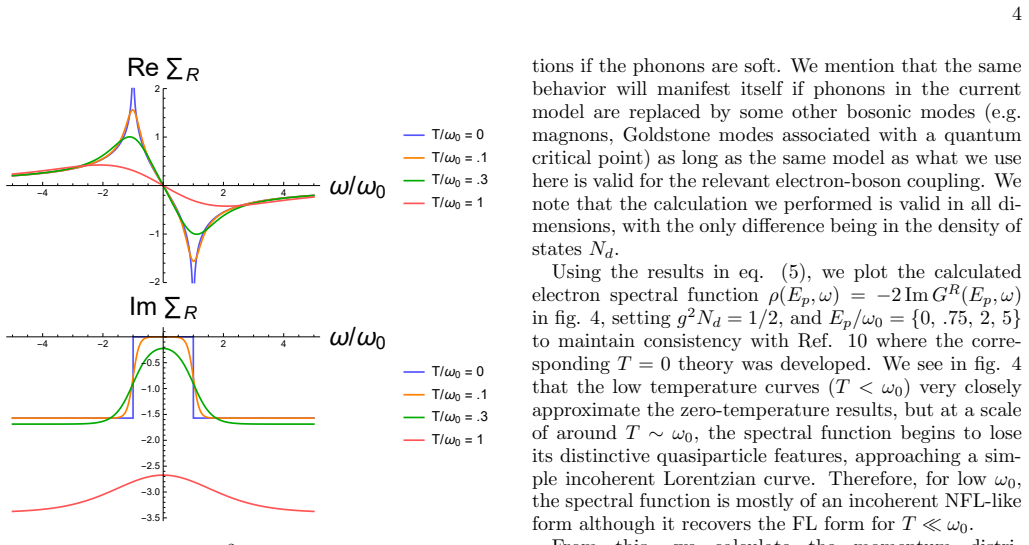
- In the electron-phonon system, the imaginary part of the self-energy becomes linear in temperature for $T \gtrsim 0.2\,\omega_0$, so linear-in-$T$ resistivity can persist to low absolute temperatures whenever the relevant phonon modes are soft.
- Impurity scattering removes the zero-temperature discontinuity in the momentum distribution, meaning a disordered metal has no well-defined Fermi surface even at $T=0$ on the paper's criterion.
- In the clean electron-phonon system, the zero-temperature limit is a Fermi liquid with a delta-function quasiparticle peak and a finite discontinuity in $n(p)$; the paper's “non-Fermi liquid” characterization of the phonon case is a finite-temperature, effective statement rather than a ground-state phase.
Reading between the lines
- An implication the authors leave implicit is that their criterion—no Fermi-function momentum distribution and no sharp quasiparticle peak—would classify nearly every real metal, which always contains phonons and some disorder, as a trivial non-Fermi liquid at accessible temperatures; the useful question then becomes how far a measurement deviates from this trivial baseline.
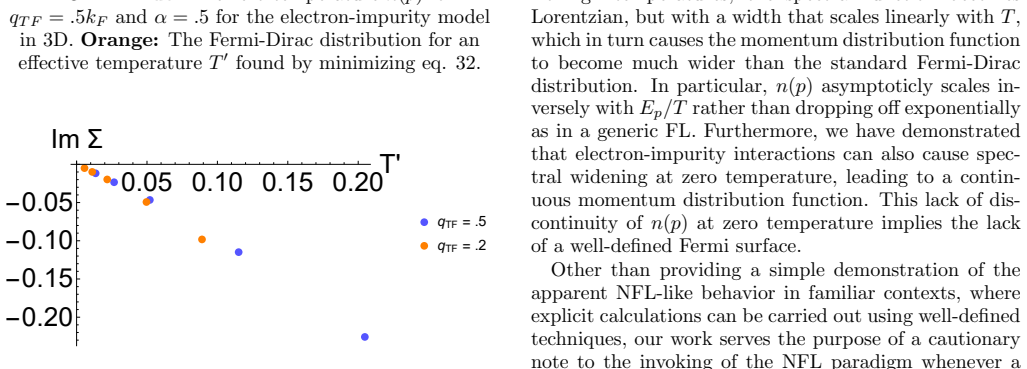
- The effective-temperature mapping $T' \approx 0.9\,|\mathrm{Im}\,\Sigma(k_F,0)|$ suggests a practical diagnostic: a disordered sample's momentum distribution at base temperature should mimic a clean sample at temperature $T'$, so deviations from this mapping would signal something beyond simple lifetime broadening.
- A natural extension is that any measurement claiming correlation-driven non-Fermi-liquid behavior should first subtract the trivial phonon/impurity baseline predicted here; otherwise linear-in-$T$ resistivity and broad spectra remain ambiguous, especially in materials with soft phonon modes.
Signed reviews
Editorial analysis
A structured set of objections, weighed in public.
Referee Report
Summary. The paper studies, at leading order in finite-temperature many-body perturbation theory, the electron self-energy, spectral function, and momentum distribution function for three models without electron-electron interactions: electron-phonon coupling in the Einstein model, electron-phonon coupling in the Debye model (2D and 3D), and electron-impurity scattering (1D, 2D, and 3D). The authors obtain analytic expressions for the self-energies, present low- and high-temperature expansions, and plot spectral functions and momentum distributions. They argue that the resulting non-Lorentzian spectral functions and the deviation of n(p) from a Fermi-Dirac form show that these coupled systems are 'trivial non-Fermi liquids,' and they offer this as a cautionary tale against interpreting broad spectral functions or linear-in-T resistivity as evidence of correlation-driven NFL behavior.
Significance. If interpreted as a study of effective finite-temperature broadening from phonons and impurities, the paper is a useful and mostly careful compilation: the analytic self-energy expressions and their low- and high-temperature expansions are standard but presented in a convenient form, and the warning that phonons or disorder can mimic NFL-like spectral and transport features is well taken. The perturbative calculations appear internally consistent, and the paper makes no use of fitted parameters for its main self-energy results. However, the central interpretive claim—that these systems are genuinely non-Fermi liquids—is overstated and rests on a nonstandard definition of NFL that is not the zero-temperature Landau notion. The paper's own T=0 results contradict the unqualified e-ph NFL claim, and the abstract's statement about n(p) is too strong even relative to the paper's own effective-temperature fit in the impurity case.
major comments (3)
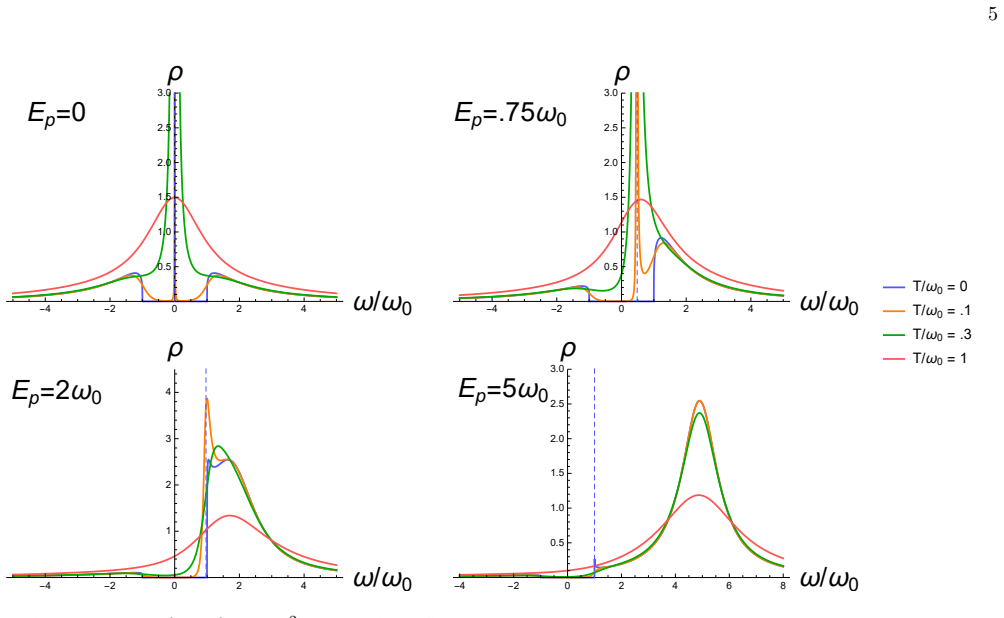
- [Abstract and §II.B (Eq. (7), Fig. 5)] The abstract's central claim that a coupled electron-phonon system 'is in fact a trivial NFL' is not supported by the paper's own T=0 results. In §II.B, Eq. (7) shows that Im Σ_R vanishes for |ω| < ω0 at T=0, and Fig. 4 includes a delta-function quasiparticle peak; Fig. 5 shows a finite discontinuity in n(p) at T=0 for the Einstein model, and the same is stated for the Debye models in §III.B. These are exactly the Landau Fermi-liquid criteria. The finite-T broadening is ordinary thermal quasiparticle damping. The Conclusion (§V) in fact concedes 'effective finite-temperature NFL behavior which will disappear at T=0 in the clean system.' The abstract and title-level claim should be revised to say apparent or effective NFL at finite temperature for the clean e-ph system.
- [§I and §V (definitional premise)] The paper's operative criterion for NFL—a finite imaginary self-energy on the Fermi surface or finite-temperature spectral broadening—is a nonstandard definition. In the Landau sense, NFL is a zero-temperature ground-state property, characterized by the absence of a quasiparticle pole and, in particular, by the absence of a discontinuity in the T=0 momentum distribution. Under the paper's criterion, every interacting Fermi liquid at finite temperature is an NFL, since Im Σ and spectral width are generically nonzero for T>0. The electron-impurity case with continuous T=0 n(p) is closer to a standard NFL signature, but even there the mechanism is elastic single-particle scattering rather than interaction-driven destruction of the quasiparticle concept. The authors should either adopt the standard zero-temperature definition and restrict the label 'NFL' to the impurity case, or explicitly state throughout that they are using an effective finite-temperature notion.
- [Abstract and §IV.B (Eq. (32), Fig. 24)] The abstract states that the calculated momentum distribution function 'cannot be approximated by a Fermi function at any temperature,' but §IV.B explicitly approximates the impurity n(p) with a Fermi-Dirac distribution at an effective temperature T′ and finds good agreement 'for α not too high' (Eq. (32), Fig. 24). As written, the claim is contradicted by the authors' own fitting procedure. The statement should be qualified—for example, 'at the physical system temperature' or 'over the entire momentum range'—or removed from the abstract.
minor comments (4)
- [§III.B, Eq. (21)] The final factor in Eq. (21) appears garbled: the exponent is printed with an imaginary unit inside a Fermi-like factor, which would make n(p) complex; this is presumably a typesetting error, and the intended real Fermi factor should be restored.
- [Figs. 8 and 9 captions] The captions for Figs. 8 and 9 say 'T/ω0' and 'Im Σ versus T/ω0,' but for the Debye model the normalization should be T/ωD; please correct the axis labels and captions.
- [§IV.A, Eqs. (27)-(29)] Eq. (27) gives a Z that is explicitly complex because of the term i q_TF^3/k_F, and yet Z is then used as a quasiparticle weight in Eqs. (24)-(25); the paper should clarify whether Z is intended to be complex and what its real part represents.
- [§II.B, sentence before Fig. 5] The text says 'The calculated Fermi distribution function is shown in fig. 5,' but the quantity plotted is the momentum distribution function n(p), not the Fermi-Dirac distribution; please correct the wording.
Circularity Check
The e-ph 'trivial NFL' claim reduces to the paper's own finite-temperature definition of NFL, despite the T=0 Fermi-liquid behavior shown in Eq. (7) and Fig. 5.
-
self definitional
[Section I (Introduction); Section II.B, near Eq. (7)]
"Electron-impurity and electron-phonon interactions invariably lead to violations of the Landau paradigm, and a coupled electron-impurity or coupled electron-phonon system, without any electron-electron interaction, is in fact a trivial NFL! ... An important thing to note is that the imaginary part of the self-energy vanishes for small ω and T guaranteeing the FL behavior as T/ω0 vanishes."
The paper's opening definition makes 'no delta-function spectral peak' and 'no zero-temperature n(p) discontinuity' the criteria for NFL. Its e-ph calculation, however, shows exactly the opposite at T=0: Eq. (7) has vanishing Im Σ for |ω|<ω0 and Fig. 5 retains a finite discontinuity, which the text itself calls 'guaranteeing the FL behavior as T/ω0 vanishes.' The label 'trivial NFL' is therefore obtained by applying the finite-temperature broadening criterion, not by a zero-temperature breakdown of Landau quasiparticles; the conclusion is true by construction of the criterion.
-
renaming known result
[Section V (Conclusion); cf. Abstract]
"it is possible that the apparent NFL behavior is arising trivially from the electrons coupling to very low energy phonons (or some other bosons) and/or quenched impurities in the system, providing an effective finite-temperature NFL behavior which will disappear at T = 0 in the clean system in the absence of impurities."
This concluding sentence concedes that the e-ph effect is an 'apparent' finite-temperature phenomenon that vanishes at T=0 in a clean system. Calling ordinary thermal/quasiparticle broadening and the resulting slow power-law tail of n(p) 'NFL' renames a known property of finite-temperature interacting systems rather than deriving a violation of the zero-temperature Fermi-liquid correspondence. The abstract's unqualified claim that the momentum distribution 'cannot be approximated by a Fermi function at any temperature' and is 'a rather simple example of a non-Fermi liquid' holds only under this redefinition.
full rationale
The self-energy derivations (Eqs. (2)-(5), (9)-(14), (23)-(29)) and the computed spectral functions and n(p) are self-contained one-loop many-body calculations; no fitted parameter enters the central NFL claim, and the auxiliary effective temperature T' in Sec. IV.B is illustrative only. The circularity is at the level of the NFL label itself. The paper adopts a definition in Sec. I under which a nonzero imaginary self-energy (equivalently, no strict delta-function spectral peak and no zero-temperature n(p) discontinuity) is taken as NFL. It then applies this label to finite-temperature phonon broadening, even though Eq. (7) and Fig. 5 show that the T=0 e-ph system has a delta function and a finite n(p) discontinuity, i.e., a Landau Fermi liquid. The conclusion concedes that the effect is 'apparent' and 'will disappear at T=0 in the clean system.' Thus the abstract's unqualified 'is in fact a trivial NFL' is not derived from a zero-temperature breakdown but is true by the paper's own finite-T definition. The impurity case is closer to a genuine zero-T continuous n(p), but classifying disorder-induced lifetime broadening as NFL is likewise a semantic redefinition of the standard zero-temperature quasiparticle concept. Score 6 reflects partial circularity: the computations stand, but the headline claim reduces to a definitional choice.
Assumptions & free parameters
free parameters (1)
- Effective temperature T' =
T'/TF = 0.115 for alpha = 0.5, qTF = 0.5 kF in 3D
assumptions (5)
- standard math Matsubara finite-temperature perturbation theory and analytic continuation to retarded self-energy are valid at leading order.
- domain assumption The density of states can be approximated as momentum-independent and the energy integral extended to plus or minus infinity (Eqs. 3 and 11).
- domain assumption Electron-electron interactions are neglected in the electron-phonon problem.
- domain assumption For electron-impurity scattering, the ensemble-averaged Born approximation with a Thomas-Fermi screened potential and the self-consistent renormalization scheme (Eqs. 23-29) correctly capture disorder effects.
- ad hoc to paper A finite imaginary self-energy on the Fermi surface or finite-temperature spectral broadening is sufficient to declare a non-Fermi liquid.
Cite this review
Pith. "Pith review of Coupled electron-impurity and electron-phonon systems as trivial non-Fermi liquids." pith.science (2026). https://pith.science/paper/B4FEWR72
@misc{pith2026190808957,
  author       = {Pith},
  title        = {Pith review of: Coupled electron-impurity and electron-phonon systems as trivial non-Fermi liquids},
  year         = {2026},
  howpublished = {\url{https://pith.science/paper/B4FEWR72}},
  note         = {Machine review of arXiv:1908.08957}
}
read the original abstract
We consider an electron gas, both in two (2D) and three (3D) dimensions, interacting with quenched impurities and phonons within leading order finite-temperature many body perturbation theories, calculating the electron self-energies, spectral functions, and momentum distribution functions at finite temperatures. The resultant spectral function is in general highly non-Lorentzian, indicating that the system is not a Fermi liquid in the usual sense. The calculated momentum distribution function cannot be approximated by a Fermi function at any temperature, providing a rather simple example of a non-Fermi liquid with well-understood properties.
Figures

Figures from the paper (17 more)


Reference graph
Works this paper leans on
-
[1]
A.\ A.\ Abrikosov, L.\ P.\ Gorkov & I.\ E.\ Dzyaloshinski, Methods of Quantum Field Theory In Statistical Physics , R.\ A.\ Silverman (Prentice Hall Inc., Englewood Cliffs, 1963)
work page 1963
-
[2]
P.\ Nozieres Theory of Interacting Fermi Systems (W.\ A.\ Benjamin, New York, 1964)
work page 1964
-
[3]
R.\ Shankar, Rev. Mod. Phys. 66 , 129 (1994)
work page 1994
-
[4]
T.\ Giamarchi, Quantum Physics in One Dimension (Clarendon Press, Oxford, 2003)
work page 2003
-
[5]
F.\ D.\ M.\ Haldane, J. Phys. C: Sol. St. Phys. 14 , 19 (1981)
work page 1981
-
[6]
J.\ Voit, Rep. Prog. Phys. 58 , 977 (1995)
work page 1995
-
[7]
G.\ Grimvall, The Electron-Phonon Interaction in Metals (North-Holland Pub. Co., Elsevier, 1981)
work page 1981
-
[8]
L.\ P.\ Kadanoff, Phys. Rev. 132 , 2073 (1963)
work page 1963
Show all 13 references
-
[9]
R.\ E.\ Prange & L.\ P.\ Kadanoff, Phys. Rev. 134 , A566 (1964)
1964
-
[10]
S.\ Engelsberg & J.\ R.\ Schrieffer, Phys. Rev. 131 , 993 (1963)
1963
-
[11]
E.\ H.\ Hwang & S.\ Das Sarma, 99 , 085105 (2019)
2019
-
[12]
S.\ Das Sarma & B.\ Vinter, 24 , 549 (1981)
1981
-
[13]
R.\ B.\ Dingle, Proc. R. Soc. Lond. A 211 , p. 517 (1952)
1952
Reviewed August 14, 2026 · model on record in the stance chip above.
Discussion (0). Continue with ORCID to comment.