LLM-Driven Heuristic Frame-Level Quantization Parameter Adaptation for VVenC
Pith reviewed 2026-06-26 15:01 UTC · model grok-4.3
The pith
Large language models can evolve effective heuristics for frame-level quantization parameter adaptation in video encoders.
A machine-rendered reading of the paper's core claim, the machinery that carries it, and where it could break.
Core claim
The paper establishes that an LLM-driven evolutionary framework generates heuristics which deliver rate-distortion gains over fixed-QP and Lagrangian methods in VVenC, with the model independently identifying the value of entropy terms that discourage rapid QP changes between frames.
What carries the argument
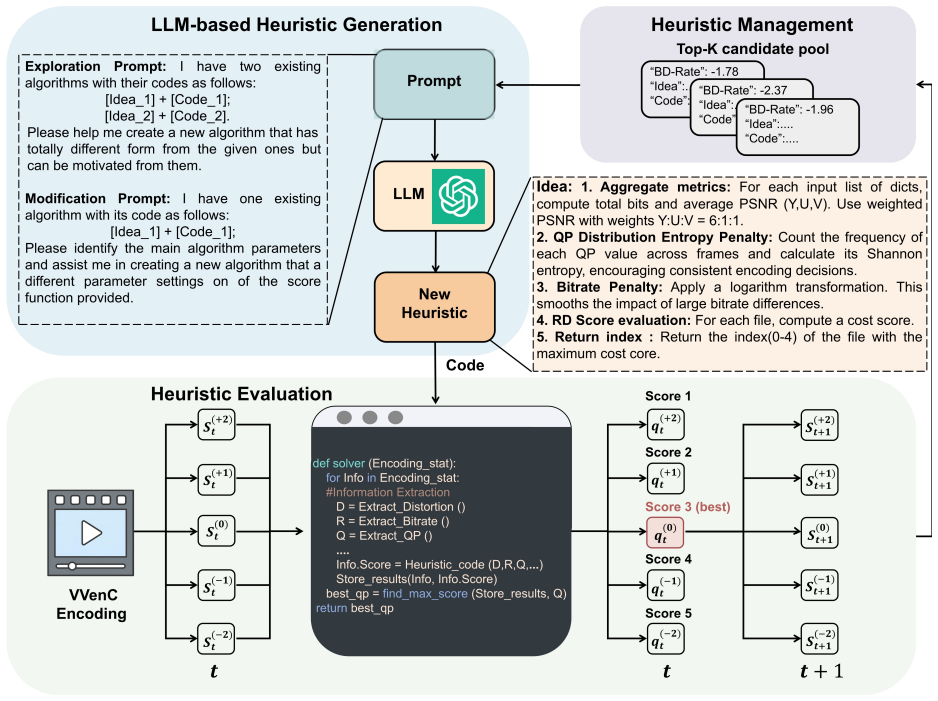
A closed-loop evolutionary framework where the LLM generates candidate heuristics as executable code, scored by their encoding performance on video sequences using VVenC.
If this is right
- The evolved heuristic provides measurable improvements in rate-distortion performance over the fixed-QP scheme.
- It also outperforms the Lagrangian baseline.
- The discovered heuristic uses entropy-based terms to penalize QP fluctuations.
- The process yields new design insights for RDO algorithms.
Where Pith is reading between the lines
- This approach could reduce reliance on hand-tuned parameters across other video coding tools.
- Extending the framework to multi-pass encoding or different codecs would test its broader utility.
- The entropy penalty finding highlights fluctuation control as a potentially under-explored lever in frame-level decisions.
Load-bearing premise
That the heuristics found to work well on the evaluated test sequences will generalize reliably to new video content and different encoding conditions.
What would settle it
Running the evolved heuristic on additional video test sequences and observing no rate-distortion gain or a loss relative to the fixed-QP and Lagrangian baselines would challenge the central claim.
Figures

read the original abstract
Optimal frame-level quantization parameter (QP) allocation remains a persistent challenge in modern video encoders. The fixed-QP scheme widely adopted in practical systems is inherently content-agnostic, while classical Lagrangian rate-distortion optimization (RDO) methods often suffer from inaccurate multiplier settings. In this paper, we explore the use of large language models (LLMs) to automatically design RDO heuristics for frame-level QP adaptation. We construct a closed-loop evolutionary framework in which the LLM iteratively proposes RDO heuristics as algorithmic ideas with executable code, and these candidates are evaluated directly through encoding with the Fraunhofer Versatile Video Encoder (VVenC), where each heuristic acts as a scoring function that compares different QP choices based on the encoding statistics of past frames and current candidates. Experimental results across multiple test sets show that the evolved heuristic achieves promising rate-distortion improvements over both the fixed-QP scheme and the Lagrangian baseline. Further analysis reveals that the LLM can autonomously discover an adaptive heuristic that penalizes QP fluctuations via entropy-based terms, providing new insights into the design of RDO algorithms
Editorial analysis
A structured set of objections, weighed in public.
Referee Report
Summary. The manuscript describes a closed-loop evolutionary framework in which an LLM iteratively proposes frame-level QP adaptation heuristics (as algorithmic ideas with executable code) for the VVenC encoder. Candidate heuristics are scored directly via VVenC encoding runs that compare QP choices using statistics from past frames and current candidates. The paper reports that the best evolved heuristic yields rate-distortion gains over both fixed-QP and classical Lagrangian RDO baselines across multiple test sets and that the LLM autonomously discovers an adaptive heuristic incorporating entropy-based penalties on QP fluctuations.
Significance. If the reported gains prove robust, the work demonstrates a practical route to automated discovery of content-adaptive RDO heuristics via LLM-driven evolution with direct encoder-in-the-loop evaluation. This could reduce reliance on hand-crafted multipliers and provide interpretable insights (e.g., entropy terms) into QP stability. The explicit use of executable code proposals and real encoding runs strengthens empirical grounding compared with purely symbolic or simulation-based methods.
major comments (2)
- [Abstract / Experimental Results] Abstract and Experimental Results section: the central claim that the evolved heuristic produces reliable RD improvements 'across multiple test sets' is load-bearing, yet the manuscript supplies no quantitative BD-rate deltas, no dataset sizes or sequence characteristics, no mention of held-out sequences, no cross-validation procedure, and no statistical significance tests or run-to-run variance. Without these, it is impossible to distinguish intrinsic heuristic quality from possible overfitting to the sequences used inside the evolutionary loop.
- [Method] Method section (heuristic evaluation loop): the scoring function is defined solely by direct VVenC runs on the paper's test content; no analysis is given of how sensitive the discovered heuristics are to encoder configuration changes (e.g., different presets, resolutions, or motion statistics) outside the reported sets. This directly affects the generalization statement in the abstract.
minor comments (2)
- [Abstract] The abstract uses the phrase 'promising rate-distortion improvements' without defining the exact RD metric (PSNR, VMAF, etc.) or the reference Lagrangian multiplier schedule; this should be stated explicitly in the first paragraph of the results.
- [Analysis] Notation for the entropy-based penalty term discovered by the LLM is introduced only in the analysis subsection; a compact equation or pseudocode block in the main method section would improve readability.
Simulated Author's Rebuttal
We thank the referee for the constructive feedback on experimental rigor and generalization. We address the points below and will revise the manuscript to strengthen the claims with additional quantitative details and analysis.
read point-by-point responses
-
Referee: [Abstract / Experimental Results] Abstract and Experimental Results section: the central claim that the evolved heuristic produces reliable RD improvements 'across multiple test sets' is load-bearing, yet the manuscript supplies no quantitative BD-rate deltas, no dataset sizes or sequence characteristics, no mention of held-out sequences, no cross-validation procedure, and no statistical significance tests or run-to-run variance. Without these, it is impossible to distinguish intrinsic heuristic quality from possible overfitting to the sequences used inside the evolutionary loop.
Authors: We agree the manuscript should provide explicit BD-rate deltas, dataset details, and statistical context to support the 'across multiple test sets' claim. In revision we will add tables with per-sequence and average BD-rate values (relative to both fixed-QP and Lagrangian baselines), list the exact sequences and their characteristics, and report any available run-to-run variance from the encoding evaluations. We will also clarify the split between sequences used inside the evolutionary scoring loop and those used for final reporting. While the framework is designed around content-adaptive statistics rather than sequence-specific tuning, we acknowledge the current presentation does not yet demonstrate this separation explicitly. revision: yes
-
Referee: [Method] Method section (heuristic evaluation loop): the scoring function is defined solely by direct VVenC runs on the paper's test content; no analysis is given of how sensitive the discovered heuristics are to encoder configuration changes (e.g., different presets, resolutions, or motion statistics) outside the reported sets. This directly affects the generalization statement in the abstract.
Authors: We concur that sensitivity to encoder presets, resolutions, and motion characteristics is necessary to support generalization claims. In the revised manuscript we will add a dedicated subsection discussing the heuristic's behavior under altered VVenC configurations (e.g., different speed presets) and will either include limited additional encoding results or explicitly qualify the scope of the reported generalization. The entropy-based penalty term discovered by the LLM is intended to be configuration-agnostic, but we accept that empirical verification beyond the original test content is required. revision: partial
Circularity Check
No significant circularity; empirical evaluation stands alone
full rationale
The paper presents an empirical closed-loop process: an LLM proposes executable heuristic code as scoring functions, which are then directly evaluated by running VVenC encodings on test sequences to measure RD performance against fixed-QP and Lagrangian baselines. No equations, fitted parameters, or self-referential definitions appear in the provided text; the reported improvements are measured outcomes of external encoder runs rather than quantities that reduce by construction to the paper's own inputs or prior self-citations. The derivation chain is therefore self-contained as a search-and-measure procedure.
Axiom & Free-Parameter Ledger
Reference graph
Works this paper leans on
-
[1]
DeepSeek-V3.2: Pushing the Frontier of Open Large Language Models
A. Liu, A. Mei, B. Lin, B. Xue, B. Wang, B. Xu, B. Wu, B. Zhang, C. Lin, C. Donget al., “Deepseek-v3. 2: Pushing the frontier of open large language models,”arXiv preprint arXiv:2512.02556, 2025
work page internal anchor Pith review Pith/arXiv arXiv 2025
-
[2]
MCL-JCV: a JND- based H. 264/A VC video quality assessment dataset,
H. Wang, W. Gan, S. Hu, J. Y . Lin, L. Jin, L. Song, P. Wang, I. Katsavounidis, A. Aaron, and C.-C. J. Kuo, “MCL-JCV: a JND- based H. 264/A VC video quality assessment dataset,” in2016 IEEE International Conference on Image Processing (ICIP). IEEE, 2016, pp. 1509–1513
2016
-
[3]
UVG dataset: 50/120fps 4K sequences for video codec analysis and development,
A. Mercat, M. Viitanen, and J. Vanne, “UVG dataset: 50/120fps 4K sequences for video codec analysis and development,” inProceedings of the 11th ACM Multimedia Systems Conference, 2020, pp. 297–302
2020
-
[4]
The SJTU 4K video sequence dataset,
L. Song, X. Tang, W. Zhang, X. Yang, and P. Xia, “The SJTU 4K video sequence dataset,” in2013 Fifth International Workshop on Quality of Multimedia Experience (QoMEX). IEEE, 2013, pp. 34–35
2013
-
[5]
Calculation of average PSNR differences between rd- curves,
G. Bjontegaard, “Calculation of average PSNR differences between rd- curves,”ITU SG16 Doc. VCEG-M33, 2001
2001
-
[6]
Evolution of heuristics: Towards efficient automatic algorithm design using large language model,
F. Liu, X. Tong, M. Yuan, X. Lin, F. Luo, Z. Wang, Z. Lu, and Q. Zhang, “Evolution of heuristics: Towards efficient automatic algorithm design using large language model,”arXiv preprint arXiv:2401.02051, 2024
-
[7]
Lambda domain optimal bit alloca- tion algorithm for high efficiency video coding,
L. Li, B. Li, H. Li, and C. W. Chen, “Lambda domain optimal bit alloca- tion algorithm for high efficiency video coding,”IEEE Transactions on Circuits and Systems for Video Technology, vol. 28, no. 1, pp. 130–142, 2016
2016
-
[8]
Lambda domain rate control algorithm for high efficiency video coding,
B. Li, H. Li, L. Li, and J. Zhang, “Lambda domain rate control algorithm for high efficiency video coding,”IEEE transactions on Image Processing, vol. 23, no. 9, pp. 3841–3854, 2014
2014
-
[9]
A theoretical and experimental study for dependent learned rate-distortion optimization,
Y . Zhang, M. Wang, J. Li, K. Zhang, L. Zhang, and S. Wang, “A theoretical and experimental study for dependent learned rate-distortion optimization,”IEEE Transactions on Circuits and Systems for Video Technology, 2025
2025
-
[10]
Hierarchical B pictures, document JVT-P014,
H. Schwarz, D. Marpe, and T. Wiegand, “Hierarchical B pictures, document JVT-P014,”Poznan, Poland, Jul, 2005
2005
-
[12]
Adaptive quantization parameter cascading in HEVC hierarchical coding,
T. Zhao, Z. Wang, and C. W. Chen, “Adaptive quantization parameter cascading in HEVC hierarchical coding,”IEEE Transactions on Image Processing, vol. 25, no. 7, pp. 2997–3009, 2016
2016
-
[13]
Rate-distortion optimization for video compression,
G. J. Sullivan and T. Wiegand, “Rate-distortion optimization for video compression,”IEEE Signal Processing Magazine, vol. 15, no. 6, pp. 74–90, 1998
1998
-
[14]
Adaptive quantization param- eter selection for H. 265/HEVC by employing inter-frame dependency,
J. He, E.-H. Yang, F. Yang, and K. Yang, “Adaptive quantization param- eter selection for H. 265/HEVC by employing inter-frame dependency,” IEEE Transactions on Circuits and Systems for Video Technology, vol. 28, no. 12, pp. 3424–3436, 2017
2017
-
[15]
Overview of the H. 264/A VC video coding standard,
T. Wiegand, G. J. Sullivan, G. Bjontegaard, and A. Luthra, “Overview of the H. 264/A VC video coding standard,”IEEE Transactions on Circuits and Systems for Video Technology, vol. 13, no. 7, pp. 560–576, 2003
2003
-
[16]
Overview of the high efficiency video coding (HEVC) standard,
G. J. Sullivan, J.-R. Ohm, W.-J. Han, and T. Wiegand, “Overview of the high efficiency video coding (HEVC) standard,”IEEE Transactions on Circuits and Systems for Video Technology, vol. 22, no. 12, pp. 1649– 1668, 2012
2012
-
[17]
Overview of the versatile video coding (VVC) standard and its applications,
B. Bross, Y .-K. Wang, Y . Ye, S. Liu, J. Chen, G. J. Sullivan, and J.- R. Ohm, “Overview of the versatile video coding (VVC) standard and its applications,”IEEE Transactions on Circuits and Systems for Video Technology, vol. 31, no. 10, pp. 3736–3764, 2021
2021
-
[18]
High efficiency video coding (hevc) test model 16 (hm 16) encoder description,
K. McCann, C. Rosewarne, B. Bross, M. Naccari, and K. Sharman, “High efficiency video coding (hevc) test model 16 (hm 16) encoder description,” inIn: 18th Meeting of the Joint Collaborative Team on Video Coding (JCT-VC). Document: JCTVC-R1002, 2014
2014
-
[19]
Recent advances in natural language processing via large pre-trained language models: A survey,
B. Min, H. Ross, E. Sulem, A. P. B. Veyseh, T. H. Nguyen, O. Sainz, E. Agirre, I. Heintz, and D. Roth, “Recent advances in natural language processing via large pre-trained language models: A survey,”ACM Computing Surveys, vol. 56, no. 2, pp. 1–40, 2023
2023
-
[20]
Is chatgpt the ultimate programming assistant–how far is it? 2023,
H. Tian, W. Lu, T. O. Li, X. Tang, S.-C. Cheung, J. Klein, and T. F. Bissyand´e, “Is chatgpt the ultimate programming assistant–how far is it? 2023,”arXiv preprint arXiv:2304.11938, 2025
-
[21]
Exploring the potential of gpt-4 in biomedical engineering: the dawn of a new era,
K. Cheng, Q. Guo, Y . He, Y . Lu, S. Gu, and H. Wu, “Exploring the potential of gpt-4 in biomedical engineering: the dawn of a new era,” Annals of Biomedical Engineering, vol. 51, no. 8, pp. 1645–1653, 2023
2023
-
[22]
Is GPT all you need for low-data discovery in chemistry?
K. M. Jablonka, P. Schwaller, A. Ortega-Guerrero, and B. Smit, “Is GPT all you need for low-data discovery in chemistry?” 2023
2023
-
[23]
Automl-gpt: Automatic machine learning with gpt,
S. Zhang, C. Gong, L. Wu, X. Liu, and M. Zhou, “Automl-gpt: Automatic machine learning with gpt,”arXiv preprint arXiv:2305.02499, 2023
-
[24]
A Survey of Large Language Models
W. X. Zhao, K. Zhou, J. Li, T. Tang, X. Wang, Y . Hou, Y . Min, B. Zhang, J. Zhang, Z. Donget al., “A survey of large language models,”arXiv preprint arXiv:2303.18223, vol. 1, no. 2, 2023
work page internal anchor Pith review Pith/arXiv arXiv 2023
-
[25]
Improvements of the BD-PSNR model,
G. Bjontegaard, “Improvements of the BD-PSNR model,”VCEG-AI11, 2008
2008
-
[26]
Vvenc: An open and optimized vvc encoder implementation,
A. Wieckowski, J. Brandenburg, T. Hinz, C. Bartnik, V . George, G. Hege, C. Helmrich, A. Henkel, C. Lehmann, C. Stofferset al., “Vvenc: An open and optimized vvc encoder implementation,” in 2021 IEEE International Conference on Multimedia & Expo Workshops (ICMEW). IEEE, 2021, pp. 1–2
2021
-
[27]
Learned reference picture resampling control: A data-centric approach,
R. Lu, Y . Zhang, H. Man, M. Wang, L. Xu, S. Wang, and X. Fan, “Learned reference picture resampling control: A data-centric approach,” IEEE Transactions on Circuits and Systems for Video Technology, 2026
2026
-
[28]
Learning the scale in reference picture resampling for versatile video coding,
R. Lu, Y . Zhang, H. Man, M. Wang, S. Wang, and X. Fan, “Learning the scale in reference picture resampling for versatile video coding,”IEEE Transactions on Multimedia, vol. 27, pp. 5831–5842, 2025
2025
discussion (0)
Sign in with ORCID, Apple, or X to comment. Anyone can read and Pith papers without signing in.