REVIEW 2 major objections 6 minor 2 cited by
Probing correlated compensated isocurvature perturbations using scale-dependent galaxy bias
T0 review · 2 major / 6 minor · reviewed 2026-08-14 · deepseek-v4-flash
Pith's one-line read Using galaxy counts with kSZ tomography can expose hidden early-universe perturbations
desk verdict A careful and honest forecast, but the headline sigma_A=0.25 likely misses a back-reaction of the CIPs on the kSZ reconstruction itself, so treat the central number as optimistic until that is modeled. read the letter →
The pith
A machine-rendered reading of the paper's core claim, the machinery that carries it, and where it could break.
The reading
What carries the argument
The load-bearing mechanism is sample-variance cancellation between galaxy number counts and the kSZ-reconstructed remote dipole field, the CMB dipole as seen from each location in the Universe. The reconstruction uses the quadratic estimator of Eq. (15), with noise set by Eq. (17); because the remote dipole field is an unbiased tracer of the total matter density, its cross-correlation with the biased galaxy field isolates the scale-dependent bias generated by correlated CIPs without cosmic variance. The characteristic scale dependence comes from $\Delta(\mathbf{k})\propto A/k^2$, and the CIP bias function $b_{bc}(z)$ is computed from a mass function and halo occupation model. All relativistic and lightcone projection effects in the galaxy number counts are included in the forecast.
What would settle it
Measure the kSZ remote-dipole reconstruction noise on a real next-generation CMB data set, treating thermal Sunyaev-Zeldovich emission, dust, and radio sources as they appear in the maps; if the effective noise at multipoles up to 9000 exceeds Eq. (17), the projected CIP sensitivity degrades roughly in proportion, and the claimed improvement over survey-only constraints shrinks.
Extended reading notes
Core claim
The paper's central claim is that correlated CIPs with amplitude $A$ comparable to the adiabatic curvature fluctuations are detectable through their scale-dependent imprint on galaxy bias. The CIP amplitude enters the galaxy overdensity through the bias term $b_{bc}(z)\left[\delta_{bc}+f\Delta(\mathbf{k})\right]$, where $\Delta(\mathbf{k})=(5H^2\Omega_m)/(2a k^2)\,A\,\delta_m$, producing a $k^{-2}$ enhancement at large scales. Combining galaxy number counts with the kSZ-reconstructed remote dipole field and their cross-spectra in a Fisher forecast, and marginalizing over cosmological parameters and all relevant bias functions, the paper obtains $\sigma(A)=0.25$; marginalizing additionally over the local non-Gaussianity parameter $f_{NL}$ degrades this to $0.49$. The paper concludes that CIPs of order the adiabatic amplitude can be probed, improving on current CMB constraints by over two orders of magnitude, and that curvaton scenarios predicting $A=16$ or $A=-3$ can be confirmed or ruled out.
Load-bearing premise
The forecast assumes that foregrounds and uncertainty in the free-electron distribution do not substantially raise the noise of the remote-dipole reconstruction; if the effective reconstruction noise is larger than Eq. (17) predicts, the sample-variance cancellation weakens and $\sigma(A)=0.25$ is no longer reached.
Editorial extensions
If this is right
- A future CMB survey with roughly one microKelvin-arcmin noise, together with a deep photometric galaxy survey, could detect correlated CIPs with $A\sim 1$, turning a CMB-invisible mode into a routine observable.
- The same data set must fit $A$ and $f_{NL}$ together: marginalizing over primordial non-Gaussianity weakens the constraint from $0.25$ to $0.49$, so a claimed CIP detection needs a joint analysis.
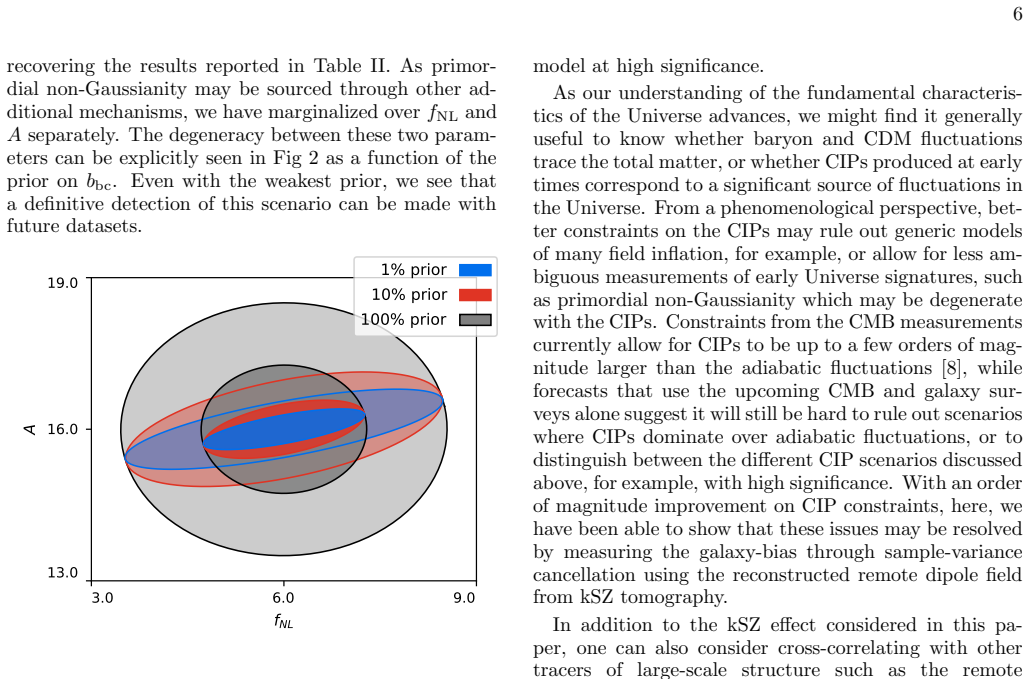
- Curvaton scenarios with $A=16$ and $f_{NL}=6$ would be detected at high significance even with a weak prior on the CIP bias function.
- Relativistic and lightcone projection effects cannot be neglected: omitting them biases the inferred CIP amplitude by about $1.5\sigma$.
- Existing photometric quasar samples may already tighten CIP constraints relative to the CMB, because their non-Gaussianity transfer function is comparable in size to the CIP contribution.
Reading between the lines
- Editorial inference: the projected $\sigma(A)=0.25$ rests on the remote-dipole reconstruction noise reaching Eq. (17); a direct measurement of that noise, including foregrounds and uncertainties in the free-electron distribution, is the most direct way to test the forecast before the surveys are built.
- Editorial inference: because the method uses cross-correlations, it is largely blind to CIP components uncorrelated with the adiabatic mode; such stochastic components would add noise to the measurement, so the quoted sensitivity applies to correlated CIPs only.
- Editorial inference: if a future experiment fails to reach the assumed small-scale CMB sensitivity, the constraint degrades, but the paper's parameter scan suggests low multipoles carry most of the signal, so an experiment optimized for large angular scales may retain much of the gain.
Signed reviews
Editorial analysis
A structured set of objections, weighed in public.
Referee Report
Summary. This paper presents a Fisher-matrix forecast for the amplitude A of correlated compensated isocurvature perturbations (CIPs), using the scale-dependent galaxy bias they induce in combination with kSZ-tomography reconstructions of the remote dipole field. The model includes all linear relativistic contributions to galaxy number counts, treats primordial non-Gaussianity as a competing source of scale-dependent bias, and marginalizes over cosmological parameters and bias functions. For an LSST-like gold sample and a CMB-S4-like experiment, the headline result is sigma_A=0.25 in the fiducial model, degrading to sigma_A=0.49 when f_NL is also marginalized; the authors find an order-of-magnitude improvement over galaxy counts alone and roughly two orders of magnitude over current CMB constraints. The paper also examines a curvaton-motivated model with A=16 and f_NL=6, explicitly showing the sensitivity of that forecast to a prior on the CIP bias b_bc(z).
Significance. If the forecast is robust, the proposed technique would be a genuinely new probe of a poorly constrained early-Universe mode, improving on Planck by two orders of magnitude and offering an independent route to disentangle CIPs from local-type primordial non-Gaussianity. The paper is a clean forward-model forecast rather than a data analysis, and it is careful to include relativistic projection effects, to marginalize over the relevant nuisance parameters, and to test robustness to several experimental choices. The main strengths are the completeness of the galaxy-count model and the explicit treatment of the f_NL degeneracy. The central caveats are that the headline significance is conditional on a halo-model prediction for b_bc(z) and on an idealized kSZ reconstruction with no foreground model; both of these need to be addressed before the headline claim can be taken at face value.
major comments (2)
- [Sec. IV, Table II; Sec. II, Eq. (10)] The fiducial result sigma_A=0.25 is computed with b_bc(z) fixed to the halo-model/HOD fit of Eq. (10). The CIP contribution to delta_g in Eq. (4) is proportional to b_bc, so the Fisher sensitivity to A is conditional on this assumed function. The authors' own analysis of the A=16 model shows that a 100% prior on b_bc degrades sigma_A to 5.8, demonstrating a strong degeneracy; the analogous degradation for the fiducial A=0 forecast is not reported. Please add a forecast with a physically motivated prior on b_bc (including the halo-model calibration uncertainty) and show how sigma_A changes, so that the headline improvement is not conditional on an unstated assumption.
- [Sec. III, Eqs. (15)-(17); Sec. IV] The reconstruction noise N_l in Eq. (17) is evaluated using a CMB temperature power spectrum C_TT that does not include foreground contamination. With the forecast summing reconstruction modes to l=9000 at 1 microK-arcmin, the small-scale CMB is dominated by tSZ, dust, and radio sources; these increase the effective C_TT and therefore N_l, weakening the sample-variance cancellation that produces sigma_A=0.25. The robustness checks in Fig. 3 vary instrument noise and l_min but not foregrounds. Please add a foreground model to C_TT or demonstrate that foreground cleaning leaves N_l, and hence the forecast, unchanged.
minor comments (6)
- [Sec. II, Eq. (13)] The term '5f/3 A b_c b(z) S_psi' appears to have a typo: the CIP contribution should be proportional to b_bc(z), not to a product b_c b(z). Please check the notation.
- [Sec. III, Eq. (16)] The paper states that the remote dipole field is an unbiased tracer of the total density, but the estimator's response depends on the optical-depth-galaxy cross-power C^{tau g} in Eq. (16). Correlated CIPs modulate the electron density by f Delta(k); please add a short estimate showing that the resulting A-dependence of C^{tau g} is negligible at the small scales that dominate the reconstruction.
- [Abstract and Sec. IV, Table II] The abstract quotes the two-orders-of-magnitude improvement using the fiducial sigma_A=0.25; because marginalizing over f_NL gives sigma_A=0.49, please state this caveat explicitly in the abstract or at least in the conclusions.
- [Sec. IV, A=16 discussion] The claim that 'a definitive detection of this scenario can be made with future datasets' even with the weakest prior is not supported by the quoted sigma_A=5.8 for A=16, which is only a roughly 2.8-sigma measurement; please either quantify what 'definitive' means or soften the claim.
- [Fig. 3] The panels in Fig. 3 would be easier to interpret with reference lines at the fiducial parameter values, since the current plots show the dependence without a clear marker for the adopted baseline.
- [Sec. V (Discussion)] The statement that photometric quasar surveys can already improve on current CMB constraints relies on a translation from f_NL to A; please show this mapping explicitly so that the reader can assess the magnitude of the claimed improvement.
Circularity Check
No circularity: the forecast is a self-contained forward model; the CIP amplitude A enters through an externally derived transfer function and no fitted quantity is renamed as a prediction.
full rationale
The paper's derivation is a forward-model Fisher forecast. The CIP contribution to the galaxy number counts is imported from Barreira et al. (Ref. [15]) via Eqs. (4)-(5), with the bias amplitude bbc(z) computed from a halo model and HOD in Eqs. (6)-(10); this is an input parameter, not a quantity defined in terms of the target A. The kSZ remote-dipole reconstruction (Eqs. 15-17), reconstruction noise, and covariance (Eqs. 18-19) are all computed from the assumed survey specifications, and derivatives with respect to A are taken analytically. No parameter is fitted to a subset of data and then 'predicted', and no result is justified solely by a self-citation: the modeling choices follow prior work by overlapping authors (Refs. [19,20,24,25]), but those prior results are methodology inputs with stated assumptions, not restatements of the paper's central claim, and the forecast is self-contained against external benchmarks (current CMB constraints, future galaxy-only forecasts). The possible omission of A-dependent baryon-density modulation in the kSZ estimator's optical-depth response is a modeling/completeness concern, not a circularity, because the forecast does not define A in terms of the reconstructed dipole field. Therefore no circular step is present.
Assumptions & free parameters
free parameters (1)
- bbc(z) polynomial coefficients =
-0.16, -0.2, -0.083 (quadratic in z)
assumptions (4)
- domain assumption CIPs are fully correlated with the adiabatic curvature perturbation: Delta = A zeta (Eq. 3)
- domain assumption Scale-dependent bias relation delta_g = b delta_m + bbc [delta_bc + f Delta(k)] from Ref. [15] (Eqs. 4-5)
- domain assumption The remote dipole field is an unbiased tracer of the total matter density and its reconstruction noise is given by Eq. 17
- domain assumption Halo mass function and HOD model of Ref. [25] describe the LSST gold sample
Cite this review
Pith. "Pith review of Probing correlated compensated isocurvature perturbations using scale-dependent galaxy bias." pith.science (2026). https://pith.science/paper/B6Q6WPAT
@misc{pith2026190808953,
  author       = {Pith},
  title        = {Pith review of: Probing correlated compensated isocurvature perturbations using scale-dependent galaxy bias},
  year         = {2026},
  howpublished = {\url{https://pith.science/paper/B6Q6WPAT}},
  note         = {Machine review of arXiv:1908.08953}
}
read the original abstract
Compensated isocurvature perturbations (CIPs) are modulations of the relative baryon and dark matter density that leave the total matter density constant. The best current constraints from the primary cosmic microwave background (CMB) are consistent with CIPs some two orders of magnitude larger in amplitude than adiabatic perturbations, suggesting that there may be a huge gap in our knowledge of the early Universe. However, it was recently suggested by Barreira~et.~al. that CIPs which are correlated with the primordial curvature perturbation, as arises in some versions of the curvaton model, lead to a new observable: scale dependent galaxy bias. Combining a galaxy survey with an unbiased tracer of the density field facilitates a measurement of the amplitude of correlated CIPs that is free from cosmic variance, the main limitation on constraints from the primary CMB. Among the most promising tracers to use for this purpose is the remote dipole field, reconstructed using the technique of kinetic Sunyaev Zel'dovich (kSZ) tomography. In this paper, we evaluate the detection significance on the amplitude of correlated CIPs possible with next-generation CMB and galaxy surveys using kSZ tomography. Our analysis includes all relativistic contributions to the observed galaxy number counts and allows for both CIPs and primordial non-Gaussianity, which also gives rise to a scale dependent galaxy bias. We find that kSZ tomography can probe CIPs of comparable amplitude to the adiabatic fluctuations, representing an improvement of over two orders of magnitude upon current constraints, and an order of magnitude over what will be possible using future CMB or galaxy surveys alone.
Figures


Forward citations
Cited by 2 Pith papers
-
Velocity Reconstruction from KSZ: Measuring $f_{NL}$ with ACT and DESILS
The first 3D velocity reconstruction from a photometric galaxy survey detects the galaxy-velocity power spectrum at 11.7 sigma and constrains fNL = -39 +40/-33.
-
Neutrino Mass Constraints from kSZ Tomography
kSZ tomography will add little to neutrino mass constraints from Stage IV surveys unless the kSZ optical depth degeneracy is broken.
Reference graph
Works this paper leans on
- [1]
-
[2]
G. P. Holder, K. M. Nollett, and A. van Engelen, Astro- phys. J. 716, 907 (2010), arXiv:0907.3919 [astro-ph.CO]
work page Pith review arXiv 2010
-
[3]
Forecasted 21 cm constraints on compensated isocurvature perturbations
C. Gordon and J. R. Pritchard, Phys. Rev. D80, 063535 (2009), arXiv:0907.5400 [astro-ph.CO]
work page Pith review arXiv 2009
-
[4]
D. Grin, O. Dore, and M. Kamionkowski, Phys. Rev. D84, 123003 (2011), arXiv:1107.5047 [astro-ph.CO]
arXiv 2011
-
[5]
D. Grin, O. Dore, and M. Kamionkowski, Phys. Rev. Lett. 107, 261301 (2011), arXiv:1107.1716 [astro-ph.CO]
arXiv 2011
-
[6]
T. L. Smith, J. B. Mu˜ noz, R. Smith, K. Yee, and D. Grin, Phys. Rev. D96, 083508 (2017), arXiv:1704.03461 [astro- ph.CO]
arXiv 2017
-
[7]
J. B. Mu˜ noz, D. Grin, L. Dai, M. Kamionkowski, and E. D. Kovetz, Phys. Rev. D93, 043008 (2016), arXiv:1511.04441 [astro-ph.CO]
arXiv 2016
-
[8]
D. Grin, D. Hanson, G. P. Holder, O. Dor´ e, and M. Kamionkowski, Phys. Rev. D89, 023006 (2014), arXiv:1306.4319 [astro-ph.CO]
arXiv 2014
Show all 56 references
- [9]
-
[10]
D. H. Lyth and D. Wands, Phys. Lett. B524, 5 (2002), arXiv:hep-ph/0110002 [hep-ph]
2002 arXiv
-
[11]
Moroi and T
T. Moroi and T. Takahashi, Phys. Rev. D66, 063501 (2002), arXiv:hep-ph/0206026 [hep-ph]
2002 arXiv
-
[12]
D. H. Lyth and D. Wands, Phys. Rev. D68, 103516 (2003), arXiv:astro-ph/0306500 [astro-ph]
2003 arXiv
-
[13]
Barkana and A
R. Barkana and A. Loeb, Mon. Not. R. Astron. Soc. 415, 3113 (2011), arXiv:1009.1393 [astro-ph.CO]
2011 arXiv
- [14]
-
[15]
Barreira, G
A. Barreira, G. Cabass, D. Nelson, and F. Schmidt, (2019), arXiv:1907.04317 [astro-ph.CO]
2019 arXiv
-
[16]
Dalal, O
N. Dalal, O. Dore, D. Huterer, and A. Shirokov, Phys. Rev. D77, 123514 (2008), arXiv:0710.4560 [astro-ph]
2008 arXiv
-
[17]
McDonald and U
P. McDonald and U. Seljak, JCAP 0910, 007 (2009), arXiv:0810.0323 [astro-ph]
2009 arXiv
- [18]
-
[19]
M¨ unchmeyer, M
M. M¨ unchmeyer, M. S. Madhavacheril, S. Ferraro, M. C. Johnson, and K. M. Smith, (2018), arXiv:1810.13424 [astro-ph.CO]
2018 arXiv
-
[20]
Contreras, M
D. Contreras, M. C. Johnson, and J. B. Mertens, (2019), arXiv:1904.10033 [astro-ph.CO]
2019 arXiv
-
[21]
Zhang, MNRAS 407, L36 (2010), arXiv:1004.0990 [astro-ph.CO]
P. Zhang, MNRAS 407, L36 (2010), arXiv:1004.0990 [astro-ph.CO]
2010 arXiv
-
[22]
Zhang and M
P. Zhang and M. C. Johnson, JCAP 1506, 046 (2015), arXiv:1501.00511 [astro-ph.CO]
2015 arXiv
-
[23]
Terrana, M.-J
A. Terrana, M.-J. Harris, and M. C. Johnson, JCAP 1702, 040 (2017), arXiv:1610.06919 [astro-ph.CO]
2017 arXiv
-
[24]
Deutsch, E
A.-S. Deutsch, E. Dimastrogiovanni, M. C. Johnson, M. M¨ unchmeyer, and A. Terrana, Phys. Rev. D98, 123501 (2018), arXiv:1707.08129 [astro-ph.CO]
2018 arXiv
-
[25]
K. M. Smith, M. S. Madhavacheril, M. M¨ unchmeyer, S. Ferraro, U. Giri, and M. C. Johnson, (2018), arXiv:1810.13423 [astro-ph.CO]
2018 arXiv
-
[26]
Aguirre et al
J. Aguirre et al. (Simons Observatory), (2018), arXiv:1808.07445 [astro-ph.CO]
2018 arXiv
-
[27]
K. N. Abazajian et al. (CMB-S4), (2016), arXiv:1610.02743 [astro-ph.CO]
2016 arXiv
-
[28]
P. A. Abell et al. (LSST Science, LSST Project), (2009), arXiv:0912.0201 [astro-ph.IM]
2009 arXiv
- [29]
- [30]
-
[31]
J. I. Cayuso and M. C. Johnson, (2019), arXiv:1904.10981 [astro-ph.CO]
2019 arXiv
-
[32]
C. He, D. Grin, and W. Hu, Phys. Rev. D92, 063018 (2015), arXiv:1505.00639 [astro-ph.CO]
2015 arXiv
-
[33]
A. D. Linde and V. F. Mukhanov, Phys. Rev. D56, R535 (1997), arXiv:astro-ph/9610219 [astro-ph]
1997 arXiv
-
[34]
Moroi and T
T. Moroi and T. Takahashi, Phys. Lett. B522, 215 (2001), [Erratum: Phys. Lett.B539,303(2002)], arXiv:hep-ph/0110096 [hep-ph]
2001 arXiv
-
[35]
Gordon and A
C. Gordon and A. Lewis, Phys. Rev. D67, 123513 (2003), arXiv:astro-ph/0212248 [astro-ph]
2003 arXiv
-
[36]
C. H. Heinrich, D. Grin, and W. Hu, Phys. Rev. D94, 043534 (2016), arXiv:1605.08439 [astro-ph.CO]
2016 arXiv
-
[37]
Sasaki, J
M. Sasaki, J. Valiviita, and D. Wands, Phys. Rev. D74, 103003 (2006), arXiv:astro-ph/0607627 [astro-ph]
2006 arXiv
-
[38]
Bonvin and R
C. Bonvin and R. Durrer, Phys. Rev. D 84, 063505 (2011), arXiv:1105.5280 [astro-ph.CO]
2011 arXiv
-
[39]
Challinor and A
A. Challinor and A. Lewis, Phys. Rev. D 84, 043516 (2011), arXiv:1105.5292 [astro-ph.CO]
2011 arXiv
-
[40]
C. M. Hirata, Mon. Not. Roy. Astron. Soc. 399, 1074 (2009), arXiv:0903.4929 [astro-ph.CO]
2009 arXiv
-
[41]
M. S. Madhavacheril, N. Battaglia, K. M. Smith, and J. L. Sievers, (2019), arXiv:1901.02418 [astro-ph.CO]
2019 arXiv
-
[42]
Mueller, F
E.-M. Mueller, F. de Bernardis, R. Bean, and M. D. Niemack, Astrophys. J. 808, 47 (2015), arXiv:1408.6248 [astro-ph.CO]
2015 arXiv
- [43]
-
[44]
C. S. Lorenz, D. Alonso, and P. G. Ferreira, Phys. Rev. D97, 023537 (2018), arXiv:1710.02477 [astro-ph.CO]
2018 arXiv
-
[45]
Alonso, P
D. Alonso, P. Bull, P. G. Ferreira, R. Maartens, and M. Santos, Astrophys. J. 814, 145 (2015), arXiv:1505.07596 [astro-ph.CO]
2015 arXiv
-
[46]
Weaverdyck, J
N. Weaverdyck, J. Muir, and D. Huterer, Phys. Rev. D97, 043515 (2018), arXiv:1709.08661 [astro-ph.CO]
2018 arXiv
-
[47]
R. A. Sunyaev and Y. B. Zeldovich, Monthly Notices of the Royal Astronomical Society 190, 413 (1980)
1980
-
[48]
Kamionkowski and A
M. Kamionkowski and A. Loeb, Phys. Rev. D56, 4511 (1997), arXiv:astro-ph/9703118 [astro-ph]
1997 arXiv
-
[49]
Deutsch, M
A.-S. Deutsch, M. C. Johnson, M. M¨ unchmeyer, and A. Terrana, JCAP 1804, 034 (2018), arXiv:1705.08907 [astro-ph.CO]
2018 arXiv
-
[50]
Meyers, P
J. Meyers, P. D. Meerburg, A. van Engelen, and N. Battaglia, Phys. Rev. D97, 103505 (2018), arXiv:1710.01708 [astro-ph.CO]
2018 arXiv
-
[51]
Birkinshaw and S
M. Birkinshaw and S. F. Gull, Nature (London) 302, 315 (1983)
1983
-
[52]
S. C. Hotinli, J. Meyers, N. Dalal, A. H. Jaffe, M. C. Johnson, J. B. Mertens, M. M¨ unchmeyer, K. M. Smith, and A. van Engelen, Phys. Rev. Lett.123, 061301 (2019), arXiv:1812.03167 [astro-ph.CO]
2019 arXiv
-
[53]
Yasini, N
S. Yasini, N. Mirzatuny, and E. Pierpaoli, Astrophys. J. 873, L23 (2019), arXiv:1812.04241 [astro-ph.CO]
2019 arXiv
-
[54]
Baumann, S
D. Baumann, S. Ferraro, D. Green, and K. M. Smith, JCAP 1305, 001 (2013), arXiv:1209.2173 [astro-ph.CO]
2013 arXiv
-
[55]
Leistedt, H
B. Leistedt, H. V. Peiris, and N. Roth, Phys. Rev. Lett. 113, 221301 (2014), arXiv:1405.4315 [astro-ph.CO]
2014 arXiv
-
[56]
Raveri, M
M. Raveri, M. Martinelli, G. Zhao, and Y. Wang, (2016), arXiv:1606.06268 [astro-ph.CO]
2016 arXiv
Reviewed August 14, 2026 · model on record in the stance chip above.
Discussion (0). Continue with ORCID to comment.