REVIEW 4 major objections 5 minor 75 references
Local-field Theory of the BCS-BEC Crossover
T0 review · 4 major / 5 minor · reviewed 2026-08-14 · deepseek-v4-flash
Pith's one-line read The paper develops a self-consistent local-field theory that unifies the BCS-BEC crossover for arbitrary Fano-Feshbach resonance width, predicting measurable corrections to the superfluid critical temperature at intermediate widths.
desk verdict The STLS-in-the-pairing-channel idea is fresh and the analytic limits check out, but the paper's advertised Tc values are asserted without the numerical solution that would justify them. read the letter →
The pith
A machine-rendered reading of the paper's core claim, the machinery that carries it, and where it could break.
The reading
What carries the argument
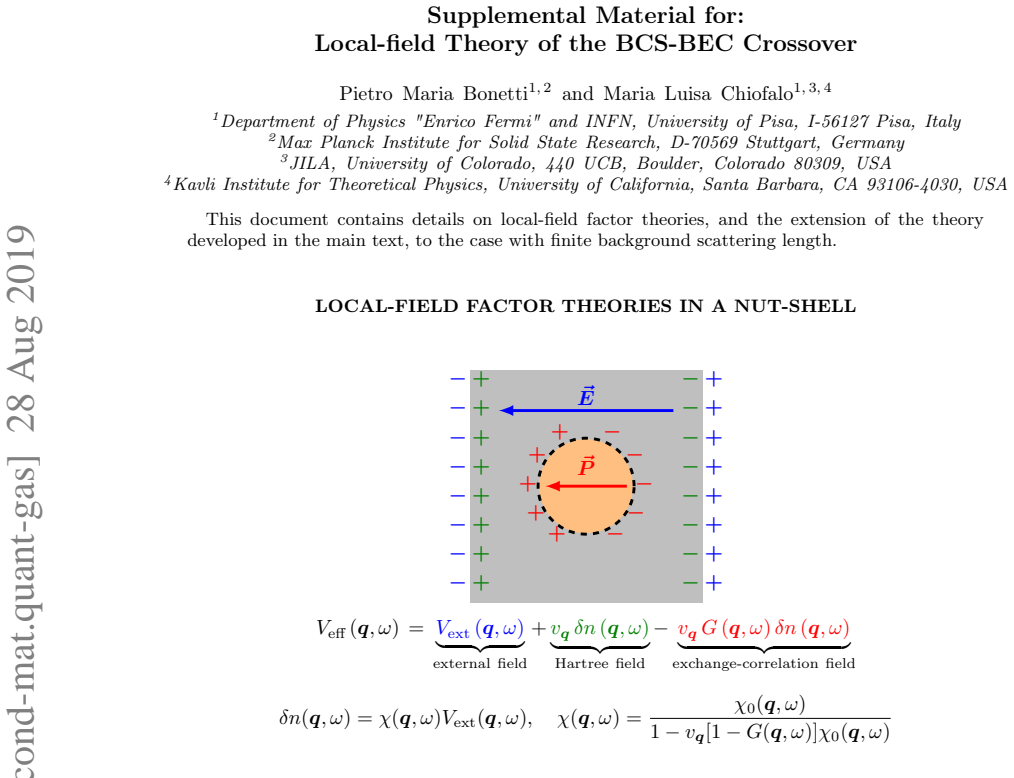
The load-bearing object is the local-field factor $G(q,\omega)$ in the pairing channel, defined by $G(q,\omega) = -\sum_{q'} [\Pi_0(q,q';\omega)/\Pi_0(q,\omega)]\,S(q-q')$, with $S(q)$ the static pairing structure factor. In the STLS spirit, the otherwise infinite equation-of-motion hierarchy is closed by replacing the connected four-operator average with a single-particle distribution times the static Cooper-pair correlation function $g_{\mathrm{corr}}(|R-x|) = \langle C(R)C^\dagger(x)\rangle_0$, the equilibrium probability that a Cooper pair destroyed at $R$ is recreated at $x$. This single decoupling defines the effective particle-particle interaction $U_{\mathrm{eff}}[1-G]$ entering the pairing susceptibility $\Pi(q,\omega)$, which is then solved self-consistently with the fluctuation-dissipation relation for $S(q)$ and the number equation obtained from the ring-diagram grand potential. The machinery carries the argument because every beyond-mean-field effect, screening, pairing fluctuations, and the crossover from narrow to broad resonances, enters through this one local field.
What would settle it
Measure the superfluid critical temperature $T_c$ in a Fermi gas with an intermediate-width Fano-Feshbach resonance, $k_F|r_0| \simeq 5$, in the BCS limit: the theory predicts an enhancement of up to about 10% over the Gor'kov-Melik-Barkhudarov value, so a measured $T_c$ at or below the perturbative value would contradict the central claim. A second check is at unitarity with $k_F r_0 \simeq 0.5$, where the theory gives $T_c/T_F \simeq 0.22$; an independent simulation or measurement that disagrees by more than the expected few-percent accuracy would also undermine the closure scheme.
Extended reading notes
Core claim
The central claim is that the closed set of equations (4)-(7) forms a unifying, single-approximation theory of the BCS-BEC crossover for arbitrary Fano-Feshbach resonance width, with quantitatively reliable $T_c$ values. The equation of motion for the pairing susceptibility is closed by an STLS-type decoupling in which the four-operator connected average is approximated using a static Cooper-pair correlation function; this yields a local-field factor $G(q,\omega)$ built from the static pairing structure factor $S(q)$, with $S(q)$ determined self-consistently by the fluctuation-dissipation theorem and the chemical potential by the grand potential. In the BCS limit the local-field correction reproduces the Gor'kov-Melik-Barkhudarov suppression of $T_c$ by a factor of about 2.2; in the BEC limit the theory returns the ideal Bose-gas transition temperature. In between, the theory predicts a maximum in $T_c$ at unitarity whose height varies by up to about 8% when $k_F|r_0|$ changes from 0.5 to 5, and a $T_c$ enhancement of up to about 10% at $k_F|r_0| \simeq 5$ in the BCS limit relative to the perturbative value. At $k_F r_0 \simeq 0.5$ it gives $T_c/T_F \simeq 0.22$, matching the quantum Monte Carlo value $0.24(2)$.
Load-bearing premise
The calculation rests on the assumption that the four-operator correlation in the pairing channel can be replaced by a static Cooper-pair correlation function times single-particle distributions, and that in the grand potential the local-field factor $G$ can be treated as independent of the couplings $g$ and $U_{\mathrm{bg}}$; the paper itself limits quantitative reliability to small and intermediate $g$ and $U_{\mathrm{bg}}$, while some predictions are made in regimes at or beyond that boundary.
Editorial extensions
If this is right
- In the broad-resonance limit at unitarity, the theory yields $T_c/T_F \simeq 0.22$, consistent with the quantum Monte Carlo value $0.24(2)$, so it can serve as a benchmark for approximate schemes in that regime.
- At intermediate resonance widths ($k_F|r_0| \simeq 5$) the theory predicts a $T_c$ enhancement of up to about 10% over the Gor'kov-Melik-Barkhudarov value in the BCS limit, an effect large enough for current experiments to detect.
- At unitarity, varying the resonance width from $k_F|r_0| \simeq 0.5$ to $5$ changes the maximum $T_c$ by up to about 8%, meaning the effective range should be treated as a controlling parameter even near unitarity.
- In the BEC limit the theory reproduces the ideal Bose-gas transition temperature of $n/2$ bosons of mass $2m$, and in the BCS limit it recovers the Gor'kov-Melik-Barkhudarov factor of about 2.2, so the two known endpoints are built in.
Reading between the lines
- An extension the paper leaves implicit: the same matrix local-field formalism written down for the superfluid state could be used to compute the gap and quasiparticle spectra below $T_c$, giving predictions for radio-frequency and momentum-resolved photoemission experiments.
- If the predicted 10% enhancement is confirmed at intermediate widths, it would imply that one-channel broad-resonance models underestimate the closed-channel contribution in that regime, and that $r_0$ should be included as a tuning parameter in crossover phenomenology.
- Because the paper's own validity statement restricts quantitative reliability to small and intermediate couplings, the narrow-resonance limit $k_F|r_0| \gg 5$ is where the single-approximation closure should first show its limits; comparing against unbiased numerical simulations there would map the practical domain of the theory.
Signed reviews
Editorial analysis
A structured set of objections, weighed in public.
Referee Report
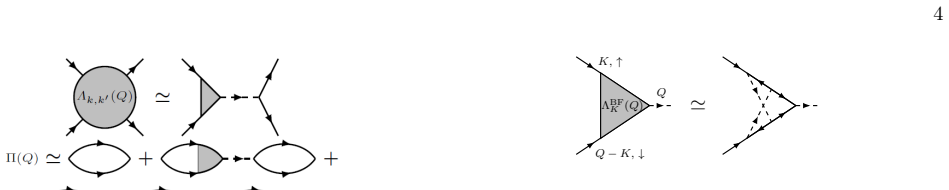
Summary. This manuscript develops a self-consistent local-field (STLS-type) theory for the BCS-BEC crossover in a two-channel boson-fermion (Fano-Feshbach) model, with the resonance width kF r0 as a second parameter alongside the scattering parameter kF a. The central objects are the pairing susceptibility (3), the local-field factor G (4), the static structure factor S (5), and the number equation (7). The authors show that in the BCS limit the theory can reproduce the Gor'kov-Melik-Barkhudarov suppression factor ~2.2, and in the BEC limit it yields the ideal Bose gas Tc. They then claim quantitative predictions for intermediate resonance widths: a Tc enhancement of up to ~10% near kF|r0| ~ 5 relative to the GMB value, and Tc/TF ~ 0.22 at kF r0 ~ 0.5, comparable to the QMC value 0.24(2) at unitarity. The supplemental material contains the extension to the superfluid state and to finite background scattering.
Significance. The theory is parameter-free and the analytic limit checks are valuable consistency tests. If the self-consistent solution of Eqs. (4)-(7) were actually carried out and produced the claimed Tc values, the work would fill a real gap, since the intermediate resonance-width regime is largely inaccessible to QMC and has not been treated by a unified non-perturbative method. However, the paper's headline quantitative results are not derived or displayed anywhere in the manuscript; they are asserted in 'Implications for current experiments' with reference to an unpublished follow-up [65]. Consequently, the central claim that this is a quantitatively reliable theory for the crossover is not substantiated as submitted. The formal framework is a promising starting point, but the paper cannot be accepted in its present form.
major comments (4)
- [Implications for current experiments] The quantitative predictions (10% Tc enhancement; Tc/TF ~ 0.22) are asserted without presenting the self-consistent solution of Eqs. (4)-(7). These equations are nonlinearly coupled through G, S, and µ, and the analytic BCS and BEC limits do not determine the intermediate-width regime. Reference [65] states the systematic numerical study is 'under way,' and the acknowledgments indicate the numerical environment is being developed by a collaborator. Without the numerical solution, the reader cannot verify the central claim. The authors must either include the full numerical results (with convergence tests and uncertainty estimates) or remove the quantitative predictions and restrict the paper to the formalism and analytic limits.
- [Implications for current experiments] The regime labeling is inconsistent with the definitions given two paragraphs earlier. The paper defines broad resonances by kF|r0| << 1, yet it describes 'the broad resonance limit with kFr0 ≃ 0.5,' which is not in this limit. Because the comparison to the QMC value at unitarity depends on which regime is being addressed, this ambiguity must be resolved (e.g., by using kF|r0| consistently and specifying the sign of r0).
- [The method (paragraph before Eq. (7))] The text states that neglecting the intrinsic dependence of G on g and U_bg means the approximation is 'quantitatively reliable for small to intermediate values of g and U_bg.' The predicted points kF|r0| ~ 5 and kF r0 ~ 0.5 are not benchmarked against this validity domain. In particular, kF r0 ~ 0.5 is an intermediate value where the neglected dependence may be significant. The authors should either demonstrate that the predictions lie inside the stated reliability domain or extend the calculation to include this dependence.
- [The method] The claim that the STLS decoupling is 'the only approximation in our theory' is contradicted by the subsequent neglect of the G dependence on g and U_bg when deriving δΩ by the running-coupling method. This is a second, distinct approximation, and the paper should state this explicitly and discuss its consequences.
minor comments (5)
- [Eq. (4)] The function Π0(q,q';ω) is not given explicitly; the description 'obtained after replacing q → q' only in the numerator' is ambiguous. Please write out the definition.
- [Abstract] The claim of covering 'the whole phase diagram' from BCS to BEC is stronger than what is demonstrated, since the main text only computes Tc and the superfluid-state equations in the SM are not solved. Consider aligning the abstract with the actual results.
- [References] Reference [65] is a self-citation to unpublished work and is used to support the central numerical claims. This is not acceptable for a standalone paper; either the results must appear in the manuscript or the claims must be downgraded.
- [Eq. (8) and surrounding text] The GMB factor is obtained from a lowest-order vertex evaluation, not from the self-consistent local-field equations. The connection to G(0,0) is asserted but not demonstrated; the text should clarify that this is an external consistency check rather than a derivation within the STLS loop.
- [Supplemental Material] The figure caption contains LaTeX error fragments such as 'brac~[t]pupl~ft...' and there are typos ('suscptibility', 'tra task'). These should be corrected.
Circularity Check
Tc predictions are outsourced to a self-cited 'under way' numerical study, making the headline quantitative claim load-bearing on the authors' own unpublished work.
-
self citation load bearing
[Implications for current experiments; Conclusions; Acknowledgments (ref. [65]); Eqs. (4)-(7) never solved in the text.]
"Self-consistent calculations in the narrow-resonance case with kF|r0|≃ 5 in the BCS limit, yields a more limited suppression with our theory, so that Tc is enhanced by a factor up to ≃ 10% than the (perturbative) Tc,GMB. ... At unitarity, varying the resonance width in the range 0.5 < kF|r0| < 5 by one order of magnitude yields variations of the maximum Tc up to ≃ 8% [65]. ... A systematic study of relevant observables like Tc and superfluid gap at T ≪ Tc, requires a full numerical solution, that is under way [65]."
The paper's headline quantitative predictions are not derived from the displayed closed set (4)-(7): no iteration scheme, convergence test, error bar, or numerical data is shown. The only support cited for these numbers is [65], an unpublished manuscript by the same authors (Bonetti, Barsanti, Chiofalo) explicitly described as 'under way.' The acknowledgments confirm that Michele Barsanti 'is developing the numerical environment for the theory [65].' Thus the central Tc claim is justified by a self-citation to a not-yet-available result rather than by an independently checkable derivation, so the claimed outputs of Eqs. (4)-(7) rest on the authors' own authority.
full rationale
The STLS closure itself is not circular: Eqs. (3)-(5) form a parameter-free self-consistent scheme, the BCS and BEC limits are checked against independent external benchmarks, and the GMB suppression factor is recovered from the boson-fermion vertex rather than assumed. No fitted parameter is renamed as a prediction, and no uniqueness theorem is imported from the authors' prior work. The circularity concern is confined to the quantitative headline. The paper states numerical values for Tc (about 10% enhancement at kF|r0| ~ 5 and about 8% variation at unitarity) without displaying the self-consistent solution that produces them; the only supporting reference is [65], a self-cited article by the same authors that is explicitly 'under way,' with the numerical environment still being developed. The paper itself also restricts quantitative reliability to 'small to intermediate values of g and Ubg,' which further weakens the support for the stated intermediate-width predictions. Because the framework has independent theoretical content and external benchmarks for its analytic limits, the score is moderate rather than maximal; nevertheless, the central quantitative claim is load-bearing on the authors' own unpublished work.
Assumptions & free parameters
assumptions (5)
- domain assumption The boson-fermion Hamiltonian (1) with local coupling g and background U_bg faithfully models Fano-Feshbach resonances from narrow to broad, with r0 = -8 pi hbar^4/(m g^2).
- ad hoc to paper The connected four-operator average can be decoupled using a static Cooper-pair correlation function g_corr(|R - x|), closing the equation-of-motion hierarchy.
- ad hoc to paper The intrinsic dependence of G on g and U_bg is neglected when deriving delta-Omega by the running-coupling method in the number equation.
- standard math The fluctuation-dissipation theorem and the Thouless criterion relate the structure factor, the pairing susceptibility, and the critical temperature.
- standard math The ultraviolet divergences are handled by renormalizing U_bg, g, and nu with gamma = sum_k m/k^2, as in the two-body problem.
Cite this review
Pith. "Pith review of Local-field Theory of the BCS-BEC Crossover." pith.science (2026). https://pith.science/paper/B76XZIK4
@misc{pith2026190810648,
  author       = {Pith},
  title        = {Pith review of: Local-field Theory of the BCS-BEC Crossover},
  year         = {2026},
  howpublished = {\url{https://pith.science/paper/B76XZIK4}},
  note         = {Machine review of arXiv:1908.10648}
}
read the original abstract
We develop a self-consistent theory unifying the description of a quantum Fermi gas in the presence of a Fano-Feshbach resonance in the whole phase diagram ranging from BCS to BEC type of superfluidity and from narrow to broad resonances, including the fluctuations beyond mean field. Our theory covers a part of the phase diagram which is not easily accessible by Quantum Monte Carlo simulations and is becoming interesting for a new class of experiments in cold atoms.
Figures

Reference graph
Works this paper leans on
-
[65]
P. Bonetti, M. Barsanti, and M. L. Chiofalo, The sys- tematic numerical study of the equations forTc is under way
- [1]
-
[2]
Pezzè, A
L. Pezzè, A. Smerzi, M. K. Oberthaler, R. Schmied, and P. Treutlein, Rev. Mod. Phys.90, 035005 (2018)
2018
-
[3]
Bloch, J
I. Bloch, J. Dalibard, and S. Nascimbène, Nature Physics 8, 267 (2012)
2012
- [4]
-
[5]
B. Bernien, S. Schwartz, A. Keesling, H. Levine, A. Om- ran, H. Pichler, S. Choi, A. S. Zibrov, M. Endres, M. Greiner, et al., Nature551, 579 (2017)
work page 2017
-
[6]
E. A. Martinez, C. A. Muschik, P. Schindler, D. Nigg, A. Erhard, M. Heyl, P. Hauke, M. Dalmonte, T. Monz, P. Zoller, et al., Nature534, 516 (2016)
work page 2016
- [7]
Show all 75 references
-
[8]
C. S. Chiu, G. Ji, A. Mazurenko, D. Greif, and M. Greiner, Phys. Rev. Lett.120, 243201 (2018)
2018
-
[9]
Messer, K
M. Messer, K. Sandholzer, F. Görg, J. Minguzzi, R. Des- buquois, and T. Esslinger, Phys. Rev. Lett.121, 233603 (2018)
2018
-
[10]
G. C. Strinati, P. Pieri, G. Röpke, P. Schuck, and M. Ur- ban, Physics Reports738, 1 (2018)
2018
-
[11]
Q. Chen, J. Stajic, S. Tan, and K. Levin, Physics Reports 412, 1 (2005)
2005
-
[12]
A. J. Leggett, inModern Trends in the Theory of Con- densed Matter, edited by A. Pekalski and J. A. Przystawa (Springer Berlin Heidelberg, Berlin, Heidelberg, 1980), pp. 13–27
1980
-
[13]
Nozières, S
P. Nozières, S. Schmitt-Rink, J. Low Temp. Phys59, 195 (1985)
1985
-
[14]
Y. J. Uemura, L. P. Le, G. M. Luke, B. J. Sternlieb, W. D. Wu, J. H. Brewer, T. M. Riseman, C. L. Seaman, M. B. Maple, M. Ishikawa, et al., Phys. Rev. Lett.66, 2665 (1991)
1991
-
[15]
Pistolesi and G
F. Pistolesi and G. C. Strinati, Phys. Rev. B49, 6356 (1994)
1994
-
[16]
Baym, in BCS: 50 Years , edited by L
G. Baym, in BCS: 50 Years , edited by L. N. Cooper (World Scientific, 2010)
2010
-
[17]
Gezerlis, C
A. Gezerlis, C. J. Pethick and A. Schwenk (2014), arXiv:1406.6109 [nucl-th] NORDITA-2014-77
2014 arXiv
-
[18]
Schwenk and C
A. Schwenk and C. J. Pethick, Phys. Rev. Lett. 95, 160401 (2005)
2005
-
[19]
Greiner, C
M. Greiner, C. Regal, and D. S. Jin, Nature426 (2003)
2003
-
[20]
M. W. Zwierlein, C. A. Stan, C. H. Schunck, S. M. F. Raupach, S. Gupta, Z. Hadzibabic, and W. Ketterle, Phys. Rev. Lett.91, 250401 (2003)
2003
-
[21]
Bourdel, L
T. Bourdel, L. Khaykovich, J. Cubizolles, J. Zhang, F. Chevy, M. Teichmann, L. Tarruell, S. J. J. M. F. Kokkelmans, and C. Salomon, Phys. Rev. Lett. 93, 050401 (2004)
2004
-
[22]
Jochim, M
S. Jochim, M. Bartenstein, A. Altmeyer, G. Hendl, S. Riedl, C. Chin, J. Hecker Denschlag, and R. Grimm, Science 302, 2101 (2003)
2003
-
[23]
Fano, Phys
U. Fano, Phys. Rev.124, 1866 (1961)
1961
-
[24]
Feshbach, Annals of Physics19, 287 (1962)
H. Feshbach, Annals of Physics19, 287 (1962)
1962
-
[25]
Q. Chen, I. Kosztin, B. Jankó, and K. Levin, Phys. Rev. Lett. 81, 4708 (1998)
1998
-
[26]
Haussmann, Zeitschrift für Physik B Condensed Mat- ter 91, 291 (1993)
R. Haussmann, Zeitschrift für Physik B Condensed Mat- ter 91, 291 (1993)
1993
-
[27]
Pieri, L
P. Pieri, L. Pisani, and G. C. Strinati, Phys. Rev. B70, 094508 (2004)
2004
-
[29]
Haussmann, W
R. Haussmann, W. Rantner, S. Cerrito, and W. Zwerger, Phys. Rev. A75, 023610 (2007)
2007
-
[30]
G. E. Astrakharchik, J. Boronat, J. Casulleras, and S. Giorgini, Phys. Rev. Lett.93, 200404 (2004)
2004
-
[31]
Bulgac, J
A. Bulgac, J. E. Drut, and P. Magierski, Phys. Rev. Lett. 96, 090404 (2006)
2006
-
[32]
Burovski, N
E. Burovski, N. Prokof’ev, B. Svistunov, and M. Troyer, Phys. Rev. Lett.96, 160402 (2006)
2006
-
[33]
V. K. Akkineni, D. M. Ceperley, and N. Trivedi, Phys. Rev. B 76, 165116 (2007)
2007
-
[34]
Nikolić and S
P. Nikolić and S. Sachdev, Phys. Rev. A75, 033608 (2007)
2007
-
[35]
Baier, D
S. Baier, D. Petter, J. H. Becher, A. Patscheider, G. Na- tale, L. Chomaz, M. J. Mark, and F. Ferlaino, Phys. Rev. Lett. 121, 093602 (2018)
2018
-
[36]
Mazurenko, C
A. Mazurenko, C. S. Chiu, G. Ji, M. F. Parsons, M. Kanász-Nagy, R. Schmidt, F. Grusdt, E. Demler, D. Greif, and M. Greiner, Nature545, 462 (2017)
2017
-
[37]
Lercher, A.D., Takekoshi, T., Debatin, M., Schuster, B., Rameshan, R., Ferlaino, F., Grimm, R., and Nägerl, H.- C., Eur. Phys. J. D65, 3 (2011)
2011
-
[38]
Gurarie and L
V. Gurarie and L. Radzihovsky, Annals of Physics322, 2 (2007)
2007
-
[39]
R. B. Diener and T.-L. Ho, arXiv:cond-mat/0405174v2 (2004)
2004 arXiv
-
[40]
C. Chin, R. Grimm, P. Julienne, and E. Tiesinga, Rev. Mod. Phys. 82, 1225 (2010)
2010
-
[41]
Gandolfi, and A
MichaelMcNeil Forbes, S. Gandolfi, and A. Gezerlis, Phys. Rev. Lett.106, 235303 (2011)
2011
-
[42]
Friedberg and T
R. Friedberg and T. D. Lee, Phys. Rev. B 40, 6745 (1989)
1989
-
[43]
Ranninger and J
J. Ranninger and J. M. Robin, Physica C: Superconduc- tivity 253, 279 (1995)
1995
-
[44]
Timmermans, P
E. Timmermans, P. Tommasini, M. Hussein, and A. Ker- man, Physics Reports315, 199 (1999)
1999
-
[45]
Holland, S
M. Holland, S. J. J. M. F. Kokkelmans, M. L. Chiofalo, and R. Walser, Phys. Rev. Lett.87, 120406 (2001)
2001
-
[46]
Ohashi and A
Y. Ohashi and A. Griffin, Phys. Rev. A 67, 063612 (2003)
2003
-
[47]
Ohashi and A
Y. Ohashi and A. Griffin, Phys. Rev. Lett.89, 130402 (2002)
2002
-
[48]
Stajic, J
J. Stajic, J. N. Milstein, Q. Chen, M. L. Chiofalo, M. J. Holland, and K. Levin, Phys. Rev. A69, 063610 (2004). 6
2004
-
[49]
Liu and H
X.-J. Liu and H. Hu, Phys. Rev. A72, 063613 (2005)
2005
-
[50]
Floerchinger, M
S. Floerchinger, M. Scherer, S. Diehl, and C. Wetterich, Phys. Rev. B78, 174528 (2008)
2008
-
[51]
Diehl, H
S. Diehl, H. Gies, J. M. Pawlowski, and C. Wetterich, Phys. Rev. A76, 053627 (2007)
2007
-
[52]
Diehl, H
S. Diehl, H. Gies, J. M. Pawlowski, and C. Wetterich, Phys. Rev. A76, 021602(R) (2007)
2007
-
[53]
Giuliani and G
For an overview see G. Giuliani and G. Vignale,Quan- tum Theory of the Electron Liquid (Cambridge university press, 2005)
2005
-
[54]
K. S. Singwi, M. P. Tosi, R. H. Land, and A. Sjölander, Phys. Rev. 176, 589 (1968)
1968
-
[56]
L. P. Gor’kov and T. K. Melik-Barkhudarov, Sov. Phys. JETP 40, 1452 (1961)
1961
-
[58]
Hubbard, Proc
J. Hubbard, Proc. Roy. Soc. (London)A243, 336 (1957)
1957
-
[59]
See Supplemental Material for details on local-field factor theories, and for the extension of the theory developed in the main text, to the case with finite background scat- tering length
-
[60]
N. M. Hugenholtz and D. Pines, Phys. Rev. 116, 489 (1959)
1959
-
[62]
Ohashi and A
Y. Ohashi and A. Griffin, Phys. Rev. A 67, 033603 (2003)
2003
-
[63]
Pisani, P
L. Pisani, P. Pieri, and G. C. Strinati, Phys. Rev. B98, 104507 (2018)
2018
-
[64]
Perali, P
A. Perali, P. Pieri, L. Pisani, and G. C. Strinati, Phys. Rev. Lett. 92, 220404 (2004)
2004
-
[66]
Enrico Fermi
S. Baier, D. Petter, J. H. Becher, A. Patscheider, G. Na- tale, L. Chomaz, M. J. Mark, and F. Ferlaino, Phys. Rev. Lett. 121, 093602 (2018). Supplemental Material for: Local-field Theory of the BCS-BEC Crossover Pietro Maria Bonetti1,2 and Maria Luisa Chiofalo1,3,4 1Department ...
2018 arXiv
-
[67]
and Zhu and Overhauser [6] for the electron liquid. Going back to the general case (12), we write the connected average in real space basis and we approximate it with the help ofgeneralized pair correlation functions : ⟨ ˆϱη(x′′)τ−η sσ ˆϱsσ′ (x, x′) ⟩ C ≃ ∑ α=± ϱη(x′′)gα;−α co...
-
[68]
For an overview see Giuliani and G
G. For an overview see Giuliani and G. Vignale,Quantum Theory of the Electron Liquid (Cambridge university press, 2005)
2005
-
[69]
K. S. Singwi, M. P. Tosi, R. H. Land, and A. Sjölander, Phys. Rev.176, 589 (1968)
1968
-
[70]
Hasegawa and M
T. Hasegawa and M. Shimizu, J. Phys. Soc. Jpn.39, 569 (1975)
1975
-
[71]
Vashishta and K
P. Vashishta and K. S. Singwi, Physical Review B6, 875 (1972)
1972
-
[72]
Niklasson, Phys
G. Niklasson, Phys. Rev. B10, 3052 (1974)
1974
-
[73]
Zhu and A
X. Zhu and A. W. Overhauser, Phys. Rev. B30, 3158 (1984)
1984
-
[74]
S. J. J. M. F. Kokkelmans, J. N. Milstein, M. L. Chiofalo, R. Walser, and M. J. Holland, Phys. Rev. A65, 053617 (2002)
2002
-
[75]
Ohashi and A
Y. Ohashi and A. Griffin, Phys. Rev. A67, 033603 (2003)
2003
-
[76]
Ohashi and A
Y. Ohashi and A. Griffin, Phys. Rev. A67, 063612 (2003)
2003
-
[77]
De Palo, C
S. De Palo, C. Castellani, C. Di Castro, and B. K. Chakraverty, Phys. Rev. B60, 564 (1999)
1999
-
[78]
P. M. Bonetti,Local-Field Dielectric Theory of the BEC-BCS Crossover (Master Thesis, University of Pisa, 2018)
2018
-
[79]
N. M. Hugenholtz and D. Pines, Phys. Rev.116, 489 (1959)
1959
Reviewed August 14, 2026 · model on record in the stance chip above.
Discussion (0). Continue with ORCID to comment.