REVIEW 6 minor 21 references
Stabilization distance between surfaces
T0 review · 0 major / 6 minor · reviewed 2026-08-14 · deepseek-v4-flash
Pith's one-line read Slice discs can be arbitrarily far apart in stabilization distance.
desk verdict Worth refereeing: the genuinely new content is Theorem C, and the delicate spot is the Proposition 7.8 splitting, which is argued in detail but should be checked line by line. read the letter →
The pith
A machine-rendered reading of the paper's core claim, the machinery that carries it, and where it could break.
The reading
What carries the argument
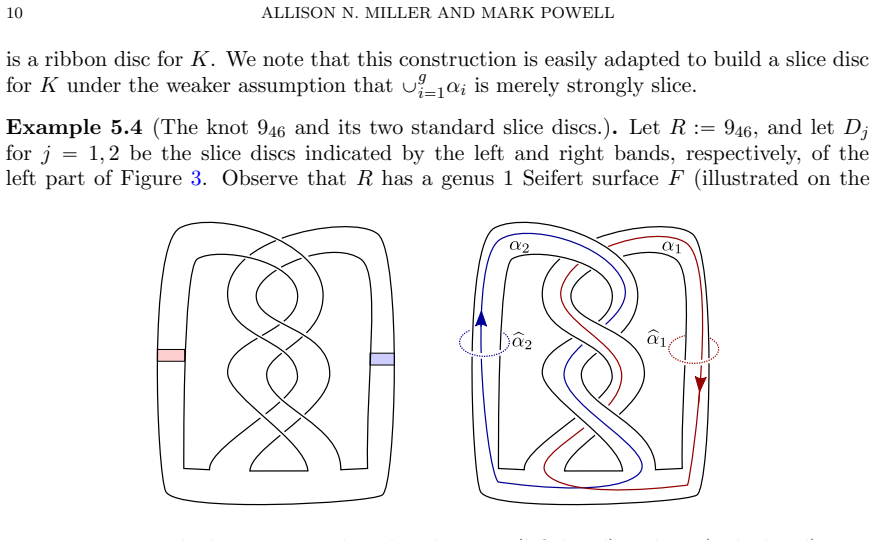
The load-bearing object is the rational Alexander module $A_{\mathbb{Q}}(L) = H_1(X_L; \mathbb{Q}[t^{\pm 1}])$ of a knot or slice-disc exterior, together with the kernel of the inclusion-induced map $A_{\mathbb{Q}}(J) \to A_{\mathbb{Q}}(D_i)$ for a slice disc $D_i$. A single 1-handle stabilization fits into a short exact sequence $0 \to \mathbb{Q}[t^{\pm 1}]/(p) \to A_{\mathbb{Q}}(F_1) \to A_{\mathbb{Q}}(F_2) \to 0$, so the generating rank drops by at most one; comparing the generating ranks of the two kernels and their intersection gives the lower bound in Proposition 6.3. For the second-order distinction, the machinery is metabelian twisted homology with representations $\varphi_\chi \colon \pi_1(X_K) \to \mathbb{Z}/2 \ltimes \mathbb{Z}_n$ factoring through the 2-fold branched cover, with $\mathbb{Z}[\xi_n]$ coefficients, and a splitting theorem (Proposition 7.8) that decomposes the kernel for a satellite slice disc into a piece from the pattern knot plus a conjugate pair of pieces from the companion. The companion is chosen as $J_0 \# -J_0$, whose two standard ribbon discs have equal Alexander-module kernels but different behaviour after tensoring with $\mathbb{Z}[\xi_3]$.
What would settle it
Recompute $A_{\mathbb{Q}}$ for the knot $9_{46}$ and its left/right band slice discs directly from the diagrams in Figure 3: if $A_{\mathbb{Q}}(9_{46})$ is not $\mathbb{Q}[t^{\pm 1}]/(2t-1) \oplus \mathbb{Q}[t^{\pm 1}]/(t-2)$, or if the inclusion maps do not project onto the two displayed summands with kernels $P_1 = \mathbb{Q}[t^{\pm 1}]/(t-2)$ and $P_2 = \mathbb{Q}[t^{\pm 1}]/(2t-1)$, then the distance claim of Theorem B fails; alternatively, exhibit an explicit sequence of fewer than $n$ stabilizations and 2-knot sums relating the two canonical slice discs of $\#^n 9_{46}$, which the theorem predicts does not exist.
Extended reading notes
Core claim
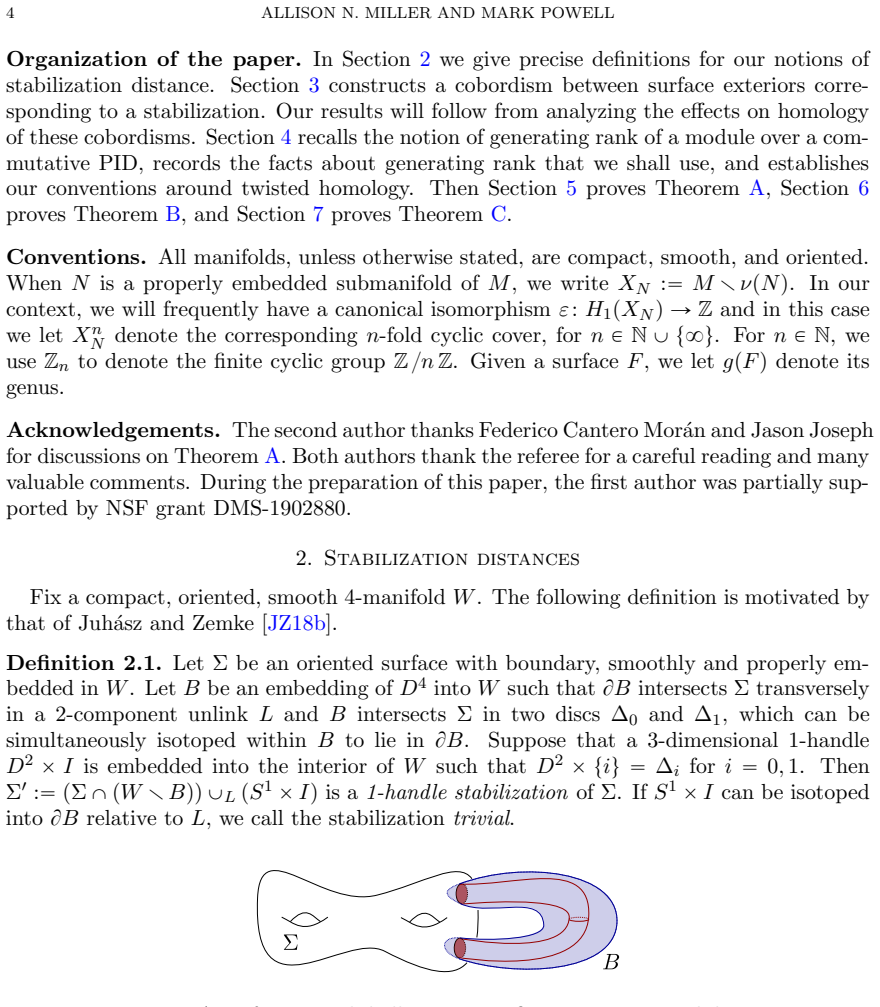
The paper claims that the 1-handle stabilization distance $d_1(F,F')$—the minimum number of 1-handle stabilizations needed to make two homologous surfaces ambiently isotopic—is unbounded and can be prescribed exactly, in the simplest setting of 2-spheres in $S^4$. For the coarser generalized distance $d_2$, which also allows connected sum with arbitrary 2-knots at zero cost, it claims that for every $m$ there is a knot $J$ in $S^3$ with two slice discs in $D^4$ whose generalized stabilization distance is exactly $m$. It further claims that such pairs exist with the kernels of the inclusion-induced maps on rational Alexander modules equal, so that all abelian cyclic-cover invariants agree; the separation is detected by metabelian twisted homology, specifically representations to $\mathbb{Z}/2 \ltimes \mathbb{Z}_3$ with coefficients in the Eisenstein integers.
Load-bearing premise
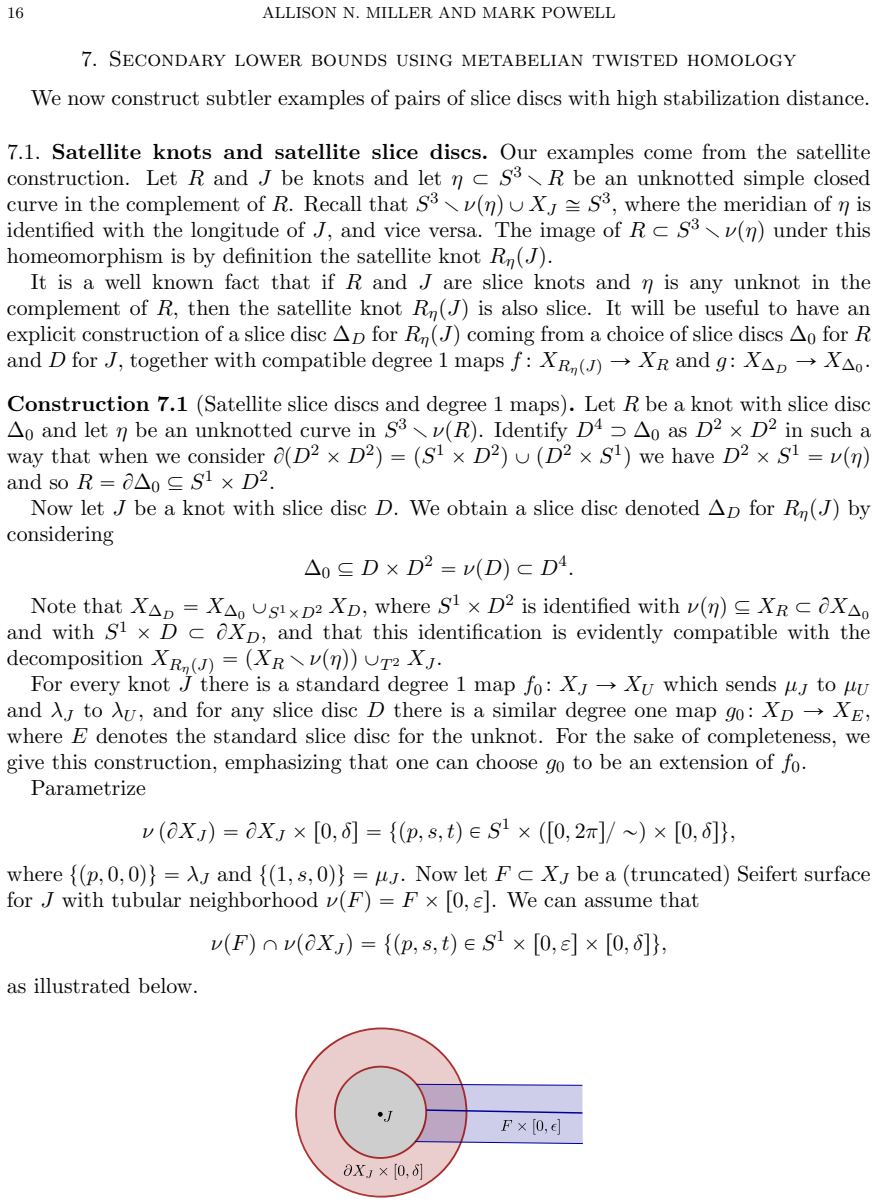
The lower-bound proofs depend on explicit diagrammatic computations: for the knot $9_{46}$ in Figure 3, that its rational Alexander module splits as $\mathbb{Q}[t^{\pm 1}]/(2t-1) \oplus \mathbb{Q}[t^{\pm 1}]/(t-2)$ with the two band discs projecting onto different summands, and for the knot $6_1$ with infection curve $\eta$ in Figure 8, that its Alexander module, kernel, and the splitting in Proposition 7.8 are as computed; if any of these module computations or kernel splittings is wrong, the claimed distances collapse, and Theorem C additionally relies on a linear-algebra existence result quoted without proof in Claim 7.17.
Editorial extensions
If this is right
- For every $m$ there are 2-knots in $S^4$ that require exactly $m$ stabilizations to become unknotted, so the metric $d_1$ is nontrivial even for null-homologous 2-spheres.
- For every $m$ there is a slice knot with two slice discs whose generalized stabilization distance is exactly $m$, so the number of slice-disc classes up to 2-knot connected sum is unbounded; for example $\#^k 9_{46}$ has at least $2^k$ such classes.
- Abelian invariants—the order and kernel of the rational Alexander module map—do not classify slice-disc pairs up to stabilization, because Theorem C exhibits pairs with equal kernels and arbitrarily large generalized distance.
- Metabelian twisted homology distinguishes slice discs obtained from the same fixed metabolising link on a Seifert surface by different choices of bounding discs, detecting a genuinely second-order slicing phenomenon.
- The distance $d_1$ is a metric on ambient isotopy classes of fixed-genus surfaces representing a fixed homology class, and the proof of the triangle inequality rearranges stabilizations before destabilizations.
Reading between the lines
- The generating-rank inequality in Proposition 6.3 is a general machine: any pair of slice discs whose Alexander-module kernels are complementary free summands should yield distance equal to the common rank, so many knots besides $9_{46}$ with suitable Seifert pairings should give similar examples.
- The paper only bounds the distance in Theorem C below by $g$ and above by $4g$; determining the exact distance for these satellite examples would likely require a twisted analogue of the precise upper-bound construction used in Theorem B.
- A natural next test is whether the same metabelian technique distinguishes slice discs whose metabelian invariants coincide, or whether still higher-order nilpotent twisted homology is needed; the kernel-splitting pattern suggests an entire hierarchy of slice-disc invariants indexed by solvable quotients.
- Because Theorem C's examples have equal rational Alexander kernels, any invariant computed from cyclic covers—orders, torsion, or kernels—cannot certify the lower bound; readers should expect other slice-disc pairs that are abelian-indistinguishable but metabelian-distinguishable, possibly including spun versus non-spun ribbon discs for $K \# -K$.
Signed reviews
Editorial analysis
A structured set of objections, weighed in public.
Referee Report
Summary. The paper defines the 1-handle stabilization distance between surfaces properly embedded in a fixed 4-manifold, together with a generalized distance that also allows connected sum with arbitrary 2-knots at zero cost. It proves three main results: Theorem A, that for every m there are embedded 2-spheres in S^4 at 1-handle stabilization distance exactly m (with an explicit added note that this was first proved by Miyazaki); Theorem B, that for every m there is a knot with two slice discs whose generalized stabilization distance is exactly m, detected by comparing kernels of inclusion-induced maps on rational Alexander modules; and Theorem C, that for every m there is a knot with two slice discs whose rational Alexander-module kernels coincide while the generalized stabilization distance is at least m, detected by metabelian twisted homology with coefficients in the Eisenstein integers. The proofs are built on a common cobordism construction between surface exteriors, generating-rank inequalities for modules over PIDs, explicit computations for the knots 9_46 and 6_1, and a satellite construction with compatible degree-one maps. The algebraic arguments are stated in detail, and the paper is careful to identify which parts depend on previously published results.
Significance. If the results hold, the paper establishes that the generalized stabilization distance between slice discs is unbounded even when the first layer of abelian invariants, namely the kernels of rational Alexander-module maps, coincides. This is a genuine step beyond the Alexander-module method: it shows that metabelian twisted homology can distinguish choices of slice discs that abelian invariants cannot. The examples are explicit and checkable: the knots 9_46 and 6_1 are analyzed via Seifert matrices and handle decompositions, and the claimed distances are derived rather than fitted. The paper also gives credit where credit is due by acknowledging that Theorem A was previously proved by Miyazaki and by framing Theorem A as a pedagogical contrast. The lower-bound strategy via generating rank over PIDs is clean, and the use of a Mayer-Vietoris splitting in Proposition 7.8 is coherent. I do not find the stress-test concern about Proposition 7.8 to be a demonstrated gap: the proof, though compressed, supplies the relevant Mayer-Vietoris diagram and the key identifications are standard consequences of the zero-winding satellite setup.
minor comments (6)
- [Section 7.2, proof of Proposition 7.8] The computation of H_1(T^2) as (Z[ξ]/(ξ−1))^{1⊕\bar{1}} and the statement that j_J = 0 because [λ_J] = 0 in H_1(X_J^∞) are highly compressed; a short explicit description of the twisted chain complex of T^2 and of why each deck translate of λ_J bounds a lift of a Seifert surface would make the proof substantially easier to verify.
- [Section 7.3, Claim 7.17] The linear-algebra fact imported from [KL05, Theorem 6.1] is not stated in the paper; please state the precise lemma, or quote the theorem, and indicate explicitly how the condition that at least N−m of the χ_i are nonzero follows from the cited argument.
- [Section 5, proof of Proposition 5.1] The verification that the banded diagram on the right of Figure 6 represents the standard unknotted torus is carried out visually; a short sentence describing the final cancellation would help. Since the added note already attributes Theorem A to Miyazaki, this part is not essential for novelty, but the exposition would be clearer with one more sentence.
- [Example 7.3 and Figure 8] The roles of η, γ, and the genus-one Seifert surface F should be stated explicitly in the caption or text; currently the reader must infer that η is the curve used in Proposition 7.8 and that η generates A(R) as required.
- [Notation 7.6 and Proposition 7.8] The notation M^{1⊕\bar{1}} is defined just before Proposition 7.8 and is then used immediately; a one-line reminder of this notation in the statement of Proposition 7.8 would avoid possible confusion.
- [Section 1, Added in proof] The paper should mention at the start of the introduction that Theorem A is due to Miyazaki, rather than only in an added note, so that readers are not misled about the novelty of the first theorem.
Circularity Check
No significant circularity: all main bounds are derived from explicit module computations and external linear algebra.
full rationale
The derivation chain is self-contained. Theorem A's lower bound uses Proposition 5.2, a short exact sequence derived from the 5-dimensional handle structure of the exterior cobordism; the upper bound is an explicit banded-diagram simplification. Theorem B's distance equality follows from the direct computation of the rational Alexander module of the knot 9_46 and the kernels of the two inclusion maps, which the paper performs via explicit Seifert matrix and handle/kernel arguments; the cited [CP19] computation is corroborating, not load-bearing. Theorem C's main algebraic input is Proposition 7.8, whose splitting is proved by Mayer-Vietoris and diagram chasing in the paper, plus the linear-algebra existence claim quoted from [KL05, Theorem 6.1], an external theorem; no fitted parameter is renamed as a prediction. The kernels in Theorem C are explicitly identified via Proposition 7.2 and Proposition 7.8, and the lower bound on generalized stabilization distance is obtained from generating-rank inequalities rather than assumed. I find no step in which an equation or invariant is defined in terms of the target quantity, and no self-citation chain that forces the conclusion.
Assumptions & free parameters
assumptions (6)
- domain assumption Baykur-Sunukjian theorem: any two homologous, properly embedded surfaces in a compact oriented smooth 4-manifold become ambiently isotopic after finitely many 1-handle stabilizations.
- standard math Classification of finitely generated modules over a PID and the generating rank and order facts in Lemma 4.1.
- domain assumption Rising water principle and standard handle decompositions for relative cobordisms from [GS99].
- domain assumption Kim-Livingston linear algebra fact: for an abelian group A with Hom(A,F) congruent to F^N, given m elements there is a character vanishing on them with at least N-m nonzero coordinates.
- standard math Shapiro lemma and Kunneth spectral sequence for twisted homology [DK01, Wei94].
- domain assumption Livingston's result that any two sets of embedded discs in S^3 capping the unlink are isotopic rel. boundary in D^4 [Liv82].
Cite this review
Pith. "Pith review of Stabilization distance between surfaces." pith.science (2026). https://pith.science/paper/BA4XZP2K
@misc{pith2026190806701,
  author       = {Pith},
  title        = {Pith review of: Stabilization distance between surfaces},
  year         = {2026},
  howpublished = {\url{https://pith.science/paper/BA4XZP2K}},
  note         = {Machine review of arXiv:1908.06701}
}
abstract
Define the 1-handle stabilization distance between two surfaces properly embedded in a fixed 4-dimensional manifold to be the minimal number of 1-handle stabilizations necessary for the surfaces to become ambiently isotopic. For every nonnegative integer $m$ we find a pair of 2-knots in the 4-sphere whose stabilization distance equals $m$. Next, using a generalized stabilization distance that counts connected sum with arbitrary 2-knots as distance zero, for every nonnegative integer $m$ we exhibit a knot $J_m$ in the 3-sphere with two slice discs in the 4-ball whose generalized stabilization distance equals $m$. We show this using homology of cyclic covers. Finally, we use metabelian twisted homology to show that for each $m$ there exists a knot and pair of slice discs with generalized stabilization distance at least $m$, with the additional property that abelian invariants associated to cyclic covering spaces coincide. This detects different choices of slicing discs corresponding to a fixed metabolising link on a Seifert surface.
Figures

Figures from the paper (5 more)



Reference graph
Works this paper leans on
-
[1]
Maciej Borodzik and Mark Powell, Embedded M orse T heory and R elative S plitting of C obordisms of M anifolds , J. Geom. Anal. 26 (2016), no. 1, 57--87. 3441503
2016
-
[2]
R. İnanç Baykur and Nathan Sunukjian, Knotted surfaces in 4-manifolds and stabilizations, Journal of Topology 9 (2015), no. 1, 215--231
work page 2015
-
[3]
Andrew Casson and Cameron Gordon, On slice knots in dimension three, Algebraic and geometric topology (Proc. Sympos. Pure Math., Stanford Univ., Stanford, Calif., 1976), Part 2, Amer. Math. Soc., Providence, R.I., 1978, pp. 39--53. 81g:57003
work page 1976
-
[4]
, Cobordism of classical knots, \`A la recherche de la topologie perdue, Birkh\"auser Boston, Boston, MA, 1986, With an appendix by P. M. Gilmer, pp. 181--199. 900 252
work page 1986
-
[5]
Anthony Conway and Mark Powell, Enumerating homotopy ribbon slice discs, ar X iv:1902.05321, 2019
arXiv 1902
-
[6]
35, American Mathematical Society, Providence, RI, 2001
Jim Davis and Paul Kirk, Lecture notes in algebraic topology, Graduate Studies in Mathematics, vol. 35, American Mathematical Society, Providence, RI, 2001. MR1841974 (2002f:55001)
work page 2001
-
[7]
Stefan Friedl, Eta invariants as sliceness obstructions and their relation to C asson- G ordon invariants , Algebr. Geom. Topol. 4 (2004), 893--934 (electronic). MR2100685 (2005j:57016)
work page 2004
-
[8]
Gompf and Andr \'a s I
Robert E. Gompf and Andr \'a s I. Stipsicz, 4 -manifolds and K irby calculus , Graduate Studies in Mathematics, vol. 20, American Mathematical Society, Providence, RI, 1999. 1707327 (2000h:57038)
1999
Show all 21 references
-
[9]
Chris Herald, Paul Kirk, and Charles Livingston, Metabelian representations, twisted A lexander polynomials, knot slicing, and mutation , Math. Z. 265 (2010), no. 4, 925--949. 2652542 (2011g:57006)
2010
-
[10]
Andr\' a s Juh\' a sz and Ian Zemke, Distinguishing slice disks using knot F loer homology , ar X iv:1804.09589, 2018
2018 arXiv
-
[11]
, Stabilization distance bounds from link F loer homology , ar X iv:1810.09158, 2018
2018 arXiv
-
[12]
3, 635--661
Paul Kirk and Charles Livingston, Twisted A lexander invariants, R eidemeister torsion, and C asson- G ordon invariants , Topology 38 (1999), no. 3, 635--661. 2000c:57010
1999
-
[13]
, Concordance and mutation, Geom. Topol. 5 (2001), 831--883 (electronic). MR1871406 (2002j:57016)
2001
-
[14]
Se-Goo Kim and Charles Livingston, Knot mutation: 4-genus of knots and algebraic concordance, Pacific J. Math. 220 (2005), no. 1, 87--105. 2195064
2005
-
[15]
Letsche, An obstruction to slicing knots using the eta invariant, Math
Carl F. Letsche, An obstruction to slicing knots using the eta invariant, Math. Proc. Cambridge Philos. Soc. 128 (2000), no. 2, 301--319. 1735303 (2001b:57017)
2000
-
[16]
W. B. Raymond Lickorish, An introduction to knot theory, Graduate Texts in Mathematics, vol. 175, Springer-Verlag, New York, 1997. 1472978
1997
-
[17]
Charles Livingston, Surfaces bounding the unlink, Michigan Math. J. 29 (1982), no. 3, 289--298. 674282
1982
-
[18]
Katura Miyazaki, On the relationship among unknotting number, knotting genus and A lexander invariant for 2 -knots , Kobe J. Math. 3 (1986), no. 1, 77--85. 867806
1986
-
[19]
Bernard Perron, Pseudo-isotopies de plongements en codimension 2 , Bull. Soc. Math. France 103 (1975), no. 3, 289--339. 0394701 (52 \#15500)
1975
-
[20]
Swenton, On a calculus for 2-knots and surfaces in 4-space, J
Frank J. Swenton, On a calculus for 2-knots and surfaces in 4-space, J. Knot Theory Ramifications 10 (2001), no. 8, 1133--1141. 1871221
2001
-
[21]
Weibel, An introduction to homological algebra, Cambridge Studies in Advanced Mathematics, vol
Charles A. Weibel, An introduction to homological algebra, Cambridge Studies in Advanced Mathematics, vol. 38, Cambridge University Press, Cambridge, 1994. 1269324 (95f:18001)
1994
Reviewed August 14, 2026 · model on record in the stance chip above.
Discussion (0). Continue with ORCID to comment.