REVIEW 4 major objections 6 minor 69 references
Relativistic Low Angular Momentum Advective Flows onto Black Hole and associated observational signatures
T0 review · 4 major / 6 minor · reviewed 2026-08-11 · deepseek-v4-flash
Pith's one-line read Oscillating standing shocks in low-angular-momentum accretion flows can explain both few-Hz X-ray QPOs in stellar-mass black holes and multi-day X-ray variability in Sgr A*.
desk verdict A competent 2D RHD shock study with genuinely new results at lower angular momentum, but the advertised match to observed QPOs and Sgr A* variability rests on a free-free emission proxy that likely does not represent the actual X-ray bands. read the letter →
The pith
A machine-rendered reading of the paper's core claim, the machinery that carries it, and where it could break.
The reading
What carries the argument
The load-bearing objects are the standing shock and its oscillatory instability in a zero-energy transonic advective flow. The flow is initialized from a Bernoulli-type energy equation with a pseudo-Newtonian potential, and the shock is located where the radial entropy divergence peaks with the Mach number crossing below unity; its radius $R_s$ is tracked in time. The emission proxy is thermal free-free (bremsstrahlung) luminosity with a constant Gaunt factor, computed from the local density and temperature. The frequency mapping uses the infall-time scaling $\nu_{\rm QPO} = \nu_{s0}\sqrt{R_s-1}/(\mathcal{R}\,R_s)$, where $\mathcal{R}$ is the compression ratio, which is what rescales the simulated oscillations from stellar-mass to supermassive black holes. The authors suggest the advective-acoustic cycle as the physical driver of the shock oscillations.
What would settle it
Check the X-ray spectrum of GX 339-4 during a type-C low-frequency QPO: if the few-Hz oscillation is produced by free-free emission, the oscillating component should be thermal and follow the emissivity in Eq. 13; detection of a synchrotron- or Compton-dominated oscillating component, or of QPOs persisting when free-free is negligible, would falsify the mapping. Similarly, if Sgr A* day-scale variability persists in states where the predicted free-free luminosity is negligible, the shock-oscillation explanation fails.
Extended reading notes
Core claim
The paper's central claim is that standing shocks are a generic feature of zero-energy low-angular-momentum relativistic accretion flows onto a non-rotating black hole, with shock properties controlled by the conserved specific angular momentum $\lambda_0$. It finds discernible standing shocks within $10$–$50\,R_g$ for $\lambda_0 \ge 1.75$, whereas the classical transonic one-dimensional analysis would require $\lambda_0 > 1.854$; the authors attribute the difference to additional sonic points appearing in two dimensions. For $\lambda_0 \in [1.70, 1.80]$, the shocks are unstable and oscillate, and the oscillations show up in the thermal free-free light curve computed from the simulated density and temperature fields. At $\lambda_0 = 1.80$, two shocks merge and produce a dramatic luminosity increase, attributed to convection and the expanding-shock cycle. The recovered oscillation frequencies, $0.1$–$10$ Hz for $10\,M_\odot$ and $10^{-6}$–$10^{-5}$ Hz for Sgr A*, are presented as an explanation of type-C low-frequency QPOs in black hole X-ray binaries and of the multi-day X-ray variability of Sgr A*.
Load-bearing premise
The load-bearing assumption is that the X-ray light curve is faithfully represented by thermal free-free emission from an unmagnetized, adiabatic, axisymmetric flow with a constant Gaunt factor, so if the observed variability is dominated by nonthermal or magnetized emission, the simulated oscillations would not correspond to what the telescopes see.
Editorial extensions
If this is right
- A $10\,M_\odot$ black hole accreting with $\lambda_0 \approx 1.75$ should show type-C low-frequency QPOs at roughly $0.4$–$30$ Hz, with the strongest peaks near the few-Hz range reported for sources like GX 339-4.
- For Sgr A*, the same shock oscillations translate to periods of one to several days, which is the variability timescale seen in long-term X-ray monitoring.
- Shocks with $\lambda_0 \ge 1.85$ are stable or outflow-dominated and should not produce detectable low-frequency QPOs, so systems with strong disk winds should be QPO-quiet.
- Shock mergers, such as the one seen at $\lambda_0 = 1.80$, should appear as quasi-periodic luminosity bursts correlated with inward and outward shock motion.
- The oscillation frequency is inversely proportional to the infall time, so for fixed $\lambda_0$ the QPO frequency should scale roughly inversely with black hole mass.
Reading between the lines
- If this mechanism is right, the same oscillating shock should modulate not only free-free luminosity but also any emission process that traces density and temperature, so multi-wavelength monitoring of Sgr A* could look for correlated day-scale oscillations in infrared and X-ray light curves.
- The threshold at $\lambda_0 \ge 1.75$ is derived in an unmagnetized flow; adding magnetic fields could shift it, since prior magnetized simulations of similar flows show shocks at lower angular momentum, which would broaden the predicted QPO frequency range.
- The paper's use of a constant Gaunt factor and optically thin free-free emission could be replaced with a fuller radiative transfer treatment, and differences between the two light curves would reveal how much of the predicted variability is an artifact of the emission proxy.
Signed reviews
Editorial analysis
A structured set of objections, weighed in public.
Referee Report
Summary. The paper presents 2D special-relativistic hydrodynamic simulations of zero-energy, low-angular-momentum accretion flows onto a Schwarzschild black hole, using the PLUTO code with a pseudo-Newtonian potential. For specific angular momentum values in the range 1.70 <= lambda0 <= 1.80, the authors report oscillating standing shocks, and they compute free-free luminosities from the simulation data. They claim that the resulting luminosity oscillations fall in the 0.1-10 Hz band for a 10 solar-mass black hole, matching low-frequency QPOs in sources like GX 339-4, and in the 10^-6 to 10^-5 Hz band for Sgr A*, matching day-scale X-ray variability observed by Chandra, Swift, and XMM-Newton. The paper also discusses multiple shock merger events, advection/convection properties, and compares the simulation results with the earlier work of Ryu et al. (1997).
Significance. If the central result stands, the paper offers a simple, mass-scalable hydrodynamic mechanism for low-frequency quasi-periodic oscillations and for Sgr A*'s day-scale X-ray variability, linking shock oscillations to observable timing features. The simulations are reproducible in principle, using the public PLUTO code and an open-source ShockFinder tool, and the parameter study across lambda0 is systematic. However, the observational significance is currently limited by the reliance on optically thin thermal free-free emission as the only radiation proxy, which is not representative of the X-ray emission processes believed to operate in the target sources. The manuscript would be a useful contribution to the study of shock instabilities in low-angular-momentum accretion flows, but the observational claims require substantial additional justification or a clearly stated narrower scope.
major comments (4)
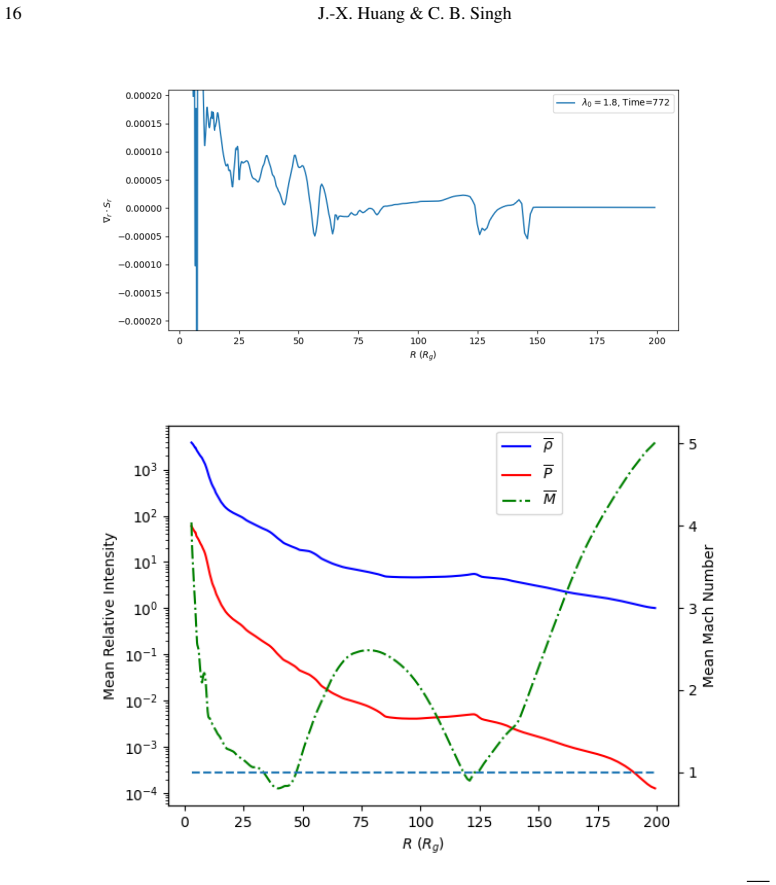
- [Section 3, Fig. 3 caption and Section 2.4] The claimed match to observed X-ray QPOs and Sgr A* variability rests entirely on Eq. (13), which computes optically thin thermal bremsstrahlung with a constant Gaunt factor from an adiabatic, unmagnetized, axisymmetric flow. However, X-ray emission in the hard/LFQPO state of black hole X-ray binaries and in Sgr A* flares is generally attributed to Comptonization, synchrotron, or synchrotron self-Compton processes, not free-free emission. The authors themselves acknowledge in the final paragraph of Section 5 that the model does not account for magnetic fields or full general relativity. Therefore, the paper has not established that the simulated luminosity oscillations are what Chandra, Swift, and XMM-Newton actually detect; this is a load-bearing gap in the observational claim. The authors should either add a radiative post-processing step with a more realistic emission model or explicitly limit the claim to the hydrodynamic oscillation mechanism without asserting direct observational correspondence.
- [Section 4.1, Eq. (14)] The funnel-region cuts for v > c, described as a way to circumvent numerical errors for lambda0 = 1.75 and 1.85, are post-hoc and suggest that parts of the computational domain violate the special-relativistic constraint. No convergence tests or resolution studies are reported; the manuscript uses a single grid setup (512 logarithmic radial zones, N_theta determined by Eq. 11). The shock positions and the oscillation frequencies extracted from these simulations could be affected by numerical artifacts in the regions where v > c. A resolution study and a quantitative statement about the influence of the v > c regions on the shock radii and power spectra are needed before the claimed frequencies can be considered robust.
- [Section 3, Fig. 7 caption] The 'confirmation' of the oscillation peaks in Figure 8 uses Eq. (14) with the shock location R_s and compression ratio R taken from the same simulation. Since the predicted frequency and the measured frequency are derived from the same simulated quantities, this is an internal consistency check rather than an independent confirmation. The wording 'this is in agreement with the oscillation peaks found in Figure 8' overstates the evidential value. The authors should clarify that Eq. (14) is being used as a scaling relation, not as a validation, or compare against an independent analytical prediction based on the inflow parameters alone.
- [Section 4.1, discussion of shocks below the Rankine-Hugoniot threshold] The luminosity normalization is arbitrary and inconsistently presented. The caption states that luminosity levels span 10^30 to 10^33 erg/s with an inflow density of 10^12 m_p, but then adds a range of 10^33 to 10^37 erg/s for typical gas densities around BHXRBs of 10^10 to 10^11 g/cm^3. Since the simulation density is dimensionless and the physical luminosity depends entirely on the assumed density scale and Gaunt factor, these numbers are not predictions. The authors should state the assumed conversion explicitly and provide a sensitivity analysis for both the luminosity and, if relevant, the oscillation frequencies.
minor comments (6)
- [Abstract] There are minor language issues, including 'we shows' in the abstract and some awkward constructions in Section 5; these should be corrected during copyediting.
- [Section 2.2] The notation for the Bernoulli constant is unclear: the text says 'specific energy of the flow or Bernoulli constant, epsilon = ...' but Eq. (4) is written with the right-hand side in code units and does not explicitly define the sign convention. Please clarify the units and the meaning of setting epsilon = 0.
- [Table 1] The column heading 'T_min' is used but the text refers to 'minimal temperature' and 'initial temperature'; also the units of P_infinity are written as rho_u c^2, which is fine, but the definition of rho_u should be stated. Please reconcile these notations.
- [Section 2.3] The derivation of the velocity distribution at the outer boundary is not fully specified. The sentence 'Opting for the smallest value in this distribution, specifically theta = pi/2' is ambiguous: does this mean the largest equatorial velocity? Please clarify how theta is chosen for the initial conditions.
- [Fig. 7] The luminosity ranges quoted in the caption appear to mix two different normalizations without a clear connection. Please revise the caption to state a single, well-defined normalization or explicitly show how the two ranges are related.
- [References] A few references have formatting issues, such as 'kwan Chan et al. 2009' where the first author's name capitalization is nonstandard, and some arXiv identifiers are absent (e.g., Liska et al. 2021, Kaaz et al. 2022). Please standardize the bibliography.
Circularity Check
No significant circularity: the shock and luminosity oscillations are outputs of the authors' own RHD simulations, with no fitted constants, and the Eq. 14 comparison is a non-load-bearing consistency check.
full rationale
The claimed derivation chain is self-contained. Initial conditions are set by the energy and hydrostatic equations (Eqs. 4, 8, 10) and evolved with PLUTO; shocks, accretion rates, and luminosity (Eq. 13) are all outputs of the simulation. The oscillation frequencies quoted for BHXRBs and Sgr A* come from FFTs of these simulated light curves (Fig. 7), with no parameter fitted to the observed QPO frequencies, so the core prediction is not forced by construction. The use of Eq. 14 in Section 4.1 inserts the simulated shock position Rs and compression ratio R into an external analytic QPO scaling and finds agreement with the simulated FFT peak. This is a consistency check rather than an independent prediction, and it does not carry the central observational claim; the claim rests on the direct FFT of the simulated luminosity. Because Eq. 14 is an external relation (Chakrabarti et al. 2008; Molteni et al. 1996) and not derived from or calibrated to the simulation, the agreement is falsifiable and does not reduce to an identity. Self-citations to Okuda et al. (2019, 2022), one co-authored by Singh, are used for contextual comparisons (expanding shocks, magnetic-field effects) and are not load-bearing for the new shock-oscillation result, which is established by the present simulations. The acknowledged omission of magnetic fields and full GR, and the use of free-free emission as a proxy, are physical-validity concerns about matching observed X-ray spectra, not circularity. Accordingly no circular step meets the evidentiary bar.
Assumptions & free parameters
free parameters (3)
- specific angular momentum lambda0 =
1.50 to 2.25 in steps of 0.05; QPO-like behavior for 1.70-1.80
- outer-boundary Mach number M_infinity =
5
- inflow density normalization rho_inj =
1.0 in code units; physical luminosity later scaled by 10^12 m_p
assumptions (6)
- domain assumption Paczynski-Wiita pseudo-Newtonian potential (Eq. 5) approximates the Schwarzschild spacetime.
- domain assumption Flow is axisymmetric, inviscid, adiabatic (Gamma=4/3), non-magnetized, with conserved specific angular momentum lambda0.
- domain assumption Vertical hydrostatic equilibrium at the outer boundary sets the injection height H/R ~ 0.28 (Eq. 8).
- domain assumption Zero-energy transonic flow with Mach number M_infinity=5 at the outer boundary.
- domain assumption Free-free (bremsstrahlung) emission with unit Gaunt factor (Eq. 13) is the relevant luminosity mechanism.
- domain assumption The QPO frequency formula (Eq. 14) from Chakrabarti et al. (2008) applies to the simulated shock oscillations.
Cite this review
Pith. "Pith review of Relativistic Low Angular Momentum Advective Flows onto Black Hole and associated observational signatures." pith.science (2026). https://pith.science/paper/BAG6E25C
@misc{pith2026241212817,
  author       = {Pith},
  title        = {Pith review of: Relativistic Low Angular Momentum Advective Flows onto Black Hole and associated observational signatures},
  year         = {2026},
  howpublished = {\url{https://pith.science/paper/BAG6E25C}},
  note         = {Machine review of arXiv:2412.12817}
}
abstract
We present simulation results examining the presence and behavior of standing shocks in zero-energy low angular momentum advective accretion flows and explore their (in)stabilities properties taking into account various specific angular momentum, $\lambda_0$. Within the range $10-50R_g$ (where $R_g$ denotes the Schwarzschild radius), shocks are discernible for $\lambda_0\geq 1.75$. In the special relativistic hydrodynamic (RHD) simulation when $\lambda_0 = 1.80$, we find the merger of two shocks resulted in a dramatic increase in luminosity. We present the impact of external and internal flow collisions from the funnel region on luminosity. Notably, oscillatory behavior characterizes shocks within $1.70 \leq \lambda_0 \leq 1.80$. Using free-free emission as a proxy for analysis, we shows that the luminosity oscillations between frequencies of $0.1-10$ Hz for $\lambda_0$ range $1.7 \leq \lambda_0 \leq 1.80$. These findings offer insights into quasi-periodic oscillations emissions from certain black hole X-ray binaries, exemplified by GX 339-4. Furthermore, for the supermassive black hole at the Milky Way's center, Sgr A*, oscillation frequencies between $10^{-6}$ and $10^{-5}$ Hz were observed. This frequency range, translating to one cycle every few days, aligns with observational data from the X-ray telescopes such as Chandra, Swift, and XMM-Newton.
Figures


Figures from the paper (9 more)




Reference graph
Works this paper leans on
-
[1]
2016, The Astrophysical Journal, 826, 77 2
Ball, D., ¨Ozel, F., Psaltis, D., & kwan Chan, C. 2016, The Astrophysical Journal, 826, 77 2
work page 2016
-
[2]
2006, Numerical Methods in Astrophysics: An Introduction, 315 18
Bodenheimer, P. 2006, Numerical Methods in Astrophysics: An Introduction, 315 18
work page 2006
- [3]
-
[4]
Chakrabarti, S. K. 1989, ApJ, 347, 365 4, 18
work page 1989
-
[5]
Chakrabarti, S. K. 1990, Theory of Transonic Astrophysical Flows 4, 14, 18
work page 1990
-
[6]
Chakrabarti, S. K. 1996, ApJ, 464, 664 2
work page 1996
-
[7]
K., Debnath, D., Nandi, A., & Pal, P
Chakrabarti, S. K., Debnath, D., Nandi, A., & Pal, P. S. 2008, A&A, 489, L41 19
work page 2008
- [8]
Show all 69 references
-
[9]
K., & Molteni, D
Chakrabarti, S. K., & Molteni, D. 1995, MNRAS, 272, 80 3
1995
-
[10]
Debnath, S., Chattopadhyay, I., & Joshi, R. K. 2024, arXiv:2401.07786 2
2024 arXiv
-
[11]
M., Kennea, J., et al
Degenaar, N., Miller, J. M., Kennea, J., et al. 2013, The Astrophysical Journal, 769, 155 20
2013
-
[12]
Dexter, J., Agol, E., & Fragile, P. C. 2009, The Astrophysical Journal, 703, L142 2
2009
-
[13]
2018, Monthly Notices of the Royal Astronomical Society, 476, 3310 14, 20
Dhang, P., Sharma, P., & Mukhopadhyay, B. 2018, Monthly Notices of the Royal Astronomical Society, 476, 3310 14, 20
2018
-
[14]
2016, Monthly Notices of the Royal Astronomical Society 14
Dhang, Prasun, Sharma, et al. 2016, Monthly Notices of the Royal Astronomical Society 14
2016
-
[15]
2010, The Astrophysical Journal, 725, 450 2 Event Horizon Telescope Collaboration, Akiyama, K., Alberdi, A., et al
Dodds-Eden, K., Sharma, P., Quataert, E., et al. 2010, The Astrophysical Journal, 725, 450 2 Event Horizon Telescope Collaboration, Akiyama, K., Alberdi, A., et al. 2019, ApJ, 875, L1 1 Event Horizon Telescope Collaboration, Akiyama, K., Alberdi, A., et al. 2022, ApJ, 930, L12...
2010
-
[16]
1986, PASJ, 38, 167 4
Fukue, J. 1986, PASJ, 38, 167 4
1986
-
[17]
2010, Rev
Genzel, R., Eisenhauer, F., & Gillessen, S. 2010, Rev. Mod. Phys., 82, 3121 2
2010
-
[18]
2021, Research Notes of the American Astronomical Society, 5, 136 1
Huang, J., Sun, Y., Dage, K., & Haggard, D. 2021, Research Notes of the American Astronomical Society, 5, 136 1
2021
-
[19]
V., Narayan, R., & Abramowicz, M
Igumenshchev, I. V., Narayan, R., & Abramowicz, M. A. 2003, The Astrophysical Journal, 592, 1042 2
2003
-
[20]
2021, ApJ, 919, 110 1
Imazawa, R., Fukazawa, Y., & Takahashi, H. 2021, ApJ, 919, 110 1
2021
-
[21]
Ingram, A., & Klis, M. v. d. 2013, Monthly Notices of the Royal Astronomical Society, 434, 1476 19
2013
-
[22]
R., & Motta, S
Ingram, A. R., & Motta, S. E. 2019, New Astronomy Reviews, 85, 101524 2, 12, 19, 20
2019
-
[23]
Kaaz, N., Liska, M. T. P., Jacquemin-Ide, J., et al. 2022, arXiv e-prints, arXiv:2210.10053 2
2022 arXiv
-
[24]
2008, Black-Hole Accretion Disks — Towards a New Paradigm — 5 kwan Chan, C., Liu, S., Fryer, C
Kato, S., Fukue, J., & Mineshige, S. 2008, Black-Hole Accretion Disks — Towards a New Paradigm — 5 kwan Chan, C., Liu, S., Fryer, C. L., et al. 2009, The Astrophysical Journal, 701, 521 2
2008
-
[25]
D., & Lifshitz, E
Landau, L. D., & Lifshitz, E. M. 1959, Fluid mechanics 3
1959
-
[26]
H., Abramowicz, M
Lee, W. H., Abramowicz, M. A., & Klu´ zniak, W. 2004, ApJ, 603, L93 20
2004
-
[27]
2013, ApJ, 767, 105 2
Li, J., Ostriker, J., & Sunyaev, R. 2013, ApJ, 767, 105 2
2013
-
[28]
Li, Y.-P., Yuan, F., & Wang, Q. D. 2017, MNRAS, 468, 2552 2
2017
-
[29]
2021, MNRAS, 507, 983 2
Liska, M., Hesp, C., Tchekhovskoy, A., et al. 2021, MNRAS, 507, 983 2
2021
-
[30]
Liska, M. T. P., Kaaz, N., Musoke, G., Tchekhovskoy, A., & Porth, O. 2023, ApJ, 944, L48 2
2023
-
[31]
Lyubarskii, Y. E. 1997, Monthly Notices of the Royal Astronomical Society, 292, 679 19
1997
-
[32]
R., & Matsumoto, R
Machida, M., Hayashi, M. R., & Matsumoto, R. 2000, ApJ, 532, L67 2
2000
-
[33]
2001, PASJ, 53, L1 2
Machida, M., Matsumoto, R., & Mineshige, S. 2001, PASJ, 53, L1 2
2001
-
[34]
Our Non-Stable Universe
Mignone, A., Bodo, G., Massaglia, S., et al. 2007, in JENAM-2007, “Our Non-Stable Universe”, 96 3, 6, 18
2007
-
[35]
Molteni, D., Sponholz, H., & Chakrabarti, S. K. 1996, ApJ, 457, 805 19
1996
-
[36]
2023, MNRAS, 526, 4718 20 Mo´scibrodzka, M., Das, T
Mondal, S., Salgundi, A., Chatterjee, D., et al. 2023, MNRAS, 526, 4718 20 Mo´scibrodzka, M., Das, T. K., & Czerny, B. 2006, MNRAS, 370, 219 2
2023
-
[37]
2023, MNRAS, 518, 1656 2
Musoke, G., Liska, M., Porth, O., van der Klis, M., & Ingram, A. 2023, MNRAS, 518, 1656 2
2023
-
[38]
V., & Abramowicz, M
Narayan, R., Igumenshchev, I. V., & Abramowicz, M. A. 2000, ApJ, 539, 798 17
2000
-
[39]
V., & Abramowicz, M
Narayan, R., Igumenshchev, I. V., & Abramowicz, M. A. 2003, PASJ, 55, L69 2
2003
-
[40]
Narayan, R., & McClintock, J. E. 2008, New Astron. Rev., 51, 733 2
2008
-
[41]
F., & Kulkarni, A
Narayan, R., S¨A dowski, A., Penna, R. F., & Kulkarni, A. K. 2012, MNRAS, 426, 3241 2
2012
-
[42]
1994, ApJ, 428, L13 2, 17
Narayan, R., & Yi, I. 1994, ApJ, 428, L13 2, 17
1994
-
[43]
A., Gammie, C., Dexter, J., & Baganoff, F
Neilsen, J., Nowak, M. A., Gammie, C., Dexter, J., & Baganoff, F. K. 2013, Astrophysical Journal, 774 20
2013
-
[44]
A., et al
Neilsen, J., Markoff, S., Nowak, M. A., et al. 2014, The Astrophysical Journal, 799 20
2014
-
[45]
B., & Aktar, R
Okuda, T., Singh, C. B., & Aktar, R. 2022, MNRAS, 514, 5074 2, 9, 14, 19, 20
2022
-
[46]
B., Das, S., et al
Okuda, T., Singh, C. B., Das, S., et al. 2019, PASJ, 71, 49 2, 5, 9, 20 Paczy´nsky, B., & Wiita, P. J. 1980, Astronomy & Astrophysics, 88, 23 4
2019
-
[47]
B., Morris, M
Ponti, G., De, M. B., Morris, M. R., et al. 2015, Fifteen years of XMM-Newton and Chandra monitoring of Sgr A*: Evidence for a recent increase in the bright flaring rate 20
2015
-
[48]
2017, MNRAS, 468, 2447 2
Ponti, G., George, E., Scaringi, S., et al. 2017, MNRAS, 468, 2447 2
2017
-
[49]
2000, ApJ, 539, 809 17
Quataert, E., & Gruzinov, A. 2000, ApJ, 539, 809 17
2000
-
[50]
M., Tchekhovskoy, A., Quataert, E., & Gammie, C
Ressler, S. M., Tchekhovskoy, A., Quataert, E., & Gammie, C. F. 2017, MNRAS, 467, 3604 2
2017
-
[51]
M., White, C
Ressler, S. M., White, C. J., & Quataert, E. 2023, MNRAS, 521, 4277 17
2023
-
[52]
R., Fabian, A
Russell, H. R., Fabian, A. C., McNamara, B. R., & Broderick, A. E. 2015, MNRAS, 451, 588 17
2015
-
[53]
, & Lightman, A
Rybicki, G. ., & Lightman, A. . 1979, Lightman Radiative Processes in Astrophysics (Lightman Radiative Processes in Astrophysics) 11
1979
-
[54]
K., & Molteni, D
Ryu, D., Chakrabarti, S. K., & Molteni, D. 1997, The Astrophysical Journal, 474, 378 2, 3, 18, 20
1997
-
[55]
T., Foglizzo, T., & Kifonidis, K
Scheck, L., Janka, H. T., Foglizzo, T., & Kifonidis, K. 2008, Astronomy & Astrophysics, 477, 931 19
2008
-
[56]
I., & Sunyaev, R
Shakura, N. I., & Sunyaev, R. A. 1973, A&A, 24, 337 1
1973
-
[57]
2010, ApJ, 714, 1227 20
Shi, C.-S., & Li, X.-D. 2010, ApJ, 714, 1227 20
2010
-
[58]
2014 20 22 J.-X
Shi, C.-S., Zhang, S.-N., & Li, X. 2014 20 22 J.-X. Huang & C. B. Singh
2014
-
[59]
2018, MNRAS, 479, 5049 20
Shi, C.-S., Zhang, S.-N., & Li, X.-D. 2018, MNRAS, 479, 5049 20
2018
-
[60]
M., & Pringle, J
Stone, J. M., & Pringle, J. E. 2001, MNRAS, 322, 461 2
2001
-
[61]
2021, MNRAS, 507, 330 12
Stoop, M., van den Eijnden, J., Degenaar, N., et al. 2021, MNRAS, 507, 330 12
2021
-
[62]
R., Burdge, K
Yao, Y., Kulkarni, S. R., Burdge, K. B., et al. 2021, ApJ, 920, 120 12
2021
-
[63]
2012, The Astrophysical Journal, 761, 130 2
Yuan, F., Bu, D., & Wu, M. 2012, The Astrophysical Journal, 761, 130 2
2012
-
[64]
2015, The Astrophysical Journal, 804, 101 2
Yuan, F., Gan, Z., Narayan, R., et al. 2015, The Astrophysical Journal, 804, 101 2
2015
-
[65]
2014, ARA&A, 52, 529 2
Yuan, F., & Narayan, R. 2014, ARA&A, 52, 529 2
2014
-
[66]
2012, ApJ, 761, 129 2
Yuan, F., Wu, M., & Bu, D. 2012, ApJ, 761, 129 2
2012
-
[67]
2008, ApJ, 682, 361 9
Yusef-Zadeh, F., Wardle, M., Heinke, C., et al. 2008, ApJ, 682, 361 9
2008
-
[68]
D., et al
Yusef-Zadeh, F., Bushouse, H., Dowell, C. D., et al. 2006, The Astrophysical Journal, 644, 198 9
2006
-
[69]
2009, The Astrophysical Journal, 706, 348 9 Appendix A: SIMULATION RUN WITH 𝛾= 5/3 Fig
Yusef-Zadeh, F., Bushouse, H., Wardle, M., et al. 2009, The Astrophysical Journal, 706, 348 9 Appendix A: SIMULATION RUN WITH 𝛾= 5/3 Fig. A.1: The density profile of the simulation with 𝜆0= 1.75 with𝛾= 5/3 in 90000𝑡0. We also ran the simulation case𝜆0= 1.75 with𝛾= 5/3, and we ...
2009
Reviewed August 11, 2026 · model on record in the stance chip above.
Discussion (0). Continue with ORCID to comment.