REVIEW 3 major objections 4 minor 17 references
On supported deformations and birational isotriviality
T0 review · 3 major / 4 minor · reviewed 2026-08-07 · deepseek-v4-flash
Pith's one-line read General fibers are birational when the Kodaira-Spencer class is supported on a foliation-invariant divisor.
desk verdict A solid, honestly written paper with a real but fixable gap in the main flow argument; worth sending to a serious referee. read the letter →
The pith
A machine-rendered reading of the paper's core claim, the machinery that carries it, and where it could break.
The reading
What carries the argument
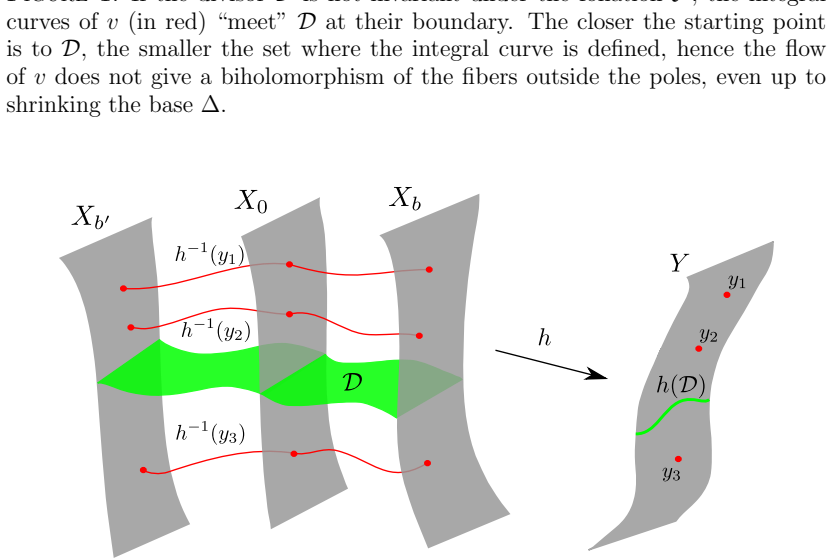
The load-bearing object is the meromorphic vector field $v$ on $f^{-1}(\Delta)$ with poles on $D$ that lifts the base vector field $\partial/\partial t$ (Proposition 3.5). It is controlled by the volume-detecting subspace $U=\langle\eta_1,\ldots,\eta_{k+1}\rangle$: a subspace of the local system of de Rham closed relative one-forms whose wedge product $\eta_1\wedge\cdots\wedge\eta_{k+1}$ vanishes and which is strictly independent on the general fiber. These forms yield closed one-forms $s_i$ with $s_1\wedge\cdots\wedge s_{k+1}=0$, which define a surjective morphism $h\colon X\to Y$ and a foliation $F=T_{X/Y}$. Lemma 5.6, via the injectivity of the morphism $\beta'$ in diagram (5.2), shows that the contractions $s_i(v)$ vanish, so the leaves of the flow foliation $F_v$ lie inside the fibers of $h$ and avoid $D$. Compactness of $X$ then gives a uniform disk of definition for the flow, and the general-type hypothesis upgrades the resulting holomorphic maps to bimeromorphic, hence birational, maps.
What would settle it
Construct a semistable fibration of general-type fibers that satisfies all the hypotheses of Theorem 5.9—a volume-detecting subspace, $h^0(X_b,\mathcal{O}_{X_b}(D_b))=1$, Kodaira-Spencer supported on $D_b$, and $D$ invariant under $F$—but whose general fibers are not birational. Concretely, in local coordinates compute the radius of definition of the integral curves of the meromorphic vector field $v$; the theorem predicts a uniform positive lower bound independent of the starting point, so any example satisfying the hypotheses with radii shrinking to zero as the starting point approaches $D$ would disprove it.
Extended reading notes
Core claim
The central claim is Theorem 5.9. Let $f\colon X\to B$ be a semistable fibration whose fibers are of general type, and suppose there is a volume-detecting subspace $U=\langle\eta_1,\ldots,\eta_{k+1}\rangle$ of the local system of de Rham closed relative $1$-forms, with an associated effective horizontal divisor $D$ contained in the common zero locus of the relative forms $\omega_i$. Assume $h^0(X_b,\mathcal{O}_{X_b}(D_b))=1$ for general $b$, that the Kodaira-Spencer class $\xi_b$ is supported on $D_b$ for general $b$, and that $D$ is invariant under the foliation $F$ induced by the morphism $h\colon X\to Y$ obtained from $U$. Then the general fibers of $f$ are birational. Here "supported on a divisor" means the class maps to zero under $H^1(X_b,T_{X_b})\to H^1(X_b,T_{X_b}(D_b))$, i.e. the first-order deformation is carried by the divisor. The proof produces a meromorphic vector field $v$ with poles on $D$ lifting $\partial/\partial t$, uses the volume-detecting condition to show its flow foliation is contained in the fibers of $h$ and avoids $D$, and then extends the resulting holomorphic maps between fibers to birational maps using the general-type hypothesis.
Load-bearing premise
The load-bearing premise is that the polar divisor D is invariant under the foliation given by the fibers of h, together with the strictness of U on the general fiber; these are what keep the integral curves of the meromorphic vector field away from the poles and defined on a common disk.
Editorial extensions
If this is right
- Under the hypotheses of Theorem 5.9, the general fibers of the fibration are birational, so the family is birationally isotrivial.
- By Corollary 5.11, after passing to a finite cover of a Zariski open subset of the base, the family becomes birational to a product $X_0\times B'$, with $X_0$ a projective model of the fiber.
- Theorem 6.8 gives a global, non-smooth version of the Volumetric Theorem: a semistable family with a morphism to an abelian variety whose general fiber maps generically one-to-one, and with a general pullback subspace that is fiberwise Massey trivial, has birational general fibers.
- Theorem 6.9 reproves the original local Volumetric Theorem using the same flow-and-foliation mechanism.
- The same methods apply to Bogomolov sheaves (Theorem 5.15): a Bogomolov sheaf whose associated map is of general type and whose divisorial pole locus is foliation-invariant forces birational fibers.
Reading between the lines
- The three hypotheses in Theorem 5.9—supportedness, non-movability, and foliation invariance—are exactly the traces that birationality leaves on the Kodaira-Spencer class, so the theorem can be read as a deformation-theoretic characterization of birational isotriviality that avoids constructing an explicit birational map.
- A quantitative version suggested by the proof is that the obstruction to birational triviality is governed by the rate at which the flow disks of $v$ shrink as initial points approach the polar divisor; this rate is controlled by foliation invariance and could be estimated in explicit families, as in the examples of Section 6.
- The same flow-and-foliation mechanism should apply beyond volume-detecting subspaces, for instance whenever a rational map to a variety of general type controls the meromorphic vector field and its polar divisor is invariant; the Bogomolov sheaf case in Section 5.4 is evidence for this.
Editorial analysis
A structured set of objections, weighed in public.
Referee Report
Summary. The paper studies the birational analogue of the classical statement that vanishing Kodaira--Spencer class implies that general fibers of a fibration are isomorphic. Theorem 4.1 proves that if the general fibers of a fibration are birational, then the general Kodaira--Spencer class is supported on an effective non-movable divisor. The main result, Theorem 5.9, gives a converse under additional hypotheses: a volume detecting subspace U, a relatively non-movable divisor D, generic fiberwise support of the Kodaira--Spencer class on D, and F-invariance of D. The proof constructs a meromorphic vector field lifting the base vector field, uses the volume detecting forms to build a morphism h and a foliation F, and then uses the flow of the vector field on the h-fibers to obtain bimeromorphic maps between general fibers. Section 6 provides local and global examples testing the necessity of the hypotheses, and derives a global Volumetric Theorem as an application.
Significance. If the main theorem is correct, it fills a natural gap in the literature by giving a birational isotriviality criterion in terms of supported deformations, complementing Theorem 4.1. The proof strategy, combining a meromorphic vector field with a volume-detecting subspace and a foliation, is original and plausible. The paper also contains explicit examples (Examples 6.1, 6.2, 6.3, 6.5) that illustrate why the hypotheses of non-movability and F-invariance are needed, and the final applications to the Volumetric Theorem are relevant. However, two load-bearing arguments are currently not fully justified: the surjectivity of the flow map in Theorem 5.9 and the passage from a rational map to a morphism in Proposition 5.5. These gaps appear fixable, but they need to be addressed before the main theorem can be accepted as proven.
major comments (3)
- [Section 5.3, proof of Theorem 5.9] The claim that the map g: F0 → Δ is surjective is not justified as written. From a limit point ar x of a sequence x_n ∈ F0 with f(x_n) → ar t, one can only conclude that ar x lies in the closure of F0; the local transversality of F_v at ar x concerns the leaf through ar x, not the leaf F0 through x0. The sentence "it easily follows" therefore does not prove that f^{-1}(ar t) meets F0. The missing ingredient is that the h-fiber H = h^{-1}(h(x0)) is compact and v is holomorphic on H, so the holomorphic vector field v is complete on H and the integral curve through x0 is defined over all of Δ. This completeness argument is load-bearing: without it, g(F0) could be a proper open interval, and the holomorphic map X0 \ h_0^{-1}(Z) → X_t used to conclude birationality is not obtained.
- [Section 5.1, Proposition 5.5] The proof of Proposition 5.5 is too terse at two central points. First, the "standard local argument" showing that the forms s_i are pullbacks of meromorphic forms on Y' and that dim Y' = k is only indicated by a citation. Second, the passage from a rational map X ⇢ Y' to a surjective morphism h: X → Y over a normal k-dimensional variety of Albanese general type via the generalized Castelnuovo-de Franchis theorem needs a precise statement or proof. Theorem 5.9 uses h and F = T_{X/Y} essentially, so this step should be fully justified rather than summarized.
- [Section 5.1, after Diagram (5.2)] In the proof of Proposition 5.3, the deduction of equation (5.3) from the commutativity of Diagram (5.2) and the assumption h^0(X_b, O_{X_b}(D_b)) = 1 is stated as "immediately get", but it involves a base-change/divisorial argument that is not written out. Since the equality s_1 ∧ ⋯ ∧ s_{k+1} = Σ ω_i ∧ f^*σ_i is one of the main ingredients used later to construct the foliation, a fuller explanation of this step would improve the accessibility and rigour of the paper.
minor comments (4)
- [Section 5.1 and Section 5.3] The notation X_0 is used inconsistently: in Section 5.1 it denotes f^{-1}(B_0), while in the proof of Theorem 5.9 it denotes the central fiber over Δ. This creates confusion in the containments involving closures of leaves; please use different notation for the central fiber, e.g. X_c or X_0^{\mathrm{cent}}.
- [Lemma 5.6] Lemma 5.6 states the conclusion s_i(v) = 0 for i = 1, ..., n+1, but there are only k+1 forms s_i; the index range should be i = 1, ..., k+1. The same typo appears in the last sentence of the proof and in Remark 5.14, where "Corollary 5.6" should read "Lemma 5.6".
- [Section 5.3, proof of Theorem 5.9] The sentence "Note that \bar x is in \overline{F_0} ⊂ h^{-1}(h(x_0)) ∩ X_0" is only correct if X_0 denotes the whole space f^{-1}(Δ), not the central fiber; moreover, the inclusion of the closure in a fiber of h should be justified by the fact that h is continuous and constant on the leaves of F_v.
- [Section 6.1, Example 6.1] In the displayed formula for the integral curve, the branch of the square root is specified on C \setminus \mathbb{R}_{<0}, but the expression \sqrt{2t + \lambda_1^2} requires that 2t + \lambda_1^2 avoids that locus; this is true for the stated choices but might be worth a brief remark to avoid ambiguity.
Circularity Check
No circular step is established: the main theorem's flow argument and its supporting lemmas do not assume the birationality they conclude.
full rationale
The derivation chain in Theorem 5.9 is not circular. The theorem assumes a volume detecting subspace, a relatively non-movable divisor D satisfying h^0(X_b,O(D_b))=1, a generically fiberwise supported Kodaira-Spencer class, and F-invariance of D; none of these is the conclusion that the general fibers are birational. Proposition 3.5 constructs the meromorphic vector field v from the supported deformation via the commutative diagrams (3.2)-(3.3), not from birationality. Proposition 5.3 and Lemma 5.6 derive the closed forms s_i and the identities s_i(v)=0 using strictness, h^0=1, and the splitting (2.4) cited from [RZ2, Lemma 2.2]; that cited splitting is an independent theorem in prior work, not a restatement of the target result. The flow argument then attempts to propagate a leaf across the disk, with Corollary 5.7 ensuring F_v is contained in the foliation of h. There is a genuine proof gap in the surjectivity claim for g:F_0 -> Delta: the text says a limit point x-bar 'is in F_0' and that this 'easily follows' gives a point in f^{-1}(t-bar) cap F_0, but a boundary point of a leaf closure need not belong to the leaf. That is a correctness issue, not circularity, and it can be repaired by the omitted compactness/completeness argument for holomorphic vector fields on the compact fiber. The paper also cites earlier work of the same authors, including [RZ1] and [RZ2], but those are published theorems with independent derivations and are not being used to import the birationality conclusion; hence no circular reduction is exhibited.
Assumptions & free parameters
assumptions (5)
- domain assumption [BBG, Theorem 1.1]: a fibration with birational general fibers is birationally isotrivial, up to finite base cover and birational modification it becomes a product.
- domain assumption Generalized Castelnuovo-de Franchis ([Cat, Theorem 1.14], [R, Proposition II.1], [Mo]): closed holomorphic 1-forms with zero wedge product determine a surjective morphism to a normal variety of Albanese general type.
- domain assumption [RZ2, Lemma 2.2]: the sequence (2.4), 0 to omega_B to f_* Omega^1_{X,d} to D^1 to 0, splits.
- domain assumption [KO, Theorem 2]: a meromorphic map from a compact complex manifold to a compact complex space of general type has extension and bimeromorphic properties under the stated conditions.
- standard math Semistable reduction theorem [KKMS, CD]: any fibration can be made semistable by blow-ups and cyclic base covers.
Cite this review
Pith. "Pith review of On supported deformations and birational isotriviality." pith.science (2026). https://pith.science/paper/BB5QBTG5
@misc{pith2026250607059,
  author       = {Pith},
  title        = {Pith review of: On supported deformations and birational isotriviality},
  year         = {2026},
  howpublished = {\url{https://pith.science/paper/BB5QBTG5}},
  note         = {Machine review of arXiv:2506.07059}
}
abstract
It is well known that the general fibers of a fibration $f\colon X\to B$ are isomorphic if the general Kodaira-Spencer class vanishes. In this paper we consider the birational analogue when the general Kodaira-Spencer class is supported on a divisor.
Figures

Reference graph
Works this paper leans on
-
[1]
https://arxiv.org/abs/1104.5035 (2011)
Birkar C.: Topics in algebraic geometry. https://arxiv.org/abs/1104.5035 (2011)
arXiv 2011
-
[2]
F. Catanese, Moduli and classification of irregular Kaehler manifolds (and algebraic varieties) with Albanese general type fibrations, Invent. Math. 104 (1991), no. 2, 263--289
work page 1991
-
[3]
F.A. Bogomolov, C. B\"ohning, H.C. Graf von Bothmer, Birationally isotrivial fiber spaces, Eur. J. Math. 2 (2016), no. 1, 45--54
work page 2016
-
[4]
Chow, On compact complex analytic varieties, Amer
W.L. Chow, On compact complex analytic varieties, Amer. J. Math. 71 (1949), 893--914
work page 1949
-
[5]
van Straten Infinitesimal deformations of double covers of smooth algebraic varieties, Math
S, Cynk, D. van Straten Infinitesimal deformations of double covers of smooth algebraic varieties, Math. Nachr. 279, 7, (2006), 716--726
work page 2006
-
[6]
Gonz\'alez-Alonso, On deformations of curves supported on rigid divisors, Ann
V. Gonz\'alez-Alonso, On deformations of curves supported on rigid divisors, Ann. Mat. Pura Appl. 195 (2016), no. 1, 111--132
work page 2016
-
[7]
Hartshorne, Algebraic Geometry, Springer- Verlag, New York Heidelberg Berlin, (1997)
R. Hartshorne, Algebraic Geometry, Springer- Verlag, New York Heidelberg Berlin, (1997)
work page 1997
-
[8]
G. Kempf, F.F. Knudsen, D. Mumford, B. Saint-Donat, Toroidal embeddings. I. Lecture Notes in Mathematics, Vol. 339. Springer-Verlag, Berlin-New York, 1973
work page 1973
Show all 17 references
-
[9]
Kobayashi, T
S. Kobayashi, T. Ochiai, Meromorphic mappings onto compact complex spaces of general type, Invent. Math. 31 (1975), no. 1, 7--16
1975
-
[10]
Morrow, K
J. Morrow, K. Kodaira, Complex manifolds, Reprint of the 1971 edition with errata. AMS Chelsea Publishing, Providence, RI, 2006. x+194 pp
1971
-
[11]
Manetti, Lectures on deformations of complex manifolds (deformations from differential graded viewpoint), Rend
M. Manetti, Lectures on deformations of complex manifolds (deformations from differential graded viewpoint), Rend. Mat. Appl. (7) 24 (2004), no. 1, 1--183
2004
-
[12]
Pirola, F
G.P. Pirola, F. Zucconi, Variations of the Albanese morphisms, J. Algebraic Geom. 12 (2003), no. 3, 535--572
2003
-
[13]
Rizzi, Massey products and Fujita decomposition over higher dimensional base, Collect
L. Rizzi, Massey products and Fujita decomposition over higher dimensional base, Collect. Math. 75 (2024), no. 2, 511--534
2024
-
[14]
Rizzi, F
L. Rizzi, F. Zucconi, Differential forms and quadrics of the canonical image , Ann. Mat. Pura Appl. 199 (2020), no. 6, 2341--2356
2020
-
[15]
Rizzi, F
L. Rizzi, F. Zucconi, Fujita decomposition and Massey product for fibered varieties , Nagoya Math. J. 247 (2022), 624--652
2022
-
[16]
Rizzi, F
L. Rizzi, F. Zucconi, Local systems of Castelnuovo-type and factorization of semistable families, J. Geom. Phys. 211 (2025), Paper No. 105452
2025
-
[17]
Rizzi, F
L. Rizzi, F. Zucconi, Global Kodaira-Spencer class and Massey products, Rend. Mat. Appl. (7) 46 (2025), no. 3, 151--179
2025
Reviewed August 7, 2026 · model on record in the stance chip above.
Discussion (0). Continue with ORCID to comment.