REVIEW 5 minor
Particle Identification at Future Colliders
T0 review · 0 major / 5 minor · reviewed 2026-08-12 · deepseek-v4-flash
Pith's one-line read This paper establishes that particle identification remains a key ingredient of future collider programmes, requiring dedicated velocity measurements beyond tracking and calorimetry.
desk verdict A fair, scoped review of PID options for future colliders; no new results, but a useful map of the R&D landscape. read the letter →
The pith
A machine-rendered reading of the paper's core claim, the machinery that carries it, and where it could break.
The reading
What carries the argument
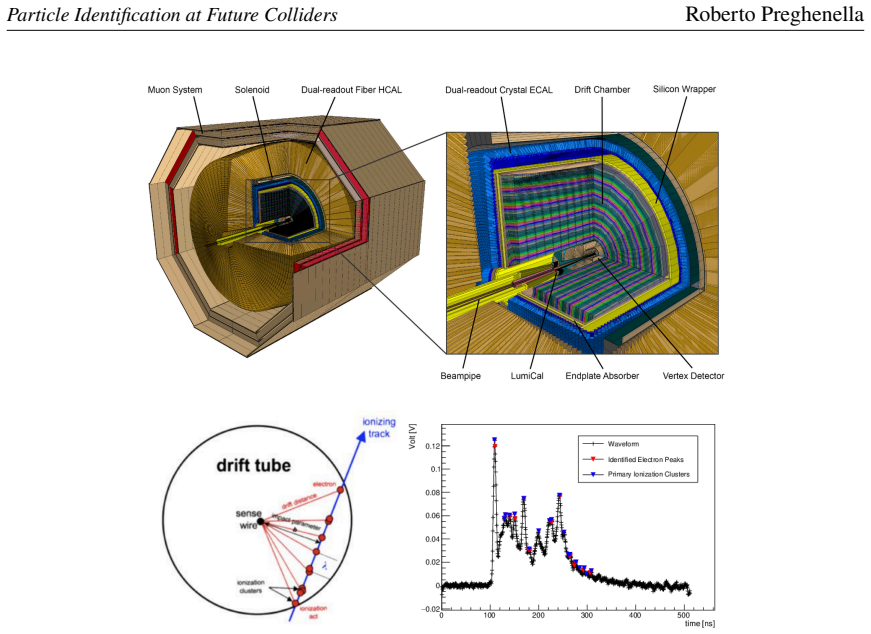
The physical machinery is the relation between velocity and mass: with momentum from the tracker, identifying a charged hadron reduces to measuring its velocity, and the paper's four techniques are different ways to do that. Cherenkov imaging measures the angle of emitted Cherenkov light, a direct velocity readout; cluster counting measures the number of primary ionisation clusters along the trajectory, reducing the Landau-fluctuation limit that degrades conventional $\mathrm{d}E/\mathrm{d}x$; time-of-flight with ~20 ps silicon sensors ($\mathrm{LGAD}$s and AC-LGADs) infers velocity from arrival time; timing-enhanced Cherenkov systems like TORCH combine photon position and arrival time. The named detector concepts—ePIC dRICH, ARC, hpDIRC, TORCH, IDEA—are the concrete instantiations that carry the argument, and the paper uses their simulated or beam-tested performance to argue feasibility in future collider environments.
What would settle it
A direct comparison, in a common beam test or a common simulation framework, of reconstructed $\pi/K$ separation efficiency versus momentum for ARC, the ePIC dRICH, a cluster-counting drift chamber, and an LGAD time-of-flight layer under identical magnetic field, material budget, and occupancy conditions would settle whether the claimed performance translates to real detectors.
Extended reading notes
Core claim
On the paper's own terms, the central claim is that charged-hadron identification will be a key ingredient of the physics programmes of future colliders, and that no single existing technology covers the required phase space. The author argues that future Higgs factories (FCC-ee, CEPC, ILC, CLIC) and the Electron–Ion Collider each impose demanding, complementary requirements—broad momentum coverage, compact geometry, low material budget, and, at hadron and muon colliders, radiation tolerance—and that the field is converging on a specific set of responses: compact dual-radiator RICH detectors (ePIC dRICH, ARC), timing-enhanced Cherenkov systems (hpDIRC, TORCH), cluster-counting drift chambers (IDEA), and LGAD/AC-LGAD precision timing. The paper presents these as representative examples of current directions, not as a complete catalogue, with the performance numbers for each coming from the developing collaborations' own simulations and beam tests.
Load-bearing premise
The argument rests on the assumption that the performance figures reported by the developing collaborations—for example the 40 $\mathrm{GeV}/c$ reach for ARC, the ~20 $\mathrm{GeV}/c$ cluster-counting results, and LGAD timing near 20 ps—are reliable, because these numbers are not independently checked here.
Editorial extensions
If this is right
- FCC-ee and EIC detector concepts will need dedicated hadron-PID systems in addition to tracking, calorimetry, and muon identification.
- Cluster counting can replace $\mathrm{d}E/\mathrm{d}x$ in drift-chamber trackers, pushing $\pi/K$ separation beyond the Landau-limited reach and up to roughly 20 $\mathrm{GeV}/c$.
- LGAD timing near 20 ps extends time-of-flight PID to momenta that were previously out of reach, and contributes to pile-up and background rejection.
- SiPM-based RICH detectors become practical in clean lepton-collider environments, while at FCC-hh and muon colliders radiation tolerance becomes the limiting design constraint.
Reading between the lines
- If the quoted performance survives independent validation, a natural design consequence the review only hints at is that future detectors will combine all three mechanisms hierarchically—timing at low momentum, cluster counting at intermediate momentum, Cherenkov at high momentum—rather than choosing one technology.
- The convergence of AC-LGAD timing with single-photon SPAD/SiPM detection suggests that a single granular silicon layer could eventually perform tracking, timing, and Cherenkov photon detection simultaneously, which would reduce material budget further than the paper explicitly claims.
- A cost-benefit question the survey leaves open is whether the ~40 $\mathrm{GeV}/c$ Cherenkov reach of ARC justifies its radial envelope compared with a cluster-counting-only tracker; an independent comparison would settle it.
Signed reviews
Editorial analysis
A structured set of objections, weighed in public.
Referee Report
Summary. This conference proceedings paper, based on an invited LHCP 2026 talk, argues that charged-hadron particle identification (PID) remains a key ingredient of future collider physics programmes and reviews selected detector concepts under development. It covers physics drivers at Higgs factories and the Electron-Ion Collider; compact Cherenkov detectors (ePIC dRICH, ARC, hpDIRC, TORCH); cluster counting in the IDEA drift chamber; precision timing with LGADs and AC-LGADs; and radiation-environment considerations including FCC-hh and muon-collider backgrounds. The text explicitly limits itself to representative examples and does not claim to be a comprehensive review or to present new measurements.
Significance. The manuscript is a well-scoped, clearly written review. Its central claim—that dedicated hadron PID is still needed and that compact RICH, cluster counting, and precision timing are the main development directions—is modest and carefully hedged, with quantitative statements tied to cited collaboration papers. The review is potentially useful to the community as a concise entry point to the current technology landscape, and it usefully highlights the diversity of constraints (material budget at FCC-ee, broad kinematic coverage at the EIC, backgrounds at muon colliders). It does not introduce new data, derivations, or parameter-free predictions, so its value is expository; within that scope, the claims are appropriately attributed and the acknowledged limitation to selected examples is stated in the abstract and in Section 1.
minor comments (5)
- [Section 3.2] The quoted ARC momentum reach of "up to about 40 GeV/c" (Ref. [10]) is not accompanied by the assumed pi/K separation criterion or radiator configuration; a reader cannot assess how robust the number is without consulting the cited paper.
- [Section 4] The statement that Garfield++ and Geant4 simulations "confirmed the expected performance up to momenta of approximately 20 GeV/c" would be more informative if the particle species, separation power, and simulation conditions were specified.
- [Section 5.1] The LGAD timing value "close to 20 ps" (Ref. [18]) is reported without stating sensor thickness, temperature, or operating voltage; specifying these conditions would make the statement more reproducible.
- [Figure 1] The ATLAS and LHCb invariant-mass spectra shown in Figure 1 are not accompanied by citations to the original ATLAS/LHCb publications; please add the relevant references.
- [References] The reference list is not fully uniform: for example, Ref. [9] is given only as a DOI and Ref. [13] only as an arXiv preprint; standardizing the entries would improve the proceedings quality.
Circularity Check
No significant circularity: the review makes no derivation and imports all quantitative claims from cited external collaboration studies.
full rationale
This is a scoped conference review, not a derivation with fitted parameters. The central claim—that PID remains important for future colliders and that compact RICH, cluster counting, and precision timing are active directions—is descriptive and supported by citations to the developing collaborations. Every quantitative performance figure (e.g., 40 GeV/c ARC reach in Sec. 3.2 [10], 20 GeV/c cluster-counting validation in Sec. 4 [14], ~20 ps LGAD timing in Sec. 5.1 [18]) is explicitly attributed to external simulation, beam-test, or sensor-characterization papers, none of which are by the present author. The author does appear on Refs [6], [7], [8], and [16], but those self-citations support background statements about SiPM properties and silicon-sensor trends; they are not load-bearing for any derived result, and no equation or fitted quantity is renamed as a prediction. The paper also explicitly limits itself to selected representative examples, so the absence of a full derivation is an acknowledged scope choice rather than a hidden circular step.
Assumptions & free parameters
assumptions (2)
- domain assumption Charged hadron mass can be inferred from a velocity measurement (Cherenkov angle, dE/dx, or time-of-flight) combined with track momentum.
- domain assumption Quantitative performance reported for each surveyed detector matches the cited papers (e.g., ARC to about 40 GeV/c, cluster counting to about 20 GeV/c, LGAD about 20 ps timing).
Cite this review
Pith. "Pith review of Particle Identification at Future Colliders." pith.science (2026). https://pith.science/paper/BBH33TNI
@misc{pith2026260811028,
  author       = {Pith},
  title        = {Pith review of: Particle Identification at Future Colliders},
  year         = {2026},
  howpublished = {\url{https://pith.science/paper/BBH33TNI}},
  note         = {Machine review of arXiv:2608.11028}
}
read the original abstract
Particle identification (PID) remains a key ingredient of the physics programmes of future collider experiments. While traditional collider detectors rely on calorimetry, tracking and muon systems for particle classification, the identification of charged hadrons requires dedicated measurements of particle velocity through Cherenkov radiation, ionisation or time-of-flight techniques. Future facilities such as FCC-ee and the Electron-Ion Collider place demanding requirements on momentum coverage, detector integration and material budget, motivating the development of novel PID concepts. This contribution reviews several approaches currently under investigation, including compact Ring-Imaging Cherenkov detectors, cluster-counting drift chambers, timing-enhanced Cherenkov detectors and precision timing systems based on advanced silicon sensors. The role of emerging photodetector technologies and radiation-tolerance considerations for future collider environments is also discussed. This contribution summarises the main topics presented in the invited LHCP 2026 talk and focuses on selected representative examples rather than a comprehensive review of the field.
Figures


Figures from the paper (2 more)

Reviewed August 12, 2026 · model on record in the stance chip above.
Discussion (0). Continue with ORCID to comment.