REVIEW 4 major objections 6 minor 2 cited by
Chemical tuning between triangular and honeycomb structures in a 5$d$ spin-orbit Mott insulator
T0 review · 4 major / 6 minor · reviewed 2026-08-14 · deepseek-v4-flash
Pith's one-line read This paper claims that potassium content x in KxIryO2 acts as a chemical tuning parameter that switches the iridium layer from a triangular to a honeycomb arrangement through ordering of iridium vacancies.
desk verdict A credible structural study of a new tunable triangular-to-honeycomb iridate family, with a charge-balance assumption that needs independent testing before the phase diagram is taken to the bank. read the letter →
The pith
A machine-rendered reading of the paper's core claim, the machinery that carries it, and where it could break.
The reading
What carries the argument
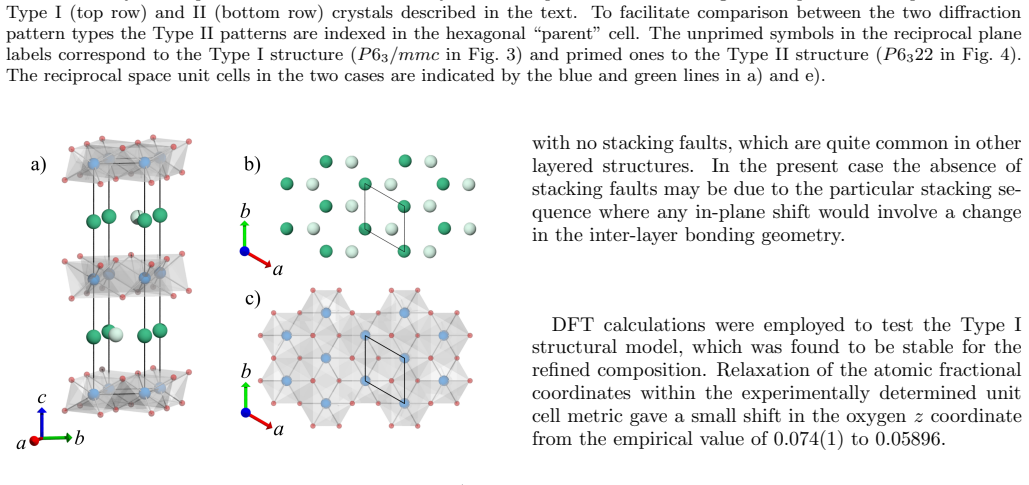
The load-bearing machinery is the charge-neutrality relation y = 1 − x/4 combined with an occupation order parameter ε for the iridium vacancies. The relation states that each added potassium removes a quarter of an iridium site, keeping Ir fixed at 4+; it is imposed as a constraint in both single-crystal refinements and in the virtual-crystal DFT scan. The order parameter, built from symmetry-adapted modes ν1, ν4 and ν5 of the P63/mmc parent, interpolates between a uniform vacancy distribution (ε = 0, triangular phase) and full vacancy order at the honeycomb centres (ε = x, honeycomb phase), with the super-space group P6322 selected uniquely by the observed reflection conditions. The DFT scan applies this model at fractional occupancies via the virtual crystal approximation to locate the phase boundary.
What would settle it
X-ray absorption near-edge spectroscopy at the Ir L3 edge across a range of x, or a structural refinement that leaves Ir and O occupancies free, would settle whether every Ir is 4+. If the refined Ir valence departs from 4+, the formula KxIr1−x/4O2 and the predicted boundary between triangular and honeycomb phases lose their foundation.
Extended reading notes
Core claim
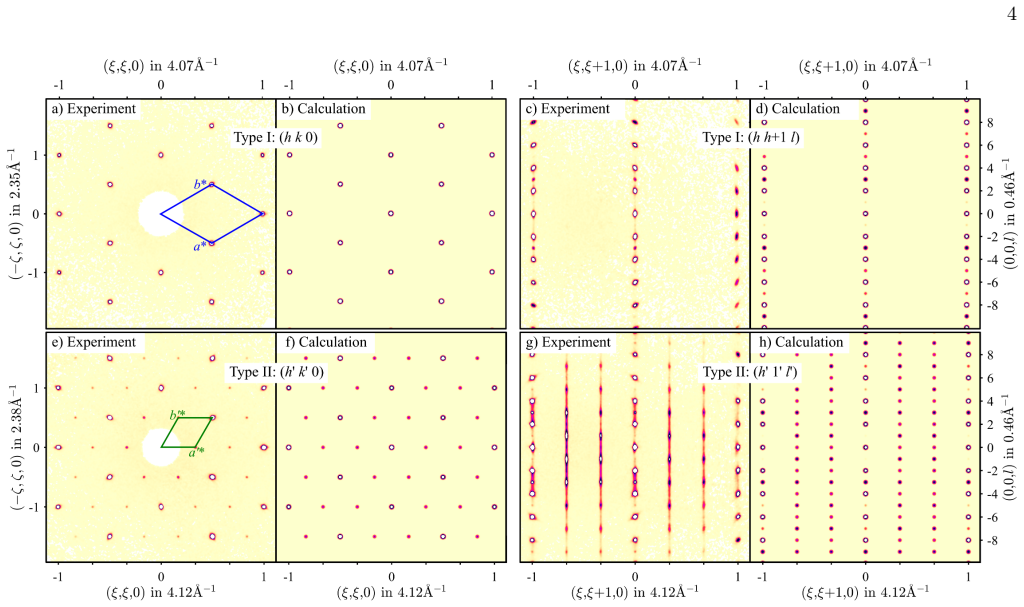
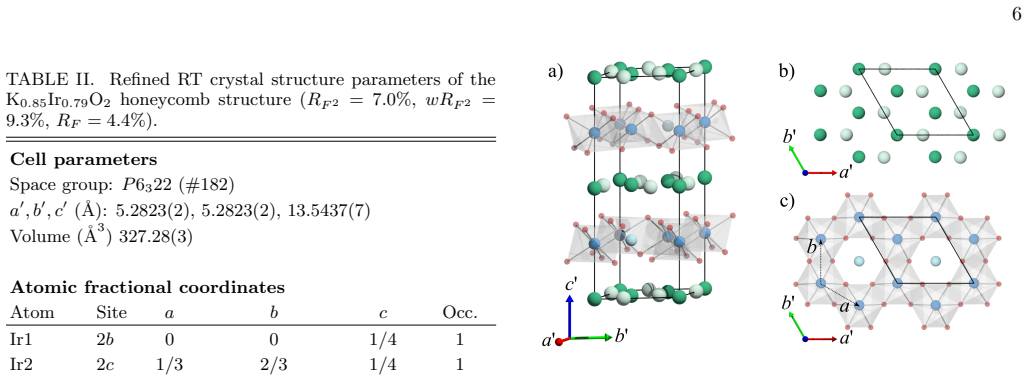
The central claim is that in KxIryO2, charge neutrality is maintained entirely by iridium vacancies, giving the composition KxIr1−x/4O2, and that these vacancies undergo an ordering transition as potassium content rises. Below a critical composition, the vacancies are randomly distributed over the triangular iridium sublattice, preserving the parent P63/mmc structure. Above it, the vacancies sit preferentially at the centres of a honeycomb lattice of fully occupied iridium sites, tripling the in-plane unit cell and lowering symmetry to P6322. Single-crystal x-ray diffraction refinements at the two compositions K0.61Ir0.85O2 and K0.85Ir0.79O2 realize the two sides of the transition, and DFT structural relaxations place the boundary in the narrow window 0.805 < x < 0.843. The authors further compute that the hypothetical end member K2IrO3 has jeff = 1/2 character and exchange parameters close to the Kitaev limit, making this interpolation family a candidate platform for Kitaev magnetism.
Load-bearing premise
The argument rests on the premise that every iridium ion is exactly 4+ and that charge neutrality is balanced solely by iridium vacancies, with no oxygen deficiency, no excess potassium, and no mixed iridium valence; this premise is imposed as a constraint in the refinements and in the DFT scan rather than tested by them.
Editorial extensions
If this is right
- Compositions with x below about 0.8 should form triangular KxIr1−x/4O2 with uniform vacancies, while x above about 0.84 forms the honeycomb P6322 structure; intermediate x values are predicted to fall in a narrow phase-boundary region.
- The honeycomb phase is a candidate Kitaev spin-liquid host in a geometry not previously explored, since GGA+SO calculations give jeff = 1/2 moments with (J, K, Γ, Γ′) near the Kitaev limit for the Z bond.
- Tuning x continuously should allow the magnetic exchange anisotropy and the degree of geometric frustration to vary within one chemical family, providing a controlled testbed for competing triangular and honeycomb magnetism.
- The transition is weakly first order, so diffuse scattering and stacking faults of the honeycomb centres are expected near xc, consistent with the observed diffuse rods along l in the Type II data.
Reading between the lines
- A direct test of the vacancy-ordering picture would be electron or neutron diffraction on crystals with intermediate x, looking for the predicted first-order jump in the supercell peak intensity rather than a continuous growth of ε.
- If real, the same vacancy-ordering mechanism may appear in other 5d layered oxides where strong spin-orbit coupling suppresses mixed valence, making interlayer cation content a generic route between triangular and honeycomb magnets.
- The paper's assumption that Ir is strictly 4+ could be checked by XANES at the Ir L3 edge; a measurable valence drift with x would indicate that the phase diagram needs a second composition variable.
- The authors' prediction that K2IrO3 is locally stable suggests high-pressure synthesis attempts to reach the x = 4/3 end member, where the honeycomb is fully formed and the Kitaev parameters could be measured directly.
Signed reviews
Editorial analysis
A structured set of objections, weighed in public.
Referee Report
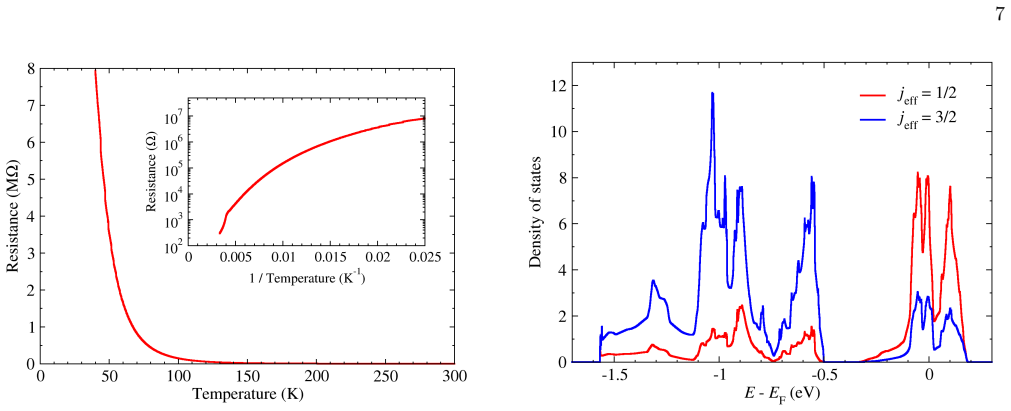
Summary. The manuscript reports a structural study of the layered iridate family K_xIr_yO_2. It proposes that charge neutrality is maintained by iridium vacancies with y = 1 - x/4, under the hypothesis that all Ir is in a 4+ oxidation state, and that above a critical potassium content x_c the vacancies order at the centers of a honeycomb lattice, converting the Ir layer from triangular to honeycomb. Two compositions are refined by single-crystal X-ray diffraction: a Type I triangular structure in P63/mmc at x = 0.61 and a Type II honeycomb structure in P6322 at x = 0.85. DFT calculations (GGA+SO with the virtual crystal approximation) predict the transition between x = 0.805 and x = 0.843. The paper also reports insulating resistance behavior and computes a Kitaev-like exchange Hamiltonian for the honeycomb end member, K2IrO3.
Significance. If the vacancy-ordering interpretation is correct, K_xIr_{1-x/4}O_2 would be a rare structural family in which a single chemical variable tunes between triangular and honeycomb arrangements of edge-sharing IrO6 octahedra, with potential Kitaev physics in an unexplored regime. The paper's strengths are its careful symmetry analysis (Appendix A), the identification of two structurally distinct single-crystal phases with reasonable refinement residuals, the explicit DFT prediction of a phase boundary, and the measurement of insulating behavior. However, the central compositional assumption — Ir4+ with oxygen stoichiometric and y = 1 - x/4 — is imposed as a constraint in both the SXD refinements and the DFT scan, rather than independently tested. The agreement between experiment and theory is therefore partly built into the model. The significance of the work is real but conditional on a direct test of Ir valence and oxygen stoichiometry.
major comments (4)
- [Sec. I; Tables I and II; Sec. IV] The load-bearing relation y = 1 - x/4 is imposed, not tested. In the Type I refinement the potassium and iridium occupancies are constrained to satisfy charge neutrality for Ir4+; in Type II the occupancies are constrained to impose the 4+ state; and in the DFT VCA scan the same relation defines the virtual atoms. The paper itself calls the Ir4+ state a 'hypothesis' (Sec. I), yet the agreement between refined compositions and DFT is partly built into the model. The fully unconstrained Type I refinement is mentioned only as giving 'comparable' fit quality, and the oxygen occupancy is never refined, so alternatives such as oxygen deficiency or an Ir3+/Ir4+ mixed-valence state cannot be excluded. Please report the unconstrained occupancies including the oxygen site, give the numerical comparison between constrained and unconstrained fits for both structures, and test at least one alternative charge-balance model in both refinement and DFT. A direct measurement of Ir valence or oxygen content would be the decisive test.
- [Table I] The Type I structural model is refined against only 88 independent reflections (I > 1.5 sigma) with eight fitted parameters, and the potassium occupancies on K1 and K2 are constrained equal. The refined composition x = 0.61 is a central input to the phase diagram, so the paper should state the estimated standard deviation of x as derived from the refinement, report the fully unconstrained occupancy values, and show that the result is stable when the K1 and K2 occupancies are allowed to differ. Without this, the experimental location of the Type I composition is not sufficiently established to support the comparison with the DFT boundary at x_c.
- [Sec. IV] The DFT prediction of the Type I-Type II boundary between x = 0.805 and x = 0.843 relies on the virtual crystal approximation for disordered vacancies. VCA averages over configurations and cannot capture vacancy-vacancy correlations or local relaxations around individual vacancies; the only supercell test reported is at x = 1. Please provide explicit supercell relaxations for at least one composition on each side of the predicted boundary and check that the VCA result for x_c is robust to the choice of vacancy arrangement. As it stands, the quantitative value x_c = 0.82(2) is a prediction of a model in which the charge-balance relation is assumed.
- [Fig. 1; Sec. IV] The experimental data establish Type I only at x approximately 0.61 and Type II only at x approximately 0.85; no crystal in the proposed transition region 0.805 < x < 0.843 was measured. The claim of a 'critical composition' is therefore not directly supported by diffraction data. The authors should either clearly state that x_c is a DFT prediction with no experimental bracket, or provide additional compositions in the transition region to test the phase boundary.
minor comments (6)
- [Sec. V] The Conclusions state that the isostructural families have Ir replaced by 'Co or Ru,' but the Introduction and the cited literature refer to KxRhO2; 'Ru' should be 'Rh'.
- [Fig. 7 caption] The caption contains the typo 'distrbuted'; it should be 'distributed'.
- [Sec. III A] The text refers to 'Rietveld refinement' of a single crystal data set; FullProf was used for single-crystal refinement, which is not a Rietveld refinement in the powder-diffraction sense. Please adjust the terminology.
- [Table II] The relation between the refined Ir3 occupancy of 0.35(8) and the nominal composition x = 0.85 (which, under the charge-neutrality model, implies Ir3 = 0.3625) should be stated explicitly, since this agreement is a central check of the vacancy-ordered model.
- [Sec. IV, Eq. (1)] The 'Z-bond' in the exchange Hamiltonian is not defined in the context of the P6322 structure; please specify the bond orientation and the local axes used for the J, K, Gamma, and Gamma-prime parameters.
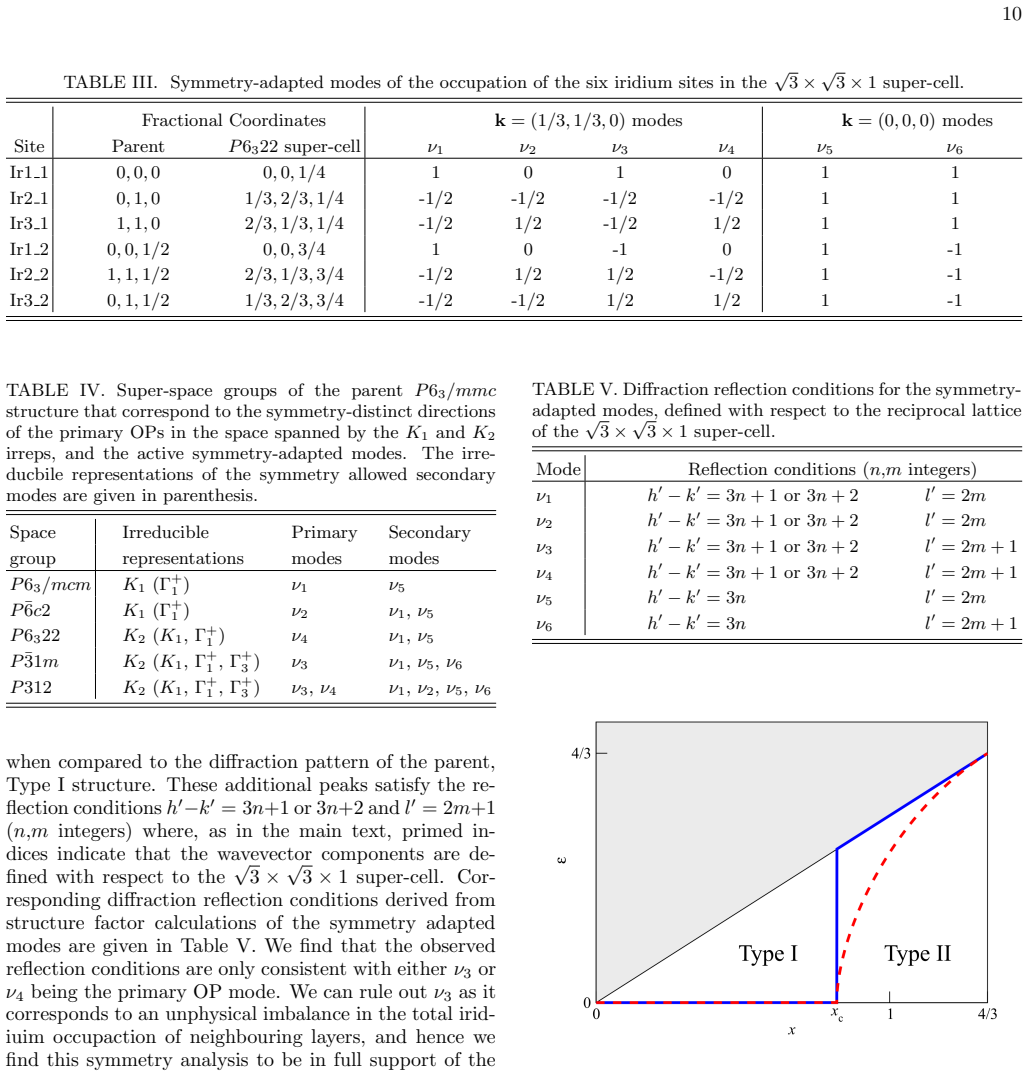
- [Appendix A, Table III] The symmetry-adapted modes nu1 through nu6 are tabulated but not described physically in the main text; a one-sentence description of the occupation pattern represented by each mode would help the reader follow the reflection-condition analysis.
Circularity Check
The refined "Ir4+-consistent" compositions are produced by imposing the Ir4+/vacancy charge-balance constraint in the refinements, then cited as confirmation of that constraint; the phase boundary itself is an independent DFT result.
-
self definitional
[Section III A (Type I: Triangular Structure), Table I]
"A final model was refined against the data, in which the potassium partial occupation x was varied freely but constrained to be the same on both K1 and K2 sublattices, and the iridium occupation constrained to satisfy charge neutrality for valence 4+. ... Finally, the K:Ir composition ratio was found to be consistent with an Ir4+ valence."
In this final model the Ir occupancy is not a free parameter: the constraint y = 1 - x/4 fixes it once x is refined. Hence the reported composition K0.61Ir0.85O2 and the statement "consistent with an Ir4+ valence" are true by construction, not by independent measurement. The paper does cite a fully unconstrained refinement with comparable fit as support, which partially mitigates the circularity, but the constrained-model conclusion itself is tautological.
-
fitted input called prediction
[Section III B (Type II: Honeycomb Structure), Table II]
"As before, the cation occupations were constrained to impose ... the 4+ oxidation state of iridium, while allowing the K:Ir ratio to vary. ... Relaxing these constraints did not significantly improve the fit, showing again that iridium adopts the 4+ oxidation state, which then dictates the iridium occupation of the honeycomb centres for a given amount of potassium..."
With Ir1 and Ir2 fixed at full occupancy, charge neutrality for Ir4+ fixes the honeycomb-centre occupancy as occ(Ir3) = 1 - 3x/4 once the potassium content x is refined; Table II's Ir3 = 0.35(8) and K0.85Ir0.79O2 are therefore outputs of the constraint. Saying that relaxing constraints did not improve the fit "showing again that iridium adopts the 4+ oxidation state" treats the input assumption as its own confirmation. The diffraction data show consistency, not an independent determination of the Ir valence.
full rationale
The paper is transparent that the Ir4+ oxidation state is a hypothesis and that the formula KxIr1-x/4O2 is adopted under that constraint (Sec. I). However, in the two structural refinements the cation occupancies are constrained to satisfy that formula, so the reported compositions and the statements that the K:Ir ratio is "consistent with an Ir4+ valence" are to a significant degree true by construction. The Type II claim that relaxing the constraints did not improve the fit "showing again that iridium adopts the 4+ oxidation state" is a fitted-input-called-prediction / self-definitional step in the composition analysis. The paper's other central results are independent: the (1/3,1/3,0) superlattice reflections with odd l directly indicate ordering of the strongly scattering Ir sublattice; the free Type I refinement gave comparable fit without the valence constraint; and the DFT relaxation scan predicts the Type I/II boundary between x=0.805 and 0.843 without fitting the two experimental compositions. The phase diagram therefore does not reduce entirely to the constraint, but the charge-neutrality/vacancy-formula "finding" is partially circular. No load-bearing self-citation chain is involved; ref. 17 is motivational support for the hypothesis rather than the derivation of the reported structures.
Assumptions & free parameters
free parameters (5)
- Refined potassium composition x (Type I) =
0.61
- Refined potassium composition x (Type II) =
0.85
- Ir3 honeycomb-centre occupation =
0.35(8)
- Vacancy order parameter epsilon =
assumed epsilon = x (maximal ordering)
- Onsite Coulomb U for Ir 5d =
not specified (small U, not shown)
assumptions (4)
- domain assumption Iridium adopts a 4+ oxidation state (jeff=1/2 spin-orbit Mott insulator) due to strong SOC, correlations, and crystal field.
- domain assumption Charge neutrality is maintained solely by iridium vacancies with y=1-x/4; no oxygen nonstoichiometry or mixed Ir valence.
- domain assumption Fictitious virtual atoms (VCA) interpolating between Ir/K and vacancies faithfully describe effects of fractional occupancy.
- domain assumption GGA+SOC(+U) functionals capture the relative stability of Type I versus Type II structures and the effective spin model.
Cite this review
Pith. "Pith review of Chemical tuning between triangular and honeycomb structures in a 5$d$ spin-orbit Mott insulator." pith.science (2026). https://pith.science/paper/BBTZQRAO
@misc{pith2026190804584,
  author       = {Pith},
  title        = {Pith review of: Chemical tuning between triangular and honeycomb structures in a 5$d$ spin-orbit Mott insulator},
  year         = {2026},
  howpublished = {\url{https://pith.science/paper/BBTZQRAO}},
  note         = {Machine review of arXiv:1908.04584}
}
abstract
We report structural studies of the spin-orbit Mott insulator family K$_x$Ir$_y$O$_2$, with triangular layers of edge-sharing IrO$_6$ octahedra bonded by potassium ions. The potassium content acts as a chemical tuning parameter to control the amount of charge in the Ir-O layers. Unlike the isostructural families with Ir replaced by Co or Rh ($y=1$), which are metallic over a range of potassium compositions $x$, we instead find insulating behaviour with charge neutrality achieved via iridium vacancies, which order in a honeycomb supercell above a critical composition $x_c$. By performing density functional theory calculations we attribute the observed behaviour to a subtle interplay of crystal-field environment, local electronic correlations and strong spin-orbit interaction at the Ir$^{4+}$ sites, making this structural family a candidate to display Kitaev magnetism in the experimentally unexplored regime that interpolates between triangular and honeycomb structures.
Figures

Figures from the paper (5 more)


Forward citations
Cited by 2 Pith papers
-
Large off diagonal exchange couplings and spin liquid states in $\mathbf{C_3}$ symmetric iridates
C3-symmetric K2IrO3 is predicted to have off-diagonal exchange couplings about ten times larger than Na2IrO3, and exact diagonalization shows such couplings can stabilize spin liquid phases.
-
Quantum Spin Liquid in a depleted triangular lattice Iridate K$_x$Ir$_y$O$_2$
Measurements on the new layered iridate K0.85Ir0.79O2 show no magnetic order down to 1.8 K and a T-linear heat capacity, consistent with a gapless quantum spin liquid.
Reference graph
Works this paper leans on
-
[1]
author author J. G. \ Rau , author E. K.-H. \ Lee , \ and\ author H.-Y. \ Kee ,\ 10.1146/annurev-conmatphys-031115-011319 journal journal Annual Review of Condensed Matter Physics \ volume 7 ,\ pages 195 ( year 2015 ) NoStop
-
[2]
author author S. M. \ Winter , author A. A. \ Tsirlin , author M. Daghofer , author J. van den Brink , author Y. Singh , author P. Gegenwart , \ and\ author R. Valent \' ,\ 10.1088/1361-648X/aa8cf5 journal journal J, Phys: Condens. Matter \ volume 29 ,\ pages 493002 ( year 2017 ) NoStop
-
[3]
author author S. C. \ Williams , author R. D. \ Johnson , author F. Freund , author S. Choi , author A. Jesche , author I. Kimchi , author S. Manni , author A. Bombardi , author P. Manuel , author P. Gegenwart , \ and\ author R. Coldea ,\ 10.1103/PhysRevB.93.195158 journal journal Phys. Rev. B \ volume 93 ,\ pages 195158 ( year 2016 ) NoStop
-
[4]
author author S. Hwan Chun , author J.-W. \ Kim , author J. Kim , author H. Zheng , author C. C. \ Stoumpos , author C. D. \ Malliakas , author J. F. \ Mitchell , author K. Mehlawat , author Y. Singh , author Y. Choi , author T. Gog , author A. Al-Zein , author M. M. \ Sala , author M. Krisch , author J. Chaloupka , author G. Jackeli , author G. Khaliulli...
-
[5]
author author A. Banerjee , author C. Bridges , author J.-Q. \ Yan , author A. Aczel , author L. Li , author M. Stone , author G. Granroth , author M. Lumsden , author Y. Yiu , author J. Knolle , author D. Kovrizhin , author S. Bhattacharjee , author R. Moessner , author D. Tennant , author D. Mandrus , \ and\ author S. Nagler ,\ 10.1038/nmat4604 journal ...
-
[6]
author author T. Takayama , author A. Kato , author R. Dinnebier , author J. Nuss , author H. Kono , author L. S. I. \ Veiga , author G. Fabbris , author D. Haskel , \ and\ author H. Takagi ,\ 10.1103/PhysRevLett.114.077202 journal journal Phys. Rev. Lett. \ volume 114 ,\ pages 077202 ( year 2015 ) NoStop
-
[7]
author author A. Biffin , author R. D. \ Johnson , author S. Choi , author F. Freund , author S. Manni , author A. Bombardi , author P. Manuel , author P. Gegenwart , \ and\ author R. Coldea ,\ 10.1103/PhysRevB.90.205116 journal journal Phys. Rev. B \ volume 90 ,\ pages 205116 ( year 2014 a ) NoStop
-
[8]
author author A. Biffin , author R. D. \ Johnson , author I. Kimchi , author R. Morris , author A. Bombardi , author J. G. \ Analytis , author A. Vishwanath , \ and\ author R. Coldea ,\ 10.1103/PhysRevLett.113.197201 journal journal Phys. Rev. Lett. \ volume 113 ,\ pages 197201 ( year 2014 b ) NoStop
Show all 38 references
-
[9]
Rousochatzakis , author U
author author I. Rousochatzakis , author U. K. \ R\"ossler , author J. van den Brink , \ and\ author M. Daghofer ,\ 10.1103/PhysRevB.93.104417 journal journal Phys. Rev. B \ volume 93 ,\ pages 104417 ( year 2016 ) NoStop
2016 doi
-
[10]
Kimchi \ and\ author A
author author I. Kimchi \ and\ author A. Vishwanath ,\ 10.1103/PhysRevB.89.014414 journal journal Phys. Rev. B \ volume 89 ,\ pages 014414 ( year 2014 ) NoStop
2014 doi
-
[11]
Huang , author M
author author Q. Huang , author M. L. \ Foo , author R. A. \ Pascal , author J. W. \ Lynn , author B. H. \ Toby , author T. He , author H. W. \ Zandbergen , \ and\ author R. J. \ Cava ,\ 10.1103/PhysRevB.70.184110 journal journal Phys. Rev. B \ volume 70 ,\ pages 184110 ( year...
-
[12]
Jansen \ and\ author R
author author M. Jansen \ and\ author R. Hoppe ,\ 10.1002/zaac.19744080202 journal journal Z. Anorg. Allg. Chem. \ volume 408 ,\ pages 97 ( year 1974 ) NoStop
1974 doi
-
[13]
Hironaka , author K
author author Y. Hironaka , author K. Kubota , \ and\ author S. Komaba ,\ 10.1039/c7cc00806f journal journal Chem. Commun. \ volume 53 ,\ pages 3693 ( year 2017 ) NoStop
2017 doi
-
[14]
Nakamura , author J
author author S. Nakamura , author J. Ohtake , author N. Yonezawa , \ and\ author S. Iida ,\ 10.1143/JPSJ.65.358 journal journal J. Phys. Soc. Japan \ volume 65 ,\ pages 358 ( year 1996 ) NoStop
1996 doi
-
[15]
Shibasaki , author T
author author S. Shibasaki , author T. Nakano , author I. Terasaki , author K. Yubuta , \ and\ author T. Kajitani ,\ 10.1088/0953-8984/22/11/115603 journal journal Journal of Physics: Condensed Matter \ volume 22 ,\ pages 115603 ( year 2010 ) NoStop
-
[16]
\ Zhang , author S.-T
author author B.-B. \ Zhang , author S.-T. \ Dong , author Y. B. \ Chen , author L.-Y. \ Zhang , author J. Zhou , author S. H. \ Yao , author Z.-B. \ Gu , author S.-T. \ Zhang , \ and\ author Y.-F. \ Chen ,\ 10.1039/C3CE40083B journal journal Cryst. Eng. Comm. \ volume 15 ,\ p...
-
[17]
author author A. J. \ Kim , author H. O. \ Jeschke , author P. Werner , \ and\ author R. Valenti ,\ @noop journal journal Physical review letters \ volume 118 ,\ pages 086401 ( year 2017 ) NoStop
2017
-
[18]
Delmas , author G
author author C. Delmas , author G. Demazeau , author M. Devalette , author C. Fouassier , \ and\ author P. Hagenmuller ,\ https://doi.org/10.1016/0022-4596(76)90154-7 journal journal Journal of Solid State Chemistry \ volume 19 ,\ pages 87 ( year 1976 ) NoStop
-
[19]
Freund , author S
author author F. Freund , author S. C. \ Williams , author R. D. \ Johnson , author R. Coldea , author P. Gegenwart , \ and\ author A. Jesche ,\ 10.1038/srep35362 journal journal Scientific Reports \ volume 6 ,\ pages 35362 ( year 2015 ) NoStop
-
[20]
Rodr \' guez-Carvajal ,\ @noop journal journal Physica B \ volume 192 ,\ pages 55 ( year 1993 ) NoStop
author author J. Rodr \' guez-Carvajal ,\ @noop journal journal Physica B \ volume 192 ,\ pages 55 ( year 1993 ) NoStop
1993
-
[21]
Kresse \ and\ author J
author author G. Kresse \ and\ author J. Hafner ,\ 10.1103/PhysRevB.47.558 journal journal Phys. Rev. B \ volume 47 ,\ pages 558 ( year 1993 ) NoStop
1993 doi
-
[22]
Kresse \ and\ author J
author author G. Kresse \ and\ author J. Furthm\"uller ,\ 10.1103/PhysRevB.54.11169 journal journal Phys. Rev. B \ volume 54 ,\ pages 11169 ( year 1996 ) NoStop
1996 doi
-
[23]
Kresse \ and\ author J
author author G. Kresse \ and\ author J. Furthm??ller ,\ https://doi.org/10.1016/0927-0256(96)00008-0 journal journal Computational Materials Science \ volume 6 ,\ pages 15 ( year 1996 ) NoStop
1996 doi
-
[24]
author author J. P. \ Perdew , author K. Burke , \ and\ author M. Ernzerhof ,\ 10.1103/PhysRevLett.77.3865 journal journal Phys. Rev. Lett. \ volume 77 ,\ pages 3865 ( year 1996 ) NoStop
1996 doi
-
[25]
author author P. E. \ Bl\"ochl ,\ 10.1103/PhysRevB.50.17953 journal journal Phys. Rev. B \ volume 50 ,\ pages 17953 ( year 1994 ) NoStop
1994 doi
-
[26]
author author I. I. \ Mazin ,\ @noop journal journal Physical Review B \ volume 81 ,\ pages 140508(R) ( year 2010 ) NoStop
2010
-
[27]
Blaha , author K
author author P. Blaha , author K. Schwarz , author G. K. H. \ Madsen , author D. Kvasnicka , \ and\ author J. Luitz ,\ @noop \ ( year 2001 ) NoStop
2001
-
[28]
author author S. M. \ Winter , author Y. Li , author H. O. \ Jeschke , \ and\ author R. Valent\' ,\ 10.1103/PhysRevB.93.214431 journal journal Phys. Rev. B \ volume 93 ,\ pages 214431 ( year 2016 a ) NoStop
2016 doi
-
[29]
S\" o rgel \ and\ author M
author author T. S\" o rgel \ and\ author M. Jansen ,\ 10.1002/zaac.200500295 journal journal Z. Anorg. Allg. Chem. \ volume 631 ,\ pages 2970 ( year 2005 ) NoStop
2005 doi
-
[30]
author author S. K. \ Choi , author R. Coldea , author A. N. \ Kolmogorov , author T. Lancaster , author I. I. \ Mazin , author S. J. \ Blundell , author P. G. \ Radaelli , author Y. Singh , author P. Gegenwart , author K. R. \ Choi , author S.-W. \ Cheong , author P. J. \ Bak...
-
[31]
Singh \ and\ author P
author author Y. Singh \ and\ author P. Gegenwart ,\ 10.1103/PhysRevB.82.064412 journal journal Phys. Rev. B \ volume 82 ,\ pages 064412 ( year 2010 ) NoStop
2010 doi
-
[32]
Goldschmidt , author T
author author V. Goldschmidt , author T. Barth , author D. Holmsen , author G. Lunde , \ and\ author W. Zachariasen ,\ @noop \ ( year 1926 ) NoStop
1926
-
[33]
Smolyanyuk , author M
author author A. Smolyanyuk , author M. Aichhorn , author I. Mazin , \ and\ author L. Boeri ,\ @noop journal journal arXiv preprint arXiv:1907.01966 \ ( year 2019 ) NoStop
1907 arXiv
-
[34]
author author S. M. \ Winter , author Y. Li , author H. O. \ Jeschke , \ and\ author R. Valenti ,\ @noop journal journal Physical Review B \ volume 93 ,\ pages 214431 ( year 2016 b ) NoStop
2016
-
[35]
Foyevtsova , author H
author author K. Foyevtsova , author H. O. \ Jeschke , author I. I. \ Mazin , author D. I. \ Khomskii , \ and\ author R. Valenti ,\ @noop journal journal Physical Review B \ volume 88 ,\ pages 035107 ( year 2013 ) NoStop
2013
-
[36]
author author R. D. \ Johnson , author S. C. \ Williams , author A. A. \ Haghighirad , author J. Singleton , author V. Zapf , author P. Manuel , author I. I. \ Mazin , author Y. Li , author H. O. \ Jeschke , author R. Valenti , \ and\ author R. Coldea ,\ @noop journal journal ...
2015
-
[37]
author author B. J. \ Campbell , author H. T. \ Stokes , author D. E. \ Tanner , \ and\ author D. M. \ Hatch ,\ @noop journal journal J. Appl. Crystallogr. \ volume 39 ,\ pages 607 ( year 2006 ) NoStop
2006
-
[38]
author author H. T. \ Stokes , author D. M. \ Hatch , \ and\ author B. J. \ Campbell ,\ http://stokes.byu.edu/isotropy.html title Isotropy , \ ( year 2007 ) NoStop
2007
Reviewed August 14, 2026 · model on record in the stance chip above.
Discussion (0). Continue with ORCID to comment.