REVIEW 4 major objections 6 minor 77 references
Improved Bethe-Heitler positron creation and retention by combining direct laser acceleration and solid target interaction within a gas jet
T0 review · 4 major / 6 minor · reviewed 2026-08-12 · deepseek-v4-flash
Pith's one-line read A single-stage laser-plasma setup can produce roughly 1.5 million positrons and hold onto about 10 percent of them, an eight-fold retention gain over earlier designs.
desk verdict A plausible, simulation-only optimization study of a DLA positron source; the 8x retention claim is conditional on resolving the single-mode quasi-3D issue. read the letter →
The pith
A machine-rendered reading of the paper's core claim, the machinery that carries it, and where it could break.
The reading
What carries the argument
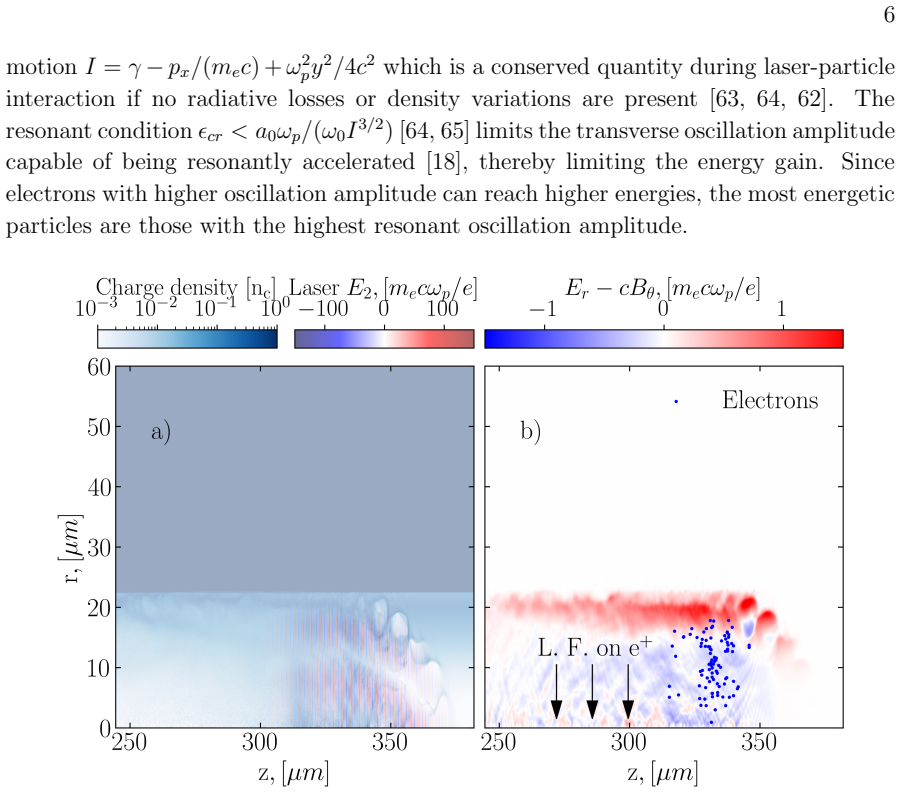
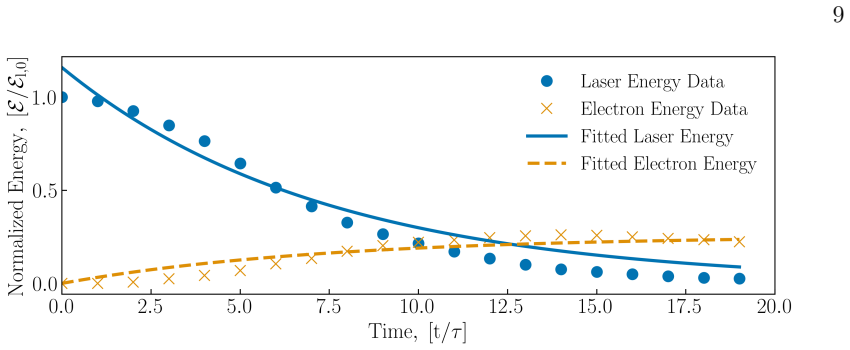
The engine of the scheme is beam-loading-driven field inversion: as electrons are continuously injected from the channel wall and accelerated by direct laser acceleration, the charge of the electron beam exceeds the background ion charge, reversing the sign of the radial electric field and creating a potential well that focuses positively charged particles. The paper's quantitative design tool is a semi-analytical laser depletion law, $E_l(t) = E_{l,0} e^{-k t/\tau}$ with $k = A (n_p/(a_0 n_c))^a$ and fitted $a \approx 0.5$, which predicts how much laser energy remains at a given foil depth and identifies where the DLA electron charge saturates. The foil position is then chosen where the laser has both loaded enough charge and retained enough energy to guide the newly created positrons.
What would settle it
A full-3D simulation with the same nominal parameters, or a single 10 PW experiment using a 240 nm aluminium foil placed about 600 micrometres into a plasma channel with wall density 0.2 n_c, that measures far fewer than about 1.5 million positrons or retains well under 10 percent of the produced pairs after one millimetre would falsify the central quantitative claim.
Extended reading notes
Core claim
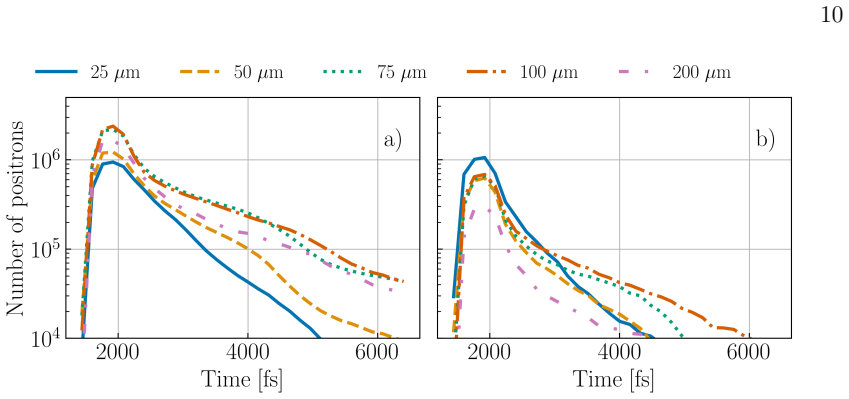
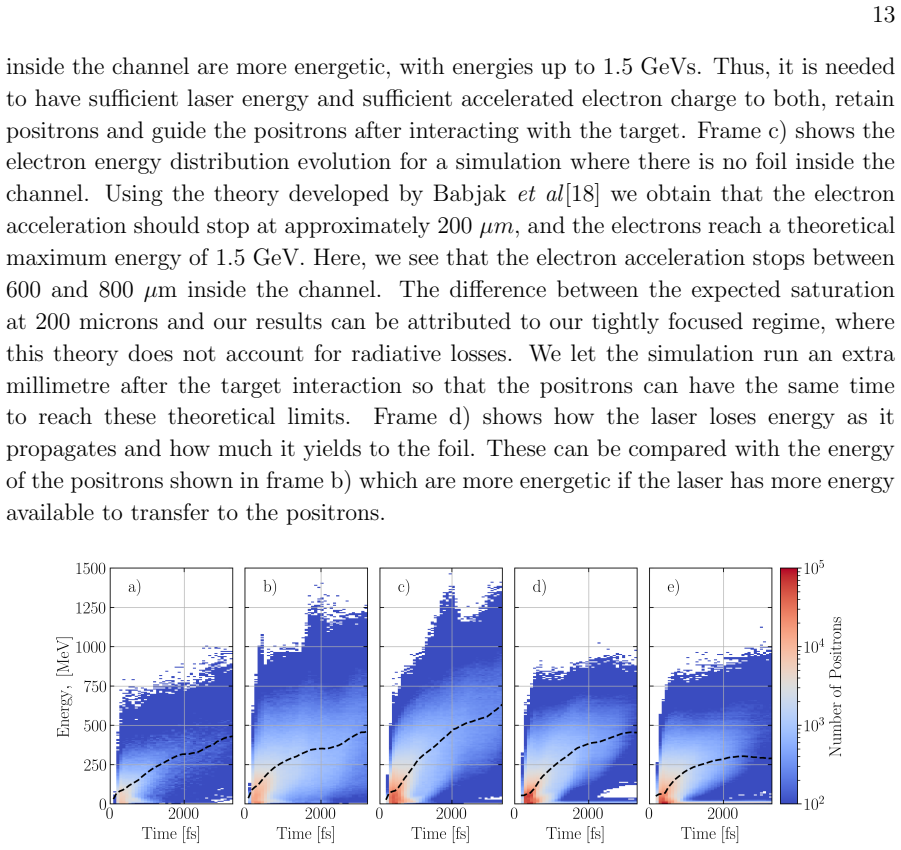
On the paper's own terms, the central discovery is that the laser does not need a separate positron accelerator: the electron beam accelerated by direct laser acceleration within the plasma channel can do triple duty. It carries enough charge to invert the channel's transverse field through beam loading, so that positrons created later are focused toward the axis; it collides with the aluminium foil to generate bremsstrahlung photons that decay into electron-positron pairs through Bethe-Heitler; and it leaves enough laser energy behind to resonantly accelerate the retained positrons to hundreds of MeV per metre. The authors scan laser focal position, channel wall density, foil depth, and foil thickness, and report an optimum at a 240 nm aluminium foil placed roughly 600 micrometres inside the channel with a wall density of 0.2 n_c, yielding about 1.5 million positrons and approximately 10 percent retention after one millimetre. Thicker targets create more positrons, up to about 7 million for a 750 nm foil, but drain the laser and spoil retention and final energy, while the optimized case shows positrons reaching energies up to about 1.5 GeV.
Load-bearing premise
The load-bearing premise is that the computer simulations used here, which model the plasma as nearly rotationally symmetric, capture the real three-dimensional behaviour of the laser, the electron beam, the foil collision, and the pair cascade accurately enough for the quoted positron counts and the eight-fold retention gain.
Editorial extensions
If this is right
- An optimized single-stage configuration produces about 1.5 million positrons and retains around 10 percent of the produced pairs after a millimetre, an eight-fold improvement over the earlier approach.
- Positron retention and energy are maximized when the foil sits near the point where DLA electron charge saturates: too early gives few pairs, too late leaves the laser too depleted to guide them.
- Lowering the channel wall density to about 0.2 n_c lets the laser accelerate roughly 160 nC of electrons, substantially increasing pair yield.
- Thicker aluminium targets raise the raw positron count, up to about 7 million for a 750 nm foil, but cost laser energy, retention, and final positron energy.
- The semi-analytical depletion model lets future studies choose laser and channel parameters and foil depth without scanning every combination in simulation.
Reading between the lines
- The depletion formula suggests an engineering rule: the optimal foil depth is where the gain in pairs from more DLA charge balances the loss of laser energy available to guide those pairs, so the scan reported here could be condensed into one simulation plus the fit.
- If the beam-loading mechanism is as robust as claimed, the scheme should transfer to higher-Z foil materials, which the paper notes could raise pair yield roughly quadratically, although retention would need re-optimizing because the laser loses more energy to thicker, higher-Z targets.
- Because positron acceleration after creation parallels electron DLA, the spot-size and resonance-matching optimization that maximizes electron energy should also raise the positron energy ceiling beyond the 1.5 GeV seen here.
- The quantitative claims are precise enough to be checked directly: a full-3D simulation or a dedicated 10 PW shot at the optimized parameters would test whether the million-scale positron count and 10 percent retention hold.
Editorial analysis
A structured set of objections, weighed in public.
Referee Report
Summary. This manuscript proposes a single-stage, all-optical positron source that combines direct laser acceleration (DLA) in a preformed plasma channel with a thin aluminium foil inserted inside the channel. Using OSIRIS quasi-3D simulations with QED modules for Bremsstrahlung, Bethe-Heitler, Breit-Wheeler, and nonlinear inverse Compton scattering, the authors show that electron beam loading can invert the channel field and create a focusing structure for positrons. They then scan the laser focal position, foil position, channel wall density, and foil thickness. The main reported result is that a 240 nm aluminium foil at approximately 600 microns inside a channel with wall density 0.2 n_c retains about 10% of the produced pairs after one millimetre of propagation, an 8-fold improvement over the earlier DLA design in Ref. [52], with roughly 1.5e6 positrons created for the optimal configuration. The paper also introduces an exponential laser-depletion model fitted to a parameter scan and uses it to estimate the remaining laser energy at various foil positions.
Significance. If the quantitative results survive a convergence check, the paper would provide a practical design for a single-stage positron source at ELI-Beamlines-class lasers, with a sharp falsifiable prediction for positron retention. The strengths are the comprehensive PIC parameter scan, the explicit inclusion of four QED processes, the transparent least-squares depletion model, and the clear physical mechanism of charge inversion followed by positron trapping. The central claim is not circular: the headline retention result comes directly from the PIC simulations, while the depletion model is a secondary fitting tool. The main weakness is that the entire campaign rests on a single-azimuthal-mode quasi-3D representation of a linearly polarized laser, with no full-3D or multi-mode check; until that is addressed, the 8-fold improvement is not quantitatively established.
major comments (4)
- [2 (Quasi-3D simulations)] Section 2 states that the simulations are quasi-3D with 'one angular mode' while the laser is linearly polarized and the channel/beam-loading structure is axisymmetric. A single azimuthal harmonic cannot simultaneously represent the m=±1 structure of a linearly polarized Gaussian pulse and the m=0 channel and beam-loading fields that are responsible for the positron-focusing mechanism. The manuscript does not state which harmonic is retained and provides no multi-mode or full-3D convergence check. Because the 8-fold retention claim is a ratio of retained charge, this truncation is load-bearing and not a minor resolution effect. I request either a multi-mode or full-3D benchmark for the optimal case, or a clear proof-of-principle framing with a quantified mode-truncation uncertainty.
- [2 (Laser parameters)] Section 2 lists P=10 PW, lambda=1 micron, tau=150 fs, waist=3.4 microns, and a peak intensity of 5e24 W/cm^2. For a Gaussian focal spot these parameters give a0 approximately 200 and I0 approximately 5.5e22 W/cm^2, roughly two orders of magnitude lower than the quoted value. This discrepancy changes the QED rates, the depletion fit, and the absolute pair-production yields. The authors should correct the intensity or the pulse parameters and propagate the correction through the reported positron counts and retention percentages.
- [4 and 5.2 (Depletion model)] The depletion model in Eqs. (4) and (5) is a least-squares fit of a single exponential to the laser-energy evolution from simulations at an 8.0 micron waist and 200 fs duration. In Section 5.2 it is then used to predict remaining laser energy for the 3.4 micron waist runs after scaling the coefficient A with the waist ratio. That waist scaling is an assumption, and the fit uncertainties (A=2.06±0.71, a=0.48±0.06, b=-0.50±0.09) are not propagated. The quoted values of 92%, 87%, 83%, 79%, and 75% are therefore extrapolations with unknown uncertainty. The model should be presented as a phenomenological fit for the simulated parameter range, and the waist scaling should be validated on at least one dedicated simulation before being used to guide foil placement.
- [5.2-5.3 (Statistics and convergence)] The reported positron counts and retention percentages, such as 1.5e6 positrons with about 10% retention and 7e6 positrons with 0.8% retention, are single-run quantities. There is no convergence test with respect to cell size, particles per cell, QED macro-particle weights, or the assumed 500 nm preplasma scale length. The comparison with Ref. [52] is presented only as the factor '8 times' without a side-by-side table of retention values or a common diagnostic definition. I recommend adding at least one resolution and particle-number convergence test for the optimal configuration and reporting the comparison with Ref. [52] in normalized form.
minor comments (6)
- [Introduction and Section 2] The Introduction contains 'Bremmstrahlung' instead of 'Bremsstrahlung', and Section 2 gives the intensity unit as W/cm^-2 instead of W/cm^2.
- [Sections 5.1 and 5.2] The text refers to 'Eq. 10' for the laser-depletion estimate, but the numbered equations in the paper end at Eq. (5); please renumber or point explicitly to Eqs. (4) and (5).
- [Section 2] The simulation domain is quoted as '137.5 x 80 square microns' with dr=dx=16 nm; please state the grid dimensions in cells and specify which coordinate the 80 micron extent covers.
- [Figure 6] Panel c is described as a waterfall plot of accelerated electron charge, but the text also mentions a simulation without a foil; please state explicitly which run is plotted and what the vertical lines denote.
- [Section 5.2] The average positron energy gain is quoted as '300 to 600 GeV/m'; please specify the time interval or propagation distance over which this average is computed, since the gain is not constant.
- [Figure 8] The definition p_perp = p_r = sqrt(p_x^2+p_y^2) is unusual because p_r normally denotes the radial momentum; please define the transverse momentum consistently or use p_perp without identifying it as p_r.
Circularity Check
Secondary energy-depletion model is a least-squares fit to the same PIC code and is then presented as a prediction; the central positron-retention result is independently simulated.
-
fitted input called prediction
[Section 4 (Eq. 5) and Section 5.2 (energy expectations from Eq. 4)]
"We then use the Python library SciPy [66] and the method curve_fit, which uses non-linear least squares regression, to fit the laser energy and the average energy of the electrons over time to the energy transfer rate k. ... From Eq. 4, and scaling the parameter A with the ratio of the waist of the pervious simulations to this 3.4 µm, we can expect the laser energy remaining to be 92%, 87%, 83%, 79% and 75% for the foil positions at 400, 600, 800, 1000, and 1200 µm, respectively, inside the channel."
The depletion rate k entering Eq. 4 is not a first-principles quantity: its parameters A, a, b in Eq. 5 are obtained by nonlinear least-squares regression to the laser-energy-vs-time curves produced by the same OSIRIS quasi-3D code. The 'predicted' remaining-laser-energy fractions in Sec. 5.2 are then obtained by evaluating this fitted exponential formula at the relevant propagation distances, with A rescaled by a waist ratio. Thus the prediction is the fitted calibration curve evaluated at new abscissae, not an independent forecast, and it is not checked against any external data or a different code. This is a secondary component, however: the headline positron counts and retention improvement come directly from the PIC simulations rather than from this model.
full rationale
The paper's central claim (about 1.5e6 positrons, roughly 10% retention after one millimetre, and an 8-fold retention improvement over [52]) is generated directly by OSIRIS quasi-3D simulations with QED modules for bremsstrahlung, Bethe-Heitler, Breit-Wheeler, and nonlinear inverse Compton scattering. That result is not derived from the semi-analytical depletion model, so the main conclusion has independent computational content. The comparison with [52] is a simulation-to-simulation comparison by the same group, which is legitimate for a relative improvement claim even though both simulations share the same quasi-3D assumptions. The one clear circular step is the energy-depletion 'prediction': the constants in Eq. 5 are least-squares fits to the laser-energy time series from the same code, and the numbers quoted in Sec. 5.2 are simply that fitted exponential evaluated at larger propagation distances with a manually rescaled A. This is a fitted input presented as a prediction, but it is not load-bearing for the positron yield or retention numbers. Concerns about the single-azimuthal-mode quasi-3D approximation, the absence of a full-3D convergence check, and the apparent inconsistency between the stated peak intensity and 10 PW with a 3.4 um waist are correctness and verification risks, not circularity. Overall, the circularity score is moderate because a secondary 'prediction' reduces to a fit, while the central result remains independently simulated.
Assumptions & free parameters
free parameters (4)
- Energy-depletion fit coefficients (A, a, b) in kfit = A (np/nc)^a a0^b =
A = 2.06 plus or minus 0.71, a = 0.48 plus or minus 0.06, b = negative 0.50 plus or minus 0.09
- Waist scaling of A =
A scaled by the ratio of the 8.0 micrometre fit waist to the 3.4 micrometre target-scan waist
- Channel profile steepness alpha = 5 =
5
- Pre-expanded foil preplasma scale length =
500 nm exponential layer at the foil front
assumptions (4)
- ad hoc to paper The depletion model assumes energy transfer rate dE_l proportional to negative k E_l dt/tau with k depending only on initial a0, n_p, and tau.
- domain assumption Quasi-3D OSIRIS with one angular mode reproduces the relevant 3D laser, beam, and foil dynamics well enough for quantitative charge predictions.
- domain assumption The OSIRIS QED modules for Bremsstrahlung, Bethe-Heitler, Breit-Wheeler, and nonlinear inverse Compton scattering are accurate in this regime.
- standard math The integral of motion I = gamma - p_x/(m_e c) + omega_p^2 y^2/(4 c^2) is conserved during laser-particle interaction apart from radiative losses and density variations.
Cite this review
Pith. "Pith review of Improved Bethe-Heitler positron creation and retention by combining direct laser acceleration and solid target interaction within a gas jet." pith.science (2026). https://pith.science/paper/BBVFYHZP
@misc{pith2026241117455,
  author       = {Pith},
  title        = {Pith review of: Improved Bethe-Heitler positron creation and retention by combining direct laser acceleration and solid target interaction within a gas jet},
  year         = {2026},
  howpublished = {\url{https://pith.science/paper/BBVFYHZP}},
  note         = {Machine review of arXiv:2411.17455}
}
read the original abstract
The next generation of Petawatt-class lasers presents the opportunity to study positron production and acceleration experimentally, in an all-optical setting. Several configurations were proposed to produce and accelerate positrons in a single laser stage. However, these configurations have yielded limited positron beam quality and low particle count. This paper presents methods for improving the injection and retention of positrons obtained via Bethe-Heitler pair production and accelerated using direct laser acceleration (DLA) in a plasma channel. The work first introduces a semi-analytical model which predicts laser energy depletion in this highly nonlinear regime. We demonstrate through PIC simulations that accelerated electrons can induce charge inversion within the channel, leading to positron trapping and acceleration. We investigate how laser focusing position, channel wall density, target foil position and target thickness influence positron creation and retention. Our configuration can achieve an 8-fold increase in positron retention compared to previous studies and a higher number of positrons produced overall. This work establishes a robust, single-stage approach for obtaining positron beams, opening new avenues for experiments with Petawatt-class lasers and potential applications in electron-positron collisions and QED cascades.
Figures

Figures from the paper (6 more)




Reference graph
Works this paper leans on
-
[52]
Diederichs S, Mehrling T, Benedetti C, Schroeder C, Knetsch A, Esarey E and Osterhoff J 2019 Phys. Rev. Accel. Beams 22 081301 publisher: American Physical Society URL https: //link.aps.org/doi/10.1103/PhysRevAccelBeams.22.081301
-
[1]
Introduction The acceleration of particles has a wide variety of applications in high-energy physics [1, 2], astrophysics [3, 4] and for radiation sources [5]. Traditional radio-frequency (RF) accelerators have successfully accelerated particles to high energies. Electron-positron pairs were created experimentally by accelerating electrons in a linear acc...
-
[2]
Quasi-3D simulations Simulating the proposed setup in a complete 3D simulation is unfeasible due to the disparity of the spatial and temporal scales. Alternatively, quasi-3D simulations can be used by exploiting the cylindrical symmetry of the system, greatly reducing the computational resources required. The advantage of Quasi-3D over 2D geometry is that...
-
[3]
Direct Laser Acceleration and creation of a guiding structure In DLA, electrons are accelerated within a background channel. The ions produce a radial electric field created by charge separation and an azimuthal magnetic field produced by the accelerated charge [15, 60, 13]. In the vicinity of the central axis, the channel fields linearly depend on the ra...
-
[4]
Description of energy transfer from the laser to the electrons As the laser propagates through the plasma channel, it exerts a ponderomotive force on plasma electrons, creating an ion cavity. Later, the electrons are pulled back and can be attracted by the radial electric field of the ion channel. The laser can then accelerate some of these electrons. How...
-
[5]
The effect of the laser focal position on the number of created positrons Martinez et al
Results 5.1. The effect of the laser focal position on the number of created positrons Martinez et al. [52] showed that a laser with an a0 = 200 and 150 fs duration loads enough electron charge into the plasma channel approximately at 200 µm of laser propagation. Therefore, we fix the aluminium foil at 200 µm inside the channel to maximize the electron lo...
-
[6]
Discussion This study expands upon previous work [52] by presenting effective methods to optimize positron production and their subsequent acceleration and retention. In addition to the optimization study, we have introduced a simple analytical model which describes the energy transfer dynamics from the laser to the electrons. This model can be a valuable...
-
[7]
Conclusion In this paper, we have demonstrated an effective method to improve the creation and acceleration of positrons in a single stage using DLA. We have shown that the injected charge can induce a charge inversion within the plasma channel, effectively trapping positrons. Moreover, we developed an engineering formula that illustrates the dynamics of ...
Show all 77 references
-
[8]
CEECIND/01906/2018, DOI: PTDC/FIS- PLA/3800/2021 DOI: 10.54499/PTDC/FISPLA/3800/2021 and UI/BD/151560/2021 DOI: https://doi.org/10.54499/UI/BD/151560/2021
Acknowledgements The authors would like to acknowledge the support of the Portuguese Sci- ence Foundation (FCT) Grant No. CEECIND/01906/2018, DOI: PTDC/FIS- PLA/3800/2021 DOI: 10.54499/PTDC/FISPLA/3800/2021 and UI/BD/151560/2021 DOI: https://doi.org/10.54499/UI/BD/151560/2021....
2018 doi
-
[9]
Bulanov S S, Schroeder C B, Esarey E and Leemans W P 2013 Phys. Rev. A 87 062110 publisher: American Physical Society URL https://link.aps.org/doi/10.1103/PhysRevA.87.062110
2013 doi
-
[10]
Greaves R G and Surko C M 1995 Phys. Rev. Lett. 75 3846–3849 publisher: American Physical Society URL https://link.aps.org/doi/10.1103/PhysRevLett.75.3846
1995 doi
-
[11]
Wardle J F C, Homan D C, Ojha R and Roberts D H 1998 Nature 395 457–461 ISSN 1476-4687 number: 6701 Publisher: Nature Publishing Group URL https://www.nature.com/articles/ 26675
1998
-
[12]
org/content/journals/10.1146/annurev.astro.37.1.409
Mirabel I F and Rodr ´ ıguez L F 1999Annual Review of Astronomy and Astrophysics 37 409–443 ISSN 0066-4146, 1545-4282 publisher: Annual Reviews URL https://www.annualreviews. org/content/journals/10.1146/annurev.astro.37.1.409
-
[13]
Benedetti C, Bulanov S S, Esarey E, Gonsalves C G R G A J, Jacobs P M, Knapen S, Nachman B, Nakamura K, Griso S P, Schroeder C B, Terzani D, van Tilborg J, Turner M, Yao W M, Bernstein R, Shiltsev V, Gessner S J, Hogan M J, Nelson T, Jing C, Low I, Lu X, Yoshida R, Lee C, Mead...
2024 arXiv
-
[14]
Burke D L, Field R C, Horton-Smith G, Spencer J E, Walz D, Berridge S C, Bugg W M, Shmakov K, Weidemann A W, Bula C, McDonald K T, Prebys E J, Bamber C, Boege S J, Koffas T, Kotseroglou T, Melissinos A C, Meyerhofer D D, Reis D A and Ragg W 1997Phys. Rev. Lett. 79 1626–1629 pu...
-
[15]
Tajima T and Dawson J M 1979 Phys. Rev. Lett. 43 267–270 publisher: American Physical Society URL https://link.aps.org/doi/10.1103/PhysRevLett.43.267
1979 doi
-
[16]
Mangles S P D, Murphy C D, Najmudin Z, Thomas A G R, Collier J L, Dangor A E, Divall E J, Foster P S, Gallacher J G, Hooker C J, Jaroszynski D A, Langley A J, Mori W B, Norreys P A, Tsung F S, Viskup R, Walton B R and Krushelnick K 2004Nature 431 535–538 ISSN 1476-4687 publish...
-
[17]
Wang X, Zgadzaj R, Fazel N, Yi S A, Zhang X, Henderson W, Chang Y Y, Korzekwa R, Tsai H E, Pai C H, Li Z, Quevedo H, Dyer G, Gaul E, Martinez M, Bernstein A, Borger T, Spinks M, Donovan M, Kalmykov S Y, Khudik V, Shvets G, Ditmire T and Downer M C 2012 AIP Conference Proceedin...
2012 doi
-
[18]
Kim H T, Pae K H, Cha H J, Kim I J, Yu T J, Sung J H, Lee S K, Jeong T M and Lee J 2013 Phys. Rev. Lett. 111 165002 publisher: American Physical Society URL https: //link.aps.org/doi/10.1103/PhysRevLett.111.165002
2013 doi
-
[19]
Gonsalves A, Nakamura K, Daniels J, Benedetti C, Pieronek C, de Raadt T, Steinke S, Bin J, Bulanov S, van Tilborg J, Geddes C, Schroeder C, T´ oth C, Esarey E, Swanson K, Fan-Chiang L, Bagdasarov G, Bobrova N, Gasilov V, Korn G, Sasorov P and Leemans W 2019 Phys. Rev. Lett. 12...
2019
-
[20]
Aniculaesei C, Ha T, Yoffe S, Labun L, Milton S, McCary E, Spinks M M, Quevedo H J, Labun O Z, Sain R, Hannasch A, Zgadzaj R, Pagano I, Franco-Altamirano J A, Ringuette M L, Gaul E, Luedtke S V, Tiwari G, Ersfeld B, Brunetti E, Ruhl H, Ditmire T, Bruce S, Donovan M E, Downer M...
2023 doi
-
[21]
Pukhov A, Sheng Z M and Meyer-ter Vehn J 1999Physics of Plasmas 6 2847–2854 ISSN 1070-664X URL https://doi.org/10.1063/1.873242
-
[22]
Pukhov A and Meyer-ter Vehn J 1998 Physics of Plasmas 5 1880–1886 ISSN 1070-664X URL https://doi.org/10.1063/1.872821
1998 doi
-
[23]
Vranic M, Fonseca R A and Silva L O 2018 Plasma Phys. Control. Fusion 60 034002 ISSN 0741- 3335 publisher: IOP Publishing URL https://dx.doi.org/10.1088/1361-6587/aaa36c
2018 doi
-
[24]
Hussein A E, Arefiev A V, Batson T, Chen H, Craxton R S, Davies A S, Froula D H, Gong Z, Haberberger D, Ma Y, Nilson P M, Theobald W, Wang T, Weichman K, Williams G J and Willingale L 2021 New J. Phys. 23 023031 ISSN 1367-2630 publisher: IOP Publishing URL https://dx.doi.org/1...
2021 doi
-
[25]
Shaw J L, Romo-Gonzalez M A, Lemos N, King P M, Bruhaug G, Miller K G, Dorrer C, Kruschwitz B, Waxer L, Williams G J, Ambat M V, McKie M M, Sinclair M D, Mori W B, Joshi C, Chen H, Palastro J P, Albert F and Froula D H 2021 Sci Rep 11 7498 ISSN 2045-2322 publisher: Nature Publ...
2021
-
[26]
Babjak R, Willingale L, Arefiev A and Vranic M 2024 Phys. Rev. Lett. 132 125001 publisher: American Physical Society URL https://link.aps.org/doi/10.1103/PhysRevLett.132. 125001
2024 doi
-
[27]
Tang H, Tangtartharakul K, Babjak R, Yeh I L, Albert F, Chen H, Campbell P T, Ma Y, Nilson P M, Russell B K, Shaw J L, Thomas A G R, Vranic M, Arefiev A V and Willingale L 2024 New J. Phys. 26 053010 ISSN 1367-2630 publisher: IOP Publishing URL https://dx.doi.org/10.1088/1367-...
2024 doi
-
[28]
Kneip S, Nagel S R, Bellei C, Bourgeois N, Dangor A E, Gopal A, Heathcote R, Mangles S P D, Marqu` es J R, Maksimchuk A, Nilson P M, Phuoc K T, Reed S, Tzoufras M, Tsung F S, Willingale L, Mori W B, Rousse A, Krushelnick K and Najmudin Z 2008 Phys. Rev. Lett. 100(10) 105006 UR...
2008 doi
-
[29]
Cipiccia S, Islam M R, Ersfeld B, Shanks R P, Brunetti E, Vieux G, Yang X, Issac R C, Wiggins S M, Welsh G H, Anania M P, Maneuski D, Montgomery R, Smith G, Hoek M, Hamilton D J, Lemos N R C, Symes D, Rajeev P P, Shea V O, Dias J M and Jaroszynski D A 2011 Nature Phys 7 867–87...
2011
-
[30]
19 1063/5.0181119/19524980/027201_1_5.0181119.pdf) URL https://doi.org/10.1063/5
Cikhardt J, Gyrdymov M, Z¨ ahter S, Tavana P, G¨ unther M M, Bukharskii N, Borisenko N, Jacoby J, Shen X F, Pukhov A, Andreev N E and Rosmej O N 2024 Matter and Radiation at Extremes 9 027201 ISSN 2468-2047 ( Preprint https://pubs.aip.org/aip/mre/article-pdf/doi/10. 19 1063/5....
2024 doi
-
[31]
Rinderknecht H G, Wang T, Garcia A L, Bruhaug G, Wei M S, Quevedo H J, Ditmire T, Williams J, Haid A, Doria D, Spohr K M, Toncian T and Arefiev A 2021 New Journal of Physics 23 095009 URL https://dx.doi.org/10.1088/1367-2630/ac22e7
2021 doi
-
[32]
G¨ unther M M, Rosmej O N, Tavana P, Gyrdymov M, Skobliakov A, Kantsyrev A, Z¨ ahter S, Borisenko N G, Pukhov A and Andreev N E 2022 Nature Communications 13 170 URL https://doi.org/10.1038/s41467-021-27694-7
2022 doi
-
[33]
Cohen I, Meir T, Tangtartharakul K, Perelmutter L, Elkind M, Gershuni Y, Levanon A, Arefiev A V and Pomerantz I 2024 Science Advances 10 eadk1947 publisher: American Association for the Advancement of Science URL https://www.science.org/doi/10.1126/sciadv.adk1947
2024 doi
-
[34]
Warwick J, Dzelzainis T, Dieckmann M E, Schumaker W, Doria D, Romagnani L, Poder K, Cole J M, Alejo A, Yeung M, Krushelnick K, Mangles S P D, Najmudin Z, Reville B, Samarin G M, Symes D D, Thomas A G R, Borghesi M and Sarri G 2017 Phys. Rev. Lett. 119(18) 185002 URL https://li...
2017 doi
-
[35]
Sarri G, Poder K, Cole J M, Schumaker W, Di Piazza A, Reville B, Dzelzainis T, Doria D, Gizzi L A, Grittani G, Kar S, Keitel C H, Krushelnick K, Kuschel S, Mangles S P D, Najmudin Z, Shukla N, Silva L O, Symes D, Thomas A G R, Vargas M, Vieira J and Zepf M 2015 Nat Commun 6 67...
2015
-
[36]
Bell A R and Kirk J G 2008 Phys. Rev. Lett. 101(20) 200403 URL https://link.aps.org/doi/ 10.1103/PhysRevLett.101.200403
2008 doi
-
[37]
Nerush E N, Kostyukov I Y, Fedotov A M, Narozhny N B, Elkina N V and Ruhl H 2011Phys. Rev. Lett. 106(3) 035001 URL https://link.aps.org/doi/10.1103/PhysRevLett.106.035001
-
[38]
Grismayer T, Vranic M, Martins J L, Fonseca R A and Silva L O 2017 Phys. Rev. E 95(2) 023210 URL https://link.aps.org/doi/10.1103/PhysRevE.95.023210
2017 doi
-
[39]
Express, OE 27 20412–20420 ISSN 1094-4087 publisher: Optica Publishing Group URL https://opg.optica.org/oe/abstract.cfm?uri=oe-27-15-20412
Yoon J W, Jeon C, Shin J, Lee S K, Lee H W, Choi I W, Kim H T, Sung J H and Nam C H 2019 Opt. Express, OE 27 20412–20420 ISSN 1094-4087 publisher: Optica Publishing Group URL https://opg.optica.org/oe/abstract.cfm?uri=oe-27-15-20412
2019
-
[40]
Papadopoulos D N, Zou J P, Blanc C L, Ranc L, Druon F, Martin L, Fr´ eneaux A, Beluze A, Lebas N, Chabanis M, Bonnin C, Accary J B, Garrec B L, Mathieu F and Audebert P 2019 First commissioning results of the Apollon laser on the 1 PW beam line Conference on Lasers and Electro...
2019
-
[41]
Bromage J, Bahk S W, Begishev I A, Dorrer C, Guardalben M J, Hoffman B N, Oliver J B, Roides R G, Schiesser E M, Iii M J S, Spilatro M, Webb B, Weiner D and Zuegel J D 2019 High Power Laser Science and Engineering 7 e4 ISSN 2095-4719, 2052-3289 URL https: //www.cambridge.org/c...
2019
-
[42]
Sokolov I V, Naumova N M, Nees J A and Mourou G A 2010Phys. Rev. Lett. 105 195005 publisher: American Physical Society URL https://link.aps.org/doi/10.1103/PhysRevLett.105. 195005
-
[43]
Lobet M, Davoine X, d’Humi` eres E and Gremillet L 2017 Phys. Rev. Accel. Beams 20 043401 publisher: American Physical Society URL https://link.aps.org/doi/10.1103/ PhysRevAccelBeams.20.043401
2017
-
[44]
Blackburn T G, Ilderton A, Murphy C D and Marklund M 2017 Phys. Rev. A 96 022128 publisher: American Physical Society URL https://link.aps.org/doi/10.1103/PhysRevA.96.022128
2017 doi
-
[45]
Streeter M J V, Colgan C, Carderelli J, Ma Y, Cavanagh N, Los E E, Ahmed H, Antoine A F, Audet T, Balcazar M D, Calvin L, Kettle B, Mangles S P D, Najmudin Z, Rajeev P P, Symes D R, Thomas A G R and Sarri G 2024 Sci Rep 14 6001 ISSN 2045-2322 publisher: Nature Publishing Group...
2024
-
[46]
Krajewska K, M¨ uller C and Kami´ nski J Z 2013 Phys. Rev. A 87 062107 publisher: American Physical Society URL https://link.aps.org/doi/10.1103/PhysRevA.87.062107
2013 doi
-
[47]
Vranic M, Klimo O, Korn G and Weber S 2018 Sci Rep 8 4702 ISSN 2045-2322 number: 1 Publisher: Nature Publishing Group URL https://www.nature.com/articles/ s41598-018-23126-7
2018
-
[48]
Gahn C, Tsakiris G D, Pretzler G, Witte K J, Thirolf P, Habs D, Delfin C and Wahlstr¨ om C G 2002 Physics of Plasmas 9 987–999 ISSN 1070-664X URL https://doi.org/10.1063/1.1446879
2002 doi
-
[49]
Sarri G, Schumaker W, Di Piazza A, Vargas M, Dromey B, Dieckmann M E, Chvykov V, Maksimchuk A, Yanovsky V, He Z H, Hou B X, Nees J A, Thomas A G R, Keitel C H, Zepf M and Krushelnick K 2013 Phys. Rev. Lett. 110 255002 publisher: American Physical Society URL https://link.aps.o...
2013 doi
-
[50]
Vieira J and Mendon¸ ca J 2014Phys. Rev. Lett. 112 215001 publisher: American Physical Society URL https://link.aps.org/doi/10.1103/PhysRevLett.112.215001
-
[51]
Yi L, Shen B, Ji L, Lotov K, Sosedkin A, XiaomeiZhang, Wang W, Xu J, Shi Y, Zhang L and Xu Z 2014 Sci Rep 4 4171 ISSN 2045-2322 publisher: Nature Publishing Group URL https://www.nature.com/articles/srep04171
2014
-
[53]
Silva T, Amorim L, Downer M, Hogan M, Yakimenko V, Zgadzaj R and Vieira J 2021 Phys. Rev. Lett. 127 104801 publisher: American Physical Society URL https://link.aps.org/doi/10. 1103/PhysRevLett.127.104801
2021
-
[54]
Silva T and Vieira J 2023 Phys. Rev. Accel. Beams 26 091301 publisher: American Physical Society URL https://link.aps.org/doi/10.1103/PhysRevAccelBeams.26.091301
2023 doi
-
[55]
Muggli P, Blue B E, Clayton C E, Decker F J, Hogan M J, Huang C, Joshi C, Katsouleas T C, Lu W, Mori W B, O’Connell C L, Siemann R H, Walz D and Zhou M 2008 Phys. Rev. Lett. 101 055001 publisher: American Physical Society URL https://link.aps.org/doi/10.1103/ PhysRevLett.101.055001
2008
-
[56]
Schroeder C B, Esarey E, Geddes C G R, Benedetti C and Leemans W P 2010 Phys. Rev. ST Accel. Beams 13 101301 publisher: American Physical Society URL https://link.aps.org/ doi/10.1103/PhysRevSTAB.13.101301
2010 doi
-
[57]
Joshi C, Corde S and Mori W B 2020 Physics of Plasmas 27 070602 ISSN 1070-664X URL https://doi.org/10.1063/5.0004039
2020 doi
-
[58]
Martinez B, Barbosa B and Vranic M 2023Phys. Rev. Accel. Beams26 011301 publisher: American Physical Society URL https://link.aps.org/doi/10.1103/PhysRevAccelBeams.26.011301
-
[59]
Maslarova D, Martinez B and Vranic M 2023 Physics of Plasmas 30 093107 ISSN 1070-664X URL https://doi.org/10.1063/5.0160121
2023 doi
-
[60]
Martinez B, Babjak R and Vranic M 2024 Direct Laser Acceleration of Bethe-Heitler positrons in laser-channel interactions arXiv:2405.20930 [physics] URL http://arxiv.org/abs/2405.20930
2024 arXiv
-
[61]
Alejo A, Samarin G M, Warwick J R and Sarri G 2019Frontiers in Physics 7 ISSN 2296-424X URL https://www.frontiersin.org/journals/physics/articles/10.3389/fphy.2019.00049
2019
-
[62]
KOCH H W and MOTZ J W 1959 Rev. Mod. Phys. 31 920–955 publisher: American Physical Society URL https://link.aps.org/doi/10.1103/RevModPhys.31.920
1959 doi
-
[63]
org/10.1063/1.1703787
Reiss H R 1962 Journal of Mathematical Physics 3 59–67 ISSN 0022-2488 URL https://doi. org/10.1063/1.1703787
1962 doi
-
[64]
MOTZ J W, OLSEN H A and KOCH H W 1969 Rev. Mod. Phys. 41 581–639 publisher: American Physical Society URL https://link.aps.org/doi/10.1103/RevModPhys.41.581
1969 doi
-
[65]
Breit G and Wheeler J A 1934 Phys. Rev. 46 1087–1091 publisher: American Physical Society URL https://link.aps.org/doi/10.1103/PhysRev.46.1087
1934 doi
-
[66]
Fonseca R A, Silva L O, Tsung F S, Decyk V K, Lu W, Ren C, Mori W B, Deng S, Lee S, Katsouleas T and Adam J C 2002 OSIRIS: A Three-Dimensional, Fully Relativistic Particle in 21 Cell Code for Modeling Plasma Based Accelerators Computational Science — ICCS 2002 ed Sloot P M A, ...
2002
-
[67]
Davidson A, Tableman A, An W, Tsung F S, Lu W, Vieira J, Fonseca R A, Silva L O and Mori W B 2015 Journal of Computational Physics 281 1063–1077 ISSN 0021-9991 URL https://www.sciencedirect.com/science/article/pii/S0021999114007529
2015
-
[68]
Jirka M, Vranic M, Grismayer T and Silva L O 2020 New J. Phys. 22 083058 ISSN 1367-2630 publisher: IOP Publishing URL https://dx.doi.org/10.1088/1367-2630/aba653
2020 doi
-
[69]
Valenta P, Maslarova D, Babjak R, Martinez B, Bulanov S V and Vrani´ c M 2024 Phys. Rev. E 109 065204 publisher: American Physical Society URL https://link.aps.org/doi/10.1103/ PhysRevE.109.065204
2024
-
[70]
Babjak R, Martinez B, Krus M and Vranic M 2024 New J. Phys. 26 093002 ISSN 1367-2630 publisher: IOP Publishing URL https://dx.doi.org/10.1088/1367-2630/ad7280
2024 doi
-
[71]
Arefiev A V, Breizman B N, Schollmeier M and Khudik V N 2012 Phys. Rev. Lett. 108 145004 publisher: American Physical Society URL https://link.aps.org/doi/10.1103/ PhysRevLett.108.145004
2012
-
[72]
Khudik V, Arefiev A, Zhang X and Shvets G 2016 Physics of Plasmas 23 103108 ISSN 1070-664X URL https://doi.org/10.1063/1.4964901
2016 doi
-
[73]
Arefiev A V, Khudik V N and Schollmeier M 2014 Physics of Plasmas 21 033104 ISSN 1070-664X URL https://doi.org/10.1063/1.4867491
2014 doi
-
[74]
Virtanen P, Gommers R, Oliphant T E, Haberland M, Reddy T, Cournapeau D, Burovski E, Peterson P, Weckesser W, Bright J, van der Walt S J, Brett M, Wilson J, Millman K J, Mayorov N, Nelson A R J, Jones E, Kern R, Larson E, Carey C J, Polat˙I, Feng Y, Moore E W, VanderPlas J, La...
2020
-
[75]
Gordienko S and Pukhov A 2005 Physics of Plasmas 12 043109 ISSN 1070-664X URL https: //doi.org/10.1063/1.1884126
2005 doi
-
[76]
Wang T, Khudik V, Arefiev A and Shvets G 2019 Physics of Plasmas 26 083101 ISSN 1070-664X URL https://doi.org/10.1063/1.5110407
2019 doi
-
[77]
Sylla F, Veltcheva M, Kahaly S, Flacco A and Malka V 2012 Review of Scientific Instruments 83 033507 ISSN 0034-6748 URL https://doi.org/10.1063/1.3697859
2012 doi
Reviewed August 12, 2026 · model on record in the stance chip above.
Discussion (0). Continue with ORCID to comment.