REVIEW 2 major objections 5 minor 54 references
Multimode Lasing in Wave-Chaotic Semiconductor Microlasers
T0 review · 2 major / 5 minor · reviewed 2026-08-14 · deepseek-v4-flash
Pith's one-line read Wave-chaotic semiconductor microlasers stay multimode under steady pumping, and gain competition alone cannot force a single lasing line.
desk verdict Solid time-resolved experiments show multimode lasing in wave-chaotic microlasers, but the theoretical 'never single-mode' claim rests on an approximation whose validity is weakest at experimental sizes. read the letter →
The pith
A machine-rendered reading of the paper's core claim, the machinery that carries it, and where it could break.
The reading
What carries the argument
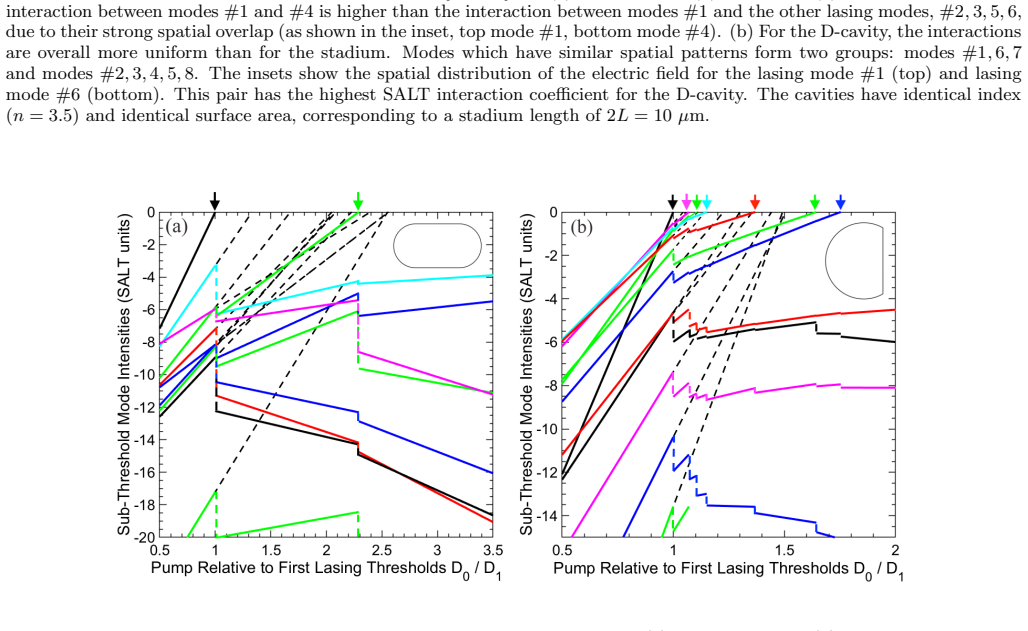
The central object is the paper's steady-state ab initio laser theory (SALT) and its single-pole approximation, which reduces multimode lasing to a set of linear equations for mode intensities, $D_0/D_\mu^0 - 1 = \sum_\nu A_{\mu\nu} I_\nu$, where the interaction matrix $A_{\mu\nu}=\Gamma_\nu \chi_{\mu\nu}$ contains the Lorentzian gain factor and the spatial overlap integral $\chi_{\mu\nu}=\int d^2r\, \Psi_\mu^2 |\Psi_\nu|^2$. The single-pole approximation fixes each lasing mode to its threshold field distribution, and the resonance approximation replaces threshold lasing modes by passive cavity resonances, letting the authors simulate cavities up to 60 micrometers. The machinery decides how many modes turn on: it yields the interacting thresholds, the sub-threshold 'negative intensities' whose slopes show when gain clamping prevents any further mode from turning on, and the number of lasing modes as a function of pump strength.
What would settle it
A cw-pumped, low-roughness stadium or D-shaped GaAs microlaser of the size used here that reproducibly emits a single lasing line while the same cavity's steady-state calculation predicts several modes would disprove the claim that gain competition cannot force single-mode operation.
Extended reading notes
Core claim
On the paper's own terms, the discovery is that gain competition is not sufficient to induce single-mode lasing in wave-chaotic microlasers: both experiment and the steady-state laser equations show sustained multimode operation. The calculations, which include saturable gain and cross-saturation to all orders, never yield a single lasing mode for stadium or D-shaped cavities pumped well above threshold, for any refractive index tested, nor do the predictions change when surface roughness is added or cavity size is increased. The difference between the few-mode stadium and the eight-mode D-cavity at small size is traced to high-Q scarred modes, whose anomalously high quality factors let the first mode clamp the gain; those non-universal outliers weaken with size and roughness, so the theoretical spectra of the two shapes converge. Because the equations include the full effects of gain competition, the paper concludes that the single-mode lasing observed in other stadium experiments must arise from dynamical effects outside steady-state theory, such as frequency locking of nearly degenerate modes.
Load-bearing premise
The whole case against single-mode lasing rests on a steady-state laser model that assumes the gain medium responds slowly and that each lasing mode keeps the shape of a passive cavity resonance—assumptions that become harder to justify in the large, densely multimode cavities actually used in the experiments.
Editorial extensions
If this is right
- If the central claim is right, steady-state multimode operation is generic for wave-chaotic semiconductor microlasers, so single-mode reports are the anomaly to explain rather than the rule.
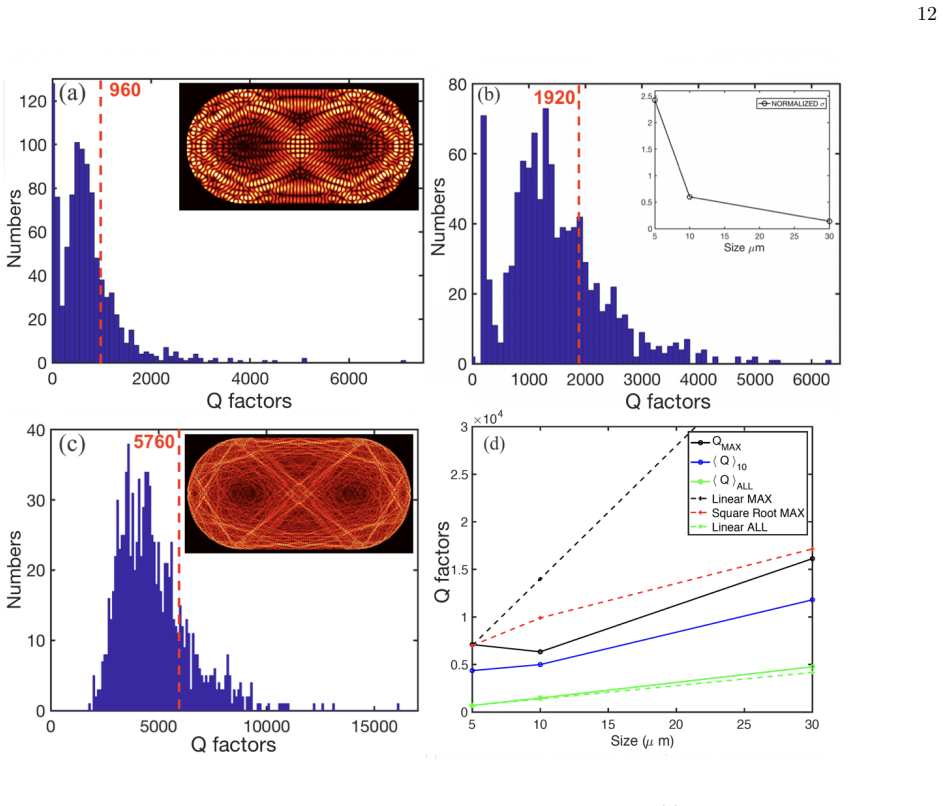
- The number of lasing modes is set by a combination of the Q-factor distribution and cross-saturation: high-Q scarred modes can suppress other modes, but this suppression weakens as the cavity grows and as surface roughness scatters the scarred fields.
- Surface roughness and larger sizes make stadium and D-cavity lasers quantitatively more similar, matching the similar thresholds observed experimentally.
- Any complete explanation of single-mode lasing in wave-chaotic cavities must invoke dynamics beyond gain saturation and spatial hole burning, such as frequency locking driven by population relaxation.
- Time-resolved spectra that are stable over 10 microseconds and do not shrink to one line over 500 microsecond pulses support treating the measured multimode state as the true steady state.
Reading between the lines
- A consequence the paper leaves implicit: if gain competition cannot kill the extra modes, then the practical route to single-mode wave-chaotic lasers runs through engineering the gain dynamics or the mode spectrum, not through making the cavity more chaotic.
- The sub-threshold intensity plots could be turned into a design tool: before fabrication, one could screen cavity shapes and roughness levels for how many modes they will support by reading which modes acquire negative slopes.
- A direct test would be to repeat the single-mode cw experiment while tuning the carrier lifetime (via temperature or doping); the paper's logic predicts that single-mode lasing, if it appears, will track dynamical locking conditions rather than mode overlap.
- The size-scaling results suggest a testable prediction: in very large wave-chaotic lasers, the spectral statistics should become shape-independent as scar outliers vanish.
Signed reviews
Editorial analysis
A structured set of objections, weighed in public.
Referee Report
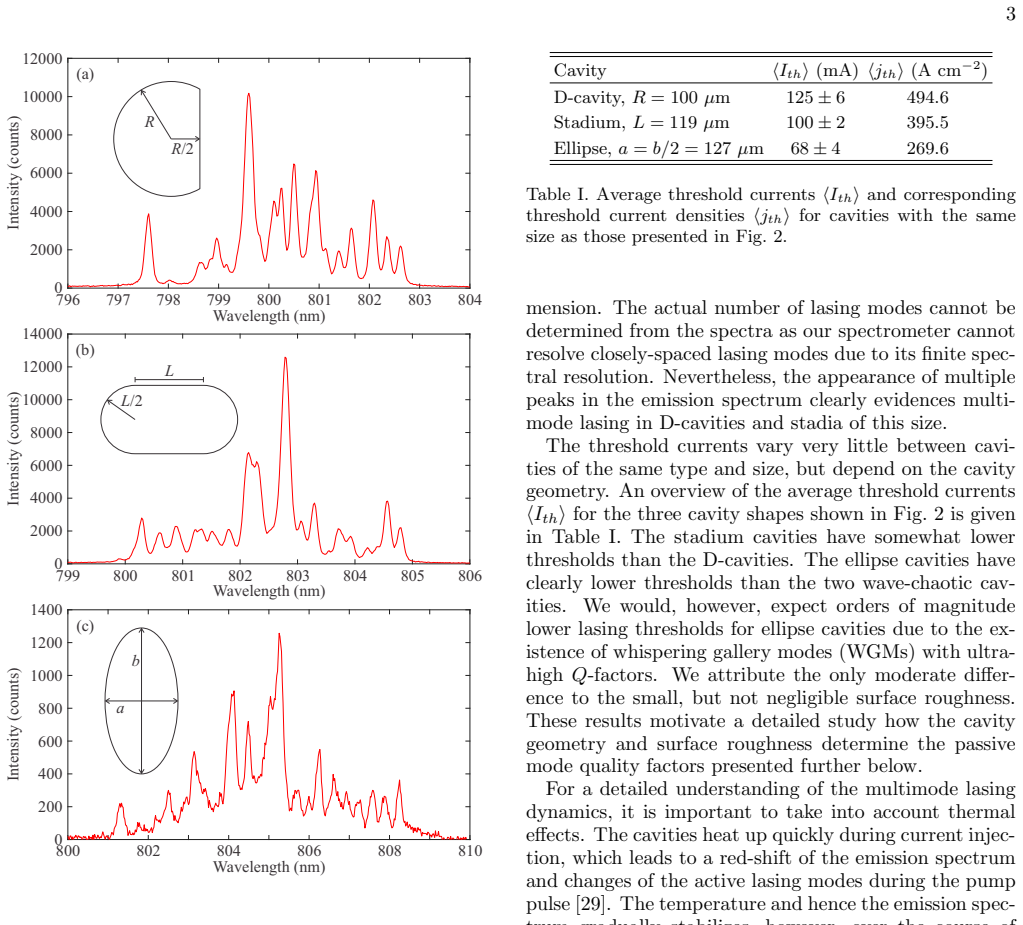
Summary. The manuscript reports an experimental and theoretical study of lasing mode competition in wave-chaotic semiconductor microlasers. Experimentally, the authors measure emission spectra of D-shaped and stadium-shaped GaAs microlasers of 100-200 micrometer scale under pulsed electrical pumping with microsecond time resolution, finding multiple spectral peaks at all times and no evolution toward single-mode operation over 500 microsecond pulses; the spectra are stable over 10 microsecond windows, which they interpret as quasi-steady state. Theoretically, they use SPA-SALT and its resonance approximation to compute lasing spectra for stadium and D-cavity resonators with sizes of 10-60 micrometers, refractive indices of 2.5-3.5, and with or without surface roughness. All calculated cases show multimode lasing; the number of modes varies with geometry and refractive index, mainly because of scarred high-Q modes in the smooth stadium, an effect that weakens with increasing size and with surface roughness. The authors conclude that gain competition and spatial hole burning are not sufficient to produce single-mode lasing in these systems, and that the single-mode behavior reported by Sunada et al. likely requires dynamical mechanisms such as frequency locking.
Significance. If correct, the paper contributes to resolving a controversy between the authors' earlier multimode observations and the single-mode cw experiments of Sunada et al., by providing direct experimental evidence of steady multimode lasing in two fully chaotic geometries and a systematic theoretical argument that cross-saturation alone does not select a single mode. The work is careful in several respects: the time-resolved spectra establish quasi-steady-state conditions rather than relying only on time-integrated measurements; the theoretical calculations use a published SPA-SALT code with stated inputs (gain width 50 nm, roughness 30 nm, refractive index) that are not fitted to the new spectra; and the paper candidly lists the limitations of SIA and SALT in dense spectra. The identification of dynamical frequency locking as the likely cause of single-mode lasing in prior experiments is a testable hypothesis and gives the paper significance beyond the specific devices.
major comments (2)
- [Secs. III.B-C and V; Abstract] The central theoretical claim, stated categorically in Sec. V as 'SALT theory ... never predicts single-mode lasing for wave-chaotic resonators pumped well above threshold' and in the Abstract as 'gain competition is not sufficient to result in single-mode lasing in these systems,' is based on SPA-SALT and resonance SPA-SALT calculations whose validity assumptions are explicitly acknowledged to break down in the regime of the experiments. The manuscript states in Sec. III.A that the Stationary Inversion Approximation 'becomes harder to meet in the highly-multimode regime and for larger laser cavities' and in Sec. I that SALT 'loses quantitative validity when the lasing spectra becomes too dense.' The largest simulated cavities (2L=60 um stadium, R=8.4 um D-cavity with roughness) are still factors of 2 to 4 smaller in linear dimension than the experimental cavities (R=100-200 um, L=119-238 um), so the inference from the simulated regime to the experimental regime is an extrapolation. To make the claim load-bearing, the authors should either provide a quantitative argument, for example a scaling analysis of the SPA-SALT interaction matrix A_mu_nu with cavity size showing that cross-saturation cannot become mode-selecting at larger sizes, or explicitly restrict the conclusion to the regime in which SPA-SALT is valid. As written, the categorical conclusion is not supported by the calculations presented.
- [Sec. IV.E and Table III] The size-scaling evidence is incomplete for the extrapolation to the experimental regime. Figure 8 and the accompanying text demonstrate that the Q-factor distributions of smooth stadia narrow with increasing size and that Qmax grows sub-linearly, but they do not show the corresponding evolution of the number of lasing modes for smooth cavities beyond 2L=10 um. Table III gives mode counts for rough cavities at only two sizes (10 and 20 um), not at 60 um or beyond, and the claimed roughly two-fold increase in mode count with doubling of size is inferred from a single doubling. The statement that the differences between stadium and D-cavity 'decrease as the system size increases' is therefore not directly connected to a computed mode count at the experimental sizes; the connection is an assumption that should be flagged as such.
minor comments (5)
- [Eq. (10)] The displayed formula for D_mu^0 has unbalanced parentheses and absolute-value bars, and the fraction in the second factor is not typeset unambiguously; this should be corrected for reproducibility.
- [Sec. IV.F] The definition of sigma is dimensionally inconsistent: the text first calls sigma the standard deviation of the boundary deformation, then gives sigma = E[(r-r0)^2]/r0, which is a normalized variance with units of length rather than a standard deviation. Because the roughness magnitude is a key input for the suppression of scar modes, the definition should be stated precisely.
- [Sec. II] The sentence 'All three cavities have approximately the same area of 25, 300 um^2' should read '25,300 um^2'; the comma is easily misread as a separator between two numbers.
- [Sec. IV.A and Fig. 8] The notation '2L = 10, 20, 60 um' is used for the stadium size, but L is defined earlier as the side of the square part; the reader must infer that the total length is 2L. A brief restatement of the geometry parameterization in Sec. IV.E would improve clarity.
- [Sec. IV.B and Table II] The paper states that for the stadium at n=3.5, 'two modes start lasing within a factor of 10' and 'reaching six modes' at higher pump, but the corresponding gain-clamping limit in Table II is given as 6; the relation between the factor-of-10 count and the gain-clamping count is clear only after reading Sec. IV.D, so a one-sentence explanation near Table II would help.
Circularity Check
No significant circularity: the multimode prediction follows from forward SALT/SPA-SALT calculations with stated physical inputs, not from fitting or definitional reduction.
full rationale
The theoretical claim is a forward calculation of the SALT/SPA-SALT equations with stated physical inputs: cavity geometry, refractive index n, gain width γ⊥=50 nm, gain center λa=1 μm, and surface roughness σ=30 nm estimated from SEM images. No parameter is fitted to the lasing spectra whose multimode character is at issue. The mode set is not assumed to be multimode: the SPA-SALT positivity condition (Eq. 4 with Iν≥0) can and does suppress modes, for example the n=3.5 stadium yields only two lasing modes within 10× threshold, so single-mode lasing is a possible outcome of the model yet was not found in any computed case. The resonance-SPA-SALT approximation, in which passive cavity modes replace threshold lasing modes (Eq. 10), is an explicitly stated approximation that the paper says was compared with full SALT in prior work; this self-citation is supporting evidence, not a definitional reduction, and the paper openly flags the dense-spectrum, large-cavity regime as one where SALT loses quantitative validity. The remaining gap, extrapolating from 60 μm simulated cavities to 100–200 μm experimental cavities, is an acknowledged limitation of computational reach and model validity, not a circularity. There are therefore no load-bearing steps that reduce by construction to the claimed result.
Assumptions & free parameters
free parameters (4)
- Gain curve width γ⊥ =
50 nm
- Surface roughness σ =
30 nm
- Refractive index n =
3.5 (also 3.0, 2.5)
- Cavity aspect ratios ρ_S=2, ρ_D=0.5
assumptions (6)
- domain assumption Stationary Inversion Approximation (SIA) is valid for the simulated cavities
- domain assumption Lasing modes are well approximated by passive cavity resonances (resonance SPA-SALT)
- domain assumption Two-dimensional scalar TM description is sufficient
- domain assumption D-cavity and stadium ray dynamics are fully chaotic
- domain assumption Carrier diffusion is neglected
- domain assumption The emission spectra after 400-500 us represent a quasi-steady state
Cite this review
Pith. "Pith review of Multimode Lasing in Wave-Chaotic Semiconductor Microlasers." pith.science (2026). https://pith.science/paper/BBZ5WDE6
@misc{pith2026190805397,
  author       = {Pith},
  title        = {Pith review of: Multimode Lasing in Wave-Chaotic Semiconductor Microlasers},
  year         = {2026},
  howpublished = {\url{https://pith.science/paper/BBZ5WDE6}},
  note         = {Machine review of arXiv:1908.05397}
}
read the original abstract
We investigate experimentally and theoretically the lasing behavior of dielectric microcavity lasers with chaotic ray dynamics. Experiments show multimode lasing for both D-shaped and stadium-shaped wave-chaotic cavities. Theoretical calculations also find multimode lasing for different shapes, sizes and refractive indices. While there are quantitative differences between the theoretical lasing spectra of the stadium and D-cavity, due to the presence of scarred modes with anomalously high quality factors, these differences decrease as the system size increases, and are also substantially reduced when the effects of surface roughness are taken into account. Lasing spectra calculations are based on Steady-State Ab Initio Laser Theory, and indicate that gain competition is not sufficient to result in single-mode lasing in these systems.
Figures


Figures from the paper (6 more)



Reference graph
Works this paper leans on
-
[1]
Cao and J
H. Cao and J. Wiersig, Rev. Mod. Phys. 87, 61 (2015)
2015
-
[2]
E. G. Altmann, J. S. E. Portela, and T. T´ el, Rev. Mod. Phys. 85, 869 (2013)
work page 2013
-
[3]
Ohtsubo, Semiconductor Lasers: Stability, Instability and Chaos (Springer, 2013)
J. Ohtsubo, Semiconductor Lasers: Stability, Instability and Chaos (Springer, 2013)
work page 2013
-
[4]
S. L. McCall, A. F. J. Levi, R. E. Slusher, S. J. Pearton, and R. A. Logan, Appl. Phys. Lett. 60, 289 (1992)
work page 1992
-
[5]
J. U. N¨ ockel, A. D. Stone, and R. K. Chang, Opt. Lett. 19, 1693 (1994)
work page 1994
-
[6]
J. U. N¨ ockel and A. D. Stone, Nature385, 45 (1997)
1997
-
[7]
N. B. Rex, H. E. Tureci, H. G. L. Schwefel, R. K. Chang, and A. Douglas Stone, Phys. Rev. Lett. 88, 094102 (2002)
work page 2002
-
[8]
J. U. N¨ ockel, A. D. Stone, G. Chen, H. L. Grossman, and R. K. Chang, Opt. Lett. 21, 1609 (1996)
work page 1996
Show all 54 references
-
[9]
Wiersig and M
J. Wiersig and M. Hentschel, Phys. Rev. A 73, 031802 (2006)
2006
-
[10]
Q. Song, L. Ge, A. D. Stone, H. Cao, J. Wiersig, J.- B. Shim, J. Unterhinninghofen, W. Fang, and G. S. Solomon, Phys. Rev. Lett. 105, 103902 (2010)
2010
-
[11]
Q. Song, L. Ge, J. Wiersig, J.-B. Shim, J. Unterhin- ninghofen, A. Ebersp¨ acher, W. Fang, G. S. Solomon, and H. Cao, Phys. Rev. A 84, 063843 (2011)
2011
-
[12]
Fang and H
W. Fang and H. Cao, Appl. Phys. Lett. 91, 041108 (2007)
2007
-
[13]
Q. Song, W. Fang, B. Liu, S.-T. Ho, G. S. Solomon, , and H. Cao, Phys. Rev. A 80, 041807 (2009)
2009
-
[14]
H. E. T¨ ureci, A. D. Stone, and B. Collier, Phys. Rev. A 74, 043822 (2006)
2006
-
[15]
H. E. T¨ ureci, A. D. Stone, and L. Ge, Phys. Rev. A 76, 013813 (2007)
2007
-
[16]
H. E. T¨ ureci, L. Ge, S. Rotter, and A. D. Stone, Science 320, 643 (2008)
2008
-
[17]
L. Ge, Y. Chong, and A. D. Stone, Phys. Rev. A 82, 063824 (2010)
2010
-
[18]
Esterhazy, D
S. Esterhazy, D. Liu, M. Liertzer, A. Cerjan, L. Ge, K. Makris, A. Stone, J. Melenk, S. Johnson, and S. Rot- ter, Phys. Rev. A 90, 023816 (2014)
2014
-
[19]
Cerjan, Y
A. Cerjan, Y. Chong, and A. D. Stone, Opt. Express 23, 6455 (2015)
2015
-
[20]
Fu and H
H. Fu and H. Haken, J. Opt. Soc. Am. B 5, 899 (1988)
1988
-
[21]
L. Ge, R. J. Tandy, A. D. Stone, and H. E. T¨ ureci, Opt. Express 16, 16895 (2008)
2008
-
[22]
Redding, A
B. Redding, A. Cerjan, X. Huang, M. L. Lee, A. D. Stone, M. A. Choma, and H. Cao, Proc. Nat. Acad. of Sci. 112, 1304 (2015)
2015
-
[23]
Redding, M
B. Redding, M. A. Choma, and H. Cao, Nature Photon- ics 6, 355 (2012)
2012
-
[24]
Mermillod-Blondin, H
A. Mermillod-Blondin, H. Mentzel, and A. Rosenfeld, Opt. Lett. 38, 4112 (2013)
2013
-
[25]
H. Cao, R. Chriki, S. Bittner, A. A. Friesem, and N. Davidson, Nature Reviews Physics 1, 156 (2019)
2019
-
[26]
Sunada, T
S. Sunada, T. Fukushima, S. Shinohara, T. Harayama, and M. Adachi, Phys. Rev. A 88, 013802 (2013)
2013
-
[27]
Sunada, S
S. Sunada, S. Shinohara, T. Fukushima, and T. Harayama, Phys. Rev. Lett. 116, 203903 (2016)
2016
-
[28]
Harayama, S
T. Harayama, S. Sunada, and S. Shinohara, Photon. Res. 5, B39 (2017)
2017
-
[29]
Bittner, S
S. Bittner, S. Guazzotti, Y. Zeng, X. Hu, H. Yılmaz, K. Kim, S. S. Oh, Q. J. Wang, O. Hess, and H. Cao, Science 361, 1225 (2018)
2018
-
[30]
L. A. Bunimovich, Comm. Math. Phys. 65, 295 (1979)
1979
-
[31]
Ree and L
S. Ree and L. Reichl, Phys. Rev. E 60, 1607 (1999)
1999
-
[32]
T. L. Myers, R. M. Williams, M. S. Taubman, C. Gmachl, F. Capasso, D. L. Sivco, J. N. Baillargeon, and A. Y. Cho, Opt. Lett. 27, 170 (2002)
2002
-
[33]
Harayama, T
T. Harayama, T. Fukushima, P. Davis, P. O. Vaccaro, T. Miyasaka, T. Nishimura, and T. Aida, Phys. Rev. E 67, 015207 (2003)
2003
-
[34]
W. Fang, A. Yamilov, and H. Cao, Phys. Rev. A 72, 023815 (2005)
2005
-
[35]
Novaes, Phys
M. Novaes, Phys. Rev. E 85, 036202 (2012)
2012
-
[36]
Bid´ egaray, Numerical Methods for Partial Differential Equations: An International Journal 19, 284 (2003)
B. Bid´ egaray, Numerical Methods for Partial Differential Equations: An International Journal 19, 284 (2003)
2003
-
[37]
Huang and S.-T
Y. Huang and S.-T. Ho, Opt. Express 14, 3569 (2006)
2006
-
[38]
Cerjan, A
A. Cerjan, A. Pick, Y. D. Chong, S. G. Johnson, and A. D. Stone, Opt. Express 23, 28316 (2015)
2015
-
[39]
B¨ ohringer and O
K. B¨ ohringer and O. Hess, Progress in Quantum Elec- tronics 32, 159 (2008)
2008
-
[40]
Cerjan, Y
A. Cerjan, Y. Chong, L. Ge, and A. D. Stone, Opt. Express 20, 474 (2012)
2012
-
[41]
Esterhazy, D
S. Esterhazy, D. Liu, M. Liertzer, A. Cerjan, L. Ge, K. G. Makris, A. D. Stone, J. M. Melenk, S. G. Johnson, and S. Rotter, Phys. Rev. A 90, 023816 (2014)
2014
-
[42]
Cerjan, B
A. Cerjan, B. Redding, L. Ge, S. F. Liew, H. Cao, and A. D. Stone, Opt. Express 24, 26006 (2016)
2016
-
[43]
Resonance spa-salt,
A. Cerjan, “Resonance spa-salt,” (2016), https://github.com/acerjan/comsolspasalt
2016
-
[44]
E. J. Heller, Phys. Rev. Lett. 53, 1515 (1984)
1984
-
[45]
J. P. Keating, M. Novaes, and H. Schomerus, Phys. Rev. A 77, 013834 (2008)
2008
-
[46]
Schomerus, J
H. Schomerus, J. Wiersig, and J. Main, Phys. Rev. A 79, 053806 (2009)
2009
-
[47]
Bittner, S., et al, Manuscript in preparation. 16
-
[48]
E. G. Vergini, Europhys. Lett. 110, 10010 (2015)
2015
-
[49]
Shinohara and T
S. Shinohara and T. Harayama, Phys. Rev. E 75, 036216 (2007)
2007
-
[50]
Harayama and S
T. Harayama and S. Shinohara, Phys. Rev. E 92, 042916 (2015)
2015
-
[51]
E. G. Vergini, Phys. Rev. Lett. 108, 264101 (2012)
2012
-
[52]
S. F. Liew, B. Redding, L. Ge, G. S. Solomon, and H. Cao, Appl. Phys. Lett. 104, 231108 (2014)
2014
-
[53]
Harayama, T
T. Harayama, T. Fukushima, S. Sunada, and K. S. Ikeda, Phys. Rev. Lett. 91, 073903 (2003)
2003
-
[54]
Kawashima, S
Y. Kawashima, S. Shinohara, S. Sunada, and T. Harayama, Photon. Res. 5, B47 (2017)
2017
Reviewed August 14, 2026 · model on record in the stance chip above.
Discussion (0). Continue with ORCID to comment.