REVIEW 4 major objections 5 minor 1 cited by
Protostellar disks in their natural habitat -- the formation of protostars and their accretion disks in the turbulent and magnetized interstellar medium
T0 review · 4 major / 5 minor · reviewed 2026-08-07 · deepseek-v4-flash
Pith's one-line read Zoom-in simulations from a supernova-driven turbulent interstellar medium find that ideal magnetohydrodynamics prevents protostellar disks larger than about 10 au at stellar birth, while ambipolar diffusion restores such disks in only two…
desk verdict Impressive multi-scale zoom-in comparison, but the universal 'never-with-a-disk' statement outruns the six-core sample. read the letter →
The pith
A machine-rendered reading of the paper's core claim, the machinery that carries it, and where it could break.
The reading
What carries the argument
The machinery is a two-stage zoom-in simulation pipeline built on the moving-mesh code AREPO. A $(256\,\mathrm{pc})^3$ periodic box of supernova-driven turbulent interstellar medium is evolved with gravity until dense cores collapse; six well-separated cores are then re-simulated from identical initial conditions with pure hydrodynamics, ideal MHD, or ambipolar diffusion, with mass resolution down to $3.33\times10^{-7}\,\mathrm{M}_\odot$ and no sink particles, so the first and second Larson cores form explicitly. The decisive physics is the competition between magnetic braking, the removal of angular momentum by field tension and magneto-rotational outflows, and ambipolar diffusion, the slip of neutral gas past the magnetic field that resists that transport; the ambipolar diffusion coefficient comes from a chemical library table with a cosmic-ray ionization rate of $10^{-17}$ s$^{-1}$. Supporting apparatus includes an eccentricity-based disk definition (cells with orbital eccentricity $e < 0.3$ and density above $8\times10^{-14}$ g cm$^{-3}$, projected onto the rotation plane) and a Toomre $Q$ analysis with magnetic pressure added to the effective sound speed.
What would settle it
Decisive test one: re-simulate the six zoom-in cores with the physical, uncapped ambipolar diffusion coefficient, adding Ohmic dissipation and cosmic-ray attenuation; if three or more of the six cores then form disks larger than 10 au, the 'two of six' statistic and the claim that ambipolar diffusion does not guarantee a disk would need revision. Decisive test two: re-simulate any single core in ideal MHD from an earlier zoom-in start, without the volume limit, at higher resolution; a rotationally supported disk larger than 10 au already present at second-core formation would refute the claim that ideal MHD prevents disk birth, and the paper's own Appendix C tests currently find no such disk.
Extended reading notes
Core claim
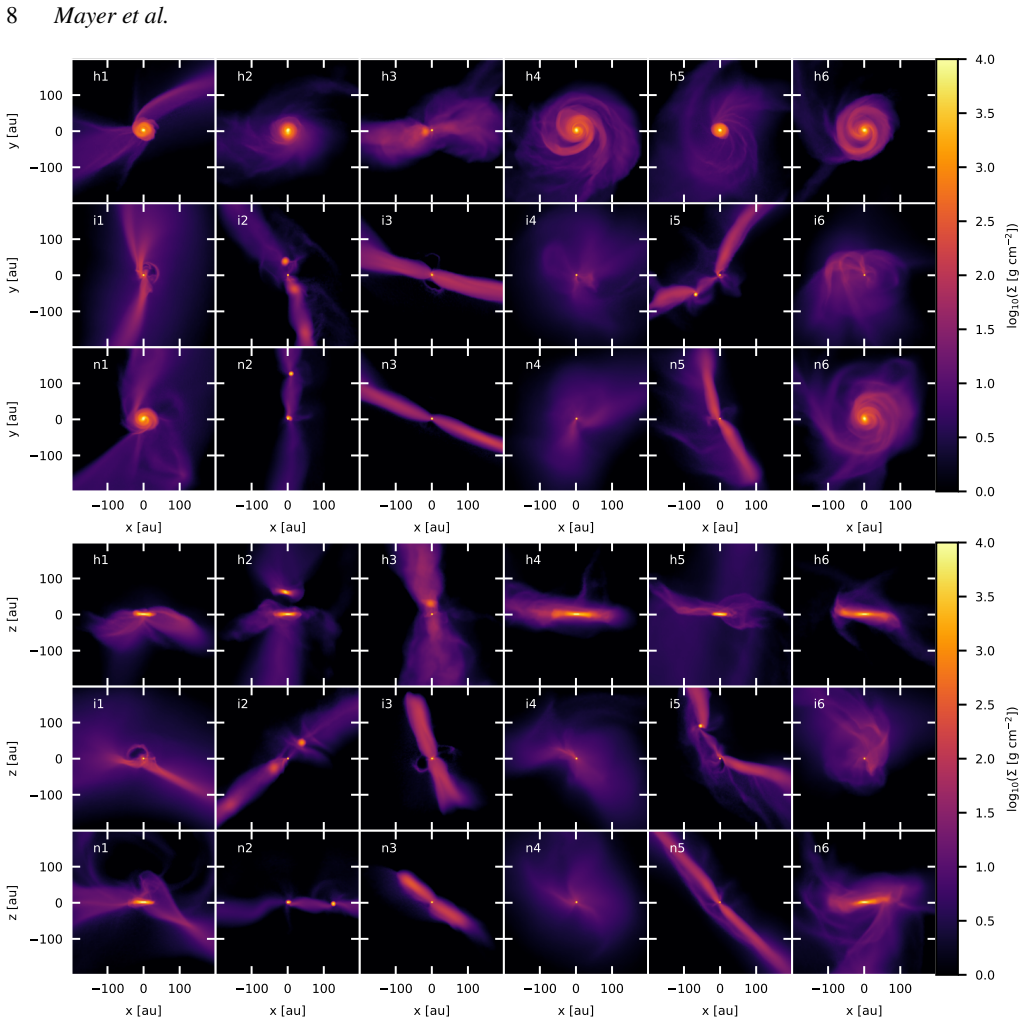
The central claim is that the magnetic field treatment, not the initial core properties, decides whether a protostar has a disk at birth. In all six zoom-in cores the purely hydrodynamical runs form rotationally supported disks of roughly 10-100 au before the second core appears, while every ideal MHD run ends with a nearly spherical hydrostatic core and no disk above about 10 au, even though these cores are irregular, shock-shaped, and carry magnetic fields misaligned with their rotation, conditions previously thought to bypass the magnetic braking catastrophe. With ambipolar diffusion the outcome splits: cores n1 and n6 form large disks with rotation speeds above 1 km s$^{-1}$ extending past 100 au, spiral substructure, and Toomre $Q < 1$, while the other four cores remain diskless. The mechanism the authors identify is the magneto-rotational outflow: wherever outflows carry away sufficient angular momentum, disk formation is shut off, and ambipolar diffusion enables disks precisely by weakening those outflows and letting the magnetic flux diffuse outward in the inner few au. The paper extends this to a stark statement: if ideal MHD were a good description of reality, stars would never be born with a disk, although disks might still assemble later, beyond the simulated epoch.
Load-bearing premise
The paper caps the ambipolar diffusion coefficient so that the non-ideal magnetic effect is weaker than the real physical effect, and if that cap were removed, more than two of the six cores might form large disks and the central 'two out of six' statistic would change.
Editorial extensions
If this is right
- The magnetic braking catastrophe survives realistic turbulence: ideal MHD suppresses disks above about 10 au at stellar birth in all six cores, so the suppression is not an artifact of idealized aligned rotators.
- Non-ideal MHD does not guarantee a disk; the two-of-six outcome means disk presence at birth depends on core geometry interacting with ambipolar diffusion.
- Magneto-rotational outflows are the angular-momentum valve: where they are strong they prevent rotationally supported disks, and ambipolar diffusion's main disk-enabling effect is to weaken them.
- Disks that do form early are large and gravitationally unstable, with $Q < 1$ in spiral arms, so fragmentation and complex substructure can begin at birth.
- The diversity among six cores, from diskless births to 100 au grand-design disks with nested second disks around the stellar core, implies observations of the youngest protostars should find a wide range of disk sizes and morphologies.
Reading between the lines
- Because the code caps the ambipolar diffusion coefficient at a fraction of the ideal-MHD timestep, making the non-ideal effect weaker than the modeled physics, the two-in-six figure is best read as a lower bound on how often ambipolar diffusion enables early disks; including Ohmic dissipation, the Hall effect, and cosmic-ray attenuation could push the count higher.
- The paper switches ambipolar diffusion on only at the zoom-in stage; evolving the driving and tracing phases with non-ideal MHD as well could change which cores are selected and how their fields are oriented, possibly shifting the disk statistics from the outset.
- A direct observational consequence, implicit but untested here, is a population of genuinely diskless births: very young Class 0 protostars in strongly magnetized clouds with no detectable rotationally supported structure would be the signature of the ideal-MHD-like outcome the paper predicts for a subset of cores.
- If early disks are required for subsequent planet formation, the paper's result implies that the planet-forming potential of a star is partly set by the magnetic microphysics (ionization, grain properties) of its natal core, not just by core mass and angular momentum.
Editorial analysis
A structured set of objections, weighed in public.
Referee Report
Summary. The paper presents zoom-in simulations that start from a (256 pc)^3 supernova-driven turbulent ISM and follow six prestellar cores down to the formation of the second Larson core, comparing pure hydrodynamics, ideal MHD, and ambipolar diffusion. The main qualitative findings are that the hydro runs form rotationally supported disks of roughly 10-100 au, that ideal MHD suppresses such disks by the time of second-core formation, and that ambipolar diffusion allows large disks in two of the six cores while generally weakening outflows. The paper also reports magnetically driven outflows, strong magnetic field growth to >10 G in the first cores, Toomre Q<1 spiral structure in the disks that do form, and streamer-like anisotropic accretion. The authors conclude that non-ideal MHD is required for early disk formation in realistic turbulent environments and, in the final paragraph, state that if ideal MHD were a good description of reality, 'stars would never be born with a disk'.
Significance. If the qualitative result holds, this is a valuable demonstration that ideal-MHD magnetic braking suppresses early disk formation in a realistic multi-scale ISM context, beyond the idealized aligned-collapse setups that motivated the 'magnetic braking catastrophe' debate. The study's strengths are its dynamic range (256 pc to ~10^-4 au), the matched six-core comparison across three magnetic treatments, the resolved first and second Larson cores without sink particles in the zoom-in, and the additional robustness runs in Appendix C. The morphology and outflow diagnostics, the Toomre analysis of the two AD disks, and the streamer rendering in n6 are concrete, falsifiable contributions. The main weakness is that the paper's headline universal claim is not supported by its own stated sample-size caveat and by the acknowledged existence of later-time disks in ideal MHD from previous work; the global claim should therefore be separated from the sample-level result.
major comments (4)
- [Section 8; Section 7] The concluding statement that 'stars would never be born with a disk' under ideal MHD is a universal negative that is not supported by the simulation sample. Section 7 explicitly says the six-core sample is not statistically significant and 'precluding us from drawing very general conclusions', and it acknowledges that longer-term ideal-MHD studies (Kuffmeier et al. 2017; Yang & Federrath 2025) find disks forming later. Since the paper also says it cannot follow evolution beyond second-core formation, the final conclusion should be reworded to a statement about early disk formation in this sample, or the authors must supply evidence that the six cores are representative of all protostellar collapse geometries.
- [Abstract; Table 3] The abstract's claim that there are 'no disks larger than 10 au with ideal MHD' is quantitatively contradicted by Table 3, where simulation i1 has R_eff = 11 au, and Section 5.3 similarly notes that region 1 is the exception with disk material in the ideal-MHD run. The abstract should say 'about 10 au' or the i1 disk-size measurement must be re-examined, since this threshold is the paper's central quantitative result.
- [Section 2.3, Eq. (6); Appendix C] The cap on the ambipolar diffusion coefficient, eta_AD < (1/f_ni) c_s r with f_ni = 0.125, makes the non-ideal scheme weaker than the physical effect, as the paper states, and the lack of cosmic-ray attenuation further weakens AD. The conclusion that AD 'does not guarantee' a disk rests on the 2/6 statistic, and the only uncapped test is described inconsistently: Section 5.4 says 'in the case of n5', while the Appendix C text and Figure C1 caption refer to 'n6'. This test is the key evidence that the cap is not decisive, so the run identity must be corrected and the dependence of the 2/6 statistic on the cap should be discussed or tested more broadly.
- [Section 2.2, Eq. (5)] The barotropic equation of state is a fit to the densest fluid element in Wurster et al. (2018a) and, as the paper itself states, 'systematically underestimates the temperature of any material that collapses later, which includes the entire protostellar disk'. Because the disk temperature enters the pressure support and the Toomre Q analysis, the quantitative disk sizes, spiral-structure, and gravitational-instability claims are affected. The paper should either quantify the effect of this EOS choice or temper the quantitative conclusions that depend on it.
minor comments (5)
- [Section 5.4] The sentence 'it can then no longer amplify effectively ans is even diffused' contains a typo; it should read 'and is even diffused'.
- [Figure C1; Appendix C] The bottom-left panel is labeled 'n6' in the figure caption but is called 'n5_nolim' in the main text and in the Appendix text; the naming should be made consistent.
- [Section 2.2; Eq. (5)] The cooling prescription uses a mean molecular weight of mu = 1.4, while Eq. (5) uses mu ≈ 2.381; the paper should state explicitly that the two values correspond to different physical regimes.
- [Section 3.3] The text says the runs are continued 'until the formation of the second core', but n6 is stopped before that; this is explained later in the same paragraph, so the sentence should be adjusted for internal consistency.
- [Figure 19] The lower panels of Figure 19 repeat '(as y-axis)' in the axis labels, which is confusing; these should be replaced with proper distance labels.
Circularity Check
No significant circularity: the disk statistics emerge from self-contained MHD simulations; cited prior work is methodological, and the universal 'never' phrasing is an acknowledged generalization overreach, not a by-construction reduction.
full rationale
The paper's central result—that ideal MHD suppresses disks larger than ~10 au at second-core formation while ambipolar diffusion allows such disks in two of six cores—is an emergent outcome of solving the ideal/non-ideal MHD equations (Eq. 1) with standard subgrid physics, not a quantity fitted to or defined by the input parameters. The ambipolar diffusion coefficient cap (Eq. 6, f_ni = 0.125) is a numerical timestep restriction, explicitly stated to make the non-ideal scheme weaker than physical, and the paper does not tune it to produce the disk statistics; Appendix C's n5_nolim runs remove the cap and add Ohmic diffusion yet still find no disk, so the non-disk outcome is not forced by the cap. The self-citations (Mayer et al. 2025 for the barotropic EOS of Eq. 5 and the NICIL chemistry table; Zier et al. 2024a,b for the AREPO non-ideal MHD implementation) are code and method references, not load-bearing evidence for the disk-size conclusion, and the EOS itself is a fit to external radiative calculations of Wurster et al. (2018a). The only concern the manuscript itself raises is statistical and logical generality: Section 7 states the sample is 'not statistically significant... precluding us from drawing very general conclusions,' and the final paragraph qualifies the 'never born with a disk' statement with 'even though they might still form later, which is beyond the scope of our study.' These are inference-strength and sample-representativeness caveats, not circularity by construction. No equation or parameter in the paper reduces to the target disk statistics, so no circular step is present.
Assumptions & free parameters
free parameters (3)
- Barotropic EOS parameters =
c_s0 = 0.22 km/s, n1 = 2e10 cm^-3, n2 = 2.5e14 cm^-3, n3 = 1e20 cm^-3, mu = 2.381
- Ambipolar diffusion timestep cap f_ni =
0.125
- Density thresholds for core and disk definitions =
rho_core = 5e-18 g/cm^3, rho_fhc = 1e-11 g/cm^3, rho_disk = 8e-14 g/cm^3
assumptions (6)
- standard math Ideal MHD equations with Powell divergence cleaning provide a valid description of the magnetic field evolution.
- domain assumption The barotropic equation of state (Eq. 5) captures the essential thermal physics of collapse.
- domain assumption Ambipolar diffusion is the dominant non-ideal MHD effect; Ohmic and Hall terms are negligible at the scales studied.
- domain assumption The supernova-driving prescription and the absence of galactic shear and a galactic potential produce a representative ISM.
- domain assumption The six selected cores are isolated and representative of star-forming cores in the ISM.
- domain assumption Sink particles in the tracing phase correctly identify collapsing regions without feedback.
Cite this review
Pith. "Pith review of Protostellar disks in their natural habitat -- the formation of protostars and their accretion disks in the turbulent and magnetized interstellar medium." pith.science (2026). https://pith.science/paper/BD5U3U2G
@misc{pith2026250614394,
  author       = {Pith},
  title        = {Pith review of: Protostellar disks in their natural habitat -- the formation of protostars and their accretion disks in the turbulent and magnetized interstellar medium},
  year         = {2026},
  howpublished = {\url{https://pith.science/paper/BD5U3U2G}},
  note         = {Machine review of arXiv:2506.14394}
}
abstract
We present simulations of the supernova-driven turbulent interstellar medium (ISM) in a simulation domain of volume $(256\,{\rm pc})^3$ within which we resolve the formation of protostellar accretion disks and their stellar cores to spatial scales of $\sim 10^{-4}$ au, using the moving-mesh code {\small AREPO}. We perform simulations with no magnetic fields, ideal magnetohydrodynamics (MHD) and ambipolar diffusion, and compare the resulting first Larson cores and their associated structures, including the accretion disks, their location within the larger-scale structure and the streamers connecting these. We find that disks of sizes $10-100\,{\rm au}$ form early in the simulations without magnetic fields, while there are no disks larger than 10 au with ideal MHD. Ambipolar diffusion causes large disks to form in a subset of cases (two out of six cores), and generally reduces the strength of outflows, which are seen to play a central role. When they are able to carry away significant angular momentum, they prevent the formation of a rotationally supported disk. Magnetic fields strengths grow from $0.1 - 1$ mG in the protostellar core to more than 10 G in the first Larson core in all simulations with ideal MHD. The rotationally supported disks which form can have rotation speeds $> 1$ km s$^{-1}$ even out to further than 100 au from the centre, become gravitationally unstable and form complex spiral substructures with Toomre $Q < 1$. We conclude that the impact of magnetic fields and non-ideal MHD on the formation of protostellar disks is substantial in realistic formation scenarios from the turbulent ISM.
Figures


Figures from the paper (15 more)


Forward citations
Cited by 1 Pith paper
-
Accretion across scales: streamers, surface-layer transport, and rapid replenishment in young protoplanetary discs
Cloud-fed ideal-MHD zoom-in simulations of nine young stars show discs are replenished on ~10,000-year timescales via surface-layer accretion and can be truncated by massive streamers.
Reference graph
Works this paper leans on
-
[1]
A \ n ez-L \'o pez N., et al., 2020, @doi [ ] 10.1051/0004-6361/202039152 , https://ui.adsabs.harvard.edu/abs/2020A&A...644A..52A 644, A52
-
[2]
Ahmad A., Gonz \'a lez M., Hennebelle P., Commer c on B., 2023, @doi [ ] 10.1051/0004-6361/202346711 , https://ui.adsabs.harvard.edu/abs/2023A&A...680A..23A 680, A23
-
[3]
Birth of magnetized low-mass protostars and circumstellar disks
Ahmad A. A., Gonz \'a lez M., Hennebelle P., Lebreuilly U., Commer c on B., 2025, @doi [arXiv e-prints] 10.48550/arXiv.2503.08637 , https://ui.adsabs.harvard.edu/abs/2025arXiv250308637A p. arXiv:2503.08637
work page Pith review arXiv doi:10.48550/arxiv.2503.08637 2025
-
[4]
H., 2003, @doi [ ] 10.1086/379243 , https://ui.adsabs.harvard.edu/abs/2003ApJ...599..363A 599, 363
Allen A., Li Z.-Y., Shu F. H., 2003, @doi [ ] 10.1086/379243 , https://ui.adsabs.harvard.edu/abs/2003ApJ...599..363A 599, 363
doi:10.1086/379243 2003
-
[5]
Alves J. F., Lada C. J., Lada E. A., 2001, @doi [ ] 10.1038/35051509 , https://ui.adsabs.harvard.edu/abs/2001Natur.409..159A 409, 159
doi:10.1038/35051509 2001
-
[6]
Andr \'e P., Di Francesco J., Ward-Thompson D., Inutsuka S. I., Pudritz R. E., Pineda J. E., 2014, in Beuther H., Klessen R. S., Dullemond C. P., Henning T., eds, Protostars and Planets VI. pp 27--51 ( @eprint arXiv 1312.6232 ), @doi 10.2458/azu_uapress_9780816531240-ch002
arXiv 2014
-
[7]
Bate M. R., 2018, @doi [ ] 10.1093/mnras/sty169 , https://ui.adsabs.harvard.edu/abs/2018MNRAS.475.5618B 475, 5618
-
[8]
Bate M. R., 2025, @doi [ ] 10.1093/mnras/staf059 , https://ui.adsabs.harvard.edu/abs/2025MNRAS.537..752B 537, 752
Show all 112 references
-
[9]
R., Bonnell I
Bate M. R., Bonnell I. A., Bromm V., 2003, @doi [ ] 10.1046/j.1365-8711.2003.06210.x , https://ui.adsabs.harvard.edu/abs/2003MNRAS.339..577B 339, 577
2003
-
[10]
R., Tricco T
Bate M. R., Tricco T. S., Price D. J., 2014, @doi [ ] 10.1093/mnras/stt1865 , https://ui.adsabs.harvard.edu/abs/2014MNRAS.437...77B 437, 77
2014 doi
-
[11]
J., Myers P
Benson P. J., Myers P. C., 1989, @doi [ ] 10.1086/191365 , https://ui.adsabs.harvard.edu/abs/1989ApJS...71...89B 71, 89
1989 doi
-
[12]
Bhandare A., Commer c on B., Laibe G., Flock M., Kuiper R., Henning T., Mignone A., Marleau G.-D., 2024, @doi [ ] 10.1051/0004-6361/202449594 , https://ui.adsabs.harvard.edu/abs/2024A&A...687A.158B 687, A158
2024 doi
-
[13]
Brucy N., Hennebelle P., Bournaud F., Colling C., 2020, @doi [ ] 10.3847/2041-8213/ab9830 , https://ui.adsabs.harvard.edu/abs/2020ApJ...896L..34B 896, L34
2020 doi
-
[14]
Caselli P., et al., 2019, @doi [ ] 10.3847/1538-4357/ab0700 , https://ui.adsabs.harvard.edu/abs/2019ApJ...874...89C 874, 89
2019 doi
-
[15]
Caselli P., et al., 2022, @doi [ ] 10.3847/1538-4357/ac5913 , https://ui.adsabs.harvard.edu/abs/2022ApJ...929...13C 929, 13
2022 doi
-
[16]
R., McLeod A
Chevance M., Krumholz M. R., McLeod A. F., Ostriker E. C., Rosolowsky E. W., Sternberg A., 2023, in Inutsuka S., Aikawa Y., Muto T., Tomida K., Tamura M., eds, Astronomical Society of the Pacific Conference Series Vol. 534, Protostars and Planets VII. p. 1 ( @eprint arXiv 2203...
- [17]
-
[18]
Commer c on B., Hennebelle P., Audit E., Chabrier G., Teyssier R., 2010, @doi [ ] 10.1051/0004-6361/200913597 , https://ui.adsabs.harvard.edu/abs/2010A&A...510L...3C 510, L3
2010 doi
-
[19]
D., Schnitzer T., Wesenberg M., 2002, @doi [Journal of Computational Physics] 10.1006/jcph.2001.6961 , https://ui.adsabs.harvard.edu/abs/2002JCoPh.175..645D 175, 645
Dedner A., Kemm F., Kr \"o ner D., Munz C. D., Schnitzer T., Wesenberg M., 2002, @doi [Journal of Computational Physics] 10.1006/jcph.2001.6961 , https://ui.adsabs.harvard.edu/abs/2002JCoPh.175..645D 175, 645
2002
-
[20]
J., 2024, @doi [ ] 10.1093/mnras/stae862 , https://ui.adsabs.harvard.edu/abs/2024MNRAS.529.4699D 529, 4699
Dhandha J., Faes Z., Smith R. J., 2024, @doi [ ] 10.1093/mnras/stae862 , https://ui.adsabs.harvard.edu/abs/2024MNRAS.529.4699D 529, 4699
2024 doi
-
[21]
Flores C., et al., 2023, @doi [ ] 10.3847/1538-4357/acf7c1 , https://ui.adsabs.harvard.edu/abs/2023ApJ...958...98F 958, 98
2023 doi
-
[22]
H., 1993a, @doi [ ] 10.1086/173305 , https://ui.adsabs.harvard.edu/abs/1993ApJ...417..220G 417, 220
Galli D., Shu F. H., 1993a, @doi [ ] 10.1086/173305 , https://ui.adsabs.harvard.edu/abs/1993ApJ...417..220G 417, 220
-
[23]
H., 1993b, @doi [ ] 10.1086/173306 , https://ui.adsabs.harvard.edu/abs/1993ApJ...417..243G 417, 243
Galli D., Shu F. H., 1993b, @doi [ ] 10.1086/173306 , https://ui.adsabs.harvard.edu/abs/1993ApJ...417..243G 417, 243
-
[24]
H., Allen A., 2006, @doi [ ] 10.1086/505257 , https://ui.adsabs.harvard.edu/abs/2006ApJ...647..374G 647, 374
Galli D., Lizano S., Shu F. H., Allen A., 2006, @doi [ ] 10.1086/505257 , https://ui.adsabs.harvard.edu/abs/2006ApJ...647..374G 647, 374
2006 doi
-
[25]
Gatto A., et al., 2015, @doi [ ] 10.1093/mnras/stv324 , https://ui.adsabs.harvard.edu/abs/2015MNRAS.449.1057G 449, 1057
2015 doi
-
[26]
Gieser C., et al., 2024, @doi [ ] 10.1051/0004-6361/202450653 , https://ui.adsabs.harvard.edu/abs/2024A&A...692A..55G 692, A55
2024 doi
-
[27]
C., V \'a zquez-Semadeni E., Zamora-Avil \'e s M., 2018, @doi [ ] 10.1093/mnras/sty2018 , https://ui.adsabs.harvard.edu/abs/2018MNRAS.480.2939G 480, 2939
G \'o mez G. C., V \'a zquez-Semadeni E., Zamora-Avil \'e s M., 2018, @doi [ ] 10.1093/mnras/sty2018 , https://ui.adsabs.harvard.edu/abs/2018MNRAS.480.2939G 480, 2939
2018 doi
-
[28]
V., Demidova T
Grigoryev V. V., Demidova T. V., 2024, @doi [Astronomy Reports] 10.1134/S1063772924700859 , https://ui.adsabs.harvard.edu/abs/2024ARep...68..949G 68, 949
2024 doi
-
[29]
Y., Guszejnov D., Hopkins P
Grudi \'c M. Y., Guszejnov D., Hopkins P. F., Offner S. S. R., Faucher-Gigu \`e re C.-A., 2021, @doi [ ] 10.1093/mnras/stab1347 , https://ui.adsabs.harvard.edu/abs/2021MNRAS.506.2199G 506, 2199
2021 doi
- [30]
-
[31]
Y., Offner S
Guszejnov D., Grudi \'c M. Y., Offner S. S. R., Faucher-Gigu \`e re C.-A., Hopkins P. F., Rosen A. L., 2022, @doi [ ] 10.1093/mnras/stac2060 , https://ui.adsabs.harvard.edu/abs/2022MNRAS.515.4929G 515, 4929
2022 doi
-
[32]
E., Heitsch F., Kainulainen J., Panopoulou G
Hacar A., Clark S. E., Heitsch F., Kainulainen J., Panopoulou G. V., Seifried D., Smith R., 2023, in Inutsuka S., Aikawa Y., Muto T., Tomida K., Tamura M., eds, Astronomical Society of the Pacific Conference Series Vol. 534, Protostars and Planets VII. p. 153 ( @eprint arXiv 2...
- [33]
-
[34]
Hennebelle P., Ciardi A., 2009, @doi [ ] 10.1051/0004-6361/200913008 , https://ui.adsabs.harvard.edu/abs/2009A&A...506L..29H 506, L29
2009 doi
-
[35]
Hennebelle P., Fromang S., 2008, @doi [ ] 10.1051/0004-6361:20078309 , https://ui.adsabs.harvard.edu/abs/2008A&A...477....9H 477, 9
2008 doi
-
[36]
H., et al., 2023, @doi [ ] 10.1051/0004-6361/202244183 , https://ui.adsabs.harvard.edu/abs/2023A&A...669A.137H 669, A137
Hsieh T. H., et al., 2023, @doi [ ] 10.1051/0004-6361/202244183 , https://ui.adsabs.harvard.edu/abs/2023A&A...669A.137H 669, A137
2023 doi
-
[37]
Joos M., Hennebelle P., Ciardi A., 2012, @doi [ ] 10.1051/0004-6361/201118730 , https://ui.adsabs.harvard.edu/abs/2012A&A...543A.128J 543, A128
2012 doi
-
[38]
Joung M. K. R., Mac Low M.-M., 2006, @doi [ ] 10.1086/508795 , https://ui.adsabs.harvard.edu/abs/2006ApJ...653.1266J 653, 1266
2006 doi
-
[39]
Kennicutt Jr. R. C., 1998, @doi [ ] 10.1086/305588 , https://ui.adsabs.harvard.edu/abs/1998ApJ...498..541K 498, 541
1998 doi
-
[41]
C., 2015, @doi [ ] 10.1088/0004-637X/802/2/99 , https://ui.adsabs.harvard.edu/abs/2015ApJ...802...99K 802, 99
Kim C.-G., Ostriker E. C., 2015, @doi [ ] 10.1088/0004-637X/802/2/99 , https://ui.adsabs.harvard.edu/abs/2015ApJ...802...99K 802, 99
2015 doi
-
[42]
C., 2017, @doi [ ] 10.3847/1538-4357/aa8599 , https://ui.adsabs.harvard.edu/abs/2017ApJ...846..133K 846, 133
Kim C.-G., Ostriker E. C., 2017, @doi [ ] 10.3847/1538-4357/aa8599 , https://ui.adsabs.harvard.edu/abs/2017ApJ...846..133K 846, 133
2017 doi
-
[43]
Koyama H., Inutsuka S.-i., 2002, @doi [ ] 10.1086/338978 , https://ui.adsabs.harvard.edu/abs/2002ApJ...564L..97K 564, L97
2002 doi
-
[44]
Kuffmeier M., Haugb lle T., Nordlund A ., 2017, @doi [ ] 10.3847/1538-4357/aa7c64 , https://ui.adsabs.harvard.edu/abs/2017ApJ...846....7K 846, 7
2017 doi
-
[45]
E., 2019, @doi [ ] 10.1051/0004-6361/201935504 , https://ui.adsabs.harvard.edu/abs/2019A&A...628A.112K 628, A112
Kuffmeier M., Calcutt H., Kristensen L. E., 2019, @doi [ ] 10.1051/0004-6361/201935504 , https://ui.adsabs.harvard.edu/abs/2019A&A...628A.112K 628, A112
2019 doi
-
[46]
B., 1969, @doi [ ] 10.1093/mnras/145.3.271 , https://ui.adsabs.harvard.edu/abs/1969MNRAS.145..271L 145, 271
Larson R. B., 1969, @doi [ ] 10.1093/mnras/145.3.271 , https://ui.adsabs.harvard.edu/abs/1969MNRAS.145..271L 145, 271
1969 doi
-
[47]
Lebreuilly U., Hennebelle P., Colman T., Commer c on B., Klessen R., Maury A., Molinari S., Testi L., 2021, @doi [ ] 10.3847/2041-8213/ac158c , https://ui.adsabs.harvard.edu/abs/2021ApJ...917L..10L 917, L10
2021 doi
-
[48]
Lebreuilly U., et al., 2024, @doi [ ] 10.1051/0004-6361/202346558 , https://ui.adsabs.harvard.edu/abs/2024A&A...682A..30L 682, A30
2024 doi
-
[49]
S., 2004, @doi [Reviews of Modern Physics] 10.1103/RevModPhys.76.125 , https://ui.adsabs.harvard.edu/abs/2004RvMP...76..125M 76, 125
Mac Low M.-M., Klessen R. S., 2004, @doi [Reviews of Modern Physics] 10.1103/RevModPhys.76.125 , https://ui.adsabs.harvard.edu/abs/2004RvMP...76..125M 76, 125
2004 doi
-
[50]
N., Basu S., 2025, @doi [ ] 10.3847/2041-8213/adabc5 , https://ui.adsabs.harvard.edu/abs/2025ApJ...979L..49M 979, L49
Machida M. N., Basu S., 2025, @doi [ ] 10.3847/2041-8213/adabc5 , https://ui.adsabs.harvard.edu/abs/2025ApJ...979L..49M 979, L49
2025 doi
-
[51]
N., Inutsuka S.-i., Matsumoto T., 2014, @doi [ ] 10.1093/mnras/stt2343 , https://ui.adsabs.harvard.edu/abs/2014MNRAS.438.2278M 438, 2278
Machida M. N., Inutsuka S.-i., Matsumoto T., 2014, @doi [ ] 10.1093/mnras/stt2343 , https://ui.adsabs.harvard.edu/abs/2014MNRAS.438.2278M 438, 2278
2014 doi
-
[52]
S., Rumpl W., Nordsieck K
Mathis J. S., Rumpl W., Nordsieck K. H., 1977, @doi [ ] 10.1086/155591 , https://ui.adsabs.harvard.edu/abs/1977ApJ...217..425M 217, 425
1977 doi
-
[53]
C., Zier O., Naab T., Pakmor R., Caselli P., Ivlev A
Mayer A. C., Zier O., Naab T., Pakmor R., Caselli P., Ivlev A. V., Springel V., Walch S., 2025, @doi [ ] 10.1093/mnras/staf027 , https://ui.adsabs.harvard.edu/abs/2025MNRAS.tmp...40M
2025 doi
-
[54]
F., Ostriker E
McKee C. F., Ostriker E. C., 2007, @doi [ ] 10.1146/annurev.astro.45.051806.110602 , https://ui.adsabs.harvard.edu/abs/2007ARA&A..45..565M 45, 565
2007 arXiv
-
[55]
Micic M., Glover S. C. O., Banerjee R., Klessen R. S., 2013, @doi [ ] 10.1093/mnras/stt489 , https://ui.adsabs.harvard.edu/abs/2013MNRAS.432..626M 432, 626
2013 doi
-
[56]
Miyoshi T., Kusano K., 2005, @doi [Journal of Computational Physics] 10.1016/j.jcp.2005.02.017 , https://ui.adsabs.harvard.edu/abs/2005JCoPh.208..315M 208, 315
2005 doi
-
[57]
T., McKee C
Myers A. T., McKee C. F., Cunningham A. J., Klein R. I., Krumholz M. R., 2013, @doi [ ] 10.1088/0004-637X/766/2/97 , https://ui.adsabs.harvard.edu/abs/2013ApJ...766...97M 766, 97
2013 doi
-
[58]
R., Colombo D., Offner S., Wyrowski F., Menten K
Neralwar K. R., Colombo D., Offner S., Wyrowski F., Menten K. M., Karska A., Grudi \'c M. Y., Neupane S., 2024, @doi [ ] 10.1051/0004-6361/202451156 , https://ui.adsabs.harvard.edu/abs/2024A&A...690A.345N 690, A345
2024 doi
-
[59]
S., 2025, @doi [arXiv e-prints] 10.48550/arXiv.2505.09231 , https://ui.adsabs.harvard.edu/abs/2025arXiv250509231N p
Nishio E., Tomida K., Kudoh Y., Kimura S. S., 2025, @doi [arXiv e-prints] 10.48550/arXiv.2505.09231 , https://ui.adsabs.harvard.edu/abs/2025arXiv250509231N p. arXiv:2505.09231
-
[60]
Offner S. S. R., Taylor J., Grud \' c M. Y., 2025, @doi [ ] 10.3847/1538-4357/adb71d , https://ui.adsabs.harvard.edu/abs/2025ApJ...982..138O 982, 138
2025 doi
-
[61]
E., 2009, @doi [ ] 10.1051/0004-6361/200911794 , https://ui.adsabs.harvard.edu/abs/2009A&A...501..619P 501, 619
Padovani M., Galli D., Glassgold A. E., 2009, @doi [ ] 10.1051/0004-6361/200911794 , https://ui.adsabs.harvard.edu/abs/2009A&A...501..619P 501, 619
2009 doi
-
[62]
Pakmor R., Springel V., 2013, @doi [ ] 10.1093/mnras/stt428 , https://ui.adsabs.harvard.edu/abs/2013MNRAS.432..176P 432, 176
2013 doi
-
[64]
J., Ohlmann S
Pakmor R., Springel V., Bauer A., Mocz P., Munoz D. J., Ohlmann S. T., Schaal K., Zhu C., 2016, @doi [ ] 10.1093/mnras/stv2380 , https://ui.adsabs.harvard.edu/abs/2016MNRAS.455.1134P 455, 1134
2016 doi
-
[65]
P., Wardle M., 2008, @doi [ ] 10.1111/j.1365-2966.2008.12998.x , https://ui.adsabs.harvard.edu/abs/2008MNRAS.385.2269P 385, 2269
Pandey B. P., Wardle M., 2008, @doi [ ] 10.1111/j.1365-2966.2008.12998.x , https://ui.adsabs.harvard.edu/abs/2008MNRAS.385.2269P 385, 2269
2008
-
[66]
Pardi A., et al., 2017, @doi [ ] 10.1093/mnras/stw3071 , https://ui.adsabs.harvard.edu/abs/2017MNRAS.465.4611P 465, 4611
2017 doi
-
[67]
534, Protostars and Planets VII
Pattle K., Fissel L., Tahani M., Liu T., Ntormousi E., 2023, in Inutsuka S., Aikawa Y., Muto T., Tomida K., Tamura M., eds, Astronomical Society of the Pacific Conference Series Vol. 534, Protostars and Planets VII. p. 193 ( @eprint arXiv 2203.11179 ), @doi 10.48550/arXiv.2203.11179
-
[68]
E., Segura-Cox D., Caselli P., Cunningham N., Zhao B., Schmiedeke A., Maureira M
Pineda J. E., Segura-Cox D., Caselli P., Cunningham N., Zhao B., Schmiedeke A., Maureira M. J., Neri R., 2020, @doi [Nature Astronomy] 10.1038/s41550-020-1150-z , https://ui.adsabs.harvard.edu/abs/2020NatAs...4.1158P 4, 1158
2020 doi
-
[69]
E., et al., 2023, in Inutsuka S., Aikawa Y., Muto T., Tomida K., Tamura M., eds, Astronomical Society of the Pacific Conference Series Vol
Pineda J. E., et al., 2023, in Inutsuka S., Aikawa Y., Muto T., Tomida K., Tamura M., eds, Astronomical Society of the Pacific Conference Series Vol. 534, Protostars and Planets VII. p. 233 ( @eprint arXiv 2205.03935 ), @doi 10.48550/arXiv.2205.03935
-
[70]
E., et al., 2024, @doi [ ] 10.1051/0004-6361/202347997 , https://ui.adsabs.harvard.edu/abs/2024A&A...686A.162P 686, A162
Pineda J. E., et al., 2024, @doi [ ] 10.1051/0004-6361/202347997 , https://ui.adsabs.harvard.edu/abs/2024A&A...686A.162P 686, A162
2024 doi
-
[71]
Podio L., et al., 2024, @doi [ ] 10.1051/0004-6361/202450742 , https://ui.adsabs.harvard.edu/abs/2024A&A...688L..22P 688, L22
2024 doi
-
[72]
G., Roe P
Powell K. G., Roe P. L., Linde T. J., Gombosi T. I., De Zeeuw D. L., 1999, @doi [Journal of Computational Physics] 10.1006/jcph.1999.6299 , https://ui.adsabs.harvard.edu/abs/1999JCoPh.154..284P 154, 284
1999
-
[73]
V., 2021, @doi [ ] 10.1051/0004-6361/202141776 , https://ui.adsabs.harvard.edu/abs/2021A&A...656A.109R 656, A109
Redaelli E., Sipil \"a O., Padovani M., Caselli P., Galli D., Ivlev A. V., 2021, @doi [ ] 10.1051/0004-6361/202141776 , https://ui.adsabs.harvard.edu/abs/2021A&A...656A.109R 656, A109
2021 doi
-
[74]
E., Omukai K., Sugimura K., Matsumoto T., Tomida K., 2023, @doi [ ] 10.1093/mnras/stac3724 , https://ui.adsabs.harvard.edu/abs/2023MNRAS.519.3076S 519, 3076
Sadanari K. E., Omukai K., Sugimura K., Matsumoto T., Tomida K., 2023, @doi [ ] 10.1093/mnras/stac3724 , https://ui.adsabs.harvard.edu/abs/2023MNRAS.519.3076S 519, 3076
2023 doi
-
[75]
M., Lazarian A., 2012, @doi [ ] 10.1088/0004-637X/747/1/21 , https://ui.adsabs.harvard.edu/abs/2012ApJ...747...21S 747, 21
Santos-Lima R., de Gouveia Dal Pino E. M., Lazarian A., 2012, @doi [ ] 10.1088/0004-637X/747/1/21 , https://ui.adsabs.harvard.edu/abs/2012ApJ...747...21S 747, 21
2012 doi
-
[76]
E., Robertson B
Schneider E. E., Robertson B. E., 2018, @doi [ ] 10.3847/1538-4357/aac329 , https://ui.adsabs.harvard.edu/abs/2018ApJ...860..135S 860, 135
2018 doi
-
[77]
M., Kosenko D., Kaastra J
Schure K. M., Kosenko D., Kaastra J. S., Keppens R., Vink J., 2009, @doi [ ] 10.1051/0004-6361/200912495 , https://ui.adsabs.harvard.edu/abs/2009A&A...508..751S 508, 751
2009 doi
-
[78]
E., Klessen R
Seifried D., Banerjee R., Pudritz R. E., Klessen R. S., 2013, @doi [ ] 10.1093/mnras/stt682 , https://ui.adsabs.harvard.edu/abs/2013MNRAS.432.3320S 432, 3320
2013 doi
-
[79]
Seifried D., et al., 2017, @doi [ ] 10.1093/mnras/stx2343 , https://ui.adsabs.harvard.edu/abs/2017MNRAS.472.4797S 472, 4797
2017 doi
-
[80]
Springel V., 2010, @doi [ ] 10.1111/j.1365-2966.2009.15715.x , https://ui.adsabs.harvard.edu/abs/2010MNRAS.401..791S 401, 791
2010
-
[81]
C., Caselli P., Walmsley C
Tafalla M., Myers P. C., Caselli P., Walmsley C. M., Comito C., 2002, @doi [ ] 10.1086/339321 , https://ui.adsabs.harvard.edu/abs/2002ApJ...569..815T 569, 815
2002 doi
-
[82]
N., Saigo K., 2013, @doi [ ] 10.1088/0004-637X/763/1/6 , https://ui.adsabs.harvard.edu/abs/2013ApJ...763....6T 763, 6
Tomida K., Tomisaka K., Matsumoto T., Hori Y., Okuzumi S., Machida M. N., Saigo K., 2013, @doi [ ] 10.1088/0004-637X/763/1/6 , https://ui.adsabs.harvard.edu/abs/2013ApJ...763....6T 763, 6
2013 doi
-
[83]
Toomre A., 1964, @doi [ ] 10.1086/147861 , https://ui.adsabs.harvard.edu/abs/1964ApJ...139.1217T 139, 1217
1964 doi
-
[84]
T \'o th G., 2000, @doi [Journal of Computational Physics] 10.1006/jcph.2000.6519 , https://ui.adsabs.harvard.edu/abs/2000JCoPh.161..605T 161, 605
2000
-
[85]
K., Klein R
Truelove J. K., Klein R. I., McKee C. F., Holliman II J. H., Howell L. H., Greenough J. A., Woods D. T., 1998, @doi [ ] 10.1086/305329 , https://ui.adsabs.harvard.edu/abs/1998ApJ...495..821T 495, 821
1998 doi
-
[86]
Tu Y., Li Z.-Y., Zhu Z., Hsu C.-Y., 2024, @doi [ ] 10.1093/mnras/stae1639 , https://ui.adsabs.harvard.edu/abs/2024MNRAS.532.3135T 532, 3135
2024 doi
-
[87]
T., et al., 2022, @doi [ ] 10.1051/0004-6361/202243310 , https://ui.adsabs.harvard.edu/abs/2022A&A...667A..12V 667, A12
Valdivia-Mena M. T., et al., 2022, @doi [ ] 10.1051/0004-6361/202243310 , https://ui.adsabs.harvard.edu/abs/2022A&A...667A..12V 667, A12
2022 doi
-
[88]
Vaytet N., Commer c on B., Masson J., Gonz \'a lez M., Chabrier G., 2018, @doi [ ] 10.1051/0004-6361/201732075 , https://ui.adsabs.harvard.edu/abs/2018A&A...615A...5V 615, A5
2018 doi
-
[89]
P., Girichidis P., 2012, @doi [ ] 10.1111/j.1365-2966.2011.19741.x , https://ui.adsabs.harvard.edu/abs/2012MNRAS.419..760W 419, 760
Walch S., Whitworth A. P., Girichidis P., 2012, @doi [ ] 10.1111/j.1365-2966.2011.19741.x , https://ui.adsabs.harvard.edu/abs/2012MNRAS.419..760W 419, 760
2012
-
[90]
Walch S., et al., 2015, @doi [ ] 10.1093/mnras/stv1975 , https://ui.adsabs.harvard.edu/abs/2015MNRAS.454..238W 454, 238
2015 doi
-
[91]
Wardle M., Ng C., 1999, @doi [ ] 10.1046/j.1365-8711.1999.02211.x , https://ui.adsabs.harvard.edu/abs/1999MNRAS.303..239W 303, 239
1999
-
[92]
Weinberger R., Springel V., Pakmor R., 2020, @doi [ ] 10.3847/1538-4365/ab908c , https://ui.adsabs.harvard.edu/abs/2020ApJS..248...32W 248, 32
2020 doi
-
[93]
C., Bate M
Whitehouse S. C., Bate M. R., 2006, @doi [ ] 10.1111/j.1365-2966.2005.09950.x , https://ui.adsabs.harvard.edu/abs/2006MNRAS.367...32W 367, 32
2006
-
[94]
Wurster J., 2016, @doi [ ] 10.1017/pasa.2016.34 , https://ui.adsabs.harvard.edu/abs/2016PASA...33...41W 33, e041
2016 doi
-
[95]
Wurster J., 2021, @doi [ ] 10.1093/mnras/staa3943 , https://ui.adsabs.harvard.edu/abs/2021MNRAS.501.5873W 501, 5873
2021 doi
-
[96]
T., 2020, @doi [ ] 10.1093/mnras/staa1339 , https://ui.adsabs.harvard.edu/abs/2020MNRAS.495.3795W 495, 3795
Wurster J., Lewis B. T., 2020, @doi [ ] 10.1093/mnras/staa1339 , https://ui.adsabs.harvard.edu/abs/2020MNRAS.495.3795W 495, 3795
2020 doi
-
[97]
Wurster J., Li Z.-Y., 2018, @doi [Frontiers in Astronomy and Space Sciences] 10.3389/fspas.2018.00039 , https://ui.adsabs.harvard.edu/abs/2018FrASS...5...39W 5, 39
2018
-
[98]
R., Price D
Wurster J., Bate M. R., Price D. J., 2018a, @doi [ ] 10.1093/mnras/stx3339 , https://ui.adsabs.harvard.edu/abs/2018MNRAS.475.1859W 475, 1859
-
[99]
R., Price D
Wurster J., Bate M. R., Price D. J., 2018b, @doi [ ] 10.1093/mnras/sty392 , https://ui.adsabs.harvard.edu/abs/2018MNRAS.476.2063W 476, 2063
-
[100]
R., Price D
Wurster J., Bate M. R., Price D. J., 2018c, @doi [ ] 10.1093/mnras/sty2438 , https://ui.adsabs.harvard.edu/abs/2018MNRAS.481.2450W 481, 2450
-
[101]
R., Price D
Wurster J., Bate M. R., Price D. J., 2019, @doi [ ] 10.1093/mnras/stz2215 , https://ui.adsabs.harvard.edu/abs/2019MNRAS.489.1719W 489, 1719
2019 doi
-
[102]
R., Bonnell I
Wurster J., Bate M. R., Bonnell I. A., 2021, @doi [ ] 10.1093/mnras/stab2296 , https://ui.adsabs.harvard.edu/abs/2021MNRAS.507.2354W 507, 2354
2021 doi
-
[103]
W., 2021a, @doi [ ] 10.1093/mnras/stab314 , https://ui.adsabs.harvard.edu/abs/2021MNRAS.502.4911X 502, 4911
Xu W., Kunz M. W., 2021a, @doi [ ] 10.1093/mnras/stab314 , https://ui.adsabs.harvard.edu/abs/2021MNRAS.502.4911X 502, 4911
-
[104]
W., 2021b, @doi [ ] 10.1093/mnras/stab2715 , https://ui.adsabs.harvard.edu/abs/2021MNRAS.508.2142X 508, 2142
Xu W., Kunz M. W., 2021b, @doi [ ] 10.1093/mnras/stab2715 , https://ui.adsabs.harvard.edu/abs/2021MNRAS.508.2142X 508, 2142
-
[105]
Q., Federrath C., 2025, @doi [arXiv e-prints] 10.48550/arXiv.2501.07626 , https://ui.adsabs.harvard.edu/abs/2025arXiv250107626Y p
Yang T. Q., Federrath C., 2025, @doi [arXiv e-prints] 10.48550/arXiv.2501.07626 , https://ui.adsabs.harvard.edu/abs/2025arXiv250107626Y p. arXiv:2501.07626
-
[106]
Zhao B., Caselli P., Li Z.-Y., Krasnopolsky R., Shang H., Nakamura F., 2016, @doi [ ] 10.1093/mnras/stw1124 , https://ui.adsabs.harvard.edu/abs/2016MNRAS.460.2050Z 460, 2050
2016 doi
-
[107]
Zhao B., Caselli P., Li Z.-Y., 2018, @doi [ ] 10.1093/mnras/sty1165 , https://ui.adsabs.harvard.edu/abs/2018MNRAS.478.2723Z 478, 2723
2018 doi
-
[108]
Zhao B., et al., 2020, @doi [ ] 10.1007/s11214-020-00664-z , https://ui.adsabs.harvard.edu/abs/2020SSRv..216...43Z 216, 43
2020 doi
-
[109]
H., 2021, @doi [ ] 10.1093/mnras/stab1295 , https://ui.adsabs.harvard.edu/abs/2021MNRAS.505.5142Z 505, 5142
Zhao B., Caselli P., Li Z.-Y., Krasnopolsky R., Shang H., Lam K. H., 2021, @doi [ ] 10.1093/mnras/stab1295 , https://ui.adsabs.harvard.edu/abs/2021MNRAS.505.5142Z 505, 5142
2021 doi
-
[111]
Zier O., Springel V., 2022b, @doi [ ] 10.1093/mnras/stac2831 , https://ui.adsabs.harvard.edu/abs/2022MNRAS.517.2639Z 517, 2639
-
[112]
Zier O., Springel V., 2023, @doi [ ] 10.1093/mnras/stad319 , https://ui.adsabs.harvard.edu/abs/2023MNRAS.520.3097Z 520, 3097
2023 doi
-
[113]
Zier O., Burkert A., Alig C., 2021, @doi [ ] 10.3847/1538-4357/abfdc8 , https://ui.adsabs.harvard.edu/abs/2021ApJ...915....7Z 915, 7
2021 doi
-
[114]
C., 2024a, @doi [ ] 10.1093/mnras/stad3200 , https://ui.adsabs.harvard.edu/abs/2024MNRAS.527.1563Z 527, 1563
Zier O., Springel V., Mayer A. C., 2024a, @doi [ ] 10.1093/mnras/stad3200 , https://ui.adsabs.harvard.edu/abs/2024MNRAS.527.1563Z 527, 1563
-
[115]
C., Springel V., 2024b, @doi [ ] 10.1093/mnras/stad3769 , https://ui.adsabs.harvard.edu/abs/2024MNRAS.527.8355Z 527, 8355
Zier O., Mayer A. C., Springel V., 2024b, @doi [ ] 10.1093/mnras/stad3769 , https://ui.adsabs.harvard.edu/abs/2024MNRAS.527.8355Z 527, 8355
Reviewed August 7, 2026 · model on record in the stance chip above.
Discussion (0). Sign in to comment.