Detection of time-varying heat sources using an analytic forward model
Pith reviewed 2026-05-25 13:38 UTC · model grok-4.3
The pith
An analytic point source model solves the three-dimensional heat equation for both static and time-varying sources and supports detection of their locations and spectra.
A machine-rendered reading of the paper's core claim, the machinery that carries it, and where it could break.
Core claim
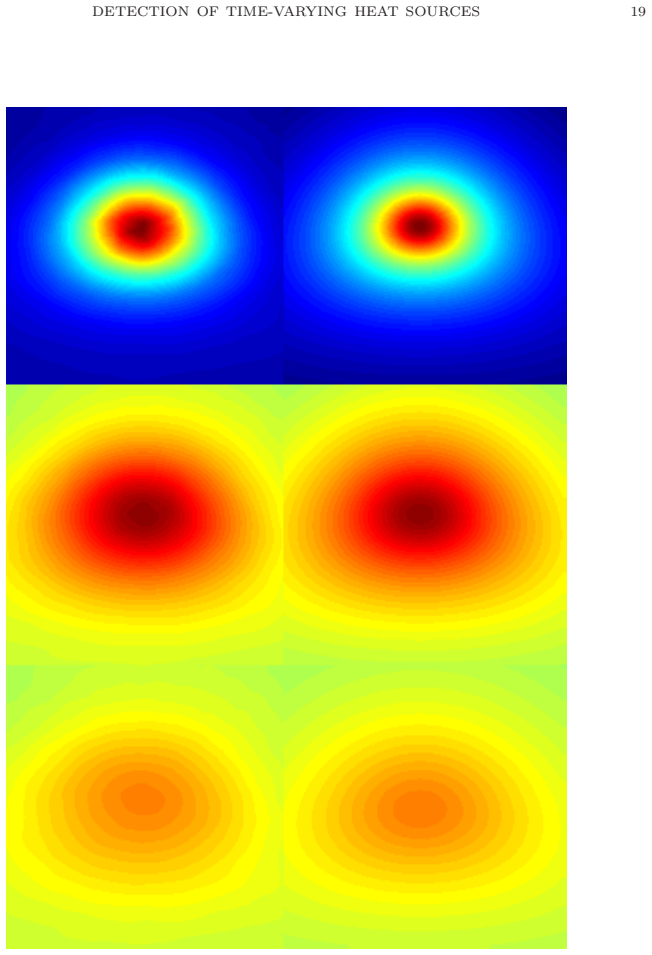
A simple analytic point source model is presented for both static and time-varying point-like heat sources and the resulting temperature profile that solves the heat equation in dimension three. Simple algorithms to detect the location and spectral content of these sources are developed and numerically tested using Finite Element Mesh simulations. The resulting framework for heat source reconstruction problems, which are ill-posed inverse problems, seems promising.
What carries the argument
Analytic point-source solution to the three-dimensional heat equation that remains valid when source strength varies with time.
If this is right
- Location of both static and time-varying sources can be recovered from temperature data by simple fitting procedures.
- The frequency content of oscillating sources can be extracted directly from the same temperature field.
- The analytic forward map turns an ill-posed inverse problem into a more tractable parameter-estimation task.
- The same expressions apply to material-defect detection and to locating abnormal heat sources in medical imaging.
Where Pith is reading between the lines
- If real materials have boundaries, the infinite-medium solution could be corrected by the method of images or by adding a separate boundary-correction term.
- Experimental temperature time series with known embedded heat sources would directly test whether measurement noise or model mismatch prevents reliable recovery of source parameters.
- The same closed-form approach may extend to other linear diffusion problems whose fundamental solutions are known.
Load-bearing premise
The sources behave as idealized mathematical points inside an infinite homogeneous medium with no boundaries or material interfaces.
What would settle it
A direct numerical solution of the heat equation for a delta-function source in infinite space that produces a temperature field measurably different from the closed-form expression at any point and time.
Figures




read the original abstract
We present a simple, analytic point source model for both static and time-varying point-like heat sources and the resulting temperature profile that solves the heat equation in dimension three. Simple algorithms to detect the location and spectral content of these sources are developed and numerically tested using Finite Element Mesh simulations. The resulting framework for heat source reconstruction problems, which are ill-posed inverse problems, seems promising and warrants for future research. Possible fields of application for our work are material testing, to detect manufacturing defects, and medical imaging to detect abnormal health conditions.
Editorial analysis
A structured set of objections, weighed in public.
Referee Report
Summary. The manuscript presents an analytic forward model for static and time-varying point-like heat sources based on the Green's function solution to the three-dimensional heat equation in an infinite homogeneous medium. It derives simple detection algorithms for source location and spectral content and reports numerical tests of these algorithms on data generated by Finite Element Method (FEM) simulations. The work positions the framework as promising for ill-posed inverse problems in material testing and medical imaging.
Significance. If the analytic derivation is free of gaps and the detection algorithms remain effective when the infinite-domain assumption is relaxed, the parameter-free Green's function approach would supply a computationally lightweight starting point for heat-source reconstruction. The explicit grounding in the heat equation and the absence of free parameters in the forward model are strengths that distinguish the contribution from purely data-driven methods.
major comments (2)
- [Numerical validation] Numerical validation section: the manuscript reports that algorithms were tested on FEM data but provides no quantitative error analysis (e.g., L² or pointwise discrepancy) between the closed-form analytic temperature field and the FEM output. This comparison is load-bearing for the claim that the numerical tests support the analytic model, because the FEM computations are performed on finite meshes while the analytic solution assumes an infinite domain.
- [Model assumptions and FEM setup] Model assumptions and FEM setup: the forward model is derived under the idealization of an infinite homogeneous medium, yet the FEM tests use finite computational domains without reported boundary conditions, domain-size sensitivity studies, or tests on distributed sources or material interfaces. These omissions directly affect whether the detection algorithms can be expected to transfer to the applications listed in the abstract.
minor comments (1)
- [Abstract] Abstract: the clause 'warrants for future research' is grammatically incorrect and should read 'warrants future research'.
Simulated Author's Rebuttal
We thank the referee for their thoughtful review and constructive comments. Below we provide point-by-point responses to the major comments.
read point-by-point responses
-
Referee: [Numerical validation] Numerical validation section: the manuscript reports that algorithms were tested on FEM data but provides no quantitative error analysis (e.g., L² or pointwise discrepancy) between the closed-form analytic temperature field and the FEM output. This comparison is load-bearing for the claim that the numerical tests support the analytic model, because the FEM computations are performed on finite meshes while the analytic solution assumes an infinite domain.
Authors: We agree that a quantitative comparison between the analytic solution and the FEM results would strengthen the validation of the forward model. In the revised version of the manuscript, we will add an error analysis section that includes L² norm discrepancies and pointwise comparisons for representative cases, confirming that the FEM approximates the analytic solution to within discretization error tolerances. revision: yes
-
Referee: [Model assumptions and FEM setup] Model assumptions and FEM setup: the forward model is derived under the idealization of an infinite homogeneous medium, yet the FEM tests use finite computational domains without reported boundary conditions, domain-size sensitivity studies, or tests on distributed sources or material interfaces. These omissions directly affect whether the detection algorithms can be expected to transfer to the applications listed in the abstract.
Authors: The FEM simulations were conducted on large finite domains chosen to approximate the infinite medium, with boundary conditions set to minimize reflections (e.g., Dirichlet or Neumann at distant boundaries). We acknowledge that these details were not sufficiently reported. In the revision, we will expand the numerical methods section to include explicit description of the domain size, boundary conditions employed, and a sensitivity study demonstrating negligible boundary influence for the source positions tested. The work is intentionally focused on point sources in homogeneous media as the foundational case for the analytic model and detection algorithms; while extensions to distributed sources and heterogeneous media are important for the listed applications, they fall outside the current scope and are noted as directions for future research. revision: partial
Circularity Check
Analytic forward model derived from heat equation with independent FEM validation; no circular reductions
full rationale
The paper presents an analytic point source model explicitly as a solution to the 3D heat equation for static and time-varying sources, with detection algorithms developed from this model and tested via separate FEM simulations. No quoted steps show a prediction reducing to a fitted input by construction, no self-citations are load-bearing for the central claim, and the derivation chain remains self-contained against the PDE without renaming or smuggling ansatzes. The infinite-domain assumption and lack of boundary error analysis are validation gaps, not circularity.
Axiom & Free-Parameter Ledger
axioms (1)
- domain assumption Temperature obeys the linear heat equation in an infinite homogeneous 3D medium.
Reference graph
Works this paper leans on
-
[1]
W. Ben Lardi, C. Ibarra-Castanedo, M. Klein, A. Bendada, X. Maldague, Experimental Com- parison of Lock-in and Pulsed Thermography for the Nondestr uctive Evaluation of Aerospace Materials, Electrical and Computing Engineering Department, Univer sit Laval, Quebec City (2010)
work page 2010
-
[2]
S. Marinetti, Y. A. Plotnikov, W. P. Winfree, A. Braggiot ti, Pulse phase thermography for defect detection and visualization , Proc. SPIE 3586, Nondestructive Evaluation of Aging Aircraft, Airports, and Aerospace Hardware III (1999)
work page 1999
-
[3]
N. Dalir, Exact Analytical Solution for 3D Time-Dependent Heat Condu ction in a Multi- layer Sphere with Heat Sources Using Eigenfunction Expansi on Method , Hindawi Publishing Corporation, International Scholarly Research Notices (2 014)
-
[4]
T. F. Flint, J. A. Francis, M. C. Smith, A. N. Vasileiou, Semi-analytical solutions for the transient temperature fields induced by a moving heat source in an orthogonal domain , Inter- national Journal of Thermal Sciences 123 (2018), 140 – 150
work page 2018
-
[5]
F. Davoodi, A. Abbas Nejad, A. Shahrezaee, M. J. Maghrebi , Control parameter estimation in a semi-linear parabolic inverse problem using a high accura te method , Applied Mathematics and Computation 218 (2011), 1798 – 1804
work page 2011
-
[6]
W. Liao, M. Dehghan, A. Mohebbi, Direct numerical method for an inverse problem of a parabolic partial differential equation , Journal of Computational and Applied Mathematics 232 (2009), 351 – 360
work page 2009
-
[7]
J. Liu, B. W ang, Z. Liu, Determination of a source term in a heat equation , International Journal of Computer Mathematics 87(5) (2010), 969 – 975
work page 2010
-
[8]
J. R. Cannon, Determination of an unknown heat source from overspecified b oundary data , SIAM Journal of Numerical Analysis 5(2) (1968), 275 – 286
work page 1968
-
[9]
J. R. Cannon, D. Zachmann, Parameter determination in parabolic partial differential equa- tions from overspecified boundary data , Int. J. Engng Sci. 20(6) (1982), 779 – 788
work page 1982
-
[10]
W. Cheng, L-L. Zhao, C-L. Fu, Source term identification for an axisymmetric inverse heat conduction problem, Computers and Mathematics with Applications 59 (2010), 142 – 148
work page 2010
-
[11]
W. Cheng, Y-J. Ma, C-L. Fu, Identifying an unknown source term in radial heat conductio n, Inverse Problems in Science and Engineering 20(3) (2012), 335 – 349
work page 2012
- [12]
-
[13]
F-F. Dou, Wavelet-Galerkin Method for Identifying an Unknown Source Term in a Heat Equation, Mathematical Problems in Engineering (2012)
work page 2012
-
[14]
D. N. Hao, B. V. Huong, N. T. N. Oanh, P. X. Thanh, Determination of a term in the right-hand side of parabolic equations , Journal of Computational and Applied Mathematics 309(2017), 28 – 43
work page 2017
- [15]
-
[16]
J. R. Cannon, R. E. Ewing, Determination of a Source Term in a Linear Parabolic Partial Differential Equation , Journal of Applied Mathematics and Physics 27 (1976), 393 – 401. DETECTION OF TIME-V ARYING HEAT SOURCES 23
work page 1976
-
[17]
J. R. Cannon, S. Perez-Esteva, An inverse problem for the heat equation , Inverse Problems 2 (1986), 395 – 403
work page 1986
-
[18]
J. R. Cannon, S. Perez-Esteva, Uniqueness and stability of 3D heat sources , Inverse Problems 7 (1991), 57 – 62
work page 1991
-
[19]
G. Talenti, S. Vessella, A note on an ill-posed problem for the heat equation , J. Austral. Math. Soc. (Series A) 32 (1982), 358 – 368
work page 1982
-
[20]
D. D. Trong, T. T. Tuyen, P. T. Nam, A. P. N Dinh, Determine the special term of a two- dimensional heat source , Applicable Analysis 88(3) (2010), 457 – 474
work page 2010
-
[21]
M. Yamamoto, Conditional Stability in Determination of Force Terms of He at Equations in a Rectangle, Mathl. Comput. Modelling 18(1) (1993), 79 – 88
work page 1993
-
[22]
N. Renault, S. Andre, D. Maillet, C. Cunat, A two-step regularized inverse solution for 2-D heat source reconstruction, International Journal of Thermal Sciences 47 (2008), 834–847
work page 2008
-
[23]
N. Renault, S. Andre, D. Maillet, C. Cunat, A spectral method for the estimation of a ther- momechanical heat source from infrared temperature measur ements, International Journal of Thermal Sciences 49 (2010), 1394–1406
work page 2010
-
[24]
Y. X. Zhang, C. L. Fu, Y. J. Ma, An a posteriori parameter choice rule for the truncation regularization method for solving backward parabolic prob lems, Journal of Computational and Applied Mathematics 255 (2014), 150 – 160
work page 2014
- [25]
-
[26]
T. M. Button, H. Li, P. Fisher, R. Rosenblatt, K. Dulaimy , S. Li, B. O’Hea, M. Salvitti, V. Geronimo, C. Geronimo, S. Jambawalikar, P. Carvelli, R. W eiss, Dynamic infrared imaging for the detection of malignancy , Phys. Med. Biol. 49 (2004), 3105–3116
work page 2004
-
[27]
R. Joro, A.-L. L¨ a¨ aperi, P. Dastidar, S. Soimakallio,T. Kuukasj¨ arvi, T. Toivonen, R. Saaristo, R. J¨ arvenp¨ a¨ a,Imaging of breast cancer with mid- and long-wave infrared ca mera, Journal of Medical Engineering & Technology 32(3) (2008), 189–197
work page 2008
-
[28]
R. Joro, A.-L. L¨ a¨ aperi, S. Soimakallio, R. J¨ arvenp¨ a¨ a, T. Kuukasj¨ arvi, T. Toivonen, R. Saaristo, P. Dastidar, Dynamic infrared imaging in identification of breast cancer tis- sue with combined image processing and frequency analysis , Journal of Medical Engineering & Technology 32(4) (2008), 325–334
work page 2008
-
[29]
R. Joro, A.-L. L¨ a¨ aperi, P. Dastidar, R. J¨ arvenp¨ a¨ a, T. Kuukasj¨ arvi, T. Toivonen, R. Saaristo, S. Soimakallio, A Dynamic Infrared Imaging-Based Diagnostic Process for Br east Cancer , Acta Radiol 8 (2009), 860–869
work page 2009
-
[30]
R. Joro, P. Dastidar, V. Iivonen, H. Ylnen, S. Soimakall io, NADINE: new approaches to detecting breast cancer by sequential µm-wavelength imaging with the aid of novel frequency analysis techniques , Journal of Medical Engineering & Technology 36(5) (2012), 251–260
work page 2012
-
[31]
H. Ahmadikia, R. Fazlali, A. Moradi, Analytical solution of the parabolic and hyperbolic heat transfer equations with constant and transient heat flux con ditions on skin tissue , Interna- tional Communications in Heat and Mass Transfer 39 (2012), 121 – 130
work page 2012
-
[32]
A. Lakhssassi, E. Kengne, H. Semmaoui, Modifed pennes’ equation modelling bio-heat transfer in living tissues: analytical and numerical analysis , Natural Science 2 (2010), 1375 – 1385
work page 2010
-
[33]
K. Das, R. Singh, S. C. Mishra, Numerical analysis for determination of the presence of a tumor and estimation of its size and location in a tissue , Journal of Thermal Biology 38 (2013), 32 – 40
work page 2013
-
[34]
K. Das, S. C. Mishra, Study of thermal behavior of a biological tissue: An equival ence of Pennes bioheat equation and Wulff continuum model , Journal of Thermal Biology 45 (2014), 103 – 109
work page 2014
-
[35]
D. Arthur, Towards Application of Thermal Infrared Imaging in Medical Diagnosis: Protocols and Investigations , PhD thesis, Curtin University (2014)
work page 2014
-
[36]
G. Shi, F. Han, L. W ang, C. Liang and K. Li, Q-r curve of thermal tomography and its clinical application on breast tumor diagnosis , Optical Society of America 6(4) (2015), 1109–1123
work page 2015
-
[37]
Gurarie, M445: Heat equation with sources , Lecture note on ”MATH 445
D. Gurarie, M445: Heat equation with sources , Lecture note on ”MATH 445. Introduction to Partial Differential Equations”, Case W estern Reserve Univ ersity
-
[38]
H. S. Carslaw, J. C. Jaeger, Conduction of Heat in Solids , Oxford University Press, second edition (1959). E-mail address : janne.tamminen@imaqen.com
work page 1959
discussion (0)
Sign in with ORCID, Apple, or X to comment. Anyone can read and Pith papers without signing in.