REVIEW 5 major objections 5 minor 48 references
Topological Run-time Monitoring for Complex Systems
T0 review · 5 major / 5 minor · reviewed 2026-08-14 · deepseek-v4-flash
Pith's one-line read This paper claims that plateaus in persistent entropy mined from component-level data can be turned into an automaton whose traces separate immune-memory successes from failures and yield bounded temporal-logic invariants.
desk verdict The formal PELTS/MPEA semantics is clean and worth preserving, but the paper's central empirical claim about immunization memory is not supported by the reported evidence. read the letter →
The pith
A machine-rendered reading of the paper's core claim, the machinery that carries it, and where it could break.
The reading
What carries the argument
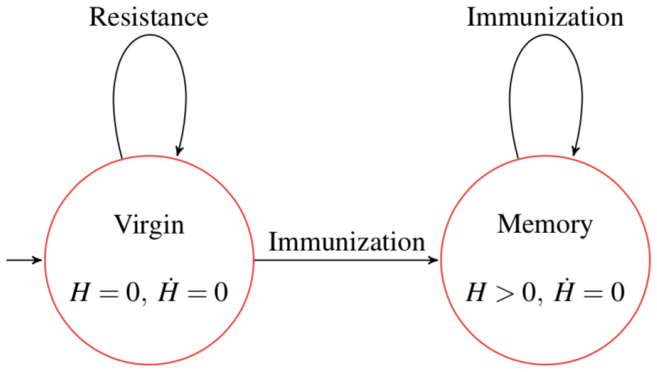
The load-bearing object is the Persistent Entropy Automaton (PEA). Persistent entropy $H(t)$ is the Shannon entropy of the lengths of the bars in a persistence barcode; the PEA's states are equilibrium conditions expressed as boolean combinations of $H$ and its discrete derivative $\dot H$. The associated PELTS determines when the system stays in a steady state (Steady), leaves it (StartT), travels through intermediate observations (ContT), and settles into a next steady state (StopT). The Monitor PEA adds atomic propositions to steady states, so each execution yields a trace over $\{\text{virgin},\text{memory},\omega\}$, with $\omega$ marking the non-instantaneous transition phases; these traces are the objects on which bounded LTL formulas are evaluated.
What would settle it
Run the MPEA on a simulation with no antigen injection: if the persistent-entropy series ever shows a plateau with $H>0$ and $\dot H=0$, the monitor labels a never-immunized system as memory, falsifying the claimed invariant. Alternatively, delete the unobserved virgin self-loop and check whether any trace of the form $\{virgin\}^{+}\{\omega\}^{+}\{virgin\}^{+}$ survives.
Extended reading notes
Core claim
The central claim is that a Persistent Entropy Automaton, augmented with atomic propositions into a Monitor PEA (MPEA), can act as a run-time monitor mined entirely from component-level data. The paper formalizes the PEA by defining its semantics as a persistent entropy labelled transition system (PELTS) with four rules—steady, start transition, continue transition, stop transition—so that a time series of persistent entropy values induces a set of executions. On the Idiotypic Network case study, running 1000 simulated traces through the MPEA classifies 198 traces as ending in virgin, 780 as ending in memory, and 22 as ending inside a transition; the final class is read as a violation. From these trace classes the paper derives bounded LTL properties, such as 'an immunization phase that starts ends within 180 ticks,' that must hold if the system is to reach immunization memory.
Load-bearing premise
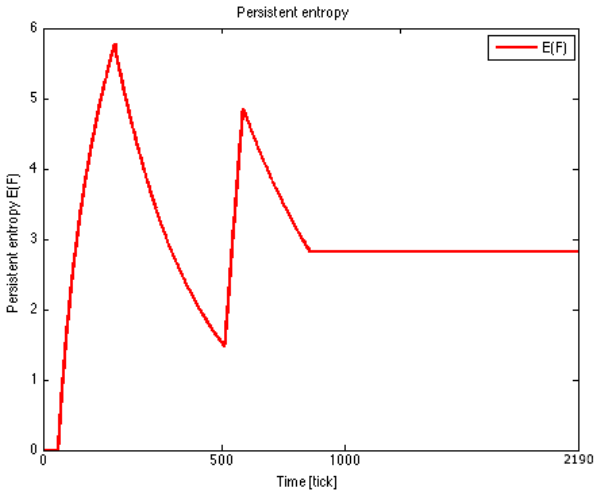
Everything hangs on the manually chosen equilibrium conditions—virgin is $H=0$ with $\dot H=0$, memory is $H>0$ with $\dot H=0$—read by eye from a smoothed persistent-entropy plot, together with automaton structure (a memory self-loop suggested by the two-peak shape and a virgin self-loop imported from biological knowledge though never observed).
Editorial extensions
If this is right
- The same pipeline—coexistence matrix, persistent homology, persistent entropy, plateau extraction—produces a monitor for any time-evolving weighted graph, not only immune-system simulations.
- Trace classes give an operational meaning to 'immunization memory': a run reaches memory exactly when the MPEA trace ends in $\{memory\}$, and the 22 traces ending in $\{\omega\}$ are detectable failures (insufficient antibody repertoire or too-short simulation).
- The mined properties become checkable obligations: for example, every started immunization phase must end within 180 ticks, a bounded temporal-logic formula over the MPEA trace alphabet.
- Because the MPEA is derived from data rather than from a hand-written model, it can be re-derived whenever the system changes, giving a run-time verification layer for self-adaptive systems.
Reading between the lines
- A natural next step the paper leaves open is online monitoring: because the PELTS marks transition phases with $\omega$, an alarm could be raised the moment a trace enters $\omega$ and stays there beyond the 180-tick bound used in the mined properties, rather than only after the trace ends.
- The reported trace counts (780 successes against 22 violations out of 1000) imply the monitor could be calibrated as a probabilistic statement about simulator configurations—for instance, how large the antibody repertoire must be—but the paper does not run that statistical analysis.
- If the equilibrium conditions were replaced by a statistical rule for plateau detection, the entire pipeline would become parameter-free; that would let the method transfer to other streams (network traffic, sensor logs) without case-by-case human judgment.
- The paper does not report a negative control; shuffling the time order of persistent entropy values and re-deriving the PEA would test whether the virgin/memory split is an artifact of the smoothing.
Signed reviews
Editorial analysis
A structured set of objections, weighed in public.
Referee Report
Summary. The paper proposes a data-driven runtime monitoring framework for complex systems. It defines Persistent Entropy Automata (PEA) and their operational semantics as Persistent Entropy Labelled Transition Systems (PELTS), then augments PEAs into Monitor PEAs (MPEAs) that consume time-stamped persistent-entropy traces and emit traces of atomic propositions. The method is applied to simulated data from the C-ImmSim immune-system model, where the authors report that MPEA execution over 1000 traces yields three trace groups (198 ending in virgin, 780 ending in memory, 22 ending in an incomplete transition), and they list three bounded-LTL properties as examples of invariants that could be verified. The abstract claims that the monitor 'reveals temporal properties that should be satisfied in order to reach immunization memory.' The formal PELTS semantics is the paper's main technical contribution; the empirical support for the central claim is the main weakness.
Significance. If the empirical claim were established, the paper would offer a genuinely useful bridge between topological data analysis and runtime verification: component-level observations, summarized by persistent entropy, are used to build an automaton-level monitor for a global system property. The formal definitions of PELTS and MPEA are largely coherent and provide a reusable semantic basis for this idea. The paper also honestly exposes its own construction choices, including a self-loop added from domain knowledge. However, the load-bearing empirical demonstration is not currently supported: the PEA states are hand-assigned from a smoothed plot, no ground-truth comparison is made with C-ImmSim's own immune-memory indicators, and the proposed LTL properties are presented only as examples rather than as statistically mined and verified invariants. The formal framework also contains a codomain error for persistent entropy values. These issues can, in principle, be repaired with additional experiments and a tightened specification, so the paper warrants revision rather than outright rejection.
major comments (5)
- [Section 4.1 and 5.1] The MPEA states and transitions are not mined in a reproducible way. Section 4.1 fixes the virgin condition H=0 ∧ Hdot=0 and the memory condition H>0 ∧ Hdot=0 by visual inspection of a smoothed PE plot, and it adds the virgin self-loop 'even if we did not observe it in our simulation' from domain knowledge. Since the entire trace classification of Section 5.1 (198/780/22) is generated by executing this MPEA, any mis-specification of these equilibrium conditions propagates directly into all group counts and all example properties. The paper should replace these hand-assigned conditions with an explicit algorithmic plateau-detection and steady-state identification procedure, including its parameters, or the empirical claims cannot be audited.
- [Section 5.1 / 3.2] No independent ground truth is used to validate the MPEA verdicts. Section 3.2 states that C-ImmSim implements immune memory as a cell state with increased half-life, which provides direct indicators (e.g., memory-cell counts or secondary-response kinetics), but the paper never compares the MPEA classifications with any such indicator. Without this comparison, the abstract's claim that the monitor 'reveals temporal properties that should be satisfied in order to reach immunization memory' is not established. At minimum, the authors should report the agreement between MPEA trace groups and C-ImmSim's own memory markers, e.g., precision and recall of the memory classification.
- [Section 5.1] The three bounded-LTL formulas are introduced as 'examples of properties that could be run-time verified' and as 'possible properties', not as invariants mined from the 1000 traces with statistical support. The paper does not report satisfaction rates per trace group, confidence intervals, or any test of whether the properties separate groups I, II, and III. The central claim requires actually evaluating the inferred properties on all traces and showing that they hold on memory traces and fail on non-memory traces. As written, no property is evaluated on any trace.
- [Definitions 4.4 and 4.5] Definitions 4.4 and 4.5 place PE values in the interval R[0,1], but the persistent entropy of Definition 2.1 ranges over [0, log n] and the paper itself reports H=2.87 in Section 4.1. The PELTS state space and label alphabet therefore exclude the very values the monitor is required to process. Replace R[0,1] by R_{\ge 0} throughout the formal definitions, or explicitly introduce and apply a normalization step.
- [Section 4.1] The TDA pipeline is under-specified. The text states that persistent homology was computed with jHoles using the weighted rank clique homology algorithm, but it does not specify the filtration thresholds, the weighting scheme used to turn the coexistence matrix into a filtered simplicial complex, how the β0 and β1 barcodes are combined into the PE values, or how the 'average sequence' in Figure 4 is computed over simulations. These details are necessary to reproduce the PETs and to assess whether the two plateaus are robust features rather than artifacts of smoothing or parameter choice.
minor comments (5)
- [Section 3.2] Section 3.2 states that 'several (in the order of hundreds) simulations' were executed, while Section 5.1 reports 1000 simulations; please align the two numbers.
- [Section 4] The word 'typycally' before the discussion of state-based traces should be corrected to 'typically'.
- [Figure 4] The caption says 'PE of IS computed from a simulation', but the surrounding text describes the average sequence of PE values; clarify which quantity is actually plotted.
- [Definition 4.7] Definition 4.7 uses abbreviated path notation such as ((·,·,ϵ))+ without defining the shorthand; please expand the notation or add a sentence explaining the regular-expression-like operators.
- [Section 5.1] The bounded-LTL formulas use symbols like 2≤30 and © without a semantics table; since the paper targets runtime verification, define the bounded operators and the next operator for finite traces.
Circularity Check
The monitor's 'memory' label is defined by the same PE-plateau condition used to classify traces, and the self-loop additions are hand-fitted; the claimed revelation of immunization-memory properties is therefore partly a restatement of the model's construction.
-
self definitional
[Section 4.1 (PEA construction) and Section 5.1 (trace classification)]
"The memory steady state corresponds to a plateau in the chart and it is characterized by the equilibrium condition H > 0 ∧ ̇H = 0. ... We could classify the obtained traces into three groups ... II 780 traces terminated with {memory}"
The MPEA uses L(Memory) = (H > 0 ∧ Hdot = 0) to decide whether a PET's final plateau is the memory state. Thus 'terminated with {memory}' is true exactly when the trace ends in a positive PE plateau. The abstract's claim that the monitor 'reveals temporal properties that should be satisfied in order to reach immunization memory' is therefore a restatement of the equilibrium condition used to define the memory state: any trace reaching that plateau is labeled memory by construction. No independent C-ImmSim marker of immune memory (e.g., memory-cell half-life or secondary-response success) is used to validate the label, so the classification cannot confirm the biological claim.
-
fitted input called prediction
[Section 4.1 (self-loop addition) and Section 5.1 (group II.a interpretation)]
"By analyzing the chart it is evident that two peaks are present. This reflects the fact that the system was stimulated twice and, thus, entered a critical transition followed by an adaptation phase from state memory to itself. This then suggests that a self-transition should be added to the state memory in the PEA. ... The traces in group II.a belong to systems that were stimulated multiple times."
The memory self-loop is inserted into the PEA because the authors already know the system was stimulated twice. The monitor then classifies the 429 traces of the form {virgin}+({ω}+{memory}+)+ as 'systems that were stimulated multiple times' (group II.a). The output pattern is an artifact of the input transition: without the hand-added self-loop, that trace shape could not arise. The paper also adds a virgin self-loop explicitly 'even if we did not observe it in our simulation', further showing that the trace taxonomy is shaped by prior assumptions rather than discovered.
full rationale
The formal PELTS semantics in Section 4 is coherent and self-contained: the labelled transition system, the equilibrium-condition rules, and the induced PET definitions are genuine mathematical contributions and are not circular. The circularity is confined to the empirical validation. The two steady states are fixed by visual inspection of the same PE plot that the monitor later consumes: 'virgin' is H=0∧Hdot=0 and 'memory' is H>0∧Hdot=0, so any PET ending in a positive plateau is automatically 'memory' by definition. The claimed 'revealing' of temporal properties for reaching immunization memory is therefore partly a recoding of the state definitions rather than an independent discovery. The LTL formulas in Section 5.1 are explicitly presented as 'examples of properties that could be run-time verified', not as statistically mined invariants from the 1000 traces, so they do not substantiate the abstract's stronger wording. The added memory self-loop is derived from the known double-stimulation design and then used to interpret repeated-memory traces as multiple stimulations, which is fitting the model to the data and reading the same structure back out. The unobserved virgin self-loop, inserted from domain knowledge, further weakens the claim that the trace taxonomy is data-mined. These issues are partial rather than total: the automaton construction, the PELTS semantics, and the monitoring framework have independent content, but the central empirical claim about immunization memory is in-sample and partly definitional, justifying a moderate circularity score of 4.
Assumptions & free parameters
free parameters (4)
- Equilibrium conditions for PEA states (virgin and memory) =
virgin: H=0 and Hdot=0; memory: H>0 and Hdot=0 (plateau value about 2.87 in Figure 4)
- Plateau detection tolerance for first derivative of PE =
not specified
- Infinite-interval truncation bound m =
m = tmax + 1
- Second antigen injection time =
random, distribution not specified
assumptions (4)
- standard math Standard definitions and stability properties of persistent homology, persistence barcodes, and persistent entropy
- domain assumption Persistent entropy values are comparable across time in the C-ImmSim simulation
- domain assumption C-ImmSim faithfully models the human immune system and the Idiotypic Network
- ad hoc to paper The two PE plateaus correspond to the biological virgin and memory states
Cite this review
Pith. "Pith review of Topological Run-time Monitoring for Complex Systems." pith.science (2026). https://pith.science/paper/BEZOHNLL
@misc{pith2026190803489,
  author       = {Pith},
  title        = {Pith review of: Topological Run-time Monitoring for Complex Systems},
  year         = {2026},
  howpublished = {\url{https://pith.science/paper/BEZOHNLL}},
  note         = {Machine review of arXiv:1908.03489}
}
read the original abstract
In this paper we introduce a new data-driven run-time monitoring system for analysing the behaviour of time evolving complex systems. The monitor controls the evolution of the whole system but it is mined from the data produced by its single interacting components. Relevant behavioural changes happening at the component level and that are responsible for global system evolution are captured by the monitor. Topological Data Analysis is used for shaping and analysing the data for mining an automaton mimicking the global system dynamics, the so-called Persistent Entropy Automaton (PEA). A slight augmented PEA, the monitor, can be used to run current or past executions of the system to mine temporal invariants, for instance through statistical reasoning. Such invariants can be formulated as properties of a temporal logic, e.g. bounded LTL, that can be run-time model-checked. We have performed a feasibility assessment of the PEA and the associated monitoring system by analysing a simulated biological complex system, namely the human immune system. The application of the monitor to simulated traces reveals temporal properties that should be satisfied in order to reach immunization memory.
Figures
Figures from the paper (2 more)
Reference graph
Works this paper leans on
- [1]
-
[2]
Persistent entropy for separating topological features from noise in vietoris-rips complexes
Nieves Atienza, Rocio Gonzalez-Diaz, and Matteo Rucco. Persistent entropy for separating topological features from noise in vietoris-rips complexes. Journal of Intelligent Information Systems, 52(3):637–655, 2019. 23
work page 2019
-
[3]
Christel Baier, Joost-Pieter Katoen, et al.Principles of model checking, volume 26202649. MIT press Cambridge, 2008
work page 2008
-
[4]
E. Bartocci, Y. Falcone, A. Francalanza, and G. Reger. Introduction to Runtime Verification. In E. Bartocci and Y. Falcone, editors,Lectures on Runtime Verification, volume 10457 ofLecture Notes in Computer Science. Springer, Cham, 2018
work page 2018
-
[5]
Jacopo Binchi, Emanuela Merelli, Matteo Rucco, Giovanni Petri, and Francesco Vaccarino. jHoles: A Tool for Understanding Biological Complex Networks via Clique Weight Rank Persistent Homology.Electronic Notes in Theoretical Computer Science, 306:5–18, 2014
work page 2014
-
[6]
Nino Boccara. Modeling complex systems. Springer Science & Business Media, 2010
work page 2010
-
[7]
A persistence landscapes toolbox for topological statistics
Peter Bubenik and Paweł Dłotko. A persistence landscapes toolbox for topological statistics. Journal of Symbolic Computation, pages –, 2016
work page 2016
-
[8]
Topology and data.Bulletin of the American Mathemat- ical Society, 46(2):255–308, 2009
Gunnar Carlsson. Topology and data.Bulletin of the American Mathemat- ical Society, 46(2):255–308, 2009
work page 2009
Show all 48 references
-
[9]
A Survey of Runtime Monitoring Instrumentation Techniques.arXiv preprint arXiv:1708.07229, 2017
Ian Cassar, Adrian Francalanza, Luca Aceto, and Anna Ingólfsdóttir. A Survey of Runtime Monitoring Instrumentation Techniques.arXiv preprint arXiv:1708.07229, 2017
2017 arXiv
-
[10]
CRC Press, 2015
Filippo Castiglione and Franco Celada.Immune System Modelling and Simulation. CRC Press, 2015
2015
-
[11]
Guibas, and Steve Oudot
Frédéric Chazal, David Cohen-Steiner, Marc Glisse, Leonidas J. Guibas, and Steve Oudot. Proximity of persistence modules and their diagrams. In Proceedings of the 25th ACM Symposium on Computational Geometry, Aarhus, Denmark, June 8-10, pages 237–246, 2009
2009
-
[12]
An entropy-based persistence barcode.Pattern Recognition, 48(2):391–401, 2015
Harish Chintakunta, Thanos Gentimis, Rocio Gonzalez-Diaz, Maria-Jose Jimenez, and Hamid Krim. An entropy-based persistence barcode.Pattern Recognition, 48(2):391–401, 2015
2015
-
[13]
Extending persistence using poincaré and lefschetz duality.Foundations of Computa- tional Mathematics, 9(1):79–103, 2009
David Cohen-Steiner, Herbert Edelsbrunner, and John Harer. Extending persistence using poincaré and lefschetz duality.Foundations of Computa- tional Mathematics, 9(1):79–103, 2009
2009
-
[14]
Software engineering for self-adaptive systems: 24 A second research roadmap
Rogério De Lemos, Holger Giese, Hausi A Müller, Mary Shaw, Jesper Andersson, Marin Litoiu, Bradley Schmerl, Gabriel Tamura, Norha M Villegas, Thomas Vogel, et al. Software engineering for self-adaptive systems: 24 A second research roadmap. In Software Engineering for Self-Ada...
2013
-
[15]
Action versus state based logics for transition systems
Rocco De Nicola and Frits Vaandrager. Action versus state based logics for transition systems. In I. Guessarian, editor,Semantics of Systems of Concurrent Processes. LITP 1990, volume 469 ofLecture Notes in Computer Science, pages 407–419. Springer, Berlin, Heidelberg, 1990
1990
-
[16]
Delgado, A.Q
N. Delgado, A.Q. Gates, and S. Roach. A taxonomy and catalog of runtime software-fault monitoring tools.IEEE Transactions on Software Engineering, 30(12):859 –872, 2004
2004
-
[17]
Persistent Homology – a Survey
Herbert Edelsbrunner and John Harer. Persistent Homology – a Survey. Contemporary mathematics, 453:257–282, 2008
2008
-
[18]
American Mathematical Soc., 2010
Herbert Edelsbrunner and John Harer.Computational topology: an intro- duction. American Mathematical Soc., 2010
2010
-
[19]
Agent-based modelling and simulation of the immune system: a review
Nuno Fachada, V Lopes, and Agostinho Rosa. Agent-based modelling and simulation of the immune system: a review. InEPIA 2007-13th Portuguese Conference on Artificial Intelligence, 2007
2007
-
[20]
Algebraic Topology
Allen Hatcher. Algebraic Topology. Cambridge University Press, 2002
2002
-
[21]
A theory of regulation and self-nonself discrimination in an immune network.European journal of immunology, 5(9):638–647, 1975
GW_ Hoffmann. A theory of regulation and self-nonself discrimination in an immune network.European journal of immunology, 5(9):638–647, 1975
1975
-
[22]
Topological data analysis for self-organization of biological tissues
María José Jimenez, Matteo Rucco, P Vicente-Munuera, P Gómez-Gálvez, and Luis M Escudero. Topological data analysis for self-organization of biological tissues. In International Workshop on Combinatorial Image Analysis, pages 229–242. Springer, 2017
2017
-
[23]
Toward a framework for highly automated vehicle safety validation
Philip Koopman and Michael Wagner. Toward a framework for highly automated vehicle safety validation. Technical report, SAE Technical Paper, 2018
2018
-
[24]
Simple Bounded LTL Model Checking
Timo Latvala, Armin Biere, Keijo Heljanko, and Tommi Junttila. Simple Bounded LTL Model Checking. InProc of the 5th International Conference on Formal Methods in Computer-Aided Design (FMCAD 2004), pages 186–200, Berlin, Heidelberg, 2004. Springer Berlin Heidelberg
2004
-
[25]
Teaching runtime verification
Martin Leucker. Teaching runtime verification. InRuntime Verification, pages 34–48. Springer, 2012
2012
-
[26]
A brief account of runtime verification.The Journal of Logic and Algebraic Programming, 78(5):293– 303, 2009
Martin Leucker and Christian Schallhart. A brief account of runtime verification.The Journal of Logic and Algebraic Programming, 78(5):293– 303, 2009. 25
2009
-
[27]
Combination of platinum standard first front line chemotherapy and vaxira vaccine in patients with advanced non-small-cell lung cancer
Amparo Macias. Combination of platinum standard first front line chemotherapy and vaxira vaccine in patients with advanced non-small-cell lung cancer. Age, 62:40–75, 2014
2014
-
[28]
Hiv reservoirs and immune surveillance evasion cause the failure of structured treatment interruptions: A computational study.PloS one, 7(4):e36108, 2012
Emiliano Mancini, Filippo Castiglione, Massimo Bernaschi, Andrea De Luca, and Peter Sloot. Hiv reservoirs and immune surveillance evasion cause the failure of structured treatment interruptions: A computational study.PloS one, 7(4):e36108, 2012
2012
-
[29]
The gudhi library: Simplicial complexes and persistent homology
Clément Maria, Jean-Daniel Boissonnat, Marc Glisse, and Mariette Yvinec. The gudhi library: Simplicial complexes and persistent homology. InIn- ternational Congress on Mathematical Software, pages 167–174. Springer, 2014
2014
-
[30]
A multi-level model for self-adaptive systems
Emanuela Merelli, Nicola Paoletti, and Luca Tesei. A multi-level model for self-adaptive systems. FOCLASA 2012, EPTCS, 91:112–126, 2012
2012
-
[31]
Adaptability Checking in Complex Systems.Science of Computer Programming, 115-116(1):23–46, 2016
Emanuela Merelli, Nicola Paoletti, and Luca Tesei. Adaptability Checking in Complex Systems.Science of Computer Programming, 115-116(1):23–46, 2016
2016
-
[32]
Topology driven modeling: the IS metaphor.Natural Computing, pages 1–10, 2014
Emanuela Merelli, Marco Pettini, and Mario Rasetti. Topology driven modeling: the IS metaphor.Natural Computing, pages 1–10, 2014
2014
-
[33]
Topological characterization of complex systems: Using persistent entropy.Entropy, 17(10):6872–6892, 2015
Emanuela Merelli, Matteo Rucco, Peter Sloot, and Luca Tesei. Topological characterization of complex systems: Using persistent entropy.Entropy, 17(10):6872–6892, 2015
2015
-
[34]
Addison-Wesley Reading, 1984
James R Munkres.Elements of algebraic topology, volume 2. Addison-Wesley Reading, 1984
1984
-
[35]
A roadmap for the computation of persistent homology
Nina Otter, Mason A Porter, Ulrike Tillmann, Peter Grindrod, and Heather A Harrington. A roadmap for the computation of persistent homology. EPJ Data Science, 6(1):17, 2017
2017
-
[36]
A simple model for the immune network.Proceedings of the National Academy of Sciences, 87(1):429–433, 1990
G Parisi. A simple model for the immune network.Proceedings of the National Academy of Sciences, 87(1):429–433, 1990
1990
-
[37]
Immune network theory.Immunological reviews, 110(1):5– 36, 1989
Alan S Perelson. Immune network theory.Immunological reviews, 110(1):5– 36, 1989
1989
-
[38]
Immunology for physicists.Reviews of modern physics, 69(4):1219, 1997
Alan S Perelson and Gérard Weisbuch. Immunology for physicists.Reviews of modern physics, 69(4):1219, 1997
1997
-
[39]
Topological strata of weighted complex networks.PloS one, 8(6):e66506, 2013
Giovanni Petri, Martina Scolamiero, Irene Donato, and Francesco Vaccarino. Topological strata of weighted complex networks.PloS one, 8(6):e66506, 2013. 26
2013
-
[40]
Topo- logical classifier for detecting the emergence of epileptic seizures.BMC research notes, 11(1):392, 2018
Marco Piangerelli, Matteo Rucco, Luca Tesei, and Emanuela Merelli. Topo- logical classifier for detecting the emergence of epileptic seizures.BMC research notes, 11(1):392, 2018
2018
-
[41]
Immune system simula- tion online
Nicolas Rapin, Ole Lund, and Filippo Castiglione. Immune system simula- tion online. Bioinformatics, 27(14):2013–2014, 2011
2013
-
[42]
A pattern-based approach to parametric specification mining
Giles Reger, Howard Barringer, and David Rydeheard. A pattern-based approach to parametric specification mining. InProceedings of the 28th IEEE/ACM International Conference on Automated Software Engineering, pages 658–663. IEEE Press, 2013
2013
-
[43]
Topological Data Analysis for Modeling Complex Systems
Matteo Rucco. Topological Data Analysis for Modeling Complex Systems. Research, Università degli studi di Camerino - Science and Technology: information science and complex systems, apr 2016
2016
-
[44]
Characterisation of the idiotypic immune network through persistent entropy
Matteo Rucco, Filippo Castiglione, Emanuela Merelli, and Marco Pettini. Characterisation of the idiotypic immune network through persistent entropy. In Proceedings of ECCS 2014, pages 117–128. Springer, 2016
2014
-
[45]
A new topological entropy-based approach for measuring similarities among piecewise linear functions.Signal Processing, 134:130–138, 2017
Matteo Rucco, Rocio Gonzalez-Diaz, Maria-Jose Jimenez, Nieves Atienza, Cristina Cristalli, Enrico Concettoni, Andrea Ferrante, and Emanuela Merelli. A new topological entropy-based approach for measuring similarities among piecewise linear functions.Signal Processing, 134:130–...
2017
-
[46]
Survey of topdrim applications of topological data analysis
Matteo Rucco, Adane Letta Mamuye, Marco Piangerelli, Michela Quadrini, Luca Tesei, and Emanuela Merelli. Survey of topdrim applications of topological data analysis. InCEUR Workshop Proceedings, volume 1748, page 1814, 2016
2016
-
[47]
Lineage relationship and protective immunity of memory cd8 t cell subsets
E John Wherry, Volker Teichgräber, Todd C Becker, David Masopust, Susan M Kaech, Rustom Antia, Ulrich H Von Andrian, and Rafi Ahmed. Lineage relationship and protective immunity of memory cd8 t cell subsets. Nature immunology, 4(3):225–234, 2003
2003
-
[48]
Topological data analysis
Afra Zomorodian. Topological data analysis. InAdvances in Applied and Computational Topology. Proceedings of Symposia in Applied Mathematics, volume 70, pages 1–39, 2007. 27
2007
Reviewed August 14, 2026 · model on record in the stance chip above.
Discussion (0). Continue with ORCID to comment.