REVIEW 1 major objections 5 minor 34 references
Adaptive Control Barrier Functions with Vanishing Conservativeness Under Persistency of Excitation
T0 review · 1 major / 5 minor · reviewed 2026-08-12 · deepseek-v4-flash
Pith's one-line read An adaptive control-barrier constraint that estimates unknown model parameters online is shown to converge to the ideal safety constraint under persistency of excitation, preserving safety throughout.
desk verdict Sound safety construction with a nonincreasing error margin, but the headline vanishing-conservativeness theorem is false as stated: eventual full-rank Ω_k does not imply θ_k→θ*, and a uniform PE bound is needed. read the letter →
The pith
A machine-rendered reading of the paper's core claim, the machinery that carries it, and where it could break.
The reading
What carries the argument
The load-bearing object is the computable error-bound recursion $\nu_{k+1} = \min\{\sigma_k\lambda_{\max}(P_k)\nu_k, \sqrt{\nu_k^2+\tau_k}\}$, combined with the identity $\tau_k=\Delta V_k$ (Lemma 1). Here $\Omega_k=\sum_{i=k-k_n}^{k}\Phi_i^T\Phi_i$ is a sliding-window information matrix built from sampled regressors, $P_k=(\sigma_k I_p+\Omega_k)^{-1}$, and $\tau_k$ is defined purely from measured data and the current estimate. The identity turns an unmeasurable Lyapunov-like decrease into a measurable quantity, and the min operation keeps $\nu_k$ nonincreasing while always dominating the true error norm. The CBF constraint (27) uses $\theta(t)$ and $\nu(t)$ linearly, so whenever $\nu(t)$ bounds the error, $\psi$ is a lower bound of the ideal $\psi^*$ (Proposition 4). Under full rank of $\Omega_k$, both the parameter error and $\nu_k$ are driven to zero, so $\psi\to\psi^*$.
What would settle it
Take the least-squares recursion (7)–(11) with a regressor sequence $\Phi_k$ that is full rank for every $k$ but whose information matrix $\Omega_k$ has smallest eigenvalue tending to zero while $\sigma_k$ is held fixed, so that $\sigma_k\lambda_{\max}(P_k)\to 1$; if $\|\theta_k-\theta^*\|$ and $\nu_k$ do not converge to zero, then the convergence claims in Propositions 2(c) and 3(d) are false.
Extended reading notes
Core claim
Under a persistency-of-excitation condition, the adaptive CBF constraint $\psi(x,\theta(t),\nu(t),\hat u,\hat\delta)$ converges pointwise to the ideal constraint $\psi^*(x,\hat u,\hat\delta)$ that would be used with the true parameter vector $\theta^*$, and this happens while the state remains inside the safe set for all time. The key is that the one-step decrease of the Lyapunov-like function for the regularized finite-horizon least-squares estimator is exactly computable from measured data: the quantity $\tau_k$ defined in (19) equals $\Delta V_k$, even though $\theta^*$ is unknown. This identity yields a nonincreasing bound $\nu_k$ on the parameter-error norm and, under the full-rank condition on $\Omega_k$, forces both $\|\theta_k-\theta^*\|$ and $\nu_k$ to zero. Consequently the CBF constraint begins conservative and asymptotically sheds its conservativeness, while the same estimate simultaneously improves the desired control law.
Load-bearing premise
The advertised vanishing of conservativeness depends on the parameter estimate actually converging to the true value, which the paper derives from strict decrease of a Lyapunov-like function under a full-rank condition on the sampled regression data; if strict decrease does not by itself force convergence, the central feature fails even though the safety guarantee survives.
Editorial extensions
If this is right
- Safety is guaranteed for all time under the closed-form control $u^*$, regardless of whether the excitation condition holds.
- Under the full-rank condition on $\Omega_k$ for all large $k$, the parameter estimate converges to $\theta^*$ and the error bound $\nu_k$ tends to zero.
- The enforced constraint converges to the ideal known-parameter constraint, so in the long run the adaptive filter behaves as if the model uncertainty were absent.
- Because the error bound is nonincreasing, the desired control law $u_d(x,\theta(t))$ improves monotonically even before parameter convergence is complete.
Reading between the lines
- The same $\tau_k=\Delta V_k$ identity should transfer to any recursive-least-squares estimator whose regressors are sampled integrals of known functions, giving a ready-made nonincreasing error certificate for other adaptive safety filters; the paper does not develop this generality.
- A quantitative excitation condition—a uniform lower bound on the smallest eigenvalue of $\Omega_k$—would let one state convergence rates for $\nu_k$ and hence a finite-time bound on the conservativeness gap; the paper only asserts asymptotic vanishing.
- Since the safety constraint is valid for any $\nu(t)$ that dominates the estimation error, one could replace the least-squares bound with any tighter set-membership or interval bound and keep the same $\psi$ construction, potentially reducing conservativeness faster than the RLS bound does.
Editorial analysis
A structured set of objections, weighed in public.
Referee Report
Summary. The paper proposes a sampled-data adaptive control-barrier-function (CBF) scheme for nonlinear systems with linearly parameterized uncertainty. A recursive-least-squares estimator with a sliding window and regularization produces a parameter estimate theta_k and a computable nonincreasing upper bound nu_k on the parameter estimation error. These are interpolated continuously in time and used inside a higher-order CBF constraint, together with a slack variable and a closed-form optimal control law, to guarantee constraint satisfaction and to make the constraint no more conservative over time. The paper further claims that, under a persistency-of-excitation condition, theta_k converges to theta*, nu_k converges to zero, and the adaptive CBF constraint converges to the ideal constraint that would be used if theta* were known. Two numerical examples, a pendulum and a nonholonomic robot, illustrate the approach.
Significance. If the convergence claims were established, the paper would make a useful contribution: it gives a closed-form adaptive CBF construction, a computable nonincreasing error bound, and a systematic way to reduce conservativeness while maintaining safety. The safety part of the argument, in particular the fact that psi is a lower bound on the ideal CBF when nu bounds the estimation error (Proposition 4(a)-(b)), is sound and is a genuine strength. However, the central asymptotic claims about vanishing conservativeness are not proven under the assumptions stated in the manuscript. The current 'full rank' assumption is not persistency of excitation, and the proofs of parameter convergence and nu_k -> 0 contain a load-bearing gap. The significance of the paper therefore depends on a correction of the excitation assumption and the convergence proofs.
major comments (1)
- [Section IV, Proposition 3(d)] The proof of Proposition 2(c) is invalid: strict decrease of the Lyapunov-like function V_k does not imply V_k -> 0 when the contraction ratio tends to 1. From equation (16), tilde_theta_{k+1} = sigma_k P_k tilde_theta_k, so the contraction factor is sigma_k lambda_max(P_k) = sigma_k / (sigma_k + lambda_min(Omega_k)). The assumption that Omega_k is full rank for all k >= k_i only gives lambda_min(Omega_k) > 0 pointwise; if lambda_min(Omega_k) decays to zero sufficiently fast, the product of contraction factors has a positive limit. Concretely, take p = 1, k_n = 0, sigma_k = 1, and Phi_k = 2^{-k}; then Omega_k = 2^{-2k} is full rank for every k, yet tilde_theta_{k+1} = (1 + 2^{-2k})^{-1} tilde_theta_k, so tilde_theta_k converges to tilde_theta_0 * prod_{j=0}^infty (1 + 2^{-2j})^{-1} > 0 rather than to zero. Thus theta_k does not converge to theta* under the stated assumption, and Proposition 4(c), which relies on this result for the advertised vanishing-conservativeness property, is unsupported. A uniform lower bound such as lambda_min(Omega_k) >= epsilon > 0 for all large k is needed to obtain a uniform contraction factor less than 1.
minor comments (5)
- [Abstract] The phrase "2 two numerical examples" should be corrected to "two numerical examples."
- [Section III] The word "Lipshchitz" should be "Lipschitz."
- [Section V heading] The heading "SAFE AND OPTIMAL CONTROL" is misspelled in the manuscript as "safe an optimal control."
- [Section V, Theorems 1 and 2] The proofs of Theorem 1 and Theorem 2 are omitted. If the authors rely on standard CBF arguments and on [24], they should state the precise theorem numbers and provide a short proof sketch that accounts for the sampled-data construction of theta and nu; otherwise the central safety result is not self-contained.
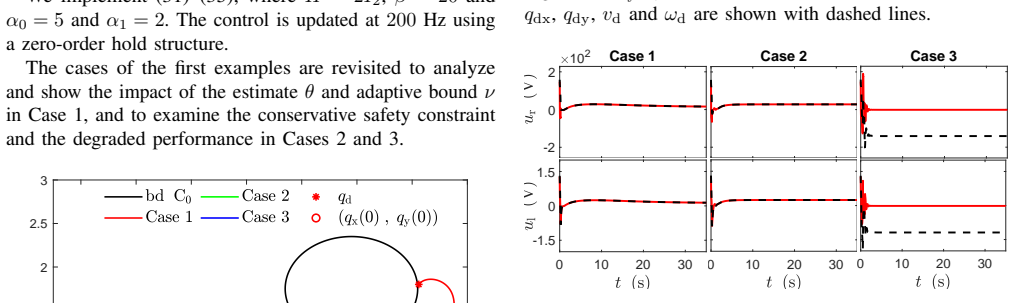
- [Section VI and VII] The examples do not report any measure such as lambda_min(Omega_k) along the trajectories, so the reader cannot check whether the excitation condition that would support the convergence claims is actually satisfied in the simulations.
Circularity Check
No significant circularity: the adaptive CBF bound is computed from measured regression residuals, not fitted to safety outcomes.
full rationale
The derivation chain is self-contained and non-circular. The parameter error recursion (16) and Lemma 1's identity τ_k = ΔV_k are obtained algebraically from y_k = Φ_k θ* (Proposition 1), which follows from integrating the system dynamics; they do not assume the desired safety or convergence conclusions. The bound ν_{k+1} is constructed from the computable Lyapunov difference τ_k and a contraction factor σ_k λ_max(P_k), and Proposition 3(a) verifies inductively that it majorizes ‖θ_k − θ*‖; it is not fitted to observed safety violations. The CBF constraint ψ in (27) is a conservative lower bound for the ideal constraint ψ* whenever the uncertainty bound holds (Proposition 4(a)), which is a direct inequality, not a definitional equivalence. The vanishing-conservativeness claim depends on θ_k→θ* and ν_k→0 under full-rank Ω_k; this is a convergence theorem whose proof is mathematically questionable (strict decrease alone does not imply convergence), but that is a correctness gap, not circularity. Self-citations (e.g., [24] for a closed-form QP solution and [32] for the recursive RLS form) are used for standard or supporting results; neither smuggles in the paper's central vanishing-conservativeness conclusion. Thus no step reduces by construction to its inputs.
Assumptions & free parameters
free parameters (6)
- σ_k =
0.1 (pendulum), 0.001 (robot)
- k_n =
30 (pendulum), 10 (robot)
- β =
200 (pendulum), 20 (robot)
- η =
2 in both examples
- CBF gains α0, α1 =
200 (pendulum), 5 and 2 (robot)
- sampling interval t_{k+1}-t_k =
0.25 s (pendulum), 0.1 s (robot)
assumptions (7)
- domain assumption Assumption 1: for i=0,...,d-2, L_g L_f^i ψ0(x)=0 and L_ϕ L_f^i ψ0(x)=0 for all x.
- domain assumption Assumption 2: L_g L_f^{d-1} ψ0(x) ≠ 0 for all x on the boundary of C_{d-1}.
- domain assumption The uncertainty set Θ is bounded and known, and f, g, φ are locally Lipschitz.
- standard math All derivatives appearing in the Lie-derivative recursions exist and are continuous.
- standard math The function ξ in (24) exists with the stated smoothness and switching properties.
- domain assumption Ω_k is full rank for all k≥k_i (interpreted in the paper as persistency of excitation).
- domain assumption ψ'_{d−1} is locally Lipschitz.
Cite this review
Pith. "Pith review of Adaptive Control Barrier Functions with Vanishing Conservativeness Under Persistency of Excitation." pith.science (2026). https://pith.science/paper/BFARXPA2
@misc{pith2026241112899,
  author       = {Pith},
  title        = {Pith review of: Adaptive Control Barrier Functions with Vanishing Conservativeness Under Persistency of Excitation},
  year         = {2026},
  howpublished = {\url{https://pith.science/paper/BFARXPA2}},
  note         = {Machine review of arXiv:2411.12899}
}
read the original abstract
This article presents a closed-form adaptive controlbarrier-function (CBF) approach for satisfying state constraints in systems with parametric uncertainty. This approach uses a sampled-data recursive-least-squares algorithm to estimate the unknown model parameters and construct a nonincreasing upper bound on the norm of the estimation error. Together, this estimate and upper bound are used to construct a CBF-based constraint that has nonincreasing conservativeness. Furthermore, if a persistency of excitation condition is satisfied, then the CBFbased constraint has vanishing conservativeness in the sense that the CBF-based constraint converges to the ideal constraint corresponding to the case where the uncertainty is known. In addition, the approach incorporates a monotonically improving estimate of the unknown model parameters thus, this estimate can be effectively incorporated into a desired control law. We demonstrate constraint satisfaction and performance using 2 two numerical examples, namely, a nonlinear pendulum and a nonholonomic robot.
Figures


Figures from the paper (6 more)




Reference graph
Works this paper leans on
-
[1]
Control barrier certificates for safe swarm behavior,
U. Borrmann, L. Wang, A. D. Ames, and M. Egerstedt, “Control barrier certificates for safe swarm behavior,” IF AC-PapersOnLine, vol. 48, no. 27, pp. 68–73, 2015
work page 2015
-
[2]
Formation control with time-varying formations, bounded controls, and local collision avoidance,
Z. S. Lippay and J. B. Hoagg, “Formation control with time-varying formations, bounded controls, and local collision avoidance,” IEEE Trans. on Contr . Sys. Tech., vol. 30, no. 1, pp. 261–276, 2021
work page 2021
-
[3]
Formation control for autonomous fixed-wing air vehicles with strict speed constraints,
C. Heintz, S. C. Bailey, and J. B. Hoagg, “Formation control for autonomous fixed-wing air vehicles with strict speed constraints,” Autonomous Robots , vol. 47, no. 8, pp. 1299–1323, 2023
work page 2023
-
[4]
Safety-critical control for dynamical bipedal walking with precise footstep placement,
Q. Nguyen and K. Sreenath, “Safety-critical control for dynamical bipedal walking with precise footstep placement,” IF AC-PapersOnLine, vol. 48, no. 27, pp. 147–154, 2015
work page 2015
-
[5]
Borrelli, A
F. Borrelli, A. Bemporad, and M. Morari, Predictive control for linear and hybrid systems . Cambridge University Press, 2017
2017
-
[6]
Model predictive control based on linear programming˜ the explicit solution,
A. Bemporad, F. Borrelli, M. Morari, et al. , “Model predictive control based on linear programming˜ the explicit solution,” IEEE Trans. Autom. Contr ., vol. 47, no. 12, pp. 1974–1985, 2002
work page 1974
-
[7]
An algorithm for multi-parametric quadratic programming and explicit mpc solutions,
P. Tøndel, T. A. Johansen, and A. Bemporad, “An algorithm for multi-parametric quadratic programming and explicit mpc solutions,” Automatica, vol. 39, no. 3, pp. 489–497, 2003
2003
-
[8]
Safety-critical model predictive control with discrete-time control barrier function,
J. Zeng, B. Zhang, and K. Sreenath, “Safety-critical model predictive control with discrete-time control barrier function,” in Proc. Amer . Contr . Conf., pp. 3882–3889, 2021
work page 2021
Show all 34 references
-
[9]
A framework for worst-case and stochastic safety verification using barrier certificates,
S. Prajna, A. Jadbabaie, and G. J. Pappas, “A framework for worst-case and stochastic safety verification using barrier certificates,” IEEE Trans. Autom. Contr ., vol. 52, no. 8, pp. 1415–1428, 2007
2007
-
[10]
Constructive safety using control barrier functions,
P. Wieland and F. Allg ¨ower, “Constructive safety using control barrier functions,” IF AC Proceedings V olumes, vol. 40, no. 12, pp. 462–467, 2007
2007
-
[11]
Control barrier function based quadratic programs for safety critical systems,
A. D. Ames, X. Xu, J. W. Grizzle, and P. Tabuada, “Control barrier function based quadratic programs for safety critical systems,” IEEE Trans. Autom. Contr ., vol. 62, no. 8, pp. 3861–3876, 2016
2016
-
[12]
Exponential control barrier functions for enforcing high relative-degree safety-critical constraints,
Q. Nguyen and K. Sreenath, “Exponential control barrier functions for enforcing high relative-degree safety-critical constraints,” in Proc. Amer . Contr . Conf., pp. 322–328, 2016
2016
-
[13]
Adaptive fixed-time control for mimo nonlinear systems with asymmetric output constraints using universal barrier functions,
X. Jin, “Adaptive fixed-time control for mimo nonlinear systems with asymmetric output constraints using universal barrier functions,” IEEE Trans. Autom. Contr ., vol. 64, no. 7, pp. 3046–3053, 2018
2018
-
[14]
High-order control barrier functions,
W. Xiao and C. Belta, “High-order control barrier functions,” IEEE Trans. Autom. Contr ., vol. 67, no. 7, pp. 3655–3662, 2021
2021
-
[15]
High-order barrier functions: Robustness, safety, and performance-critical control,
X. Tan, W. S. Cortez, and D. V . Dimarogonas, “High-order barrier functions: Robustness, safety, and performance-critical control,” IEEE Trans. Autom. Contr ., vol. 67, no. 6, pp. 3021–3028, 2021
2021
-
[16]
Event-triggered control for safety-critical systems with unknown dynamics,
W. Xiao, C. Belta, and C. G. Cassandras, “Event-triggered control for safety-critical systems with unknown dynamics,” IEEE Trans. Autom. Contr ., vol. 68, no. 7, pp. 4143–4158, 2022
2022
-
[17]
Robust control barrier functions under high relative degree and input constraints for satellite trajectories,
J. Breeden and D. Panagou, “Robust control barrier functions under high relative degree and input constraints for satellite trajectories,” Automatica, vol. 155, p. 111109, 2023
2023
-
[18]
Multi-uav safe collaborative transporta- tion based on adaptive control barrier function,
Z. Wang, T. Hu, and L. Long, “Multi-uav safe collaborative transporta- tion based on adaptive control barrier function,” IEEE Trans. Sys., Man, and Cyb.: Systems , 2023
2023
-
[19]
Constrained moving path fol- lowing control for uav with robust control barrier function,
Z. Zheng, J. Li, Z. Guan, and Z. Zuo, “Constrained moving path fol- lowing control for uav with robust control barrier function,” IEEE/CAA Automatica Sinica , vol. 10, no. 7, pp. 1557–1570, 2023
2023
-
[20]
Control barrier functions: Theory and applications,
A. D. Ames, S. Coogan, M. Egerstedt, G. Notomista, K. Sreenath, and P. Tabuada, “Control barrier functions: Theory and applications,” in 2019 18th Proc. Euro. Contr . Conf. , pp. 3420–3431, IEEE, 2019
2019
-
[21]
Measurement-robust control barrier functions: Certainty in safety with uncertainty in state,
R. K. Cosner, A. W. Singletary, A. J. Taylor, T. G. Molnar, K. L. Bouman, and A. D. Ames, “Measurement-robust control barrier functions: Certainty in safety with uncertainty in state,” in 2021 IEEE/RSJ Int. Conf. Int. Robots Sys. , pp. 6286–6291, IEEE, 2021
2021
-
[22]
Soft-minimum and soft-maximum barrier functions for safety with actuation constraints,
P. Rabiee and J. B. Hoagg, “Soft-minimum and soft-maximum barrier functions for safety with actuation constraints,” Automatica, 2024
2024
-
[23]
A closed-form control for safety under input constraints using a composition of control barrier functions,
P. Rabiee and J. B. Hoagg, “A closed-form control for safety under input constraints using a composition of control barrier functions,” arXiv preprint arXiv:2406.16874 , 2024
2024 arXiv
-
[24]
Time-varying soft-maximum barrier functions for safety in unmapped and dynamic environments,
A. Safari and J. B. Hoagg, “Time-varying soft-maximum barrier functions for safety in unmapped and dynamic environments,” arXiv preprint arXiv:2409.01458, 2024
2024 arXiv
-
[25]
Robust control barrier functions for constrained sta- bilization of nonlinear systems,
M. Jankovic, “Robust control barrier functions for constrained sta- bilization of nonlinear systems,” Automatica, vol. 96, pp. 359–367, 2018
2018
-
[26]
Robust control barrier functions for nonlinear control systems with uncertainty: A duality-based approach,
M. H. Cohen, C. Belta, and R. Tron, “Robust control barrier functions for nonlinear control systems with uncertainty: A duality-based approach,” in Proc. Conf. Dec. Contr ., pp. 174–179, IEEE, 2022
2022
-
[27]
Adaptive safety with control barrier functions,
A. J. Taylor and A. D. Ames, “Adaptive safety with control barrier functions,” in Proc. Amer . Contr . Conf., pp. 1399–1405, IEEE, 2020
2020
-
[28]
Robust adaptive control barrier functions: An adaptive and data-driven approach to safety,
B. T. Lopez, J.-J. E. Slotine, and J. P. How, “Robust adaptive control barrier functions: An adaptive and data-driven approach to safety,” IEEE Contr . Syst. Letts. , vol. 5, no. 3, pp. 1031–1036, 2020
2020
-
[29]
L 1 adaptive control barrier functions for nonlinear underactuated systems,
Q. Nguyen and K. Sreenath, “L 1 adaptive control barrier functions for nonlinear underactuated systems,” in Proc. Amer . Contr . Conf., pp. 721–728, 2022
2022
-
[30]
High order robust adaptive control barrier functions and exponentially stabilizing adaptive control lyapunov functions,
M. H. Cohen and C. Belta, “High order robust adaptive control barrier functions and exponentially stabilizing adaptive control lyapunov functions,” in Proc. Amer . Contr . Conf., pp. 2233–2238, IEEE, 2022
2022
-
[31]
Robust adaptive control barrier functions for input-affine systems: Application to uncertain manipulator safety constraints,
D. Zeng, Y . Jiang, Y . Wang, H. Zhang, and Y . Feng, “Robust adaptive control barrier functions for input-affine systems: Application to uncertain manipulator safety constraints,” IEEE Contr . Syst. Letts. , 2023
2023
-
[32]
On the stability and convergence of a sliding-window variable-regularization recursive-least-squares algorithm,
A. A. Ali, J. B. Hoagg, M. Mossberg, and D. S. Bernstein, “On the stability and convergence of a sliding-window variable-regularization recursive-least-squares algorithm,” Int. J. of Adap. Contr . Sig. Process. , vol. 30, no. 5, pp. 715–735, 2016
2016
-
[33]
On compatibility and region of attraction for safe, stabilizing control laws,
W. S. Cortez and D. V . Dimarogonas, “On compatibility and region of attraction for safe, stabilizing control laws,” IEEE Trans. Autom. Contr ., vol. 67, no. 9, pp. 4924–4931, 2022
2022
-
[34]
Non-holonomic differential drive mobile robot control & design: Critical dynamics and coupling constraints,
I. Anvari, “Non-holonomic differential drive mobile robot control & design: Critical dynamics and coupling constraints,” tech. rep., Arizona State University, 2013
2013
Reviewed August 12, 2026 · model on record in the stance chip above.
Discussion (0). Continue with ORCID to comment.