REVIEW 4 major objections 6 minor 58 references
Recovery of the Solar Cycle from Maunder-like Grand Minima Episodes: A Quantification of the Necessary Polar Flux Threshold through Solar Dynamo Simulations
T0 review · 4 major / 6 minor · reviewed 2026-08-15 · deepseek-v4-flash
Pith's one-line read The paper argues that a statistically inferred polar flux threshold, about 63 ± 4% of the modal polar flux amplitude in the primary simulation, triggers resumption of polarity reversal and thereby recovery from grand minima.
desk verdict A genuinely new threshold statistic for grand-minimum recovery from a standard dynamo model, but the 63±4% number is built on a single stochastic run — important enough to referee, not yet solid enough to forecast with. read the letter →
The pith
A machine-rendered reading of the paper's core claim, the machinery that carries it, and where it could break.
The reading
What carries the argument
The load-bearing object is an axisymmetric, kinematic Babcock-Leighton dynamo model with a deep mean-field alpha source and a surface Babcock-Leighton source, each stochastically forced by uniform white noise. The recovery threshold is diagnosed from the signed hemispheric polar flux, computed as the poloidal flux crossing the photosphere between 70° and 87° latitude in each hemisphere. During a simulated grand minimum, surface eruptions are absent and the deep mean-field alpha source converts weak internal toroidal fields into poloidal fields that migrate poleward; polarity reversal resumes once enough flux of one polarity accumulates at the poles. The modal polar flux amplitude, from a skewed Gaussian fit to the distribution of cycle-amplitude values over millennia, supplies the normalizing scale against which the threshold is measured.
What would settle it
Track the Sun's polar field through a future grand minimum, or reconstruct polar-field proxies from cosmogenic isotopes across the Maunder Minimum: if sunspot cycles resume before the hemispheric polar flux reaches about $63\%$ of the modal amplitude in either hemisphere, or fail to resume after both hemispheres pass that value, the threshold claim is falsified.
Extended reading notes
Core claim
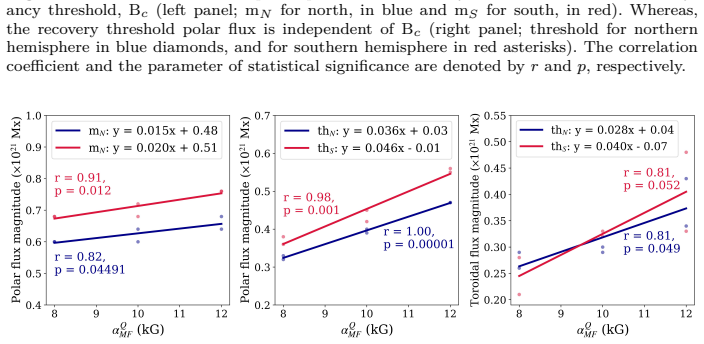
The central claim, stated on the paper's own terms, is that there exists a statistically inferred threshold polar flux amplitude whose attainment allows the regular polar flux reversal to kick-start and thereby ends a grand minimum phase. In the primary simulation, recovery flux amplitudes cluster at $63 \pm 4\%$ of the modal value of the skewed Gaussian distribution of signed hemispheric polar flux amplitudes, for both polarities and both hemispheres. The threshold is independent of the critical buoyancy threshold $B_c$, because during a grand minimum the dynamo mostly produces weak toroidal fields below that threshold; it does scale with the quenching limit of the mean-field poloidal source $\alpha^Q_{MF}$, indicating that this source governs recovery. The paper also reports that the duration of a simulated grand minimum shows no significant correlation with either the rate of solar-cycle decline at onset or the rate of recovery, and that no precursor in the polar flux threshold signals the onset of a grand minimum.
Load-bearing premise
Everything rests on the model's noise amplitudes and nonlinear parameters being tuned so that simulated grand-minimum occurrence matches multi-millennial reconstructions; direct polar-field measurements from a real grand minimum do not exist, so the $63\%$ threshold is an emergent property of that tuned model rather than a calibrated solar observable.
Editorial extensions
If this is right
- If a real grand minimum follows this threshold law, regular measurement of the Sun's polar flux during the minimum would let forecasters estimate when polarity reversal and normal sunspot cycles should resume.
- The independence of the recovery threshold from the critical buoyancy threshold means uncertainty about deep-seated toroidal field emergence does not directly affect the predicted recovery condition.
- Because the mean-field poloidal source sets both the modal polar flux and the recovery threshold, stronger quenching of this source implies a higher recovery threshold and hence a harder, slower recovery from a grand minimum.
- The absence of a correlation between grand-minimum duration and onset or recovery rates implies that historical cycle-decline rates cannot be used to predict how long a minimum will last.
- The failure to find any precursor in the simulated polar flux before entry into a grand minimum suggests that predicting the onset of such episodes remains an open problem.
Reading between the lines
- If the $63 \pm 4\%$ ratio is a generic property of stochastically forced threshold-reset dynamo systems, the same relative threshold may appear in other Babcock-Leighton models, which could be checked without waiting for a real grand minimum.
- A testable extension is to compare the threshold against solar-stellar analogues: stars showing minima episodes with polar-field proxies could reveal whether recovery indeed follows a fixed fraction of modal polar flux rather than an absolute value.
- The lack of onset precursors, if robust, would imply that grand-minimum onset is set by rare noise realizations near a critical dynamo state, so predictability of onset is intrinsically limited; this is a consequence the authors hint at but do not fully develop.
- Applying a similar threshold analysis to the timing of polarity-reversal resumption in hemispheric asymmetries could help refine forecasts of which hemisphere leads the recovery from an asymmetric grand minimum.
Signed reviews
Editorial analysis
A structured set of objections, weighed in public.
Referee Report
Summary. The manuscript uses an axisymmetric kinematic solar dynamo model with stochastic fluctuations in the mean-field and Babcock-Leighton poloidal sources, tuned to reproduce multi-millennial grand-minimum occurrence statistics. It defines 'unipolar phases' during deep minima in which polar-field reversal halts, tracks the signed hemispheric polar flux in 70–87 degrees latitude, and reports that polar flux amplitudes at the end of these unipolar phases cluster near 63 ± 4% of the modal polar flux amplitude for the primary simulation. The authors further explore how the modal and recovery-threshold fluxes depend on the critical buoyancy threshold Bc and the mean-field quenching limit alpha_Q^MF, and they report no statistically significant correlation between grand-minimum duration and the rates of onset or recovery. They propose that regular polar-flux monitoring during a minimum could forecast recovery and emphasize that no reliable precursors for grand-minimum onset were found.
Significance. The potential contribution is a quantitative, physically motivated recovery statistic for solar grand minima, connecting the stochastic mean-field alpha source to the resumption of polarity reversal. The parameter-space exploration separating the Bc and alpha_Q^MF dependencies is useful, and the manuscript is commendably explicit about its null results and limitations. However, the central threshold claim is currently supported by a single stochastic realization and by clustering of exit amplitudes rather than by a conditional recovery-probability analysis, so the result is not yet established as a robust, forecastable quantity.
major comments (4)
- [Sec. 3.1 and Abstract] The paper labels the measured quantity a 'necessary' polar flux threshold, but the analysis only documents that recovery events cluster at roughly 63 ± 4% of the modal polar flux. Section 3.1 itself notes that weak polar flux cycles weaker than the recovery threshold occur during regular activity, so the threshold is not a barrier whose crossing is required for reversal. The forecast claim needs a conditional analysis: estimate the probability of recovery or reversal as a function of instantaneous polar flux during unipolar phases, and compare the exit-amplitude distribution to the distribution of polar flux values sampled throughout those phases. Without this, the clustering is a mean exit amplitude rather than a threshold.
- [Sec. 2, Sec. 3.1, Table 2] The 63 ± 4% value is obtained from a single 10,000-year stochastic run with fixed noise amplitudes (100% on alpha_MF and 150% on alpha_BL), and the additional runs vary Bc and alpha_Q^MF but not the noise amplitude or the random seed. Since alpha_MF is the dominant poloidal source during minima, the recovery statistics are controlled by exactly the stochastic forcing that is held fixed. An ensemble over noise realizations, at minimum different seeds for the primary parameter set, is needed to attach uncertainty to the threshold, and a small sweep of the alpha_MF noise amplitude is needed to test whether the normalized ratio is invariant. The text should also define how the threshold value and the reported ± range are estimated from the green diamond points in Fig. 3.
- [Sec. 3.2, Figs. 4 and 5] The linear-correlation statements are based on one realization per parameter combination, with no error bars on the modal or threshold flux estimates. In particular, the claim that the recovery threshold is independent of Bc (right panel of Fig. 4) rests on differences between threshold values that may be comparable to the sampling uncertainty from only 22 grand-minimum events in the primary run. Reporting confidence intervals or a small ensemble of realizations per parameter set is necessary to support the p-values and the independence claim.
- [Sec. 4 and Concluding Remarks] The proposed forecast recipe requires an absolute or normalized polar flux scale, but no direct observational calibration exists for the polar field inside a real grand minimum, and the modal value used for normalization is itself model-dependent, as shown by its variation with Bc and alpha_Q^MF in Figs. 4 and 5. The authors should state explicitly how the modal polar flux would be determined in an actual forecast and what systematic uncertainty the model dependence contributes; otherwise the transfer of the 63 ± 4% value to the Sun is not established.
minor comments (6)
- [Eq. (3)] Equation (3) is written as alpha0^MF ~ alpha0^MF / (1 + (B/alpha_Q^MF)^2), which is self-referential and cannot be read as the quenching law; the left side should be the actual mean-field alpha coefficient or a differently named amplitude.
- [Abstract] In the abstract, 'thought to resume, Using' should be 'thought to resume. Using'.
- [Fig. 3 caption] The Fig. 3 caption says the distribution spans ten millennia, while Fig. 2 illustrates one millennium; specify whether the same long run is used for both and how many unipolar-phase events contribute to the threshold estimate.
- [Table 1] Table 1 uses 'BC' in the header while the text uses 'Bc'; please use a single consistent notation.
- [Sec. 3.2] In Sec. 3.2, 'recovery if the polar flux threshold' contains a typo and should be 'recovery of the polar flux threshold' or similar.
- [Data availability] The data availability statement promises data on reasonable request but does not mention code; for a simulation-based forecast claim, depositing the model code and run scripts would substantially improve reproducibility.
Circularity Check
No significant circularity: the recovery polar-flux threshold is an emergent statistic measured from the simulations, not a fitted input or a self-citation chain.
full rationale
The paper's central claim is the recovery polar-flux threshold, quantified as 63±4% of the modal polar flux amplitude. This value is obtained by locating the terminations of unipolar phases in long stochastically forced dynamo runs and averaging the signed polar flux amplitudes at those terminations. The threshold is not inserted into the model as an input; rather, reversals resume in the model when sufficient polar flux has built up, and the threshold is read off from the resulting time series. It is therefore an emergent statistic, not a fitted parameter renamed as a prediction. The modal polar flux used for normalization is dominated by regular cycles, not by grand minima, so the 63% ratio is not tautological. The noise amplitudes are calibrated to reproduce observed grand-minimum occurrence statistics from Usoskin et al., which is an external benchmark and not the recovery-threshold target; the threshold itself is not used to fit those amplitudes. The model profiles and nonlinear quenching prescriptions are adopted from earlier published work, including some coauthored by Nandy, but these are concrete model ingredients and independent published simulations, not unverified uniqueness theorems invoked to forbid alternatives. The dependence of the recovery threshold on the mean-field alpha quenching parameter is tested directly by varying αQ_MF, and the claimed independence from Bc is tested by a parameter sweep. A robustness caveat remains — the threshold is derived from single noise-tuned realizations per parameter set and lacks direct observational calibration of polar flux during real minima — but this is a scientific limitation, not circular reasoning. No step in the derivation reduces by construction to its own inputs.
Assumptions & free parameters
free parameters (4)
- Stochastic noise amplitude on mean-field alpha =
100%
- Stochastic noise amplitude on Babcock-Leighton alpha =
150%
- Mean-field quenching limit alpha_Q_MF =
10 kG (primary), 8 and 12 kG in sensitivity runs
- Critical buoyancy threshold Bc =
80 kG (primary), 75 and 85 kG in sensitivity runs
assumptions (5)
- domain assumption The axisymmetric kinematic mean-field dynamo approximation (Eqs. 1-2) adequately captures the large-scale solar cycle and its grand minima.
- domain assumption The solar dynamo currently operates in a near-critical regime.
- domain assumption Stochastic fluctuations in the poloidal sources are uniform white noise, added independently in each hemisphere.
- domain assumption The mean-field alpha source alpha_MF dominates poloidal field generation during grand minima because no active regions exist to feed the Babcock-Leighton source.
- standard math The skew-normal distribution adequately represents the simulated polar flux amplitude histogram; the modal value is a stable reference.
invented entities (1)
-
Recovery polar flux threshold
Cite this review
Pith. "Pith review of Recovery of the Solar Cycle from Maunder-like Grand Minima Episodes: A Quantification of the Necessary Polar Flux Threshold through Solar Dynamo Simulations." pith.science (2026). https://pith.science/paper/BFY2QDEF
@misc{pith2026250508380,
  author       = {Pith},
  title        = {Pith review of: Recovery of the Solar Cycle from Maunder-like Grand Minima Episodes: A Quantification of the Necessary Polar Flux Threshold through Solar Dynamo Simulations},
  year         = {2026},
  howpublished = {\url{https://pith.science/paper/BFY2QDEF}},
  note         = {Machine review of arXiv:2505.08380}
}
read the original abstract
The 11-yr cycle of sunspots undergo amplitude modulation over longer timescales. As a part of this long-term modulation in solar activity, the decennial rhythm occasionally breaks, with quiescent phases with very few sunspots observed over multiple decades. These episodes are termed as solar grand minima. Observation of solar magnetic activity proxies complemented by solar dynamo simulations suggests that the large-scale solar polar fields become very weak during these minima phases with a temporary halt in the polar field reversal. Eventually, with the accumulation of sufficient polar fluxes, the polarity reversal and regular cyclic activity is thought to resume, Using multi-millennial dynamo simulations with stochastic forcing, we quantify the polar flux threshold necessary to recover global solar polarity reversal and surmount grand minima phases. We find that the duration of a grand minimum is independent of the onset rate and does not affect the recovery rate. Our results suggest a method to forecast the Sun's recovery from a grand minima phase. However, based on our approach, we could not identify specific precursors that signal entry in to a grand minima phase -- implying that predicting the onset of grand minima remains an outstanding challenge.
Figures


Figures from the paper (4 more)



Reference graph
Works this paper leans on
-
[1]
barticle Beer , J. , Tobias , S. , Weiss , N. : 1998 , An Active Sun Throughout the Maunder Minimum . Solar Physics 181 , 237 . https://doi.org/10.1023/A:1005026001784 . https://doi.org/10.1023/A:1005026001784 . barticle
-
[2]
, Nandy , D
barticle Bhowmik , P. , Nandy , D. : 2018 , Prediction of the strength and timing of sunspot cycle 25 reveal decadal-scale space environmental conditions . Nat. Commun. 9 , 5209 . barticle
2018
-
[3]
barticle Callebaut , D.K. , Makarov , V.I. , Tlatov , A.G. : 2007 , Monopolar structure of the Sun in between polar reversals and in Maunder Minimum . Adv. Space Res. 40 , 1917 . barticle
work page 2007
-
[4]
barticle Cameron , R. , Schüssler , M. : 2015 , The crucial role of surface magnetic fields for the solar dynamo . Science 347 , 1333 . https://doi.org/10.1126/science.1261470 . https://www.science.org/doi/abs/10.1126/science.1261470 . barticle
-
[5]
barticle Cameron , R.H. , Schüssler , M. : 2017 , Understanding Solar Cycle Variability . The Astrophysical Journal 843 , 111 . https://doi.org/10.3847/1538-4357/aa767a . https://dx.doi.org/10.3847/1538-4357/aa767a . barticle
-
[6]
barticle Cameron , R.H. , Schüssler , M. : 2019 , Solar activity: periodicities beyond 11 years are consistent with random forcing . Astronomy and astrophysics 625 , A28 . https://doi.org/10.1051/0004-6361/201935290 . https://doi.org/10.1051/0004-6361/201935290 . barticle
-
[7]
barticle Carrasco , V.M.S. , Hayakawa , H. , Kuroyanagi , C. , Gallego , M.C. , Vaquero , J.M. : 2021 , Strong evidence of low levels of solar activity during the Maunder Minimum . Mon. Not. R. Astron. Soc. 504 , 5199 . barticle
work page 2021
-
[8]
barticle Charbonneau , P. , Blais-Laurier , G. , St-Jean , C. : 2004 , Intermittency and phase persistence in a Babcock-Leighton model of the solar cycle . Astrophys. J. 616 , L183 . barticle
work page 2004
Show all 58 references
-
[9]
, Nandy , D
barticle Chatterjee , P. , Nandy , D. , Choudhuri , A.R. : 2004 , Full-sphere simulations of a circulation-dominated solar dynamo: Exploring the parity issue . Astronomy & Astrophysics 427 , 1019 . barticle
2004
-
[10]
: 1992 , Stochastic fluctuations of the solar dynamo
barticle Choudhuri , A. : 1992 , Stochastic fluctuations of the solar dynamo . Astronomy and Astrophysics (ISSN 0004-6361), vol. 253, no. 1, Jan. 1992, p. 277-285. Research supported by ISRO. 253 , 277 . barticle
1992
-
[11]
, Chang , L.C
barticle Daglis , I.A. , Chang , L.C. , Dasso , S. , Gopalswamy , N. , Khabarova , O.V. , Kilpua , E. , Lopez , R. , Marsh , D. , Matthes , K. , Nandy , D. , Sepp\"al\"a , A. , Shiokawa , K. , Thi\'eblemont , R. , Zong , Q. : 2021 , Predictability of variable solar--terrestria...
2021 doi
-
[12]
, Nandy , D
barticle Dash , S. , Nandy , D. , Usoskin , I. : 2023 , Long-term forcing of the Sun's coronal field, open flux, and cosmic ray modulation potential during grand minima, maxima, and regular activity phases by the solar dynamo mechanism . Mon. Not. R. Astron. Soc. 525 , 4801 . barticle
2023
-
[13]
, Solanki, S
barticle Dasi-Espuig, M. , Solanki, S. K. , Krivova, N. A. , Cameron, R. , Pe\ nuela, T. : 2010 , Sunspot group tilt angles and the strength of the solar cycle . Astronomy and Astrophysics 518 , A7 . https://doi.org/10.1051/0004-6361/201014301 . https://doi.org/10.1051/0004-63...
2010 doi
-
[14]
: 1976 , The Maunder Minimum
barticle Eddy , J.A. : 1976 , The Maunder Minimum . Science 192 , 1189 . https://doi.org/10.1126/science.192.4245.1189 . https://www.science.org/doi/abs/10.1126/science.192.4245.1189 . barticle
1976
-
[15]
: 2021 , Magnetic fields in the solar convection zone
barticle Fan , Y. : 2021 , Magnetic fields in the solar convection zone . Living Reviews in Solar Physics 18 , 5 . https://doi.org/10.1007/s41116-021-00031-2 . https://doi.org/10.1007/s41116-021-00031-2 . barticle
2021 doi
-
[16]
: 2015 , The Solar Cycle
barticle Hathaway , D.H. : 2015 , The Solar Cycle . Living Reviews in Solar Physics 12 , 4 . https://doi.org/10.1007/lrsp-2015-4 . https://doi.org/10.1007/lrsp-2015-4 . barticle
2015 doi
-
[17]
, Lockwood , M
barticle Hayakawa , H. , Lockwood , M. , Owens , M.J. , S \^o ma , M. , Besser , B.P. , van Driel-Gesztelyi , L. : 2021 , Graphical evidence for the solar coronal structure during the Maunder minimum: comparative study of the total eclipse drawings in 1706 and 1715 . J. Space ...
2021
-
[18]
, Nandy , D
barticle Hazra , S. , Nandy , D. : 2019 , The origin of parity changes in the solar cycle . Mon. Not. R. Astron. Soc. 489 , 4329 . barticle
2019
-
[19]
, Passos , D
barticle Hazra , S. , Passos , D. , Nandy , D. : 2014 , A stochastically forced time delay solar dynamo model: self-consistent recovery from a Maunder-like grand minimum necessitates a mean-field alpha effect . The Astrophysical Journal 789 , 5 . barticle
2014
-
[20]
: 2024 , Exploring solar dynamo behavior using an annually resolved carbon-14 compilation during multiple grand solar minima
barticle Inceoglu , F. : 2024 , Exploring solar dynamo behavior using an annually resolved carbon-14 compilation during multiple grand solar minima . Sci. Rep. 14 , 5617 . barticle
2024
-
[21]
, Saha , C
barticle Jaswal , P. , Saha , C. , Nandy , D. : 2023 , Discovery of a relation between the decay rate of the Sun’s magnetic dipole and the growth rate of the following sunspot cycle: a new precursor for solar cycle prediction . Monthly Notices of the Royal Astronomical Society...
2023 doi
-
[22]
, Cameron , R.H
barticle Jiang , J. , Cameron , R.H. , Schüssler , M. : 2014 , EFFECTS OF THE SCATTER IN SUNSPOT GROUP TILT ANGLES ON THE LARGE-SCALE MAGNETIC FIELD AT THE SOLAR SURFACE . The Astrophysical Journal 791 , 5 . https://doi.org/10.1088/0004-637X/791/1/5 . https://dx.doi.org/10.108...
2014 doi
-
[23]
, Cameron , R.H
barticle Jiang , J. , Cameron , R.H. , Schüssler , M. : 2015 , THE CAUSE OF THE WEAK SOLAR CYCLE 24 . The Astrophysical Journal Letters 808 , L28 . https://doi.org/10.1088/2041-8205/808/1/L28 . https://dx.doi.org/10.1088/2041-8205/808/1/L28 . barticle
2015 doi
-
[24]
, Miesch , M
barticle Karak , B.B. , Miesch , M. : 2017 , Solar Cycle Variability Induced by Tilt Angle Scatter in a Babcock–Leighton Solar Dynamo Model . The Astrophysical Journal 847 , 69 . https://doi.org/10.3847/1538-4357/aa8636 . https://dx.doi.org/10.3847/1538-4357/aa8636 . barticle
2017 doi
-
[25]
, Miesch , M
barticle Karak , B.B. , Miesch , M. : 2018 , Recovery from Maunder-like Grand Minima in a Babcock–Leighton Solar Dynamo Model . The Astrophysical Journal Letters 860 , L26 . https://doi.org/10.3847/2041-8213/aaca97 . https://dx.doi.org/10.3847/2041-8213/aaca97 . barticle
2018 doi
-
[26]
, Karak , B.B
barticle Kumar , P. , Karak , B.B. , Sreedevi , A. : 2024 , Variabilities in the polar field and solar cycle due to irregular properties of bipolar magnetic regions . Monthly Notices of the Royal Astronomical Society 530 , 2895 . https://doi.org/10.1093/mnras/stae1052 . https:...
2024 doi
-
[27]
: 2003 , Magnetic Flux Transport Simulations of Solar Surface Magnetic Distributions During a Grand Minimum
barticle Mackay , D.H. : 2003 , Magnetic Flux Transport Simulations of Solar Surface Magnetic Distributions During a Grand Minimum . Sol. Phys. 213 , 173 . barticle
2003
-
[28]
, Tlatov , A.G
barticle Makarov , V.I. , Tlatov , A.G. : 2000 , Polar magnetic field reversals of the Sun in Maunder Minimum . J. Astrophys. Astron. 21 , 193 . barticle
2000
-
[29]
, Egeland , R
barticle Metcalfe , T.S. , Egeland , R. , van Saders , J. : 2016 , STELLAR EVIDENCE THAT THE SOLAR DYNAMO MAY BE IN TRANSITION . The Astrophysical Journal Letters 826 , L2 . https://doi.org/10.3847/2041-8205/826/1/L2 . https://dx.doi.org/10.3847/2041-8205/826/1/L2 . barticle
2016 doi
-
[30]
, G\'omez , D.O
barticle Mininni , P.D. , G\'omez , D.O. , Mindlin , G.B. : 2002 , Biorthogonal Decomposition Techniques Unveil the Nature of the Irregularities Observed in the Solar Cycle . Phys. Rev. Lett. 89 , 061101 . https://doi.org/10.1103/PhysRevLett.89.061101 . https://link.aps.org/do...
2002 doi
-
[31]
, Sokoloff , D
barticle Moss , D. , Sokoloff , D. , Usoskin , I. , Tutubalin , V. : 2008 , Solar grand minima and random fluctuations in dynamo parameters . Sol. Phys. 250 , 221 . barticle
2008
-
[32]
, Vaquero , J.M
barticle Mu \ n oz-Jaramillo , A. , Vaquero , J.M. : 2018 , Visualization of the challenges and limitations of the long-term sunspot number record . Nat. Astron. 3 , 205 . barticle
2018
-
[33]
, Lemerle , A
barticle Nagy , M. , Lemerle , A. , Labonville , F. , Petrovay , K. , Charbonneau , P. : 2017 , The Effect of ``Rogue'' Active Regions on the Solar Cycle . Solar Physics 292 , 167 . https://doi.org/10.1007/s11207-017-1194-0 . https://doi.org/10.1007/s11207-017-1194-0 . barticle
2017 doi
-
[34]
: 2002 , Constraints on the Solar Internal Magnetic Field from a Buoyancy Driven Solar Dynamo
barticle Nandy , D. : 2002 , Constraints on the Solar Internal Magnetic Field from a Buoyancy Driven Solar Dynamo . Astrophysics and Space Science 282 , 209 . https://doi.org/10.1023/A:1021632522168 . https://doi.org/10.1023/A:1021632522168 . barticle
2002 doi
-
[35]
, Choudhuri , A.R
barticle Nandy , D. , Choudhuri , A.R. : 2001 , Toward a mean field formulation of the Babcock‐Leighton type solar dynamo. I. ‐coefficient versus durney's double‐ring approach . Astrophys. J. 551 , 576 . barticle
2001
-
[36]
, Choudhuri , A.R
barticle Nandy , D. , Choudhuri , A.R. : 2002 , Explaining the latitudinal distribution of sunspots with deep meridional flow . Science 296 , 1671 . barticle
2002
-
[37]
, Martens , P.C.H
barticle Nandy , D. , Martens , P.C.H. , Obridko , V. , Dash , S. , Georgieva , K. : 2021 , Solar evolution and extrema: current state of understanding of long-term solar variability and its planetary impacts . Progress in Earth and Planetary Science 8 , 40 . https://doi.org/1...
2021 doi
-
[38]
, Baruah , Y
barticle Nandy , D. , Baruah , Y. , Bhowmik , P. , Dash , S. , Gupta , S. , Hazra , S. , Lekshmi , B. , Pal , S. , Pal , S. , Roy , S. , Saha , C. , Sinha , S. : 2023 , Causality in heliophysics: Magnetic fields as a bridge between the Sun's interior and the Earth's space envi...
2023
-
[39]
, Banerjee , D
bchapter Nandy , D. , Banerjee , D. , Bhowmik , P. , BRUN , A.S. , Cameron , R.H. , Gibson , S.E. , Hanasoge , S. , Harra , L. , Hassler , D.M. , Jain , R. , Jiang , J. , Jouve , L. , Mackay , D.H. , Mahajan , S.S. , Mandrini , C.H. , Owens , M. , Pal , S. , Pinto , R.F. , Sah...
2023 doi
-
[40]
, Kitchatinov , L.L
barticle Olemskoy , S.V. , Kitchatinov , L.L. : 2013 , Grand minima and north-south asymmetry of solar activity . Astrophys. J. 777 , 71 . barticle
2013
-
[41]
, Nandy , D
barticle Pal , S. , Nandy , D. : 2024 , Algebraic quantification of the contribution of active regions to the Sun’s dipole moment: applications to century-scale polar field estimates and solar cycle forecasting . Monthly Notices of the Royal Astronomical Society 531 , 1546 . h...
2024 doi
-
[42]
, Bhowmik , P
barticle Pal , S. , Bhowmik , P. , Mahajan , S.S. , Nandy , D. : 2023 , Impact of Anomalous Active Regions on the Large-scale Magnetic Field of the Sun . The Astrophysical Journal 953 , 51 . https://doi.org/10.3847/1538-4357/acd77e . https://dx.doi.org/10.3847/1538-4357/acd77e...
2023 doi
-
[43]
, Nandy , D
barticle Passos , D. , Nandy , D. , Hazra , S. , Lopes , I. : 2014 , A solar dynamo model driven by mean-field alpha and Babcock-Leighton sources: fluctuations, grand-minima-maxima, and hemispheric asymmetry in sunspot cycles . Astronomy & Astrophysics 563 , A18 . barticle
2014
-
[44]
, Nandy , D
botherref Pevtsov , A.A. , Nandy , D. , Usoskin , I. , Pevtsov , A.A. , Corti , C. , Lef \`e vre , L. , Owens , M. , Li , G. , Krivova , N. , Saha , C. , Perri , B. , Brun , A.S. , Strugarek , A. , Dayeh , M.A. , Nagovitsyn , Y.A. , Erd \'e lyi , R. : 2023, Long-term solar var...
2023
-
[45]
, Shapiro , A.I
barticle Reinhold , T. , Shapiro , A.I. , Solanki , S.K. , Montet , B.T. , Krivova , N.A. , Cameron , R.H. , Amazo-Gómez , E.M. : 2020 , The Sun is less active than other solar-like stars . Science 368 , 518 . https://doi.org/10.1126/science.aay3821 . https://www.science.org/d...
2020 doi
-
[46]
, Nandy , D
barticle Saha , C. , Nandy , D. : 2023 , Understanding Grand Minima in Solar Activity: Confronting Observations with Dynamo Simulations . Proceedings of the International Astronomical Union 19 , 128–140 . https://doi.org/10.1017/S1743921324000905 . barticle
2023 doi
-
[47]
, Chandra , S
barticle Saha , C. , Chandra , S. , Nandy , D. : 2022 , Evidence of persistence of weak magnetic cycles driven by meridional plasma flows during solar grand minima phases . 517 , L36 . https://doi.org/10.1093/mnrasl/slac104 . 2022MNRAS.517L..36S . barticle
2022 doi
-
[48]
, Mukhopadhyay , S
barticle Saha , C. , Mukhopadhyay , S. , Nandy , D. : 2025 , On the Origin of Long-term Modulation in the Sun’s Magnetic Activity Cycle . The Astrophysical Journal Letters 984 , L5 . https://doi.org/10.3847/2041-8213/adc91e . https://dx.doi.org/10.3847/2041-8213/adc91e . barticle
2025 doi
-
[49]
, Kauristie , K
botherref Schrijver , C.J. , Kauristie , K. , Aylward , A.D. , Denardini , C.M. , Gibson , S.E. , Glover , A. , Gopalswamy , N. , Grande , M. , Hapgood , M. , Heynderickx , D. , Jakowski , N. , Kalegaev , V.V. , Lapenta , G. , Linker , J.A. , Liu , S. , Mandrini , C.H. , Mann ...
2015
-
[50]
, Schmidt , G.A
barticle Shindell , D.T. , Schmidt , G.A. , Mann , M.E. , Rind , D. , Waple , A. : 2001 , Solar Forcing of Regional Climate Change During the Maunder Minimum . Science 294 , 2149 . https://doi.org/10.1126/science.1064363 . https://www.science.org/doi/abs/10.1126/science.106436...
2001 doi
-
[51]
, Nandy , D
barticle Tripathi , B. , Nandy , D. , Banerjee , S. : 2021 , Stellar mid-life crisis: subcritical magnetic dynamos of solar-like stars and the breakdown of gyrochronology . Monthly Notices of the Royal Astronomical Society: Letters 506 , L50 . https://doi.org/10.1093/mnrasl/sl...
2021 doi
-
[52]
: 2023 , A history of solar activity over millennia
barticle Usoskin , I.G. : 2023 , A history of solar activity over millennia . Living Reviews in Solar Physics 20 , 2 . https://doi.org/10.1007/s41116-023-00036-z . https://doi.org/10.1007/s41116-023-00036-z . barticle
2023 doi
-
[53]
, Sokoloff , D
barticle Usoskin , I.G. , Sokoloff , D. , Moss , D. : 2009 , Grand minima of solar activity and the mean-field dynamo . Sol. Phys. 254 , 345 . barticle
2009
-
[54]
, Solanki , S.K
barticle Usoskin , I.G. , Solanki , S.K. , Kovaltsov , G.A. : 2007 , Grand minima and maxima of solar activity: new observational constraints . Astron. Astrophys. 471 , 301 . barticle
2007
-
[55]
, Arlt , R
barticle Usoskin , I.G. , Arlt , R. , Asvestari , E. , Hawkins , E. , K \"a pyl \"a , M. , Kovaltsov , G.A. , Krivova , N. , Lockwood , M. , Mursula , K. , O'Reilly , J. , Owens , M. , Scott , C.J. , Sokoloff , D.D. , Solanki , S.K. , Soon , W. , Vaquero , J.M. : 2015 , The Ma...
2015
-
[56]
, Ceillier , T
botherref van Saders , J.L. , Ceillier , T. , Metcalfe , T.S. , Aguirre , V.S. , Pinsonneault , M.H. , Garc \'i a , R.A. , Mathur , S. , Davies , G.R. : 2016, Weakened magnetic braking as the origin of anomalously rapid rotation in old field stars. Nature. botherref
2016
-
[57]
, Kumar , P
barticle Wavhal , S. , Kumar , P. , Karak , B.B. : 2025 , Analyses of Features of Magnetic Cycles at Different Amounts of Dynamo Supercriticality: Solar Dynamo Is About Two Times Critical . Solar Physics 300 , 21 . https://doi.org/10.1007/s11207-025-02428-w . https://doi.org/1...
2025 doi
-
[58]
, Fan , Y
barticle Weber , M.A. , Fan , Y. , Miesch , M.S. : 2011 , THE RISE OF ACTIVE REGION FLUX TUBES IN THE TURBULENT SOLAR CONVECTIVE ENVELOPE . The Astrophysical Journal 741 , 11 . https://doi.org/10.1088/0004-637X/741/1/11 . https://dx.doi.org/10.1088/0004-637X/741/1/11 . barticle
2011 doi
Reviewed August 15, 2026 · model on record in the stance chip above.
Discussion (0). Continue with ORCID to comment.