REVIEW 4 major objections 5 minor 48 references
On the Modeling of Kink Oscillations in Fine-Structured Coronal Loops with Field-aligned Nonlinear Longitudinal Disturbances
T0 review · 4 major / 5 minor · reviewed 2026-07-31 · grok-4.5
Pith's one-line read Spatially extended field-aligned flows cut kink-oscillation damping times by up to ~25% in cool coronal strands.
desk verdict Solid incremental MHD numerics: unbounded/extended initial flows cut kink damping times by ~25% versus bounded ones in isobaric cool strands; useful for seismology forward models, not a field-changer. read the letter →
The pith
A machine-rendered reading of the paper's core claim, the machinery that carries it, and where it could break.
The reading
What carries the argument
Three classes of initial field-aligned velocity geometry (bounded inside the strand, unbounded across strand and ambient corona, external-only) that freely evolve into nonlinear longitudinal disturbances; their effect is quantified by damped-sine fits to the strand-axis displacement extracted from Gaussian density profiles in 2-D ideal MHD runs.
What would settle it
Measure damping times of kink oscillations in cool strands that have independently mapped internal versus external field-aligned flows; if unbounded or extended-flow cases do not systematically show ~20–25% shorter damping times than bounded-flow cases at matched density contrast, the claimed geometry effect fails.
Extended reading notes
Core claim
Nonlinear longitudinal disturbances launched by initial field-aligned flows substantially modify the damping time of standing kink oscillations in cool isobaric coronal strands, with unbounded flows reducing damping time by up to ~25% relative to bounded flows via enhanced wave-flow coupling and scattering; longitudinally inhomogeneous flows intensify the damping still more, and supersonic internal flow additionally generates mixed-mode responses (slow sausage harmonics and weak slow shocks).
Load-bearing premise
The whole result rests on a gravity-free, straight two-dimensional slab with open boundaries and exact isobaric total-pressure balance, so real three-dimensional curvature, gravity, or non-isobaric thermodynamics could change how strongly flow geometry controls damping.
Editorial extensions
If this is right
- Forward models and seismology inversions that omit extended flow geometry will systematically mis-estimate damping rates and therefore magnetic-field or density diagnostics.
- High-density-contrast strands converge faster to the uniform-flow damping limit, so cool dense threads are especially sensitive to flow structuring.
- Supersonic internal flows generate mixed kink-plus-slow-mode signatures that can be sought as an observational flag of flow-dominated loops.
- Energy leakage into the ambient plasma is stronger for unbounded flows, offering a possible localized heating channel tied to flow geometry.
Reading between the lines
- If the ~25% geometry effect survives in 3-D curved loops, routine seismology pipelines will need at least a binary internal/external-flow flag before converting observed damping times into field strengths.
- The same flow-scattering mechanism may help explain why some observed kink events damp faster than resonant-absorption theory alone predicts.
- Coordinated Doppler and imaging campaigns that resolve flow width relative to strand width would directly test whether damping scales with the flow half-width as the simulations show.
Editorial analysis
A structured set of objections, weighed in public.
Referee Report
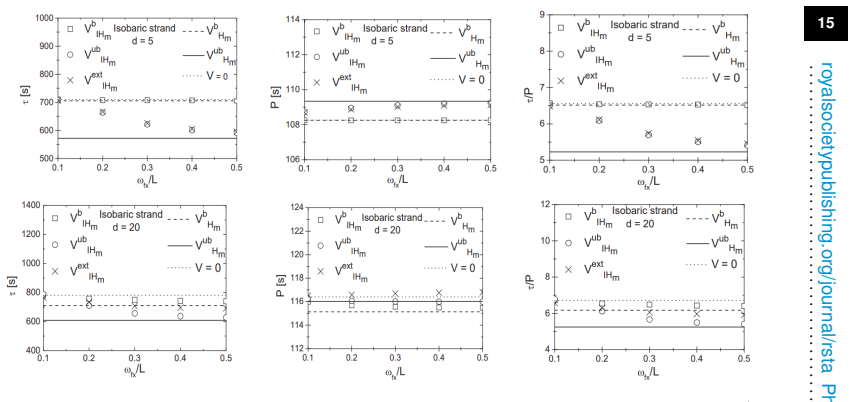
Summary. The manuscript presents 2D ideal-MHD (ATHENA) slab simulations of an isobaric cool strand (density contrast d=5 and d=20, width 0.4 Mm) embedded in a 100 Mm loop with chromospheric layers. An impulsive transverse pulse excites standing kink oscillations; an initial field-aligned flow (92 km/s, from Hinode/SOT constraints) in three geometries (bounded, unbounded, external), plus Gaussian longitudinally varying and two-stream configurations, evolves nonlinearly into longitudinal disturbances. The kink mode is tracked by Gaussian fits to the transverse density profile (Eq. 3.1) and a damped-sine fit (Eq. 3.2). The central claims are: (i) unbounded/external flows reduce the damping time by ~15-20% relative to bounded/no-flow cases (Table 1; the abstract says "up to ~25%"); (ii) longitudinally inhomogeneous flows enhance damping and converge to the uniform limit, faster for d=20; (iii) supersonic internal flow (d=20, Mach~1.64) excites standing slow-sausage harmonics and weak slow shocks (Figs. 7-9). The authors conclude that flow geometry should be included in forward modeling and seismology diagnostics.
Significance. If the numbers hold up under a demonstrated resolution-convergence test, the paper makes a useful and falsifiable point for coronal seismology: the transverse/longitudinal geometry of a flow, not merely its amplitude, controls kink-mode damping, with the external flow component dominant. Strengths worth naming: observationally grounded inputs (92 km/s from Hinode/SOT, contrasts d=5,20 consistent with coronal-rain strand observations), a systematic and well-organized sweep of flow geometries (bounded/unbounded/external/Gaussian/two-stream), kink-mode identification via coherent strand-axis displacement rather than the ambiguous ambient Vz field, and a self-consistent treatment of the flow as an evolving initial condition rather than an artificially maintained steady state. The predicted ordering (unbounded < external << bounded ~ no-flow in tau) is a concrete, testable output for forward modeling of cool fine-structured loops.
major comments (4)
- [§2(a), numerical setup; Table 1] The stated uniform grid (300x400 over (0,0.91L)x(-0.5L,0.5L)) gives Dz~0.25 Mm, so the a=0.4 Mm strand (z=+-0.2 Mm, Fig. 1) is spanned by fewer than two cells across its width. In an ideal-MHD run with a linearized Riemann solver and no explicit dissipation, the measured damping time necessarily contains a numerical-diffusion contribution that scales with transverse resolution. Since the headline result is a 15-20% change in tau (Table 1) and the kink mode is extracted by a Gaussian fit (Eq. 3.1) to this sub-two-cell profile, the assertion that 'results are not sensitive to numerical resolution' must be demonstrated: a convergence table/figure of P, tau, and tau/P at (at least) doubled and quadrupled z-resolution for one bounded and one unbounded case. This is load-bearing for every quantitative damping claim.
- [Abstract; §3(a)(i); Table 1] The abstract and §4 state that unbounded flows reduce the damping time 'by up to ~25% compared to bounded flows', and §3(a)(i) claims a '20-25%' reduction for d=5. Table 1 does not support this: d=5 bounded->unbounded is 705.4->571.8 s (-18.9%), and vs. the no-flow case it is -19.5%; for d=20 the reduction is -14.4%. The largest supported number is ~20%. Either correct the abstract/§3/§4 figures, or identify the specific run (e.g., a large-omega_fx inhomogeneous case in Fig. 11) in which a 25% reduction actually occurs and cite it explicitly.
- [§3(b), paragraph 2; Fig. 12] The minimum of tau at Vout/Vin=1 is attributed to 'enhanced energy leakage facilitated by symmetric shear at the strand boundaries.' This is physically inconsistent: at Vout=Vin the initial velocity field is uniform across the boundary, so the transverse shear is exactly zero there; shear is maximal as Vout->0, which is where the damping is weakest (tau saturates at the bounded-flow value). The proposed mechanism is therefore contradicted by the trend in the authors' own figure. The result itself is plausible and consistent with the Fig. 11 finding that the external flow component dominates damping, but the explanation must be replaced (e.g., coupling/scattering of the kink mode by the extended moving plasma rather than boundary shear), and Fig. 12 should perhaps be plotted against (Vin-Vout) to make this clear.
- [§3(a)(i); Figs. 8-9 and caption of Fig. 9] The harmonic labels do not follow from the stated period ratios. For d=20 the fundamental slow period is given as 2Lsd/cSi=2535 s and the observed sausage periodicity as ~600 s — a factor ~4.2 shorter, which by standard nomenclature indicates the fourth harmonic (period P1/n), not the 'third harmonic' claimed. For d=5, 1270 s/400 s ~3.2, which indicates the third harmonic, not the 'second' claimed in the Fig. 9 caption. Either the node counts visible in Fig. 9 override the period ratios (in which case count and mark the nodes explicitly) or the labels must be revised. Relatedly, for d=20 the internal flow is supersonic (Mach 1.64); please clarify in what sense a slow mode advected by a supersonic through-flow can be 'standing', and how this coexists with the claimed weak slow shock.
minor comments (5)
- [§3(a), Eq. (3.2) and Table 1] No fit uncertainties are reported for Amax, P, tau in Table 1, and residuals are not discussed. Because the imposed flow is an evolving initial condition that decays and reverses within the fitting window (Fig. 4), a single time-independent exponential may mix an early fast-damping phase with a late slow one; please report fit errors and comment on whether piecewise or time-dependent tau changes the Table 1 conclusions.
- [§3(a); References] Citation errors: in §3(a), 'following Gruszecki et al. 2008 [10]' — reference [10] is Van Doorsselaere et al.; presumably [44] or [38] is meant. Also 'Gruszecki et al. (2008a)' is used for both [38] and [44]; define the (a)/(b) suffixes consistently.
- [Figs. 3, 11; §2(a)-(b); §3(a)] Several typographical/definitional issues: Fig. 3 caption 'density contract' -> 'contrast'; m=1.24 in §2(a) lacks units (presumably units of the proton mass); dp and sp are each defined twice in consecutive paragraphs of §2(b); 'delta/delta y = 0' should be partial/partial y = 0; 'extending across the surrounding plasma as a spatially pattern' is garbled; Fig. 11 caption 'Gaussian flow with a uniform profile' is self-contradictory — clarify.
- [Abstract; §4, penultimate paragraph] Because the 2D in-plane setup excludes Alfven waves and hence resonant absorption, the damping here is leakage plus scattering into longitudinal modes plus numerical dissipation. The comparison of tau with the observed 500-1500 s range (§4) is presented as validation, but the physical channel differs from the accepted one for hot loops; please temper this claim and, ideally, provide an energy-budget estimate of how much of the damping is leakage versus numerical loss.
- [§3(a)(i), Fig. 6 discussion] The statement 'Mass density at the middle of the strand always decreases with time' (Fig. 6 discussion) is followed by reference to 'top left and bottom right panels' — the panel references are hard to follow; also please state explicitly whether the strand broadening (contrast with Selwa et al. 2005) persists at higher resolution, since it may share the numerical-diffusion origin flagged above.
Circularity Check
No circularity: damping results are measured outputs of forward ideal-MHD runs, not forced by definition or self-citation.
full rationale
The paper’s central claim (unbounded/inhomogeneous initial flows reduce kink damping time by up to ~25% vs bounded flows; supersonic internal flow also excites slow sausage harmonics/weak shocks) is obtained by integrating the ideal MHD system (Eqs. 2.1–2.6) from prescribed initial conditions (isobaric density contrasts d=5,20; field-aligned Vx profiles of 92 km s−1 in bounded/unbounded/external and Gaussian geometries; impulsive Vz pulse) and then fitting the simulated strand-axis displacement to a damped sine (Eq. 3.2 / Table 1). Period, amplitude, and damping time are diagnostic outputs of those runs, not quantities built into the initial data or recovered by construction from a fit to the same target. Observational anchors (Hinode/SOT flow speed and cool-strand contrasts) set the setup; they are not tuned to produce the reported percentage. Methodological citations to Gruszecki/Selwa concern slab geometry and Gaussian fitting practice and do not overlap with the present author list, so they are not load-bearing self-citations. No uniqueness theorem, renamed empirical law, or self-definitional loop appears in the derivation chain. Score 0 is therefore appropriate.
Assumptions & free parameters
free parameters (7)
- Initial flow speed v0 =
92 km/s
- Density contrast d =
5 and 20
- Ambient plasma beta / sound-speed reference =
β≈0.075; vAe=1000 km/s
- Transverse pulse amplitude Az0 and width ω =
0.15 VA0, ω=10 Mm
- Gaussian flow half-width ω_fx / L =
varied (e.g. 0.2–0.4 and →∞)
- Chromosphere-to-corona density ratio dp and transition width sp =
dp=10^3, sp=2 Mm
- Strand width a and loop length L =
a=0.4 Mm, L=100 Mm
assumptions (8)
- domain assumption Single-fluid ideal MHD (continuity, momentum, induction, energy) with γ=5/3 adequately describes cool-strand kink dynamics on the simulated timescales.
- domain assumption Gravity may be neglected and the loop treated as a straight slab.
- domain assumption Two-dimensional x–z geometry with ∂/∂y=0 is sufficient; Alfvén waves are absent and only fast/slow magnetoacoustic modes matter.
- domain assumption Isobaric strand (pi=pe) implies Bi=Be and pure density/temperature contrast under uniform total pressure.
- domain assumption Open boundary conditions allow free outflow without spurious reflection that would dominate damping.
- ad hoc to paper An initial field-aligned velocity (not a driven steady flow) evolving into nonlinear longitudinal disturbances is the correct way to represent observed flows for damping studies.
- domain assumption Kink mode is adequately identified by Gaussian fitting of the dense-strand transverse density centroid rather than by global Vz structure.
- ad hoc to paper Numerical results are resolution-insensitive on a 300×400 grid for the reported oscillation metrics.
Cite this review
Pith. "Pith review of On the Modeling of Kink Oscillations in Fine-Structured Coronal Loops with Field-aligned Nonlinear Longitudinal Disturbances." pith.science (2026). https://pith.science/paper/BG3USYYH
@misc{pith2026260724450,
  author       = {Pith},
  title        = {Pith review of: On the Modeling of Kink Oscillations in Fine-Structured Coronal Loops with Field-aligned Nonlinear Longitudinal Disturbances},
  year         = {2026},
  howpublished = {\url{https://pith.science/paper/BG3USYYH}},
  note         = {Machine review of arXiv:2607.24450}
}
abstract
We investigate the influence of nonlinear longitudinal disturbances, triggered by an initial field-aligned velocity flow, on the damping of standing kink oscillations in fine-structured, cool coronal loop strands under isobaric conditions. Using two-dimensional ideal MHD simulations, we model different realistic flow geometries, bounded, unbounded, and external, and quantify their impact on wave excitation, damping, and energy leakage. Our modelled loop strand incorporates strong density contrasts ($d = 5$ and $d = 20$), providing a configuration consistent with cool-loop observations from Hinode/SOT and SDO/AIA. Our results show that while the nonlinear disturbances exert mild influence on the oscillation period, they substantially modify the damping time. Unbounded flows yield the strongest damping, reducing the damping time by up to $\sim 25\%$ compared to bounded flows, caused by enhanced wave-flow coupling and scattering. Longitudinally inhomogeneous flows further intensify the damping, with high-density strands exhibiting faster convergence toward the uniform-flow limit. In cases with supersonic internal flow, slow sausage-mode harmonics and weak slow shocks are additionally excited, indicating the generation of mixed-mode wave responses in flow-dominated loops. These findings demonstrate that realistic, spatially extended nonlinear disturbances play a significant role in the damping of kink oscillations and should be incorporated into forward modeling and coronal seismology diagnostics.
Figures


Figures from the paper (9 more)



Reference graph
Works this paper leans on
-
[1]
Coronal Rain as a Marker for Coronal Heating Mechanisms. , keywords =. doi:10.1088/0004-637X/716/1/154 , archivePrefix =. 0910.2383 , primaryClass =
-
[2]
Transverse Oscillations of Loops with Coronal Rain Observed by Hinode/Solar Optical Telescope. , keywords =. doi:10.1088/0004-637X/736/2/121 , archivePrefix =. 1105.2175 , primaryClass =
-
[3]
Determination of the Coronal Density Stratification from the Observation of Harmonic Coronal Loop Oscillations. , keywords =. doi:10.1086/430347 , adsurl =
-
[4]
Observational Tests of Damping by Resonant Absorption in Coronal Loop Oscillations. , keywords =. doi:10.1086/379104 , archivePrefix =. astro-ph/0309470 , primaryClass =
-
[5]
Solar Corona Loop Studies with the Atmospheric Imaging Assembly. I. Cross-sectional Temperature Structure. , keywords =. doi:10.1088/0004-637X/732/2/81 , archivePrefix =. 1103.0228 , primaryClass =
-
[6]
Coronal Loop Oscillations Observed with the Transition Region and Coronal Explorer. , keywords =. doi:10.1086/307502 , adsurl =
-
[7]
Persistent Horizontal Flows and Magnetic Support of Vertical Threads in a Quiescent Prominence. , keywords =. doi:10.1086/595785 , adsurl =
-
[8]
Observational signatures of the third harmonic in a decaying kink oscillation of a coronal loop. , keywords =. doi:10.1051/0004-6361/201936822 , adsurl =
Show all 48 references
-
[9]
Journal of Computational Physics , keywords =
An unsplit Godunov method for ideal MHD via constrained transport. Journal of Computational Physics , keywords =. doi:10.1016/j.jcp.2004.11.016 , archivePrefix =. astro-ph/0501557 , primaryClass =
2004 arXiv
-
[10]
, keywords =
Exploring the damping of Alfv \'e n waves along a long off-limb coronal loop, up to 1.4 Solar Radii. , keywords =. doi:10.1051/0004-6361/201935357 , archivePrefix =. 1905.08194 , primaryClass =
1905 arXiv
-
[11]
, keywords =
Standing fast magnetoacoustic kink waves of solar coronal loops with field-aligned flow. , keywords =. doi:10.1051/0004-6361:200809873 , adsurl =
-
[12]
, keywords =
Influence of a dense photosphere-like layer on vertical oscillations of a curved coronal slab. , keywords =. doi:10.1051/0004-6361:20078092 , adsurl =
-
[13]
An interpretation in terms of resonant absorption of quasi-mode kink oscillations
Coronal loop oscillations. An interpretation in terms of resonant absorption of quasi-mode kink oscillations. , keywords =. doi:10.1051/0004-6361:20021378 , adsurl =
-
[14]
, year = 2011, month = jul, volume =
Alfv \'e nic waves with sufficient energy to power the quiet solar corona and fast solar wind. , year = 2011, month = jul, volume =. doi:10.1038/nature10235 , adsurl =
2011 doi
-
[15]
Dynamics of solar coronal loops. I. Condensation in cool loops and its effect on transition region lines. , keywords =. doi:10.1051/0004-6361:20031328 , adsurl =
-
[16]
, keywords =
Magnetosonic Waves in Structured Atmospheres with Steady Flows, I. , keywords =. doi:10.1007/BF00686530 , adsurl =
-
[17]
, keywords =
Determination of the coronal magnetic field by coronal loop oscillations. , keywords =. doi:10.1051/0004-6361:20010607 , adsurl =
-
[18]
, keywords =
Kink Oscillations of Coronal Loops. , keywords =. doi:10.1007/s11214-021-00847-2 , archivePrefix =. 2109.11220 , primaryClass =
-
[19]
, keywords =
Hinode observations of transverse waves with flows in coronal loops. , keywords =. doi:10.1051/0004-6361:20079340 , adsurl =
-
[20]
, keywords =
Structure of solar coronal loops: from miniature to large-scale. , keywords =. doi:10.1051/0004-6361/201321826 , archivePrefix =. 1306.4685 , primaryClass =
-
[21]
, keywords =
Coronal loop seismology using damping of standing kink oscillations by mode coupling. , keywords =. doi:10.1051/0004-6361/201628255 , adsurl =
-
[22]
, keywords =
The Damping of Coronal Loop Oscillations. , keywords =. doi:10.1086/342130 , adsurl =
-
[23]
, keywords =
Energy leakage as an attenuation mechanism for vertical kink oscillations in solar coronal wave guides. , keywords =. doi:10.1051/0004-6361:20065122 , adsurl =
-
[24]
, keywords =
Numerical simulations of impulsively generated vertical oscillations in a solar coronal arcade loop. , keywords =. doi:10.1051/0004-6361:20054286 , adsurl =
-
[25]
, keywords =
Numerical simulations of vertical oscillations of a solar coronal loop. , keywords =. doi:10.1051/0004-6361:20053121 , adsurl =
-
[26]
, keywords =
Transition region small-scale dynamics as seen by SUMER on SOHO. , keywords =. doi:10.1051/0004-6361:20040503 , adsurl =
-
[27]
, keywords =
Linear and non-linear MHD wave propagation in steady-state magnetic cylinders. , keywords =. doi:10.1023/B:SOLA.0000006901.22169.59 , adsurl =
-
[28]
, keywords =
Nonlinear Instability of Kink Oscillations due to Shear Motions. , keywords =. doi:10.1086/593203 , archivePrefix =. 0809.3664 , primaryClass =
-
[29]
, keywords =
Vertical oscillations of a coronal loop observed by TRACE. , keywords =. doi:10.1051/0004-6361:20040186 , adsurl =
-
[30]
, keywords =
Apparent Flows above an Active Region Observed with the Transition Region and Coronal Explorer. , keywords =. doi:10.1086/320496 , adsurl =
-
[31]
, keywords =
Steady Flows Detected in Extreme-Ultraviolet Loops. , keywords =. doi:10.1086/339796 , adsurl =
-
[32]
, keywords =
Damping Time Scaling of Coronal Loop Oscillations Deduced from Transition Region and Coronal Explorer Observations. , keywords =. doi:10.1086/343886 , adsurl =
-
[33]
, keywords =
Excitation of kink oscillations of coronal loops: statistical study. , keywords =. doi:10.1051/0004-6361/201424960 , adsurl =
-
[34]
, year = 2020, month = aug, volume =
Magnetohydrodynamic Waves in the Solar Corona. , year = 2020, month = aug, volume =. doi:10.1146/annurev-astro-032320-042940 , adsurl =
2020 doi
-
[35]
Plasma Physics and Controlled Fusion , keywords =
Thermal instability and non-equilibrium in solar coronal loops: from coronal rain to long-period intensity pulsations. Plasma Physics and Controlled Fusion , keywords =. doi:10.1088/1361-6587/ab5406 , adsurl =
-
[36]
, keywords =
Statistical investigation of decayless oscillations in small-scale coronal loops observed by Solar Orbiter/EUI. , keywords =. doi:10.1051/0004-6361/202346670 , archivePrefix =. 2304.13554 , primaryClass =
-
[37]
, keywords =
Transition from decaying to decayless kink oscillations of solar coronal loops. , keywords =. doi:10.1093/mnras/stae1483 , archivePrefix =. 2406.07490 , primaryClass =
-
[38]
Science , year = 1999, month = aug, volume =
TRACE observation of damped coronal loop oscillations: Implications for coronal heating. Science , year = 1999, month = aug, volume =. doi:10.1126/science.285.5429.862 , adsurl =
1999 doi
-
[39]
, keywords =
Catalog of Decaying Kink Oscillations of Coronal Loops in the 24th Solar Cycle. , keywords =. doi:10.3847/1538-4365/ab0e86 , adsurl =
-
[40]
, keywords =
Standing kink oscillations of thin twisted magnetic tubes with continuous equilibrium magnetic field. , keywords =. doi:10.1051/0004-6361/201526168 , adsurl =
-
[41]
, keywords =
Resonant damping and instability of propagating kink waves in flowing and twisted magnetic flux tubes. , keywords =. doi:10.1093/mnras/staa1442 , adsurl =
-
[42]
, keywords =
Transverse Oscillations and Kelvin Helmholtz Instability in Curved Arcade Loops with Siphon Flows. , keywords =. doi:10.3847/1538-4357/ad6318 , adsurl =
-
[43]
, keywords =
Coronal magnetic field measurement using loop oscillations observed by Hinode/EIS. , keywords =. doi:10.1051/0004-6361:200810186 , adsurl =
-
[44]
, keywords =
Magnetohydrodynamic Seismology of a Coronal Loop System by the First Two Modes of Standing Kink Waves. , keywords =. doi:10.1088/0004-637X/799/2/151 , archivePrefix =. 1411.7095 , primaryClass =
-
[45]
, keywords =
X6.9-class Flare-induced Vertical Kink Oscillations in a Large-scale Plasma Curtain as Observed by the Solar Dynamics Observatory/Atmospheric Imaging Assembly. , keywords =. doi:10.1088/0004-637X/777/1/17 , archivePrefix =. 1308.5758 , primaryClass =
-
[46]
, keywords =
First observation of a transverse vertical oscillation during the formation of a hot post-flare loop. , keywords =. doi:10.1051/0004-6361/201219856 , adsurl =
-
[47]
, keywords =
Three-dimensional MHD modeling of vertical kink oscillations in an active region plasma curtain. , keywords =. doi:10.1051/0004-6361/201425054 , archivePrefix =. 1505.05427 , primaryClass =
-
[48]
The Role of Active Region Loop Geometry. I. How Can it Affect Coronal Seismology?. , keywords =. doi:10.1088/0004-637X/726/1/42 , adsurl =
Reviewed July 31, 2026 · model on record in the stance chip above.
Discussion (0). Continue with ORCID to comment.