REVIEW 4 major objections 5 minor 24 references
Fuzzy informer homed routing protocol for wireless sensor network
T0 review · 4 major / 5 minor · reviewed 2026-08-14 · deepseek-v4-flash
Pith's one-line read The paper claims that replacing probabilistic clustering in Informer Homed Routing with fuzzy-logic-sized communication ranges and distributed competition yields a protocol that beats IHR and DHR in simulation.
desk verdict FIHR is a real but incremental protocol variant; the reported gains look plausible except the critical cluster-contention rule is under-specified enough that the simulation cannot be reproduced as written. read the letter →
The pith
A machine-rendered reading of the paper's core claim, the machinery that carries it, and where it could break.
The reading
What carries the argument
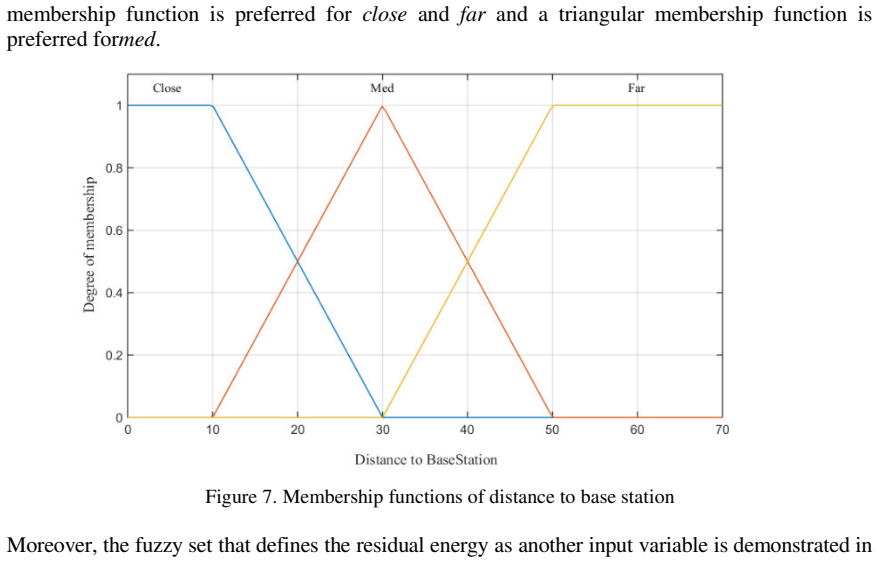
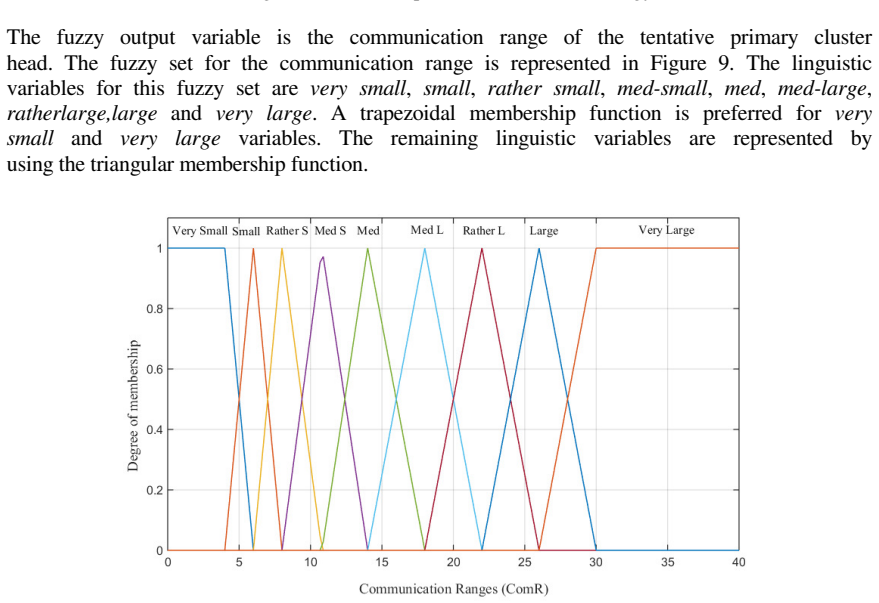
The load-bearing mechanism is the fuzzy communication-range estimator combined with a local competition rule. The estimator converts two crisp inputs—residual energy and distance to the base station—into a crisp output, the communication range ComR, using trapezoidal and triangular membership functions, a nine-rule fuzzy rule base, fuzzy if-then inference, and Center of Area defuzzification. The competition rule then decides cluster head status: high-energy nodes far from the base station receive very large ranges, while low-energy nodes near the base station receive very small ranges, which creates unequal clusters and prevents primary cluster heads from concentrating in one zone. This mechanism is what FIHR adds to the IHR baseline, and it is the part that carries the reported energy and lifetime differences.
What would settle it
Run an independent simulation with the same energy model and parameters (100 nodes in 100 m × 100 m and 200 nodes in 200 m × 200 m, base station at center, 3 J per node) and a concretely chosen threshold, for instance half of the maximum ComR, with the line-16 comparison read as 'ComR is no larger than the distance to the nearest other PCH.' If the reproduced first-node-dead and half-node-alive rounds do not stay at or near Table 3 (126 and 304) and Table 6 (67 and 214), and do not keep FIHR ahead of IHR and DHR, the protocol as written is not the source of the reported gains.
Extended reading notes
Core claim
The authors state the discovery as follows: a distributed unequal clustering rule, driven by a fuzzy inference system, can assign communication ranges to tentative primary cluster heads in a way that spreads cluster heads across the field and fits each range to local conditions. The fuzzy system takes residual energy and distance to the base station as inputs and produces a communication range (ComR) as output through nine if-then rules, fuzzy inference, and Center of Area defuzzification. A candidate that wins the local competition becomes a primary cluster head; otherwise it stays silent. The protocol keeps the IHR fault-tolerance structure—each cluster has a primary and a backup cluster head, and the backup polls the primary with inquiry messages and replaces it after three unanswered queries—so the energy savings come from clustering, not from dropping fault tolerance. The reported numbers, averaged over 20 simulation runs, are first node dead at round 126 versus 123 for IHR and 106 for DHR in the 100-node field, and at round 67 versus 47 and 30 in the 200-node field, with parallel gains in half-node-alive round, throughput, and remaining energy.
Load-bearing premise
The simulation comparison rests on the cluster-head competition rule in the pseudocode, but the Threshold value in line 12 and the comparison 'ComR <= distance-ComR' in line 16 are left undefined, so an implementer must choose them before the claimed results can be reproduced.
Editorial extensions
If this is right
- In a 100 m × 100 m field with 100 nodes, FIHR delays first node death to round 126 from 123 for IHR and 106 for DHR, and delays half of the nodes dying to round 304 from 289 and 166.
- In a 200 m × 200 m field with 200 nodes, first node death moves to round 67 from 47 for IHR and 30 for DHR, and half-node death moves to round 214 from 165 and 94.
- Total remaining energy stays higher for FIHR at every reported round in the smaller field: 250.89 J, 200.61 J, 106.24 J, 40.04 J, and 4.95 J at rounds 50, 100, 200, 300, and 400.
- Network throughput rises to 41,760 KB in the smaller field and 37,375 KB in the larger field, against 41,625 KB and 34,246 KB for IHR and 19,590 KB and 14,451 KB for DHR.
- Because deaths begin later and then climb steadily, the protocol appears to spread the workload across nodes rather than exhausting a few cluster heads early.
Reading between the lines
- Because the paper leaves the threshold and the line-16 comparison unspecified, the cleanest next step is to fix those choices and re-run the two scenarios; until then, the reported margins are tied to an incompletely defined rule.
- The scenario-1 gain over IHR is small (round 126 vs 123 on first node death) while the scenario-2 gain is large (round 67 vs 47), which suggests node density, not fuzzy logic alone, may drive the advantage; the paper does not vary density as a parameter.
- Porting the same fuzzy range assignment to mobile nodes or to two-level clustering for large-scale networks is named in the conclusion but not simulated; those are natural testbeds for whether the mechanism generalizes.
Signed reviews
Editorial analysis
A structured set of objections, weighed in public.
Referee Report
Summary. The paper proposes a Fuzzy Informer Homed Routing (FIHR) protocol for stationary wireless sensor networks, extending the IHR and DHR protocols with a fuzzy-logic-based unequal clustering scheme. In FIHR, candidate cluster heads compute a communication range (ComR) from residual energy and distance to the base station using a Mamdani fuzzy inference system, then compete locally to become primary cluster heads (PCHs); each PCH selects a backup cluster head (BCH) that monitors its aliveness and takes over on failure. The paper reports simulations in two scenarios (100 nodes in 100x100 m and 200 nodes in 200x200 m) comparing FIHR against IHR and DHR on first node dead (FND), half nodes alive (HNA), throughput, and total residual energy, concluding that FIHR is more stable and energy-efficient.
Significance. If the protocol were fully specified and the results reproducible, the paper would make a credible contribution to energy-efficient fault-tolerant clustering in WSNs. Strengths include comparison against two relevant baselines, explicit network and energy models, tabulated and graphical results for both scenarios, and a stated 20-run averaging procedure. The fuzzy rule base (Table 1) and the use of a distributed competition mechanism are sensible design choices. However, the central claim of significant improvement is undermined by under-specification of the algorithm and by the lack of statistical support, especially in Scenario 1 where margins over IHR are only a few rounds or a few hundred KB.
major comments (4)
- [Section 4, Pseudocode lines 12 and 16] The cluster-contention rule that decides which tentative CHs become PCHs is not fully specified. Line 12 tests 'ComR > Threshold', but Threshold is never defined in the text or in Table 2. Line 16, 'ComR <= distance-ComR', is syntactically incomplete and ambiguous: it is unclear whether 'distance' denotes the distance to the nearest other tentative CH, the distance to the base station, or some other quantity, and why ComR is subtracted on the right-hand side. Since this rule determines cluster topology and therefore energy consumption, the Section 6 simulation results cannot be reconstructed from the paper. Please provide the exact threshold value, a corrected and unambiguous comparison, and a justification for the chosen value.
- [Section 5, Figures 7-9 and Table 1] The fuzzy logic system is not numerically defined. The membership functions for distance to BS, residual energy, and communication range are drawn without coordinate values, and Table 1 lists only linguistic outputs (e.g., 'Verysmall', 'Med') without crisp reference values. The Center of Area defuzzification mentioned on page 53 therefore cannot be reproduced, so ComR is not uniquely determined by the text. Because ComR drives the competition in Section 4, the entire simulation pipeline depends on unspecified numerical details. Please supply the numeric endpoints of all membership functions and the crisp output values (or defuzzified ranges) used in the simulator.
- [Section 6, Tables 3-5 and Table 7] The reported gains over IHR in Scenario 1 are marginal: FND is 126 vs. 123 (a 2.4% difference), HNA is 304 vs. 289, and throughput is 41,760 vs. 41,625 KB (a 135 KB difference). The paper states that results were averaged over 20 runs but provides no variance, confidence intervals, or significance tests, so the abstract's claim of 'significantly reduce energy consumption' is not statistically supported even for the reported implementation. Given the unspecified parameters in Sections 4 and 5, a sensitivity analysis is also needed to show that the Scenario 1 conclusion is robust to reasonable variations in Threshold and fuzzy-set endpoints.
- [Section 6, Table 2 (energy model parameters)] Table 2 reports 'εfs and εmp' as '10, 0.004 pJ/bit/m2' with the same exponent for both coefficients. In the standard first-order radio model cited in [16-18], ε_fs and ε_mp have different units (typically pJ/bit/m^2 and pJ/bit/m^4), and the two-exponent model is used for free-space and multipath channels respectively. As written, the units and values are inconsistent with the cited model, which affects all computed energy-consumption figures. Please clarify whether this is a typographical error and, if so, provide the correct values and units used in the simulator.
minor comments (5)
- [Abstract] The abstract contains a typographical error: 'severalsensor' should be 'several sensor'.
- [Section 4, text after pseudocode] The paragraph immediately following the pseudocode is duplicated and textually corrupted (the passage 'In this protocol, there are two fuzzy input variables...' appears twice, with one copy broken mid-sentence). This needs rewriting for readability.
- [Table 7, caption] The caption reads 'Throughput for FIHR and IHR protocols', but the table includes a DHR row; the caption should mention all three protocols.
- [Table 3] The protocol name is misspelled as 'FHIR' in Table 3; it should be 'FIHR'.
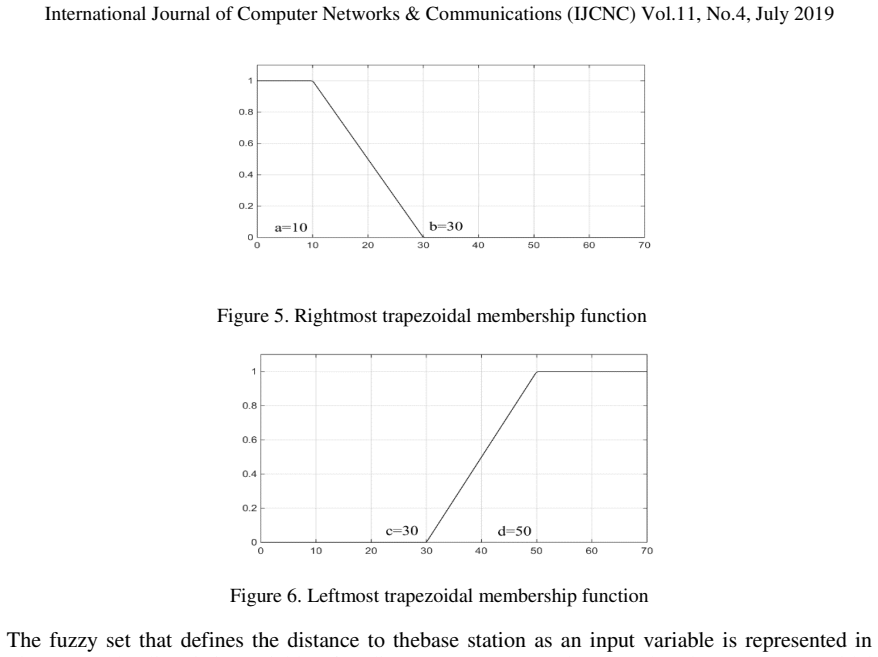
- [Equations (1)-(3)] Equations (1)-(3) are typeset with garbled notation (e.g., 'Triangular m; x, z, y' and undefined variables such as 'c' in the text). Please check the mathematical typesetting and ensure the definitions of x, z, y, a, b, c, d are clear and consistent with Figures 4-6.
Circularity Check
No circularity: FIHR is an empirical simulation comparison against external IHR/DHR baselines; no fitted parameter is renamed as a prediction.
full rationale
The paper's central claim is a simulation performance comparison of FIHR against IHR and DHR (Tables 3-7, Figures 11-13). The fuzzy rule base (Table 1) and membership functions are design inputs, not outputs derived from the target metrics; no equation in the paper reduces a reported FND/HNA/throughput/residual-energy value to the ComR rule base by construction. The only self-citation (ref. [3], authors' earlier survey) is a non-load-bearing related-work reference. The undefined 'Threshold' and malformed 'ComR <= distance-ComR' in the Section 4 pseudocode, and the absence of numeric membership-function coordinates, are reproducibility/correctness concerns, not circularity: they do not make the claimed comparison equivalent to its own inputs. Because the evaluation is benchmarked against externally specified protocols under a stated energy model, there is no fitted-input-called-prediction or self-citation chain. Score 0.
Assumptions & free parameters
free parameters (5)
- T, probability to become a tentative CH =
Not specified in the paper.
- Threshold for ComR competition =
Not specified in the paper.
- Fuzzy membership function endpoints =
Not specified in the paper.
- Fuzzy rule output reference values =
Not specified in the paper.
- BCH failure detection inquiry threshold =
3
assumptions (5)
- domain assumption Energy model of [16,17,18] accurately models radio dissipation in the simulated WSNs
- domain assumption Simulation geometry: stationary nodes, single central base station, equal initial energy, uniform random placement
- ad hoc to paper Fuzzy rules in Table 1 are expert-correct approximations of the ideal communication range
- domain assumption The IHR and DHR reference implementations used in Section 6 match the published protocols of [13] and [14]
- domain assumption PCH aliveness is detectable by the three-inquiry beacon mechanism
Cite this review
Pith. "Pith review of Fuzzy informer homed routing protocol for wireless sensor network." pith.science (2026). https://pith.science/paper/BGAYTL33
@misc{pith2026190801475,
  author       = {Pith},
  title        = {Pith review of: Fuzzy informer homed routing protocol for wireless sensor network},
  year         = {2026},
  howpublished = {\url{https://pith.science/paper/BGAYTL33}},
  note         = {Machine review of arXiv:1908.01475}
}
read the original abstract
A wireless sensor network consists of several sensor nodes. Sensor nodes collaborate to collect meaningful environmental information and send them to the base station. During these processes, nodes are prone to failure, due to the energy depletion, hardware or software failure, etc. Therefore, fault tolerance and energy efficiency are two important objectives for reliable packet delivery. To address these objectives a novel method called fuzzy informer homed routing protocol is introduced. The proposed method tries to distribute the workload between every sensor node. A fuzzy logic approach is used to handle uncertainties in cluster head communication range estimation. The simulation results show that the proposed method can significantly reduce energy consumption as compared with IHR and DHR protocols. Furthermore, results revealed that it performs better than IHR and DHR protocols in terms of first node dead and half of the nodes alive, throughput and total remaining energy. It is concluded that the proposed protocol is a stable and energy efficient fault tolerance algorithm for wireless sensor networks.
Figures

Figures from the paper (6 more)



Reference graph
Works this paper leans on
-
[1]
Atero,F. J., Vinagre,J. J.,Ramiro J. and Wilby, M. “A low energy and adaptive routing architecture for efficient field monitoring in heterogeneous wireles s sensor networks,” In proc. IEEE Int. Conf. on High Performance Computing and Simulation, Istanbul, Turkey, 2011, pp.449 – 455
work page 2011
-
[2]
Load-consci ous maximization of base-station location privacy i n wireless sensor networks,
Baroutis, N. and Younis, M., (2017)“Load-consci ous maximization of base-station location privacy i n wireless sensor networks,” Computer Networks, 124, pp.126-139
work page 2017
-
[3]
A su rvey on fault tolerance techniques in Wireless Sensor Networks,
Kakamanshadi, G., Gupta, S. and Singh, S. "A su rvey on fault tolerance techniques in Wireless Sensor Networks," In proc. IEEE Int. Conf. on Green Computing and Internet of Things, India, 2015, pp. 168-173
work page 2015
-
[4]
Energy-efficient connected target coverage in multi - hop wireless sensor networks,
Biswas, S., Das, R. and Chatterjee, P., (2018)“ Energy-efficient connected target coverage in multi - hop wireless sensor networks,” In Industry Interact ive Innovations in Science, Engineering and Technology, Springer, Singapore, pp. 411-421
work page 2018
-
[5]
An energy awar e fuzzy approach to unequal clustering in wireless sensor networks,
Bagci, H. and Yazici, A., (2013)“An energy awar e fuzzy approach to unequal clustering in wireless sensor networks,” Applied Soft Computing, vol. 13, no.4, pp.1741-1749
work page 2013
-
[6]
A stable energy efficient clustering protocol for wir eless sensor networks,
Mittal, N., Singh, U. and Sohi, B.S., (2017)“A stable energy efficient clustering protocol for wir eless sensor networks,”Wireless Networks, vol.23, no.6, p p.1809-1821
work page 2017
-
[7]
EEHCCP: an energy-efficient hybrid clustering communication protocol for wireless sensor network,
Pachlor, R. and Shrimankar, D., (2018)“EEHCCP: an energy-efficient hybrid clustering communication protocol for wireless sensor network,” In Ad Hoc Networks, Springer, Cham, vol.223, pp. 199-207
work page 2018
-
[8]
An energy efficient fuzzy cluster head selection algorithm for WSNs,
Wang, J., Niu, J., Wang, K. and Liu, W., (2018) “An energy efficient fuzzy cluster head selection algorithm for WSNs,” In IEEE International Workshop on Advanced Image Technology (IWAIT), pp. 1-4
work page 2018
Show all 24 references
-
[9]
Two-step fuzzy logic system to achieve energy efficiency and prolonging the lifetime of WSNs,
Tamandani, Y.K., Bokhari, M.U. and Shallal, Q.M., (2017)“Two-step fuzzy logic system to achieve energy efficiency and prolonging the lifetime of WSNs,” Wireless Networks, vol.23, no.6, pp.1889-1899
2017
-
[10]
Cluster Head Selection using a Two-Level Fuzzy Logic in Wireless Sensor Networks,
Torghabeh, N. A., Totonchi, M. R. A. and Mogha ddam, M. H. Y. “Cluster Head Selection using a Two-Level Fuzzy Logic in Wireless Sensor Networks,” In proc. 2nd IEEE Int. Conf. on Computer Engineering and Technology, China, 2010, pp.357–361 . International Journal of Computer Ne...
2010
-
[11]
Distributed fuzzy logic based routing protocol for wireless sensor networks,
Messaoudi, A., Elkamel, R., Helali, A. and Bou allegue, R.,“Distributed fuzzy logic based routing protocol for wireless sensor networks,” In proc. 24 thIEEE Int. Conf. onSoftware, Telecommunications and Computer Networks (SoftCOM), 2016,pp. 1-7
2016
-
[12]
A survey on unequal clustering protocols in Wireless Sensor Networks,
Arjunan, S. and Sujatha P., (2017)“A survey on unequal clustering protocols in Wireless Sensor Networks,”Journal of King Saud University-Computer and Information Sciences,vol. xx, PP.1-14
2017
-
[13]
Informer homed routing fault tolerance mechanism for wireless sensor networks,
Meikang, Q., Ming, Z., Li, J., Liu, J., Quan, G. and Zhu, Y., (2013)“Informer homed routing fault tolerance mechanism for wireless sensor networks,” Journal of Systems Architecture, vol. 59, pp.260- 270, May. 2013
2013
-
[14]
Per formance analysis of dual-homed fault tolerant routing in wireless sensor networks,
Jain, N., Vokkarane, V.M. and Wang, J.P., “Per formance analysis of dual-homed fault tolerant routing in wireless sensor networks,” In proc. IEEE Conf. o n Technologies for Homeland Security, Waltham, 2008, pp. 474–479
2008
-
[15]
Fault tolerance analysis of heterogeneous wireless sensor network,
Abedi, R. H., Aslam, N. and Ghani, S., "Fault tolerance analysis of heterogeneous wireless sensor network," In proc. 24th IEEECanadian Conf. on Elect rical and Computer Engineering, Canada, 2011, pp.175-179
2011
-
[16]
and Vuran, C
Akyildiz, F. and Vuran, C. Wireless sensor net works. 1st ed. Georgia, Institute of Technology, US A: John Wiley & Sons, 2010, pp.48-49
2010
-
[17]
Energy-aware routing for wireless sensor networ ks by AHP,
Xiaoling, W., Cho, J., Brian, J. d. and Lee, S ., "Energy-aware routing for wireless sensor networ ks by AHP," In IFIP Int. Workshop on Software Technologie s for Embedded and Ubiquitous Systems, Springer Berlin Heidelberg, 2007, pp. 446-455
2007
-
[18]
Fuzzy Log ic-Based Sink Selection and Load Balancing in Multi-Sink Wireless Sensor Networks,
Masdari, M. and Naghiloo, F., (2017)“Fuzzy Log ic-Based Sink Selection and Load Balancing in Multi-Sink Wireless Sensor Networks,” Wireless Pers onal Communications, vol.97, no.2, pp.2713- 2739
2017
-
[19]
March. Energy-eff icient fuzzy logic cluster head selection in wirele ss sensor networks,
El Alami, H. and Najid, A., “March. Energy-eff icient fuzzy logic cluster head selection in wirele ss sensor networks,” In proc.IEEE Int. Conf. on Inform ation Technology for Organizations Development (IT4OD), 2016, pp. 1-7
2016
-
[20]
FUCA: Fuzzy ‐based unequal clustering algorithm to prolong the lifetime of wireless sensor networks,
Agrawal, D. and Pandey, S., (2017)“FUCA: Fuzzy ‐based unequal clustering algorithm to prolong the lifetime of wireless sensor networks,” Internationa l Journal of Communication Systems, vol.31, no.2, pp.1-18
2017
-
[21]
Hybrid approach for optimal cluster head selection in WSN using leach and monke y search algorithms,
Shankar, T., Karthikeyan, A., Sivasankar, P., and Rajesh A., (2017)“Hybrid approach for optimal cluster head selection in WSN using leach and monke y search algorithms,” Journal of Engineering Science and Technology, vol.12, no.2, pp.506-517
2017
-
[22]
An Energy Aware Unequal Clustering Algorithm using Fuzzy Logic for Wireless Sensor Networks,
Adhikary, D.R.D. and Mallick, D.K., (2017)“An Energy Aware Unequal Clustering Algorithm using Fuzzy Logic for Wireless Sensor Networks,” Journal of ICT Research and Applications, vol.11, no.1, pp.55-76
2017
-
[23]
M OFCA: Multi-objective fuzzy clustering algorithm fo r wireless sensor networks,
Sert, S.A., Bagci, H. and Yazici, A., (2015)“M OFCA: Multi-objective fuzzy clustering algorithm fo r wireless sensor networks,” Applied Soft Computing, vol.30, pp.151-165
2015
-
[24]
Fuzzy lo gic based unequal clustering for wireless sensor networks,
Logambigai, R. and Kannan, A., (2016)“Fuzzy lo gic based unequal clustering for wireless sensor networks,”Wireless Networks, vol.22, no.3, pp.945-9 57. International Journal of Computer Networks & Communications (IJCNC) Vol.11, No.4, July 2019 60 AUTHORS BIOGRAPHY GholamrezaKa...
2016
Reviewed August 14, 2026 · model on record in the stance chip above.
Discussion (0). Continue with ORCID to comment.