REVIEW 3 major objections 4 minor 26 references
Fallback Strategies in Operation Control of Microgrids with Communication Failures
T0 review · 3 major / 4 minor · reviewed 2026-08-14 · deepseek-v4-flash
Pith's one-line read A model predictive controller that plans around the microgrid's local frequency loop can keep a single-storage communication failure from changing the optimal schedule.
desk verdict Useful MPC formulation for microgrid communication failures, but Proposition 1's equivalence proof is incomplete because it ignores set-point bounds and leaves ρ unbounded; needs major revision. read the letter →
The pith
A machine-rendered reading of the paper's core claim, the machinery that carries it, and where it could break.
The reading
What carries the argument
The central mechanism is the scalar frequency-response signal $\rho(k)$ appearing linearly in the power equations of every storage and thermal unit through its droop gain $\chi$. In Problem 2, $\rho(k+j)$ is promoted from a fixed constant zero to a decision variable over the whole horizon, which couples the failed unit's output $p_{s,q} = d_{s,q} + \chi_{s,q}\rho$ to the rest of the microgrid. Proposition 1 exploits this coupling: for a single failed storage unit, the equality $\rho(k+j) = (p^1_{s,q}(k+j)-d^2_{s,q}(k+j))/\chi_{s,q}$ reconstructs the failed unit's no-failure power from its default trajectory, and the other units absorb the shared $\rho$ through $u = p - \chi\rho$. A second supporting piece is the estimator (8), which reconstructs the failed battery's energy level from the default set-points, the power-balance equation, and previous forecasts.
What would settle it
Add a finite bound on $\rho$, say $|\rho(k)|\le\rho_{\max}$, to Problem 2 and rerun scenario I; if the closed-loop storage energy or renewable wastage departs from the no-failure reference, the claimed exact equivalence fails. A direct check on the proof is to take the case-study parameters, construct $u_{s,q'}^2 = p^1_{s,q'} - \chi_{s,q'}\rho$ as in Proposition 1, and verify whether those adjusted set-points satisfy the unit limits (4a)-(4c) at every step.
Extended reading notes
Core claim
The paper's central discovery is that the lower-layer local control of a microgrid can serve as a fallback actuator when the communication link to a storage unit fails. In the steady-state model, every storage and thermal unit's power contains a term $\chi\rho(k)$, where $\rho(k)$ is a scalar proportional to frequency deviation and $\chi$ is the unit's droop gain. The standard MPC fixes $\rho=0$ and therefore treats a failed unit as frozen at its default power; the enhanced MPC instead makes $\rho$ a free variable. Proposition 1 then shows that for a single failed storage unit $q$, choosing $\rho(k+j) = (p_{s,q}^1(k+j)-d_{s,q}^2(k+j))/\chi_{s,q}$ and setting every other unit's set-point to $u = p - \chi\rho$ reproduces any no-failure power profile $p^1$ while satisfying power balance, so the open-loop optimal solutions with and without the failure are equivalent. The case study indicates the same coincidence in closed loop for scenario I and a close approximation when both storages fail.
Load-bearing premise
The exact recovery result assumes the local frequency controller can act without any bounds, and that shifting power between the disconnected unit and the other units never pushes any unit's commanded power outside its safe operating range.
Editorial extensions
If this is right
- A single storage-unit communication failure need not change the economically optimal schedule: the enhanced MPC matches the no-failure reference exactly in the open loop, and the case study shows the same in closed loop.
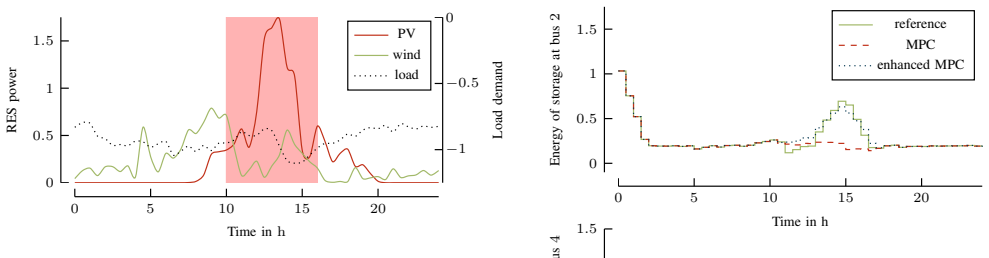
- No extra renewable curtailment is needed to cover a single failed battery: renewable wastage stays at 2.68 puh with the enhanced MPC, against 3.16 puh for the standard MPC.
- The fallback strategy demands no new hardware, only a reformulation of the MPC that includes the local frequency loop and an estimate of the failed battery's state of charge from default set-points.
- When both storage units lose communication, the enhanced MPC no longer matches the reference exactly, but it stays close (2.73 puh renewable wastage and 11.71 puh thermal output versus 3.85 puh and 12.77 puh for the standard MPC).
- Because any feasible solution of Problem 1 is feasible for Problem 2, the enhanced MPC can never do worse than the standard MPC in terms of optimal value at a given state.
Reading between the lines
- If the local frequency controllers have hard bounds on $\rho$ — droop limits, rate limits, or saturation — Proposition 1's exact coincidence becomes approximate; testing scenario I with a finite bound $\rho_{\max}$ would quantify how much of the no-failure optimum survives.
- The same compensation logic may extend to communication failures at thermal units, since their power equations share the same $\chi\rho$ structure; the paper does not prove this case, but the mechanism suggests the failure could be covered by the remaining local controllers.
- The energy estimator in (8) uses forecast values in place of actual renewable infeed and load; under significant forecast errors the reconstructed battery energy will be biased, so a robust or scenario-based MPC is a natural next step — the paper itself flags forecast uncertainty as future work.
- The equivalence is open-loop and relies on the default set-point trajectory being fixed in advance; if the communication failure lasts longer than the remaining horizon of the last received solution, or if failures recur frequently, the fallback's performance would depend on how often the MPC can re-plan before losing contact.
Signed reviews
Editorial analysis
A structured set of objections, weighed in public.
Referee Report
Summary. The paper proposes a model predictive control (MPC) formulation for islanded microgrid operation under communication failures (CFs). The standard MPC (Problem 1) freezes the failing unit at default set-points. The authors propose an enhanced MPC (Problem 2) that treats the local frequency-response variable rho as a decision variable, so that local controllers of non-failing units can compensate for a failing storage unit. They derive a battery energy estimator for the CF case, prove a proposition claiming open-loop equivalence between Problem 2 with and without a single storage CF, and validate the approach in a case study with one or two storage CFs over a six-hour window. The reported simulations show that the enhanced MPC reduces RES wastage and thermal energy use relative to the standard MPC in both scenarios, and in scenario I matches the no-CF reference exactly.
Significance. If the central equivalence claim and the closed-loop behavior were rigorously established, the paper would offer a practical way to mitigate single-point communication failures in microgrid energy management without disconnecting the affected unit. The problem formulation is clear, the case study is concrete, and the qualitative observation that including local-control awareness can reduce the cost of CFs is plausible and useful. The paper also gives a reproducible numerical comparison and a reasonable battery-energy estimation scheme. However, the main theoretical claim is not proven as stated, and the scenario-I 'perfect match' with the reference may be an artifact of unbounded local-control authority rather than a physical property of the microgrid. The significance of the contribution therefore hinges on whether the authors can repair the feasibility arguments and make the control authority realistic.
major comments (3)
- [Section IV.C, Proposition 1] The forward direction of the proof is incomplete because it omits the set-point constraints that the paper itself imposes in Section II.A.2. The proof states that 'in the remaining units without CF, there are no constraints on the power set-points,' but constraints (4) explicitly apply to u(k) and d(k), not only to the actual powers p(k). The constructed set-points u2_{s,q'}(k+j) = p1_{s,q'}(k+j) - chi_{s,q'} rho(k+j) are not verified against (4a)-(4c), and they can violate those bounds even when the original profile p1 is feasible. For example, if the failed unit q has default power 0 and its target power p1_{s,q} is at its maximum, an active storage unit at its minimum with chi = 1 would be assigned a set-point below its lower bound. Thus the claimed equivalence is not established by the proof as written.
- [Section IV.B, Remark 4.3 and Problem 2] The decision variable rho is introduced with no bounds and no physical interpretation constraint. Proposition 1 exploits this unbounded authority: the scalar rho is chosen to make the failed unit's power equal to the no-CF profile, and the adjustment is then imprinted on every other unit through the chi_i rho terms. In a real microgrid, rho is proportional to frequency deviation and the local controllers have finite actuation limits, so the exact restoration of the no-CF power profile in scenario I is not guaranteed under bounded rho. The case study does not report rho or the adjusted set-points over the 10:00-16:00 failure window, so the exact 2.68/11.68 match in Table III cannot be distinguished from the optimizer using unbounded control authority. I ask the authors to add physically motivated bounds on rho, prove Proposition 1 under those bounds, or at minimum report rho and set-point feasibility in the simulation.
- [Section V, paragraph following Fig. 3] The statement that scenario I provides 'empirical evidence that the statement made on open-loop behaviour in Proposition 1 also applies to closed-loop behaviour' is not justified. Proposition 1 is an open-loop equivalence statement; closed-loop equivalence requires showing that at every re-optimization step the feasible sets, objective values, and state estimates coincide under the two regimes, which does not follow automatically from an open-loop result. Moreover, the reference in the case study is obtained with Problem 1 (rho = 0), whereas Proposition 1 compares Problem 2 with and without CF, so the numerical comparison does not directly test the proposition. The authors should either prove the closed-loop claim or rephrase the empirical conclusion to avoid overclaiming.
minor comments (4)
- [Section II.A.1] In the definition of communication status vectors, the second occurrence of zeta_t(k) should be zeta_s(k): the text currently reads 'zeta_t(k) in {0,1}^{|T|}, zeta_t(k) in {0,1}^{|S|}, zeta_t(k) in {0,1}^{|R|}'.
- [Section IV.B, Remark 4.4] There is a typo: 'soultion' should be 'solution'.
- [Section IV.A, Eq. (8a)] The sign conventions for Delta w_l and Delta w_r should be stated explicitly; as written, it is unclear whether rho(k) compensates the forecast error or amplifies it. A one-line derivation from the power balance equation would remove the ambiguity.
- [Table III] The column headers 'MPC enhanced MPC' and 'MPC enhanced MPC' are visually confusing; use separate headings such as 'standard MPC' and 'enhanced MPC' for each scenario.
Circularity Check
No significant circularity: the enhanced MPC equivalence result is a model-level constructive proof, not a fitted prediction or a self-citation chain.
full rationale
The paper's central claim—that including the local frequency-response term makes the single-storage communication-failure case match the no-failure case—is stated as Proposition 1 and proved by constructing ρ and set-points from a given no-CF power profile. This is a constructive feasibility argument inside the authors' explicit model (2), not a parameter fitted to data and then renamed as a prediction; the cost weights, forecasts, and case-study parameters are taken from external/standard sources, and no output quantity is used as an input to the optimization. The only load-bearing citation with author overlap is [20], which supplies the standard microgrid local-control model p_s = com(u_s,d_s,ζ_s)+χ_s ρ; this is an independently published control-law model, and Proposition 1 is not merely a restatement of that citation. The reviewer-style concern that ρ is unbounded (Remark 4.3) and that the proof's forward direction asserts 'In the remaining units without CF, there are no constraints on the power set-points' despite Section II.A.2 requiring u to satisfy constraints (4) identifies a genuine proof gap and a potential feasibility violation, but this is a correctness limitation rather than circularity: the equivalence is conditional on the model equations and would fail if the set-point bounds bind, which is the opposite of being forced by definition. No step in the derivation chain equates the conclusion to its inputs by construction, so the appropriate circularity score is 0.
Assumptions & free parameters
free parameters (3)
- local control gains chi_s, chi_t =
chi_s = [0.5, 1]^T, chi_t = [0.6, 1]^T (Table II)
- cost weights in objective (5) =
Table I values
- sampling time, horizon, discount factor =
Ts = 30 min, h = 12, gamma = 0.95
assumptions (7)
- domain assumption Steady-state model is valid at the MPC sampling time of several minutes.
- domain assumption Certainty equivalence: forecasts are used and communication status is constant over the prediction horizon.
- domain assumption Default power set-points during CF come from the last MPC solution.
- domain assumption Local controller power injection is linear in rho with constant gains.
- ad hoc to paper rho has no physical bounds in Problem 2.
- domain assumption Electrical network losses are negligible.
- domain assumption Both the EMS and units can detect communication failure.
Cite this review
Pith. "Pith review of Fallback Strategies in Operation Control of Microgrids with Communication Failures." pith.science (2026). https://pith.science/paper/BGFT2RA4
@misc{pith2026190803736,
  author       = {Pith},
  title        = {Pith review of: Fallback Strategies in Operation Control of Microgrids with Communication Failures},
  year         = {2026},
  howpublished = {\url{https://pith.science/paper/BGFT2RA4}},
  note         = {Machine review of arXiv:1908.03736}
}
read the original abstract
This paper proposes a model predictive control (MPC)-based energy management system to address communication failures in an islanded microgrid (MG). The energy management system relies on a communication network to monitor and control power generation in the units. A communication failure to a unit inhibits the ability of the MPC to change the power of the unit. However, this unit is electrically connected to the network and ignoring this aspect could have adverse effect in the operation of the microgrid. Therefore, this paper considers an MPC design that includes the electrical connectivity of the unit during communication failures. This paper also highlights the benefit of including the lower layer control behaviour of the MG to withstand communication failures. The proposed approaches are validated with a case study.
Figures


Figures from the paper (1 more)

Reference graph
Works this paper leans on
-
[1]
Renewables 2018 global status report,
REN21 Secretariat, “Renewables 2018 global status report,” REN21, Paris, France, Tech. Rep., 2018
work page 2018
-
[2]
2012 DOE microgrid workshop summary report,
Department of Energy Office of Electricity Delivery and Energy Reli- ability, “2012 DOE microgrid workshop summary report,” Department of Energy Office of Electricity Delivery and Energy Reliability, Tech. Rep., 2012
work page 2012
-
[3]
A model predictive control approach to microgrid operation optimization,
A. Parisio, E. Rikos, and L. Glielmo, “A model predictive control approach to microgrid operation optimization,” IEEE Transactions on Control Systems Technology, vol. 22, no. 5, pp. 1813–1827, Sep. 2014
work page 2014
-
[4]
A hierarchical algorithm for integrated scheduling and control with applications to power systems,
L. E. Sokoler, P. J. Dinesen, and J. B. Jørgensen, “A hierarchical algorithm for integrated scheduling and control with applications to power systems,” IEEE Transactions on Control Systems Technology , vol. 25, no. 2, pp. 590–599, March 2017
work page 2017
-
[5]
Risk-Averse Model Predictive Operation Control of Islanded Microgrids
C. A. Hans, P. Sopasakis, J. Raisch, C. Reincke-Collon, and P. Patrinos, “Risk-averse model predictive operation control of islanded microgrids,” 2019, accepted for publication in the IEEE Transactions on Control Systems Technology. [Online]. Available: https://arxiv.org/abs/1809.06062
work page Pith review arXiv 2019
-
[6]
A survey of communication/networking in smart grids,
J. Gao, Y . Xiao, J. Liu, W. Liang, and C. P. Chen, “A survey of communication/networking in smart grids,” Future Generation Computer Systems , vol. 28, no. 2, pp. 391–404, 2012
work page 2012
-
[7]
Reliability assessment of smart grid considering direct cyber-power interdependencies,
B. Falahati, Y . Fu, and L. Wu, “Reliability assessment of smart grid considering direct cyber-power interdependencies,” IEEE Transactions on Smart Grid , vol. 3, no. 3, pp. 1515–1524, Sep. 2012
work page 2012
-
[8]
R. Siqueira de Carvalho and S. Mohagheghi, “Analyzing impact of communication network topologies on reconfiguration of networked microgrids, impact of communication system on smart grid reliability, security and operation,” in 2016 North American Power Symposium (NAPS), Sep. 2016, pp. 1–6
work page 2016
Show all 26 references
-
[9]
Impact of wams malfunction on power system reliability assessment,
F. Aminifar, M. Fotuhi-Firuzabad, M. Shahidehpour, and A. Safdarian, “Impact of wams malfunction on power system reliability assessment,” IEEE Transactions on Smart Grid , vol. 3, no. 3, pp. 1302–1309, Sep. 2012
2012
-
[10]
Critical links identi- fication for selective outages in interdependent power-communication networks,
B. Moussa, P. Akaber, M. Debbabi, and C. Assi, “Critical links identi- fication for selective outages in interdependent power-communication networks,” IEEE Transactions on Industrial Informatics , vol. 14, no. 2, pp. 472–483, Feb 2018
2018
-
[11]
Impacts of information and communication failures on optimal power system operation,
B. Falahati, A. Kargarian, and Y . Fu, “Impacts of information and communication failures on optimal power system operation,” in 2013 IEEE PES Innovative Smart Grid Technologies Conference (ISGT) , Feb 2013, pp. 1–6
2013
-
[12]
Fault detection, isolation, and service restoration in distribution systems: State-of-the- art and future trends,
A. Zidan, M. Khairalla, A. M. Abdrabou, T. Khalifa, K. Shaban, A. Abdrabou, R. El Shatshat, and A. M. Gaouda, “Fault detection, isolation, and service restoration in distribution systems: State-of-the- art and future trends,” IEEE Transactions on Smart Grid , vol. 8, no. 5, pp...
2017
-
[13]
Fault tolerant predictive control design for reliable microgrid energy management under uncertainties,
I. Prodan, E. Zio, and F. Stoican, “Fault tolerant predictive control design for reliable microgrid energy management under uncertainties,” Energy, vol. 91, pp. 20 – 34, 2015
2015
-
[14]
Joint frequency regulation and economic dispatch using limited communication,
J. Zhang and E. Modiano, “Joint frequency regulation and economic dispatch using limited communication,” in 2018 IEEE International Conference on Communications, Control, and Computing Technolo- gies for Smart Grids (SmartGridComm) , Oct 2018, pp. 1–6
2018
-
[15]
A framework for attack-resilient industrial control systems: Attack detection and controller reconfigu- ration,
K. Paridari, N. O’Mahony, A. El-Din Mady, R. Chabukswar, M. Boubekeur, and H. Sandberg, “A framework for attack-resilient industrial control systems: Attack detection and controller reconfigu- ration,” Proceedings of the IEEE , vol. 106, no. 1, pp. 113–128, Jan 2018
2018
-
[16]
Lyapunov-based model predictive control of nonlinear systems subject to data losses,
D. M. de la Peña and P. D. Christofides, “Lyapunov-based model predictive control of nonlinear systems subject to data losses,” IEEE Transactions on Automatic Control , vol. 53, no. 9, pp. 2076–2089, 2008
2008
-
[17]
Model predictive control for constrained networked systems subject to data losses,
G. Franzè, F. Tedesco, and D. Famularo, “Model predictive control for constrained networked systems subject to data losses,” Automatica, vol. 54, pp. 272 – 278, 2015
2015
-
[18]
Microgrids: Hierarchical control and an overview of the control and reserve management strategies,
T. L. Vandoorn, J. C. Vasquez, J. De Kooning, J. M. Guerrero, and L. Vandevelde, “Microgrids: Hierarchical control and an overview of the control and reserve management strategies,” IEEE Industrial Electronics Magazine, vol. 7, no. 4, pp. 42–55, Dec 2013
2013
-
[19]
An overview of demand side management control schemes for buildings in smart grids,
A. M. Kosek, G. T. Costanzo, H. W. Bindner, and O. Gehrke, “An overview of demand side management control schemes for buildings in smart grids,” in 2013 IEEE International Conference on Smart Energy Grid Engineering (SEGE) , Aug 2013, pp. 1–9
2013
-
[20]
A consensus-based control law for accurate frequency restoration and power sharing in microgrids in the presence of clock drifts,
A. Krishna, J. Schiffer, and J. Raisch, “A consensus-based control law for accurate frequency restoration and power sharing in microgrids in the presence of clock drifts,” in 2018 European Control Conference (ECC), June 2018, pp. 2575–2580
2018
-
[21]
Dc power flow revisited,
B. Stott, J. Jardim, and O. Alsac, “Dc power flow revisited,” IEEE Transactions on Power Systems , vol. 24, no. 3, pp. 1290–1300, Aug 2009
2009
-
[22]
An improved method for the dcopf with losses,
B. Eldridge, R. O’Neill, and A. Castillo, “An improved method for the dcopf with losses,” IEEE Transactions on Power Systems , vol. 33, no. 4, pp. 3779–3788, July 2018
2018
-
[23]
A simplified model of quadratic cost function for thermal generators,
M. Živi ´c Ðurovi ´c, A. Mila ˇci´c, and M. Kršulja, “A simplified model of quadratic cost function for thermal generators,” Ann. DAAAM 2012 Proc. 23 Int. DAAAM Symp. , vol. 23, no. 1, pp. 25–28, 2012
2012
-
[24]
N, 28◦ 1’ 45
Atmospheric Radiation Measurement Climate Research Facility. Sur- face Meteorology System. June 2009–Oct. 2009, 39◦ 5’ 28" N, 28◦ 1’ 45" W: Eastern North Atlantic Facility, windspeed. ARM Data Archive: Oak Ridge, TN, USA. Data set accessed 2011-07-14 at www.arm.gov
2009
-
[25]
R. J. Hyndman and G. Athanasopoulos, F orecasting: principles and practice. OTexts, 2018
2018
-
[26]
Y ALMIP: A toolbox for modeling and optimization in MATLAB,
J. Löfberg, “Y ALMIP: A toolbox for modeling and optimization in MATLAB,” in IEEE CACSD, 2004, pp. 284–289
2004
Reviewed August 14, 2026 · model on record in the stance chip above.
Discussion (0). Continue with ORCID to comment.