REVIEW 2 major objections 4 minor 38 references
Invariant predictions of epidemic patterns from radically different forms of seasonal forcing
T0 review · 2 major / 4 minor · reviewed 2026-08-14 · deepseek-v4-flash
Pith's one-line read A single matched bifurcation makes epidemic predictions indifferent to the shape of seasonal forcing.
desk verdict Solid numerical study of birth-fold invariance in seasonally forced SIR; the abstract oversells it, but the core result is real and worth refereeing. read the letter →
The pith
A machine-rendered reading of the paper's core claim, the machinery that carries it, and where it could break.
The reading
What carries the argument
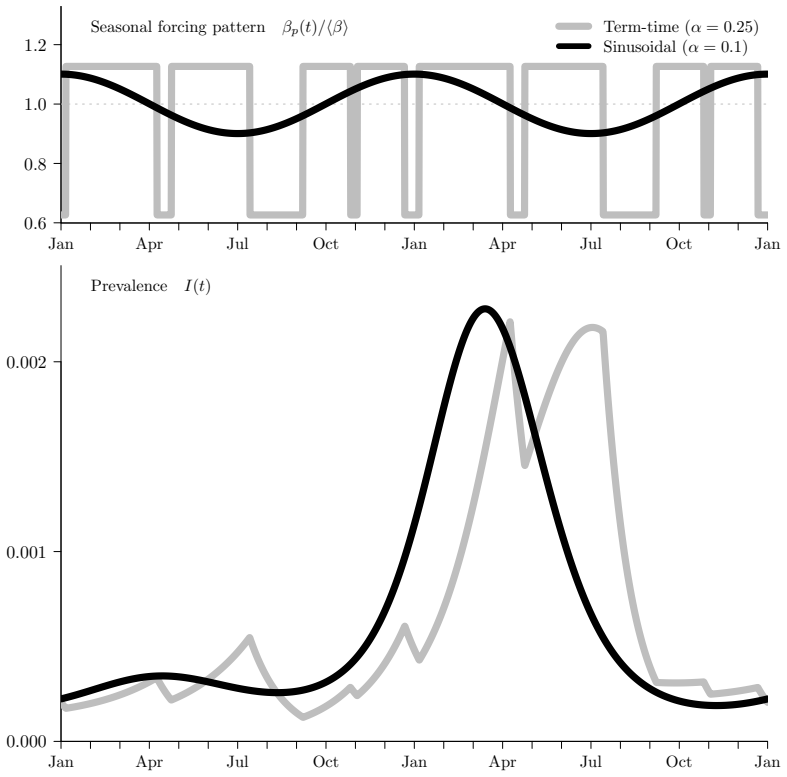
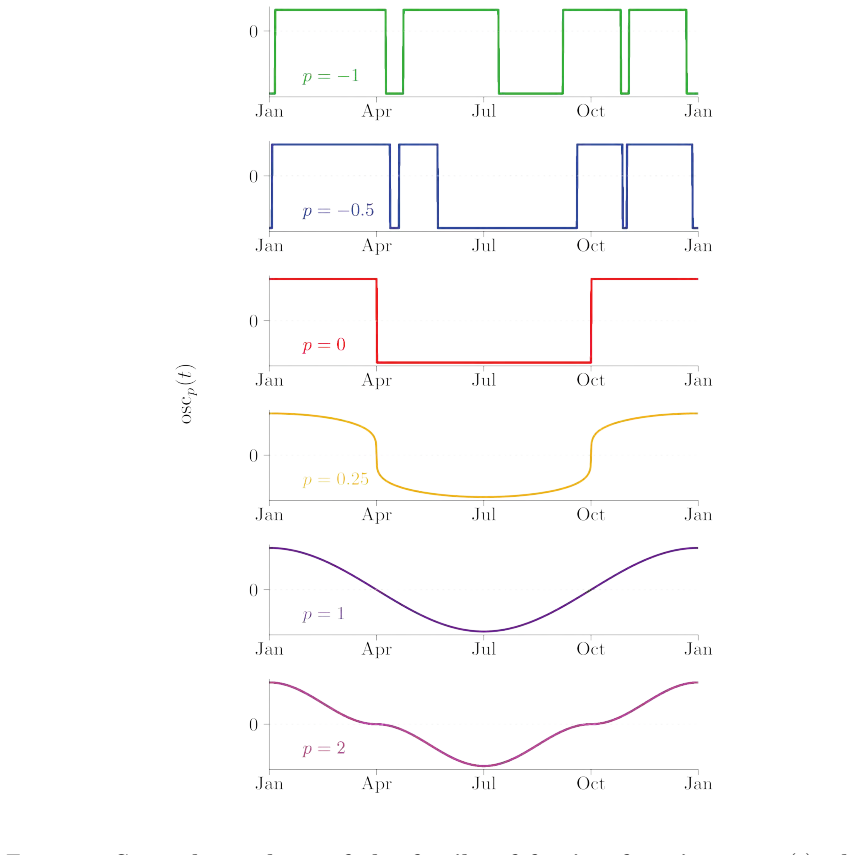
The central machinery is the one-year stroboscopic map of the forced SIR model, which samples the continuous trajectory once per forcing period, together with numerical continuation of bifurcation curves. A one-parameter family of forcing functions $\mathrm{osc}_p(t)$ interpolates from term-time forcing ($p = -1$) through square wave forcing ($p = 0$) to sinusoidal forcing ($p = 1$) and beyond to impulse-like forcing ($p \to \infty$). The amplitude-matching function $\alpha(p)$ is obtained by continuing the stable period-doubling bifurcation in the $(p, \alpha)$ plane from the anchor point $p = -1$, $\alpha = 0.25$, $R_0 = 15.12$; this function fixes the amplitude that makes the principal period-doubling occur at the same $R_0$ for each shape. The claim is carried by the observation that along this curve, the birth folds of period-3 through period-7 cycles remain aligned in $R_0$, while death folds do not.
What would settle it
Compute the bifurcation diagram for forcing shapes outside the family, e.g., a realistic two-term school calendar with unequal term lengths, choosing amplitude by the same $\alpha(p)$ continuation rule; if the $R_0$ positions of the 3- to 7-year birth folds deviate by more than the roughly one percent spread in table 1, the invariance claim fails. Alternatively, repeat the continuation anchored at a different bifurcation, such as the period-3 birth fold, and check whether all the other folds still align.
Extended reading notes
Core claim
The central claim is that the key bifurcations of the standard seasonally forced SIR model are invariant to the shape of seasonal forcing after a single amplitude adjustment. Starting from term-time forcing with amplitude $\alpha = 0.25$, the authors continue the stable period-doubling bifurcation in the two-parameter (shape, amplitude) plane, obtaining an amplitude function $\alpha(p)$ that pins the period-doubling at $R_0 = 15.12$ for every forcing shape in the family. With no further adjustment, the fold bifurcations that create 3-, 4-, 5-, 6-, and 7-year epidemic cycles occur at essentially the same $R_0$ values for all shapes, with relative differences between $0.0005$ and $0.009$, at most about one percent. The invariance is quantitative for these birth folds and qualitative for the overall bifurcation structure; the corresponding death folds are not invariant. The paper additionally finds the same type of invariance in a seasonally forced predator-prey model and conjectures that the phenomenon may be general among periodically forced dynamical systems.
Load-bearing premise
The invariance is established by matching one bifurcation at a single anchor point ($R_0 = 15.12$) for one measles-like parameter set; if a different anchor point or a different demographic regime breaks the alignment, the practical recommendation to use sinusoidal forcing would not generalize.
Editorial extensions
If this is right
- Epidemiological transition analyses for measles and other childhood diseases can be conducted with sinusoidal forcing and still capture the $R_0$ values at which biennial, triennial, and longer epidemic cycles appear, provided the amplitude is adjusted to fix the principal period-doubling.
- Rigorous mathematical results obtained under sinusoidal forcing, such as proofs of coexistence of multiple attractors or of chaos, are more likely to transfer to realistic forcing patterns than previously assumed.
- The invariance extends beyond epidemics: the same matched-bifurcation behavior occurs in a seasonally forced predator-prey model, so ecosystem predictions may also be robust to forcing shape.
- The practical scope of the invariance is the births of multi-year cycle branches: the folds that destroy those branches and some intermediate period doublings do shift with forcing shape, so quantitative predictions about those transitions still require accurate forcing.
- The paper's conjecture suggests that any forced nonlinear oscillator with comparable resonance structure may show the same invariance, making idealized forcing a safer default in other fields.
Reading between the lines
- A natural testable extension is to apply the same amplitude-matching rule to forcing shapes outside the constructed family, such as real school calendars with unequal terms or climate-driven forcing in vector-borne diseases; if the birth folds still align, the invariance is more general than the paper's family.
- The paper does not identify the conserved property of the forcing that produces the invariance; average spectral power is explicitly ruled out. If such a property exists, it might allow the correct amplitude for an arbitrary forcing shape to be computed without running a two-parameter continuation.
- The anchor dependence is an open question: repeating the continuation from a different bifurcation, such as one of the birth folds themselves, would test whether the amplitude-matching rule is self-consistent across all key transitions.
- If the invariance holds for other strongly nonlinear oscillators, it would give practical warrant to a general strategy: when only the period of forcing is certain, use the simplest periodic shape and calibrate amplitude to one measured transition.
Signed reviews
Editorial analysis
A structured set of objections, weighed in public.
Referee Report
Summary. This paper asks whether the detailed shape of seasonal forcing matters for the bifurcation structure of the standard seasonally forced SIR epidemic model. The authors construct a continuous family of forcing functions osc_p(t) that interpolates between term-time forcing (p = -1), square-wave (p = 0), sinusoidal (p = 1), and a delta-impulse-like limit (p large). Using numerical continuation with XPPAUT, they compute, for each shape p, the forcing amplitude alpha(p) that places the principal period-doubling (PD) bifurcation at the same value R0 = 15.12 as for term-time forcing. They then compare the positions of other bifurcations under this matched-amplitude condition. The main quantitative result, summarized in Table 1 and Figure 5, is that five 'birth fold' bifurcations, which create period-3 through period-7 attractors, occur at very similar R0 values across the six forcing shapes, with relative differences between 0.0004 and 0.009. The paper also reports that the corresponding 'death folds' and some intermediate period-doublings do not align, and that a similar qualitative invariance is observed in a seasonally forced predator-prey model. The authors conclude that key bifurcations are invariant to forcing shape when the amplitude is appropriately adjusted, and recommend sinusoidal forcing as a safe stand-in for real, poorly characterized seasonal forcing.
Significance. If the reported invariance holds beyond the specific calibrated case, this is a genuinely useful result for epidemiological modeling: it would validate the widespread use of sinusoidal forcing in studies of epidemic transitions and chaos, despite the fact that real seasonal forcing (e.g., school terms) is strongly non-sinusoidal. The numerical work is careful and reproducible: the continuation uses standard open-source software, the code is provided in supplementary material, and the relative-difference table permits quantitative scrutiny. A notable strength is that the birth-fold positions are not fitted; after fixing the principal PD by construction, the five folds are computed and found to align. The authors are also honest in Section 3.2 about the non-invariance of death folds and intermediate PDs. However, the abstract and conclusion substantially overstate the scope of the result: the quantitative invariance is demonstrated for only one anchor (R0 = 15.12), one parameter set (measles-like), and only the birth folds, not the entire bifurcation skeleton. The practical recommendation to use sinusoidal forcing 'with confidence' therefore goes beyond what is currently shown.
major comments (2)
- [Abstract and Section 3.2] The abstract states that 'the key bifurcations of the standard epidemic model are invariant to the shape of seasonal forcing if the amplitude of forcing is appropriately adjusted,' and Section 4 repeats this claim in stronger language. Yet Section 3.2 explicitly states that the 'death folds' at the right edges of the fold branches and some intermediate period-doublings are not invariant, as shown by the open symbols in Figure 5. The concrete quantitative result in Table 1 is restricted to the principal PD (fixed by construction) and the five birth folds. This is more than a semantic nuance: the phrase 'key bifurcations' is precisely what a reader would use to decide whether sinusoidal forcing can reproduce the full bifurcation diagram. The abstract and conclusion should be revised to specify that the invariance is quantitative for the birth folds and only qualitative for the remainder of the bifurcation structure.
- [Section 2.4] The amplitude-adjustment function alpha(p) is defined by continuing the stable period-doubling bifurcation from a single anchor point, R0 = 15.12, with fixed parameters mu = 0.02/year and 1/gamma = 13 days. The paper does not test whether the alignment of the five birth folds persists if the anchor is chosen differently, for example by continuing from another R0 value on the same PD branch or from a different bifurcation, or with different mu and gamma. Since the central claim and the practical recommendation depend on the matching being representative rather than accidental, the authors should either (a) report additional continuation runs for at least a few alternative anchors and parameter sets, or (b) explicitly limit the conclusion to the calibrated regime. Without this, the general statement that 'the key bifurcations ... are invariant' is not fully supported.
minor comments (4)
- [Section 4] The word 'sinuoidal' in the final paragraph should be 'sinusoidal'.
- [Figure 3 caption] The caption says 'In the top two panels' and 'In the bottom two panels,' implying a 2x2 layout, but the body text in Section 2.4 refers to 'the term-time bifurcation diagram (figure 3, top panel)' and 'the bottom panel of figure 3.' Please clarify the layout of the figure panels and use consistent terminology (e.g., 'top-left,' 'bottom-right') throughout.
- [Table 1] The table title says 'Invariance of fold bifurcations,' but the table includes a row for the period-doubling bifurcation. Either rename the table to indicate that the PD is shown for reference, or add a note that the PD is included to show the anchoring condition.
- [Figure 5] The figure demonstrates the alignment of birth folds visually, but the numerical tolerance of the continuation is not stated in the caption. Adding a sentence about the continuation error (or stating that relative differences are given in Table 1) would help readers judge whether the observed scatter is within numerical precision.
Circularity Check
No circularity: the period-doubling alignment is an explicit calibration, and the reported fold-bifurcation invariance is computed independently.
full rationale
The paper's central claim is that, after matching the principal period-doubling (PD) bifurcation at R0 = 15.12, five birth folds of the seasonally forced SIR model are quantitatively invariant across forcing shapes. This is not circular because the matched PD is openly treated as a calibration, not as a prediction. Section 2.4 says the continuation 'can be thought of as a function, alpha(p), which specifies the forcing amplitude (alpha) that yields a PD at the same R0 value for any given shape of forcing pattern (p).' Figure 5's caption explicitly marks 'The PD that is fixed by construction' with solid black squares, and Section 3.4 repeats that the vertical alignment of the squares is because each occurs at R0 = 15.12. Thus the PD alignment is an input, not a derived outcome. The five fold bifurcations in Table 1 are computed separately by continuing one-parameter bifurcation diagrams at the calibrated amplitudes; their R0 values are not used to define alpha(p), and their close alignment (relative differences 0.0005 to 0.0090 for Fold 3 through Fold 7) is an independent numerical finding. The paper also discloses the limits of the invariance: Section 3.2 states that the folds at the right edges of the branches 'do not line up precisely' and that the quantitative invariance is restricted to the births, not deaths, of the branches. This candor further shows that the claim is not being stretched to cover anything forced by construction. The self-citations used for the anchor amplitude and measles parameters ([6], [17], [26]) supply starting values, but the invariance itself is established by the authors' own continuation calculations, not by assertoric citation. There is no self-definitional reduction, no fitted parameter renamed as a prediction, and no load-bearing uniqueness or ansatz imported from the authors' prior work. The derivation chain is self-contained for what it claims: a calibrated comparison across forcing shapes with the folds reported as computed, not as fitted.
Assumptions & free parameters
free parameters (6)
- alpha(p=-1) =
0.25
- alpha(p=-0.5) =
0.1012
- alpha(p=0) =
0.0782
- alpha(p=0.25) =
0.0839
- alpha(p=1) =
0.1
- alpha(p=2) =
0.1182
assumptions (4)
- standard math The numerical continuation software (XPPAUT) correctly computes bifurcation curves for the stroboscopic map.
- domain assumption The standard seasonally forced SIR model (equation 2.1) adequately represents childhood disease transmission dynamics.
- ad hoc to paper The constructed family of forcing functions osc_p(t) (supplementary S1.1) spans 'radically different' realistic seasonal patterns.
- domain assumption The invariance observed at p=-1,-0.5,0,0.25,1,2 holds for all shapes in the continuous family.
Cite this review
Pith. "Pith review of Invariant predictions of epidemic patterns from radically different forms of seasonal forcing." pith.science (2026). https://pith.science/paper/BGSYMPIU
@misc{pith2026190802843,
  author       = {Pith},
  title        = {Pith review of: Invariant predictions of epidemic patterns from radically different forms of seasonal forcing},
  year         = {2026},
  howpublished = {\url{https://pith.science/paper/BGSYMPIU}},
  note         = {Machine review of arXiv:1908.02843}
}
read the original abstract
Seasonal variation in environmental variables, and in rates of contact among individuals, are fundamental drivers of infectious disease dynamics. Unlike most periodically-forced physical systems, for which the precise pattern of forcing is typically known, underlying patterns of seasonal variation in transmission rates can be estimated approximately at best, and only the period of forcing is accurately known. Yet solutions of epidemic models depend strongly on the forcing function, so dynamical predictions---such as changes in epidemic patterns that can be induced by demographic transitions or mass vaccination---are always subject to the objection that the underlying patterns of seasonality are poorly specified. Here, we demonstrate that the key bifurcations of the standard epidemic model are invariant to the shape of seasonal forcing if the amplitude of forcing is appropriately adjusted. Consequently, analyses applicable to real disease dynamics can be conducted with a smooth, idealized sinusoidal forcing function, and qualitative changes in epidemic patterns can be predicted without precise knowledge of the underlying forcing pattern. We find similar invariance in a seasonally forced predator-prey model, and conjecture that this phenomenon---and the associated robustness of predictions---might be a feature of many other periodically forced dynamical systems.
Figures

Figures from the paper (2 more)


Reference graph
Works this paper leans on
-
[1]
Absolute humidity modulates influenza survival, transmis- sion, and seasonality
Shaman J, Kohn M. Absolute humidity modulates influenza survival, transmis- sion, and seasonality. Proc. Natl. Acad. Sci. USA. 2009;106(9):3243–3248
work page 2009
-
[2]
Patterns of spread of influenza A in Canada
He D, Dushoff J, Eftimie R, Earn DJD. Patterns of spread of influenza A in Canada. Proc. R. Soc. Lond. B. 2013;280(1770):20131174
work page 2013
-
[3]
Epidemiological effects of seasonal oscillations in birth rates
He D, Earn DJD. Epidemiological effects of seasonal oscillations in birth rates. Theor Popul Biol. 2007;72:274–291
work page 2007
-
[4]
Human birth seasonality: latitudinal gradient and interplay with childhood disease dynamics
Martinez-Bakker M, Bakker KM, King AA, Rohani P. Human birth seasonality: latitudinal gradient and interplay with childhood disease dynamics. Proc. R. Soc. Lond. B. 2014;281(1783)
work page 2014
-
[5]
Recurrent outbreaks of measles, chickenpox and mumps
London W, Yorke JA. Recurrent outbreaks of measles, chickenpox and mumps. I. Seasonal variation in contact rates. Am J Epidemiol. 1973;98(6):453–468. 8
work page 1973
-
[6]
A simple model for complex dynamical transitions in epidemics
Earn DJD, Rohani P, Bolker BM, Grenfell BT. A simple model for complex dynamical transitions in epidemics. Science. 2000;287(5453):667–670
work page 2000
-
[7]
Seasonal dynamics of recurrent epidemics
Stone L, Olinky R, Huppert A. Seasonal dynamics of recurrent epidemics. Na- ture. 2007;446(7135):533–536
work page 2007
-
[8]
Effects of school closure on incidence of pandemic influenza in Alberta, Canada
Earn DJD, He D, Loeb MB, Fonseca K, Lee BE, Dushoff J. Effects of school closure on incidence of pandemic influenza in Alberta, Canada. Ann Intern Med. 2012;156(3):173–181
work page 2012
Show all 38 references
-
[9]
An age-structured model of pre- and post-vaccination measles trans- mission
Schenzle D. An age-structured model of pre- and post-vaccination measles trans- mission. IMA J Math Appl Med Biol. 1984;1:169–191
1984
-
[10]
Infectious Diseases of Humans: Dynamics and Control
Anderson RM, May RM. Infectious Diseases of Humans: Dynamics and Control. Oxford: Oxford University Press; 1991
1991
-
[11]
Mathematical models in population biology and epidemiology
Brauer F, Castillo-Chavez C. Mathematical models in population biology and epidemiology. vol. 40 of Texts in Applied Mathematics. New York: Springer- Verlag; 2001
2001
-
[12]
Periodicity in epidemiological models
Hethcote H, Levin SA. Periodicity in epidemiological models. In: Levin SA, Hallam TG, Gross LJ, editors. Applied Mathematical Ecology. Biomathmatics
-
[13]
Chaos versus noisy periodicity: alternative hypotheses for childhood epidemics
Olsen LF, Schaffer WM. Chaos versus noisy periodicity: alternative hypotheses for childhood epidemics. Science. 1990;249:499–504
1990
-
[14]
The mathematics of infectious diseases
Hethcote HW. The mathematics of infectious diseases. SIAM Rev. 2000;42(4):599–653
2000
-
[15]
Dynamical resonance can ac- count for seasonality of influenza epidemics
Dushoff J, Plotkin JB, Levin SA, Earn DJD. Dynamical resonance can ac- count for seasonality of influenza epidemics. Proc. Natl. Acad. Sci. USA. 2004;101(48):16915–16916
2004
-
[16]
Chaos and biological complexity in measles dynamics
Bolker BM, Grenfell BT. Chaos and biological complexity in measles dynamics. Proc. R. Soc. Lond. B. 1993;251:75–81
1993
-
[17]
Transients and attractors in epidemics
Bauch CT, Earn DJD. Transients and attractors in epidemics. Proc. R. Soc. Lond. B. 2003;270(1524):1573–1578
2003
-
[18]
Heidelberg: Springer-Verlag; 1989. p. 193–211
1989
-
[19]
Interepidemic intervals in forced and unforced SEIR models
Bauch CT, Earn DJD. Interepidemic intervals in forced and unforced SEIR models. In: Ruan S, Wolkowicz G, Wu J, editors. Dynamical Systems and Their Applications in Biology. vol. 36 of Fields Institute Communications. Toronto: American Mathematical Society; 2003. p. 33–44
2003
-
[20]
A Century of Transitions in New York City’s Measles Dynamics
Hempel K, Earn DJD. A Century of Transitions in New York City’s Measles Dynamics. J. R. Soc. Interface. 2015;12(106):20150024. 9
2015
-
[21]
Epidemic threshold conditions for seasonally forced SEIR models
Ma J, Ma Z. Epidemic threshold conditions for seasonally forced SEIR models. Math Biosci Eng. 2006;3(1):161–172
2006
-
[22]
Nonlinear Dynamics and Chaos: With Applications to Physics, Biology, Chemistry, and Engineering
Strogatz SH. Nonlinear Dynamics and Chaos: With Applications to Physics, Biology, Chemistry, and Engineering. CRC Press; 2018
2018
-
[23]
Elements of applied bifurcation theory
Kuznetsov YA. Elements of applied bifurcation theory. vol. 112 of Applied Math- ematical Sciences. 3rd ed. New York: Springer-Verlag; 2004
2004
-
[24]
Simulating, analyzing, and animating dynamical systems: a guide to XPPAUT for researchers and students
Ermentrout B. Simulating, analyzing, and animating dynamical systems: a guide to XPPAUT for researchers and students. Software, Environments, and Tools. Philadelphia: Society for Industrial and Applied Mathematics; 2002
2002
-
[25]
Infinite subharmonic bifurcation in an SEIR model
Schwartz IB, Smith HL. Infinite subharmonic bifurcation in an SEIR model. J Math Biol. 1983;18:233–253
1983
-
[26]
Melnikov analysis of chaos in a simple epidemiological model
Glendinning P, Perry LP. Melnikov analysis of chaos in a simple epidemiological model. J Math Biol. 1997;35(3):359–373
1997
-
[27]
Effects of the infectious period distribution on predicted transitions in childhood disease dynamics
Krylova O, Earn DJD. Effects of the infectious period distribution on predicted transitions in childhood disease dynamics. J. R. Soc. Interface. 2013;10:20130098
2013
-
[28]
Measles in England and Wales — I: An Analysis of Factors Underlying Seasonal Patterns
Fine PEM, Clarkson JA. Measles in England and Wales — I: An Analysis of Factors Underlying Seasonal Patterns. Int J Epidemiol. 1982;11(1):5–14
1982
-
[29]
Parameterizing state- space models for infectious disease dynamics by generalized profiling: measles in Ontario
Hooker G, Ellner SP, De Vargas Roditi L, Earn DJD. Parameterizing state- space models for infectious disease dynamics by generalized profiling: measles in Ontario. J. R. Soc. Interface. 2011;8(60):961–974
2011
-
[30]
Predicting epidemiological transitions in infectious disease dynamics: Smallpox in historic London (1664-1930) [PhD]
Krylova O. Predicting epidemiological transitions in infectious disease dynamics: Smallpox in historic London (1664-1930) [PhD]. McMaster University, Canada; 2011
1930
-
[31]
Fast estimation of time-varying transmission rates for infectious diseases [MSc]
deJonge M. Fast estimation of time-varying transmission rates for infectious diseases [MSc]. McMaster University, Canada; 2014
2014
-
[32]
Understanding Nonlinear Dynamics
Kaplan DT, Glass L. Understanding Nonlinear Dynamics. Textbooks in math- ematical sciences. New York: Springer-Verlag; 1995
1995
-
[33]
The Geometry of Biological Time
Winfree AT. The Geometry of Biological Time. vol. 12 of Interdisciplinary Ap- plied Mathematics. 2nd ed. New York: Springer-Verlag; 2001
2001
-
[34]
Multiple attractors, catastrophes and chaos in seasonally perturbed predator-prey communities
Rinaldi S, Muratori S, Kuznetsov Y. Multiple attractors, catastrophes and chaos in seasonally perturbed predator-prey communities. Bull Math Biol. 1993;55(1):15–35. 10
1993
-
[35]
A universal bifurcation diagram for seasonally perturbed predator-prey models
Gragnani A, Rinaldi S. A universal bifurcation diagram for seasonally perturbed predator-prey models. Bull Math Biol. 1995;57(5):701–712
1995
-
[36]
Seasonal dynamics of Daphnia and algae explained as a periodically forced predator-prey system
Scheffer M, Rinaldi S, Kuznetsov YA, van Nes EH. Seasonal dynamics of Daphnia and algae explained as a periodically forced predator-prey system. Oikos. 1997;p. 519–532
1997
-
[37]
Bifurcations and chaos in a periodic predator-prey model
Kuznetsov YA, Muratori S, Rinaldi S. Bifurcations and chaos in a periodic predator-prey model. Int J Bifurc Chaos. 1992;2(01):117–128
1992
-
[38]
birth folds
Doedel EJ, Oldeman BE. AUTO-07P: Continuation and bifurcation software for ordinary differential equations. Montreal, Canada: Concordia University; 2011. 11 Table 1: Invariance of fold bifurcations [22] at different R0 values when the principal period doubling (PD) bifurcation a...
2011
Reviewed August 14, 2026 · model on record in the stance chip above.
Discussion (0). Continue with ORCID to comment.