REVIEW 1 major objections 5 minor 19 references
Searches for point-like sources of cosmic neutrinos with 11 years of ANTARES data
T0 review · 1 major / 5 minor · reviewed 2026-08-14 · deepseek-v4-flash
Pith's one-line read Eleven years of ANTARES data reveal no significant point-like cosmic neutrino sources, with the strongest cluster at only 23% post-trial probability.
desk verdict Useful ANTARES null result, but the description of the background pseudo-experiments is wrong for the steady-state searches and the quoted p-values are not reproducible as written. read the letter →
The pith
A machine-rendered reading of the paper's core claim, the machinery that carries it, and where it could break.
The reading
What carries the argument
The machinery is the unbinned extended maximum-likelihood ratio test statistic $Q=\log L_{\max}-\log L_{\mathrm{bkg}}$, summed over track and shower samples. Each event contributes a signal-plus-background likelihood in which the signal and background probability densities factor into a directional and an energy term: the spatial signal PDF is a parametrized point-spread function, the spatial background PDF is the observed declination distribution of the data, and the energy PDFs come from Monte Carlo simulated signal events and from a simulated atmospheric neutrino background spectrum. For time-dependent searches, a Gaussian or externally provided time profile is added to both PDFs. Significance is calibrated by generating background-only pseudo-experiments in which event times are randomized, and the post-trial $p$-value is the fraction of pseudo-experiments whose best cluster is at least as signal-like as the observed one.
What would settle it
Recompute the full-sky search and the 90% confidence limits after replacing the simulated energy-dependent acceptance with a measured calibration response, for example from in-situ light sources or a high-statistics atmospheric-muon control sample; if the post-trial probability of the $\alpha=343.7^\circ$, $\delta=23.6^\circ$ cluster moves from 23% to below about 1%, the paper's null conclusion would be overturned in that direction.
Extended reading notes
Core claim
The central claim is that no point-like cosmic neutrino source is detected in the ANTARES data recorded between January 2007 and December 2017, analysed as 8754 track-like and 195 shower-like events. Using an unbinned extended maximum-likelihood ratio, the search scans the full visible sky, tests a list of 112 astrophysical candidates and 75 IceCube track directions, and performs dedicated time-integrated and time-dependent searches toward TXS 0506+056. The hottest full-sky cluster ($\alpha=343.7^\circ$, $\delta=23.6^\circ$) contains 18 tracks within $5^\circ$ and 1 shower, but its post-trial significance is only 23%; the same position coincides with IceCube EHE event 3 and yields the strongest IceCube-track correlation at $2.4\sigma$ after trials. For the candidate list, HESS J0632+057 is the most signal-like with a post-trial significance of $1.4\sigma$. From these null observations the paper derives 90% confidence upper limits on the flux normalization for an assumed $E^{-2}$ spectrum, including special cut-off-spectrum limits for Eta Carinae, and fluence limits for transient emission toward IceCube tracks.
Load-bearing premise
The quoted significances and upper limits assume the Monte Carlo simulation of the detector response and the adopted atmospheric neutrino background model describe the real 11-year data accurately, and that randomizing event times reproduces all background fluctuations.
Editorial extensions
If this is right
- No previously reported IceCube track, including EHE event 3, reaches more than $2.4\sigma$ trial-corrected significance as a steady ANTARES point source.
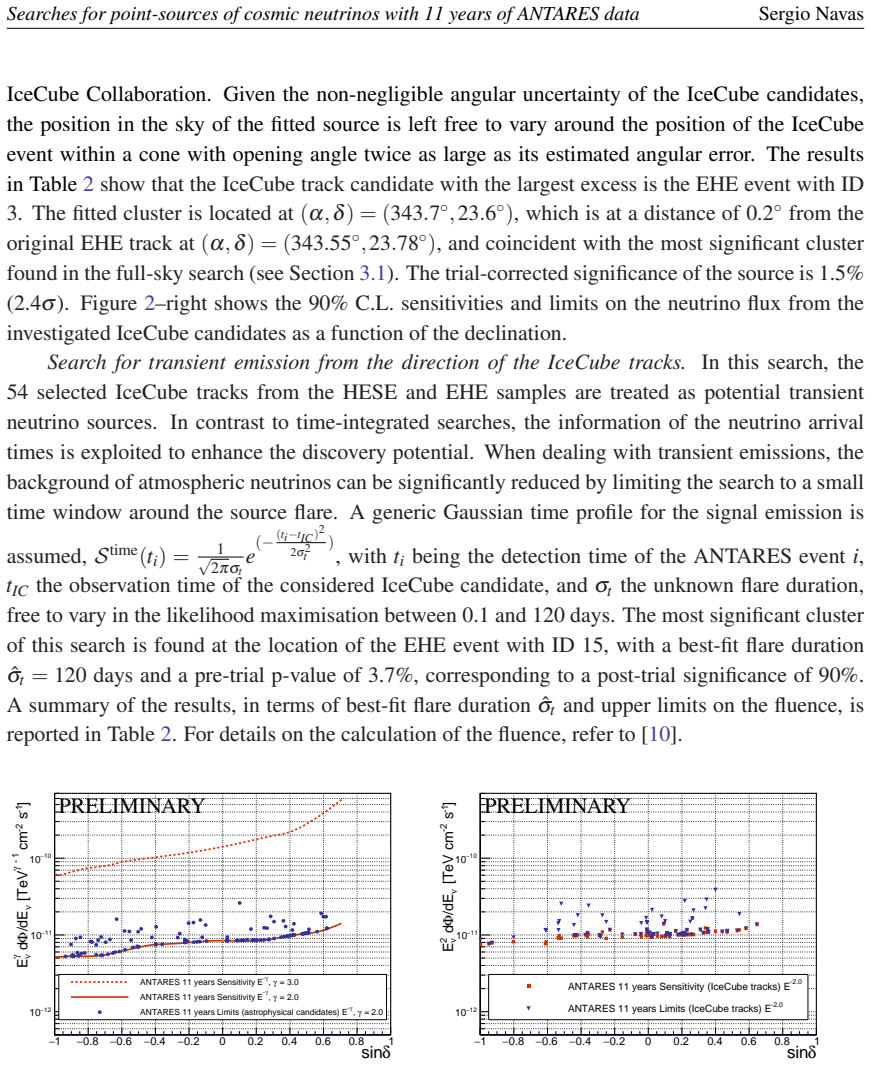
- The 90% confidence upper limits exclude steady $E^{-2}$ neutrino fluxes at the few $\times 10^{-8}\,\mathrm{GeV}\,\mathrm{cm}^{-2}\,\mathrm{s}^{-1}$ level for most of the 112 candidate directions, so any real source among these candidates must be fainter than the quoted bound.
- For TXS 0506+056, neither the steady search nor the searches matching IceCube's 2014 flare time windows finds a significant excess; the Gaussian-window limit on the flux normalization at 100 TeV is $4.6\times 10^{-18}\,\mathrm{GeV}^{-1}\,\mathrm{cm}^{-2}\,\mathrm{s}^{-1}$ for an $E^{-2}$ spectrum.
- The authors expect the same likelihood and pseudo-experiment procedure, scaled to a larger cubic-kilometre telescope, to detect the neutrino flux reported by IceCube within months of operation and to make firm statements about Galactic candidates.
Reading between the lines
- The paper does not pursue a stacked test, but the positional coincidence between the full-sky hottest cluster and IceCube EHE track 3 suggests a combined ANTARES plus IceCube likelihood at that direction could decide whether the $2.4\sigma$ hint grows or disappears.
- The limits assume a steady unbroken $E^{-2}$ spectrum, so the null result constrains hard-spectrum sources most strongly; extending the cut-off-spectrum treatment used for Eta Carinae to the full candidate list would quantify how much weaker the constraints are for softer sources.
- If the diffuse astrophysical neutrino flux observed by IceCube were produced by a handful of bright steady sources in the ANTARES visible sky, this search should have seen them; the null result therefore points toward many faint sources or transient or hidden populations, an inference the paper leaves implicit.
Signed reviews
Editorial analysis
A structured set of objections, weighed in public.
Referee Report
Summary. The paper, a contribution to the 36th ICRC (2019), reports updated ANTARES searches for point-like cosmic neutrino sources using 11 years of data (January 2007 to December 2017, 3125.4 days livetime per Section 1) for a final sample of 8754 track-like and 195 shower-like events. The method is an unbinned extended maximum likelihood ratio test (Eq. 2.1) over track and shower samples, with signal and background PDFs built from directional and energy terms; time-dependent Gaussian or externally provided time profiles are added for transient searches (Section 2). Five analyses are presented: a full-sky scan, a search at 112 astrophysical candidate positions, a time-integrated search at 75 IceCube-track directions, a time-dependent search at 54 IceCube tracks, and dedicated time-integrated and time-dependent searches toward TXS 0506+056 after IC170922A (Section 3). No significant excess is found: the most significant full-sky cluster (RA 343.7 deg, Dec 23.6 deg) has a post-trial p-value of 23% (1.2 sigma), and the strongest IceCube-track correlation (EHE event 3, at the same sky position) has a trial-corrected p-value of 1.5% (2.4 sigma). The paper also tabulates 90% CL Neyman upper limits on the E^-2 flux normalization for all investigated candidates and fluence limits for the transient analyses, and concludes that no point-like cosmic neutrino source is established.
Significance. If the reported numbers hold, this is the most complete ANTARES point-source statement available at energies below about 100 TeV, where the experiment's sub-degree angular resolution is complementary to IceCube. The statistical framework is standard for the field: a combined track+shower unbinned likelihood with MC-derived energy PDFs, Neyman 90% CL upper limits, and pseudo-experiment-based trial corrections used consistently across the full-sky, candidate-list, and IceCube-track searches. The coincidence of the most significant full-sky cluster with the position of IceCube EHE event 3 is a useful internal cross-check, and the overall null conclusion is consistent with the quoted significances. The dedicated TXS 0506+056 limits under several spectral and time-window hypotheses are a useful complement to the IceCube detection claim. The principal weaknesses are that the manuscript is a preliminary conference contribution (figures labeled PRELIMINARY, compressed methodology) and that the pseudo-experiment calibration is not reproducible as written (major comment below); the quoted p-values and limits are also conditional on MC-simulated detector response and the Barr et al.
major comments (1)
- [Section 2, Eq. (2.1)-(2.2); Sections 3.1-3.3] The description of the background-only pseudo-experiments is internally inconsistent with the time-integrated searches. Section 2 states that PEs are "pseudo-data sets of data randomised in time," but for the steady searches the likelihood in Eq. (2.1) contains no time term: the signal and background PDFs are products of directional and energy terms only, with the background spatial PDF built from the observed declination distribution of the data. Randomizing arrival times therefore leaves the test statistic Q in Eq. (2.2) unchanged in every pseudo-experiment, so the quoted post-trial p-values (23% for the full-sky cluster in Section 3.1, 1.5% for EHE track 3 in Section 3.2, and 87% for TXS 0506+056 in Section 3.3) cannot be produced by the procedure as stated. The time-integrated searches require a spatial scrambling that preserves the declination-dependent acceptance (e.g., randomization of right ascension), which is exactly what the construction of the background PDF implies. Please either describe that procedure explicitly in Section 2 as applying to the steady searches, or state that the time-integrated significances were obtained with the spatially scrambled PE procedure of refs. [8] and [10] and give the precise reference. As written, the significance estimates that carry the central null result are not reproducible from the stated method; this affects the central claim and must be corrected. Note that for the time-dependent searches the time randomization is legitimate, so the fix is a clarification rather than a re-analysis.
minor comments (5)
- [Abstract / Section 1] The Abstract quotes a total livetime of 3136 days, while Section 1 quotes 3125.4 days for the same data period; these numbers should be reconciled in the final version.
- [Section 3.2 / Section 3.3] The candidate-count bookkeeping is inconsistent: Section 3.2 states that the list of 106 candidates of [8] was updated with five new TeVCat sources, giving 112 analysed candidates, while Section 3.3 says TXS 0506+056 was added to the "106 pre-selected sources" of [8], yielding "107 investigated sources." Please clarify the source counts, since the trial corrections for the candidate searches depend on the exact number of tested directions.
- [Section 3.1 / Section 3.2] Please state which trials enter each quoted "trial-corrected" or post-trial value: for the full-sky scan the grid of tested directions, for the 112-candidate search the number of candidates, and for the IceCube-track search the 75 candidates plus the freedom of the fitted position within twice the angular error cone. Also specify the convention (presumably two-sided Gaussian) used to convert p-values to sigma, given that 23% is quoted as 1.2 sigma.
- [Section 2 / Section 3.2] The text should state explicitly whether the quoted p-values and 90% CL limits include any systematic uncertainties (e.g., from the MC-based energy estimators and point spread function, or the Barr et al. (2004) atmospheric background normalization); if they do not, a sentence pointing to the companion paper [8] for the systematic treatment would avoid over-interpretation of the limits.
- [Section 3.2 / Table 2] The phrase "post-trial significance of 90%" for the transient EHE 15 search should read "post-trial p-value of 90%" (or the equivalent significance), since 90% is a p-value rather than a significance in the usual sigma sense; additionally, Table 2 is very dense and the interleaving of HESE, EHE, and AMON rows makes it difficult to parse, so separating the samples into distinct blocks or tables would improve readability.
Circularity Check
No circularity: the search derives p-values and limits from the data via a likelihood ratio and pseudo-experiments; no claimed result reduces to an input or to a self-citation by construction.
full rationale
This paper is an observational point-source search, not a derivation of a theoretical prediction from an ansatz. The test statistic Q in Eq. (2.2) is computed from the unbinned likelihood in Eq. (2.1), whose signal and background PDFs are specified independently: signal spatial PDF from the point-spread function, background spatial PDF from the observed declination distribution, and energy PDFs from Monte Carlo simulations and an atmospheric-neutrino model. The significance of the most significant cluster and of the EHE track correlation is obtained by comparing the observed Q to the Q distribution from background-only pseudo-experiments, and the 90% C.L. upper limits are standard Neyman intervals. No fitted parameter is relabeled as a prediction, and no external result is invoked as a forced uniqueness theorem. The analysis inherits the reconstruction and candidate-selection methods from previous ANTARES papers (refs. [8] and [10]), but that is methodological inheritance, not load-bearing circularity. A possible concern is that Section 2 describes pseudo-experiments as 'pseudo-data sets of data randomised in time' while the time-integrated likelihood in Eq. (2.1) contains no time term; taken literally, time randomization would leave Q unchanged and could not generate the quoted p-values. This is a reporting/reproducibility ambiguity about the actual background ensemble, not a circular derivation: the claimed significances are not equivalent to the analysis inputs by construction. The paper's central null result and limits therefore do not reduce to their own assumptions in the sense relevant to circularity.
Assumptions & free parameters
free parameters (3)
- Signal event counts mu_sig (track and shower samples) =
Varies per search; e.g. 4.8 for EHE track 3 in the time-integrated fit
- Source position (RA, Dec) when free =
e.g., (343.7 deg, 23.6 deg) for the most significant cluster
- Flare duration sigma_t (time-dependent searches) =
e.g., 120 days (upper bound) for many candidates
assumptions (4)
- domain assumption Atmospheric neutrino background spectrum from Barr et al. (2004) is used for the background energy PDF.
- domain assumption The point spread function and energy estimators from Monte Carlo simulations (ref [8]) are accurate.
- standard math Pseudo-experiments generated by randomizing event times correctly model background-only fluctuations.
- standard math The unbinned extended likelihood ratio test statistic and its Monte Carlo calibration are valid.
Cite this review
Pith. "Pith review of Searches for point-like sources of cosmic neutrinos with 11 years of ANTARES data." pith.science (2026). https://pith.science/paper/BHQIZCCJ
@misc{pith2026190808248,
  author       = {Pith},
  title        = {Pith review of: Searches for point-like sources of cosmic neutrinos with 11 years of ANTARES data},
  year         = {2026},
  howpublished = {\url{https://pith.science/paper/BHQIZCCJ}},
  note         = {Machine review of arXiv:1908.08248}
}
abstract
The main goal of the ANTARES neutrino telescope is the identification of neutrinos from cosmic accelerators. The good visibility towards the Southern sky for neutrino energies below 100 TeV and the good angular resolution for reconstructed events make the telescope excellent to test for the presence of point-like sources, especially of Galactic origin. The median angular resolution for track-like events (mainly from $\nu_{\mu}$ CC interactions) is $0.4^{\circ}$ while the median angular resolution for contained shower-like events (mainly from $\nu_{e}$ CC and all-flavour NC interactions) is $3^{\circ}$. Recently the ANTARES Collaboration published the result of the search for cosmic point-like neutrino sources using track-like and shower-like events collected during nine years of data taking. In this contribution, an update to this analysis using eleven years of data recorded between early 2007 and the end of 2017, for a total livetime of 3136 days, is presented. Moreover, the results of a search for time and space correlation between the ANTARES events and 54 IceCube tracks and those of the searches for neutrino candidates associated with the IceCube-170922A event or from the direction of the TXS 0506+056 blazar are reported.
Figures


Reference graph
Works this paper leans on
-
[8]
Albert et al., Phys
ANTARES Collaboration, A. Albert et al., Phys. Rev. D96 (2017) 082001
2017
-
[10]
ANTARES Collaboration, A. Albert et al., Astrophys. J. 879 (2019) 108
work page 2019
-
[1]
ANTARES Collaboration, M. Ageron et al., Nucl. Instrum. Meth. A656 (2011) 11
work page 2011
-
[2]
IceCube Coll. Collaboration, M. G. Aartsen et al., Phys. Rev. Lett. 113 (2014) 101101
work page 2014
-
[3]
IceCube Coll. Collaboration, C. Kopper, W. Giang, and N. Kurahashi,PoS(ICRC2015)1081 (2016)
work page 2016
- [4]
-
[5]
IceCube Coll. Collaboration, M. G. Aartsen et al., Astrophys. J. 833 (2016) 3
work page 2016
-
[6]
IceCube Coll. Collaboration, C. Haack and C. Wiebusch, PoS(ICRC2017)1005 (2017)
work page 2017
Show all 19 references
-
[7]
IceCube Collaboration, M. G. Aartsen et al., Science 361 (2018) 147–151
2018
-
[9]
G. D. Barr, T. K. Gaisser, P. Lipari, S. Robbins, and T. Stanev, Phys. Rev. D70 (2004) 023006
2004
-
[11]
S. P. Wakely and D. Horan, Proceedings, 30th International Cosmic Ray Conference (ICRC 2007): Merida, Yucatan, Mexico, July 3-11, 2007 3 (2007) 1341
2007
-
[12]
Neyman, Phil
J. Neyman, Phil. Trans. Roy. Soc. Lond. A236 (1937) 333
1937
-
[13]
Gupta and S
N. Gupta and S. Razzaque, Phys. Rev. D96 (2017) 123017
2017
-
[14]
IceCube Collaboration, AMON ICECUBE_HESE Event Information; https://gcn.gsfc.nasa.gov/amon_hese_events.html
-
[15]
IceCube Collaboration, AMON ICECUBE_EHE Event Information; https://gcn.gsfc.nasa.gov/amon_ehe_events.html
-
[16]
IceCube Collaboration, GCN circular 21916; https://gcn.gsfc.nasa.gov/gcn3/21916.gcn3
-
[17]
Albert et al., Astrophys
ANTARES Collaboration, A. Albert et al., Astrophys. J. 863 (2018) L30
2018
-
[18]
IceCube, Fermi-LA T, MAGIC, AGILE, ASAS-SN, HA WC, H.E.S.S., INTEGRAL, Kanata, Kiso, Kapteyn, Liverpool Telescope, Subaru, Swift NuSTAR, VERITAS, VLA/17B-403 Collaboration, M. G. Aartsen et al., Science 361 (2018) eaat1378
2018
-
[19]
Adrian-Martinez et al., J
KM3Net Collaboration, S. Adrian-Martinez et al., J. Phys. G43 (2016) 084001. 8
2016
Reviewed August 14, 2026 · model on record in the stance chip above.
Discussion (0). Continue with ORCID to comment.