REVIEW 4 major objections 4 minor 51 references
HPP-Voice: A Large-Scale Evaluation of Speech Embeddings for Multi-Phenotypic Classification
T0 review · 4 major / 4 minor · reviewed 2026-08-07 · deepseek-v4-flash
Pith's one-line read A 30-second counting task, encoded by a speaker-identification embedding, predicts moderate-to-severe sleep apnea in men with AUC 0.64, beating MFCC and age-only baselines.
desk verdict A useful new corpus and benchmark, but the headline 'objective' sleep apnea result is undercut by the paper's own label definition, which mixes self-report with AHI>15. read the letter →
The pith
A machine-rendered reading of the paper's core claim, the machinery that carries it, and where it could break.
The reading
What carries the argument
The pipeline turns each 30-second count into one fixed-length vector by splitting it into 5-second segments, embedding each segment, mean-pooling frame-level outputs, and using only the first segment in a gradient-boosted classifier with age as an extra feature; evaluation is 4-fold cross-validation over 20 seeds with FDR-adjusted significance tests. The central objects being compared are the embedding families: speaker identification (x-vector, pyannote-FT, EfficientNet), speaker diarization (pyannote, WavLM-SD), speech foundation models (wav2vec2, WavLM, XLSR), Hebrew-specific models, and emotion-specific models, with MFCC and age as baselines. The x-vector, a time-delay neural network embedding that pools frame-level statistics into a fixed-length speaker vector, is the model that carries the headline sleep-apnea result.
What would settle it
Restrict the male sleep-apnea analysis to participants whose apnea is confirmed by the three-night AHI measurement, drop self-reported positives, and retrain the same x-vector, MFCC, and age-only classifiers under the paper's protocol. If x-vector's AUC falls to the MFCC or age-only level, or the significant difference disappears, the headline claim fails.
Extended reading notes
Core claim
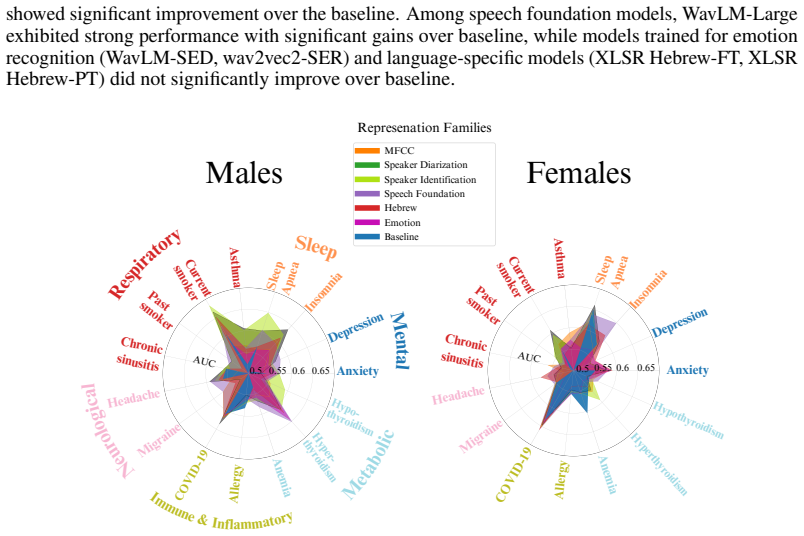
On the paper's own terms, the discovery is that ordinary counting speech, encoded by models trained to recognize who is speaking, carries clinically detectable health signals, and that the best embedding family depends on both the condition and the speaker's gender. The headline result is that the x-vector embedding reaches AUC $0.64 \pm 0.03$ for moderate-to-severe sleep apnea in males, where the label is clinically defined by an apnea-hypopnea index above 15 averaged over three nights, with self-reported cases also included in the positive set. This significantly exceeds MFCC ($0.56 \pm 0.02$) and age-only ($0.57 \pm 0.02$) baselines. The broader pattern the authors draw is that a simple counting task can support multi-phenotypic voice screening, with speaker identification and diarization embeddings generally best for physiological conditions and Hebrew-specific models best for anxiety in females.
Load-bearing premise
The headline male sleep-apnea result assumes the apnea labels are purely objective, but the label definition also admits self-reported cases, so part of the x-vector signal could reflect who reports being ill rather than who has measured apnea.
Editorial extensions
If this is right
- A single counting utterance can be reused to screen for several distinct phenotypes, so future voice-biomarker studies need not record a separate speech task for each disease.
- Speaker identification and diarization embeddings, rather than generic speech foundation models, should be the default starting point for respiratory and sleep phenotypes, at least in male cohorts.
- Embedding selection should be conditioned on both the target condition and the speaker's gender, since the best family changes across both.
- The expected effect sizes are modest, with AUC gains of roughly 0.05 to 0.08 over baselines, so voice screening would complement rather than replace clinical testing.
- Language-specific pretraining can matter for mental-health phenotypes, as Hebrew-fine-tuned models outperformed general foundation models for anxiety in females.
Reading between the lines
- Not in the paper: if the male sleep-apnea effect is stable, the same x-vector pipeline should transfer to other languages and to phone-recorded audio; a transfer failure would suggest the result depends partly on studio-grade recording conditions.
- Not in the paper: because all non-apnea labels are self-reported, the multi-condition AUCs are likely upper bounds, and re-annotation with clinical records would probably shrink the gaps.
- Not in the paper: since only the first 5-second segment was used, later segments or full-utterance pooling might change model rankings, a cheap experiment to run on the released embeddings.
- Not in the paper: a deployed screener should be calibrated separately by gender, since the male-only apnea result and the gender-specific patterns imply pooled models could mislead.
Editorial analysis
A structured set of objections, weighed in public.
Referee Report
Summary. The paper introduces HPP-Voice, a corpus of 7,188 30-second Hebrew counting recordings from 6,760 adults, each linked to up to 15 health phenotypes spanning respiratory, sleep, mental health, metabolic, immune, and neurological conditions. The authors benchmark 14 speech embedding models plus MFCCs for downstream phenotype classification, using LightGBM with gender-stratified training and an age-only demographic baseline. The headline result is that a pretrained x-vector speaker embedding predicts moderate-to-severe sleep apnea in males with AUC 0.64 ± 0.03, compared with 0.56 ± 0.02 for MFCCs and 0.57 ± 0.02 for age alone. The paper further claims that speaker identification and diarization embeddings outperform speech foundation models for respiratory and sleep conditions in males, and that model-family ranking is gender- and condition-specific.
Significance. If the claims hold, this is one of the largest multi-phenotype voice-screening evaluations to date and a useful practical benchmark for model selection in vocal biomarker research. The manuscript has notable strengths: a relatively large cohort with a simple, reproducible recording protocol; a systematic comparison under matched splits and repeated seeds; an externally pretrained x-vector result that is, in principle, an independent benchmark; and explicit multiple-testing correction for individual comparisons. The central x-vector finding is falsifiable and, if confirmed on a clean label subset, would be a meaningful contribution. However, the significance of the headline result depends heavily on the sleep apnea label definition, and the broad "outperforms demographics" claim rests on a baseline that is only age, not demographic features generally.
major comments (4)
- [§3, §5] The sleep apnea label definition is internally inconsistent. Section 3 defines sleep apnea by AHI > 15 from three-night monitoring but then states that "Cases were also included if the subject self-reported the condition." Section 5 then describes the same labels as "curated using objective physiological recordings" and "clinical-grade." Since the headline x-vector AUC of 0.64 is the paper's strongest quantitative claim, the authors must report how many male positives are AHI-verified versus self-report-only and rerun the analysis restricted to AHI-verified positives. Without this, the AUC gap over MFCCs and age could reflect correlates of self-reported illness or health awareness rather than physiological apnea.
- [§4.2, §5, Fig. 1] The transductive setup for EffNet and pyannote-FT is a serious methodological flaw. These models are trained on HPP-Voice audio via a contrastive speaker-identification objective, and embeddings are then extracted for all recordings before the 4-fold cross-validation split. Test speakers' audio has therefore been seen by the embedding model, allowing the downstream classifier to exploit speaker-specific or recording-specific information that would not be available in a truly held-out evaluation. Because the paper uses the phrase "speaker identification models consistently outperformed" to describe the SI family, the authors should either retrain these embeddings in speaker-disjoint folds or explicitly restrict the SI-family claim to externally pretrained models such as x-vector.
- [Abstract, §4.3, §5] The manuscript repeatedly says that modern embeddings outperform "demographics" or "demographic features," but the only demographic baseline in §4.3 is age as the sole input feature. Abstract claims such as "outperform MFCCs and demographics" are therefore overstated. The baseline should be described as age-only throughout, and any conclusion about demographic features more broadly should be removed unless additional demographic variables are actually tested.
- [§4.3, §5, Fig. 2] The paper runs a large number of comparisons: 14 embedding models × 15 conditions × 2 genders, with selected results highlighted in the text and radar plots. The Benjamini–Hochberg correction is described for pairwise comparisons against the baseline, but it is not stated whether correction is applied globally across all conditions, model families, and genders or only within each model-condition pair. The authors should provide a full results table with corrected q-values for every condition and model, and should avoid drawing domain-level conclusions (e.g., "SI and SD models consistently outperformed") from a small number of selected asterisks without demonstrating consistency across the whole comparison grid.
minor comments (4)
- [§1, §4.2] The paper alternately says "15 state-of-the-art encoders" and "14 different speech embeddings." The count should be clarified: 14 modern embeddings plus MFCC as a classical baseline, or 15 total features, and the wording should be consistent throughout.
- [§4.3] The use of only the first 5-second segment after silence trimming is an arbitrary but consequential modeling choice. The authors should report sensitivity of the headline result to segment position or to averaging embeddings over segments, since the chosen segment may not be equally informative across all models and conditions.
- [§5, Fig. 1] The asterisks in Figure 1 are stated to be FDR-BH corrected, but the actual q-values are not reported. Reporting the corrected q-values and the Wilcoxon test statistics for the key x-vector versus baseline comparison would make the significance claim easier to assess.
- [Fig. 2] The radar plots show AUC values only in a narrow range (roughly 0.50–0.65) and would be easier to interpret if the scale were explicitly stated in the caption and if the underlying numeric AUCs were given in a table or supplementary file.
Circularity Check
No circular derivation: the headline x-vector apnea result uses externally pretrained embeddings; EffNet and pyannote-FT are trained on HPP-Voice itself, creating leakage but not by-construction circularity.
full rationale
The central claim is an external-embedding benchmark: x-vector is pretrained on VoxCeleb (Table 2, [40]) and only the downstream LightGBM classifier is trained with 4-fold cross-validation on HPP-Voice, with 20 seeds, age as an additional feature, and FDR-corrected Wilcoxon tests. No parameter of the x-vector model or of the apnea label is fitted to the target labels, so the reported AUC 0.64 vs MFCC 0.56 and age-only 0.57 comparisons are not identities or re-fitted quantities. The sleep-apnea label definition in Section 3 mixes AHI>15 with self-report ('Cases were also included if the subject self-reported the condition'), which contradicts the 'objective physiological recordings' wording in Section 5; this is a label-validity and interpretation problem, not a circular derivation. The two in-corpus-trained SI models (EffNet and pyannote-FT) are trained on HPP-Voice recordings before downstream evaluation, so their results reflect transductive leakage and should not be treated as out-of-corpus generalization; this is a benchmarking artifact, not an equivalence-by-construction of prediction and input. Self-citations such as [20], [26], and [39] are data/source citations for the cohort, AHI measurements, and the Hebrew corpus, not unverified theorems carrying the reasoning. No load-bearing step reduces to its own input by definition.
Assumptions & free parameters
free parameters (3)
- Audio-quality exclusion threshold =
predicted problematic probability > 0.50
- Segment length and segment choice =
5 seconds; first segment only
- LightGBM hyperparameters =
selected by Optuna, 20 trials per fold
assumptions (4)
- domain assumption Self-reported labels are valid proxies for target phenotypes for all conditions except sleep apnea
- domain assumption The audio-quality classifier trained on 488 manually labeled recordings generalizes to the full dataset
- domain assumption Gender stratification and inclusion of age as an input feature adequately control confounding
- ad hoc to paper The first 5-second segment after silence trimming represents the health-relevant content of the 30-second count
Cite this review
Pith. "Pith review of HPP-Voice: A Large-Scale Evaluation of Speech Embeddings for Multi-Phenotypic Classification." pith.science (2026). https://pith.science/paper/BHUQWC4W
@misc{pith2026250516490,
  author       = {Pith},
  title        = {Pith review of: HPP-Voice: A Large-Scale Evaluation of Speech Embeddings for Multi-Phenotypic Classification},
  year         = {2026},
  howpublished = {\url{https://pith.science/paper/BHUQWC4W}},
  note         = {Machine review of arXiv:2505.16490}
}
abstract
Human speech contains paralinguistic cues that reflect a speaker's physiological and neurological state, potentially enabling non-invasive detection of various medical phenotypes. We introduce the Human Phenotype Project Voice corpus (HPP-Voice): a dataset of 7,188 recordings in which Hebrew-speaking adults count for 30 seconds, with each speaker linked to up to 15 potentially voice-related phenotypes spanning respiratory, sleep, mental health, metabolic, immune, and neurological conditions. We present a systematic comparison of 14 modern speech embedding models, where modern speech embeddings from these 30-second counting tasks outperform MFCCs and demographics for downstream health condition classifications. We found that embedding learned from a speaker identification model can predict objectively measured moderate to severe sleep apnea in males with an AUC of 0.64 $\pm$ 0.03, while MFCC and demographic features led to AUCs of 0.56 $\pm$ 0.02 and 0.57 $\pm$ 0.02, respectively. Additionally, our results reveal gender-specific patterns in model effectiveness across different medical domains. For males, speaker identification and diarization models consistently outperformed speech foundation models for respiratory conditions (e.g., asthma: 0.61 $\pm$ 0.03 vs. 0.56 $\pm$ 0.02) and sleep-related conditions (insomnia: 0.65 $\pm$ 0.04 vs. 0.59 $\pm$ 0.05). For females, speaker diarization models performed best for smoking status (0.61 $\pm$ 0.02 vs 0.55 $\pm$ 0.02), while Hebrew-specific models performed best (0.59 $\pm$ 0.02 vs. 0.58 $\pm$ 0.02) in classifying anxiety compared to speech foundation models. Our findings provide evidence that a simple counting task can support large-scale, multi-phenotypic voice screening and highlight which embedding families generalize best to specific conditions, insights that can guide future vocal biomarker research and clinical deployment.
Figures

Reference graph
Works this paper leans on
-
[1]
Optuna: A Next-generation Hyperparameter Optimization Framework, July 2019
Takuya Akiba, Shotaro Sano, Toshihiko Yanase, Takeru Ohta, and Masanori Koyama. Optuna: A Next-generation Hyperparameter Optimization Framework, July 2019. URL http://arxiv. org/abs/1907.10902. arXiv:1907.10902 [cs]
arXiv 2019
-
[2]
Common V oice: A Massively-Multilingual Speech Corpus
Rosana Ardila, Megan Branson, Kelly Davis, Michael Kohler, Josh Meyer, Michael Henretty, Reuben Morais, Lindsay Saunders, Francis Tyers, and Gregor Weber. Common V oice: A Massively-Multilingual Speech Corpus. In Nicoletta Calzolari, Frédéric Béchet, Philippe Blache, Khalid Choukri, Christopher Cieri, Thierry Declerck, Sara Goggi, Hitoshi Isahara, Bente M...
work page 2020
-
[3]
wav2vec 2.0: A framework for self-supervised learning of speech representations.Advances in neural information processing systems, 33:12449–12460, 2020
Alexei Baevski, Yuhao Zhou, Abdelrahman Mohamed, and Michael Auli. wav2vec 2.0: A framework for self-supervised learning of speech representations.Advances in neural information processing systems, 33:12449–12460, 2020
2020
-
[4]
Hear– health acoustic representations.arXiv preprint arXiv:2403.02522, 2024
Sebastien Baur, Zaid Nabulsi, Wei-Hung Weng, Jake Garrison, Louis Blankemeier, Sam Fishman, Christina Chen, Sujay Kakarmath, Minyoi Maimbolwa, Nsala Sanjase, et al. Hear– health acoustic representations.arXiv preprint arXiv:2403.02522, 2024
arXiv 2024
-
[5]
pyannote.audio: neural building blocks for speaker diarization
Hervé Bredin, Ruiqing Yin, Juan Manuel Coria, Gregory Gelly, Pavel Korshunov, Mar- vin Lavechin, Diego Fustes, Hadrien Titeux, Wassim Bouaziz, and Marie-Philippe Gill. pyannote.audio: neural building blocks for speaker diarization, November 2019. URL http://arxiv.org/abs/1911.01255. arXiv:1911.01255 [eess]
work page Pith review arXiv 2019
-
[6]
Iemocap: Interactive emotional dyadic motion capture database.Language resources and evaluation, 42:335–359, 2008
Carlos Busso, Murtaza Bulut, Chi-Chun Lee, Abe Kazemzadeh, Emily Mower, Samuel Kim, Jeannette N Chang, Sungbok Lee, and Shrikanth S Narayanan. Iemocap: Interactive emotional dyadic motion capture database.Language resources and evaluation, 42:335–359, 2008
2008
-
[7]
Guoguo Chen, Shuzhou Chai, Guanbo Wang, Jiayu Du, Wei-Qiang Zhang, Chao Weng, Dan Su, Daniel Povey, Jan Trmal, Junbo Zhang, et al. Gigaspeech: An evolving, multi-domain asr corpus with 10,000 hours of transcribed audio.arXiv preprint arXiv:2106.06909, 2021
arXiv 2021
-
[8]
Wavlm: Large-scale self-supervised pre- training for full stack speech processing.IEEE Journal of Selected Topics in Signal Processing, 16(6):1505–1518, 2022
Sanyuan Chen, Chengyi Wang, Zhengyang Chen, Yu Wu, Shujie Liu, Zhuo Chen, Jinyu Li, Naoyuki Kanda, Takuya Yoshioka, Xiong Xiao, et al. Wavlm: Large-scale self-supervised pre- training for full stack speech processing.IEEE Journal of Selected Topics in Signal Processing, 16(6):1505–1518, 2022
2022
Show all 51 references
-
[9]
Unsupervised cross-lingual representation learning for speech recognition.Interspeech 2021, 2021
Alexis Conneau, Alexei Baevski, Ronan Collobert, Abdelrahman Mohamed, and Michael Auli. Unsupervised cross-lingual representation learning for speech recognition.Interspeech 2021, 2021
2021
-
[10]
Steven Davis and Paul Mermelstein. Comparison of parametric representations for monosyllabic word recognition in continuously spoken sentences.IEEE transactions on acoustics, speech, and signal processing, 28(4):357–366, 1980
1980
-
[11]
Number 2
Gunnar Fant.Acoustic theory of speech production: with calculations based on X-ray studies of Russian articulations. Number 2. Walter de Gruyter, 1971
1971
-
[12]
Survey on biomarkers in human vocalizations.arXiv preprint arXiv:2407.17505, 2024
Aki Härmä, Bert den Brinker, Ulf Grossekathofer, Okke Ouweltjes, Srikanth Nallanthighal, Sidharth Abrol, and Vibhu Sharma. Survey on biomarkers in human vocalizations.arXiv preprint arXiv:2407.17505, 2024
2024 arXiv
-
[13]
Feature Extraction Techniques in Speech Processing: A Survey.International Journal of Computer Applications, 107(5):1–8, December 2014
Rekha Hibare and Anup Vibhute. Feature Extraction Techniques in Speech Processing: A Survey.International Journal of Computer Applications, 107(5):1–8, December 2014. ISSN 09758887. doi: 10.5120/18744-9997. URL http://research.ijcaonline.org/ volume107/number5/pxc3899997.pdf
2014 doi
-
[14]
Hubert: Self-supervised speech representation learning by masked prediction of hidden units.IEEE/ACM transactions on audio, speech, and language processing, 29:3451–3460, 2021
Wei-Ning Hsu, Benjamin Bolte, Yao-Hung Hubert Tsai, Kushal Lakhotia, Ruslan Salakhutdinov, and Abdelrahman Mohamed. Hubert: Self-supervised speech representation learning by masked prediction of hidden units.IEEE/ACM transactions on audio, speech, and language processing, 29:3...
2021
-
[15]
Copdvd: Automated classification of chronic obstructive pulmonary disease on a new collected and evaluated voice dataset.Artificial Intelligence in Medicine, 156: 102953, 2024
Alper Idrisoglu, Ana Luiza Dallora, Abbas Cheddad, Peter Anderberg, Andreas Jakobsson, and Johan Sanmartin Berglund. Copdvd: Automated classification of chronic obstructive pulmonary disease on a new collected and evaluated voice dataset.Artificial Intelligence in Medicine, 15...
2024
-
[16]
Speaker identification through artificial intelligence techniques: A comprehensive review and research challenges.Expert Systems with Applications, 171:114591, 2021
Rashid Jahangir, Ying Wah Teh, Henry Friday Nweke, Ghulam Mujtaba, Mohammed Ali Al-Garadi, and Ihsan Ali. Speaker identification through artificial intelligence techniques: A comprehensive review and research challenges.Expert Systems with Applications, 171:114591, 2021. 10
2021
-
[17]
Libri-light: A benchmark for asr with limited or no supervision
Jacob Kahn, Morgane Riviere, Weiyi Zheng, Evgeny Kharitonov, Qiantong Xu, Pierre- Emmanuel Mazaré, Julien Karadayi, Vitaliy Liptchinsky, Ronan Collobert, Christian Fuegen, et al. Libri-light: A benchmark for asr with limited or no supervision. InICASSP 2020-2020 IEEE Internati...
2020
-
[18]
LightGBM: A Highly Efficient Gradient Boosting Deci- sion Tree
Guolin Ke, Qi Meng, Thomas Finley, Taifeng Wang, Wei Chen, Weidong Ma, Qi- wei Ye, and Tie-Yan Liu. LightGBM: A Highly Efficient Gradient Boosting Deci- sion Tree. InAdvances in Neural Information Processing Systems, volume 30. Curran Associates, Inc., 2017. URL https://procee...
2017
-
[19]
Hyun-Bum Kim, Jaemin Song, Seho Park, and Yong Oh Lee. Classification of laryngeal diseases including laryngeal cancer, benign mucosal disease, and vocal cord paralysis by artificial intelligence using voice analysis.Scientific Reports, 14(1):9297, 2024
2024
-
[20]
Phenome-wide associations of sleep characteristics in the Human Phenotype Project.Nature Medicine, 31(3):1026–1037, March 2025
Sarah Kohn, Alon Diament, Anastasia Godneva, Raja Dhir, Adina Weinberger, Yotam Reisner, Hagai Rossman, and Eran Segal. Phenome-wide associations of sleep characteristics in the Human Phenotype Project.Nature Medicine, 31(3):1026–1037, March 2025. ISSN 1546- 170X. doi: 10.1038...
2025 doi
-
[21]
Gender and Age Estimation Methods Based on Speech Using Deep Neural Networks.Sensors (Basel, Switzerland), 21(14):4785, July 2021
Damian Kwasny and Daria Hemmerling. Gender and Age Estimation Methods Based on Speech Using Deep Neural Networks.Sensors (Basel, Switzerland), 21(14):4785, July 2021. ISSN 1424-8220. doi: 10.3390/s21144785
2021 doi
-
[22]
Covid-19 artificial intelligence diagnosis using only cough recordings.IEEE Open Journal of Engineering in Medicine and Biology, 1: 275–281, 2020
Jordi Laguarta, Ferran Hueto, and Brian Subirana. Covid-19 artificial intelligence diagnosis using only cough recordings.IEEE Open Journal of Engineering in Medicine and Biology, 1: 275–281, 2020. doi: 10.1109/OJEMB.2020.3026928
2020
-
[23]
Survey of deep representation learning for speech emotion recognition.IEEE Transactions on Affective Computing, 14(2):1634–1654, 2021
Siddique Latif, Rajib Rana, Sara Khalifa, Raja Jurdak, Junaid Qadir, and Björn Schuller. Survey of deep representation learning for speech emotion recognition.IEEE Transactions on Affective Computing, 14(2):1634–1654, 2021
2021
-
[24]
Steven R Livingstone and Frank A Russo. The ryerson audio-visual database of emotional speech and song (ravdess): A dynamic, multimodal set of facial and vocal expressions in north american english.PloS one, 13(5):e0196391, 2018
2018
-
[25]
Detecting Cognitive Decline Using Speech Only: The ADReSSo Challenge
Saturnino Luz, Fasih Haider, Sofia De La Fuente, Davida Fromm, and Brian MacWhinney. Detecting Cognitive Decline Using Speech Only: The ADReSSo Challenge. InInterspeech 2021, pages 3780–3784. ISCA, August 2021. doi: 10.21437/Interspeech.2021-1220. URL https://www.isca-archive....
2021 doi
-
[26]
ivrit.ai: A Comprehensive Dataset of Hebrew Speech for AI Research and Development, July 2023
Yanir Marmor, Kinneret Misgav, and Yair Lifshitz. ivrit.ai: A Comprehensive Dataset of Hebrew Speech for AI Research and Development, July 2023. URL http://arxiv.org/abs/2307. 08720. arXiv:2307.08720
2023 arXiv
-
[27]
Brian McFee, Matt McVicar, Daniel Faronbi, Iran Roman, Matan Gover, Stefan Balke, Scott Seyfarth, Ayoub Malek, Colin Raffel, Vincent Lostanlen, Benjamin van Niekirk, Dana Lee, Frank Cwitkowitz, Frank Zalkow, Oriol Nieto, Dan Ellis, Jack Mason, Kyungyun Lee, Bea Steers, Emily H...
2025
-
[28]
Automatic speaker verification systems and spoof detection techniques: review and analysis.International Journal of Speech Technology, 25(1):105–134, 2022
Aakshi Mittal and Mohit Dua. Automatic speaker verification systems and spoof detection techniques: review and analysis.International Journal of Speech Technology, 25(1):105–134, 2022
2022
-
[29]
Study of the performance of automatic speech recognition systems in speakers with parkinson’s disease
Laureano Moro-Velazquez, JaeJin Cho, Shinji Watanabe, Mark A Hasegawa-Johnson, Odette Scharenborg, Heejin Kim, and Najim Dehak. Study of the performance of automatic speech recognition systems in speakers with parkinson’s disease. InInterspeech, volume 9, pages 3875–3879, 2019
2019
-
[30]
Laureano Moro-Velazquez, Jorge A Gomez-Garcia, Julian D Arias-Londoño, Najim Dehak, and Juan I Godino-Llorente. Advances in parkinson’s disease detection and assessment using voice and speech: A review of the articulatory and phonatory aspects.Biomedical Signal Processing and ...
2021
-
[31]
V oxceleb: Large-scale speaker verification in the wild.Computer Speech & Language, 60:101027, 2020
Arsha Nagrani, Joon Son Chung, Weidi Xie, and Andrew Zisserman. V oxceleb: Large-scale speaker verification in the wild.Computer Speech & Language, 60:101027, 2020
2020
-
[32]
The coughvid crowdsourcing dataset, a corpus for the study of large-scale cough analysis algorithms.Scientific Data, 8(1):156, 2021
Lara Orlandic, Tomas Teijeiro, and David Atienza. The coughvid crowdsourcing dataset, a corpus for the study of large-scale cough analysis algorithms.Scientific Data, 8(1):156, 2021
2021
-
[33]
Librispeech: an asr corpus based on public domain audio books
Vassil Panayotov, Guoguo Chen, Daniel Povey, and Sanjeev Khudanpur. Librispeech: an asr corpus based on public domain audio books. In2015 IEEE international conference on acoustics, speech and signal processing (ICASSP), pages 5206–5210. IEEE, 2015
-
[34]
A german database of patterns of pathological vocal fold vibration.Phonus, 3:143–153, 1997
Manfred Pützer and Jacques Koreman. A german database of patterns of pathological vocal fold vibration.Phonus, 3:143–153, 1997
1997
-
[35]
SpeechBrain: A General-Purpose Speech Toolkit, June 2021
Mirco Ravanelli, Titouan Parcollet, Peter Plantinga, Aku Rouhe, Samuele Cornell, Loren Lugosch, Cem Subakan, Nauman Dawalatabad, Abdelwahab Heba, Jianyuan Zhong, Ju-Chieh Chou, Sung-Lin Yeh, Szu-Wei Fu, Chien-Feng Liao, Elena Rastorgueva, François Grondin, William Aris, Hwidon...
2021 arXiv
-
[36]
The Third DIHARD Diarization Challenge, April 2021
Neville Ryant, Prachi Singh, Venkat Krishnamohan, Rajat Varma, Kenneth Church, Christopher Cieri, Jun Du, Sriram Ganapathy, and Mark Liberman. The Third DIHARD Diarization Challenge, April 2021. URL http://arxiv.org/abs/2012.01477. arXiv:2012.01477 [eess]
2021 arXiv
-
[37]
Evaluation of speech and pause alterations in patients with acute and chronic heart failure.Journal of the American Heart Association, 11(21):e027023, 2022
Dario Schöbi, Yan-Ping Zhang, Joelle Kehl, Meriam Aissani, Otmar Pfister, Martin Strahm, Paul van Haelst, and Qian Zhou. Evaluation of speech and pause alterations in patients with acute and chronic heart failure.Journal of the American Heart Association, 11(21):e027023, 2022
2022
-
[38]
Coswara–a database of breathing, cough, and voice sounds for covid-19 diagnosis.arXiv preprint arXiv:2005.10548, 2020
Neeraj Sharma, Prashant Krishnan, Rohit Kumar, Shreyas Ramoji, Srikanth Raj Chetupalli, Prasanta Kumar Ghosh, Sriram Ganapathy, et al. Coswara–a database of breathing, cough, and voice sounds for covid-19 diagnosis.arXiv preprint arXiv:2005.10548, 2020
2005 arXiv
-
[39]
10 K: a large-scale prospective longitudinal study in Israel.European Journal of Epidemiology, 36(11):1187–1194, November 2021
Smadar Shilo, Noam Bar, Ayya Keshet, Yeela Talmor-Barkan, Hagai Rossman, Anastasia Godneva, Yaron Aviv, Yochai Edlitz, Lee Reicher, Dmitry Kolobkov, Bat Chen Wolf, Maya Lotan-Pompan, Kohava Levi, Ori Cohen, Hila Saranga, Adina Weinberger, and Eran Segal. 10 K: a large-scale pr...
2021 doi
-
[40]
X-Vectors: Robust DNN Embeddings for Speaker Recognition
David Snyder, Daniel Garcia-Romero, Gregory Sell, Daniel Povey, and Sanjeev Khudanpur. X-Vectors: Robust DNN Embeddings for Speaker Recognition. In2018 IEEE International Conference on Acoustics, Speech and Signal Processing (ICASSP), pages 5329–5333, Calgary, AB, April 2018. ...
2018
-
[41]
Comparison of speech tasks and recording devices for voice based automatic classification of healthy subjects and patients with amyotrophic lateral sclerosis
BN Suhas, Deep Patel, Nithin Rao Koluguri, Yamini Belur, Pradeep Reddy, Atchayaram Nalini, Ravi Yadav, Dipanjan Gope, and Prasanta Kumar Ghosh. Comparison of speech tasks and recording devices for voice based automatic classification of healthy subjects and patients with amyot...
2019
-
[42]
Efficientnet: Rethinking model scaling for convolutional neural networks
Mingxing Tan and Quoc Le. Efficientnet: Rethinking model scaling for convolutional neural networks. InInternational conference on machine learning, pages 6105–6114. PMLR, 2019
2019
-
[43]
Mingxing Tan and Quoc V . Le. EfficientNet: Rethinking Model Scaling for Convolu- tional Neural Networks, September 2020. URL http://arxiv.org/abs/1905.11946. arXiv:1905.11946 [cs]
2020 arXiv
-
[44]
Early dementia detection using multiple spontaneous speech prompts: The process challenge
Fuxiang Tao, Bahman Mirheidari, Madhurananda Pahar, Sophie Young, Yao Xiao, Hend Elghazaly, Fritz Peters, Caitlin Illingworth, Dorota Braun, Ronan O’Malley, et al. Early dementia detection using multiple spontaneous speech prompts: The process challenge. In ICASSP 2025-2025 IE...
2025
-
[45]
Ray Dorsey, and Adam V ogel
Brian Tracey, Dmitri V olfson, James Glass, R’mani Haulcy, Melissa Kostrzebski, Jamie Adams, Tairmae Kangarloo, Amy Brodtmann, E. Ray Dorsey, and Adam V ogel. Towards interpretable speech biomarkers: exploring MFCCs.Scientific Reports, 13(1):22787, December 2023. ISSN 2045-232...
2023 doi
-
[46]
V oxpopuli: A large-scale multilingual speech corpus for representation learning, semi-supervised learning and interpretation.arXiv preprint arXiv:2101.00390, 2021
Changhan Wang, Morgane Riviere, Ann Lee, Anne Wu, Chaitanya Talnikar, Daniel Haziza, Mary Williamson, Juan Pino, and Emmanuel Dupoux. V oxpopuli: A large-scale multilingual speech corpus for representation learning, semi-supervised learning and interpretation.arXiv preprint ar...
2021 arXiv
-
[47]
Speech Emotion Diarization: Which Emotion Appears When?, October 2023
Yingzhi Wang, Mirco Ravanelli, and Alya Yacoubi. Speech Emotion Diarization: Which Emotion Appears When?, October 2023. URL http://arxiv.org/abs/2306.12991. arXiv:2306.12991 [cs]
2023 arXiv
-
[48]
A comprehensive review of speech emotion recognition systems
Taiba Majid Wani, Teddy Surya Gunawan, Syed Asif Ahmad Qadri, Mira Kartiwi, and Eliathamby Ambikairajah. A comprehensive review of speech emotion recognition systems. IEEE access, 9:47795–47814, 2021
2021
-
[49]
Quantifying talk: developing reliable measures of verbal productivity.Behavior research methods, 43:168–178, 2011
Margaret Wardle, Katherine Cederbaum, and Harriet de Wit. Quantifying talk: developing reliable measures of verbal productivity.Behavior research methods, 43:168–178, 2011
2011
-
[50]
Superb: Speech processing universal performance benchmark.Interspeech 2021, 2021
Shu-wen Yang, Po-Han Chi, Yung-Sung Chuang, Cheng-I Jeff Lai, Kushal Lakhotia, Yist Y Lin, Andy T Liu, Jiatong Shi, Xuankai Chang, Guan-Ting Lin, et al. Superb: Speech processing universal performance benchmark.Interspeech 2021, 2021
2021
-
[51]
Liu, Cheng-I
Shu-wen Yang, Heng-Jui Chang, Zili Huang, Andy T. Liu, Cheng-I. Lai, Haibin Wu, Jiatong Shi, Xuankai Chang, Hsiang-Sheng Tsai, Wen-Chin Huang, Tzu-hsun Feng, Po-Han Chi, Yist Y . Lin, Yung-Sung Chuang, Tzu-Hsien Huang, Wei-Cheng Tseng, Kushal Lakhotia, Shang-Wen Li, Abdelrahma...
2024 arXiv
Reviewed August 7, 2026 · model on record in the stance chip above.
Discussion (0). Sign in to comment.