Developing a novel Comorbidities Index for predicting 10-year mortality in Prostate Cancer patients: A computational data-driven approach
Pith reviewed 2026-06-28 20:05 UTC · model grok-4.3
The pith
Data-driven optimization creates a comorbidities index that predicts ten-year mortality more accurately in prostate cancer patients eligible for surgery.
A machine-rendered reading of the paper's core claim, the machinery that carries it, and where it could break.
Core claim
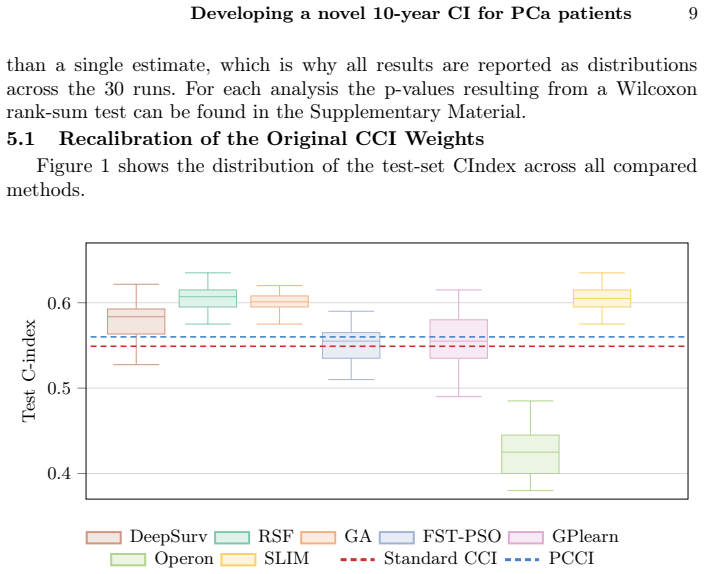
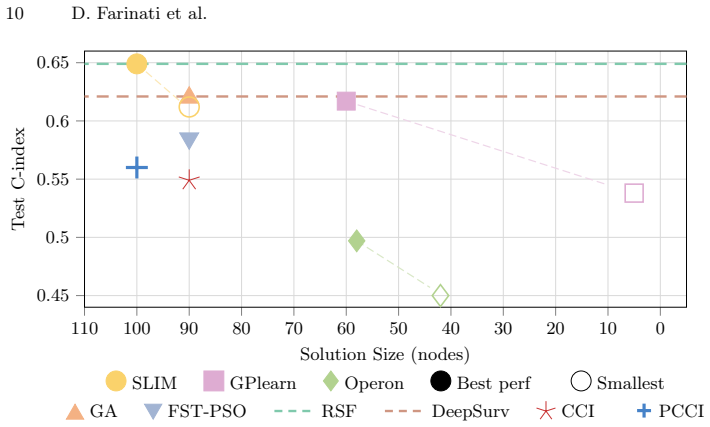
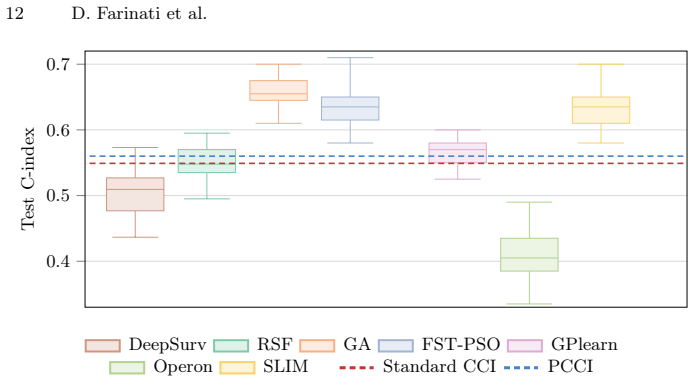
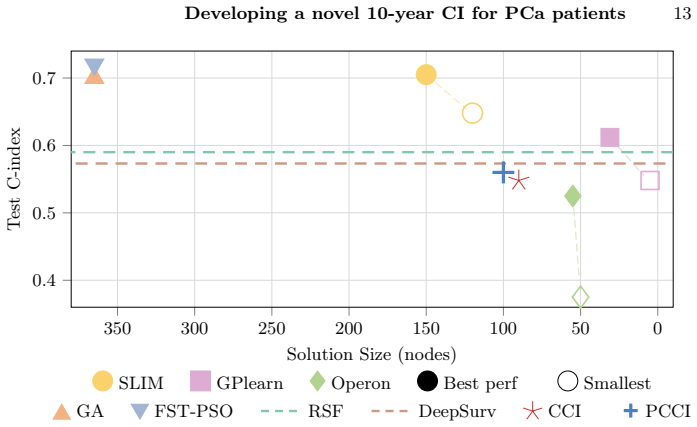
Using a retrospective single-institution cohort of prostate cancer patients considered for radical prostatectomy, population-based bio-inspired algorithms recalibrate the weights of the Charlson Comorbidities Index and evolve alternative formulations to better discriminate ten-year survival, with methods such as GA, FST-PSO, and SLIM achieving higher concordance indices than the original CCI or the prostate cancer-specific PCCI, especially when prostate cancer variables are included.
What carries the argument
Population-Based Bio-Inspired Algorithms (PBBIAs) applied to recalibrate comorbidity weights and evolve symbolic formulations for optimized ten-year survival discrimination.
If this is right
- GA, FST-PSO, and SLIM outperform both the original CCI and the PCCI when PCa-specific variables are included.
- These methods improve the Concordance Index by up to 0.1.
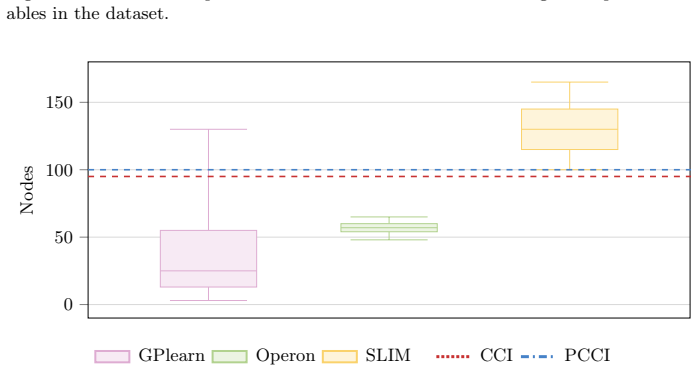
- GPLearn produces compact and interpretable models with competitive performance.
- The approach yields an updated and interpretable tool for improving patient selection for radical prostatectomy.
Where Pith is reading between the lines
- If the new index generalizes, it could reduce overtreatment by better identifying patients unlikely to live ten years due to comorbidities.
- Similar optimization techniques might be applied to create tailored indices for other cancer types where competing mortality risks affect treatment choices.
- Integration of additional clinical variables beyond comorbidities could further refine the predictions in future extensions.
Load-bearing premise
The retrospective single-institution cohort used for model development and testing represents the wider population of prostate cancer patients considered for radical prostatectomy.
What would settle it
A test on an independent external dataset from multiple institutions where the new indices do not show a statistically significant improvement in concordance index over the original CCI would indicate the claimed superiority does not hold.
Figures
read the original abstract
The Charlson Comorbidities Index (CCI) is a weighted additive index widely used to estimate ten-year mortality risk, but its original weights may not reflect contemporary prognoses. This limitation is critical in Prostate Cancer (PCa), where radical treatment is recommended only for patients with a life expectancy of at least ten years. For candidates eligible for Radical Prostatectomy (RP), accurate estimation of ten-year other-cause mortality is essential to balance oncological benefit against competing risks and avoid overtreatment. We propose a data-driven framework to derive a comorbidity index tailored to PCa patients considered for RP. Using a retrospective single-institution cohort, we apply Population-Based Bio-Inspired Algorithms (PBBIAs) to recalibrate comorbidity weights and evolve alternative symbolic formulations optimized for ten-year survival discrimination. We compared six optimization strategies, including symbolic regression approaches based on Genetic Programming (GP), population-based metaheuristics, clinically validated baselines, and survival prediction models. Results show that GA, FST-PSO, and SLIM outperform both the original CCI and the PCCI, particularly when PCa-specific variables are included, improving the Concordance Index by up to 0.1. GPLearn yields compact and interpretable models with competitive performance. Overall, the proposed approach provides an updated and interpretable tool to improve patient selection for RP.
Editorial analysis
A structured set of objections, weighed in public.
Referee Report
Summary. The paper claims that Population-Based Bio-Inspired Algorithms (PBBIAs) including GA, FST-PSO, and SLIM can be used on a single retrospective single-institution cohort of prostate cancer patients considered for radical prostatectomy to recalibrate comorbidity weights and evolve symbolic forms, yielding indices that outperform the original CCI and PCCI (with C-index gains up to 0.1) especially when PCa-specific variables are added; GPLearn is highlighted for producing compact interpretable models.
Significance. If the performance claims survive proper out-of-sample validation, the work would supply a computationally derived, potentially more accurate tool for estimating 10-year other-cause mortality to guide RP eligibility and reduce overtreatment. The application of evolutionary algorithms both for weight optimization and for symbolic regression in a survival setting is a methodological contribution worth noting.
major comments (3)
- [Abstract] Abstract: the reported C-index improvements (up to 0.1) are obtained by applying GA, FST-PSO, and SLIM to recalibrate weights and evolve expressions on the identical retrospective cohort used to compute the concordance indices; no cross-validation, temporal split, or external validation set is described, so the observed lift cannot be separated from in-sample fitting.
- [Abstract] Abstract and methods description: the central claim that the new indices 'outperform' CCI and PCCI rests on discrimination measured after optimization on the same ten-year survival outcomes; this circularity means the gains are expected by construction and do not yet demonstrate improved generalization.
- [Abstract] Abstract: the single-institution retrospective cohort is used for both model derivation and performance reporting, yet no information is supplied on cohort size, event rate, follow-up completeness, or any control for overfitting (e.g., nested CV or regularization), leaving the robustness of the 0.1 C-index delta unsupported.
minor comments (1)
- [Abstract] Abstract: the phrase 'six optimization strategies' is used but only four are named; list all six explicitly for clarity.
Simulated Author's Rebuttal
We thank the referee for the detailed and constructive comments on validation, circularity, and cohort description. We agree that the original abstract was insufficiently explicit on these points and have revised the abstract, methods, and discussion to incorporate the necessary clarifications and limitations. Point-by-point responses are provided below.
read point-by-point responses
-
Referee: [Abstract] Abstract: the reported C-index improvements (up to 0.1) are obtained by applying GA, FST-PSO, and SLIM to recalibrate weights and evolve expressions on the identical retrospective cohort used to compute the concordance indices; no cross-validation, temporal split, or external validation set is described, so the observed lift cannot be separated from in-sample fitting.
Authors: We agree that the abstract did not describe any cross-validation, temporal split, or external validation. The revised abstract now explicitly states that the reported C-index values reflect performance on the derivation cohort. We have added a dedicated limitations paragraph acknowledging that the observed gains are in-sample and that external validation on independent data is required before clinical use. No new external cohort is available for the current revision. revision: yes
-
Referee: [Abstract] Abstract and methods description: the central claim that the new indices 'outperform' CCI and PCCI rests on discrimination measured after optimization on the same ten-year survival outcomes; this circularity means the gains are expected by construction and do not yet demonstrate improved generalization.
Authors: The referee correctly identifies that optimization on the same outcomes will produce improved discrimination by construction. The revised text now frames the contribution as the derivation of alternative weightings and symbolic expressions via PBBIAs rather than as a claim of superior generalization. We have added language clarifying that prospective or external validation is needed to establish transportability and have tempered the abstract claims accordingly. revision: yes
-
Referee: [Abstract] Abstract: the single-institution retrospective cohort is used for both model derivation and performance reporting, yet no information is supplied on cohort size, event rate, follow-up completeness, or any control for overfitting (e.g., nested CV or regularization), leaving the robustness of the 0.1 C-index delta unsupported.
Authors: We accept that the original abstract omitted these essential descriptors. The revised abstract now reports cohort size, number of events, median follow-up, and completeness. In the methods we have added explicit description of the regularization terms used within the PBBIA objective functions and the bootstrap resampling procedure employed to assess stability of the C-index estimates. revision: yes
- External validation on an independent multi-institutional cohort is not available in the current study.
Circularity Check
Comorbidity weights and symbolic forms optimized on same cohort used to report C-index gains, making reported improvements by construction
specific steps
-
fitted input called prediction
[Abstract]
"Using a retrospective single-institution cohort, we apply Population-Based Bio-Inspired Algorithms (PBBIAs) to recalibrate comorbidity weights and evolve alternative symbolic formulations optimized for ten-year survival discrimination. ... Results show that GA, FST-PSO, and SLIM outperform both the original CCI and the PCCI, particularly when PCa-specific variables are included, improving the Concordance Index by up to 0.1."
The optimization target is ten-year survival discrimination (the same quantity later measured by C-index). Weights and symbolic forms are fitted to the cohort's outcomes; the reported C-index lift is therefore the direct output of that fitting procedure on the identical data, not an independent test of generalization.
full rationale
The paper applies PBBIAs (GA, FST-PSO, SLIM) to recalibrate weights and evolve symbolic expressions explicitly optimized for ten-year survival discrimination on a single retrospective cohort, then reports that these yield up to 0.1 C-index improvement over CCI/PCCI on that same cohort. No external validation, temporal split, or hold-out is described, so the performance delta reduces to the result of fitting rather than independent prediction. This matches the fitted_input_called_prediction pattern with load-bearing impact on the central claim.
Axiom & Free-Parameter Ledger
free parameters (2)
- comorbidity weights
- symbolic regression parameters
axioms (1)
- domain assumption The single-institution retrospective cohort is representative of the broader population of men considered for radical prostatectomy.
Reference graph
Works this paper leans on
-
[1]
In: Proceed- ings of the 2020 Genetic and Evolutionary Computation Conference Com- panion
Bogdan Burlacu, Gabriel Kronberger, and Michael Kommenda. Operon c++: An efficient genetic programming framework for symbolic regres- sion. InProceedings of the 2020 Genetic and Evolutionary Computation Conference Companion, GECCO ’20, page 1562–1570, New York, NY, USA, 2020. Association for Computing Machinery. ISBN 9781450371278. https://doi.org/10.1145...
-
[2]
Szatrowski, Janey Peterson, and Jeffrey Gold
Mary Charlson, Ted P. Szatrowski, Janey Peterson, and Jeffrey Gold. Val- idation of a combined comorbidity index.Journal of Clinical Epidemiol- ogy, 47(11):1245–1251, Nov 1994.https://doi.org/https://doi.org/ 10.1016/0895-4356(94)90129-5. URLhttps://pubmed.ncbi.nlm.nih. gov/7722560/
-
[3]
Charlson, Peter Pompei, Kathy L
Mary E. Charlson, Peter Pompei, Kathy L. Ales, and C.Ronald MacKenzie. A new method of classifying prognostic comorbidity in longitudinal studies: Development and validation.Journal of Chronic Diseases, 40(5):373–383, Jan 1987.https://doi.org/https://doi.org/10.1016/0021-9681(87) 90171-8. URLhttps://pubmed.ncbi.nlm.nih.gov/3558716/
-
[4]
Philip Cornford, Roderick C.N. van den Bergh, Erik Briers, Thomas Van den Broeck, Oliver Brunckhorst, Julie Darraugh, Daniel Eberli, Gert De Meerleer, Maria De Santis, Andrea Farolfi, Giorgio Gandaglia, Silke Gillessen, Nikolaos Grivas, Ann M. Henry, Michael Lardas, Geert J.L.H. van Leenders, Matthew Liew, Estefania Linares Espinos, Jan Oldenburg, Inge M....
-
[5]
D.R. Cox and D. Oakes. Analysis of survival data. Feb 2018. https://doi.org/https://doi.org/10.1201/9781315137438. URLhttps://www.taylorfrancis.com/books/mono/10.1201/ 9781315137438/analysis-survival-data-reid-cox
-
[6]
Daskivich, Lorna Kwan, Atreya Dash, Christopher Saigal, and Mark S
Timothy J. Daskivich, Lorna Kwan, Atreya Dash, Christopher Saigal, and Mark S. Litwin. An age adjusted comorbidity index to predict long- term, other cause mortality in men with prostate cancer.Journal of Urology, 194(1):73–78, Jul 2015.https://doi.org/https://doi.org/10. 1016/j.juro.2015.01.081. URLhttps://pubmed.ncbi.nlm.nih.gov/ 25623745/
2015
-
[7]
A survey on dynamic popula- tions in bio-inspired algorithms.Genetic Programming and Evolvable Ma- 16 D
Davide Farinati and Leonardo Vanneschi. A survey on dynamic popula- tions in bio-inspired algorithms.Genetic Programming and Evolvable Ma- 16 D. Farinati et al. chines, 25(2), Jul 2024.https://doi.org/https://doi.org/10.1007/ s10710-024-09492-4. URLhttps://link.springer.com/article/10. 1007/s10710-024-09492-4
2024
-
[8]
Davide Farinati, Gloria Pietropolli, and Leonardo Vanneschi. A study on the dynamics and effectiveness of the deflate geometric semantic muta- tion.IEEE Transactions on Evolutionary Computation, page 1–1, 2025. https://doi.org/https://doi.org/10.1109/tevc.2025.3611226. URL https://ieeexplore.ieee.org/abstract/document/11168418
-
[9]
Freddie C. Hamdy, Jenny L. Donovan, J. Athene Lane, Malcolm Mason, Chris Metcalfe, Peter Holding, Michael Davis, Tim J. Peters, Emma L. Turner, Richard M. Martin, Jon Oxley, Mary Robinson, John Staffurth, Eleanor Walsh, Prasad Bollina, James Catto, Andrew Doble, Alan Doherty, David Gillatt, and Roger Kockelbergh. 10-year outcomes after monitoring, surgery...
-
[10]
Hemant Ishwaran, Udaya B. Kogalur, Eugene H. Blackstone, and Michael S. Lauer. Random survival forests.The Annals of Applied Statistics, 2(3), Sep 2008.https://doi.org/https: //doi.org/10.1214/08-aoas169. URLhttps://projecteuclid. org/journals/annals-of-applied-statistics/volume-2/issue-3/ Random-survival-forests/10.1214/08-AOAS169.full
-
[11]
Katzman, Uri Shaham, Alexander Cloninger, Jonathan Bates, Tingting Jiang, and Yuval Kluger
Jared L. Katzman, Uri Shaham, Alexander Cloninger, Jonathan Bates, Tingting Jiang, and Yuval Kluger. Deepsurv: personalized treatment recommender system using a cox proportional hazards deep neural net- work.BMC Medical Research Methodology, 18(1), Feb 2018.https:// doi.org/https://doi.org/10.1186/s12874-018-0482-1. URLhttps: //link.springer.com/article/1...
-
[12]
gplearn-readthedocs-io-en-stable, 2026
juan lopez. gplearn-readthedocs-io-en-stable, 2026. URLhttps://www.scribd.com/document/691097226/ gplearn-readthedocs-io-en-stable
-
[13]
Marco S. Nobile, Paolo Cazzaniga, Daniela Besozzi, Riccardo Colombo, Gi- ancarlo Mauri, and Gabriella Pasi. Fuzzy self-tuning pso: A settings-free algorithm for global optimization.Swarm and Evolutionary Computation, 39:70–85, Apr 2018.https://doi.org/https://doi.org/10.1016/j. swevo.2017.09.001. URLhttps://www.sciencedirect.com/science/ article/pii/S2210...
work page doi:10.1016/j 2018
-
[14]
Frank J. Palella, Kathleen M. Delaney, Anne C. Moorman, Mark O. Loveless, Jack Fuhrer, Glen A. Satten, Diane J. Aschman, and Scott D. Holmberg. Declining morbidity and mortality among patients with ad- vanced human immunodeficiency virus infection.New England Journal of Medicine, 338(13):853–860, Mar 1998.https://doi.org/https://doi. org/10.1056/nejm19980...
-
[15]
Liah Rosenfeld, Davide Farinati, Diogo Rasteiro, Gloria Pietropolli, Karina Rebuli, Sara Silva, and Leonardo Vanneschi. Slim_gsgp: A python library for non-bloating gsgp.Proceedings of the Genetic and Evolutionary Com- putation Conference, page 1026–1034, Jul 2025.https://doi.org/https: //doi.org/10.1145/3712256.3726398
-
[16]
Hasina Samji, Angela Cescon, Robert S. Hogg, Sharada P. Modur, Keri N. Althoff, Kate Buchacz, Ann N. Burchell, Mardge Cohen, Kelly A. Gebo, M. John Gill, Amy Justice, Gregory Kirk, Marina B. Klein, P. Todd Ko- rthuis, Jeff Martin, Sonia Napravnik, Sean B. Rourke, Timothy R. Sterling, Michael J. Silverberg, and Stephen Deeks. Closing the gap: Increases in ...
-
[17]
Airi Sekine and Kei Nakajima. Development of an algorithm for the charl- son comorbidity index using the national database study in the japan kanto 7 prefectures. Apr 2025.https://doi.org/https://doi.org/10. 1101/2025.04.10.25325568. URLhttps://www.medrxiv.org/content/ 10.1101/2025.04.10.25325568v1
-
[18]
Rebecca L. Siegel, Kimberly D. Miller, Nikita Sandeep Wagle, and Ahmedin Jemal. Cancer statistics, 2023.CA: A Cancer Journal for Clinicians, 73 (1):17–48, Jan 2023.https://doi.org/https://doi.org/10.3322/caac. 21763. URLhttps://pubmed.ncbi.nlm.nih.gov/36633525/
-
[19]
Leonardo Vanneschi, Davide Farinati, Diogo Rasteiro, Liah Rosenfeld, Gloria Pietropolli, and Sara Silva. Exploring non-bloating geometric semantic genetic programming.Genetic and Evolutionary Computa- tion, page 237–258, 2025.https://doi.org/https://doi.org/10.1007/ 978-981-96-0077-9_12. URLhttps://link.springer.com/chapter/ 10.1007/978-981-96-0077-9_12
discussion (0)
Sign in with ORCID, Apple, or X to comment. Anyone can read and Pith papers without signing in.