REVIEW 3 major objections 4 minor 2 cited by
Probing Primordial Black Hole Mergers in Clusters with Pulsar Timing Data
T0 review · 3 major / 4 minor · reviewed 2026-08-11 · deepseek-v4-flash
Pith's one-line read PBH mergers alone cannot explain the pulsar timing background
desk verdict Solid and useful negative result for PBH-PTA interpretations, but a likely sign error in the halo radius relation and a prior-saturating free parameter make the quantitative claims weaker than the abstract suggests. read the letter →
The pith
A machine-rendered reading of the paper's core claim, the machinery that carries it, and where it could break.
The reading
What carries the argument
The load-bearing object is the combined gravitational-wave spectrum $h^2\Omega_{\rm gw}(f)=h^2\Omega_{\rm gw}^{\rm SIGW}(f)+h^2\Omega_{\rm gw}^{\rm PBHB}(f)$, built from the curvature power spectrum $P_\zeta(k)=A_\zeta (k/k_\star)^{n_s-1}$ with cut-offs $k_{\min}, k_{\max}$. The SIGW term is the second-order scalar-induced spectrum of Eq. (11); the PBHB term sums the early-universe binary merger rate of Eq. (14) and the late-time halo merger rate of Eq. (24), the latter controlled by the clustering factor $R_{\rm cl}(z)$, a dimensionful factor in Gpc$^{-3}$ yr$^{-1}$ that packages the Poisson-induced halo mass function, cuspy density profiles, and dynamical heating. The argument turns on $R_{\rm cl}$: with fixed parameters it stays at values $R_{\rm cl}\sim 1$--$10^2$ Gpc$^{-3}$ yr$^{-1}$ (or up to $\sim 10^6$ for $n_s>1$, where average masses are tiny), far below the $\gtrsim 10^4$ Gpc$^{-3}$ yr$^{-1}$ needed for late PBH binaries to dominate the signal.
What would settle it
A computation of $R_{\rm cl}$ from N-body simulations of PBH cluster formation with enhanced (non-Poissonian) initial clustering that yields $R_{\rm cl}\gtrsim 10^4$ Gpc$^{-3}$ yr$^{-1}$ while satisfying $f_{\rm PBH}\le 1$ and CMB $\mu$-distortion limits would disprove the central exclusion. Equivalently, a PTA detection whose high-frequency tail scales as $\Omega_{\rm gw}\propto f^{2/3}$ rather than the steeper SMBHB power law would reopen the PBH-binary channel.
Extended reading notes
Core claim
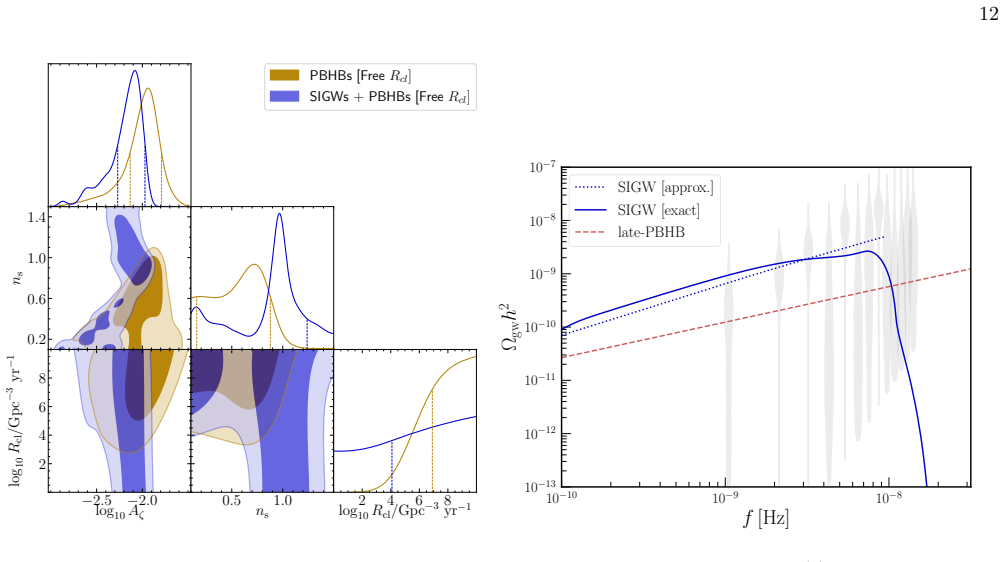
The central claim is that the common-spectrum process in IPTA DR2 does not select a PBH-merger origin. When the curvature power spectrum is constrained by CMB $\mu$-distortion limits and the $f_{\rm PBH}\le 1$ overproduction limit, the large-scale cutoff removes PBHs heavier than roughly $10^3$ solar masses, which are precisely the asymmetric binaries that earlier work had identified as the dominant merger contribution. The fixed-clustering analysis then yields a spectrum dominated by scalar-induced GWs, with PBH binaries contributing at a much lower amplitude, and a log evidence ratio $\log_{10} B \simeq 1.9$ in favor of the astrophysical supermassive-black-hole-binary model. In the free-clustering analysis, the clustering factor $R_{\rm cl}$ is driven to the prior boundary ($\log_{10} R_{\rm cl}=10$), and the PBH-only fit produces a PBH mass function that is excluded by microlensing, CMB, and ground-based interferometer merger-rate constraints. The authors conclude that, within the modeled scenarios, the IPTA DR2 signal strongly favors an astrophysical origin.
Load-bearing premise
The load-bearing premise is that late-time PBH halos form only from Poisson fluctuations in the PBH number density, with the paper's specific halo mass function from the standard collapse formalism, cuspy density profiles, and dynamical-heating prescription; if real clustering is stronger, the PBH merger background grows and the central exclusion weakens.
Editorial extensions
If this is right
- If the paper is right, the nHz common-spectrum process in IPTA DR2 is not a signature of PBH mergers under Gaussian primordial perturbations, so explaining it cosmologically requires either non-Gaussian clustering or a different PBH formation channel.
- The scalar-induced GW component remains a viable PBH-associated signal and constrains the primordial power-spectrum parameters $(A_\zeta, n_s, k_{\min}, k_{\max})$ in the window where $f_{\rm PBH}\le 1$ and CMB $\mu$-distortion limits are respected.
- Models that force the signal to come only from late-time PBH binaries need $R_{\rm cl}\gtrsim 10^4$ Gpc$^{-3}$ yr$^{-1}$, which conflicts with Poissonian clustering and yields PBH abundances excluded by microlensing, CMB anisotropies, and ground-based interferometer merger-rate measurements.
- The reported preference for an astrophysical origin is quantified by a log evidence ratio $\log_{10} B_{\rm SMBHB,PBH} \simeq 1.9$ for the models including SIGWs, and $\simeq 0.05$ for a PBH-merger-only model, favoring supermassive black hole binaries.
- The analysis provides a reusable merger-rate template for broad PBH mass functions that can be applied to other gravitational-wave searches.
Reading between the lines
- Editorial inference: because the inferred value of $R_{\rm cl}$ lands at the prior boundary, IPTA DR2 data alone do not fix the merger-rate enhancement; they only set a lower limit, and a reanalysis with a wider prior or independent cluster constraints would sharpen the bound.
- Editorial inference: the exclusion is limited to Gaussian-perturbation formation with Poissonian clustering; rerunning the same pipeline with non-Gaussian curvature perturbations that enhance PBH clustering at formation, a caveat the authors name, is the natural next test.
- Editorial inference: applied to the upcoming combined IPTA DR3 dataset, the same template should either tighten the supermassive-black-hole-binary interpretation or reveal a residual component; the $\Omega_{\rm gw}\propto f^{2/3}$ high-frequency scaling is a distinctive PBH-binary signature that separates the two.
- Editorial inference: the $\mu$-distortion bound at $k\lesssim 10^5$ Mpc$^{-1}$ is the main lever suppressing heavy PBHs, so a future spectral-distortion measurement at these scales would decide whether the late-time merger channel can ever be competitive.
Editorial analysis
A structured set of objections, weighed in public.
Referee Report
Summary. The paper performs a Bayesian search in IPTA DR2 for a stochastic gravitational-wave background sourced by primordial black holes, combining scalar-induced GWs from the curvature perturbations that form the PBHs with GWs from early-Universe PBH binaries and from late-time dynamical capture in Poisson-induced PBH halos. A broad PBH mass function is derived from a power-law primordial power spectrum with hard cutoffs, and constraints from CMB mu-distortions and fPBH<=1 are imposed. The analysis is run twice: once with the clustering factor Rcl computed from the analytic halo model, and once with Rcl as a free nuisance parameter. The authors find that scalar-induced GWs dominate the nHz band, that the PBH-merger contribution is subdominant under the Poissonian-clustering model, and that the IPTA DR2 signal favors an SMBHB interpretation over the PBH models considered. The central conclusion is stated as being conditional on standard Gaussian PBH formation and Poissonian clustering, with enhanced clustering identified as a possible loophole.
Significance. If the central conclusion holds, the paper is a useful contribution to the PBH interpretation of PTA data: it is one of the few analyses to include scalar-induced GWs and both early and late PBH merger channels for a broad, first-principles mass function, and it demonstrates quantitatively that mu-distortion cutoffs suppress the previously claimed late-time merger enhancement. The use of PTArcade, the explicit prior choices, the posterior predictive PBH mass functions, and the free-Rcl robustness test are strengths. The main result is, however, conditional on an analytic clustering model whose derivation contains a load-bearing scaling error (see major comment 1), and the free-Rcl analysis shows that the PTA likelihood alone does not strongly exclude PBH-only models. A careful revision of the clustering calculation and of the wording of the abstract's 'strongly favors' claim is needed.
major comments (3)
- [Appendix C, Eq. (C8)] The claimed scaling of the virial radius with the mass-averaged clustering quantity appears to have the wrong sign. Combining the spherical-collapse condition rho_h ~ 178 rho_c(z_h) with Eq. (C5), which gives (1+z_h) proportional to (langle m f_PBH rangle / M_h)^{1/2}, yields r_h proportional to (langle m f_PBH rangle)^{-1/2} M_h^{5/6}, whereas Eq. (C8) has the positive exponent +1/2. Because the clustering factor in Eq. (C15) contains v_vir^{-11/7} delta_cl^2 r_h^3 and delta_cl is proportional to M_h/r_h^3, this sign error changes R_cl by a factor of order (langle m f_PBH rangle)^{31/14}; for langle m f_PBH rangle ~ 10^{-3} M_sun, the printed relation overestimates R_cl by roughly four orders of magnitude or more. This affects the fixed-R_cl posteriors and the derived PBH merger contribution, and the derivation must be corrected and the fixed-R_cl analysis recomputed before the quantitative exclusion claim can be accepted.
- [Sec. V B and Table I] The free-Rcl analyses do not provide strong evidence against PBH-only models. The maximum posterior for log10 R_cl sits at the upper prior edge (log10 R_cl = 10) in both free-Rcl runs, and for the PBH-only case the Bayes factor is log10(B_SMBHB,PBH) = 0.05, which is inconclusive. The abstract's statement that IPTA DR2 'strongly favors' an astrophysical origin is therefore not supported by the PTA likelihood alone; it relies on external constraints (fPBH <= 1, CMB, LVK) applied in Sec. VI. Please qualify the central claim as conditional on the Poissonian-clustering model plus external PBH constraints, and state explicitly which Bayes factor supports the word 'strongly'.
- [Sec. IV A, Eq. (18)] The late-time suppression factor S_late is taken from a monochromatic-mass computation and extrapolated to broad mass functions without a quantified error; the manuscript itself notes that this extension is 'non-trivial and still an open issue'. Because Eq. (18) multiplies the early-binary rate that enters all three models in Table I, the early-binary contribution carries an unquantified systematic that the free-Rcl parameter cannot absorb, since Rcl only rescales the late-binary template in Eq. (24). The authors should either demonstrate that the posteriors and Bayes factors are insensitive to this extrapolation or incorporate the extrapolation uncertainty into the model comparison.
minor comments (4)
- [Appendix D 3] The statement 'The best fit values used for the GW spectrum shown in Fig. 5 are in violation of this L VK bound' conflicts with the use of the same values as the maximum-likelihood/maximum-posterior spectrum in the main text; please clarify whether the displayed spectrum is a posterior maximum or a best-fit that is excluded by LVK, and specify the status of the posterior sample used for Fig. 6.
- [Table I and Sec. V] The Bayes factors in Table I are quoted without an evidence scale; please state the Jeffreys-scale interpretation used for 'strong evidence' and note explicitly that the numerical values are specific to IPTA DR2 and to the prior choices in Table II, not to the newer NANOGrav/EPTA/PPTA datasets.
- [Eq. (C7) and Eq. (23)] The averaged quantity in Eq. (C7), defined as f_PBH^2 times the mass-weighted integral of phi(m), is central to both Eq. (23) and Eq. (C15); please define it once in the main text (or in a single appendix location) and use a notation that distinguishes it clearly from langle f_PBH m rangle used in Eq. (C3), since the two enter different parts of the halo model.
- [Figs. 4 and 5] The right-hand panels of Figs. 4 and 5 show several spectral components but do not label a 'total' curve explicitly; adding the total PBH+SIGW spectrum and the SMBHB reference model in the same panel would make the model comparison easier to interpret.
Circularity Check
No significant circularity: the central PTA model comparison is data-driven and externally constrained; self-cited clustering inputs are present but are explicitly tested by the free-Rcl analysis.
full rationale
The derivation chain is not circular in the sense of Eq. X being equivalent to Eq. Y by construction or a fitted parameter being renamed a prediction. The core result is a Bayesian model comparison against IPTA DR2: the PBH templates are built from a physical PBH mass function (Eq. 7), SIGW spectrum (Eqs. 11-13), and merger rates (Eqs. 14, 24, 29), with external priors fPBH <= 1 and CMB mu-distortion limits imposed. The Bayes factors in Table I are computed from the IPTA likelihood and a fixed SMBHB template (Eq. 31), so the preference for SMBHBs is a data-driven outcome, not an input. The free-clustering analysis in Sec. V B is an honest robustness test: log10 Rcl saturates the prior upper bound, showing that the Poissonian Rcl estimate is too small and that the PBH-only explanation is rescued only by external PBH constraints (CMB, LVK), which is a legitimate use of independent data. The paper does contain minor self-citations for the clustering and dynamical-heating framework (Refs. 19, 54, 55), and Appendix C itself states limits: 'Numerical N-body simulations would be needed for fully detailed cluster dynamics and are out of the scope of the paper' and 'This approach still contains a certain number of uncertainties and several physical effects may undermine the validity of this calculation'. These are genuine limitations, and a possible sign error in Eq. C8 noted in review would be a correctness issue, not a circularity. Because the authors explicitly test the clustering uncertainty by freeing Rcl and compare against a fixed external SMBHB template, the self-citations are not load-bearing enough to make the central claim circular.
Assumptions & free parameters
free parameters (5)
- A_zeta =
log10 A_zeta ≈ -2.06 (fixed Rcl), -2.10 (free Rcl)
- n_s =
n_s ≈ 0.97 (max posterior, both analyses)
- kmin =
log10 kmin/Mpc^-1 ≈ 5.68 (fixed Rcl), 4.58 (free Rcl)
- kmax =
log10 kmax/Mpc^-1 ≈ 7.33 (fixed Rcl), 6.99 (free Rcl)
- Rcl =
log10 Rcl/Gpc^-3yr^-1 = 10 (posterior at prior boundary)
assumptions (7)
- domain assumption Press-Schechter spherical collapse with Gaussian curvature perturbations for PBH formation
- ad hoc to paper Power-law primordial power spectrum with hard cutoffs (Eq. 3)
- domain assumption Top-hat window function for smoothing the density contrast
- domain assumption CMB mu-distortion bound mu < 9e-5 applied as a hard prior on kmin
- ad hoc to paper Late-time suppression factor S_late (Eq. 18) computed for monochromatic PBH distributions is extrapolated to broad mass functions
- domain assumption PBH halo mass function and dynamical heating model in Appendix C
- domain assumption Gaussian curvature perturbations; no non-Gaussianities in the standard scenario
Cite this review
Pith. "Pith review of Probing Primordial Black Hole Mergers in Clusters with Pulsar Timing Data." pith.science (2026). https://pith.science/paper/BJCDI4A6
@misc{pith2026241215989,
  author       = {Pith},
  title        = {Pith review of: Probing Primordial Black Hole Mergers in Clusters with Pulsar Timing Data},
  year         = {2026},
  howpublished = {\url{https://pith.science/paper/BJCDI4A6}},
  note         = {Machine review of arXiv:2412.15989}
}
abstract
We consider the possibility that the stochastic gravitational wave (GW) background suggested by Pulsar Timing Array (PTA) datasets is sourced by Primordial Black Holes (PBHs). Specifically, we perform a Bayesian search in the International PTA Data Release 2 (IPTA DR2) for a combined GW background arising from scalar perturbations and unresolved PBH mergers, assuming a broad PBH mass distribution. In our analysis, we incorporate constraints on the curvature power spectrum from CMB $\mu$-distortions and the overproduction of PBHs, which significantly suppress the contribution of PBH mergers to the total GW background. We find that scalar-induced GWs dominate the nHz frequency range, while PBH mergers alone cannot account for the observed signal under the standard PBH formation scenario involving Gaussian perturbations, and including only Poissonian PBH clustering. However, specific PBH models, such as those with enhanced clustering, could yield a GW background dominated by PBH mergers. Overall, we find that the IPTA DR2 strongly favors an astrophysical origin for the reported common-spectrum process over the PBH models considered in this analysis.
Figures


Figures from the paper (6 more)



Forward citations
Cited by 2 Pith papers
-
Implications for Pulsar Timing Arrays of Sub-solar Black Hole Detections: From LVK to Einstein Telescope and Cosmic Explorer
A Bayesian analysis shows that a future sub-solar PBH detection would make the primordial SIGW interpretation of PTA data favored over the SMBH interpretation, but this preference is driven by the detection prior.
-
A fast deep-learning approach to probing primordial black hole populations in gravitational wave events
A neural network maps single-event gravitational-wave posterior samples to joint PBH population posteriors in about one second on a GPU, with calibration matching MCMC on simulated catalogs.
Reference graph
Works this paper leans on
-
[55]
K. Inomata, K. Kohri, and T. Terada, Detected stochastic gravitational waves and subsolar-mass pri- mordial black holes, Phys. Rev. D 109, 063506 (2024), arXiv:2306.17834 [astro-ph.CO]
arXiv 2024
-
[1]
These Poisson fluctuations give rise to isocurvature per- turbations in the matter power spectrum that could be observable as a small-scale plateau [137] (see also e.g
Poisson fluctuations from PBHs Due to the discrete nature of PBHs, Poisson fluctu- ations are expected in their local number density [92]. These Poisson fluctuations give rise to isocurvature per- turbations in the matter power spectrum that could be observable as a small-scale plateau [137] (see also e.g. Refs. [54, 93, 138–140] for analyses including Po...
-
[2]
According to the Press-Schechter formalism, the density fluctuations associated to the matter power spec- trum, including Eq
Cluster formation Here, we give an estimate of the size of the PBH clus- ters formed from the collapse of Poisson density pertur- bations. According to the Press-Schechter formalism, the density fluctuations associated to the matter power spec- trum, including Eq. (C1), decouple from the Hubble flow and collapse into proper clusters when the overdensity e...
-
[3]
cos(x) . (A2) For the production of SIGWs from small scales primor- dial perturbations, it is reasonable to assume that all the relevant modes k enter the horizon early in radiation domination. Hence, deep in radiation domination, those modes satisfy the condition kη ≫ 1. On taking the oscil- lation average after squaring Eq. (A2) above, the factors of si...
-
[4]
This process is similar to the evolution properties of known gravitation- ally interacting systems, for example, star clusters
Dynamical heating of PBH clusters Once a PBH cluster is formed, gravitational interac- tions between PBHs can lead to a gain in kinetic energy, via a process called dynamical heating, eventually caus- ing the system to “puff up” or expand. This process is similar to the evolution properties of known gravitation- ally interacting systems, for example, star...
-
[5]
Clustering factor Rcl(z) In this section, we provide a calculation of the clus- tering factor that enters in Eq. 24. We can assemble Eqs. (19),(20),(22) to write: Rcl(z) = 4π2 3 85π 6 √ 2 2/7 G2 ¯ρ2 DM c10/7 Z ∞ Mmin(z) d Mh (C15) × v−11/7 vir Favg GNFWr3 h δ2 cl dn(z) dMh Gpc−3 yr−1, where GNFW is the factor associated to the radial inte- gration of the ...
-
[6]
µ-Distortions In the analysis performed in Sec.V, we imposed the CMB µ-distortion constraints on the curvature power 19 spectrum at scales k ≲ 105 Mpc−1 [56]. This is usually parameterized in terms of the parameter µ, µ ≈ Z ∞ 1Mpc−1 dk k Pζ(k)Wµ(k), (D1) with the window function defined as Wµ(k) ≈ 2.27 " exp − (k/1360)2 1 + (k/260)0.3 + k/340 ...
-
[7]
In our analysis, only the SIGWs will be subject to these con- straints since the GWB from late PBH binaries will con- tribute after CMB
∆Neff Since gravitational waves act as radiation, they are thus constrained by current bounds on the effective num- ber of neutrino species limit, ∆ Neff < 0.28 [143]. In our analysis, only the SIGWs will be subject to these con- straints since the GWB from late PBH binaries will con- tribute after CMB. This will give the following constrain (see for e.g....
Show all 155 references
-
[8]
[145, 146]) imposes that, at fL VK= 25 Hz, Ωgw ≤ 1.7 × 10⁻⁸
L VK-Constraint Finally, the L VK constraint [144] (See also Refs. [145, 146]) imposes that, at fL VK= 25 Hz, Ωgw ≤ 1.7 × 10⁻⁸. (D4) The posteriors obtained for the fixed clustering analy- sis in Fig. 8 do not violate this constraint. For ns > 1, kmax cuts-off the scalar induc...
-
[9]
Y. B. Zel’dovich and I. D. Novikov, The Hypothesis of Cores Retarded during Expansion and the Hot Cosmo- logical Model, Sov. Astron. 10, 602 (1967)
1967
-
[10]
S. W. Hawking, Black hole explosions?, Nature 248, 30 (1974)
1974
-
[11]
G. F. Chapline, Cosmological effects of primordial black holes, Nature 253, 251 (1975)
1975
-
[12]
B. J. Carr, The primordial black hole mass spectrum, Astrophys. J. 201, 1 (1975)
1975
-
[13]
S. M. Leach, M. Sasaki, D. Wands, and A. R. Liddle, Enhancement of superhorizon scale inflationary curva- ture perturbations, Phys. Rev. D 64, 023512 (2001), arXiv:astro-ph/0101406
2001 arXiv
-
[14]
Ballesteros and M
G. Ballesteros and M. Taoso, Primordial black hole dark matter from single field inflation, Phys. Rev. D 97, 023501 (2018), arXiv:1709.05565 [hep-ph]
2018 arXiv
-
[15]
S. S. Mishra and V. Sahni, Primordial Black Holes from a tiny bump/dip in the Inflaton potential, JCAP 04, 22 007, arXiv:1911.00057 [gr-qc]
1911 arXiv
-
[16]
J. Liu, L. Bian, R.-G. Cai, Z.-K. Guo, and S.-J. Wang, Primordial black hole production during first- order phase transitions, Phys. Rev. D 105, L021303 (2022), arXiv:2106.05637 [astro-ph.CO]
2022 arXiv
-
[17]
M. J. Baker, M. Breitbach, J. Kopp, and L. Mittnacht, Primordial Black Holes from First-Order Cosmologi- cal Phase Transitions, (2021), arXiv:2105.07481 [astro- ph.CO]
2021 arXiv
-
[18]
Kawana and K.-P
K. Kawana and K.-P. Xie, Primordial black holes from a cosmic phase transition: The collapse of Fermi-balls, Phys. Lett. B 824, 136791 (2022), arXiv:2106.00111 [astro-ph.CO]
2022 arXiv
-
[19]
Gross, G
C. Gross, G. Landini, A. Strumia, and D. Teresi, Dark Matter as dark dwarfs and other macroscopic objects: multiverse relics?, JHEP 09, 033, arXiv:2105.02840 [hep-ph]
-
[20]
Garriga, A
J. Garriga, A. Vilenkin, and J. Zhang, Black holes and the multiverse, JCAP 02, 064, arXiv:1512.01819 [hep- th]
-
[21]
B. Carr, K. Kohri, Y. Sendouda, and J. Yokoyama, Con- straints on primordial black holes, Rept. Prog. Phys.84, 116902 (2021), arXiv:2002.12778 [astro-ph.CO]
2021 arXiv
-
[22]
Chandrasekhar, The Maximum Mass of Ideal White Dwarfs, Astrophys
S. Chandrasekhar, The Maximum Mass of Ideal White Dwarfs, Astrophys. J. 74, 81 (1931)
1931
-
[23]
Prunier, G
M. Prunier, G. Morr´ as, J. F. N. n. Siles, S. Clesse, J. Garc ´ ıa-Bellido, and E. Ruiz Morales, Analysis of the subsolar-mass black hole candidate SSM200308 from the second part of the third observing run of Advanced LIGO-Virgo, (2023), arXiv:2311.16085 [gr-qc]
2023 arXiv
-
[24]
Morras et al
G. Morras et al. , Analysis of a subsolar-mass compact binary candidate from the second observing run of Ad- vanced LIGO, Phys. Dark Univ. 42, 101285 (2023), arXiv:2301.11619 [gr-qc]
2023 arXiv
-
[25]
Abbott et al
R. Abbott et al. (LIGO Scientific, VIRGO, KAGRA), Search for subsolar-mass black hole binaries in the sec- ond part of Advanced LIGO’s and Advanced Virgo’s third observing run, Mon. Not. Roy. Astron. Soc. 524, 5984 (2023), [Erratum: Mon.Not.Roy.Astron.Soc. 526, 6234 (2023)], a...
2023 arXiv
-
[26]
K. S. Phukon, G. Baltus, S. Caudill, S. Clesse, A. De- passe, M. Fays, H. Fong, S. J. Kapadia, R. Magee, and A. J. Tanasijczuk, The hunt for sub-solar primordial black holes in low mass ratio binaries is open, (2021), arXiv:2105.11449 [astro-ph.CO]
2021 arXiv
-
[27]
Clesse and J
S. Clesse and J. Garcia-Bellido, GW190425, GW190521 and GW190814: Three candidate mergers of primordial black holes from the QCD epoch, Phys. Dark Univ. 38, 101111 (2022), arXiv:2007.06481 [astro-ph.CO]
2022 arXiv
-
[28]
De Luca, V
V. De Luca, V. Desjacques, G. Franciolini, P. Pani, and A. Riotto, GW190521 Mass Gap Event and the Primor- dial Black Hole Scenario, Phys. Rev. Lett. 126, 051101 (2021), arXiv:2009.01728 [astro-ph.CO]
2021 arXiv
-
[29]
Abbott et al
R. Abbott et al. (LIGO Scientific, Virgo), GW190814: Gravitational Waves from the Coalescence of a 23 Solar Mass Black Hole with a 2.6 Solar Mass Compact Object, Astrophys. J. Lett. 896, L44 (2020), arXiv:2006.12611 [astro-ph.HE]
2020 arXiv
-
[30]
Abbott et al
R. Abbott et al. (LIGO Scientific, Virgo), GW190521: A Binary Black Hole Merger with a Total Mass of 150M⊙, Phys. Rev. Lett. 125, 101102 (2020), arXiv:2009.01075 [gr-qc]
2020
-
[31]
Bagui et al
E. Bagui et al. (LISA Cosmology Working Group), Pri- mordial black holes and their gravitational-wave signa- tures, (2023), arXiv:2310.19857 [astro-ph.CO]
2023 arXiv
-
[32]
Pi and M
S. Pi and M. Sasaki, Gravitational Waves Induced by Scalar Perturbations with a Lognormal Peak, JCAP 09, 037, arXiv:2005.12306 [gr-qc]
2005 arXiv
-
[33]
Inomata and T
K. Inomata and T. Terada, Gauge Independence of In- duced Gravitational Waves, Phys. Rev. D 101, 023523 (2020), arXiv:1912.00785 [gr-qc]
2020 arXiv
-
[34]
Kohri and T
K. Kohri and T. Terada, Semianalytic calculation of gravitational wave spectrum nonlinearly induced from primordial curvature perturbations, Phys. Rev. D 97, 123532 (2018), arXiv:1804.08577 [gr-qc]
2018 arXiv
-
[35]
Agazie et al
G. Agazie et al. (NANOGrav), The NANOGrav 15 yr Data Set: Observations and Timing of 68 Mil- lisecond Pulsars, Astrophys. J. Lett. 951, L9 (2023), arXiv:2306.16217 [astro-ph.HE]
2023 arXiv
-
[36]
Agazie et al
G. Agazie et al. (NANOGrav), The NANOGrav 15 yr Data Set: Evidence for a Gravitational-wave Background, Astrophys. J. Lett. 951, L8 (2023), arXiv:2306.16213 [astro-ph.HE]
2023 arXiv
-
[37]
Antoniadis et al
J. Antoniadis et al. (EPTA, InPTA:), The second data release from the European Pulsar Timing Array - III. Search for gravitational wave signals, Astron. Astro- phys. 678, A50 (2023), arXiv:2306.16214 [astro-ph.HE]
2023 arXiv
-
[38]
Antoniadis et al
J. Antoniadis et al. (EPTA), The second data re- lease from the European Pulsar Timing Array - I. The dataset and timing analysis, Astron. Astrophys. 678, A48 (2023), arXiv:2306.16224 [astro-ph.HE]
2023 arXiv
-
[39]
D. J. Reardon et al. , Search for an Isotropic Gravitational-wave Background with the Parkes Pul- sar Timing Array, Astrophys. J. Lett. 951, L6 (2023), arXiv:2306.16215 [astro-ph.HE]
2023 arXiv
-
[40]
Xu et al
H. Xu et al. , Searching for the Nano-Hertz Stochas- tic Gravitational Wave Background with the Chinese Pulsar Timing Array Data Release I, Res. Astron. As- trophys. 23, 075024 (2023), arXiv:2306.16216 [astro- ph.HE]
2023 arXiv
-
[41]
Antoniadis et al
J. Antoniadis et al. , The International Pulsar Timing Array second data release: Search for an isotropic grav- itational wave background, Mon. Not. Roy. Astron. Soc. 510, 4873 (2022), arXiv:2201.03980 [astro-ph.HE]
2022 arXiv
-
[42]
R. W. Hellings and G. S. Downs, Upper limits on the isotropic gravitational radiation background from pulsar timing analysis., Astrophys. J. Lett. 265, L39 (1983)
1983
-
[43]
Afzal et al
A. Afzal et al. (NANOGrav), The NANOGrav 15 yr Data Set: Search for Signals from New Physics, Astro- phys. J. Lett. 951, L11 (2023), arXiv:2306.16219 [astro- ph.HE]
2023 arXiv
-
[44]
Ellis, M
J. Ellis, M. Fairbairn, G. Franciolini, G. H¨ utsi, A. Iovino, M. Lewicki, M. Raidal, J. Urrutia, V. Vasko- nen, and H. Veerm¨ ae, What is the source of the PTA GW signal?, Phys. Rev. D 109, 023522 (2024), arXiv:2308.08546 [astro-ph.CO]
2024 arXiv
-
[45]
De Luca, G
V. De Luca, G. Franciolini, and A. Riotto, NANOGrav Data Hints at Primordial Black Holes as Dark Matter, Phys. Rev. Lett. 126, 041303 (2021), arXiv:2009.08268 [astro-ph.CO]
2021 arXiv
-
[46]
Harigaya, K
K. Harigaya, K. Inomata, and T. Terada, Induced grav- itational waves with kination era for recent pulsar tim- ing array signals, Phys. Rev. D 108, 123538 (2023), arXiv:2309.00228 [astro-ph.CO]
2023 arXiv
-
[47]
S. A. Hosseini Mansoori, F. Felegray, A. Talebian, and M. Sami, PBHs and GWs from T2-inflation and NANOGrav 15-year data, JCAP 08, 067, 23 arXiv:2307.06757 [astro-ph.CO]
-
[48]
Yi, Z.-Q
Z. Yi, Z.-Q. You, Y. Wu, Z.-C. Chen, and L. Liu, Ex- ploring the NANOGrav signal and planet-mass primor- dial black holes through Higgs inflation, JCAP 06, 043, arXiv:2308.14688 [astro-ph.CO]
-
[49]
Balaji, G
S. Balaji, G. Dom` enech, and G. Franciolini, Scalar- induced gravitational wave interpretation of PTA data: the role of scalar fluctuation propagation speed, JCAP 10, 041, arXiv:2307.08552 [gr-qc]
-
[50]
D. G. Figueroa, M. Pieroni, A. Ricciardone, and P. Simakachorn, Cosmological Background Interpreta- tion of Pulsar Timing Array Data, Phys. Rev. Lett.132, 171002 (2024), arXiv:2307.02399 [astro-ph.CO]
2024 arXiv
-
[51]
A. J. Iovino, G. Perna, A. Riotto, and H. Veerm¨ ae, Curbing PBHs with PTAs, JCAP 10, 050, arXiv:2406.20089 [astro-ph.CO]
-
[52]
Braglia, J
M. Braglia, J. Garcia-Bellido, and S. Kuroyanagi, Test- ing Primordial Black Holes with multi-band observa- tions of the stochastic gravitational wave background, JCAP 12 (12), 012, arXiv:2110.07488 [astro-ph.CO]
-
[53]
Ferrante, G
G. Ferrante, G. Franciolini, A. Iovino, Junior., and A. Urbano, Primordial black holes in the curvaton model: possible connections to pulsar timing arrays and dark matter, JCAP 06, 057, arXiv:2305.13382 [astro- ph.CO]
-
[54]
Madge, E
E. Madge, E. Morgante, C. Puchades-Ib´ a˜ nez, N. Ram- berg, W. Ratzinger, S. Schenk, and P. Schwaller, Pri- mordial gravitational waves in the nano-Hertz regime and PTA data — towards solving the GW inverse prob- lem, JHEP 10, 171, arXiv:2306.14856 [hep-ph]
-
[56]
Dandoy, V
V. Dandoy, V. Domcke, and F. Rompineve, Search for scalar induced gravitational waves in the interna- tional pulsar timing array data release 2 and NANOgrav 12.5 years datasets, SciPost Phys. Core 6, 060 (2023), arXiv:2302.07901 [astro-ph.CO]
2023 arXiv
-
[57]
P. F. Depta, K. Schmidt-Hoberg, P. Schwaller, and C. Tasillo, Do pulsar timing arrays observe merging pri- mordial black holes?, (2023), arXiv:2306.17836 [astro- ph.CO]
2023 arXiv
-
[58]
Gouttenoire, S
Y. Gouttenoire, S. Trifinopoulos, G. Valogiannis, and M. Vanvlasselaer, Scrutinizing the primordial black hole interpretation of PTA gravitational waves and JWST early galaxies, Phys. Rev. D 109, 123002 (2024), arXiv:2307.01457 [astro-ph.CO]
2024 arXiv
-
[59]
C. T. Byrnes, M. Hindmarsh, S. Young, and M. R. S. Hawkins, Primordial black holes with an accurate QCD equation of state, JCAP 08, 041, arXiv:1801.06138 [astro-ph.CO]
-
[60]
Moradinezhad Dizgah, G
A. Moradinezhad Dizgah, G. Franciolini, and A. Riotto, Primordial Black Holes from Broad Spectra: Abun- dance and Clustering, JCAP 11, 001, arXiv:1906.08978 [astro-ph.CO]
1906 arXiv
-
[61]
T. D. Brandt, Constraints on MACHO Dark Mat- ter from Compact Stellar Systems in Ultra-Faint Dwarf Galaxies, Astrophys. J. Lett. 824, L31 (2016), arXiv:1605.03665 [astro-ph.GA]
2016 arXiv
-
[62]
B. Carr, S. Clesse, J. Garcia-Bellido, M. Hawkins, and F. Kuhnel, Observational evidence for primordial black holes: A positivist perspective, Phys. Rept. 1054, 1 (2024), arXiv:2306.03903 [astro-ph.CO]
2024 arXiv
-
[63]
Bagui and S
E. Bagui and S. Clesse, A boosted gravitational wave background for primordial black holes with broad mass distributions and thermal features, Phys. Dark Univ. 38, 101115 (2022), arXiv:2110.07487 [astro-ph.CO]
2022 arXiv
-
[64]
Chluba, A
J. Chluba, A. L. Erickcek, and I. Ben-Dayan, Probing the inflaton: Small-scale power spectrum constraints from measurements of the CMB energy spectrum, As- trophys. J. 758, 76 (2012), arXiv:1203.2681 [astro- ph.CO]
2012 arXiv
-
[65]
B. B. P. Perera et al., The International Pulsar Timing Array: Second data release, Mon. Not. Roy. Astron. Soc. 490, 4666 (2019), arXiv:1909.04534 [astro-ph.HE]
2019 arXiv
-
[66]
Bringmann, P
T. Bringmann, P. F. Depta, V. Domcke, and K. Schmidt-Hoberg, Towards closing the window of pri- mordial black holes as dark matter: The case of large clustering, Phys. Rev. D 99, 063532 (2019)
2019
-
[67]
Raidal, V
M. Raidal, V. Vaskonen, and H. Veerm¨ ae, Gravitational Waves from Primordial Black Hole Mergers, JCAP 09, 037, arXiv:1707.01480 [astro-ph.CO]
-
[68]
Ballesteros, P
G. Ballesteros, P. D. Serpico, and M. Taoso, On the merger rate of primordial black holes: effects of nearest neighbours distribution and clustering, JCAP 10, 043, arXiv:1807.02084 [astro-ph.CO]
-
[69]
Young, The primordial black hole formation criterion re-examined: Parametrisation, timing and the choice of window function, Int
S. Young, The primordial black hole formation criterion re-examined: Parametrisation, timing and the choice of window function, Int. J. Mod. Phys. D 29, 2030002 (2019), arXiv:1905.01230 [astro-ph.CO]
2019 arXiv
-
[70]
B. Carr, S. Clesse, J. Garc ´ ıa-Bellido, and F. K¨ uhnel, Cosmic conundra explained by thermal history and primordial black holes, Phys. Dark Univ. 31, 100755 (2021), arXiv:1906.08217 [astro-ph.CO]
2021 arXiv
-
[71]
W. H. Press and P. Schechter, Formation of galaxies and clusters of galaxies by selfsimilar gravitational conden- sation, Astrophys. J. 187, 425 (1974)
1974
-
[72]
B. J. Carr, The Primordial black hole mass spectrum, Astrophys. J. 201, 1 (1975)
1975
-
[73]
A. D. Gow, C. T. Byrnes, P. S. Cole, and S. Young, The power spectrum on small scales: Robust constraints and comparing PBH methodologies, JCAP 02, 002, arXiv:2008.03289 [astro-ph.CO]
2008 arXiv
-
[74]
M. W. Choptuik, Universality and scaling in gravita- tional collapse of a massless scalar field, Phys. Rev. Lett. 70, 9 (1993)
1993
-
[75]
J. C. Niemeyer and K. Jedamzik, Near-critical gravi- tational collapse and the initial mass function of pri- mordial black holes, Phys. Rev. Lett. 80, 5481 (1998), arXiv:astro-ph/9709072
1998 arXiv
-
[76]
J. C. Niemeyer and K. Jedamzik, Dynamics of primor- dial black hole formation, Phys. Rev. D 59, 124013 (1999), arXiv:astro-ph/9901292
1999 arXiv
-
[77]
Young, I
S. Young, I. Musco, and C. T. Byrnes, Primordial black hole formation and abundance: contribution from the non-linear relation between the density and curvature perturbation, JCAP 11, 012, arXiv:1904.00984 [astro- ph.CO]
1904 arXiv
-
[78]
Franciolini, I
G. Franciolini, I. Musco, P. Pani, and A. Urbano, From inflation to black hole mergers and back again: Gravitational-wave data-driven constraints on inflation- ary scenarios with a first-principle model of primordial black holes across the QCD epoch, Phys. Rev. D 106, 123526 (...
2022 arXiv
-
[79]
Escriv` a, C
A. Escriv` a, C. Germani, and R. K. Sheth, Universal threshold for primordial black hole formation, Phys. Rev. D 101, 044022 (2020), arXiv:1907.13311 [gr-qc]. 24
2020 arXiv
-
[80]
Musco, Threshold for primordial black holes: Depen- dence on the shape of the cosmological perturbations, Phys
I. Musco, Threshold for primordial black holes: Depen- dence on the shape of the cosmological perturbations, Phys. Rev. D 100, 123524 (2019), arXiv:1809.02127 [gr- qc]
2019 arXiv
-
[81]
Musco, V
I. Musco, V. De Luca, G. Franciolini, and A. Riotto, Threshold for primordial black holes. II. A simple an- alytic prescription, Phys. Rev. D 103, 063538 (2021), arXiv:2011.03014 [astro-ph.CO]
2021 arXiv
-
[82]
Escriv` a, E
A. Escriv` a, E. Bagui, and S. Clesse, Simulations of PBH formation at the QCD epoch and comparison with the GWTC-3 catalog, JCAP 05, 004, arXiv:2209.06196 [astro-ph.CO]
-
[83]
Vaskonen and H
V. Vaskonen and H. Veerm¨ ae, Did NANOGrav see a signal from primordial black hole formation?, Phys. Rev. Lett. 126, 051303 (2021), arXiv:2009.07832 [astro- ph.CO]
2021 arXiv
-
[84]
Dom` enech, Scalar Induced Gravitational Waves Re- view, Universe 7, 398 (2021), arXiv:2109.01398 [gr-qc]
G. Dom` enech, Scalar Induced Gravitational Waves Re- view, Universe 7, 398 (2021), arXiv:2109.01398 [gr-qc]
2021 arXiv
-
[85]
K. N. Ananda, C. Clarkson, and D. Wands, The Cosmo- logical gravitational wave background from primordial density perturbations, Phys. Rev. D 75, 123518 (2007), arXiv:gr-qc/0612013
2007 arXiv
-
[86]
Bugaev and P
E. Bugaev and P. Klimai, Induced gravitational wave background and primordial black holes, Physical Review D 81, 10.1103/physrevd.81.023517 (2010)
2010 doi
-
[87]
Alabidi, K
L. Alabidi, K. Kohri, M. Sasaki, and Y. Sendouda, Observable Spectra of Induced Gravitational Waves from Inflation, JCAP 09, 017, arXiv:1203.4663 [astro- ph.CO]
-
[88]
Baumann, P
D. Baumann, P. J. Steinhardt, K. Takahashi, and K. Ichiki, Gravitational Wave Spectrum Induced by Pri- mordial Scalar Perturbations, Phys. Rev. D 76, 084019 (2007), arXiv:hep-th/0703290
2007 arXiv
-
[89]
Dom` enech, S
G. Dom` enech, S. Pi, A. Wang, and J. Wang, Induced Gravitational Wave interpretation of PTA data: a complete study for general equation of state, (2024), arXiv:2402.18965 [astro-ph.CO]
2024 arXiv
-
[90]
Franciolini, A
G. Franciolini, A. Iovino, Junior., V. Vaskonen, and H. Veermae, Recent Gravitational Wave Observation by Pulsar Timing Arrays and Primordial Black Holes: The Importance of Non-Gaussianities, Phys. Rev. Lett. 131, 201401 (2023), arXiv:2306.17149 [astro-ph.CO]
2023 arXiv
-
[91]
Liu, Z.-C
L. Liu, Z.-C. Chen, and Q.-G. Huang, Implications for the non-Gaussianity of curvature perturbation from pul- sar timing arrays, Phys. Rev. D 109, L061301 (2024), arXiv:2307.01102 [astro-ph.CO]
2024 arXiv
-
[92]
Wang, Z.-C
S. Wang, Z.-C. Zhao, J.-P. Li, and Q.-H. Zhu, Impli- cations of pulsar timing array data for scalar-induced gravitational waves and primordial black holes: Primor- dial non-Gaussianity fNL considered, Phys. Rev. Res.6, L012060 (2024), arXiv:2307.00572 [astro-ph.CO]
2024 arXiv
-
[93]
Yuan, D.-S
C. Yuan, D.-S. Meng, and Q.-G. Huang, Full analysis of the scalar-induced gravitational waves for the curvature perturbation with local-type non-Gaussianities, JCAP 12, 036, arXiv:2308.07155 [astro-ph.CO]
-
[94]
J. R. Espinosa, D. Racco, and A. Riotto, A Cosmological Signature of the SM Higgs Instability: Gravitational Waves, JCAP 09, 012, arXiv:1804.07732 [hep-ph]
-
[95]
Nakamura, M
T. Nakamura, M. Sasaki, T. Tanaka, and K. S. Thorne, Gravitational waves from coalescing black hole MA- CHO binaries, Astrophys. J. Lett. 487, L139 (1997), arXiv:astro-ph/9708060
1997 arXiv
-
[96]
K. Ioka, T. Chiba, T. Tanaka, and T. Nakamura, Black hole binary formation in the expanding universe: Three body problem approximation, Phys. Rev. D 58, 063003 (1998), arXiv:astro-ph/9807018
1998 arXiv
-
[97]
Raidal, C
M. Raidal, C. Spethmann, V. Vaskonen, and H. Veerm¨ ae, Formation and Evolution of Primordial Black Hole Binaries in the Early Universe, JCAP 02, 018, arXiv:1812.01930 [astro-ph.CO]
-
[98]
Vaskonen and H
V. Vaskonen and H. Veerm¨ ae, Lower bound on the primordial black hole merger rate, Phys. Rev. D 101, 043015 (2020), arXiv:1908.09752 [astro-ph.CO]
2020 arXiv
-
[99]
H¨ utsi, M
G. H¨ utsi, M. Raidal, and H. Veerm¨ ae, Small-scale struc- ture of primordial black hole dark matter and its impli- cations for accretion, Phys. Rev. D 100, 083016 (2019), arXiv:1907.06533 [astro-ph.CO]
2019 arXiv
-
[100]
Meszaros, Primeval black holes and galaxy formation, Astron
P. Meszaros, Primeval black holes and galaxy formation, Astron. Astrophys. 38, 5 (1975)
1975
-
[101]
Inman and Y
D. Inman and Y. Ali-Ha ¨ ımoud, Early structure forma- tion in primordial black hole cosmologies, Phys. Rev. D 100, 083528 (2019), arXiv:1907.08129 [astro-ph.CO]
2019 arXiv
-
[102]
M. S. Delos, A. Rantala, S. Young, and F. Schmidt, Structure formation with primordial black holes: col- lisional dynamics, binaries, and gravitational waves, (2024), arXiv:2410.01876 [astro-ph.CO]
2024 arXiv
-
[103]
Clesse and J
S. Clesse and J. Garc ´ ıa-Bellido, Seven Hints for Primor- dial Black Hole Dark Matter, Phys. Dark Univ. 22, 137 (2018), arXiv:1711.10458 [astro-ph.CO]
2018 arXiv
-
[104]
J. C. Mather et al. , Measurement of the Cosmic Mi- crowave Background spectrum by the COBE FIRAS instrument, Astrophys. J. 420, 439 (1994)
1994
-
[105]
D. J. Fixsen, E. S. Cheng, J. M. Gales, J. C. Mather, R. A. Shafer, and E. L. Wright, The Cosmic Microwave Background spectrum from the full COBE FIRAS data set, Astrophys. J. 473, 576 (1996), arXiv:astro- ph/9605054
1996
-
[106]
H¨ utsi, M
G. H¨ utsi, M. Raidal, V. Vaskonen, and H. Veerm¨ ae, Two populations of LIGO-Virgo black holes, JCAP 03, 068, arXiv:2012.02786 [astro-ph.CO]
2012 arXiv
-
[107]
Kadota and J
K. Kadota and J. Silk, Boosting small-scale structure via primordial black holes and implications for sub-GeV dark matter annihilation, Phys. Rev. D 103, 043530 (2021), arXiv:2012.03698 [astro-ph.CO]
2021 arXiv
-
[108]
Mouri and Y
H. Mouri and Y. Taniguchi, Runaway merging of black holes: analytical constraint on the timescale, Astrophys. J. Lett. 566, L17 (2002), arXiv:astro-ph/0201102
2002 arXiv
-
[109]
G. D. Quinlan and S. L. Shapiro, Dynamical Evolution of Dense Clusters of Compact Stars, Astrophys. J. 343, 725 (1989)
1989
-
[110]
S. Bird, I. Cholis, J. B. Mu˜ noz, Y. Ali-Ha ¨ ımoud, M. Kamionkowski, E. D. Kovetz, A. Raccanelli, and A. G. Riess, Did LIGO detect dark matter?, Phys. Rev. Lett. 116, 201301 (2016), arXiv:1603.00464 [astro- ph.CO]
2016 arXiv
-
[111]
J. F. Navarro, C. S. Frenk, and S. D. M. White, The Structure of cold dark matter halos, Astrophys. J. 462, 563 (1996), arXiv:astro-ph/9508025
1996 arXiv
-
[112]
A. D. Ludlow, S. Bose, R. E. Angulo, L. Wang, W. A. Hellwing, J. F. Navarro, S. Cole, and C. S. Frenk, The mass–concentration–redshift relation of cold and warm dark matter haloes, Mon. Not. Roy. Astron. Soc. 460, 1214 (2016), arXiv:1601.02624 [astro-ph.CO]
2016 arXiv
-
[113]
Prada, A
F. Prada, A. A. Klypin, A. J. Cuesta, J. E. Betancort- Rijo, and J. Primack, Halo concentrations in the stan- dard LCDM cosmology, Mon. Not. Roy. Astron. Soc. 423, 3018 (2012), arXiv:1104.5130 [astro-ph.CO]
2012 arXiv
-
[114]
Ali-Ha ¨ ımoud, E
Y. Ali-Ha ¨ ımoud, E. D. Kovetz, and M. Kamionkowski, 25 Merger rate of primordial black-hole binaries, Phys. Rev. D 96, 123523 (2017), arXiv:1709.06576 [astro- ph.CO]
2017 arXiv
-
[115]
De Luca, V
V. De Luca, V. Desjacques, G. Franciolini, and A. Ri- otto, The clustering evolution of primordial black holes, JCAP 11, 028, arXiv:2009.04731 [astro-ph.CO]
2009 arXiv
-
[116]
E. S. Phinney, A Practical theorem on gravitational wave backgrounds, (2001), arXiv:astro-ph/0108028
2001 arXiv
-
[117]
Clesse and J
S. Clesse and J. Garc ´ ıa-Bellido, Detecting the gravi- tational wave background from primordial black hole dark matter, Phys. Dark Univ. 18, 105 (2017), arXiv:1610.08479 [astro-ph.CO]
2017 arXiv
-
[118]
Mandic, S
V. Mandic, S. Bird, and I. Cholis, Stochastic Gravitational-Wave Background due to Primordial Bi- nary Black Hole Mergers, Phys. Rev. Lett. 117, 201102 (2016), arXiv:1608.06699 [astro-ph.CO]
2016 arXiv
-
[119]
X.-J. Zhu, E. Howell, T. Regimbau, D. Blair, and Z.-H. Zhu, Stochastic Gravitational Wave Background from Coalescing Binary Black Holes, Astrophys. J. 739, 86 (2011), arXiv:1104.3565 [gr-qc]
2011 arXiv
-
[120]
Mitridate, D
A. Mitridate, D. Wright, R. von Eckardstein, T. Schr¨ oder, J. Nay, K. Olum, K. Schmitz, and T. Trickle, PTArcade, (2023), arXiv:2306.16377 [hep- ph]
2023 arXiv
-
[121]
Mitridate, Ptarcade 10.5281/zenodo.7876430 (2023)
A. Mitridate, Ptarcade 10.5281/zenodo.7876430 (2023)
2023 doi
-
[122]
Desvignes et al
G. Desvignes et al. (EPTA), High-precision timing of 42 millisecond pulsars with the European Pulsar Timing Array, Mon. Not. Roy. Astron. Soc. 458, 3341 (2016), arXiv:1602.08511 [astro-ph.HE]
2016 arXiv
-
[123]
Arzoumanian et al
Z. Arzoumanian et al. (NANOGrav), The nanograv nine-year data set: Observations, arrival time measure- ments, and analysis of 37 millisecond pulsars, The As- trophysical Journal 813, 65 (2015)
2015
-
[124]
R. N. Manchester et al. (PPTA), The parkes pulsar tim- ing array project, Publications of the Astronomical So- ciety of Australia 30, 10.1017/pasa.2012.017 (2013)
2013 doi
-
[125]
D. J. Reardon et al., Timing analysis for 20 millisecond pulsars in the Parkes Pulsar Timing Array, Mon. Not. Roy. Astron. Soc. 455, 1751 (2016), arXiv:1510.04434 [astro-ph.HE]
2016 arXiv
-
[126]
R. A. Allsman et al. (Macho), MACHO project limits on black hole dark matter in the 1-30 solar mass range, Astrophys. J. Lett. 550, L169 (2001), arXiv:astro- ph/0011506
2001
-
[127]
Oguri, J
M. Oguri, J. M. Diego, N. Kaiser, P. L. Kelly, and T. Broadhurst, Understanding caustic crossings in gi- ant arcs: characteristic scales, event rates, and con- straints on compact dark matter, Phys. Rev. D 97, 023518 (2018), arXiv:1710.00148 [astro-ph.CO]
2018 arXiv
-
[128]
Kawai and M
H. Kawai and M. Oguri, Constraints on primordial black holes from the observed number of Icarus-like ultrahigh magnification events, (2024), arXiv:2411.13816 [astro- ph.CO]
2024 arXiv
-
[129]
Mr´ ozet al., No massive black holes in the Milky Way halo, Nature 632, 749 (2024), arXiv:2403.02386 [astro- ph.GA]
P. Mr´ ozet al., No massive black holes in the Milky Way halo, Nature 632, 749 (2024), arXiv:2403.02386 [astro- ph.GA]
2024 arXiv
-
[130]
Inoue and A
Y. Inoue and A. Kusenko, New X-ray bound on density of primordial black holes, JCAP 10, 034, arXiv:1705.00791 [astro-ph.CO]
-
[131]
Ziparo, S
F. Ziparo, S. Gallerani, A. Ferrara, and F. Vito, Cosmic radiation backgrounds from primordial black holes, Mon. Not. Roy. Astron. Soc. 517, 1086 (2022), arXiv:2209.09907 [astro-ph.CO]
2022 arXiv
-
[132]
Andr´ es-Carcasona, A
M. Andr´ es-Carcasona, A. J. Iovino, V. Vaskonen, H. Veerm¨ ae, M. Mart ´ ınez, O. Pujol` as, and L. M. Mir, Constraints on primordial black holes from LIGO-Virgo- KAGRA O3 events, Phys. Rev. D 110, 023040 (2024), arXiv:2405.05732 [astro-ph.CO]
2024 arXiv
-
[133]
P. D. Serpico, V. Poulin, D. Inman, and K. Kohri, Cos- mic microwave background bounds on primordial black holes including dark matter halo accretion, Phys. Rev. Res. 2, 023204 (2020), arXiv:2002.10771 [astro-ph.CO]
2020 arXiv
-
[134]
Agius, R
D. Agius, R. Essig, D. Gaggero, F. Scarcella, G. Suczewski, and M. Valli, Feedback in the dark: a crit- ical examination of CMB bounds on primordial black holes, JCAP 07, 003, arXiv:2403.18895 [hep-ph]
-
[135]
Facchinetti, M
G. Facchinetti, M. Lucca, and S. Clesse, Relaxing CMB bounds on primordial black holes: The role of ionization fronts, Phys. Rev. D 107, 043537 (2023), arXiv:2212.07969 [astro-ph.CO]
2023 arXiv
-
[136]
S. M. Koushiappas and A. Loeb, Dynamics of Dwarf Galaxies Disfavor Stellar-Mass Black Holes as Dark Matter, Phys. Rev. Lett. 119, 041102 (2017), arXiv:1704.01668 [astro-ph.GA]
2017 arXiv
-
[137]
B. P. Abbott et al. (LIGO Scientific, VIRGO), GW170104: Observation of a 50-Solar-Mass Binary Black Hole Coalescence at Redshift 0.2, Phys. Rev. Lett. 118, 221101 (2017), [Erratum: Phys.Rev.Lett. 121, 129901 (2018)], arXiv:1706.01812 [gr-qc]
2017 arXiv
-
[138]
Franciolini, K
G. Franciolini, K. Kritos, E. Berti, and J. Silk, Primor- dial black hole mergers from three-body interactions, Phys. Rev. D 106, 083529 (2022), arXiv:2205.15340 [astro-ph.CO]
2022 arXiv
-
[139]
Cholis, E
I. Cholis, E. D. Kovetz, Y. Ali-Ha ¨ ımoud, S. Bird, M. Kamionkowski, J. B. Mu˜ noz, and A. Raccanelli, Orbital eccentricities in primordial black hole bina- ries, Phys. Rev. D 94, 084013 (2016), arXiv:1606.07437 [astro-ph.HE]
2016 arXiv
-
[140]
Gorton and A
M. Gorton and A. M. Green, Effect of clustering on primordial black hole microlensing constraints, JCAP 08 (08), 035, arXiv:2203.04209 [astro-ph.CO]
-
[141]
Franciolini, A
G. Franciolini, A. Kehagias, S. Matarrese, and A. Ri- otto, Primordial Black Holes from Inflation and non- Gaussianity, JCAP 03, 016, arXiv:1801.09415 [astro- ph.CO]
-
[142]
¨Unal, E
C. ¨Unal, E. D. Kovetz, and S. P. Patil, Multimes- senger probes of inflationary fluctuations and primor- dial black holes, Phys. Rev. D 103, 063519 (2021), arXiv:2008.11184 [astro-ph.CO]
2021 arXiv
-
[143]
Akrami et al
Y. Akrami et al. (Planck), Planck 2018 results. IX. Con- straints on primordial non-Gaussianity, Astron. Astro- phys. 641, A9 (2020), arXiv:1905.05697 [astro-ph.CO]
2020 arXiv
-
[144]
Hooper, A
D. Hooper, A. Ireland, G. Krnjaic, and A. Stebbins, Su- permassive primordial black holes from inflation, JCAP 04, 021, arXiv:2308.00756 [astro-ph.CO]
-
[145]
Afshordi, P
N. Afshordi, P. McDonald, and D. N. Spergel, Primor- dial black holes as dark matter: The Power spectrum and evaporation of early structures, Astrophys. J. Lett. 594, L71 (2003), arXiv:astro-ph/0302035
2003 arXiv
-
[146]
Murgia, G
R. Murgia, G. Scelfo, M. Viel, and A. Raccanelli, Lyman-α Forest Constraints on Primordial Black Holes as Dark Matter, Phys. Rev. Lett. 123, 071102 (2019), arXiv:1903.10509 [astro-ph.CO]
2019 arXiv
-
[147]
Gong and N
J.-O. Gong and N. Kitajima, Small-scale structure and 21cm fluctuations by primordial black holes, JCAP 08, 017, arXiv:1704.04132 [astro-ph.CO]
-
[148]
Kashlinsky, LIGO gravitational wave detection, pri- 26 mordial black holes and the near-IR cosmic infrared background anisotropies, Astrophys
A. Kashlinsky, LIGO gravitational wave detection, pri- 26 mordial black holes and the near-IR cosmic infrared background anisotropies, Astrophys. J. Lett. 823, L25 (2016), arXiv:1605.04023 [astro-ph.CO]
2016 arXiv
-
[149]
A. M. Green, Microlensing and dynamical constraints on primordial black hole dark matter with an ex- tended mass function, Phys. Rev. D 94, 063530 (2016), arXiv:1609.01143 [astro-ph.CO]
2016 arXiv
-
[150]
J. D. Simon, The Faintest Dwarf Galaxies, Ann. Rev. Astron. Astrophys. 57, 375 (2019), arXiv:1901.05465 [astro-ph.GA]
2019 arXiv
-
[151]
Aghanim et al
N. Aghanim et al. (Planck), Planck 2018 results. VI. Cosmological parameters, Astron. Astrophys. 641, A6 (2020), [Erratum: Astron.Astrophys. 652, C4 (2021)], arXiv:1807.06209 [astro-ph.CO]
2020 arXiv
-
[152]
Abbott et al
R. Abbott et al. (KAGRA, Virgo, LIGO Scientific), Upper limits on the isotropic gravitational-wave back- ground from Advanced LIGO and Advanced Virgo’s third observing run, Phys. Rev. D 104, 022004 (2021), arXiv:2101.12130 [gr-qc]
2021
-
[153]
Mukherjee and J
S. Mukherjee and J. Silk, Can we distinguish astrophys- ical from primordial black holes via the stochastic gravi- tational wave background?, Mon. Not. Roy. Astron. Soc. 506, 3977 (2021), arXiv:2105.11139 [gr-qc]
2021 arXiv
-
[154]
Mukherjee, M
S. Mukherjee, M. S. P. Meinema, and J. Silk, Prospects of discovering subsolar primordial black holes using the stochastic gravitational wave background from third- generation detectors, Mon. Not. Roy. Astron. Soc. 510, 6218 (2022), arXiv:2107.02181 [astro-ph.CO]
2022 arXiv
-
[155]
K. Ando, K. Inomata, and M. Kawasaki, Primor- dial black holes and uncertainties in the choice of the window function, Phys. Rev. D 97, 103528 (2018), arXiv:1802.06393 [astro-ph.CO]
2018 arXiv
Reviewed August 11, 2026 · model on record in the stance chip above.
Discussion (0). Continue with ORCID to comment.