REVIEW 3 major objections 7 minor 63 references
Ancient, eclipsing, tidally-locked: A blue lurker progenitor in the population of extreme-velocity star candidates
T0 review · 3 major / 7 minor · reviewed 2026-08-06 · deepseek-v4-flash
Pith's one-line read J1903-0023, an extreme-velocity star candidate, is bound to the Galaxy and is an ancient, tidally-locked binary that will evolve into a blue lurker.
desk verdict A genuinely new eclipsing binary worth knowing, but the 'bound, ancient, pre-blue-lurker' interpretation rests on a distance built from a mass the spectra cannot pin down. read the letter →
The pith
A machine-rendered reading of the paper's core claim, the machinery that carries it, and where it could break.
The reading
What carries the argument
The argument is carried by three interlocking pieces of evidence plus one definition. The spectrum, fitted with synthetic LTE models, provides the atmospheric parameters and the fast projected rotation; the light curve, modeled with an eclipsing-binary code, fixes the orbital period at $1.179$ days and a cool, faint secondary; and the spectro-photometric distance, built from the spectral-energy-distribution angular diameter and an evolutionary-track mass of $0.75\,M_\odot$, lowers the star below the Galaxy's escape velocity. The load-bearing identity is the equality between the star's rotation period and the orbital period, which ties the fast rotation to tidal synchronization with the companion rather than to youth. The named class 'blue lurker' supplies the evolutionary endpoint: lower-mass, fast-rotating, apparently young stars in clusters, which here is predicted to arise from the upcoming mass-transfer episode.
What would settle it
A direct geometric distance to J1903-0023 that lands near 2.2 kpc rather than 1.46 kpc (for example from a future Gaia data release with a corrected parallax or from VLBI radio astrometry) would restore the roughly 800 km/s tangential velocity and falsify the claim that the star is bound. Alternatively, a full radial-velocity curve that fails to show the 1.179-day binary motion would falsify the tidal-locking interpretation.
Extended reading notes
Core claim
On the paper's own terms, the discovery is that J1903-0023, previously flagged as one of the closest hypervelocity star candidates with a tangential velocity near $800\,\mathrm{km\,s^{-1}}$, is actually a bound halo binary. The paper derives a spectroscopic distance of $1.46\,\mathrm{kpc}$ from the star's angular diameter, evolutionary mass, and surface gravity, which is significantly smaller than the $2.22\,\mathrm{kpc}$ the Gaia parallax suggests; it argues the parallax is underestimated because the star is a close binary in a crowded field. At the reduced distance the tangential velocity falls to about $585\,\mathrm{km\,s^{-1}}$, low enough that the star is bound to the Galaxy. The spectrum shows an F-type star with $[\mathrm{Fe}/\mathrm{H}]\sim -2.6$ and $[\alpha/\mathrm{Fe}]\sim 0.44$, an old low-metallicity halo composition, but with a fast projected rotation of $42.3\,\mathrm{km\,s^{-1}}$, far faster than its non-rotating twin J0725-2351. The Gaia and ZTF light curves show an eclipse at $1.179$ days, and the rotation period inferred from the radius, inclination, and $v\sin i$ matches that orbital period, so the authors conclude the star was spun up by tidal locking to a low-luminosity M dwarf companion. They further show the star will fill its Roche lobe within 1 to 3 Gyr and undergo mass transfer, the precursor stage of a blue lurker.
Load-bearing premise
The central assumption is that the Gaia parallax of J1903-0023 is biased and the spectroscopic distance of 1.46 kpc is the correct one; if the true distance is close to the parallax value of 2.22 kpc, the star would be unbound and the pre-blue-lurker interpretation would not survive.
Editorial extensions
If this is right
- J1903-0023 is bound to the Galaxy, so it is not a hypervelocity star; the extreme-velocity candidate list must contain bound, old halo binaries whose parallaxes are corrupted.
- The system is at the pre-mass-transfer stage and will become a blue lurker within 1 to 3 Gyr, providing a field-born example of a class mostly seen in clusters.
- Tidal synchronization at a 1.179-day period connects fast rotation in old, low-metallicity halo stars to the presence of a close companion, giving a selection tool for finding such binaries.
- The comparison with the non-rotating twin J0725-2351 shows that among ancient sdF stars, rapid rotation is the signature of binarity rather than youth.
Reading between the lines
- If the pre-blue-lurker reading is correct, some blue lurkers in globular clusters could have formed by in-situ stable mass transfer in the field, and the Galaxy's field population should contain a detectable number of such pre-mass-transfer binaries waiting to be found by searches for short-period eclipsing systems among metal-poor stars.
- The distance-revision strategy, using a spectroscopic distance to override a suspect parallax, would be more convincing if applied to a sample of extreme-velocity candidates; a statistical check would be to see whether the parallax-residual pattern correlates with binarity or crowding.
- The 2-sigma degeneracy between a young $0.75\,M_\odot$ star and an old $0.72\,M_\odot$ star could be broken by measuring the lithium abundance or an asteroseismic signal; a young star would retain lithium, while an old halo star would not.
Editorial analysis
A structured set of objections, weighed in public.
Referee Report
Summary. The paper reports a multi-wavelength follow-up of J1903-0023, a Gaia DR3 extreme-velocity candidate with a parallax-based tangential velocity of about 800 km/s. Combining X-shooter spectroscopy (Teff = 6416 ± 130 K, log g = 4.32 ± 0.15, [Fe/H] = -2.63 ± 0.10, [alpha/Fe] = 0.447 ± 0.050, v sin i = 42.3 ± 2.0 km/s), ZTF and Gaia light curves (P = 1.179 ± 0.005 d), and SED fitting, the authors argue that the primary is an extremely metal-poor, alpha-enhanced old halo subdwarf-F star of about 0.75 Msun, that the companion is a low-luminosity M dwarf, and that the rotation period derived from v sin i, radius, and inclination (about 1.19 d) matches the orbital period, suggesting tidal locking. They reject the Gaia DR3 parallax distance (2.22 kpc) in favor of a 'spectroscopic' distance of 1.46 kpc built from the evolutionary mass and log g, which lowers the tangential velocity to about 585 km/s and makes the star bound to the Galaxy. The system is then interpreted as a pre-blue-lurker that will begin mass transfer within 1-3 Gyr. A comparison star, J0725-2351, is reanalyzed as a non-rotating, old, metal-poor analog.
Significance. If correct, the paper would establish the first field pre-blue-lurker progenitor: an ancient, very low-metallicity, tidally synchronized short-period binary in the halo, observationally linking the extreme-velocity Gaia sample to the blue-lurker mass-transfer channel. The observational core is solid: three spectra showing about 80 km/s radial-velocity variation, eclipses at 1.179 d seen in both Gaia and ZTF data, and a secondary that is invisible in the SED. The tidal-locking argument, importantly, is not circular: the rotation period is computed from independent inputs and is not fitted to the orbital period. The authors are also commendably candid about weak points, explicitly stating in Sect. 4 that the primary is inconsistent with MIST tracks at 1 sigma, and in Appendix D that the light curve is not precise enough to give a reliable mass fraction. The paper's distinctive claims, however, all inherit a systematic mass and distance uncertainty that the quoted 1-sigma errors do not capture; I detail this below.
major comments (3)
- [§4, §6, Table 3] The spectroscopic distance d_spectro = 1.46 ± 0.1 kpc, and everything built on it (bound orbit, ancient halo star, pre-blue-lurker status), rests entirely on the evolutionary mass M = 0.75 ± 0.03 Msun. The SED fit alone yields only the angular diameter log Theta = -10.512 ± 0.006; the linear radius R = 0.99 ± 0.09 Rsun comes from R = sqrt(GM/g) with the mass taken from MIST tracks. Yet Sect. 4 states that the observed Teff and log g are inconsistent with those tracks for ages < 14 Gyr at the 1-sigma level, with two widely separated 2-sigma solutions (young < 1 Gyr at 0.75 Msun, old ~13 Gyr at 0.72 Msun). The quoted mass uncertainty of ±0.03 Msun therefore reflects only the statistical width of one posterior mode, not the systematic uncertainty of the method. Equally important, the MCMC uses a hard prior on mass of < 1.6 Msun, justified as twice the halo turn-off mass; the initial SED-plus-Gaia-parallax estimate in Sect. 2 gives R ≈ 1.5 Rsun and M ≈ 1.7 Msun, i.e., the prior edge just excludes the solution that is consistent with the parallax. I request (a) a quantification of the systematic mass uncertainty that includes the 1-sigma track mismatch, (b) a mass derivation repeated without the hard mass prior (or with a prior justified by independent data), and (c) an explicit presentation of the kinematic conclusions for the Gaia-parallax distance as a distinct scenario.
- [§7] The bound-orbit conclusion is marginal and directly distance-sensitive. At the adopted spectroscopic distance the total Galactocentric speed is about 600 km/s, which is comparable to typical Galactic escape speeds in the solar neighborhood; at the Gaia distance of 2.22 kpc the total speed would be about 800 km/s, placing the star on the unbound side. The statement that the star can only be unbound if the systemic velocity is < -600 km/s or > 250 km/s is given without stating the escape velocity of the adopted Allen & Santillan Model 1 potential at the star's position, and it addresses only the RV uncertainty, not the dominant distance uncertainty. Since the rejection of the Gaia parallax is also a key step, I ask the authors to (a) state the local escape-velocity margin of their potential, (b) show the tangential-velocity-to-escape-velocity ratio for both distance scenarios including 2-sigma ranges, and (c) estimate the astrometric wobble of the 1.179-d binary (M1 ≈ 0.75 Msun, M2 ≈ 0.35 Msun) at 1.46 kpc to substantiate the claim that binarity, not just crowding, biases the Gaia parallax.
- [§5, §8, Appendix D] The evolutionary narrative is internally hedged but the abstract and title overstate it. Appendix D concedes that 'the light curve is not precise enough to get a reliable mass fraction,' yet the pre-blue-lurker scenario requires a specific low-mass unevolved M-dwarf companion (Teff ≈ 3560 K, Requiv ≈ 0.36 Rsun, q ≈ 0.47) and an old primary near the turnoff. The claim in Sect. 8 that the primary will fill its Roche lobe within 1-3 Gyr is presented without showing the radius evolution of the MIST tracks over the allowed mass and age range; given the measured 1-sigma track mismatch, this timescale is not a prediction but a plausibility statement. I request that the authors either overlay the Roche-lobe radius on the track radius as a function of age for the full allowed mass range (including the high-mass alternative) or explicitly label the mass-transfer and blue-lurker statements as hypotheses in the abstract and in the Section 9 conclusions.
minor comments (7)
- [§3 vs Abstract] The projected rotational velocity is quoted as 42.3 ± 2.0 km/s in the Abstract and Table 1, but as 42 ± 2 km/s in Section 3; please unify the precision.
- [§2] The sentence 'parallax uncertainty might be up to 4 times larger(Scholz 2024)' is missing a space before the parenthetical citation.
- [§2] The phrase 'one of the closest known HVS candidate' should be 'one of the closest known HVS candidates' (grammar).
- [References] Bashi et al. 2024a and 2024b are the same paper (MNRAS 535, 949) with two labels; please unify them. Similarly, Gaia Collaboration 2023a and 2023b refer to the same A&A 674, A1 paper.
- [Appendix B] The sentence 'The MIST tracks are shown in Fig.B.2 Fig. B.1.' is grammatically incomplete; it should read 'The MIST tracks are shown in Figs. B.1 and B.2.'
- [§8] The rotation-period consistency check has about 10% precision (P_rot = 1.190 ± 0.12 d vs P_orb = 1.179 ± 0.005 d), and the dominant uncertainty is the model-dependent radius; a sentence noting that this is a weak consistency check rather than a precise synchronization measurement would be appropriate.
- [§6, Table 3] The distance is quoted as 1.45 ± 0.1 kpc in the text of Section 6 and 1.46 ± 0.1 kpc in Table 3; please check the rounding.
Circularity Check
No significant circularity: the tidal-synchronization and bound-orbit claims are independent of their inputs, though the distance is model-dependent.
full rationale
The paper's derivation chain is self-contained against external benchmarks. The rotation period of J1903-0023 is computed from the spectroscopically measured v sin i = 42.3 km/s, the evolutionary-track radius R = sqrt(GM/g) with M = 0.75 Msun, and the light-curve inclination of 82 deg, giving 1.190 +/- 0.12 d; this is then compared with the independently observed 1.179 d orbital period. The match is a true check, not a fit. The bound-orbit conclusion depends on the spectroscopic distance d = 1.46 kpc derived from the angular diameter and the same model radius, and the paper explicitly notes the Gaia parallax would place the star at 2.22 kpc with a higher tangential velocity; the conclusion is therefore externally falsifiable by the Gaia parallax and is not equivalent to its inputs. The paper also acknowledges the evolutionary-mass degeneracy (young <1 Gyr vs old ~13 Gyr solutions at 2 sigma) and that the light curve 'is not precise enough to get a reliable mass fraction' (Appendix D), which weakens the inference but does not constitute circular reasoning. The only self-citation involving a co-author (Scholz et al. 2015 for J0725-2351) is reanalyzed in this paper rather than being used as load-bearing support. No fitted parameter is renamed as a prediction, and no uniqueness theorem or ansatz is imported from prior work by the same authors.
Assumptions & free parameters
free parameters (8)
- [Fe/H] of J1903-0023 =
-2.63 ± 0.10
- v sin i of J1903-0023 =
42.3 ± 2.0 km/s
- log g and Teff of J1903-0023 =
4.32 ± 0.15, 6416 ± 130 K
- Secondary effective temperature (light curve) =
3560 +590/-830 K
- Secondary equivalent radius (light curve) =
0.36 +0.16/-0.05 R_sun
- Mass ratio q (light curve) =
0.47 +0.19/-0.16
- Inclination (light curve) =
82 +3.6/-3.2 deg
- Reddening E(44-55) =
0.547 ± 0.012
assumptions (5)
- domain assumption LTE assumption in ATLAS12/Synthe model atmospheres
- domain assumption MIST evolutionary tracks apply to these low-metallicity halo stars
- ad hoc to paper Gaia DR3 parallax is biased by binarity and crowding
- domain assumption Rotation axis is aligned with the orbital inclination
- ad hoc to paper Future mass transfer will form a blue lurker rather than merging or ejecting the companion
Cite this review
Pith. "Pith review of Ancient, eclipsing, tidally-locked: A blue lurker progenitor in the population of extreme-velocity star candidates." pith.science (2026). https://pith.science/paper/BJLVYFPJ
@misc{pith2026250717101,
  author       = {Pith},
  title        = {Pith review of: Ancient, eclipsing, tidally-locked: A blue lurker progenitor in the population of extreme-velocity star candidates},
  year         = {2026},
  howpublished = {\url{https://pith.science/paper/BJLVYFPJ}},
  note         = {Machine review of arXiv:2507.17101}
}
abstract
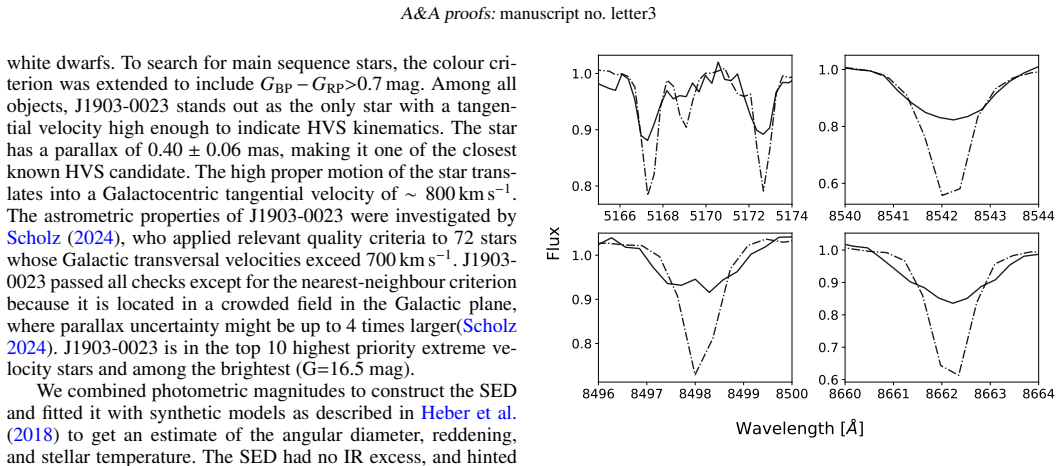
Many extreme velocity candidate stars have been found based on \textit{Gaia} astrometry, but need spectroscopic confirmation. We select late-type hypervelocity star (HVS) candidates from the \textit{Gaia} DR3 catalog with a $1\sigma$ lower limit of the tangential velocity of 800 km\,s$^{-1}$. J1903-0023, one of the brightest targets, stands out as high priority candidate for follow-up spectroscopy using the X-shooter instrument at ESO-VLT. We determine its atmospheric parameters and abundances utilizing synthetic spectral grids and a global $\chi^2-$minimization procedure, and its stellar parameters with the help of evolutionary tracks and the spectral energy distribution. The star shows variability in its light curve and follow-up spectroscopy confirms that the star is radial-velocity variable. The spectroscopic distance of J1903-0023 is lower than that based on the parallax, indicating that the star is not a hypervelocity binary star but bound to the Galaxy. The star turned out to be of spectral type F, very similar to the extreme-velocity star J0725-2351, which we analyse in the same way as the target. Apparently, both stars are very metal poor and old halo main-sequence (sdF) stars with masses slightly below the halo turn-off mass, and share the low metallicity ([Fe/H]=-2.3,-2.6) and strong alpha enhancement ([$\alpha$/Fe]$\sim0.44$). While J0725-2351 is non-rotating ($v\sin\,i<3$\,km\,s$^{-1}$), J1903-0023 is a fast rotator ($v\sin i=42.3\pm2.0$ km\,s$^{-1}$). The Gaia, and ZTF light curves show an eclipse at a 1.179 day period, similar to the rotation period of J1903-0023. We therefore conclude that J1903-0023 is a high-velocity tidally-synchronised binary most likely with a metal-poor M dwarf companion.
Figures


Figures from the paper (1 more)

Reference graph
Works this paper leans on
-
[1]
, " * write output.state after.block = add.period write newline
ENTRY address archiveprefix author booktitle chapter edition editor howpublished institution eprint journal key month note number organization pages publisher school series title type volume year label extra.label sort.label short.list INTEGERS output.state before.all mid.sentence after.sentence after.block FUNCTION init.state.consts #0 'before.all := #1 ...
-
[2]
write newline
" write newline "" before.all 'output.state := FUNCTION n.dashify 't := "" t empty not t #1 #1 substring "-" = t #1 #2 substring "--" = not "--" * t #2 global.max substring 't := t #1 #1 substring "-" = "-" * t #2 global.max substring 't := while if t #1 #1 substring * t #2 global.max substring 't := if while FUNCTION word.in bbl.in " " * FUNCTION format....
- [3]
- [4]
- [5]
- [6]
-
[7]
C., Kulkarni , S
Bellm , E. C., Kulkarni , S. R., Graham , M. J., et al. 2019, , 131, 018002
2019
-
[8]
Bonaca , A., Naidu , R. P., Conroy , C., et al. 2021, , 909, L26
work page 2021
Show all 63 references
-
[9]
2018, , 479, 2789
Boubert , D., Guillochon , J., Hawkins , K., et al. 2018, , 479, 2789
2018
-
[10]
C., Magnier , E
Chambers , K. C., Magnier , E. A., Metcalfe , N., et al. 2016, arXiv e-prints, arXiv:1612.05560
2016 arXiv
-
[11]
2016, , 823, 102
Choi , J., Dotter , A., Conroy , C., et al. 2016, , 823, 102
2016
-
[12]
E., Kochoska , A., Hey , D., et al
Conroy , K. E., Kochoska , A., Hey , D., et al. 2020 a , , 250, 34
2020
-
[13]
E., Kochoska , A., Hey , D., et al
Conroy , K. E., Kochoska , A., Hey , D., et al. 2020 b , , 250, 34
2020
-
[14]
M., Skrutskie , M
Cutri , R. M., Skrutskie , M. F., van Dyk , S., et al. 2003, VizieR Online Data Catalog: 2MASS All-Sky Catalog of Point Sources (Cutri+ 2003) , VizieR On-line Data Catalog: II/246. Originally published in: University of Massachusetts and Infrared Processing and Analysis Center...
2003
-
[15]
M., Wright , E
Cutri , R. M., Wright , E. L., Conrow , T., et al. 2021, VizieR Online Data Catalog: AllWISE Data Release (Cutri+ 2013) , VizieR On-line Data Catalog: II/328. Originally published in: IPAC/Caltech (2013)
2013
-
[16]
K., Yadav , R
Dattatrey , A. K., Yadav , R. K. S., Kumawat , G., et al. 2023, , 523, L58
2023
-
[17]
2016, , 222, 8
Dotter , A. 2016, , 222, 8
2016
-
[18]
Eggleton , P. P. 1983, , 268, 368
1983
-
[19]
J., Chandra , V., et al
El-Badry , K., Shen , K. J., Chandra , V., et al. 2023, The Open Journal of Astrophysics, 6, 28
2023
-
[20]
P., Barnes , R., Davenport , J
Fleming , D. P., Barnes , R., Davenport , J. R. A., & Luger , R. 2019, , 881, 88
2019
-
[21]
W., Lang , D., & Goodman , J
Foreman-Mackey , D., Hogg , D. W., Lang , D., & Goodman , J. 2013 a , , 125, 306
2013
-
[22]
W., Lang , D., & Goodman , J
Foreman-Mackey , D., Hogg , D. W., Lang , D., & Goodman , J. 2013 b , , 125, 306
2013
-
[23]
2022 a , VizieR Online Data Catalog: Gaia DR3 Part 1
Gaia Collaboration . 2022 a , VizieR Online Data Catalog: Gaia DR3 Part 1. Main source (Gaia Collaboration, 2022) , VizieR On-line Data Catalog: I/355. Originally published in: Astron. Astrophys., in prep. (2022)
2022
-
[24]
2022 b , VizieR Online Data Catalog: Gaia DR3 Part 4
Gaia Collaboration . 2022 b , VizieR Online Data Catalog: Gaia DR3 Part 4. Variability (Gaia Collaboration, 2022) , VizieR On-line Data Catalog: I/358. Originally published in: 2023A&A...674A...1G
2022
-
[25]
Gaia Collaboration , Vallenari , A., Brown , A. G. A., et al. 2023 a , , 674, A1
2023
-
[26]
Gaia Collaboration , Vallenari , A., Brown , A. G. A., et al. 2023 b , , 674, A1
2023
-
[27]
& Wyse , R
Hawkins , K. & Wyse , R. F. G. 2018, , 481, 1028
2018
-
[28]
2018, Open Astronomy, 27, 35
Heber , U., Irrgang , A., & Schaffenroth , J. 2018, Open Astronomy, 27, 35
2018
-
[29]
E., Jones , D., & Pr s a , A
Horvat , M., Conroy , K. E., Jones , D., & Pr s a , A. 2019, , 240, 36
2019
-
[30]
2018, , 620, A48
Irrgang , A., Kreuzer , S., & Heber , U. 2018, , 620, A48
2018
-
[31]
2014, , 565, A63
Irrgang , A., Przybilla , N., Heber , U., et al. 2014, , 565, A63
2014
-
[32]
2013, , 549, A137
Irrgang , A., Wilcox , B., Tucker , E., & Schiefelbein , L. 2013, , 549, A137
2013
-
[33]
Kurucz , R. L. 1996, in Astronomical Society of the Pacific Conference Series, Vol. 108, M.A.S.S., Model Atmospheres and Spectrum Synthesis, ed. S. J. Adelman , F. Kupka , & W. W. Weiss , 160
1996
-
[34]
W., Stefanik , R
Latham , D. W., Stefanik , R. P., Torres , G., et al. 2002, , 124, 1144
2002
-
[35]
D., Vanderburg , A., Gosnell , N
Leiner , E., Mathieu , R. D., Vanderburg , A., Gosnell , N. M., & Smith , J. C. 2019, , 881, 47
2019
-
[36]
2023, , 166, 12
Li , Q.-Z., Huang , Y., Dong , X.-B., et al. 2023, , 166, 12
2023
-
[37]
W., Hoare , M
Lucas , P. W., Hoare , M. G., Longmore , A., et al. 2008, , 391, 136
2008
-
[38]
& Gratton , R
Lucatello , S. & Gratton , R. G. 2003, , 406, 691
2003
-
[39]
F., Ibata , R
Martin , N. F., Ibata , R. A., Starkenburg , E., et al. 2022, , 516, 5331
2022
-
[40]
J., Laher , R
Masci , F. J., Laher , R. R., Rusholme , B., et al. 2019, , 131, 018003
2019
-
[41]
M., & Badenes , C
Moe , M., Kratter , K. M., & Badenes , C. 2019, , 875, 61
2019
-
[42]
E., et al
Mongui \'o , M., Greimel , R., Drew , J. E., et al. 2020, , 638, A18
2020
-
[43]
2024, , 532, 2875
Nelson , T., Hawkins , K., Reggiani , H., et al. 2024, , 532, 2875
2024
-
[44]
E., Amarsi , A
Nissen , P. E., Amarsi , A. M., Sk \'u lad \'o ttir , \'A ., & Schuster , W. J. 2024, , 682, A116
2024
-
[45]
2000, , 143, 23
Ochsenbein , F., Bauer , P., & Marcout , J. 2000, , 143, 23
2000
-
[46]
A., Wolf , C., Bessell , M
Onken , C. A., Wolf , C., Bessell , M. S., et al. 2024, , 41, e061
2024
-
[47]
2011, , 192, 3
Paxton , B., Bildsten , L., Dotter , A., et al. 2011, , 192, 3
2011
-
[48]
2013, , 208, 4
Paxton , B., Cantiello , M., Arras , P., et al. 2013, , 208, 4
2013
-
[49]
2015, , 220, 15
Paxton , B., Marchant , P., Schwab , J., et al. 2015, , 220, 15
2015
-
[50]
E., Horvat , M., et al
Pr s a , A., Conroy , K. E., Horvat , M., et al. 2016, , 227, 29
2016
-
[51]
& Zwitter , T
Pr s a , A. & Zwitter , T. 2005, , 628, 426
2005
-
[52]
P., Schlaufman , K
Reggiani , H., Ji , A. P., Schlaufman , K. C., et al. 2022, , 163, 252
2022
-
[53]
Scholz , R. D. 2024, , 685, A162
2024
-
[54]
D., Heber , U., Heuser , C., et al
Scholz , R. D., Heber , U., Heuser , C., et al. 2015, , 574, A96
2015
-
[55]
2010, , 403, 1829
Sch \"o nrich , R., Binney , J., & Dehnen , W. 2010, , 403, 1829
2010
-
[56]
J., Moreno , E., Nissen , P
Schuster , W. J., Moreno , E., Nissen , P. E., & Pichardo , B. 2012, , 538, A21
2012
-
[57]
V., & Sahu , S
Subramaniam , A., Pandey , S., Jadhav , V. V., & Sahu , S. 2020, Journal of Astrophysics and Astronomy, 41, 45
2020
-
[58]
2024, , 969, 8
Sun , M., Levina , S., Gossage , S., et al. 2024, , 969, 8
2024
-
[59]
& Martin , S
Terquem , C. & Martin , S. 2021, , 507, 4165
2021
-
[60]
E., et al
Virtanen, P., Gommers, R., Oliphant, T. E., et al. 2020, Nature Methods, 17, 261
2020
-
[61]
2000, , 143, 9
Wenger , M., Ochsenbein , F., Egret , D., et al. 2000, , 143, 9
2000
-
[62]
& Poleski , R
Wojtkowska , G. & Poleski , R. 2024, , 167, 225
2024
-
[63]
Zahn , J. P. & Bouchet , L. 1989, , 223, 112
1989
Reviewed August 6, 2026 · model on record in the stance chip above.
Discussion (0). Continue with ORCID to comment.