REVIEW 2 major objections 3 minor 37 references
Fixed-Effect Saturation Is Not Weak Identification: Certifying Inference under Measurement Error
T0 review · 2 major / 3 minor · reviewed 2026-08-07 · deepseek-v4-flash
Pith's one-line read Saturating a regression with fixed effects does not by itself create weak identification; classical measurement error in a continuous treatment does, and the paper derives the exact threshold.
desk verdict The theory is real and carefully done, but the lead applications run on a design that violates the paper's own saturation condition, so the empirical certificates are not formally supported. read the letter →
The pith
A machine-rendered reading of the paper's core claim, the machinery that carries it, and where it could break.
The reading
What carries the argument
The load-bearing object is the $(\rho,\tau^2)$ drift: $\rho = d_K/n$ is the share of sample dimensions consumed by fixed effects, and $\tau^2 = nQ_K$ rescales the residual treatment variance. Around it the paper builds a joint CLT for the score, Hessian, and error quadratic form, plus an attenuation lemma showing that projected signal and projected measurement noise both concentrate on $(1-\rho)$ times their unprojected limits under Condition (B). That common discount is what makes the within reliability $\lambda = \tau^2/(\tau^2+c^2)$ independent of $\rho$, and it converts the contaminated $t$-statistic into $N(\eta,1)$, leading to the closed-form threshold and the fixed-point breakdown reliability $\lambda^\dagger = t_*/(t_*+\eta^\dagger(\alpha,\delta))$.
What would settle it
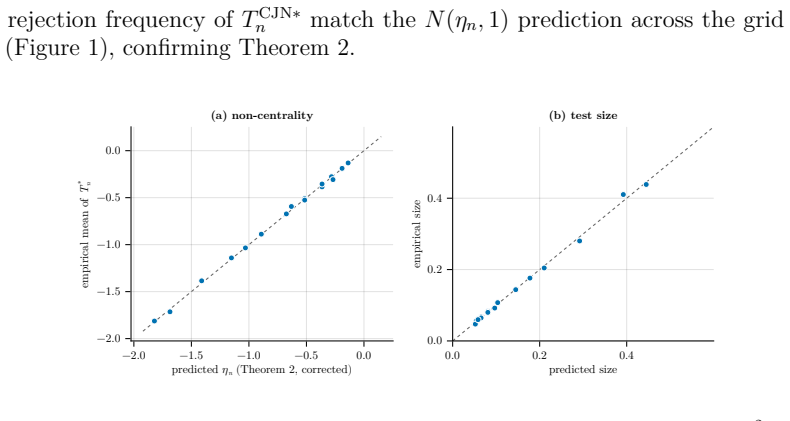
In a two-way fixed-effect design with known $\tau^2$, $c^2$, $\rho$, $\beta_0$, and $\sigma$, fix a finite noise variance that targets a within reliability $\lambda$ and simulate the nominal 5% $t$-test. The central claim fails if the empirical rejection rate departs from the exact non-central prediction $\alpha + \Phi(-z-\eta)+1-\Phi(z-\eta)$ by more than Monte Carlo error in the moderate regime $\lambda \ge 0.65$, or if the empirically located size-crossing $\tau^2$ disagrees with the closed-form threshold (8)/(9) beyond simulation accuracy.
Extended reading notes
Core claim
On the paper's own terms, the central discovery is Theorem 2: under the local measurement-error drift $\sigma_\nu^2 = c^2/n$, the fixed-effect OLS $t$-statistic for $H_0:\beta=\beta_0$ converges to $N(\eta,1)$ with $\eta = -\beta_0 c^2\sqrt{1-\rho}/(\sigma\sqrt{\tau^2+c^2})$, where $\tau^2 = nQ_K$ is the residual treatment variance and $\rho$ is the limiting fixed-effect dimension. Under the treatment-balance Condition (B), signal and noise lose the same $(1-\rho)$ fraction of their variance to the fixed effects, so the within reliability $\lambda = \tau^2/(\tau^2+c^2)$ is $\rho$-free and saturation enters only through the overall $\sqrt{1-\rho}$ scale. Inverting the leading quadratic size distortion gives a Stock–Yogo-style threshold $\tau^2_{\mathrm{crit}} = \beta_0^2 c^4(1-\rho)\,z\,\phi(z)/(\sigma^2\delta) - c^2$, and the feasible form $|\eta| = (|\beta_0|/\sigma)(1-\lambda)\sqrt{\tau^{*2}}$ turns the diagnostic into one inequality using regression output plus an external reliability pilot. The same non-centrality drives a cluster-robust version $\eta_{CR} = \eta/\sqrt{\psi}$, and a formal certificate replaces the coefficient pilot by an upper confidence bound to control false-certification probability. The scope is classical measurement error in a continuous regressor; applying the diagnostic to a mismeasured binary treatment is explicitly out of bounds.
Load-bearing premise
The weakest premise is treatment balance: within each fixed-effect cell the treatment deviations must have essentially the same variance, so that the fixed effects shrink the true signal and the measurement noise by the same fraction; if balance fails, the rho-free reliability threshold no longer follows, and the applications in the paper do not verify this condition before using the formula.
Editorial extensions
If this is right
- FE saturation alone—no measurement error, no other bias source—does not create a weak-instrument-like size problem; no residual-variance-dependent critical values are needed in the baseline model.
- With classical measurement error, conventional confidence intervals for the true coefficient can miss it at a non-central rate even when the t-test of no effect is correctly sized; the threshold governs magnitude inference, not significance.
- The cluster-robust diagnostic is the i.i.d. diagnostic run on the reported cluster-robust t-statistic, because the non-centrality rescales by 1/sqrt(psi) and the breakdown reliability is an exact sample identity.
- Certification needs only a lower bound on reliability while bias correction needs a point estimate, so validation studies that report reliability ranges are enough to run the diagnostic conservatively.
- In saturated designs the conventional CRVE small-sample factor must be omitted; keeping it over-corrects by an asymptotic factor 1/(1-rho).
Reading between the lines
- Editorial inference: if the rho-free reliability channel holds under replication, the same breakdown-reliability table could be precomputed for common fixed-effect structures and noisy regressors, letting readers audit published specifications from a printed t-statistic alone.
- Editorial inference: the paper leaves treatment balance as an open condition; a direct extension would derive the exact rho-dependence of the threshold when within-cell treatment variances are heterogeneous and check whether the tabulated breakdown reliability becomes anti-conservative in unbalanced designs.
- Editorial inference: the local-drift derivation pattern is portable to other bias sources the paper lists—heterogeneous two-way fixed-effect treatment effects, omitted nonlinearities, binary misclassification—but the paper itself warns that for binary misclassification the classical error assumption fails by construction and the diagnostic must not be applied.
- Editorial inference: because the verdict can reverse between i.i.d. and cluster-robust standard errors, a practical replication norm suggested by the paper is to report the variance-inflation factor (or the cluster-robust standard error) alongside the t-statistic, so the breakdown reliability can be recomputed under either assumption.
Editorial analysis
A structured set of objections, weighed in public.
Referee Report
Summary. The paper argues that fixed-effect saturation alone does not create a weak-identification problem: under strict exogeneity, FE-residualized OLS is unbiased and its t-statistic has an exact t distribution. Classical measurement error in a continuous treatment restores a bias, and under the local drift σν² = c²/n the FE-OLS t-statistic is shown to converge to a non-central normal with non-centrality η = −β0 c²√(1−ρ)/(σ√(τ²+c²)). The paper derives a closed-form threshold for τ², a feasible diagnostic based on the within reliability λ, a corrected pilot, a formal certificate with controlled false-certification probability, and a cluster-robust version. Simulations support the local-drift approximation, and two applications illustrate the diagnostic on a V-Dem democracy-growth panel and a PSID earnings panel.
Significance. If the stated conditions hold, the paper makes a substantive contribution: exact baseline t inference for FE-OLS, a clean local-drift analysis of measurement-error-induced attenuation, a feasible one-line diagnostic, an honest separation between a descriptive point pass and a conservative certificate, and a cluster-robust theory with explicit projection-compatibility conditions. The paper ships reproducible code and uses externally observable noise measures in the applications, which is a genuine strength. The main caveat is that the load-bearing ρ-free formulas require a saturation condition and a treatment-balance condition that are not verified in the applications.
major comments (2)
- [§2 (saturation) and §7.1–7.2] The formal results (Lemma 2, Theorem 2, Corollaries 3–4, Definition 1) are proved under the saturation condition that D_K spans all G_K-measurable functions, so that M_K E[X|G_K]=0 and X'M_K X = ξ'M_K ξ. The applications use additive country-and-year and person-and-year fixed effects on one-observation-per-cell panels. For such designs rank(D_K)=N+T−1, far below NT, and unless E[X|country, year] is exactly additive, M_K E[X|G_K] is nonzero. The conditional-mean quadratic form then contributes to the Hessian, the (1−ρ) discount is no longer common to signal and noise, and the formulas for λ, η, τ²_crit, and λ† are not formally established for the reported specifications. Protocol step 0 of Section 5.3 checks only that the regressor is continuous with classical error; it does not check saturation. This is load-bearing because the empirical verdicts in Tables 3 and 4 are the operational content of the paper. The applications need either a verification that E[X|G_K] is additive (or a bound on the omitted quadratic form), or an explicit statement that those rows are illustrative and outside the formal theorem. Section 9's limitation list does not acknowledge this gap.
- [§4.1–4.3 and Appendix A, Condition (B)] Lemma 2 and Theorem 2 rely on Condition (B) so that the signal and measurement-noise Hessians carry the same (1−ρ) trace discount, which is what makes the within reliability λ ρ-free. The applications do not report any check of (B1) or (B2), and the Section 5.3 protocol contains no such check. The simulations use X_it = s ε_it with i.i.d. noise, which satisfies (B1) by construction, so they cannot validate the applications. Without Condition (B) the non-centrality gains additional ρ-dependence, the threshold formula changes, and the tabulated breakdown reliability applies only to balanced designs. The paper should either provide a residual-conditional-variance and leverage diagnostic for the real regressors, or explicitly restrict the ρ-free claims and give the ρ-dependent extension for unbalanced designs.
minor comments (3)
- [§6.4, Table 2] The text claims that empirical size is invariant to n at fixed λn, but Table 2 reports each λn at only one n; please add paired rows with the same λn at both n=1000 and n=5000, or state explicitly that the invariance is visible only in Figure 2.
- [§5.2–5.3 and Definition 1] Corollary 4 carefully distinguishes the random observed quantity τ*²_n from its probability limit τ*², but Definition 1 and Table 1 use the same symbol family without a subscript; a brief reminder before Definition 1 would prevent confusion about which object enters the breakdown reliability.
- [§7.1] The abstract and Section 7.1 describe the democracy-growth panel as 'saturated', which conflicts with the Section 2 definition of saturation; 'two-way fixed-effect panel' would avoid implying that the formal saturation condition is satisfied.
Circularity Check
No significant circularity: the main derivation is self-contained, and the self-citations are descriptive and non-load-bearing.
full rationale
The paper's derivation chain is self-contained. Lemma 1 (joint CLT) and Lemma 2 (Hessian concentration and attenuation factor) are proved in Appendices A and B from Assumptions 1–2 and Conditions (B)–(C), rather than imported from the author's prior work. Theorem 2's non-centrality is assembled from those lemmas via a Lyapunov score CLT; Corollary 3 inverts the quadratic size expansion of the limit law; Corollary 4 is the algebraic substitution lambda = tau^2/(tau^2 + c^2); Definition 1 is the inversion of the feasible inequality (10); and Proposition 2 gives a coverage argument for the certificate. The simulations are stated as checks of these formulas with known DGP parameters, and the applications are explicitly labeled 'point pass' (descriptive) versus 'certificate,' with the finite-sample size column read ordinally. The only self-references, Halkiewicz (2026a) for the companion program and Halkiewicz (2026b) for the PanelAdequacy software, are programmatic or implementation citations and do not carry any load-bearing identification or distributional claim. Potential scope concerns, such as the full-saturation condition versus additive country/year fixed effects and the unverified Condition (B), are applicability or correctness issues rather than circular reductions of outputs to inputs.
Assumptions & free parameters
assumptions (7)
- domain assumption Classical measurement error: X* = X + nu with nu independent of (X,u), mean zero, and variance sigma_nu^2.
- domain assumption Treatment balance Condition (B): within-cell treatment deviations have equal conditional variance (B1) or bounded variance plus uniform leverage (B2).
- domain assumption Local measurement-error drift sigma_nu^2 = c^2/n.
- domain assumption Saturated fixed effects: the FE dummies span G_K-measurable functions, so M_K E[X|G_K] = 0.
- domain assumption Conditional homoskedasticity and independence u independent of X given G_K for the i.i.d. Theorem 2.
- domain assumption Cluster regularity: many clusters, bounded cluster sizes, no dominant cluster, and projection compatibility for the cluster-robust results.
- standard math Standard CLT, Chebyshev, quadratic-form concentration, and Frisch-Waugh-Lovell theorem.
Cite this review
Pith. "Pith review of Fixed-Effect Saturation Is Not Weak Identification: Certifying Inference under Measurement Error." pith.science (2026). https://pith.science/paper/BKPIW2UK
@misc{pith2026260806053,
  author       = {Pith},
  title        = {Pith review of: Fixed-Effect Saturation Is Not Weak Identification: Certifying Inference under Measurement Error},
  year         = {2026},
  howpublished = {\url{https://pith.science/paper/BKPIW2UK}},
  note         = {Machine review of arXiv:2608.06053}
}
abstract
Fixed-effect saturation alone is not weak identification: in the baseline model, fixed-effect--residualized OLS is unbiased and conventional inference is asymptotically exact for every residual treatment variance $\tau^2=nQ_K>0$. Classical measurement error in the treatment restores it, and we derive Stock--Yogo-style critical values for $\tau^2$. Under the local drift $\sigma_\nu^2 = c^2/n$, attenuation produces a non-central limit whose non-centrality $\eta$ decreases in $\tau^2$ and, under a treatment-balance condition, depends on the fixed-effect dimension $\rho$ only through an overall $\sqrt{1-\rho}$ scaling, leaving the within reliability $\rho$-free. Inverting the leading quadratic size distortion gives a closed-form threshold; the breakdown reliability has a fixed-point form in the reported $t$-statistic alone. The diagnostic needs only a lower bound on reliability, where bias correction needs a point estimate. We separate a descriptive \emph{point pass} from a \emph{formal certificate}, evaluated at an upper confidence bound and carrying false-certification probability at most $\gamma$. A cluster-level score CLT and Arellano-variance consistency under a checkable projection-compatibility condition yield $\eta_{CR}=\eta/\sqrt{\psi}$. Simulations confirm the threshold; in a saturated democracy--growth panel, aggregate V-Dem polyarchy is certified at $\gamma=0.05$ while its judicial-constraints sub-index is flagged under i.i.d.\ and clustered errors. The diagnostic covers classical error in a continuous regressor, \emph{not} binary-treatment misclassification.
Figures


Figures from the paper (1 more)

Reference graph
Works this paper leans on
-
[1]
author Abowd, J.M. , author Kramarz, F. , author Margolis, D.N. , year 1999 . title High wage workers and high wage firms . journal Econometrica volume 67 , pages 251--333
work page 1999
-
[2]
author Abramowitz, M. , author Stegun, I.A. , year 1972 . title Handbook of Mathematical Functions with Formulas, Graphs, and Mathematical Tables . edition 10th ed., publisher Dover Publications , address New York
work page 1972
-
[3]
author Acemoglu, D. , author Naidu, S. , author Restrepo, P. , author Robinson, J.A. , year 2019 . title Democracy does cause growth . journal Journal of Political Economy volume 127 , pages 47--100
work page 2019
-
[4]
author Aigner, D.J. , year 1973 . title Regression with a binary independent variable subject to errors of observation . journal Journal of Econometrics volume 1 , pages 49--59 . :10.1016/0304-4076(73)90005-5
-
[5]
author Anderson, T.W. , author Rubin, H. , year 1949 . title Estimation of the parameters of a single equation in a complete system of stochastic equations . journal Annals of Mathematical Statistics volume 20 , pages 46--63
work page 1949
-
[6]
author Andrews, I. , author Stock, J.H. , author Sun, L. , year 2019 . title Weak instruments in instrumental variables regression: Theory and practice . journal Annual Review of Economics volume 11 , pages 727--753
work page 2019
-
[7]
author Arellano, M. , year 1987 . title Computing robust standard errors for within-groups estimators . journal Oxford Bulletin of Economics and Statistics volume 49 , pages 431--434
work page 1987
-
[8]
author Bertrand, M. , author Duflo, E. , author Mullainathan, S. , year 2004 . title How much should we trust differences-in-differences estimates? journal Quarterly Journal of Economics volume 119 , pages 249--275
work page 2004
Show all 37 references
-
[9]
, year 1996
author Bollinger, C.R. , year 1996 . title Bounding mean regressions when a binary regressor is mismeasured . journal Journal of Econometrics volume 73 , pages 387--399 . :10.1016/S0304-4076(95)01730-5
1996 doi
-
[10]
, author Brown, C
author Bound, J. , author Brown, C. , author Duncan, G.J. , author Rodgers, W.L. , year 1994 . title Evidence on the validity of cross-sectional and longitudinal labor market data . journal Journal of Labor Economics volume 12 , pages 345--368
1994
-
[11]
, author Brown, C
author Bound, J. , author Brown, C. , author Mathiowetz, N. , year 2001 . title Measurement error in survey data , in: editor Heckman, J.J. , editor Leamer, E.E. (Eds.), booktitle Handbook of Econometrics . publisher Elsevier , address Amsterdam . volume volume 5 . chapter cha...
2001
-
[12]
, author Krueger, A.B
author Bound, J. , author Krueger, A.B. , year 1991 . title The extent of measurement error in longitudinal earnings data: Do two wrongs make a right? journal Journal of Labor Economics volume 9 , pages 1--24
1991
-
[13]
, author Miller, D.L
author Cameron, A.C. , author Miller, D.L. , year 2015 . title A practitioner's guide to cluster-robust inference . journal Journal of Human Resources volume 50 , pages 317--372
2015
-
[14]
, author Romano, J.P
author Canay, I.A. , author Romano, J.P. , author Shaikh, A.M. , year 2017 . title Randomization tests under an approximate symmetry assumption . journal Econometrica volume 85 , pages 1013--1030 . :10.3982/ECTA13081
2017 doi
-
[15]
, year 1996
author Card, D. , year 1996 . title The effect of unions on the structure of wages: A longitudinal analysis . journal Econometrica volume 64 , pages 957--979
1996
-
[16]
, author Jansson, M
author Cattaneo, M.D. , author Jansson, M. , author Newey, W.K. , year 2018 . title Inference in linear regression models with many covariates and heteroscedasticity . journal Journal of the American Statistical Association volume 113 , pages 1350--1361
2018
-
[17]
, author D'Haultf uille, X
author de Chaisemartin, C. , author D'Haultf uille, X. , year 2020 . title Two-way fixed effects estimators with heterogeneous treatment effects . journal American Economic Review volume 110 , pages 2964--2996
2020
-
[18]
, author Cornish, E.A
author Fisher, R.A. , author Cornish, E.A. , year 1960 . title The percentile points of distributions having known cumulants . journal Technometrics volume 2 , pages 209--225
1960
-
[19]
, author Waugh, F.V
author Frisch, R. , author Waugh, F.V. , year 1933 . title Partial time regressions as compared with individual trends . journal Econometrica volume 1 , pages 387--401
1933
-
[20]
, author Hausman, J.A
author Griliches, Z. , author Hausman, J.A. , year 1986 . title Errors in variables in panel data . journal Journal of Econometrics volume 31 , pages 93--118
1986
-
[21]
, year 2026 a
author Halkiewicz, S.M.S. , year 2026 a. title Exact inference in fixed-effect regressions with concentrated identifying variation . note Working paper, Jagiellonian University
2026
-
[22]
, year 2026 b
author Halkiewicz, S.M.S. , year 2026 b. title PanelAdequacy : Inference-adequacy diagnostics for fixed-effect panel designs . note Software. Julia package PanelAdequacy.jl , version 0.5.1, doi:10.5281/zenodo.21797815 https://doi.org/10.5281/zenodo.21797815; R package panelcer...
2026 doi
-
[23]
, author M\"uller, U.K
author Ibragimov, R. , author M\"uller, U.K. , year 2010 . title t-statistic based correlation and heterogeneity robust inference . journal Journal of Business & Economic Statistics volume 28 , pages 453--468 . :10.1198/jbes.2009.08046
2010 arXiv
-
[24]
, year 2022
author Jochmans, K. , year 2022 . title Heteroscedasticity-robust inference in linear regression models with many covariates . journal Journal of the American Statistical Association volume 117 , pages 887--896
2022
-
[25]
, year 1987
author de Jong, P. , year 1987 . title A central limit theorem for generalized quadratic forms . journal Probability Theory and Related Fields volume 75 , pages 261--277
1987
-
[26]
, author Saggio, R
author Kline, P. , author Saggio, R. , author S lvsten, M. , year 2020 . title Leave-out estimation of variance components . journal Econometrica volume 88 , pages 1859--1898
2020
-
[27]
, author McCrary, J
author Lee, D.S. , author McCrary, J. , author Moreira, M.J. , author Porter, J. , year 2022 . title Valid t -ratio inference for IV . journal American Economic Review volume 112 , pages 3260--3290
2022
-
[28]
, year 1963
author Lovell, M.C. , year 1963 . title Seasonal adjustment of economic time series and multiple regression analysis . journal Journal of the American Statistical Association volume 58 , pages 993--1010
1963
-
[29]
, year 2008
author Lovell, M.C. , year 2008 . title A simple proof of the FWL theorem . journal Journal of Economic Education volume 39 , pages 88--91
2008
-
[30]
, author Nielsen, M
author MacKinnon, J.G. , author Nielsen, M. . , author Webb, M.D. , year 2023 . title Cluster-robust inference: A guide to empirical practice . journal Journal of Econometrics volume 232 , pages 272--299
2023
-
[31]
, author Pflueger, C
author Montiel Olea, J.L. , author Pflueger, C. , year 2013 . title A robust test for weak instruments . journal Journal of Business & Economic Statistics volume 31 , pages 358--369
2013
-
[32]
, year 2003
author Moreira, M.J. , year 2003 . title A conditional likelihood ratio test for structural models . journal Econometrica volume 71 , pages 1027--1048
2003
-
[33]
, author Meserve, S.A
author Pemstein, D. , author Meserve, S.A. , author Melton, J. , year 2010 . title Democratic compromise: A latent variable analysis of ten measures of regime type . journal Political Analysis volume 18 , pages 426--449
2010
-
[34]
, year 2016
author Schennach, S.M. , year 2016 . title Recent advances in the measurement error literature . journal Annual Review of Economics volume 8 , pages 341--377
2016
-
[35]
, author Stock, J.H
author Staiger, D. , author Stock, J.H. , year 1997 . title Instrumental variables regression with weak instruments . journal Econometrica volume 65 , pages 557--586
1997
-
[36]
, author Yogo, M
author Stock, J.H. , author Yogo, M. , year 2005 . title Testing for weak instruments in linear IV regression , in: editor Andrews, D.W.K. , editor Stock, J.H. (Eds.), booktitle Identification and Inference for Econometric Models: Essays in Honor of Thomas Rothenberg . publish...
2005
-
[37]
, year 2020
author Verdier, V. , year 2020 . title Estimation and inference for linear models with two-way fixed effects and sparsely matched data . journal The Review of Economics and Statistics volume 102 , pages 1--16
2020
Reviewed August 7, 2026 · model on record in the stance chip above.
Discussion (0). Continue with ORCID to comment.