REVIEW 3 major objections 4 minor 25 references
Newtonian orbits of nanoparticles interacting with structured light beams
T0 review · 3 major / 4 minor · reviewed 2026-08-14 · deepseek-v4-flash
Pith's one-line read In cylindrical vector beams the scattering forces vanish exactly, leaving only the gradient force, so a nanoparticle oscillates in a stable orbit around the intensity maximum.
desk verdict Useful LG-vortex force derivations, but the headline CV zero-scattering result rests on first-order Lax truncation and the numerics are underreported. read the letter →
The pith
A machine-rendered reading of the paper's core claim, the machinery that carries it, and where it could break.
The reading
What carries the argument
The central object is the cylindrical vector beam, built as a collinear superposition of two optical vortices of opposite topological charge and opposite circular polarization, $E_{\mathrm{CV},t} = (U_\ell \hat{c}_+ + e^{i\delta}U_{-\ell}\hat{c}_-)/\sqrt{2}$. The argument runs through the dipole-approximation force decomposition (Eq. 1) into gradient, radiation-pressure, and curl terms; the longitudinal field components are obtained from the transverse fields by a perturbative series (Eq. 4). The exact cancellation for CV beams follows from the structure of the products of the polarization coefficients: the combination $\tau_j^*\tau_k$ is purely imaginary for $j\neq k$ while $\nabla U_0$ is real, so the expressions for $F_{\mathrm{RP}}$ and $F_C$ are purely imaginary and vanish after taking the real part. This mechanism is what converts a nominally non-conservative system into one governed only by the conservative gradient force.
What would settle it
Measure the trajectory of a subwavelength dielectric sphere in a radially polarized beam at low pressure: the claimed exact cancellation predicts a stable closed orbit around the intensity ring, so any clear outward spiral or azimuthal deflection would disprove the zero-scattering-force result. A complementary check is to compute the force on a particle of radius $a=\lambda/10$ in the same beam using a full electromagnetic scattering calculation and see whether the transverse scattering force is actually zero.
Extended reading notes
Core claim
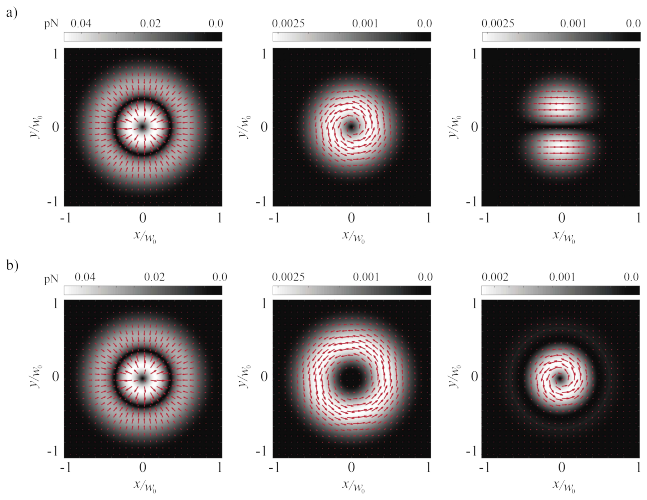
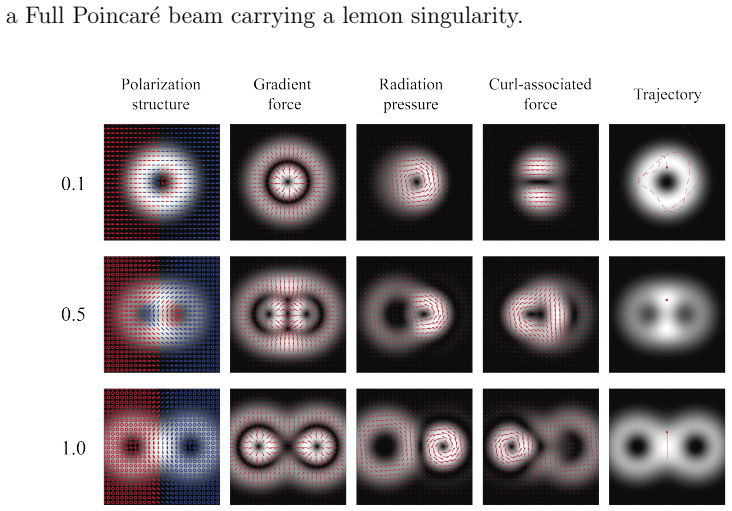
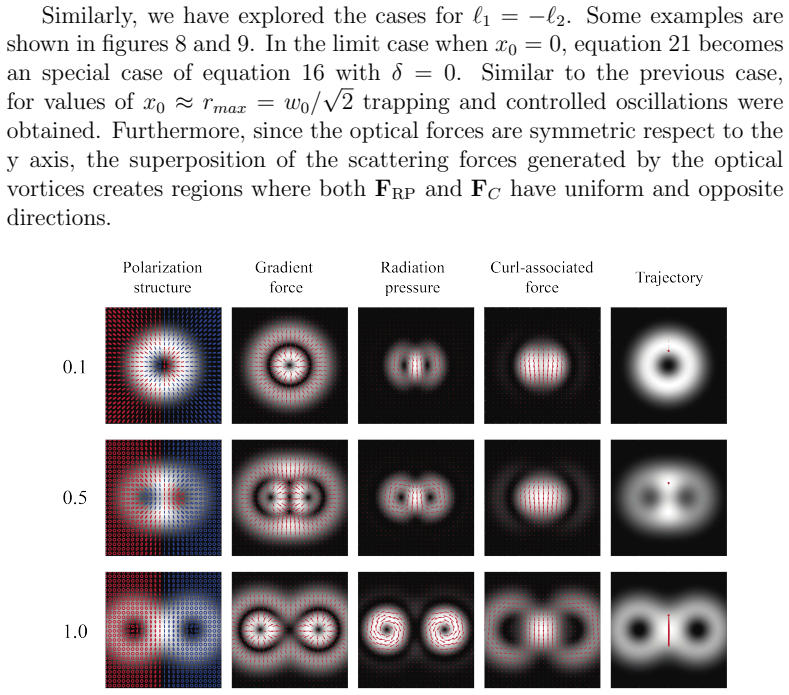
Under the dipole approximation, the transverse optical force on a subwavelength particle in a single-ringed Laguerre-Gauss beam with uniform polarization is a sum of the gradient force $F_G = \tfrac{1}{2}\mathrm{Re}[\alpha]|U_\ell|^2(|\ell|/r-2r/w_0^2)\hat{r}$ and polarization-dependent radiation-pressure and curl-force terms. The paper shows that these scattering terms are always present except for a fundamental Gaussian beam with uniform linear polarization, so the particle follows an open outward trajectory no matter how strong the gradient force is, matching the known behavior of curl forces with rotational symmetry. For cylindrical vector beams, the paper proves analytically that both scattering terms vanish exactly, $F_{\mathrm{RP}}=0$ and $F_C=0$, independent of topological charge and of the relative phase between the circular components. Since only the gradient force survives, the nanoparticle oscillates about the intensity maximum in a stable closed orbit. In Full Poincaré beams, a central flat-top region has nearly zero gradient force; a star singularity has cylindrically symmetric scattering forces and gives spiral expulsion, while a lemon singularity breaks that symmetry and gives open non-spiral trajectories. For off-axis superpositions of two vortices with charges of equal magnitude, stable trapping and controlled oscillations occur at a vortex separation $x_0\approx w_0/\sqrt{2}$.
Load-bearing premise
The entire result hangs on the dipole-approximation force formula of Eq. 1, especially the curl-force term that models the force from the spin angular momentum of the light; if that term is incomplete or the particle is not small enough, the exact vanishing of scattering forces in cylindrical vector beams would not hold.
Editorial extensions
If this is right
- A uniformly polarized Laguerre-Gauss vortex always expels the particle through non-conservative scattering forces, so stable trapping with such beams requires counteracting or canceling those terms.
- Cylindrical vector beams offer a polarization route to stable gradient-only trapping of subwavelength particles, with no radiation pressure or curl force to drive them away.
- The handedness of circular polarization relative to the orbital angular momentum of a vortex controls whether the radiation pressure and curl force form one or two rings of force.
- Full Poincaré beams with star singularities give laboratory-realizable spiral dynamics of the kind predicted for symmetrically distributed curl forces.
- Two-vortex beams trap particles when the vortices are separated by about $w_0/\sqrt{2}$, even though the same field configuration is unstable at zero separation.
Reading between the lines
- The authors do not draw this implication, but if the exact cancellation survives Brownian motion and finite-size corrections, cylindrical vector beams become a natural platform for low-noise optical traps in vacuum, since the missing scattering forces remove a non-conservative heating channel.
- A direct test the paper does not propose: compare the transverse motion of the same nanoparticle in a radially polarized beam and in an equally intense uniformly polarized vortex; the former should show no azimuthal scattering force, while the latter should show the azimuthal component that drives expulsion.
- The same cancellation argument should extend to other balanced superpositions of a vortex and its opposite-charge counterpart with opposite circular polarizations, giving a family of scattering-free structured beams beyond radially and azimuthally polarized ones.
- The spiral handedness observed in star Full Poincaré beams should reverse when the singularity handedness is flipped, a checkable prediction with the same optical setup.
Signed reviews
Editorial analysis
A structured set of objections, weighed in public.
Referee Report
Summary. The manuscript studies the Newtonian dynamics of a Rayleigh nanoparticle driven by optical forces in paraxial structured light beams. The force model (Eq. 1) includes gradient, radiation-pressure, and spin-curl terms. Analytic expressions are derived for the transverse forces of a single Laguerre-Gaussian vortex with arbitrary uniform polarization (Eqs. 9-11). Numerical integrations then map particle orbits for LG vortices, cylindrical-vector (CV) beams, Full-Poincaré beams, and off-axis superpositions of two vortices. The main claims are: (i) vortices expel particles for essentially all polarizations, regardless of trapping strength; (ii) for CV beams the scattering forces vanish exactly, leaving a conservative gradient force and stable oscillations around the intensity ring; (iii) Full-Poincaré beams with a star singularity produce spiral trajectories while lemon singularities do not; (iv) off-axis composite vortices trap particles near x0 ≈ w0/√2.
Significance. The paper connects the Berry-Shukla curl-force dynamics to concrete, experimentally realizable beams and provides closed-form force expressions for LG vortices that are not easily found in the literature. The qualitative predictions—expulsion from vortices, spiral orbits for star Full-Poincaré beams, and conservative dynamics for CV beams—are falsifiable and could guide experiments on optical manipulation in vacuum. The work uses no fitted parameters: all force expressions follow from the standard dipole formula and the paraxial field model. The main caveats are the first-order paraxial treatment of longitudinal fields and the absence of quantitative simulation parameters.
major comments (3)
- [Sec. 5.1, Eqs. (18)-(19) and Fig. 4] The central claim that scattering forces in CV beams vanish independently of topological charge and relative phase δ is derived using Eq. (4), the first term of the Lax expansion. For the field in Eq. (17), at z=0 the transverse field is, up to a global phase, a real vector field; hence the bracketed quantities in Eqs. (18) and (19) are purely imaginary and their real parts vanish. This is a property of the first-order truncation, not a symmetry theorem for the exact Maxwell field. At the next order of the Lax expansion the transverse field acquires an imaginary correction and the longitudinal field a real correction, so the same argument no longer applies; residual radiation-pressure and curl forces are generically nonzero, though small. Since the stable-orbit conclusion and the contrast with vortex expulsion rest on the exact vanishing, the authors should either compute the next-order corrections and show that they cancel, or state the result as approximate and estimate the residual forces.
- [Abstract and Sec. 4, Fig. 3(c)] The abstract claims that the particle is expelled from the beam independent of the gradient force intensity if some of the scattering forces have cylindrical symmetry, and presents this as a numerical result. The scan shown in Fig. 3(c) varies the polarization angles θ and β and the initial condition, but does not vary the gradient-force magnitude relative to the scattering forces (e.g., by changing Re[α], beam power, or particle size). The independence is a theorem from Berry and Shukla [14], not something the simulations demonstrate. Add a parameter scan or reattribute the claim to the cited theory.
- [Secs. 3 and 6, numerical method] No values are given for the particle mass m, polarizability α, beam waist w0, beam power, or the time units used in the Verlet/Runge-Kutta integration. Consequently the trajectories in Figs. 3-9 and the quantitative statements such as trapping and controlled oscillations for x0 ≈ w0/√2 cannot be reproduced or checked. The authors should provide the dimensionless scaling, all material and beam parameters, and the integration parameters.
minor comments (4)
- [Eq. (16) and Table 1] The circular polarization basis is written as c± = x ± i y without normalization and with a sign convention that appears to disagree with the usual c+ = (x + i y)/√2; please clarify, since the coefficient in Eq. (17) depends on this convention.
- [Eq. (1)] The coefficient of the curl-force term is typeset as σ/2 ε0 k Re[i(E·∇)E*], which is ambiguous; write it as a single fraction and check the normalization against Ref. [7].
- [Sec. 4] The statement that scattering forces are always present in homogeneously-polarized LG beams except for β = l = 0 is stronger than the abstract's qualification about cylindrical symmetry; for a generic linear polarization the total scattering force is not cylindrically symmetric, so the wording should be aligned.
- [Sec. 3] The paper says the Verlet algorithm was validated with a fourth-order Runge-Kutta method, but no convergence or error tolerances are reported; a sentence on the accuracy of the trajectories would help.
Circularity Check
No significant circularity; the CV zero-scattering result is a derived algebraic consequence of the stated paraxial model, and the self-citations are minor and non-load-bearing.
full rationale
The paper's central derivations are self-contained. Equation (1) is the standard dipole force expression cited to Albaladejo et al. [7], and Eq. (4) is the first-order Lax longitudinal field taken from Lax et al. [22]. The analytical force expressions for LG beams (Eqs. 9-11) follow by substitution from those inputs, and the CV-beam zero-scattering result (Eqs. 18-19) follows algebraically from the fact that, at z = 0, the transverse CV field is real up to a global phase, so the bracketed quantities are purely imaginary and Re[i(real)] = 0. No parameter is fitted, and no prediction is introduced by definitional identity or by renaming an input. The expulsion and spiral dynamics are interpreted through Berry and Shukla's independent curl-force theory [14], rather than being derived from it as an assumption. The self-citations are minor: [20] supplies a numerical toolbox and a numerical confirmation, and [25] provides background on polarization singularities; neither is load-bearing for the analytical claims. The skeptic's concern that higher-order Lax corrections may reintroduce scattering forces is a scope-of-approximation question about the paraxial model, not a circularity, because the paper explicitly bases its calculation on the first-order Lax relation Eq. (4).
Assumptions & free parameters
free parameters (4)
- Particle mass m =
not specified
- Particle polarizability α (real and imaginary parts) =
not specified
- Beam waist w0 and beam power (field normalization) =
not specified
- Integration time and time step =
not specified
assumptions (3)
- domain assumption Dipole approximation force expression (Eq. 1) is valid for subwavelength particles.
- domain assumption Paraxial description with Lax-series longitudinal components (Eq. 4) correctly captures transverse radiation pressure.
- domain assumption Brownian motion and other medium interactions are negligible.
Cite this review
Pith. "Pith review of Newtonian orbits of nanoparticles interacting with structured light beams." pith.science (2026). https://pith.science/paper/BL357LQD
@misc{pith2026190803798,
  author       = {Pith},
  title        = {Pith review of: Newtonian orbits of nanoparticles interacting with structured light beams},
  year         = {2026},
  howpublished = {\url{https://pith.science/paper/BL357LQD}},
  note         = {Machine review of arXiv:1908.03798}
}
read the original abstract
We perform numerical analysis to study the orbits described by subwavelength size particles interacting with structured light beams. Our solution to the particle dynamics considers: (i) the gradient force, (ii) the radiation pressure, and (iii) the force from the curl of the spin angular momentum. The last two terms, (ii) and (iii), constitute the scattering forces. The optical structures of interest are vortices, vector, and Full-Poincar\'{e} beams. From our numerical results, we show that the particle is expelled from the beam, independent of the gradient force intensity if some of the scattering forces have cylindrical symmetry. Furthermore, we found spiral orbits for some particular conditions and types of Full-Poincare beams.
Figures


Figures from the paper (6 more)



Reference graph
Works this paper leans on
-
[14]
Berry M V and Shukla P 2013 Physical curl forces: dipole dynamics near optical vortices Journal of Physics A: Mathematical and Theoretical 46 422001
work page 2013
-
[1]
Ashkin A 1970 Acceleration and Trapping of Particles by Radiation Pressure Phys. Rev. Lett. 24 156–9
work page 1970
-
[2]
MacDonald M P, Spalding G C and Dholakia K 2003 Microfluidic sorting in an optical lattice Nature 426 421–4
work page 2003
-
[3]
Lehmuskero A, Johansson P, Rubinsztein-Dunlop H, Tong L and Kll M 2015 Laser Trapping of Colloidal Metal Nanoparticles ACS Nano 9 3453-69
work page 2015
-
[4]
Ayala Y A, Arzola A V and Volke-Sep´ ulveda K 2016 Comparative study of optical levitation traps: focused Bessel beam versus Gaussian beams J. Opt. Soc. Am. B 33 1060–67 17
work page 2016
-
[5]
Dhakal K R and Lakshminarayanan V 2018 Optical Tweezers: Fun- damentals and Some Biophysical Applications Progress in Optics 63 31
work page 2018
-
[6]
2017 Roadmap on structured light J
Rubinsztein-Dunlop H et al. 2017 Roadmap on structured light J. Op- tics 19 013001
work page 2017
-
[7]
Albaladejo S, Marqu´ es M I, Laroche M and S´ aenz J J 2009 Scattering Forces from the Curl of the Spin Angular Momentum of a Light Field Phys. Rev. Lett. 102 113602
work page 2009
Show all 25 references
-
[8]
express 20 11351–56
Angelsky O V, Bekshaev A Y, Maksimyak P P, Maksimyak a P, Mokhun I I, Hanson S G, Zenkova C Y and Tyurin a V 2012 Circular motion of particles suspended in a Gaussian beam with circular polarization validates the spin part of the internal energy flow Opt. express 20 11351–56
2012
-
[9]
Express 20 3563–71
Angelsky O V, Bekshaev A Y, Maksimyak P P, Maksimyak A P, Hanson S G and Zenkova C Y 2012 Orbital rotation without orbital angular momentum: mechanical action of the spin part of the internal energy flow in light beams Opt. Express 20 3563–71
2012
-
[10]
Zapata I, Delgado-Buscalioni R and S´ aenz J J 2016 Control of diffusion of nanoparticles in an optical vortex lattice Phys. Rev. E 93 062130
2016
-
[11]
9 3527–31
Albaladejo S, Marqu´ es M I, Scheffold F and S´ aenz J J 2009 Giant En- hanced Diffusion of Gold Nanoparticles in Optical Vortex Fields Nano Lett. 9 3527–31
2009
-
[12]
Berry M V and Shukla P 2016 Curl force dynamics: Symmetries, chaos and constants of motion New Journal of Physics 18 063018
2016
-
[13]
Berry M V and Shukla P 2012 Classical dynamics with curl forces, and motion driven by time-dependent flux Journal of Physics A 45 305201
2012
-
[15]
Berry M V and Shukla P 2015 Hamiltonian curl forces Proc. R. Soc. A 471 20150002 18
2015
-
[16]
Reimann R, Doderer M, Hebestreit E, Diehl R, Frimmer M, Windey D, Tebbenjohanns F and Novotny L 2018 GHz Rotation of an Optically Trapped Nanoparticle in Vacuum Phys. Rev. Lett. 121 033602
2018
-
[17]
Allen L, Beijersbergen M, Spreeuw R and Woerdman J 1992 Orbital an- gular momentum of light and the transformation of Laguerre-Gaussian laser modes Phys. Rev. A 45 8185–9
1992
-
[18]
Zhan Q 2009 Cylindrical vector beams: from mathematical concepts to applications Advances in Optics and Photonics 1 1–57
2009
-
[19]
Express 18 10777–85
Beckley A M, Brown T G and Alonso M A 2010 Full Poincar´ e beams Opt. Express 18 10777–85
2010
-
[20]
Ferrer-Garcia M F and Lopez-Mago D 2018 Computational toolbox to calculate the dynamics of nanometer-size particles interacting with structured light beams Proc.SPIE 10723 10723
2018
-
[21]
Carnicer A, Juvells I, Maluenda D, Mart´ ınez-Herrero R and Mej´ ıas P M 2012 On the longitudinal component of paraxial fields European Journal of Physics 33 1235–1247
2012
-
[22]
Lax M, Louisell W H and McKnight W B 1975 From Maxwell to paraxial wave optics Phys. Rev. A 11 1365–70
1975
-
[23]
Divitt S, Rondin L and Novotny L 2015 Cancellation of non-conservative scattering forces in optical traps by counter-propagating beams Opt. Lett. 40 1900–3
2015
-
[24]
Express 20 20814–26
Wang L 2012 Optical forces on submicron particles induced by full Poincar´ e beamsOpt. Express 20 20814–26
2012
-
[25]
Lopez-Mago D, Perez-Garcia B, Yepiz A, Hernandez-Aranda R I and Guti´ errez-Vega J C 2013 Dynamics of polarization singularities in com- posite optical vortices J. Opt. 15 044028 19
2013
Reviewed August 14, 2026 · model on record in the stance chip above.
Discussion (0). Continue with ORCID to comment.