REVIEW 4 major objections 4 minor 69 references
From Hitchin Systems to Rational Elliptic Surfaces with C*-actions via Orbifold Hilbert Schemes
T0 review · 4 major / 4 minor · reviewed 2026-08-04 · deepseek-v4-flash
Pith's one-line read The four affine Dynkin Hitchin systems are compactified by orbifold Hilbert schemes to rational elliptic surfaces with C*-actions, each a blow-up of the second Hirzebruch surface.
desk verdict A genuinely useful construction for the D4, E6, and E7 cases, with general orbifold Hilbert scheme theorems that stand on their own; the E8 case is missing its proof, and the Hitchin-system identification leans on an unverified preprint, so it is a conditional accept rather than a finished paper. read the letter →
The pith
A machine-rendered reading of the paper's core claim, the machinery that carries it, and where it could break.
The reading
What carries the argument
The central object is the orbifold Hilbert scheme $\mathrm{Hilb}^1(P(T^\vee_{X_i}\oplus O_{X_i}))$, where $X_i=[E_i/\mu_i]$ is the quotient stack of an elliptic curve by a cyclic group; this scheme is the compactification of the Hitchin system $M(i)$. The Hilbert-Chow morphism $h_i$ maps it to the GIT quotient $P(T^\vee E_i\oplus O_{E_i})/\mu_i$ and provides a minimal Poisson resolution. The identification of each $\tilde{X}_i$ with a blow-up of the second Hirzebruch surface is carried out case-by-case by tracking strict transforms and exceptional curves under a sequence of blow-downs, using the configuration of curves determined by the singular fibers of the two natural fibrations.
What would settle it
Compute the $C^*$-action on a generic fiber of $\pi_i:\tilde{X}_i\to P^1$ and compare its weights with the known scaling action on the corresponding Higgs bundles; a mismatch in the weights, or a mismatch in the fixed-point loci over the singular fibers, would disprove the compatibility claim (Theorem 1.4(1)) and thus the identification of the compactification with the Hitchin system's compactification.
Extended reading notes
Core claim
The central result is Theorem 1.5: for $i = 2,3,4,6$, the compactification $\tilde{X}_i = \mathrm{Hilb}^1(P(T^\vee_{X_i}\oplus O_{X_i}))$ is a rational elliptic surface with $C^*$-action, whose fibration $\pi_i:\tilde{X}_i\to P^1$ has singular fibers only over $0$ and $\infty$, of types summarized in Table 1. Each $\tilde{X}_i$ is isomorphic to an iterated blow-up of the second Hirzebruch surface (Propositions 6.8, 6.11, 6.14, 6.17), and the Hitchin system $M(i)$ is isomorphic to $\tilde{X}_i$ with the fiber over $\infty$ removed. In addition, the paper proves that $\mathrm{Hilb}^n(X)$ for an orbifold surface $X$ is a smooth connected projective scheme, and that the Hilbert-Chow morphism $\mathrm{Hilb}^1(X)\to X$ is the minimal resolution of singularities and a Poisson r...
Load-bearing premise
The identification of the Hilbert-scheme compactification with the Hitchin system's own compactification assumes that the natural $C^*$-action and Poisson structure on the Hilbert scheme agree with the $C^*$-action and symplectic structure on the Hitchin system; this compatibility is attributed to a very recent preprint and to an unstated assertion in the earlier construction it builds on.
Editorial extensions
If this is right
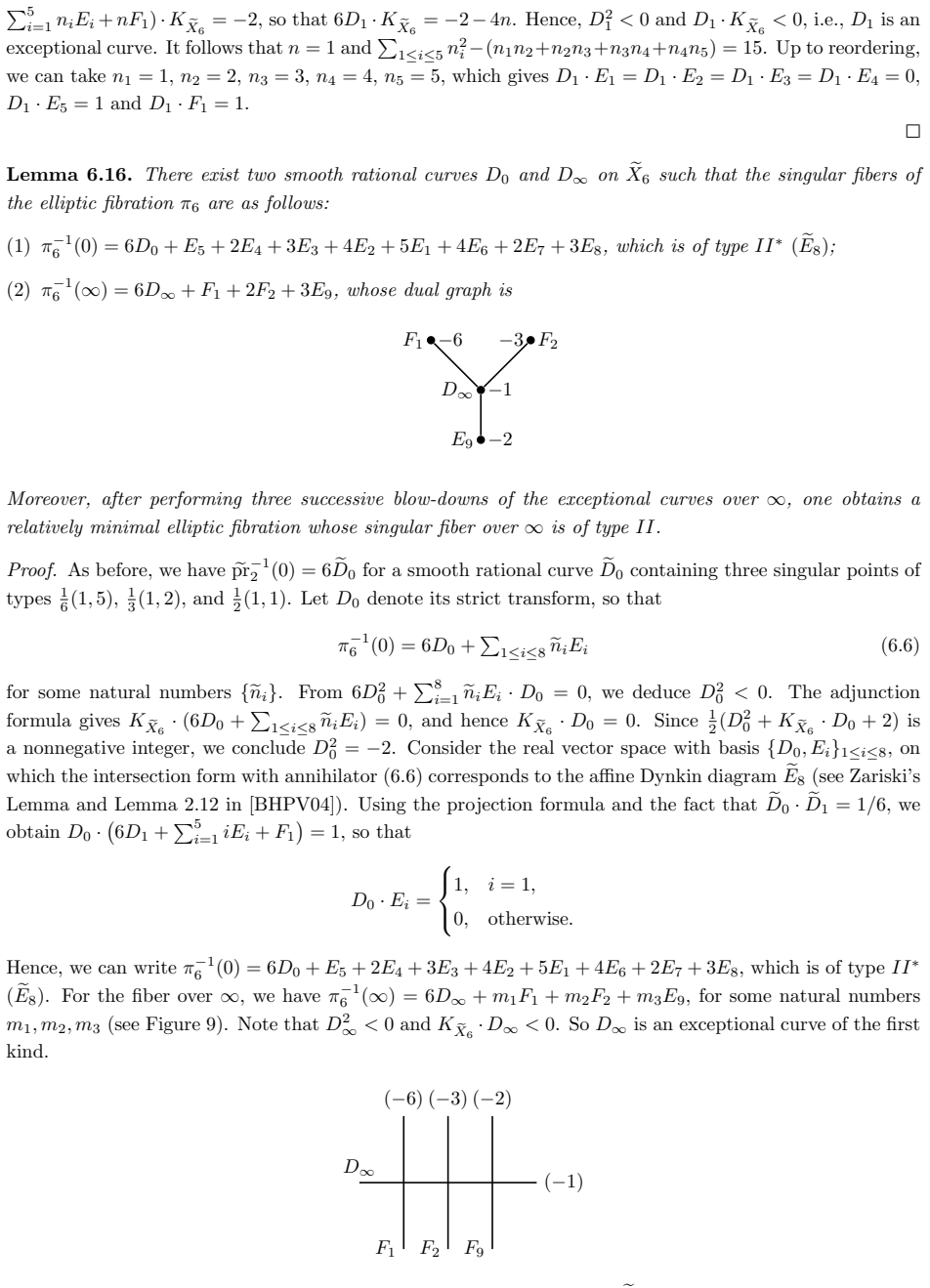
- The Hitchin fibrations for D̃4, Ẽ6, Ẽ7, Ẽ8 are now described explicitly by the elliptic fiber types I*_0 over 0 and ∞ for D̃4, IV* and IV for Ẽ6 (after one blow-down), III* and III for Ẽ7 (after two blow-downs), and II* and II for Ẽ8 (after three blow-downs).
- Since the compactification is a blow-up of the second Hirzebruch surface, the rational elliptic surfaces inherit concrete coordinates and intersection forms from that model.
- Removing the fiber over ∞ recovers the Hitchin system, so the compactification is a natural one-point (in the base) compactification, with boundary consisting of s+1 copies of P^1.
- The Hilbert-Chow morphism being a Poisson resolution means the compactification is compatible with the symplectic/Poisson geometry, not just the underlying complex structure.
- The smoothness and connectedness results for orbifold Hilbert schemes extend the standard Hilbert scheme theory to orbifold surfaces, providing tools for further moduli problems.
Reading between the lines
- If the compatibility of the C*-action and Poisson structure with the Hitchin system's structures holds, then the fixed-point loci of the C*-action on these rational elliptic surfaces should match the fixed-point loci of the scaling action on Higgs bundles; this is a concrete check that could be done locally on the fibers over 0 and ∞.
- The explicit blow-up descriptions may make it possible to compute enumerative invariants (e.g., Gromov-Witten or Donaldson-Thomas invariants) of these Hitchin compactifications by reducing them to computations on the second Hirzebruch surface.
- The pattern of relative minimal models obtained by blowing down curves over ∞ suggests that each Hitchin system carries a hierarchy of elliptic compactifications, parameterized by which (−1)-curves one contracts; these may correspond to different stability conditions or different choices of compactification.
- The four cases treated are exactly the non-elliptic one-dimensional Calabi-Yau orbifolds; the same orbifold-Hilbert-scheme construction might, with suitable modifications, compactify higher-dimensional Hitchin systems or Hitchin systems for other orbifold curves.
Editorial analysis
A structured set of objections, weighed in public.
Referee Report
Summary. The paper defines orbifold Hilbert schemes Hilb^n(X) for projective orbifold surfaces with codimension-two stacky locus, proves smoothness, connectedness, and a Hilbert–Chow minimal-resolution theorem, and applies this to compactify the two-dimensional Hitchin systems of affine types D4, E6, E7, E8 as Hilb^1(P(T^∨X_i ⊕ O_{X_i})). The main geometric claim, Theorem 1.5, is that each compactification is a rational elliptic surface with a C*-action, has only singular fibers over 0 and ∞ with the fiber types listed in Table 1, and is obtained by an explicit sequence of blow-ups of the second Hirzebruch surface. The D4, E6, and E7 cases are supported by detailed curve configurations and blow-down arguments; the E8 case is asserted in Proposition 6.17 via a self-referential proof.
Significance. If the results are correct, the paper gives a concrete and uniform description of the compactified Hitchin systems for the affine Dynkin types D4, E6, E7, E8, connecting them to rational elliptic surfaces and to explicit blow-up constructions on H_2. This is a valuable contribution to the explicit study of Hitchin systems and orbifold Hilbert schemes. The general smoothness and connectedness statements for orbifold Hilbert schemes are also potentially useful beyond the application. However, the central claim currently rests on several incompletely proved steps, most importantly the E8 blow-up classification, so the contribution is not yet fully established.
major comments (4)
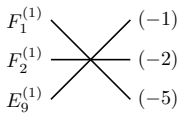
- [§6.4, Proposition 6.17] The proof of Proposition 6.17 consists of the sentence "As in the proof of Proposition 6.17, this figure illustrates the configuration of the curves, from which the proposition follows." This is a self-reference, not a proof. Lemmas 6.15 and 6.16 identify the local singular fibers over p_1, p_2, p_3 and over 0, ∞, but they do not prove that the global surface eX_6 is isomorphic to the iterated blow-up H_2^(6) of the second Hirzebruch surface described in the text. One must check that the exceptional curves introduced in the six blow-up steps have exactly the intersection pattern of Figure 13 and that no other curves are present. As written, the E8 row of Table 1 and the corresponding part of Theorem 1.5 are unsubstantiated.
- [Theorem 1.4(1) and Remark 6.2] The statement that the natural C*-action and Poisson structure on Hilb^1(P(T^∨X_i ⊕ O_{X_i})) are compatible with, and extend, the C*-action and symplectic structure on the Hitchin system M(i) is load-bearing: it is what identifies the Hilbert scheme compactification with the Hitchin-system compactification. The justification in Remark 6.2 says Groechenig proved the C*-action assertion 'although this is not stated explicitly in his paper', and cites [Jia25] for the symplectomorphism. This is not sufficient as a proof. If the C*-action compatibility fails, or if [Jia25] does not cover the present setting, Theorem 1.4(1) collapses. A precise proof or an exact quotation of the relevant statements is needed.
- [§3.2, Lemma 3.3] The proof of Lemma 3.3 cites "[?, Theorem A.0.6]" with a literal placeholder, so the reference is missing. More importantly, the proof asserts without derivation that a Gieseker semistable sheaf satisfying the displayed slope inequality is µ_H-stable. This implication is the key point of the lemma, and it is not immediate from the preceding lines. Lemma 3.3 is foundational for Proposition 3.4, Corollary 4.3, and hence for the smoothness and connectedness of the Hilbert schemes used in Section 6. The proof must be completed or replaced by a precise reference.
- [§4, Corollary 4.3] The proof of Corollary 4.3 says that 'the proof of this corollary can be completed by following the proof of Corollary 10 in [Ma07]' and gives no details. This is especially delicate in the K_X ≅ O_X case, where Lemma 4.2 and the three-term locally free complex are invoked but the necessary rank, vanishing, and degeneracy-locus computations are omitted. Since connectedness of Hilb^n(X) is used in Theorem 5.9 and hence in the compactification theorem, this step should be written out or the cited argument should be adapted explicitly to the orbifold setting.
minor comments (4)
- [§6.4, paragraph before Lemma 6.15] In the E7 case, the two displayed diagrams are both labelled 'eX4'; the first should presumably be X_4 and the second eX_4. This typo makes the notation confusing.
- [§6.1, Lemma 6.7 proof] The text writes 'en_i = D_0 · E_i' and then concludes 'en_1 = en_2 = en_3 = en_4 = -1'. Since the en_i are natural numbers, the intended statement must involve squares or absolute values; please correct the notation.
- [§6.2, Lemma 6.10 proof] In the sentence 'Analogously, let eD_∞ ⊂ X_2 be the smooth rational curve...', the symbol X_2 should presumably be X_3. Also 'em_i = D_∞ · F_i' followed by 'em_1 = em_2 = em_3 = 1' has the same sign/notation issue as in Lemma 6.7.
- [References] There is a literal placeholder '[?]' in the proof of Lemma 3.3. Also, the reference [ACL] appears in the bibliography but does not seem to be cited in the text; please add citations or remove the entry.
Circularity Check
E8 blow-up classification (Proposition 6.17) is supported only by a self-referential proof; the rest of the derivation is self-contained.
-
other
[Section 6.4, Proposition 6.17 (proof), p. 28]
"As in the proof of Proposition 6.17, this figure illustrates the configuration of the curves, from which the proposition follows."
The proof of Proposition 6.17 cites 'the proof of Proposition 6.17' as the justification for the conclusion. There is no separate or earlier proof of Proposition 6.17; the proposition itself is the claim that the E8-case surface eX6 is isomorphic to the explicit blow-up H_2^(6) of the second Hirzebruch surface. Thus the proof assumes the very statement it is meant to establish. This is load-bearing because Theorem 1.5 explicitly cites Proposition 6.17 for the E8 row of Table 1, so the E8 part of the central blow-up classification is not derived from the preceding lemmas but reduced to a self-reference.
full rationale
The central derivation is mostly self-contained and non-circular. The compactifications Hilb^1(P(T^vee X_i plus O_X_i)) are constructed directly via orbifold Hilbert schemes, the Hilbert--Chow morphisms are identified with Hitchin maps, and the singular fibers and relative minimal models for the D4, E6, and E7 cases are obtained by explicit curve configurations, adjunction, Zariski's lemma, and explicit blow-downs to the second Hirzebruch surface (Propositions 6.8, 6.11, 6.14). No fitted parameter is relabeled as a prediction, and no uniqueness theorem is imported from the authors' prior work. The compatibility assertion in Theorem 1.4(1) relies on Remark 6.2, which cites Groechenig [Go14] and the external preprint [Jia25]; this is a correctness risk, not a circularity. However, the E8 case of Theorem 1.5 is not supported by a substantive proof: Proposition 6.17's proof refers to itself. Since the proposition is the sole cited support for the E8 row, the derivation of that case reduces to an assertion of its own truth. This is a genuine circular step, though confined to one of the four cases. Therefore the overall circularity score is 6 (partial circularity).
Assumptions & free parameters
assumptions (8)
- domain assumption Existence of coarse moduli space, Picard scheme, and GAGA for smooth Deligne-Mumford stacks (Toen, Brochard)
- domain assumption Stacky Bogomolov inequality (Lieblich, [Li11], Proposition 4.2.4)
- domain assumption Toen-Riemann-Roch formula for orbifold Chern characters
- standard math Riemenschneider's classification of cyclic quotient singularities ([Rie77])
- standard math Zariski's Lemma and Kodaira's classification of singular elliptic fibers ([BHPV04])
- domain assumption Groechenig's theorem that Hilb^1(T^*X_i) is the moduli space M(i) of orbifold Higgs bundles ([Go14])
- domain assumption Symplectomorphism and C*-action compatibility from [Jia25]
- domain assumption Canonical stack compactification of [C^2/G] by (P^2/G)^{can} ([GS17, Theorem 1])
Cite this review
Pith. "Pith review of From Hitchin Systems to Rational Elliptic Surfaces with C*-actions via Orbifold Hilbert Schemes." pith.science (2026). https://pith.science/paper/BLF3SLLV
@misc{pith2026250914812,
  author       = {Pith},
  title        = {Pith review of: From Hitchin Systems to Rational Elliptic Surfaces with C*-actions via Orbifold Hilbert Schemes},
  year         = {2026},
  howpublished = {\url{https://pith.science/paper/BLF3SLLV}},
  note         = {Machine review of arXiv:2509.14812}
}
read the original abstract
Using orbifold Hilbert schemes, we compactify all two-dimensional Hitchin systems corresponding to types A0-tilde, D4-tilde, E6-tilde, E7-tilde, and E8-tilde, thereby obtaining four rational elliptic surfaces with C*-actions. Their singular fibers and relative minimal models are listed in the main table. A particularly interesting point is that we found they can all be obtained by performing a finite number of blow-ups on the second Hirzebruch surface. To this end, we prove that Hilbert schemes of orbifold surfaces are connected smooth projective schemes under suitable conditions, and we use the Hilbert-Chow morphism to construct the minimal resolutions of the coarse moduli spaces.
Figures


Figures from the paper (10 more)




Reference graph
Works this paper leans on
-
[1]
Abramovich, M
D. Abramovich, M. Olsson and A. Vistoli, Tame stacks in positive characteristic, Ann. Inst. Fourier (Grenoble), 58(4) (2008), 1057-1091
2008
-
[2]
Abramovich and A
D. Abramovich and A. Vistoli, Compactifying the space of stable maps, J. Am. Math. Soc, 15(1) (2002), 27-75
2002
-
[3]
Artin, On Isolated Rational Singularities of Surfaces, Am
M. Artin, On Isolated Rational Singularities of Surfaces, Am. J. Math, 88(1) (1966), 129-136
1966
-
[4]
W. L. Baily, The decomposition theorem for V-manifolds, Amer. J. Math. 78 (1956), 862-888
1956
-
[5]
W. L. Baily, On the imbedding of V -manifolds in projective space, Amer. J. Math. 79 (1957), 403-430
1957
-
[6]
Barth, K
W. Barth, K. Hulek, Chris Peters, A. Van de Ven, Compact complex surfaces. 2nd enlarged ed. Ergebnisse der Mathematik und ihrer Grenzgebiete. 3. Folge 4. Berlin: Springer (ISBN 3-540-00832-2/hbk). xii, 436 p. (2004)
2004
-
[7]
Beauville, Sur la cohomologie de certains espaces de modules de fibr\' e s vectoriels , Geometry and analysis (Bombay, 1992), Tata Inst
A. Beauville, Sur la cohomologie de certains espaces de modules de fibr\' e s vectoriels , Geometry and analysis (Bombay, 1992), Tata Inst. Fund. Res., Bombay (1995), 37-40
1992
-
[8]
Behrend, Cohomology of stacks, from: Intersection theory and moduli, (E
K. Behrend, Cohomology of stacks, from: Intersection theory and moduli, (E. Arbarello, G. Ellingsrud, L. Goettsche, editors), ICTP Lect. Notes 19 , Abdus Salam Int. Cent. Theoret. Phys. Trieste (2004), 249-294
2004
Show all 69 references
-
[9]
Bejleri and G
D. Bejleri and G. Zaimi, The topology of equivariant Hilbert schemes, Res. Math. Sci. 10:28 (2023), https://doi.org/10.1007/s40687-023-00393-z
2023 doi
-
[10]
Birkar, Topics in algebraic geometry, arXiv:1104.5035v1 (2011)
C. Birkar, Topics in algebraic geometry, arXiv:1104.5035v1 (2011)
2011 arXiv
-
[11]
Boalch, Simply-laced isomonodromy systems,Publ
P. Boalch, Simply-laced isomonodromy systems,Publ. Math-Paris, 116 (2012), pp. 1-68
2012
-
[12]
Boden and Y
H. Boden and Y. Hu, Variations of moduli of parabolic bundles, Math. Ann. 301 (1995), 539-559
1995
-
[13]
Bottacin, Poisson structures on moduli spaces of sheaves over Poisson surfaces, Invent
F. Bottacin, Poisson structures on moduli spaces of sheaves over Poisson surfaces, Invent. Math. 121 (1985), 421-436
1985
-
[14]
Bottacin, Poisson structures on Hilbert schemes of points of a surface and integrable systems, Manuscripta Math
F. Bottacin, Poisson structures on Hilbert schemes of points of a surface and integrable systems, Manuscripta Math. 97 (1998), 517-527
1998
-
[15]
a ten komplexer Fl\
E. Brieskorn, Rationale Singularit\" a ten komplexer Fl\" a chen , Invent. Math. 4 (1968), 336--358
1968
-
[16]
Bridgeland, A
T. Bridgeland, A. King and M. Reid, The McKay Correspondence as an Equivalence of Derived Categories, J. Amer. Math. Soc. 14 (2001), 535-554
2001
-
[17]
Brochard, Foncteur de Picard dun champ alg\' e brique , Math
S. Brochard, Foncteur de Picard dun champ alg\' e brique , Math. Ann. 343 (2009), 541-602
2009
-
[18]
Brochard, Finiteness theorems for the Picard objects of an algebraic stack, Adv
S. Brochard, Finiteness theorems for the Picard objects of an algebraic stack, Adv. Math. 229 (2012) 1555-1585
2012
-
[19]
C a ld a raru, Derived categories of twisted sheaves on Calabi-Yau manifolds, Thesis, Cornell Univ., May 2000
A. C a ld a raru, Derived categories of twisted sheaves on Calabi-Yau manifolds, Thesis, Cornell Univ., May 2000
2000
-
[20]
Chen and H
J. Chen and H. Tseng, A note on derived Mckay correspondence, Math. Res. Lett. 15 (2008), No. 3, 435-445
2008
-
[21]
A. Craw, S. Gammelgaard, \' A . Gyenge and B. Szendr\" o i, Punctual Hilbert schemes for Kleinian singularities as quiver varieties, Algebraic Geom. 8(6) (2021), 680-704, doi:10.14231/AG-2021-021
2021 doi
-
[22]
Debarre, Higher-dimensional algebraic geometry, Universitext
O. Debarre, Higher-dimensional algebraic geometry, Universitext. New York, NY: Springer. xiii, 233 p. (2001)
2001
-
[23]
Edidin, B
D. Edidin, B. Hassett, A. Kresch and A. Vistoli, Brauer groups and quotient stacks, Amer. J. Math. 123 (2001), No. 4, 761-777
2001
-
[24]
Ellingsrud and S
G. Ellingsrud and S. Stromme, Towards the Chow ring of the Hilbert scheme of P^2 , J. Reine Angew. Math. 441 (1993), 33-44
1993
-
[25]
Esnault, Reflexive modules on quotient surface singularities, J
H. Esnault, Reflexive modules on quotient surface singularities, J. Reine Angew. Math. 362 (1985), 63-71
1985
-
[26]
Fantechi, L
B. Fantechi, L. Gottsche, L. Illusie, S. L. Kleiman, N. Nitsure, and A. Vistoli, Fundamental algebraic geometry: Grothendiecks FGA explained, Mathematical Surveys and Monographs, vol. 123, American Mathematical Society, Providence, RI, 2005
2005
-
[27]
Fantechi, E
B. Fantechi, E. Mann and F. Nironi, Smooth toric Deligne-Mumford stacks, J. Reine Angew. Math. 648 (2010), 201-244
2010
-
[28]
Fu, Poisson resolutions, J
B. Fu, Poisson resolutions, J. Reine Angew. Math. 587 (2005), 17-26
2005
-
[29]
Bottom Up
A. Geraschenko and M. Satriano, A "Bottom Up" Characterization of Smooth Deligne-Mumford Stacks, Int. Math. Res. Not. (2017), No. 21, pp. 6469-6483
2017
-
[30]
Gorsky, N
A. Gorsky, N. Nekrasov and V. Rubtsov, Hilbert Schemes, Separated Variables, and D-Branes, Commun. Math. Phys. 222 (2001), 299-318
2001
-
[31]
Griffiths and J
P. Griffiths and J. Harris, Principles of algebraic geometry. 2nd ed., Wiley Classics Library. New York, NY: John Wiley, Sons Ltd. xii, 813 p. (1994)
1994
-
[32]
Groechenig, Hilbert schemes as moduli of Higgs bundles and local systems, Int
M. Groechenig, Hilbert schemes as moduli of Higgs bundles and local systems, Int. Math. Res. Not. (2014), No. 23, 6523-6575
2014
-
[33]
Grothendieck, Techniques de construction en g\' e om\' e trie analytique
A. Grothendieck, Techniques de construction en g\' e om\' e trie analytique. 9 . Quelques probl\` e mes de modules , S\' e minaire Henri Cartan, Volume 13 (1960-1961) No. 2, Talk No. 16, 20 p
1960
-
[34]
Grothendieck and M
A. Grothendieck and M. Raynaud, Rev\^ e tements \' E tales et Groupe Fondamental , S\' e minaire de G\' e om\' e trie Alg\' e brique du Bois Marie 1960/61 (SGA 1)
1960
-
[35]
Hartshorne, Algebraic Geometry, Graduate Texts in Mathematics, No
R. Hartshorne, Algebraic Geometry, Graduate Texts in Mathematics, No. 52. Springer-Verlag, New York-Heidelberg, 1977. xvi+496 pp. ISBN: 0-387-90244-9
1977
-
[36]
Huang, Langton's type theorem on algebraic orbifolds, Acta Math
Y. Huang, Langton's type theorem on algebraic orbifolds, Acta Math. Sin., Engl. Ser. 39 (2023), No. 4, 584-602
2023
-
[37]
Huang, Mirror symmetry and Hitchin system on Deligne-Mumford curves: Strominger-Yau-Zaslow duality, Canad
Y. Huang, Mirror symmetry and Hitchin system on Deligne-Mumford curves: Strominger-Yau-Zaslow duality, Canad. J. Math. (2024), 1-58, http://dx.doi.org/10.4153/S0008414X24000439
2024 doi
-
[38]
Hitchin, The self-duality equations on a Riemann surface, Proc
N. Hitchin, The self-duality equations on a Riemann surface, Proc. London Math. Soc. (3) 55 (1987), 59-126
1987
-
[39]
Huybrechts and M
D. Huybrechts and M. Lehn, The geometry of moduli spaces of sheaves. 2nd ed., Cambridge University Press (2010)
2010
-
[40]
Illusie, Complexe cotangent et deformations
L. Illusie, Complexe cotangent et deformations. 1 . , Lecture Notes in Mathematics, Vol. 239. Springer-Verlag, Berlin (1971)
1971
-
[41]
Ishii, On the McKay correspondence for a finite small subgroup of (2, C) , J
A. Ishii, On the McKay correspondence for a finite small subgroup of (2, C) , J. Reine Angew. Math. 549 (2002), 221-233
2002
-
[42]
Jia, Symplectic Geometry of Higgs Moduli and the Hilbert Scheme of Points, arXiv:2505.02334v2
Z. Jia, Symplectic Geometry of Higgs Moduli and the Hilbert Scheme of Points, arXiv:2505.02334v2
-
[43]
Kaledin, M
D. Kaledin, M. Lehn and C. Sorger, Singular symplectic moduli spaces, Invent. Math. 164 (2006), 591-614
2006
-
[44]
Kollar, Lectures on resolution of singularities, Annals of Mathematics Studies 166
J. Kollar, Lectures on resolution of singularities, Annals of Mathematics Studies 166. Princeton, NJ: Princeton University Press (ISBN 978-0-691-12923-5/pbk; 978-0-691-12922-8/hbk). vi, 208 p. (2007)
2007
-
[45]
Kostant, The McKay correspondence, the Coxeter element and representation theory, Ast\' e risque, No
B. Kostant, The McKay correspondence, the Coxeter element and representation theory, Ast\' e risque, No. Hors Sr. (1985), 209-255
1985
-
[46]
Kresch, On the geometry of Deligne-Mumford stacks, In: Abramovich, D; Bertram, A; Katzarkov, L; Pandharipande, R; Thaddeus, M
A. Kresch, On the geometry of Deligne-Mumford stacks, In: Abramovich, D; Bertram, A; Katzarkov, L; Pandharipande, R; Thaddeus, M. Algebraic Geometry: Seattle 2005. Providence, Rhode Island: Amer. Math. Soc. 259-271
2005
-
[47]
Kuhn, The Atiyah class on algebraic stacks, Forum Math
N. Kuhn, The Atiyah class on algebraic stacks, Forum Math. Sigma 12 (2024), Paper No. e100, 54 p
2024
-
[48]
Lieblich, Moduli of twisted orbifold sheaves
M. Lieblich, Moduli of twisted orbifold sheaves. Adv. Math. 226(5) (2011), 4145-4182
2011
-
[49]
Markman, Generators of the cohomology ring of moduli spaces of sheaves on symplectic surfaces, J
E. Markman, Generators of the cohomology ring of moduli spaces of sheaves on symplectic surfaces, J. Reine Angew. Math. 544 (2002), 61-82
2002
-
[50]
Markman, Integral generators for the cohomology ring of moduli spaces of sheaves over Poisson surfaces, Adv
E. Markman, Integral generators for the cohomology ring of moduli spaces of sheaves over Poisson surfaces, Adv. Math. 208 (2007), No.2, 622-646
2007
-
[51]
McKay, Graphs, singularities, and finite groups, Proc
J. McKay, Graphs, singularities, and finite groups, Proc. Symp. Pure Math. 37 (1980), 183-186
1980
-
[52]
Mukai, On the moduli space of bundles on K3 sufaces 1 , in: Vector Bundles on Algebraic Varieties, Proc
S. Mukai, On the moduli space of bundles on K3 sufaces 1 , in: Vector Bundles on Algebraic Varieties, Proc. Bombay Conference, 1984, in: Tata Inst. Fund. Res. Stud., vol. 11, Oxford Univ. Press, 1987, pp. 341-413
1984
-
[53]
Mumford, J
D. Mumford, J. Fogarty and F. Kirwan, Geometric invariant theory, Ergebnisse der Mathematik und ihrer Grenzgebiete (2)[Results in Mathematics and Related Areas (2)], xiv+292 pp., 1994, Springer-Verlag, Berlin
1994
-
[54]
Nironi, Moduli spaces of semistable sheaves on Projective Deligne-Mumford Stack, arXiv:0811.1949v2 (2008)
F. Nironi, Moduli spaces of semistable sheaves on Projective Deligne-Mumford Stack, arXiv:0811.1949v2 (2008)
2008 arXiv
-
[55]
Nironi, Grothendieck duality for Deligne-Mumford stacks, arXiv:0811.1955v2 (2009)
F. Nironi, Grothendieck duality for Deligne-Mumford stacks, arXiv:0811.1955v2 (2009)
2009 arXiv
-
[56]
Olsson, Sheaves on Artin stacks, J
M. Olsson, Sheaves on Artin stacks, J. Reine Angew. Math. 603 (2007), 55-112
2007
-
[57]
Olsson, Algebraic spaces and stacks, American Mathematical Society Colloquium Publications, 62
M. Olsson, Algebraic spaces and stacks, American Mathematical Society Colloquium Publications, 62. American Mathematical Society, Providence, RI (2016). xi+298 pp. ISBN: 978-1-4704-2798-6
2016
-
[58]
Olsson and J
M. Olsson and J. Starr, Quot functors for Deligne-Mumford stacks, Special issue in honor of Steven L. Kleiman. Comm. Algebra 31 (2003), No. 8, 4069-4096
2003
-
[59]
Pym, Constructions and classifications of projective Poisson varieties, Lett
B. Pym, Constructions and classifications of projective Poisson varieties, Lett. Math. Phys. 108 (2018), 573-632
2018
-
[60]
Riemenschneider, Die Invarianten der endlichen Untergruppen von GL(2, C) , Math
O. Riemenschneider, Die Invarianten der endlichen Untergruppen von GL(2, C) , Math. Z. 153 (1977), 37-50
1977
-
[61]
J. H. M. Steenbrink, Mixed Hodge structure on the vanishing cohomology, Real and complex singularities (Proc. Ninth Nordic Summer School/NAVF Sympos. Math., Oslo, 1976), Sijthoff and Noordhoff, Alphen aan den Rijn (1977), 525-563
1976
-
[62]
Toen, Th\' e or\` e mes de Riemann-Roch pour les champs de Deligne-Mumford , K-Theory 18 (1999), No
B. Toen, Th\' e or\` e mes de Riemann-Roch pour les champs de Deligne-Mumford , K-Theory 18 (1999), No. 1, 33-76
1999
-
[63]
B. Toen, K-th\' e orie et cohomologie des champs alg\' e briques: Th\' e or\` e mes de Riemann-Roch, D-modules et th\' e or\` e mes ``GAGA'' , thesis, Universit\' e Paul Sabatier de Toulouse 3, 1999
1999
-
[64]
Totaro, The resolution property for schemes and stacks, J
B. Totaro, The resolution property for schemes and stacks, J. Reine Angew. Math. 577 (2004), 1-22
2004
-
[65]
Tseng, Orbifold quantum Riemann-Roch, Lefschetz and Serre, Geom
H. Tseng, Orbifold quantum Riemann-Roch, Lefschetz and Serre, Geom. Topol. 14 (2010), No. 1, 1-81
2010
-
[66]
Yoshioka, Moduli spaces of stable sheaves on abelian surfaces, Math
K. Yoshioka, Moduli spaces of stable sheaves on abelian surfaces, Math. Ann. 321 (4) (2001), 817-884
2001
-
[67]
Yamagishi, Symplectic resolutions of the Hilbert squares of ADE surface singularities, arXiv:1709.05886v4, (2018)
R. Yamagishi, Symplectic resolutions of the Hilbert squares of ADE surface singularities, arXiv:1709.05886v4, (2018)
2018 arXiv
-
[68]
Zheng, Irreducibility of the Hilbert schemes of points on surfaces with Kleinian singularities, Commun
X. Zheng, Irreducibility of the Hilbert schemes of points on surfaces with Kleinian singularities, Commun. Algebra, 51:1 (2023), 98-115,DOI: 10.1080/00927872.2022.2089993
2023
-
[69]
Zhang, Moduli spaces of sheaves on K3 surfaces and symplectic stacks, Commun
Z. Zhang, Moduli spaces of sheaves on K3 surfaces and symplectic stacks, Commun. Anal. Geom. 25, No. 5 (2017), 1063-1106
2017
Reviewed August 4, 2026 · model on record in the stance chip above.
Discussion (0). Continue with ORCID to comment.