REVIEW 3 major objections 6 minor 61 references
Local volume-conserving lattice Boltzmann model for incompressible multiphase flows
T0 review · 3 major / 6 minor · reviewed 2026-08-15 · deepseek-v4-flash
Pith's one-line read A modified Cahn-Hilliard equation with a signed-distance profile correction keeps each phase's volume nearly constant in two-phase flow simulations, where the classical equation lets small droplets shrink.
desk verdict A plausible new LB scheme for a profile-corrected Cahn-Hilliard model, but the key recovery claim is asserted rather than derived and the numerical support is only qualitative. read the letter →
The pith
A machine-rendered reading of the paper's core claim, the machinery that carries it, and where it could break.
The reading
What carries the argument
The central object is the modified Cahn-Hilliard equation (Eq. (17)) and the penalty flux carried by the signed distance function $\psi$. The penalty energy of Eq. (6) pushes the interface toward the hyperbolic-tangent profile $|\nabla\phi| = 4\phi(1-\phi)/W$; truncating its variation (Eq. (10)) and substituting $\phi(1-\phi) = \frac{1}{4}[1-\tanh^2(2\psi/W)]$ along with $\nabla\phi/|\nabla\phi|=\nabla\psi/|\nabla\psi|$ yields the smooth level-set-based flux that performs the volume-conservation work. The numerical engine is the multiple-relaxation-time lattice Boltzmann update (30)-(32), with equilibrium (31) and forcing (32) chosen so that the scheme is intended to recover Eq. (17) in the continuum limit.
What would settle it
A decisive check is a formal multiscale (Chapman-Enskog-style) expansion of the phase-field distribution update, Eqs. (30)-(32): if the recovered macroscopic equation contains terms beyond Eq. (17), or misses the level-set flux, the volume-conservation advantage would be an artifact of the discrete method. A purely numerical falsifier is a grid-refinement study of the two-droplet test in Section 4.1: if the scheme truly solves Eq. (17), the per-droplet volume error should shrink toward zero as the lattice spacing and time step are reduced at fixed physical parameters; if the error instead saturates at a level set by the dropped term in Eq. (10), the correction is not converging to the stated continuum target.
Extended reading notes
Core claim
The central claim is that local volume conservation follows from correcting the interface profile, not from adding a global mass-correction term. The paper's target equation, Eq. (17), is the classical Cahn-Hilliard equation plus a penalty term $\lambda M[\nabla^2\phi - \nabla\cdot(W^{-1}(1-\tanh^2(2\psi/W))\nabla\psi/|\nabla\psi|)]$, where $\psi$ is the signed distance function tied to $\phi$ by $\psi = (W/4)\ln(\phi/(1-\phi))$. With this term, the equilibrium profile is enforced as a soft constraint, and the level-set substitution removes the nonlinear sharpening singularity that affects earlier profile-correction formulations. The lattice Boltzmann model of Section 3 is designed so that its macroscopic limit is this modified equation; the simulation section compares it against the classical-Cahn-Hilliard lattice Boltzmann model in four benchmarks and reports consistently smaller volume drift and better interface morphology, most visibly for droplets below the critical radius where the classical model exhibits Ostwald-ripening-like shrinkage.
Load-bearing premise
The claim rests on the assumption that the lattice Boltzmann update of Section 3, with equilibrium (31) and forcing (32), truly reproduces the modified Cahn-Hilliard equation (17) in the continuum limit, including the new level-set-based source term, and that dropping the first piece of the penalty variation in Eq. (10) is harmless; the paper states both but does not prove the recovery.
Editorial extensions
If this is right
- Long-time simulations of droplet breakup and coalescence can track small satellite droplets without the artificial shrinkage that the classical Cahn-Hilliard model imposes below a critical radius.
- Because the signed-distance flux remains smooth where the original profile-correction flux has $\phi(1-\phi)$ gradients, the interface-capturing scheme can run at thinner interfaces without the precision loss caused by sharpening-flux jumps.
- The two-distribution-function architecture is unchanged, so incompressible multiphase lattice Boltzmann solvers can adopt the modified interface equation by replacing only the phase-field distribution and its forcing term.
- In surface-tension-dominated regimes, per-phase volume conservation is maintained alongside global mass conservation, which is what allows the stationary-droplet, vortex, and shear benchmarks to report near-constant volumes.
Reading between the lines
- The penalty term acts as a soft reinitializer: it pushes the phase field toward the tanh profile that the level-set signed-distance function encodes. Viewed this way, the method is a phase-field cousin of conservative level-set reinitialization, and one could test whether explicit reinitialization every few steps at the same cost recovers the same volume-conservation curves.
- Because the penalty strength $\lambda$ is fixed at 0.5 in all tests, the reported gains have not been shown at the optimal penalty strength; a sweep over $\lambda$ at fixed interface thickness, mobility, and grid spacing would reveal how much of the improvement comes from the correction term itself and how much from level-set smoothing.
- The formulation is limited to two phases; for three or more phases, one signed-distance field per phase and a triple-junction rule for the penalty fluxes would be needed, so the mechanism does not transfer automatically.
Signed reviews
Editorial analysis
A structured set of objections, weighed in public.
Referee Report
Summary. This paper proposes a modified Cahn-Hilliard (C-H) equation for incompressible two-phase flows that combines a profile-correction penalty term with the signed-distance function from level-set methods, and then constructs a multiple-relaxation-time lattice Boltzmann (MRT-LB) model to solve it together with the incompressible Navier-Stokes equations. The central claim is that this LB model preserves the local volume of each phase and the interface shape better than the classical-C-H LB model of Liang et al. [31], especially for small droplets. The paper reports four numerical tests (stationary droplets, single vortex, Rayleigh-Plateau instability, and droplet deformation in a shear flow) and concludes that the proposed model exhibits superior volume conservation and interface fidelity.
Significance. The paper addresses a relevant and well-documented limitation of phase-field LB methods: local phase-volume loss for small droplets. The construction in Sec. 2, based on an existing penalty-energy idea [27,50] and the level-set reformulation [17], is clearly presented, and the chosen benchmarks are standard and appropriate. If the MRT-LB system in Sec. 3 is rigorously shown to reproduce Eq. (17), the model could be a useful contribution to interface-capturing LB methods. However, the manuscript currently leaves the load-bearing multiscale derivation as an assertion, and the numerical evidence is largely qualitative. The interface-shape preservation is partly by construction because the penalty term in Eq. (17) explicitly targets the hyperbolic-tangent profile (4); the decisive open question is whether the discrete LB equations actually realize Eq. (17) accurately. These gaps are addressable, but they are central rather than cosmetic.
major comments (3)
- [Section 3.2, Eqs. (30)-(32)] The central assertion that the LB system recovers the modified C-H equation (17) is not derived. The text states only that the evolution equation is 'inspired by' Refs. [31,37]. This is load-bearing because Eq. (31) shifts the chemical potential by lambda*phi and Eq. (32) inserts the psi-dependent flux as a forcing term; one must show, via a Chapman-Enskog or multiscale expansion, that the discrete moments produce exactly div(M*grad(hbar)) + lambda*M*[Laplacian(phi) - div((1/W)(1 - tanh^2(2*psi/W))*grad(psi)/|grad(psi)|)] and produce no extraneous terms of order Delta t. In particular, the recovered diffusion of the shifted potential includes div(M*grad(lambda*phi)), and the force in Eq. (32) must cancel the unwanted part and reproduce the intended flux to all required orders. The time-derivative term dt(phi*u) in Eq. (32), approximated by the backward difference in Eq. (38), is a specific source of such discretization errors. The introduction itself (Sec. 1, Refs. [28-30]) documents earlier LB-C-H models that failed to recover the intended equation for exactly this class of reason, so the derivation is not a formality. Without it, the claim that the simulations solve Eq. (17) is unverified.
- [Section 2, Eqs. (9)-(10)] The derivation of Eq. (17) drops the first term on the right-hand side of Eq. (9), with the justification that 4*phi*(1-phi)/W - |grad(phi)| tends to zero as the interface approaches the hyperbolic-tangent profile. No error bound, asymptotic estimate, or numerical measurement of this term is given. In the deformed-interface tests of Secs. 4.2-4.4 the interface is not at the equilibrium profile, so the dropped term is not obviously negligible; it contributes to the effective penalty and could modify the local-volume behavior. The authors should either bound this term in the regimes simulated or explicitly state that Eq. (17) is the model to be solved, independent of the gradient-flow derivation from Eq. (8).
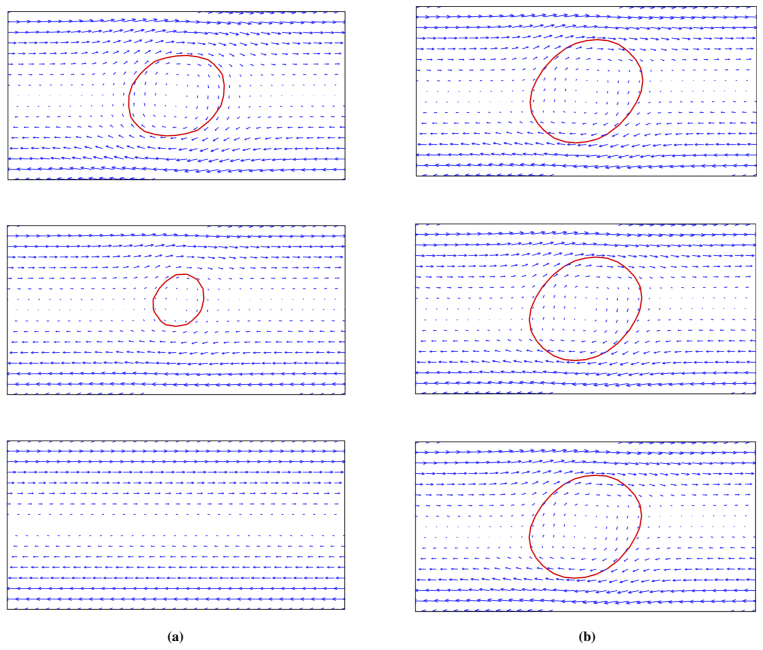
- [Section 4] The quantitative evidence for the central claim is insufficient. Only Fig. 3(b) in Sec. 4.1 provides volume-evolution curves; the single-vortex (Sec. 4.2), Rayleigh-Plateau (Sec. 4.3), and shear-flow (Sec. 4.4) comparisons consist of qualitative interface snapshots. The paper reports no relative volume-change errors, no grid-convergence study, and no comparison with a well-resolved finite-difference solution of the continuum Eq. (17). A convergence test (e.g., the single-vortex case at time T) and time series of the relative volume error for each case are needed to substantiate the statement that the model 'achieves more precise volume conservation for each phase' (Abstract). As written, the superiority claim is only visually supported for three of the four benchmarks.
minor comments (6)
- [Section 4.1, Eq. (41)] The radii r1 and r2 in Eq. (41) are not defined; please specify their values.
- [General] The quantity 'local volume' is never defined precisely; please state whether it is the integral of phi over the domain, the area enclosed by the phi = 0.5 contour, or another measure, since the main quantitative claim is expressed through this quantity.
- [Section 3.1] The density rho used in Eqs. (20), (21), (28), and (29) is never expressed as a function of the order parameter phi; although all tests use density ratio 1, the method is presented for general incompressible multiphase flows, so the interpolation formula (e.g., rho = rho_l*phi + rho_g*(1-phi)) and the way rho is updated should be stated.
- [Section 3.2, Eqs. (36)-(37)] The regularization in Eq. (37) and the clipping of phi to [0,1] before computing psi change the signed-distance function; the effect of these choices on the forcing term (32), especially near the bulk regions, should be discussed or tested.
- [General] The boundary conditions (periodic, solid walls, moving walls) are not stated for any of the four simulations, which hampers reproducibility.
- [General] The text contains numerous typos, including 'surface tansion', 'casued', 'presssion', 'conservaed', 'latice spacing', and the repeated phrase 'more consistent representation ... more consistently' in the abstract; a careful proofread is needed.
Circularity Check
No significant circularity: the LB model is constructed to recover the target modified Cahn-Hilliard equation, and the interface-preservation behavior is a designed property of that equation rather than a prediction that is equivalent to its own input.
full rationale
The paper's derivation chain is constructive rather than circular. The modified C-H equation (17) is obtained by adding a penalty energy (6) that explicitly targets the hyperbolic-tangent interface profile (4); the LB equilibrium (31) and forcing (32) are then written to match the terms of Eq. (17). This is model construction, not a derivation of a conclusion from an assumption that already contains that conclusion. The numerical sections test whether the resulting LB scheme actually preserves local volume and interface shape in practice, which is a legitimate check of the implementation. The approximation in Eq. (10), where the first term of the penalty variation is dropped, is an uncontrolled truncation and a potential numerical-modeling risk, but it is not a circular step: the dropped term is not silently replaced by the result the paper claims. The absence of a Chapman-Enskog or multiscale derivation for Eqs. (30)-(32) is a notable verification gap, and the paper's own historical discussion of earlier failed recoveries makes that gap material; however, a missing proof is a correctness concern, not evidence that the claim reduces by definition to its inputs. The only self-citations (e.g., Refs. [23] and [25]) appear in background statements about the usefulness of LB methods and do not carry the load-bearing argument. No fitted parameter is renamed as a prediction, no uniqueness theorem is imported from the authors' prior work, and no known result is merely relabeled. Overall, the central claim has independent content in the numerical comparison against the classical C-H LB model of Ref. [31].
Assumptions & free parameters
free parameters (4)
- lambda (penalty constant) =
0.5
- M (mobility) =
0.1
- W (interface thickness) =
3.0
- xi (level-set regularization) =
1e-10
assumptions (5)
- standard math The equilibrium profile of the order parameter is the hyperbolic-tangent function (Eq. 4).
- domain assumption The mapping psi = (W/4) ln(phi/(1-phi)) defines a valid level-set function.
- ad hoc to paper The first term on the right-hand side of Eq. (9) is negligible, so Eq. (10) holds.
- domain assumption The MRT-LB equations (20) and (30) recover the Navier-Stokes equations and the modified Cahn-Hilliard equation respectively.
- domain assumption The isotropic gradient and Laplacian discretizations (39)-(40) are sufficient for the singular level-set terms.
Cite this review
Pith. "Pith review of Local volume-conserving lattice Boltzmann model for incompressible multiphase flows." pith.science (2026). https://pith.science/paper/BLWFIMFW
@misc{pith2026250510899,
  author       = {Pith},
  title        = {Pith review of: Local volume-conserving lattice Boltzmann model for incompressible multiphase flows},
  year         = {2026},
  howpublished = {\url{https://pith.science/paper/BLWFIMFW}},
  note         = {Machine review of arXiv:2505.10899}
}
read the original abstract
The Cahn-Hilliard (C-H) equation, as a classical diffusion-interface method of phase-field, has been extensively employed for simulating two-phase fluid dynamics. However, it suffers from a key challenge in the simulation process, specifically the volume conservation of each phase cannot be guaranteed. To address this issue, in this paper, a modified C-H equation for two-phase flow modeling is first introduced, and the basic idea of this model lies in that it combines the profile correction method with the level-set approach, and thus, it effectively improves the deficiency of the classical C-H equation in terms of volume non-conservation of each phase. Based on this modified C-H equation, we further propose an accurate interface-capturing lattice Boltzmann (LB) model. After that, we perform a range of numerical simulations, including two stationary droplets immersed in the gas phase, single vortex, Rayleigh-Plateau fluid instability, and droplet deformation under a shear flow. These simulations illustrate that the proposed LB model has superior performance in maintaining local volume conservation and accurately capturing interfaces. More importantly, compared to the LB model derived from the classical C-H equation, it not only achieves more precise volume conservation for each phase but also provides a more consistent representation of the droplet's interface morphology more consistently, especially in dealing with small droplet problems.
Figures


Figures from the paper (5 more)


Reference graph
Works this paper leans on
-
[31]
H. Liang, B.C. Shi, Z.L. Guo, Z. Chai, Phase-field-based multiple-relaxation-time lattice Boltzmann model for incompressible multiphase flows, Phys. Rev. E 89 (5) (2014) 053320
work page 2014
-
[50]
J. Li, J. Yang, Local volume-conservation-improved di ffuse interface model for simulation of Rayleigh-Plateau fluid instability, Comput. Phys. Commun. 296 (2024) 109050
work page 2024
-
[17]
Jain, Accurate conservative phase-field method for simulation of two-phase flows, J
S.S. Jain, Accurate conservative phase-field method for simulation of two-phase flows, J. Comput. Phys. 469 (2022) 111529
work page 2022
-
[1]
H.M. Gonnermann, M. Manga, S.A. Fagents, Dynamics of magma ascent in the volcanic conduit, Modeling volcanic processes: The physics and mathematics of volcanism, Cambridge University Press (2013) 55-84
work page 2013
-
[2]
Dhir, Boiling heat transfer, Annu
V .K. Dhir, Boiling heat transfer, Annu. Rev. Fluid Mech. 30 (1) (1998) 365-401
work page 1998
-
[3]
Hart, A review of technologies for transporting heavy crude oil and bitumen via pipelines, J
A. Hart, A review of technologies for transporting heavy crude oil and bitumen via pipelines, J. Pet. Explor. Prod. Technol. 4 (2014) 327-336
work page 2014
-
[4]
T. Thorsen, S.J. Maerkl, S.R. Quake, Microfluidic large-scale integration, Science 298 (5593) (2002) 580-584
work page 2002
-
[5]
V . Cristini, Y .C. Tan, Theory and numerical simulation of droplet dynamics in complex flows—a review, Lab Chip 4 (4) (2004) 257-264
work page 2004
Show all 61 references
-
[6]
Elbar, A
C. Elbar, A. Poiatti, Weak solutions and sharp interface limit of the anisotropic Cahn-Hilliard equation with disparate mobility and inhomoge- neous potential, arXiv preprint arXiv 2502.11849 (2025)
2025 arXiv
-
[7]
Steinke, S.G
M.E. Steinke, S.G. Kandlikar, An experimental investigation of flow boiling characteristics of water in parallel microchannels, J. Heat Transfer 126 (4) (2004) 518-526
2004
-
[8]
Leshansky, S
A.M. Leshansky, S. Afkhami, M.C. Jullien, P. Tabeling, Obstructed breakup of slender drops in a microfluidic T junction, Phys. Rev. Lett. 108 (26) (2012) 264502
2012
-
[9]
Link, S.L
D.R. Link, S.L. Anna, D.A. Weitz, H.A. Stone, Geometrically mediated breakup of drops in microfluidic devices, Phys. Rev. Lett. 92 (5) (2004) 054503
2004
-
[10]
Jullien, M.J
M.C. Jullien, M.J. Tsang Mui Ching, C. Cohen, L. Menetrier, P. Tabeling, Droplet breakup in microfluidic T-junctions at small capillary numbers, Phys. Fluids 21 (7) (2009)
2009
-
[11]
Yue, J.J
P. Yue, J.J. Feng, C. Liu, J. Shen, A di ffuse-interface method for simulating two-phase flows of complex fluids, J. Fluid Mech. 515 (2004) 293-317
2004
-
[12]
H. Hao, X. Li, C. Jiang, H. Tan, An interfacial profile-preserving approach for phase field modeling of incompressible two-phase flows, Int. J. Multiph. Flow 174 (2024) 104750
2024
-
[13]
Hirt, B.D
C.W. Hirt, B.D. Nichols, V olume of fluid method (VOF) for the dynamics of free boundaries, J. Comput. Phys. 39 (1981) 201–225
1981
-
[14]
Sussman, P
M. Sussman, P. Smereka, Axisymmetric free boundary problems, J. Fluid Mech. 341 (1997) 269-294
1997
-
[15]
Unverdi, G
S.O. Unverdi, G. Tryggvason, A front-tracking method for viscous, incompressible, multi-fluid flows, J. Comput. Phys. 100 (1) (1992) 25-37
1992
-
[16]
Jacqmin, Calculation of two-phase Navier–Stokes flows using phase-field modeling, J
D. Jacqmin, Calculation of two-phase Navier–Stokes flows using phase-field modeling, J. Comput. Phys. 155 (1) (1999) 96-127
1999
-
[18]
Zhang, Z
C. Zhang, Z. Guo, H. Liang, High-order lattice-Boltzmann model for the Cahn-Hilliard equation, Phys. Rev. E 99 (4) (2019) 043310
2019
-
[19]
Sethian, P
J.A. Sethian, P. Smereka, Level set methods for fluid interfaces, Annu. Rev. Fluid Mech. 35 (1) (2003) 341-372
2003
-
[20]
Bonhomme, J
R. Bonhomme, J. Magnaudet, F. Duval, B. Piar, Inertial dynamics of air bubbles crossing a horizontal fluid–fluid interface, J. Fluid Mech. 707 (2012) 405-443
2012
-
[21]
H. Wang, X. Yuan, H. Liang, Z. Chai, B. Shi, A brief review of the phase-field-based lattice Boltzmann method for multiphase flows, Capillarity 2 (3) (2019) 32-52
2019
-
[22]
Cahn, J.E
J.W. Cahn, J.E. Hilliard, Free energy of a nonuniform system. I. Interfacial free energy, J. Chem. Phys. 28 (2) (1958) 258-267
1958
-
[23]
L. Wang, K. He, H. Wang, Phase-field-based lattice Boltzmann model for simulating thermocapillary flows, Phys. Rev. E 108 (5) (2023) 055306
2023
-
[24]
Krüger, H
T. Krüger, H. Kusumaatmaja, A. Kuzmin, O. Shardt, G. Silva, E.M. Viggen, The lattice Boltzmann method, Springer International Publishing 10 (978-3) (2017) 4-15
2017
-
[25]
Xiong, L
F. Xiong, L. Wang, J. Huang, K. Luo, A thermodynamically consistent phase-field lattice Boltzmann method for two-phase electrohydrody- namic flows, J. Sci. Comput. 103 (1) (2025) 1-32
2025
-
[26]
Q.Z. Li, Z.L. Lu, Z. Chen, C. Shu, Y .Y . Liu, T.Q. Guo, A simplified lattice Boltzmann model for two-phase electro-hydrodynamics flows and its application to simulations of droplet deformation in electric field, Appl. Math. Model. 122 (2023) 99-126
2023
-
[27]
Y . Li, J.I. Choi, J. Kim, A phase-field fluid modeling and computation with interfacial profile correction term, Commun. Nonlinear Sci. Numer. Simul. 30 (1-3) (2016) 84-100. 19
2016
-
[28]
X. He, S. Chen, R. Zhang, A lattice Boltzmann scheme for incompressible multiphase flow and its application in simulation of Rayleigh- Taylor instability, J. Comput. Phys. 152 (2) (1999) 642-663
1999
-
[29]
Lee, C.L
T. Lee, C.L. Lin, A stable discretization of the lattice Boltzmann equation for simulation of incompressible two-phase flows at high density ratio, J. Comput. Phys. 206 (1) (2005) 16-47
2005
-
[30]
Zheng, C
H.W. Zheng, C. Shu, Y .T. Chew, A lattice Boltzmann model for multiphase flows with large density ratio, J. Comput. Phys. 218 (1) (2006) 353-371
2006
-
[32]
Zheng, C
H.W. Zheng, C. Shu, Y .T. Chew, J.H. Sun, Three-dimensional lattice Boltzmann interface capturing method for incompressible flows, Int. J. Numer. Methods Fluids 56 (9) (2008) 1653-1671
2008
-
[33]
Y .Q. Zu, S. He, Phase-field-based lattice Boltzmann model for incompressible binary fluid systems with density and viscosity contrasts, Phys. Rev. E 87 (4) (2013) 043301
2013
-
[34]
L. Ju, P. Liu, B. Yan, J. Bao, S. Sun, Z. Guo, A well-balanced lattice Boltzmann model for binary fluids based on the incompressible phase-field theory, arXiv preprint arXiv, 2311.10827 (2023)
2023 arXiv
-
[35]
Geier, A
M. Geier, A. Fakhari, T. Lee, Conservative phase-field lattice Boltzmann model for interface tracking equation, Phys. Rev. E 91 (6) (2015) 063309
2015
-
[36]
Fakhari, M.H
A. Fakhari, M.H. Rahimian, Phase-field modeling by the method of lattice Boltzmann equations, Phys. Rev. E 81 (3) (2010) 036707
2010
-
[37]
Liang, R
H. Liang, R. Wang, Y . Wei, J. Xu, Lattice Boltzmann method for interface capturing, Phys. Rev. E 107 (2) (2023) 025302
2023
-
[38]
Y . Wang, C. Shu, J.Y . Shao, J. Wu, X.D. Niu, A mass-conserved diffuse interface method and its application for incompressible multiphase flows with large density ratio, J. Comput. Phys. 290 (2015) 336-351
2015
-
[39]
Mirjalili, S.S
S. Mirjalili, S.S. Jain, M. Dodd, Interface-capturing methods for two-phase flows: An overview and recent developments, Center for Turbu- lence Research Annual Research Briefs, 2017 (117-135) (2017) 13
2017
-
[40]
Chiu, Y .T
P.H. Chiu, Y .T. Lin, A conservative phase field method for solving incompressible two-phase flows, J. Comput. Phys. 230 (1) (2011) 185-204
2011
-
[41]
Chiu, A coupled phase field framework for solving incompressible two-phase flows, J
P.H. Chiu, A coupled phase field framework for solving incompressible two-phase flows, J. Comput. Phys. 392 (2019) 115-140
2019
-
[42]
Kendon, M.E
V .M. Kendon, M.E. Cates, I. Pagonabarraga, J.C. Desplat, P. Bladon, Inertial e ffects in three-dimensional spinodal decomposition of a symmetric binary fluid mixture: a lattice Boltzmann study, J. Fluid Mech. 440 (2001) 147-203
2001
-
[43]
Zhang, Q
J. Zhang, Q. Du, Numerical studies of discrete approximations to the Allen–Cahn equation in the sharp interface limit, SIAM J. Sci. Comput. 31 (4) (2009) 3042-3063
2009
-
[44]
Maraldi, L
M. Maraldi, L. Molari, D. Grandi, A unified thermodynamic framework for the modelling of di ffusive and displacive phase transitions, Int. J. Eng. Sci. 50 (1) (2012) 31-45
2012
-
[45]
Bertozzi, S
A. Bertozzi, S. Esedoglu, A. Gillette, Analysis of a two-scale Cahn–Hilliard model for binary image inpainting, Multiscale Model. Simul. 6 (3) (2007) 913-936
2007
-
[46]
Hilhorst, J
D. Hilhorst, J. Kampmann, T.N. Nguyen, K.G. Van Der Zee, Formal asymptotic limit of a di ffuse-interface tumor-growth model, Math. Models Meth. Appl. Sci. 25 (06) (2015) 1011-1043
2015
-
[47]
Wise, J.S
S.M. Wise, J.S. Lowengrub, H.B. Frieboes, V . Cristini, Three-dimensional multispecies nonlinear tumor growth — I: model and numerical method, J. Theor. Biol. 253 (3) (2008) 524-543
2008
-
[48]
Soligo, A
G. Soligo, A. Roccon, A. Soldati, Mass-conservation-improved phase field methods for turbulent multiphase flow simulation, Acta Mech. 230 (2019) 683-696
2019
-
[49]
P. Yue, C. Zhou, J.J. Feng, Spontaneous shrinkage of drops and mass conservation in phase-field simulations, J. Comput. Phys. 223 (1) (2007) 1-9
2007
-
[51]
Bertozzi, S
A.L. Bertozzi, S. Esedoglu, A. Gillette, Inpainting of binary images using the Cahn–Hilliard equation, IEEE Trans. Image Process. 16 (1) 20 2006 285-291
2006
-
[52]
Wacławczyk, A consistent solution of the re-initialization equation in the conservative level-set method, J
T. Wacławczyk, A consistent solution of the re-initialization equation in the conservative level-set method, J. Comput. Phys. 299 (2015) 487-525
2015
-
[53]
Chiodi, O
R. Chiodi, O. Desjardins, A reformulation of the conservative level set reinitialization equation for accurate and robust simulation of complex multiphase flows, J. Comput. Phys. 343 (2017) 186-200
2017
-
[54]
Y .H. Qian, D. d’Humières, P. Lallemand, Lattice BGK models for Navier-Stokes equation, Europhys. Lett. 17 (6) (1992) 479
1992
-
[55]
Ginzburg, F
I. Ginzburg, F. Verhaeghe, D. d’Humieres, Two-relaxation-time lattice Boltzmann scheme: About parametrization, velocity, pressure and mixed boundary conditions, Commun. Comput. Phys. 3 (2) (2008) 427-478
2008
-
[56]
Lallemand, L.S
P. Lallemand, L.S. Luo, Theory of the lattice Boltzmann method: Dispersion, dissipation, isotropy, Galilean invariance, and stability, Phys. Rev. E 61 (6) (2000) 6546
2000
-
[57]
Z. Chai, B. Shi, Z. Guo, A multiple-relaxation-time lattice Boltzmann model for general nonlinear anisotropic convection-diffusion equations, J. Sci. Comput. 69 (2016) 355-390
2016
-
[58]
Thampi, S
S.P. Thampi, S. Ansumali, R. Adhikari, S. Succi, Isotropic discrete Laplacian operators from lattice hydrodynamics, J. Comput. Phys. 234 (2013) 1-7
2013
-
[59]
J. Bao, Z. Guo, Phase-field lattice Boltzmann model with singular mobility for quasi-incompressible two-phase flows, Phys. Rev. E 109 (2) (2024) 025302
2024
-
[60]
H.G. Lee, J. Yang, J. Park, J. Kim, E ffect of Space Dimensions on Equilibrium Solutions of Cahn-Hilliard and Conservative Allen-Cahn equations, Numer. Math., Theory, Methods Appl. 13 (3) (2020) 644-664
2020
-
[61]
Cahn, On spinodal decomposition, Acta Metall
J.W. Cahn, On spinodal decomposition, Acta Metall. 9 (9) (1961) 795-801. 21
1961
Reviewed August 15, 2026 · model on record in the stance chip above.
Discussion (0). Continue with ORCID to comment.