REVIEW 4 major objections 5 minor 95 references
Non-Perturbative Feats in the Physics of Correlated Antiferromagnets
T0 review · 4 major / 5 minor · reviewed 2026-08-12 · deepseek-v4-flash
Pith's one-line read Antiferromagnetic order weakens, but does not cure, the breakdown of perturbation theory in the Hubbard model.
desk verdict First systematic map of two-particle vertex divergences in the AF-ordered DMFT solution, with a plausible mitigation claim that is weaker where the 2D-to-3D extrapolation is invoked. read the letter →
The pith
A machine-rendered reading of the paper's core claim, the machinery that carries it, and where it could break.
The reading
What carries the argument
The central object is the local generalized susceptibility matrix $\chi$, organized in charge and spin blocks over Matsubara frequencies, together with the Bethe-Salpeter rewriting $\chi_{q\pm} = [\chi^{-1} + \Delta\chi^{-1}_{0q}]^{-1}$ in which momentum enters only through the inverse-bubble difference. Vertex divergences are detected as zero eigenvalues of $\chi$, because the irreducible vertex is $\Gamma = \chi^{-1} - \chi_0^{-1}$. In the antiferromagnetic phase the off-diagonal $\chi_{sc}$ and $\chi_{cs}$ blocks become nonzero and purely imaginary, coupling spin and charge and making the divergence lines exchange character at exceptional points.
What would settle it
Run the same two-particle DMFT calculation in the three-dimensional Hubbard model, where Néel order is thermodynamically stable at finite temperature, and check whether the vertex-divergence lines bend toward larger $U$ once inside the ordered phase. If they do not bend, or if a two-dimensional calculation that restores the forbidden long-range order shows divergence lines moving to smaller $U$ instead of accumulating near $T=U=0$, the paper's central claim and its 2D extrapolation would both be contradicted.
Extended reading notes
Core claim
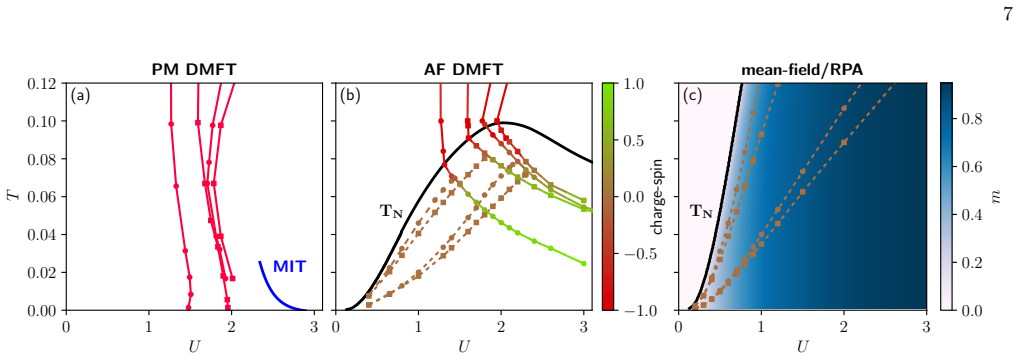
Below the Néel temperature, the divergence lines of the two-particle irreducible vertex in the Hubbard model bend toward higher $U$ relative to their paramagnetic position, so spontaneous antiferromagnetic order mitigates but does not eliminate the breakdown of the self-consistent perturbation expansion. In the AF phase the charge and spin sectors of the susceptibility couple, and a zero eigenvalue of the generalized susceptibility matrix now produces a divergence in a mixed spin-charge channel; at an exceptional point the corresponding eigenvector switches from predominantly charge to predominantly spin character, and that point coincides with the suppression of the largest spin eigenvalue responsible for the Curie-like magnetic response of the Mott bad metal. In the Slater weak-coupling regime only “real-part zero-crossing” lines, which are complex-conjugate eigenvalue pairs with zero real part, are found just as in RPA, while true vertex divergences appear in the Heisenberg strong-coupling regime. The local charge response is suppressed by AF order in the Slater regime but enhanced in the Heisenberg regime, tracing the same split to a delicate balance between bubble and vertex contributions.
Load-bearing premise
The load-bearing premise is that a two-dimensional dynamical mean-field solution with spontaneously broken spin symmetry, which violates the theorem forbidding long-range magnetic order in two dimensions, is a valid stand-in for the true antiferromagnetic Hubbard model and correctly locates the lattice vertex divergences.
Editorial extensions
If this is right
- Bold diagrammatic resummations and parquet-type schemes aimed at antiferromagnetically ordered phases should use two-particle vertices computed directly in the ordered state, because a paramagnetic starting point would miss the Slater-to-Heisenberg crossover identified here.
- The exceptional point where a divergence line changes from charge- to spin-dominated provides a sharp two-particle diagnostic of the crossover between Slater and Heisenberg antiferromagnetism.
- In two dimensions, where long-range order is forbidden at finite temperature, the “RZ lines” of the broken-symmetry solution are expected to become actual divergence lines accumulating toward $T=U=0$, implying that the self-consistent perturbation expansion has no convergence radius at zero temperature.
- At finite doping the coupled spin-charge instability condition of the AF Bethe-Salpeter equation predicts simultaneous divergences of spin and charge responses, relevant for phase-separation instabilities in doped antiferromagnets.
Reading between the lines
- The pattern “order mitigates but does not remove the singularity” may be generic: any broken-symmetry state that leaves the underlying interaction strong could show a similar bending of non-perturbative boundaries rather than their disappearance.
- If the RZ-to-divergence conversion under restoration of spin symmetry holds, then inexpensive RPA-level calculations in symmetry-broken states could be used to map where non-perturbative physics will appear in more exact treatments.
- The eigenvalue-fountain picture suggests a practical diagnostic: the appearance of complex-conjugate eigenvalue pairs in mean-field susceptibility matrices can flag a regime where a fully self-consistent calculation will develop genuine vertex divergences, even though the mean-field vertex itself cannot diverge.
Editorial analysis
A structured set of objections, weighed in public.
Referee Report
Summary. The paper extends the study of two-particle irreducible vertex divergences to the antiferromagnetically ordered phase of the half-filled Hubbard model, using dynamical mean-field theory (DMFT) and, for comparison, static mean-field/RPA. The central numerical finding is that, below the Néel temperature, the vertex divergence lines bend toward larger interaction U relative to the paramagnetic phase, indicating that long-range AF order partially mitigates but does not eliminate the breakdown of self-consistent perturbation theory. The authors also identify exceptional points at which divergence lines change from charge-dominated to spin-dominated character, trace real-part zero-crossing (RZ) lines toward the Slater regime, and connect the eigenvalue structure of the local generalized susceptibility to the Slater-Heisenberg crossover. A generalized Bethe-Salpeter analysis is used to discuss possible thermodynamic instabilities in the AF phase, and the final section speculates about implications for two-dimensional systems where Mermin-Wagner prevents true long-range order.
Significance. If the central claim holds, the paper establishes a qualitatively new result: the onset of AF order shifts but does not remove the non-perturbative breakdown of self-consistent perturbation theory. This would extend a decade of paramagnetic-phase studies into symmetry-broken phases and provides a two-particle diagnostic of the Slater-Heisenberg crossover, which is valuable for future diagrammatic extensions of DMFT. The paper has notable strengths: the formal BSE derivation for the Bethe lattice in Appendix E is transparent; the small-magnetization approximation in Section IV is explicitly tested; and the authors provide a public dataset and plotting scripts (Appendix A, Ref. [88]). The central claims are, however, currently supported by a 2D DMFT solution that violates the Mermin-Wagner theorem, by divergence-line locations reported without statistical uncertainty, and by an eigenvector selection criterion whose robustness is not established. These issues affect the strength of the central conclusion and require attention before the paper can be accepted.
major comments (4)
- [Section II A and Section VI] The central physical conclusion—that AF order mitigates but does not prevent the breakdown of perturbation theory—is established in a 2D DMFT solution in which long-range AF order at finite temperature is forbidden by the Mermin-Wagner theorem. The authors explicitly acknowledge this and assume in Section II A that their 2D results are 'qualitatively similar' to those of a 3D Hubbard model, without derivation or benchmarking. This assumption is load-bearing: if the broken-symmetry 2D DMFT solution is an artifact of the local mean-field-like approximation, the reported bending of divergence lines below TN may not be a property of AF order in the Hubbard model. I request a concrete test of this proxy, for example a 3D cubic-lattice DMFT calculation at representative (U,T) points, or at least a quantitative justification based on variance-matched density of states and a comparison of the local vertex in the AF phase. The current statement, while honest, is not sufficient to support the paper's main claim about the Hubbard model.
- [Figure 3(b) and Section III A] The claimed 'clear bending' of the divergence lines below TN and the apparent kink at TN are central results, but the reported lines are not accompanied by error bars on the eigenvalue zero crossings. Since the eigenvalues are obtained from CT-QMC data for the two-particle susceptibility, statistical and systematic noise can shift the zero-crossing locations; without quantified uncertainties, the bending could be within numerical error. In addition, the low-U portion of the TN curve in Fig. 3(b) is estimated from a mean-field result with a manually adjusted rescaling factor ('albeit with a slightly higher factor', Ref. [60]), and the exact factor is not stated. Please specify the rescaling procedure and provide either error bars on the divergence lines or a sensitivity analysis showing that the bending is robust to QMC noise and to the TN normalization.
- [Section III B, Eq. (48), and Fig. 4] The interpretation in terms of a Slater-Heisenberg crossover relies on the eigenvalues/eigenvectors 'associated with the lowest Matsubara frequencies', selected by the criterion in Eq. (48) using the lowest five Matsubara frequencies. The paper acknowledges that the quantitative behavior of χc is not reproduced without including more eigenvectors, but it still uses this subset to draw the qualitative conclusion that low-frequency eigenvalues capture the Slater-Heisenberg change. This selection threshold N* is a free parameter, and no convergence test with respect to N* or an alternative objective criterion is reported. Please demonstrate that the qualitative conclusions—negative low-frequency contributions in the Slater AF, less-negative contributions in the Heisenberg AF—are robust to N* and, ideally, corroborate the crossover location with an independent one-particle or thermodynamic diagnostic (e.g., double occupancy or the kinetic-energy gain).
- [Section IV, Eqs. (56)-(63)] The small-magnetization approximation of Eqs. (57)-(58), which is used to derive the effective renormalization t^2 D_i and the combined stability condition of Eq. (63), is verified in Fig. 8 only for U=3 and for four specific temperatures/magnetizations (m = 0.31, 0.61, 0.78, 0.92). The subsequent phase-separation discussion and the claim that the main effects of SU(2) breaking are general rely on this approximation being valid in the regime where it is applied. Please test the approximation at weak coupling (e.g., U=1, where RZ lines and the Slater regime are located) and either provide an estimate of the neglected off-diagonal couplings or explicitly restrict the conclusions to the parameter range where the approximation has been verified.
minor comments (5)
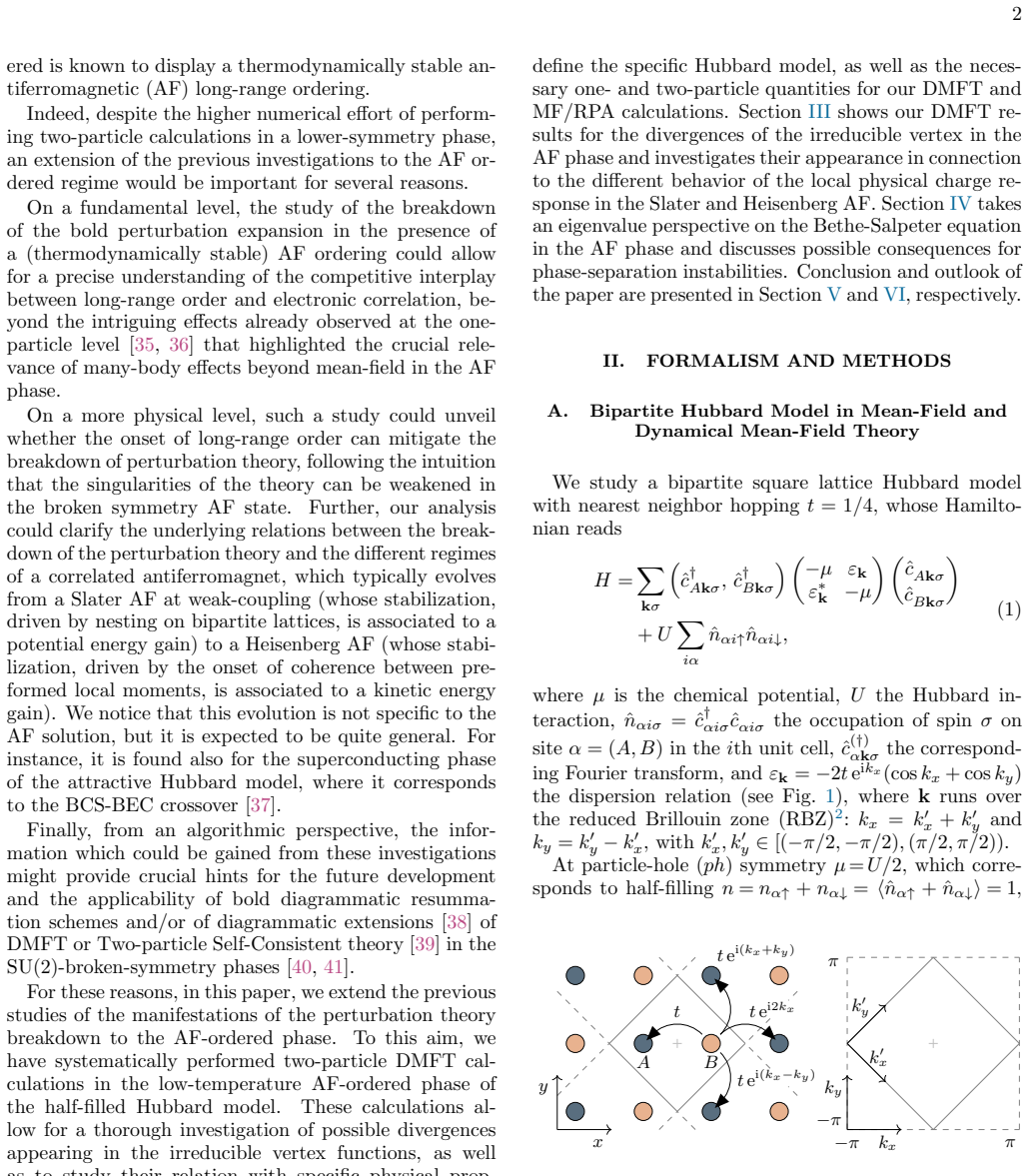
- [Fig. 1 caption] The phrase 'hopping parameters to the next neighbors' should read 'hopping parameters to the nearest neighbors'.
- [Eq. (40) and surrounding text] The text states Γ = β δΣ[G]/δG, while Eq. (40) contains an explicit factor β/2; please reconcile the notation or add a sentence explaining the factor.
- [Section VI] There is a typo in 'particle-holy symmetric' (should be 'particle-hole symmetric').
- [Section III A] The term 'exceptional point' is used for a degeneracy of two zero eigenvalues of χ; since 'exceptional point' already has a standard meaning in the context of non-Hermitian matrices, please clarify the relation between the two uses or add a footnote.
- [References] Ref. [41] is cited as an arXiv preprint; if it has been published by the time of publication, please update the reference.
Circularity Check
No significant circularity: the AF vertex-divergence results are new numerical computations and the divergence criterion is used as a diagnostic identity, not as a fitted prediction.
full rationale
The paper's derivation chain is self-contained: it computes the local generalized susceptibility of the AF DMFT solution, locates zero eigenvalues of chi, and maps them to irreducible-vertex divergences via the algebraic identity Gamma = chi^{-1} - chi0^{-1} (Eq. 39). This identity is definitional, but it is used as a diagnostic: the actual results are the numerically computed locations of the zero eigenvalues in the AF phase, which are not encoded in the definition. No parameter is fitted to the quantity later presented as a prediction, and the AF calculations are new. The PM reference lines are imported from Ref. [24], a published prior calculation by a partially overlapping group; this is a legitimate benchmark, not an unverified self-citation, and the central AF lines are newly computed. The explicit Mermin-Wagner caveat in Section II A is a physical validity assumption about 2D vs 3D behavior, not a circular definition. The Bethe-lattice formulas in Section IV are used only after numerical verification (Fig. 7). I find no step where a claimed prediction reduces to its own input by construction or by self-citation.
Assumptions & free parameters
free parameters (2)
- Low-frequency eigenvector selection threshold N* =
5 Matsubara frequencies
- Low-U Néel temperature rescaling factor =
not specified, 'slightly higher factor'
assumptions (4)
- domain assumption DMFT locality of the irreducible vertex
- domain assumption AF long-range order in 2D DMFT despite Mermin-Wagner
- ad hoc to paper Small-magnetization off-diagonal approximation in the BSE
- standard math Distinct eigenvalues of complex symmetric χ yield a transpose-orthonormal eigenbasis
Cite this review
Pith. "Pith review of Non-Perturbative Feats in the Physics of Correlated Antiferromagnets." pith.science (2026). https://pith.science/paper/BNL5CJ3J
@misc{pith2026241113417,
  author       = {Pith},
  title        = {Pith review of: Non-Perturbative Feats in the Physics of Correlated Antiferromagnets},
  year         = {2026},
  howpublished = {\url{https://pith.science/paper/BNL5CJ3J}},
  note         = {Machine review of arXiv:2411.13417}
}
read the original abstract
In the last decades multifaceted manifestations of the breakdown of the self-consistent perturbation theory have been identified for the many-electron problem. Yet, the investigations have been so far mostly limited to paramagnetic states, where symmetry breaking is not allowed. Here, we extend the analysis to the spontaneously symmetry-broken antiferromagnetic (AF) phase of the repulsive Hubbard model. To this aim, we calculated two-particle quantities using dynamical mean-field theory for the AF-ordered Hubbard model and studied the possible occurrence of divergences of the irreducible vertex functions in the charge and spin sectors. Our calculations pinpoint the divergences in the AF phase diagram, showing that while the onset of AF order mitigates the breakdown of the perturbation expansion, it does not fully prevent it. Moreover, we have been able to link the changes in the dynamical structure of the corresponding generalized susceptibilities to the physical crossover from a weak-coupling (Slater) to a strong-coupling (Heisenberg) antiferromagnet, which takes place as the interaction strength is gradually increased. Finally, we discuss possible physical consequences of the irreducible vertex divergences in triggering phase-separation instabilities within the AF phase and elaborate on the implications of our findings for two-dimensional systems, where the onset of a long-range AF order is prevented by the Mermin-Wagner theorem.
Figures

Figures from the paper (7 more)


Reference graph
Works this paper leans on
- [88]
- [60]
-
[1]
bubble” susceptibility χ0 reads: χ0 = −βG2 νσ δνν ′ (E2) and the uniform ( q = 0) “bubble
PM phase For the subsequent derivation it is convenient to ex- press the local Green’s function Gν of the Bethe lattice as Hilbert transform: Gνσ = Z ∞ −∞ dϵ ρ(ϵ) 1 ζνσ − ϵ = 1 ζνσ − t2Gνσ (E1) with the hybridization function ∆ νσ = t2Gνσ and ζνσ = iν + µ − Σνσ . The local “bubble” susceptibility χ0 reads: χ0 = −βG2 νσ δνν ′ (E2) and the uniform ( q = 0) ...
-
[2]
χs χsc χcs χc −1 − χ0 χ0 χ0 χ0 −1 + χAA 0q=0 ± χAB 0q=0 χAA 0q=0 ∓ χAB 0q=0 χAA 0q=0 ± χAB 0q=0 χAA 0q=0 ∓ χAB 0q=0 −1#−1 =
AF phase In the AF phase, the Green’s function becomes a ma- trix of the two sub-lattice sites α = (A, B): Gνσ = Z ∞ −∞ dϵ ρ(ϵ) 1 ζAνσ ζBνσ − ϵ2 ζBνσ ϵ ϵ ζ Aνσ (E6) = GAνσ 0 0 GBνσ = 1 ζAνσ −t2GBνσ 0 0 1 ζBνσ −t2GAνσ and the local “bubble” susceptibility χ0 reads: χαα 0σσ = −βG2 ανσ δνν ′. (E7) The respective χ0q=0 susceptibilities become: χαα 0q=0σσ = − ...
-
[3]
Timusk and B
T. Timusk and B. Statt, The pseudogap in high- temperature superconductors: an experimental survey, Rep. Prog. Phys. 62, 61 (1999)
1999
-
[4]
fountain
Lowest order (U = 0) In the non-interacting U = 0 case, or in the lowest or- der, the local generalized susceptibility χ of the Bethe lattice is given by the bare local “bubble” χαα(0) 0σσ = −β(G0 ανσ )2δνν ′. For a magnetic field h, the local sus- ceptibility in the charge and spin components then reads χ(0) 0 = χαα(0) 0 χαα(0) 0 χαα(0) 0 χαα(0) 0 ! . (F...
-
[5]
9, reading χ(1) 0σσ = − 2U βδνν ′(G0 νσ )3 1 β X ν1 eiν0+ G0 ν1−σ ! , (F6) χ(1) σ−σ = − U (G0 νσ )2(G0 ν′−σ)2
First order in U The first-order corrections in U to the local generalized charge susceptibility are displayed in Fig. 9, reading χ(1) 0σσ = − 2U βδνν ′(G0 νσ )3 1 β X ν1 eiν0+ G0 ν1−σ ! , (F6) χ(1) σ−σ = − U (G0 νσ )2(G0 ν′−σ)2. (F7) The former expression in Eq. (F7) corresponds to the first self-energy correction of χ0 and the latter in Eq. (F7) to the ...
-
[6]
von L¨ ohneysen, A
H. von L¨ ohneysen, A. Rosch, M. Vojta, and P. W¨ olfle, Fermi-liquid instabilities at magnetic quantum phase transitions, Rev. Mod. Phys. 79, 1015 (2007)
2007
Show all 95 references
-
[7]
Sch¨ afer, A
T. Sch¨ afer, A. A. Katanin, K. Held, and A. Toschi, Inter- play of correlations and kohn anomalies in three dimen- sions: Quantum criticality with a twist, Phys. Rev. Lett. 119, 046402 (2017)
2017
-
[8]
Kozik, M
E. Kozik, M. Ferrero, and A. Georges, Nonexistence of the luttinger-ward functional and misleading convergence of skeleton diagrammatic series for hubbard-like models, Phys. Rev. Lett. 114, 156402 (2015)
2015
-
[9]
Gunnarsson, T
O. Gunnarsson, T. Sch¨ afer, J. P. F. LeBlanc, E. Gull, J. Merino, G. Sangiovanni, G. Rohringer, and A. Toschi, Fluctuation diagnostics of the electron self-energy: Ori- gin of the pseudogap physics, Phys. Rev. Lett. 114, 236402 (2015)
2015
-
[10]
P. Worm, M. Reitner, K. Held, and A. Toschi, Fermi and luttinger arcs: Two concepts, realized on one surface, Phys. Rev. Lett. 133, 166501 (2024)
2024
-
[11]
Krsnik and K
J. Krsnik and K. Held, Local correlations necessitate wa- terfalls as a connection between quasiparticle band and developing hubbard bands, Nature Communications 16, 255 (2025)
2025
-
[12]
Sch¨ afer, G
T. Sch¨ afer, G. Rohringer, O. Gunnarsson, S. Ciuchi, G. Sangiovanni, and A. Toschi, Divergent precursors of the mott-hubbard transition at the two-particle level, Phys. Rev. Lett. 110, 246405 (2013)
2013
-
[13]
Tarantino, B
W. Tarantino, B. S. Mendoza, P. Romaniello, J. A. Berger, and L. Reining, Many-body perturbation theory and non-perturbative approaches: screened interaction as the key ingredient, Journal of Physics: Condensed Matter 30, 135602 (2018)
2018
-
[14]
A. Stan, P. Romaniello, S. Rigamonti, L. Reining, and J. A. Berger, Unphysical and physical solutions in many- body theories: from weak to strong correlation, New Journal of Physics 17, 093045 (2015)
2015
-
[15]
Gunnarsson, T
O. Gunnarsson, T. Sch¨ afer, J. P. F. LeBlanc, J. Merino, G. Sangiovanni, G. Rohringer, and A. Toschi, Parquet decomposition calculations of the electronic self-energy, Phys. Rev. B 93, 245102 (2016)
2016
-
[16]
Gunnarsson, G
O. Gunnarsson, G. Rohringer, T. Sch¨ afer, G. Sangio- vanni, and A. Toschi, Breakdown of traditional many- body theories for correlated electrons, Phys. Rev. Lett. 119, 056402 (2017)
2017
-
[17]
Chalupa, P
P. Chalupa, P. Gunacker, T. Sch¨ afer, K. Held, and A. Toschi, Divergences of the irreducible vertex functions in correlated metallic systems: Insights from the ander- son impurity model, Phys. Rev. B 97, 245136 (2018)
2018
-
[18]
Reitner, P
M. Reitner, P. Chalupa, L. Del Re, D. Springer, S. Ciuchi, G. Sangiovanni, and A. Toschi, Attractive effect of a strong electronic repulsion: The physics of vertex diver- gences, Phys. Rev. Lett. 125, 196403 (2020)
2020
-
[19]
Vuˇ ciˇ cevi´ c, N
J. Vuˇ ciˇ cevi´ c, N. Wentzell, M. Ferrero, and O. Parcollet, 20 Practical consequences of the luttinger-ward functional multivaluedness for cluster dmft methods, Phys. Rev. B 97, 125141 (2018)
2018
-
[20]
Springer, P
D. Springer, P. Chalupa, S. Ciuchi, G. Sangiovanni, and A. Toschi, Interplay between local response and vertex divergences in many-fermion systems with on-site attrac- tion, Phys. Rev. B 101, 155148 (2020)
2020
-
[21]
Reitner, L
M. Reitner, L. Crippa, D. R. Fus, J. C. Budich, A. Toschi, and G. Sangiovanni, Protection of correlation-induced phase instabilities by exceptional susceptibilities, Phys. Rev. Res. 6, L022031 (2024)
2024
-
[22]
H. Eßl, M. Reitner, G. Sangiovanni, and A. Toschi, Gen- eral shiba mapping for on-site four-point correlation func- tions, Phys. Rev. Res. 6, 033061 (2024)
2024
-
[23]
formally
(where instead of a Pauli matrix σz structure, one simply has the identity 1 ), in the AF-DMFT case, it is not possible to diagonalize simultaneously the two terms on the r.h.s. of Eq. (55). Nonetheless, at small values of the magnetization m, when χsc and χcs are small compar...
2020
-
[24]
Chalupa, T
P. Chalupa, T. Sch¨ afer, M. Reitner, D. Springer, S. An- dergassen, and A. Toschi, Fingerprints of the local mo- ment formation and its kondo screening in the gener- alized susceptibilities of many-electron problems, Phys. Rev. Lett. 126, 056403 (2021)
2021
-
[25]
T. B. Mazitov and A. A. Katanin, Local magnetic mo- ment formation and kondo screening in the half-filled single-band hubbard model, Phys. Rev. B 105, L081111 (2022)
2022
-
[26]
T. B. Mazitov and A. A. Katanin, Effect of local mag- netic moments on spectral properties and resistivity near interaction- and doping-induced mott transitions, Phys. Rev. B 106, 205148 (2022)
2022
-
[27]
smoking gun
S. Adler, F. Krien, P. Chalupa-Gantner, G. Sangiovanni, and A. Toschi, Non-perturbative intertwining between spin and charge correlations: A “smoking gun” single- boson-exchange result, SciPost Phys. 16, 054 (2024)
2024
-
[28]
Kowalski, M
A. Kowalski, M. Reitner, L. Del Re, M. Chatzielefthe- riou, A. Amaricci, A. Toschi, L. de’ Medici, G. Sangio- vanni, and T. Sch¨ afer, Thermodynamic stability at the two-particle level, Phys. Rev. Lett. 133, 066502 (2024)
2024
-
[29]
Sch¨ afer, S
T. Sch¨ afer, S. Ciuchi, M. Wallerberger, P. Thunstr¨ om, O. Gunnarsson, G. Sangiovanni, G. Rohringer, and A. Toschi, Nonperturbative landscape of the mott- hubbard transition: Multiple divergence lines around the critical endpoint, Phys. Rev. B 94, 235108 (2016)
2016
-
[30]
M. Pelz, S. Adler, M. Reitner, and A. Toschi, Highly nonperturbative nature of the mott metal-insulator tran- sition: Two-particle vertex divergences in the coexistence region, Phys. Rev. B 108, 155101 (2023)
2023
-
[31]
Nourafkan, M
R. Nourafkan, M. Cˆ ot´ e, and A.-M. S. Tremblay, Charge fluctuations in lightly hole-doped cuprates: Effect of ver- tex corrections, Phys. Rev. B 99, 035161 (2019)
2019
-
[32]
Grilli and C
M. Grilli and C. Castellani, Electron-phonon interactions in the presence of strong correlations, Phys. Rev. B 50, 16880 (1994)
1994
-
[33]
Capone, C
M. Capone, C. Castellani, and M. Grilli, Electron-phonon interaction in strongly correlated systems, Advances in Condensed Matter Physics 2010, 920860 (2010)
2010
-
[34]
Grilli, R
M. Grilli, R. Raimondi, C. Castellani, C. Di Castro, and G. Kotliar, Superconductivity, phase separation, and charge-transfer instability in the u=∞ limit of the three- band model of the cuo 2 planes, Phys. Rev. Lett. 67, 259 (1991)
1991
-
[35]
Emery and S
V. Emery and S. Kivelson, Frustrated electronic phase separation and high-temperature superconductors, Phys- ica C: Superconductivity 209, 597 (1993)
1993
-
[36]
Dagotto, J
E. Dagotto, J. Riera, Y. C. Chen, A. Moreo, A. Nazarenko, F. Alcaraz, and F. Ortolani, Supercon- ductivity near phase separation in models of correlated electrons, Phys. Rev. B 49, 3548 (1994)
1994
-
[37]
Rohshap, M
S. Rohshap, M. K. Ritter, H. Shinaoka, J. von Delft, M. Wallerberger, and A. Kauch, Two-particle calcula- tions with quantics tensor trains: Solving the parquet equations, Phys. Rev. Res. 7, 023087 (2025)
2025
-
[38]
Georges, G
A. Georges, G. Kotliar, W. Krauth, and M. J. Rozen- berg, Dynamical mean-field theory of strongly correlated fermion systems and the limit of infinite dimensions, Rev. Mod. Phys. 68, 13 (1996)
1996
-
[39]
Maier, M
T. Maier, M. Jarrell, T. Pruschke, and M. H. Hettler, Quantum cluster theories, Rev. Mod. Phys. 77, 1027 (2005)
2005
-
[40]
Sangiovanni, A
G. Sangiovanni, A. Toschi, E. Koch, K. Held, M. Capone, C. Castellani, O. Gunnarsson, S.-K. Mo, J. W. Allen, H.- D. Kim, A. Sekiyama, A. Yamasaki, S. Suga, and P. Met- calf, Static versus dynamical mean-field theory of mott antiferromagnets, Phys. Rev. B 73, 205121 (2006)
2006
-
[41]
Taranto, G
C. Taranto, G. Sangiovanni, K. Held, M. Capone, A. Georges, and A. Toschi, Signature of antiferromag- netic long-range order in the optical spectrum of strongly correlated electron systems, Phys. Rev. B 85, 085124 (2012)
2012
-
[42]
Toschi, M
A. Toschi, M. Capone, and C. Castellani, Energetic bal- ance of the superconducting transition across the bcs— bose einstein crossover in the attractive hubbard model, Phys. Rev. B 72, 235118 (2005)
2005
-
[43]
Rohringer, H
G. Rohringer, H. Hafermann, A. Toschi, A. A. Katanin, A. E. Antipov, M. I. Katsnelson, A. I. Lichtenstein, A. N. Rubtsov, and K. Held, Diagrammatic routes to nonlocal correlations beyond dynamical mean field theory, Rev. Mod. Phys. 90, 025003 (2018)
2018
-
[44]
Y. M. Vilk and A.-M. S. Tremblay, Non-perturbative many-body approach to the hubbard model and single- particle pseudogap, J. Phys. I France 7, 1309 (1997)
1997
-
[45]
Del Re and A
L. Del Re and A. Toschi, Dynamical vertex approxima- tion for many-electron systems with spontaneously bro- ken su(2) symmetry, Phys. Rev. B 104, 085120 (2021)
2021
-
[46]
Del Re, Dirac points and topological phases in corre- lated altermagnets, arXiv:2408.14288 [cond-mat.str-el]
L. Del Re, Dirac points and topological phases in corre- lated altermagnets, arXiv:2408.14288 [cond-mat.str-el]
-
[47]
S. M. Girvin and K. Yang, Modern Condensed Matter Physics (Cambridge University Press, 2019) Chap. 7.5
2019
-
[48]
Bickers, Self-consistent many-body theory for con- densed matter systems, in Theoretical Methods for Strongly Correlated Electrons (Springer, 2004) pp
N. Bickers, Self-consistent many-body theory for con- densed matter systems, in Theoretical Methods for Strongly Correlated Electrons (Springer, 2004) pp. 237– 296
2004
-
[49]
P. M. Bonetti and W. Metzner, Su(2) gauge theory of the pseudogap phase in the two-dimensional hubbard model, Phys. Rev. B 106, 205152 (2022)
2022
-
[50]
I. A. Goremykin and A. A. Katanin, Antiferromagnetic and spin spiral correlations in the doped two-dimensional hubbard model: Gauge symmetry, ward identities, and dynamical mean-field theory analysis, Phys. Rev. B 110, 085153 (2024)
2024
-
[51]
E. Gull, A. J. Millis, A. I. Lichtenstein, A. N. Rubtsov, M. Troyer, and P. Werner, Continuous-time monte carlo methods for quantum impurity models, Rev. Mod. Phys. 83, 349 (2011)
2011
-
[52]
Wallerberger, A
M. Wallerberger, A. Hausoel, P. Gunacker, A. Kowal- ski, N. Parragh, F. Goth, K. Held, and G. Sangiovanni, w2dynamics: Local one- and two-particle quantities from 21 dynamical mean field theory, Computer Physics Commu- nications 235, 388 (2019)
2019
-
[53]
A. V. Chubukov and D. M. Frenkel, Renormalized per- turbation theory of magnetic instabilities in the two- dimensional hubbard model at small doping, Phys. Rev. B 46, 11884 (1992)
1992
-
[54]
Rohringer, A
G. Rohringer, A. Valli, and A. Toschi, Local electronic correlation at the two-particle level, Phys. Rev. B 86, 125114 (2012)
2012
-
[55]
F. B. Kugler, S.-S. B. Lee, and J. von Delft, Multipoint correlation functions: Spectral representation and nu- merical evaluation, Phys. Rev. X 11, 041006 (2021)
2021
-
[56]
Watzenb¨ ock, M
C. Watzenb¨ ock, M. Fellinger, K. Held, and A. Toschi, Long-term memory magnetic correlations in the Hubbard model: A dynamical mean-field theory analysis, SciPost Phys. 12, 184 (2022)
2022
-
[57]
Metzner and D
W. Metzner and D. Vollhardt, Correlated lattice fermions in d = ∞ dimensions, Phys. Rev. Lett. 62, 324 (1989)
1989
-
[58]
Lee, Centrohermitian and skew-centrohermitian ma- trices, Linear Algebra and its Applications 29, 205 (1980), special Volume Dedicated to Alson S
A. Lee, Centrohermitian and skew-centrohermitian ma- trices, Linear Algebra and its Applications 29, 205 (1980), special Volume Dedicated to Alson S. House- holder
1980
-
[59]
J. C. Ward, An identity in quantum electrodynamics, Phys. Rev. 78, 182 (1950)
1950
-
[61]
A. J. Kim and V. Sacksteder, Multivaluedness of the luttinger-ward functional in the fermionic and bosonic system with replicas, Phys. Rev. B 101, 115146 (2020)
2020
-
[62]
H. Eßl, M. Reitner, E. Kozik, and A. Toschi, How to stay on the physical branch in self-consistent many-electron approaches (2025), arXiv:2502.01420 [cond-mat.str-el]
2025 arXiv
-
[63]
Bl¨ umer,Mott-Hubbard Metal-Insulator Transition and Optical Conductivity in High Dimensions , Ph.D
N. Bl¨ umer,Mott-Hubbard Metal-Insulator Transition and Optical Conductivity in High Dimensions , Ph.D. thesis, Universit¨ at Mainz (2002)
2002
-
[64]
Kuneˇ s, Efficient treatment of two-particle vertices in dynamical mean-field theory, Phys
J. Kuneˇ s, Efficient treatment of two-particle vertices in dynamical mean-field theory, Phys. Rev. B 83, 085102 (2011)
2011
-
[65]
P. G. J. van Dongen, Extended hubbard model at weak coupling, Phys. Rev. B 50, 14016 (1994)
1994
-
[66]
Toschi, M
A. Toschi, M. Capone, M. Ortolani, P. Calvani, S. Lupi, and C. Castellani, Temperature dependence of the op- tical spectral weight in the cuprates: Role of electron correlations, Phys. Rev. Lett. 95, 097002 (2005)
2005
-
[67]
Del Re and G
L. Del Re and G. Rohringer, Fluctuations analysis of spin susceptibility: N´ eel ordering revisited in dynamical mean field theory, Phys. Rev. B 104, 235128 (2021)
2021
-
[68]
E. G. C. P. van Loon, Second-order phase transitions and divergent linear response in dynamical mean-field theory, Phys. Rev. B 109, L241110 (2024)
2024
-
[69]
E. G. C. P. van Loon, Two-particle correlations and the metal-insulator transition: Iterated perturbation theory revisited, Phys. Rev. B 105, 245104 (2022)
2022
-
[70]
Moghadas, M
E. Moghadas, M. Reitner, T. Wehling, G. Sangiovanni, S. Ciuchi, and A. Toschi, Effective enhancement of the electron-phonon coupling driven by nonperturbative electronic density fluctuations (2025), arXiv:2503.12113 [cond-mat.str-el]
2025
-
[71]
Janiˇ s and V
V. Janiˇ s and V. Pokorn´ y, Critical metal-insulator transi- tion and divergence in a two-particle irreducible vertex in disordered and interacting electron systems, Phys. Rev. B 90, 045143 (2014)
2014
-
[72]
Rossi and F
R. Rossi and F. Werner, Skeleton series and multivalued- ness of the self-energy functional in zero space-time di- mensions, Journal of Physics A: Mathematical and The- oretical 48, 485202 (2015)
2015
-
[73]
Rossi, F
R. Rossi, F. Werner, N. Prokof’ev, and B. Svistunov, Shifted-action expansion and applicability of dressed di- agrammatic schemes, Phys. Rev. B93, 161102(R) (2016)
2016
-
[74]
E. G. C. P. van Loon, F. Krien, and A. A. Katanin, Bethe-salpeter equation at the critical end point of the mott transition, Phys. Rev. Lett. 125, 136402 (2020)
2020
-
[75]
A. K. Arzhnikov and A. G. Groshev, Effect of thermal fluctuations on magnetic phase separation and on the parameters of spin-spiral waves, JETP Letters 94, 703 (2012)
2012
-
[76]
Lenihan, A
C. Lenihan, A. J. Kim, F. ˇSimkovic, and E. Kozik, Evaluating Second-Order Phase Transitions with Dia- grammatic Monte Carlo: N´ eel Transition in the Doped Three-Dimensional Hubbard Model, Phys. Rev. Lett. 129, 107202 (2022)
2022
-
[77]
Rampon, F
L. Rampon, F. ˇSimkovic, and M. Ferrero, Magnetic phase diagram of the three-dimensional doped hubbard model, Phys. Rev. Lett. 134, 066502 (2025)
2025
-
[78]
Castellani, C
C. Castellani, C. Di Castro, and M. Grilli, Singular quasi- particle scattering in the proximity of charge instabilities, Phys. Rev. Lett. 75, 4650 (1995)
1995
-
[79]
Sorella, The phase diagram of the hubbard model by variational auxiliary field quantum monte carlo, arXiv:2101.07045 [cond-mat.str-el]
S. Sorella, The phase diagram of the hubbard model by variational auxiliary field quantum monte carlo, arXiv:2101.07045 [cond-mat.str-el]
-
[80]
Toschi, A
A. Toschi, A. A. Katanin, and K. Held, Dynamical ver- tex approximation: A step beyond dynamical mean-field theory, Phys. Rev. B 75, 045118 (2007)
2007
-
[81]
Taranto, S
C. Taranto, S. Andergassen, J. Bauer, K. Held, A. Katanin, W. Metzner, G. Rohringer, and A. Toschi, From infinite to two dimensions through the functional renormalization group, Phys. Rev. Lett. 112, 196402 (2014)
2014
-
[82]
Wentzell, C
N. Wentzell, C. Taranto, A. Katanin, A. Toschi, and S. Andergassen, Correlated starting points for the func- tional renormalization group, Phys. Rev. B 91, 045120 (2015)
2015
-
[83]
Del Re, Two-particle self-consistent approach for bro- ken symmetry phases, SciPost Phys
L. Del Re, Two-particle self-consistent approach for bro- ken symmetry phases, SciPost Phys. 18, 077 (2025)
2025
-
[84]
M. Qin, T. Sch¨ afer, S. Andergassen, P. Corboz, and E. Gull, The hubbard model: A computational perspec- tive, Annual Review of Condensed Matter Physics 13, 275–302 (2022)
2022
-
[85]
N. D. Mermin and H. Wagner, Absence of ferromag- netism or antiferromagnetism in one- or two-dimensional isotropic heisenberg models, Phys. Rev. Lett. 17, 1133 (1966)
1966
-
[86]
Baier, E
T. Baier, E. Bick, and C. Wetterich, Temperature depen- dence of antiferromagnetic order in the hubbard model, Phys. Rev. B 70, 125111 (2004)
2004
-
[87]
Jenkins, L
S. Jenkins, L. R´ ozsa, U. Atxitia, R. F. L. Evans, K. S. Novoselov, and E. J. G. Santos, Breaking through the mermin-wagner limit in 2d van der waals magnets, Na- ture Communications 13, 10.1038/s41467-022-34389-0 (2022)
2022 doi
-
[89]
A.-M. S. Tremblay, Two-particle-self-consistent approach for the hubbard model, in Strongly Correlated Systems 22 (Springer Berlin Heidelberg, 2011) p. 409–453
2011
-
[90]
Sch¨ afer, F
T. Sch¨ afer, F. Geles, D. Rost, G. Rohringer, E. Arrigoni, K. Held, N. Bl¨ umer, M. Aichhorn, and A. Toschi, Fate of the false mott-hubbard transition in two dimensions, Phys. Rev. B 91, 125109 (2015)
2015
-
[91]
Sch¨ afer, N
T. Sch¨ afer, N. Wentzell, F.ˇSimkovic, Y.-Y. He, C. Hille, M. Klett, C. J. Eckhardt, B. Arzhang, V. Harkov, F. m. c.-M. Le R´ egent, A. Kirsch, Y. Wang, A. J. Kim, E. Kozik, E. A. Stepanov, A. Kauch, S. Andergassen, P. Hansmann, D. Rohe, Y. M. Vilk, J. P. F. LeBlanc, S. Zhang...
2021
-
[92]
E. Gull, P. Werner, X. Wang, M. Troyer, and A. J. Mil- lis, Local order and the gapped phase of the hubbard model: A plaquette dynamical mean-field investigation, Europhysics Letters 84, 37009 (2008)
2008
-
[93]
Reitner, L
M. Reitner, L. Del Re, M. Capone, and A. Toschi, Dataset to: ”Non-Perturbative Feats in the Physics of Correlated Antiferromagnets”, DOI: 10.48436/6wz77- 3sz27 (2025)
2025 doi
-
[94]
R. D. Hill and S. R. Waters, On κ-real and κ-hermitian matrices, Linear Algebra and its Applications 169, 17 (1992)
1992
-
[95]
Del Re and M
L. Del Re and M. Capone, Selective insulators and anomalous responses in three-component fermionic gases with broken SU(3) symmetry, Phys. Rev. A 98, 063628 (2018)
2018
Reviewed August 12, 2026 · model on record in the stance chip above.
Discussion (0). Continue with ORCID to comment.