REVIEW 2 major objections 5 minor 39 references
White Dwarf Stellar Structure from Effective Polymer Geometry in Loop Quantum Gravity
T0 review · 2 major / 5 minor · reviewed 2026-08-08 · deepseek-v4-flash
Pith's one-line read Polymer gravity pushes white dwarfs past the Chandrasekhar limit.
desk verdict Serious, cleanly-built effective TOV for white dwarfs, but the headline super-Chandrasekhar masses may be truncation artifacts at the metric-domain filter; send to a careful referee. read the letter →
The pith
A machine-rendered reading of the paper's core claim, the machinery that carries it, and where it could break.
The reading
What carries the argument
The load-bearing object is the areal-radius form of the effective polymer metric. Its radial metric function $F(R, m; A_\lambda, \eta)$ is defined through an implicit variable $y$ satisfying a cubic equation, together with the stellar prescription $M_B \to m(R)$ and $M_W = \eta\,m(R)$. The mass and pressure equations are derived from the mixed Einstein tensor components, with the polymer correction entering only through $F$ and its partial derivatives. In the limit $A_\lambda \to 0^+$, $F \to 1 - 2m/R$ and the standard TOV system is recovered; for $\eta = 1$ the symmetric polymer benchmark is reproduced.
What would settle it
Compute the angular component of the effective Einstein equations for the perfect-fluid source used here; a nonzero residual $G^\theta_\theta - 8\pi P$ in the interior would mean the stellar system is not a consistent solution of the effective field equations.
Extended reading notes
Core claim
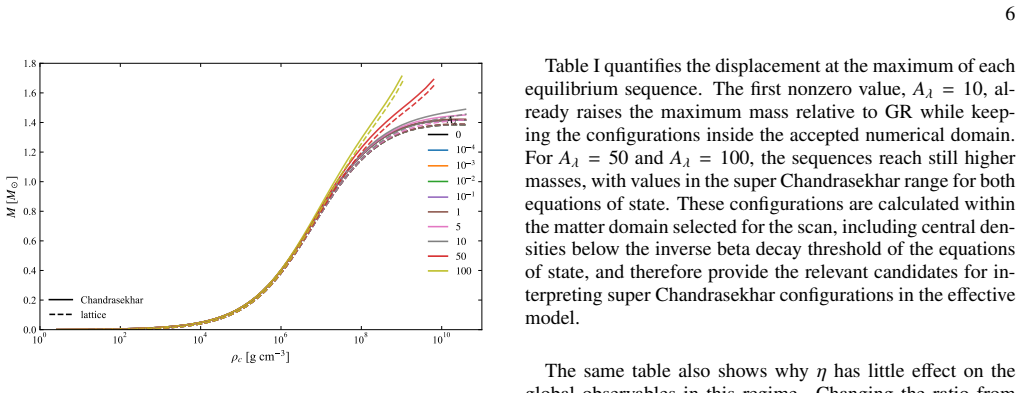
The central discovery claimed is that the areal-radius form of the effective polymer metric yields a two-parameter stellar structure system that reduces to the standard TOV equations when $A_\lambda \to 0$, and that increasing $A_\lambda$ produces a controlled upward shift of the equilibrium sequence. For the Chandrasekhar equation of state the undeformed maximum is $1.4166\,M_\odot$ at radius $1010.7$ km; with the Coulomb lattice correction it is $1.3850\,M_\odot$ at $980.5$ km. At $A_\lambda = 100$ these maxima rise to $1.7125\,M_\odot$ and $1.6907\,M_\odot$, with the configurations remaining inside the inverse $\beta$ decay domain. Varying $\eta = 0.5$ or $2$ changes $M_\mathrm{max}$ by less than $0.1\%$ and the radius at maximum mass by less than $0.33\%$, so the paper identifies $A_\lambda$, not $\eta$, as the parameter that controls the super-Chandrasekhar displacement.
Load-bearing premise
The load-bearing premise is that a spacetime geometry originally built to describe vacuum black holes, with a fixed polymer scale and with one asymptotic mass parameter turned into an interior mass function, describes the inside of a white dwarf.
Editorial extensions
If this is right
- The super-Chandrasekhar candidates at $A_\lambda = 100$ are obtained without pushing the carbon equation of state past the inverse beta decay threshold, so they are equilibrium solutions within the stated matter domain.
- The same upward displacement appears for both the Chandrasekhar equation of state and the lattice-corrected version, indicating the effect is a property of the effective gravitational sector rather than of a particular microphysical feature.
- The $\eta$ asymmetry imprints mainly on the metric function near the polymer transition region, so white-dwarf observables are nearly insensitive to it; the same effective system applied to neutron stars, where compactness is larger, should show a less suppressed $\eta$ dependence.
- Before interpreting $M_B$, $M_W$, or $M_\star$ as rest-mass observables, baryonic masses and binding energies need to be computed.
Reading between the lines
- Beyond the paper's claims, the fixed-$A_\lambda$ ansatz is the load-bearing simplification; a density-dependent polymer scale would likely change the shape of the sequence, and that is a testable extension.
- Beyond the paper's claims, enforcing the angular Einstein equation with an isotropic perfect fluid is an open consistency check; if it fails, the effective source would need anisotropic pressure or a modified matter sector.
- Beyond the paper's claims, a radial-oscillation analysis of the $A_\lambda = 50$ and $100$ configurations would tell whether these super-Chandrasekhar solutions are stable enough to be observational candidates.
- Beyond the paper's claims, a targeted search for white dwarfs with masses near $1.7\,M_\odot$ and radii near $2400$ km could discriminate the strong-deformation branch from magnetically supported super-Chandrasekhar models.
Editorial analysis
A structured set of objections, weighed in public.
Referee Report
Summary. The paper constructs an effective Tolman-Oppenheimer-Volkoff system for cold carbon white dwarfs from the areal-radius form of a polymer-inspired metric, promoting the two vacuum mass parameters to interior functions via M_B -> m(R) and M_W = eta m(R) at fixed polymer amplitude A_lambda. It derives the modified hydrostatic equations, verifies the general-relativistic and symmetric (eta=1) limits, integrates two standard cold carbon equations of state (Chandrasekhar and with the Coulomb lattice correction), and reports that increasing A_lambda raises the maximum mass to 1.7125 and 1.6907 solar masses at A_lambda=100 for the two matter models, while eta changes M_max by less than 0.1% and the corresponding radius by less than 0.33%. The paper is explicit that these are equilibrium solutions and that radial stability, baryonic masses, and observational fitting are not addressed.
Significance. If the central numerical claim is correct, the paper would identify a concrete parameter in an effective polymer geometry that shifts the white-dwarf mass-radius relation into the super-Chandrasekhar regime without stiffening the equation of state, and would cleanly separate that effect from the geometric asymmetry eta. The derivation is algebraically transparent: the GR limit and the symmetric eta=1 limit are recovered, the equations of state are standard, and the authors are honest about the limitations (no stability analysis, no fitting to observations, phenomenological treatment of A_lambda and eta). The main advertised quantitative result, however, depends on whether the largest reported 'maxima' are genuine turning points of the equilibrium sequence or truncation points of the numerical scan; this is the issue that must be resolved before the result can be accepted.
major comments (2)
- [Sec. V, Fig. 3 and Table I] The values reported as M_max for A_lambda=50 and A_lambda=100 are not shown to be maxima of the equilibrium sequence. The text states that for the largest A_lambda values 'the accepted points terminate at lower central densities because the metric domain filters remove part of the high density grid,' and Table I shows R(M_max) growing from 884.9 km at A_lambda=10 to 1495.9 km at A_lambda=50 and 2452.9 km at A_lambda=100, whereas the GR maximum occurs at about 1010 km. An increasing endpoint radius is the expected signature of a sequence cut on the rising branch, not a true mass turnover. The paper does not specify the filter criteria (thresholds on C_y, F, F_m, or the validity of the root y) and does not report dM/d(rho_c) or dM/dR at the last accepted point. If the mass is still increasing when the scan stops, the headline values 1.7125 and 1.6907 M_sun are scan-boundary truncations rather than super-Chandrasekhar maxima; the central claim of the paper is therefore not yet established. Please extend the computation to show a turnover or, if the endpoint is a genuine regularity boundary of the effective theory, define and justify that boundary and relabel the reported values accordingly.
- [Sec. II, Eq. (6)] The stellar prescription fixes A_lambda as a constant and discards the vacuum relation A_lambda=[lambda_k/(M_B M_W)]^(2/3)/2 while promoting M_B to m(R) and M_W to eta m(R). This is the step that makes A_lambda an independent parameter controlling the mass shift, so it is load-bearing for the physical interpretation. The authors should explain why the mass dependence in the vacuum relation should not survive inside the star; if A_lambda is meant as a phenomenological constant, the range of values used (up to 100) should be motivated or at least connected to the polymer scale lambda_k. Without this discussion, the super-Chandrasekhar displacement is a consequence of a particular, unmotivated assignment of the mass dependence.
minor comments (5)
- [Sec. V, paragraph before Table I] The phrase 'maximum of each equilibrium sequence' should be qualified as 'maximum within the accepted numerical domain' unless the turnover is demonstrated; this would avoid overstating the A_lambda=50 and 100 entries.
- [Table I] Please add the central density rho_c for each selected configuration and, for A_lambda=50 and 100, the value of dM/d(rho_c) (or dM/dR) at the last accepted point, so the distinction between a maximum and a scan cut-off is transparent.
- [Sec. II, Eqs. (7)-(8)] State the conditions under which the positive root y of the cubic exists and is unique for the parameter ranges used, and report the thresholds adopted for the 'metric domain filters' mentioned in Sec. V.
- [Sec. IV, Eq. (47)] The adopted inverse beta decay boundary rho_beta ~ 4.16e10 g/cm^3 should be accompanied by a brief derivation or a more specific reference, since the allowed domain depends on it.
- [Sec. II, Eq. (1)] Consider defining the units of A_lambda explicitly; the combination 8 A_lambda M_B^2 in Eq. (1) suggests a particular normalization that is not otherwise stated.
Circularity Check
No significant circularity: the polymer TOV masses are computed, not fitted, from a fixed geometric ansatz and fixed equations of state.
full rationale
The paper's quantitative derivation is self-contained: the polymer metric is imported from external references (Refs. [33–36], not authored by the present group), promoted to an interior stellar ansatz by the explicit prescription MB→m(R), MW=ηm(R), Aλ=constant, and then integrated through the effective TOV equations. No parameter is fitted to observed masses or radii; the paper explicitly states 'We do not fit supernova data' and 'The parameters Aλ and η are also treated phenomenologically and are not inferred from observations in this version.' The undeformed sequences (1.4166 and 1.3850 M_sun) are compared with known GR white-dwarf results, and the equations are checked to recover the GR TOV limit and the symmetric polymer limit, providing external anchors. The conclusion that Aλ controls the super-Chandrasekhar displacement is a parameter-sensitivity result, not a circular restatement: both Aλ and η enter the geometry, and the calculation shows that Aλ has a large effect while η has sub-percent effects at white-dwarf compactness, which is a nontrivial outcome. The limitations acknowledged in the paper—no radial stability analysis, metric-domain filters, no baryonic mass calculation—are correctness and validity caveats, not circularity. The largest numerical concern, that the Aλ=50 and Aλ=100 'maxima' may be scan-boundary truncations rather than true equilibrium maxima, is a scientific risk but does not involve a fitted input being renamed a prediction or a conclusion being assumed by construction.
Assumptions & free parameters
free parameters (2)
- A_lambda (polymer amplitude) =
scanned: 0 to 100, results highlighted at 10, 50, 100
- eta = M_W/M_B (mass asymmetry ratio) =
scanned: 0.5, 1, 2
assumptions (4)
- domain assumption The polymer metric of Refs. [33-36] remains a valid effective geometry when promoted to an interior stellar ansatz.
- ad hoc to paper The mapping M_B -> m(R) and M_W = eta m(R) at fixed A_lambda is an acceptable way to introduce the mass function.
- domain assumption The angular component of the Einstein equations is automatically satisfied or irrelevant for the perfect-fluid system.
- domain assumption The inverse beta decay boundary rho_beta = 4.16e10 g cm^-3 from Chamel et al. [4] is the correct validity limit for the carbon equations of state.
Cite this review
Pith. "Pith review of White Dwarf Stellar Structure from Effective Polymer Geometry in Loop Quantum Gravity." pith.science (2026). https://pith.science/paper/BNQ3TMB6
@misc{pith2026260805328,
  author       = {Pith},
  title        = {Pith review of: White Dwarf Stellar Structure from Effective Polymer Geometry in Loop Quantum Gravity},
  year         = {2026},
  howpublished = {\url{https://pith.science/paper/BNQ3TMB6}},
  note         = {Machine review of arXiv:2608.05328}
}
abstract
We construct an effective Tolman Oppenheimer Volkoff system for cold carbon white dwarfs using the areal radius form of a polymer metric sector motivated by loop quantum gravity. The two asymptotic mass parameters of the geometry are retained in the stellar prescription through $M_B\rightarrow m(R)$ and $M_W=\eta m(R)$, while the polymer amplitude is controlled by $A_\lambda$. The matter sector is kept fixed and is described by the Chandrasekhar equation of state and by the same carbon model with the Coulomb lattice correction. The resulting equations recover the general relativistic TOV system and the symmetric polymer limit. For the undeformed sequences we obtain $M_{\max}=1.4166\,M_\odot$ for the Chandrasekhar model and $M_{\max}=1.3850\,M_\odot$ when the lattice correction is included. Turning on $A_\lambda$ shifts the massive part of the equilibrium sequence upward without stiffening the equation of state, reaching $M_{\max}=1.7125\,M_\odot$ and $1.6907\,M_\odot$ at $A_\lambda=100$ for the two matter models. These configurations remain within the matter domain imposed by the inverse beta decay boundary used in the scan. The asymmetric ratio $\eta=M_W/M_B$ changes the metric function near the polymer transition region, but its effect on white dwarf observables is small: across the selected configurations, $M_{\max}$ changes by less than $0.1\%$ and the corresponding radius by less than $0.33\%$. The calculation therefore identifies $A_\lambda$ as the parameter controlling the super Chandrasekhar displacement of the mass radius relation, while $\eta$ acts mainly as a geometric asymmetry parameter in the low compactness regime probed by white dwarfs.
Figures


Figures from the paper (1 more)

Reference graph
Works this paper leans on
-
[1]
Chandrasekhar, Astrophysical Journal74, 81 (1931)
S. Chandrasekhar, Astrophysical Journal74, 81 (1931)
work page 1931
-
[2]
E. E. Salpeter, Astrophysical Journal134, 669 (1961)
work page 1961
- [3]
-
[4]
Stability of super-Chandrasekhar magnetic white dwarfs
N. Chamel, A. F. Fantina, and P. J. Davis, Physical Review D 88, 081301 (2013), 1306.3444
work page Pith review arXiv 2013
-
[5]
R. C. Tolman, Physical Review55, 364 (1939)
1939
-
[6]
J. R. Oppenheimer and G. M. V olkoff, Physical Review55, 374 (1939)
work page 1939
-
[7]
The relativistic Feynman-Metropolis-Teller theory for white-dwarfs in general relativity
M. Rotondo, J. A. Rueda, R. Ruffini, and S.-S. Xue, Physical Review D84, 084007 (2011), 1012.0154
work page Pith review arXiv 2011
-
[8]
G. A. Carvalho, R. M. Marinho, and M. Malheiro, General Rel- ativity and Gravitation50, 38 (2018)
work page 2018
Show all 39 references
-
[9]
D. A. Howell, M. Sullivan, P. E. Nugent, R. S. Ellis, A. J. Con- ley, D. Le Borgne, R. G. Carlberg, J. Guy, D. Balam, S. Basa, et al., Nature443, 308 (2006)
2006
-
[10]
Das and B
U. Das and B. Mukhopadhyay, Physical Review Letters110, 071102 (2013), 1301.5965
2013 arXiv
-
[11]
Otoniel, B
E. Otoniel, B. Franzon, G. A. Carvalho, M. Malheiro, S. Schramm, and F. Weber, The Astrophysical Journal879, 46 (2019)
2019
-
[12]
Malheiro, E
M. Malheiro, E. Otoniel, and J. G. Coelho, Brazilian Journal of Physics51, 223 (2021)
2021
-
[13]
G. J. Olmo, D. Rubiera-Garcia, and A. Wojnar, Physics Reports 876, 1 (2020), 1912.05202
2020 arXiv
-
[14]
R. K. Jain, C. Kouvaris, and N. G. Nielsen, Physical Review Letters116, 151103 (2016), 1512.05946
2016 arXiv
-
[15]
G. A. Carvalho, R. V . Lobato, P. H. R. S. Moraes, J. D. V . Ar- bañil, E. Otoniel, R. M. Marinho, and M. Malheiro, The Euro- pean Physical Journal C77, 871 (2017)
2017
-
[16]
Otoniel, J
E. Otoniel, J. M. Z. Pretel, C. E. Mota, C. O. V . Flores, V . B. T. Alves, and F. M. Da Silva, Physics Letters B875, 140323 (2026)
2026
-
[17]
P. Wang, H. Yang, and S. Ying, Physics Letters B718, 265 (2012)
2012
-
[18]
Rashidi, Annals of Physics374, 434 (2016)
R. Rashidi, Annals of Physics374, 434 (2016)
2016
-
[19]
B. P. Abbott et al. (LIGO Scientific, Virgo), Phys. Rev. Lett. 116, 061102 (2016), 1602.03837
2016 arXiv
-
[20]
Fomalont, S
E. Fomalont, S. Kopeikin, G. Lanyi, and J. Benson, Astrophys. J.699, 1395 (2009), 0904.3992
2009 arXiv
-
[21]
M. A. Abramowicz and P. C. Fragile, Living Rev. Rel.16, 1 (2013), 1104.5499
2013 arXiv
-
[22]
Penrose, Phys
R. Penrose, Phys. Rev. Lett.14, 57 (1965)
1965
-
[23]
S. W. Hawking and R. Penrose, Proc. Roy. Soc. Lond. A314, 529 (1970)
1970
- [24]
- [25]
- [26]
-
[27]
Olmedo, S
J. Olmedo, S. Saini, and P. Singh, Class. Quant. Grav.34, 225011 (2017), 1707.07333
2017 arXiv
-
[28]
Cornalba and M
L. Cornalba and M. S. Costa, Phys. Rev. D66, 066001 (2002), hep-th/0203031
2002 arXiv
-
[29]
Berkooz, B
M. Berkooz, B. Craps, D. Kutasov, and G. Rajesh, JHEP03, 031 (2003), hep-th/0212215
2003 arXiv
-
[30]
Maceda, J
M. Maceda, J. Madore, P. Manousselis, and G. Zoupanos, Eur. Phys. J. C36, 529 (2004), hep-th/0306136
2004 arXiv
-
[31]
M. A. Gorji, K. Nozari, and B. Vakili, Phys. Rev. D89, 084072 (2014), 1403.2623
2014 arXiv
- [32]
-
[33]
Bodendorfer, F
N. Bodendorfer, F. M. Mele, and J. Muench, Classical and Quantum Gravity36, 195015 (2019), 1902.04542
2019 arXiv
-
[34]
Bodendorfer, F
N. Bodendorfer, F. M. Mele, and J. Muench, Physics Letters B 819, 136390 (2021), 1911.12646
2021 arXiv
-
[35]
Brahma, C.-Y
S. Brahma, C.-Y . Chen, and D.-h. Yeom, Physical Review Let- ters126, 181301 (2021), 2012.08785
2021 arXiv
-
[36]
Z.-Y . Tu, T. Zhu, and A. Wang, Physical Review D108, 024035 (2023), 2304.14160
2023 arXiv
-
[37]
Wilson-Ewing, Europhysics Letters149, 39002 (2025)
E. Wilson-Ewing, Europhysics Letters149, 39002 (2025)
2025
-
[38]
Otoniel, M
E. Otoniel, M. Malheiro, and J. G. Coelho, Journal of Physics: Conference Series630, 012039 (2015)
2015
-
[39]
Otoniel, J
E. Otoniel, J. G. Coelho, S. P. Nunes, M. Malheiro, and F. We- ber, Astronomy & Astrophysics656, A77 (2021)
2021
Reviewed August 8, 2026 · model on record in the stance chip above.
Discussion (0). Continue with ORCID to comment.