REVIEW 3 major objections 5 minor 83 references
Partitioned Exponential Methods for Coupled Multiphysics Systems
T0 review · 3 major / 5 minor · reviewed 2026-08-14 · deepseek-v4-flash
Pith's one-line read Partitioned exponential methods hit third order for multiphysics ODEs
desk verdict New partitioned exponential families with genuine B-series order-conditions work, but the practical third-order claim only holds in the non-stiff regime and the stiff tests undermine the headline. read the letter →
The pith
A machine-rendered reading of the paper's core claim, the machinery that carries it, and where it could break.
The reading
What carries the argument
TPS-trees are the central object: a four-node-type generalization of Butcher's rooted trees, with square nodes representing the approximate Jacobians of the two partitions and round nodes representing the two component functions. Along with B-series operations for composing functions, multiplying by matrices, and applying matrix functions, the TPS-trees reduce the derivation of order conditions to matching B-series coefficients tree by tree. The generalized additive stage formulation is what lets each partition carry its own stages while coupling terms exchange information.
What would settle it
Measure the empirical convergence order of PEXPW3A on a stiff semilinear parabolic problem with a known exact solution down to machine precision; if the error decays as $h^3$ the central practical claim is supported, whereas the paper's reported orders of about 1.3 to 1.7 would indicate that the classical order conditions do not carry over to the stiff regime.
Extended reading notes
Core claim
The paper claims that a partitioned exponential integrator, in which each physical partition is evolved with its own exponential scheme and partitions exchange information through a generalized additive Runge-Kutta-like stage structure, can be built to have classical third-order accuracy. The order conditions are captured by TPS-trees and B-series: a W-type partitioned exponential method has order p exactly when its B-series coefficients match the exact solution on every TPS-tree of order at most p. Using this machinery, the paper constructs several explicit third-order methods with embedded second-order schemes, and proves that a direct partitioned sEPIRK formulation cannot exceed first order. On the Lorenz-96 system the new methods show full third-order convergence; on reaction-diffusion problems the PEXPW methods show reduced order but remain more efficient than unpartitioned alternatives in several regimes.
Load-bearing premise
The load-bearing premise is that classical non-stiff order conditions, matching Taylor expansion coefficients in powers of the step size, are the right design criterion for these integrators even when the underlying partitions are stiff, so that a method satisfying the TPS-tree conditions will actually converge at third order on stiff multiphysics problems.
Editorial extensions
If this is right
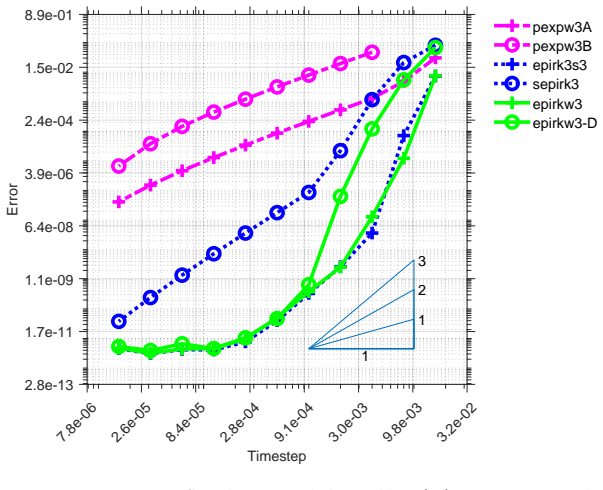
- PEXPW3A and PEXPW3B achieve their full third-order rate on the non-stiff Lorenz-96 test, confirming that the new B-series machinery produces working methods in the classical setting.
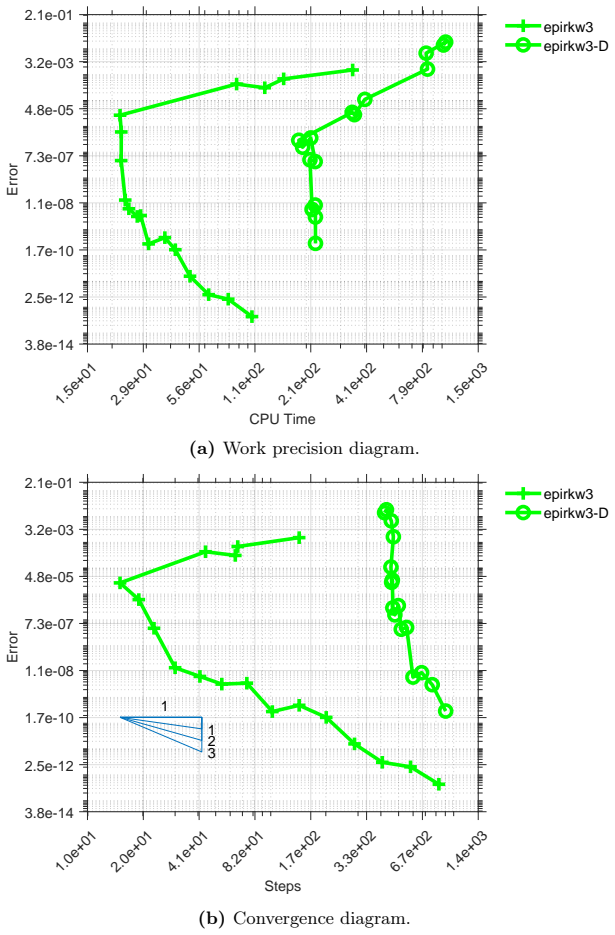
- On moderately stiff Allen-Cahn problems and on a reversible Gray-Scott system, the partitioned exponential methods can be more stable and more efficient than unpartitioned EPIRKW methods, making them attractive for reaction-diffusion simulations.
- Evaluating matrix functions on individual Jacobians enables block-parallel and permutation-based optimizations; the paper reports a parallel variant of PEXPW3A that runs about twice as fast as its serial version on Gray-Scott.
- On very stiff Allen-Cahn problems with reaction coefficient 1000, the partitioned methods fail to produce a solution while an unpartitioned method succeeds, so unpartitioned methods remain necessary in the most stiff regimes.
- The PEPIRKW3A/B methods, although third order on Lorenz-96, fail on the stiff parabolic and Allen-Cahn tests, indicating that the EPIRK-type partitioned family is not yet practical for stiff reaction-diffusion problems.
Reading between the lines
- The order reduction seen in the paper's stiff tests suggests that stiff-order conditions, rather than classical non-stiff ones, are needed before these methods can claim third-order accuracy on the reaction-diffusion applications they target.
- A natural next step is to extend the TPS-tree machinery to fourth-order methods or to embedded pairs with stiff error estimators, since the paper's construction is limited to third order by its stage counts.
- When the W matrices vanish, the partitioned exponential structure degenerates to a generalized additive Runge-Kutta method, so stability and convergence results from partitioned Runge-Kutta theory could be used to design coupling coefficients that behave well beyond the weak-interaction regime.
- For large chemical systems, the block-diagonal reaction Jacobian should permit further parallel speedups if the permutation and block evaluations are parallelized; the paper only parallelized the diffusion part.
Signed reviews
Editorial analysis
A structured set of objections, weighed in public.
Referee Report
Summary. The paper proposes a new family of partitioned exponential time integrators for systems of ODEs whose right-hand side is a sum of two component functions, such as reaction-diffusion and other multiphysics problems. For each partition, the method evolves its own exponential integrator (of EXP or EPIRK type) and exchanges information through GARK-like coupling coefficients. The theoretical core is a B-series framework based on TPS-trees, from which classical (non-stiff) order conditions are derived and several third-order methods (PEXPW3A/B, PEPIRKW3A/B, and a PSEPIRK variant) are constructed. The paper includes implementation optimizations for reaction-diffusion systems and numerical experiments. The Lorenz-96 test confirms the designed third order, but on stiff semilinear parabolic and Allen-Cahn problems the PEXPW methods show order reduction (to about 1.3 and 1.8, respectively), and the PEPIRKW methods fail to return a solution; at high stiffness (γ=1000) PEXPW also fails.
Significance. The order-conditions machinery is a substantial theoretical contribution: the TPS-tree/B-series analysis is carried out in detail, concrete methods with explicit coefficients are presented, and the implementation optimizations (permuted reaction Jacobians, block-diagonal structure, adaptive Krylov dimension) are practical and well motivated. The Lorenz-96 experiment provides a clean confirmation of the classical order. However, the practical significance for stiff multiphysics problems is not established. The paper's own experiments show that the methods do not retain third order in the stiff regime, and the absence of stiff-order or stability analysis leaves the central practical claim unsupported. The presented methodology is nevertheless a novel and potentially useful step toward partitioned exponential integrators, provided the claims are properly scoped.
major comments (3)
- [Section 7.3, Table 3] Table 3 (Fixed Timestep Experiments, Semilinear Parabolic and Allen-Cahn rows) shows that PEXPW3A/3B exhibit empirical convergence orders of about 1.31–1.32 and 1.77–1.88, respectively, while PEPIRKW3A/3B produce no solution on either problem. This directly contradicts the abstract and Section 5, which describe these methods as 'practical methods of third order.' The numerical evidence supports third order only for the non-stiff Lorenz-96 problem (orders ≈ 3.0) and, in the adaptive setting, for the reversible Gray-Scott problem (PEXPW3A order 2.99). The claim of practical third-order performance on stiff multiphysics problems is therefore not sustained by the experiments.
- [Section 4.5, Theorem 4.4] The order conditions in Theorem 4.4 are purely classical (non-stiff), with the W matrices treated as arbitrary and all W-dependent B-series coefficients forced to vanish. No stiff-order conditions, no convergence analysis in the stiff limit, and no linear stability analysis of the partitioned coupling are provided. The order reduction observed in Section 7.3 is the expected consequence of this gap: explicit coupling between partitions and the arbitrary nature of W prevent the methods from retaining their designed order when the linear parts are stiff. The authors should either add a stiff-order analysis (e.g., extending Hochbruck-Ostermann-type conditions to the partitioned setting) or explicitly restrict the third-order claim to non-stiff or weakly coupled partitions.
- [Section 7.4, Figure 7] At γ=1000 in the Allen-Cahn adaptive experiments, PEXPW methods fail to return a solution, confirming the stability limitation acknowledged in Section 8. The paper's broad framing as a method family for coupled multiphysics systems would be better balanced by a clear statement in the abstract and introduction that the methods are intended for problems in which the stiff partitions interact weakly, and that for strongly coupled stiff problems unpartitioned exponential integrators remain preferable.
minor comments (5)
- [Section 6] In the paragraph on block-diagonal Jacobians, 'These properties do not hols' should read 'do not hold' (typo).
- [Section 7.4] In the reversible Gray-Scott paragraph, 'PEXP3WA' should be 'PEXPW3A'.
- [Theorem 4.4] The theorem states that a method 'has order p only if' the B-series coefficient conditions hold; for B-series methods these conditions are also sufficient in the non-stiff setting, so the statement should likely read 'if and only if' or 'if' to justify their use as a construction tool.
- [Appendix E] The order-condition tables run to over a hundred pages; consider moving the full tables to an electronic supplement and keeping in the paper a compact algebraic formulation or a short table of independent conditions.
- [Definition 4.2] The symbolic notation for the four TPS-tree node types is difficult to parse; a figure showing the node shapes and examples of admissible trees would improve readability.
Circularity Check
No significant circularity: the methods are constructed by solving classical B-series order conditions and validated against independent ode45/ode15s reference solutions; self-citations provide prior frameworks, not the target result.
full rationale
The paper's central derivation is self-contained against an external standard. The order conditions are not fitted to benchmark data but are obtained by equating the B-series of the numerical solution to that of the exact solution: Section 4.5 states 'Order conditions are constructed for each method by equating the coefficients of the B-series expansion y_{n+1} of the numerical solution to those of the exact solution y(t_n + h) up to the desired order of accuracy,' and Theorem 4.4 formalizes the matching conditions. Section 5 then describes solving these algebraic equations with Mathematica to obtain coefficients for PEXPW3A/B and PEPIRKW3A/B. The claimed order is explicitly classical (non-stiff), and the numerical checks compare against independent reference solutions produced by ode45 and ode15s with tight tolerances, so the convergence results are not predetermined by the construction. The paper's self-citations to GARK, EPIRK-W, and Exponential-Krylov work are used as methodological scaffolding and for the B# operator, but the order-condition derivation and the concrete coefficient tables are presented in this manuscript rather than imported as a black-box theorem. The authors' own admission that the methods suffer order reduction on stiff problems (e.g., PEXPW order near 1.3 on the semilinear parabolic problem and PEPIRKW failures) is a stability/accuracy limitation in the stiff regime, not circularity, because the stated order guarantee is confined to the classical non-stiff setting. No load-bearing claim reduces by definition to its inputs, and no fitted parameter is renamed as a prediction.
Assumptions & free parameters
free parameters (2)
- PEPIRKW g coefficients (undetermined scaling factors) =
Values reported in Appendix C, including 0.1 entries
- Partition Jacobian approximations W^1 and W^2 =
Problem-dependent matrices from Table 4, e.g., full J, diagonal J, diffusion Jacobian
assumptions (4)
- standard math Standard B-series and rooted-tree formalism for order conditions
- domain assumption Each partition can be written as f^m(y) = L^m y + N^m(y), with L^m capturing stiffness
- standard math W-method order theory permits replacing exact Jacobians by arbitrary matrices W^m while preserving classical order
- domain assumption Classical non-stiff order conditions govern the accuracy of these methods on stiff multiphysics problems
Cite this review
Pith. "Pith review of Partitioned Exponential Methods for Coupled Multiphysics Systems." pith.science (2026). https://pith.science/paper/BPJRY7FA
@misc{pith2026190809434,
  author       = {Pith},
  title        = {Pith review of: Partitioned Exponential Methods for Coupled Multiphysics Systems},
  year         = {2026},
  howpublished = {\url{https://pith.science/paper/BPJRY7FA}},
  note         = {Machine review of arXiv:1908.09434}
}
read the original abstract
Multiphysics problems involving two or more coupled physical phenomena are ubiquitous in science and engineering. This work develops a new partitioned exponential approach for the time integration of multiphysics problems. After a possible semi-discretization in space, the class of problems under consideration is modeled by a system of ordinary differential equations where the right-hand side is a summation of two component functions, each corresponding to a given set of physical processes. The partitioned-exponential methods proposed herein evolve each component of the system via an exponential integrator, and information between partitions is exchanged via coupling terms. The traditional approach to constructing exponential methods, based on the variation-of-constants formula, is not directly applicable to partitioned systems. Rather, our approach to developing new partitioned-exponential families is based on a general-structure additive formulation of the schemes. Two method formulations are considered, one based on a linear-nonlinear splitting of the right hand component functions, and another based on approximate Jacobians. The paper develops classical (non-stiff) order conditions theory for partitioned exponential schemes based on particular families of T-trees and B-series theory. Several practical methods of third order are constructed that extend the Rosenbrock-type and EPIRK families of exponential integrators. Several implementation optimizations specific to the application of these methods to reaction-diffusion systems are also discussed. Numerical experiments reveal that the new partitioned-exponential methods can perform better than traditional unpartitioned exponential methods on some problems.
Figures


Figures from the paper (7 more)



Reference graph
Works this paper leans on
-
[1]
Linearly implicit methods for nonlinear parabolic equations
Georgios Akrivis and Michel Crouzeix. Linearly implicit methods for nonlinear parabolic equations. Mathematics of computation, 73(246):613–635, 2004
2004
-
[2]
Allen and John W
Samuel M. Allen and John W. Cahn. A microscopic theory for antiphase boundary motion and its application to antiphase domain coarsening. Acta Metallurgica, 27(6):1085 – 1095, 1979
1979
-
[3]
U. M. Ascher, S.J. Ruuth, and B.T.R Wetton. Implicit explicit methods for time-dependent partial-differential equations. SIAM J. Numer. Anal., 32:797–823, 1995
1995
-
[4]
A. Augustine and A. Sandu. MATLODE: A MATLAB ODE solver and sensitivity analysis toolbox.ACM TOMS, in preparation, 2019
work page 2019
-
[5]
T. Belytschko, H.-J. Yen, and R. Mullen. Mixed methods for time integration.Computer Methods in Applied Mechanics and Engineering, 17-18:259–275, feb 1979
work page 1979
-
[6]
Ashish Bhatt and Brian E. Moore. Structure-preserving Exponential Runge–Kutta Methods.SIAM Journal on Scientific Computing, 39(2):A593–A612, 2017. 31
work page 2017
-
[7]
J. C. Butcher. An algebraic theory of integration methods.Mathematics of Computation, 26(117):79–79, jan 1972
work page 1972
-
[8]
J. C. Butcher. Trees and numerical methods for ordinary differential equations.Numerical Algorithms, 53(2-3):153–170, mar 2009
work page 2009
Show all 83 references
-
[9]
J.C. Butcher. Trees, B-series and exponential integrators.IMA Journal of Numerical Analysis, 30:131—140, 2010
2010
-
[10]
J.C. Butcher. Numerical Methods for Ordinary DifferentialEquations. Wiley, 3 edition, 2016
2016
-
[11]
Kennedy and M.H
C.A. Kennedy and M.H. Carpenter. Additive Runge-Kutta schemes for convection-diffusion-reaction equations. Applied Numerical Mathematics, 44(1-2):139–181, 2003
2003
-
[12]
M. P. Calvo, J. de Frutos, and J. Novo. Linearly implicit runge-kutta methods for advection-reaction-diffusion equations. Applied Numerical Mathematics, 37(4):535–549, 2001
2001
-
[13]
Canonical B-series.Numerische Mathematik, 67(2):161–175, 1994
MP Calvo and JM Sanz-Serna. Canonical B-series.Numerische Mathematik, 67(2):161–175, 1994
1994
-
[14]
Cardone, Z
A. Cardone, Z. Jackiewicz, A. Sandu, and H. Zhang. Extrapolated IMEX Runge-Kutta methods.Mathematical Modelling and Analysis, 19(2):18–43, 2014
2014
-
[15]
Cardone, Z
A. Cardone, Z. Jackiewicz, A. Sandu, and H. Zhang. Extrapolation-based implicit-explicit general linear methods. Numerical Algorithms, 65(3):377–399, 2014
2014
-
[16]
Cardone, Z
A. Cardone, Z. Jackiewicz, A. Sandu, and H. Zhang. Construction of highly-stable implicit-explicit general linear methods. In M. de Leon, W. Feng, Z. Feng, J.L. Gomez, X. Lu, J.M. Martell, J. Parcet, D. Peralta-Salas, and W. Ruan, editors, AIMS proceedings, volume 0133-0189_20...
2015
-
[17]
Semi-Lagrangian Runge–Kutta Exponential Integrators for Convection Dominated Problems
Elena Celledoni and Bawfeh Kingsley Kometa. Semi-Lagrangian Runge–Kutta Exponential Integrators for Convection Dominated Problems. Journal of ScientificComputing, 41(1):139–164, apr 2009
2009
-
[18]
The solution of ordinary differential equations with large time constants.Mathematical methods for digital computers, 1:128–132, 1960
John Certaine. The solution of ordinary differential equations with large time constants.Mathematical methods for digital computers, 1:128–132, 1960
1960
-
[19]
PhD thesis, INRIA, 2005
Philippe Chartier, Ernst Hairer, and Gilles Vilmart.A substitution law for B-series vector fields. PhD thesis, INRIA, 2005
2005
-
[20]
Numerical methods for stiff reaction-diffusion systems
Ching-Shan Chou, Yong-Tao Zhang, Rui Zhao, and Qing Nie. Numerical methods for stiff reaction-diffusion systems. Discrete and Continuous Dynamical Systems - Series B, 7(3):515–525, feb 2007
2007
-
[21]
Constantinescu and A
E.M. Constantinescu and A. Sandu. Extrapolated implicit-explicit time stepping.SIAM Journal on ScientificComputing, 31(6):4452–4477, 2010
2010
-
[22]
Dettmer and Djordje Perić
Wulf G. Dettmer and Djordje Perić. A new staggered scheme for fluid-structure interaction.International Journal for Numerical Methods in Engineering, 93(1):1–22, jul 2012
2012
-
[23]
B. L. Ehle and J. D. Lawson. Generalized Runge–Kutta Processes for Stiff Initial-value Problems.IMA Journal of Applied Mathematics, 16(1):11–21, 1975
1975
-
[24]
Iterative operator-splitting methods for linear problems
István Faragó and Jürgen Geiser. Iterative operator-splitting methods for linear problems. International Journal of Computational Science and Engineering, 3(4):255–263, 2007
2007
-
[25]
Additive and iterative operator splitting methods and their numerical investigation
István Faragó, Boglárka Gnandt, and Ágnes Havasi. Additive and iterative operator splitting methods and their numerical investigation. Computers & Mathematics with Applications, 55(10):2266–2279, 2008
2008
-
[26]
Park, and Yves Dubois-Pelerin
Charbel Farhat, K.C. Park, and Yves Dubois-Pelerin. An unconditionally stable staggered algorithm for transient finite element analysis of coupled thermoelastic problems.Computer Methods in Applied Mechanicsand Engineering, 85(3):349– 365, feb 1991
1991
-
[27]
A fast spectral algorithm for nonlinear wave equations with linear dispersion
Bengt Fornberg and Tobin A Driscoll. A fast spectral algorithm for nonlinear wave equations with linear dispersion. Journal of Computational Physics, 155(2):456–467, 1999
1999
-
[28]
Günther and A
M. Günther and A. Sandu. Multirate generalized additive Runge-Kutta methods.Numerische Mathematik, 133(3):497– 524, 2016
2016
-
[29]
Hairer, S.P
E. Hairer, S.P. Norsett, and G. Wanner.Solving ordinary differentialequations I: Nonstiffproblems. Number 8 in Springer Series in Computational Mathematics. Springer-Verlag Berlin Heidelberg, 1993
1993
-
[30]
Hairer and G
E. Hairer and G. Wanner.Solving ordinary differentialequations II: Stiffand differential-algebraicproblems. Number 14 in Springer Series in Computational Mathematics. Springer-Verlag Berlin Heidelberg, 2 edition, 1996
1996
-
[31]
Order conditions, trees and B-series
Ernst Hairer, Gerhard Wanner, and Christian Lubich. Order conditions, trees and B-series. In Geometric Numerical Integration, pages 51–96. Springer, 2006
2006
-
[32]
Contribution à la méthode des équations aux différences.Zeitschrift für angewandte Mathematik und Physik ZAMP, 9(2):129–180, 1958
Joseph Hersch. Contribution à la méthode des équations aux différences.Zeitschrift für angewandte Mathematik und Physik ZAMP, 9(2):129–180, 1958
1958
-
[33]
Hochbruck and C
M. Hochbruck and C. Lubich. On Krylov subspace approximations to the matrix exponential operator.SIAM Journal on Numerical Analysis, 34(5):1911–1925, 1997
1911
-
[34]
Hochbruck, C
M. Hochbruck, C. Lubich, and H. Selhofer. Exponential integrators for large systems of differential equations.SIAM Journal on ScientificComputing, 19(5):1552–1574, 1998
1998
-
[35]
Hochbruck and A
M. Hochbruck and A. Ostermann. Explicit exponential Runge–Kutta methods for semilinear parabolic problems.SIAM Journal on Numerical Analysis, 43:1069—1090, 2005
2005
-
[36]
Hochbruck and A
M. Hochbruck and A. Ostermann. Exponential integrators.Acta Numerica, 19:209–286, 2012
2012
-
[37]
Hochbruck, A
M. Hochbruck, A. Ostermann, and J. Schweitzer. Exponential Rosenbrock-type methods. SIAM Journal on Numerical Analysis, 47:786–803, 2009
2009
-
[38]
Exponential Integrators for Large Systems of Differential Equations
Marlis Hochbruck, Christian Lubich, and Hubert Selhofer. Exponential Integrators for Large Systems of Differential Equations. SIAM Journal on ScientificComputing, 19(5):1552–1574, sep 1998
1998
-
[39]
Solution of the implicitly discretised fluid flow equations by operator-splitting.Journal of computational physics, 62(1):40–65, 1986
Raad I Issa. Solution of the implicitly discretised fluid flow equations by operator-splitting.Journal of computational physics, 62(1):40–65, 1986
1986
-
[40]
An operator splitting method for nonlinear convection-diffusion 32 equations
Kenneth Hvistendahl Karlsen and Nils Henrik Risebro. An operator splitting method for nonlinear convection-diffusion 32 equations. Numerische Mathematik, 77(3):365–382, 1997
1997
-
[41]
Douglas Lawson
J. Douglas Lawson. Generalized Runge-Kutta Processes for Stable Systems with Large Lipschitz Constants.SIAM Journal on Numerical Analysis, 4(3):372–380, sep 1967
1967
-
[42]
Flexible exponential integration methods for large systems of differential equations
Dongping Li, Yuhao Cong, and Kaifeng Xia. Flexible exponential integration methods for large systems of differential equations. Journal of Applied Mathematics and Computing, 51(1-2):545–567, aug 2015
2015
-
[43]
Dimensional splitting with front tracking and adaptive grid refinement.Numerical Methods for Partial DifferentialEquations: An International Journal, 14(5):627–648, 1998
K-A Lie, VIDAR Haugse, and K Hvistendahl Karlsen. Dimensional splitting with front tracking and adaptive grid refinement.Numerical Methods for Partial DifferentialEquations: An International Journal, 14(5):627–648, 1998
1998
-
[44]
Loffeld and M
J. Loffeld and M. Tokman. Comparative performance of exponential, implicit, and explicit integrators for stiff systems of ODEs. Journal of Computational and Applied Mathematics, 241:45–67, mar 2013
2013
-
[45]
Edward N. Lorenz. Predictability – a problem partly solved. In Tim Palmer and Renate Hagedorn, editors,Predictability of Weather and Climate, pages 40–58. Cambridge University Press (CUP), 1996
1996
-
[46]
Exponential B-Series: The Stiff Case.SIAM Journal on Numerical Analysis, 51(6):3431–3445, 2013
Vu Thai Luan and Alexander Ostermann. Exponential B-Series: The Stiff Case.SIAM Journal on Numerical Analysis, 51(6):3431–3445, 2013
2013
-
[47]
Exponential Rosenbrock methods of order five - Construction, analysis and numerical comparisons
Vu Thai Luan and Alexander Ostermann. Exponential Rosenbrock methods of order five - Construction, analysis and numerical comparisons. Journal of Computational and Applied Mathematics, 255:417–431, 2014
2014
-
[48]
Preconditioned implicit-exponential integrators (IMEXP) for stiff PDEs
Vu Thai Luan, Mayya Tokman, and Greg Rainwater. Preconditioned implicit-exponential integrators (IMEXP) for stiff PDEs. Journal of Computational Physics, 335:846–864, apr 2017
2017
-
[49]
Springer International Publishing, Cham, 2016
Shev MacNamara and Gilbert Strang.Operator Splitting, pages 95–114. Springer International Publishing, Cham, 2016
2016
-
[50]
Suematsu, Tomohiko Yamaguchi, Kunishige Ohgane, Yasumasa Nishiura, and Masatsugu Shimomura
Hitoshi Mahara, Nobuhiko J. Suematsu, Tomohiko Yamaguchi, Kunishige Ohgane, Yasumasa Nishiura, and Masatsugu Shimomura. Three-variable reversible Gray-Scott model.Journal of Chemical Physics, 121(18):8968–8972, 2004
2004
-
[51]
Entropy production in a two-dimensional reversible Gray-Scott system
Hitoshi Mahara, Tomohiko Yamaguchi, and Masatsugu Shimomura. Entropy production in a two-dimensional reversible Gray-Scott system. Chaos, 15(4):8968, 2005
2005
-
[52]
McLachlan and G
Robert I. McLachlan and G. Reinout W. Quispel. Splitting methods.Acta Numerica, 11(2002):341–434, jan 2002
2002
-
[53]
A review of exponential integrators for first order semi-linear problems
Borislav V Minchev and Will M Wright. A review of exponential integrators for first order semi-linear problems. 2005
2005
-
[54]
Exactly conservative semi-Lagrangian scheme for multi-dimensional hyperbolic equations with directional splitting technique.Journal of computational physics, 174(1):171– 207, 2001
Takashi Nakamura, Ryotaro Tanaka, Takashi Yabe, and Kenji Takizawa. Exactly conservative semi-Lagrangian scheme for multi-dimensional hyperbolic equations with directional splitting technique.Journal of computational physics, 174(1):171– 207, 2001
2001
-
[55]
Narayanamurthi, U
M. Narayanamurthi, U. Romer, and A. Sandu. Solving parameter estimation problems with discrete adjoint exponential integrators. Optimization Methods and Software, 33(4–6):750–770, 2018
2018
-
[56]
Narayanamurthi, P
M. Narayanamurthi, P. Tranquilli, A. Sandu, and M. Tokman. EPIRK-W and EPIRK-K time discretization methods. Journal of ScientificComputing, 78(1):167–201, 2019
2019
-
[57]
Efficient semi-implicit schemes for stiff systems.Journal of Computational Physics, 214(2):521–537, may 2006
Qing Nie, Yong-Tao Zhang, and Rui Zhao. Efficient semi-implicit schemes for stiff systems.Journal of Computational Physics, 214(2):521–537, may 2006
2006
-
[58]
Jitse Niesen and Will M. Wright. Algorithm 919: A Krylov subspace algorithm for evaluating theϕ-functions appearing in exponential integrators.ACM Trans. Math. Softw, 38(3):22:1–22:19, 2012
2012
-
[59]
John E. Pearson. Complex patterns in a simple system. Technical Report 5118, 1993
1993
-
[60]
A new class of split exponential propagation iterative methods of Runge–Kutta type (sEPIRK) for semilinear systems of ODEs.Journal of Computational Physics, 269:40–60, 2014
G Rainwater and Mayya Tokman. A new class of split exponential propagation iterative methods of Runge–Kutta type (sEPIRK) for semilinear systems of ODEs.Journal of Computational Physics, 269:40–60, 2014
2014
-
[61]
Y. Saad. Analysis of Some Krylov Subspace Approximations to the Matrix Exponential Operator.SIAM Journal on Numerical Analysis, 29(1):209–228, feb 1992
1992
-
[62]
Sandu and C
A. Sandu and C. T. Borden. A framework for the numerical treatment of aerosol dynamics. Applied Numerical Mathematics, 45(4):475–497, 2003
2003
-
[63]
Sandu and M
A. Sandu and M. Günther. A generalized-structure approach to additive Runge-Kutta methods. SIAM Journal on Numerical Analysis, 53(1):17–42, 2015
2015
-
[64]
Roger B. Sidje. Expokit: a software package for computing matrix exponentials.ACM Transactions on Mathematical Software, 24(1):130–156, mar 1998
1998
-
[65]
Cambridge university press, 2004
Barry Smith, Petter Bjorstad, and William Gropp.Domain decomposition: parallel multilevelmethods for elliptic partial differentialequations. Cambridge university press, 2004
2004
-
[66]
An analysis of operator splitting techniques in the stiff case.JournalofComputationalPhysics, 161(1):140 – 168, 2000
Bruno Sportisse. An analysis of operator splitting techniques in the stiff case.JournalofComputationalPhysics, 161(1):140 – 168, 2000
2000
-
[67]
An attempt to avoid exact Jacobian and nonlinear equations in the numerical solution of stiff differential equations.Mathematics of Computation, 33(146):521–521, may 1979
Trond Steihaug and Arne Wolfbrandt. An attempt to avoid exact Jacobian and nonlinear equations in the numerical solution of stiff differential equations.Mathematics of Computation, 33(146):521–521, may 1979
1979
-
[68]
Tang, G.R
Y. Tang, G.R. Carmichael, L.W. Horowitz, I. Uno, J.H. Woo, D.G. Streets, D. Dabdub, G. Kurata, A. Sandu, J. Allan, E. Atlas, F. Flocke, L.G. Huey, R.O. Jakoubek, D.B. Millet, D.D. Parrish, P.K. Quinn, J.M. Roberts, T.B. Ryerson, E. Williams, J.B. Nowak, D. Worsnop, A. Goldstei...
2002
-
[69]
M. Tokman. Efficient integration of large stiff systems of ODEs with exponential propagation iterative (EPI) methods. Journal of Computational Physics, 213(2):748–776, 2006
2006
-
[70]
M. Tokman. A new class of exponential propagation iterative methods of Runge–Kutta type (EPIRK). Journal of Computational Physics, 230:8762—8778, 2011
2011
-
[71]
New Adaptive Exponential Propagation Iterative Methods of Runge– Kutta Type
Mayya Tokman, John Loffeld, and Paul Tranquilli. New Adaptive Exponential Propagation Iterative Methods of Runge– Kutta Type. SIAM Journal on ScientificComputing, 34(5):A2650–A2669, 2012
2012
-
[72]
Andrea Toselli and Olof B. Widlund. Domain Decomposition Methods — Algorithms and Theory. Springer Berlin Heidelberg, 2005. 33
2005
-
[73]
Tranquilli and A
P. Tranquilli and A. Sandu. Exponential-Krylov methods for ordinary differential equations.Journal of Computational Physics, 278:31–46, 2014
2014
-
[74]
Tranquilli and A
P. Tranquilli and A. Sandu. Rosenbrock-Krylov methods for large systems of differential equations.SIAM Journal on ScientificComputing, 36(3):A1313–A1338, 2014
2014
-
[75]
Implicit-explicitRunge-Kuttamethodsfortime-dependentpartialdifferential equations
U.M.AscherandS.J.RuuthandR.J.Spiteri. Implicit-explicitRunge-Kuttamethodsfortime-dependentpartialdifferential equations. Applied Numerical Mathematics, 25:151–167, 1997
1997
-
[76]
J. G. Verwer and B. P. Sommeijer. An implicit-explicit Runge–Kutta–Chebyshev scheme for diffusion-reaction equations. SIAM Journal on ScientificComputing, 25(5):1824–1835, 2004
2004
-
[77]
Contractivity of locally one-dimensional splitting methods.Numerische Mathematik, 44(2):247–259, 1984
Jan G Verwer. Contractivity of locally one-dimensional splitting methods.Numerische Mathematik, 44(2):247–259, 1984
1984
-
[78]
Zhang and A
H. Zhang and A. Sandu. A second-order diagonally-implicit-explicit multi-stage integration method. InProceedings of the International Conference on Computational Science ICCS 2012, volume 9, pages 1039–1046, April 2012
2012
-
[79]
Zhang, A
H. Zhang, A. Sandu, and S. Blaise. Partitioned and implicit-explicit general linear methods for ordinary differential equations. Journal of ScientificComputing, 61(1):119–144, 2014
2014
-
[80]
Zhang, A
H. Zhang, A. Sandu, and S. Blaise. High order implicit–explicit general linear methods with optimized stability regions. SIAM Journal on ScientificComputing, 38(3):A1430–A1453, 2016
2016
-
[81]
Operator splitting implicit integration factor methods for stiff reaction–diffusion–advection systems.Journal of Computational Physics, 230(15):5996–6009, jul 2011
Su Zhao, Jeremy Ovadia, Xinfeng Liu, Yong-Tao Zhang, and Qing Nie. Operator splitting implicit integration factor methods for stiff reaction–diffusion–advection systems.Journal of Computational Physics, 230(15):5996–6009, jul 2011
2011
-
[82]
Zharovsky, A
E. Zharovsky, A. Sandu, and H. Zhang. A class of IMEX two-step Runge-Kutta methods.SIAM Journal on Numerical Analysis, 53(1):321–341, 2015
2015
-
[83]
O. C. Zienkiewicz, D. K. Paul, and A. H. C. Chan. Unconditionally stable staggered solution procedures for soil-pore fluid interaction problems.International Journal of Rock Mechanics and Mining Sciences & Geomechanics Abstracts, 25(5):233, oct 1988. 34 Appendix A. Partitioned ...
1988
Reviewed August 14, 2026 · model on record in the stance chip above.
Discussion (0). Continue with ORCID to comment.