REVIEW 4 major objections 6 minor 37 references
Scaling and Data Saturation in Protein Language Models
T0 review · 4 major / 6 minor · reviewed 2026-08-06 · deepseek-v4-flash
Pith's one-line read The paper claims protein language models trained on UniRef100 snapshots 2011–2024 have not saturated: zero-shot fitness prediction improves but not monotonically; supervised performance scales mainly with labeled data.
desk verdict Useful temporal data-scaling measurement on AMPLIFY snapshots, but the saturation inference is underdetermined by single-seed, composition-confounded comparisons. read the letter →
The pith
A machine-rendered reading of the paper's core claim, the machinery that carries it, and where it could break.
The reading
What carries the argument
The empirical instrument is a series of 14 AMPLIFY protein language models, a family of small masked language models sharing the same architecture and pretrained on yearly UniRef100 snapshots from 2011 to 2024. Performance is measured as the Spearman correlation between the log-likelihood a model assigns to a mutant sequence and its experimentally measured fitness in ProteinGym, with supervised experiments adding ridge regression on mean-pooled final-layer embeddings. The engineered train/test splits — random, contiguous, and modulo — are the mechanism that controls for positional data leakage, allowing the paper to separate genuine generalization from memorization of mutation positions.
What would settle it
Retrain the same AMPLIFY architecture on size-matched, composition-controlled subsets taken from different UniRef100 release years, then check whether the zero-shot Spearman curve becomes monotonic; a flat or monotonic curve would show that the non-monotonicity reported here is a data-composition artifact rather than evidence about saturation.
Extended reading notes
Core claim
The central claim is that biological data scaling for protein fitness prediction has not yet saturated and does not follow the smooth power laws seen in natural language processing. Using yearly UniRef100 checkpoints of the same model architecture, zero-shot Spearman correlation on ProteinGym substitution datasets fluctuates without monotonic improvement: the 2018-to-2021 models perform worse on average even though UniRef100 gained over a billion sequences. Supervised ridge regression on frozen embeddings shows a different pattern, with performance scaling mainly with labeled data volume, and with one-hot encodings beating embeddings under random splits but collapsing under leakage-controlled splits. In the β-Lactamase case study, unsupervised predictions improve from roughly 0.25 to above 0.6 Spearman correlation across pretraining years, yet training on a single experimental dataset suffices to match a decade of pretraining data in the supervised setting. These observations together imply that pretraining data volume is not yet the binding constraint for function prediction.
Load-bearing premise
The load-bearing premise is that the yearly AMPLIFY checkpoints isolate the effect of pretraining data scale, even though UniRef100 snapshots also differ in redundancy and composition over time and each snapshot comes from a single training run.
Editorial extensions
If this is right
- Unlabeled protein sequence repositories still have room to improve function prediction; the field has not yet passed the point of data saturation.
- Pretraining data quantity and labeled data volume act differently: zero-shot gains from pretraining are uneven, while supervised gains track the size of the labeled training set.
- Leakage-free evaluation splits overturn the apparent advantage of one-hot encodings under random splits, so scaling conclusions depend on controlling for positional leakage.
- Aggregate trends hide stratification: proteins with deep MSAs and organismal-fitness assays improve with later pretraining years, while low-MSA-depth proteins can decline.
Reading between the lines
- Editorial inference: because yearly UniRef100 snapshots confound data quantity with changing redundancy, the 'no saturation' reading would be strengthened by controlling for sequence diversity per snapshot.
- Editorial inference: a testable extension is to train on cluster-split subsets with matched diversity across years; if the performance curve flattens, scaling gains come from new sequence diversity rather than raw count.
- Editorial inference: the β-Lactamase crossover, where one labeled dataset matches a decade of pretraining, suggests that assay collection may currently buy more performance per unit of effort than further unlabeled sequencing.
Editorial analysis
A structured set of objections, weighed in public.
Referee Report
Summary. The paper investigates how protein language model performance scales with the amount of pretraining data by evaluating the AMPLIFY model suite, which contains checkpoints trained on yearly snapshots of UniRef100 from 2011 to 2024. Zero-shot variant effect prediction is measured by Spearman correlation between model log-likelihoods and ProteinGym substitution DMS scores, and supervised performance is measured by ridge regression on AMPLIFY embeddings under several train/test split schemes. The authors report that zero-shot performance fluctuates non-monotonically across pretraining years, that supervised performance depends mainly on labeled data volume rather than pretraining year, and that β-Lactamase cross-dataset evaluation shows improving unsupervised trends. They conclude that biological data scaling for protein function prediction does not follow a simple monotonic trend and that data saturation has not yet been reached.
Significance. If the central claim were established, the paper would be a useful contribution to the under-explored question of data scaling in protein language models, with direct implications for data acquisition and curation. The paper has concrete strengths: it uses an external benchmark (ProteinGym), leverages a unique suite of time-split checkpoints from a single training pipeline, releases all code, and includes leakage-controlled split schemes (contiguous and modulo) that correctly expose the failure of one-hot encodings. The β-Lactamase cross-dataset analysis is a thoughtful prospective evaluation. However, the central inference from non-monotonic year-over-year performance to 'not yet saturated' is confounded, as the year axis conflates data scale with snapshot composition and single-seed training noise. The empirical observations are valuable, but the main conclusion needs substantial reframing or additional controls.
major comments (4)
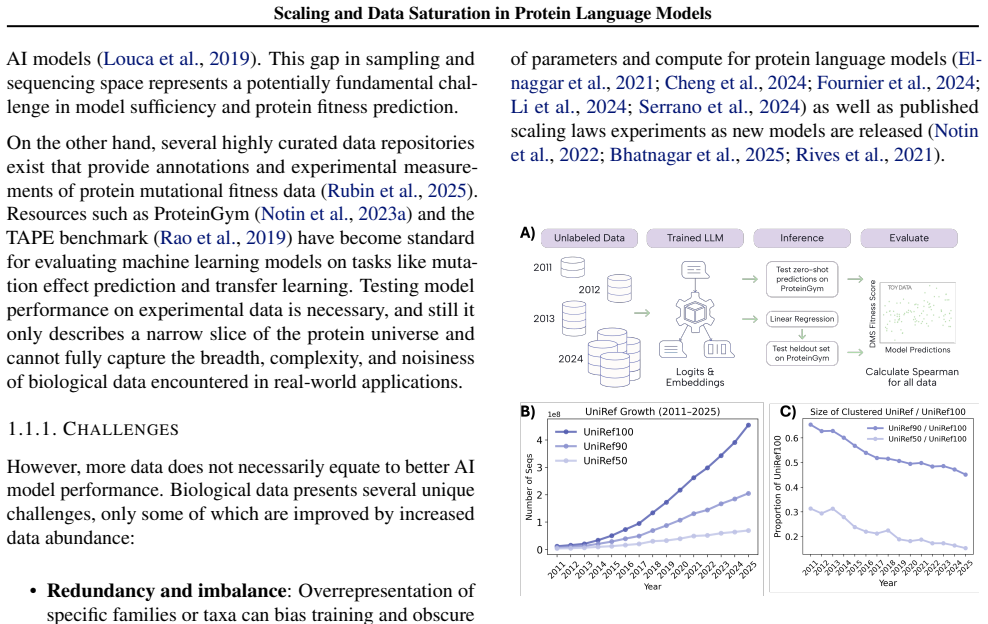
- [Section 3, Figure 2] The central zero-shot comparison treats the year of the UniRef100 snapshot as a proxy for data scale, but the manuscript itself documents that the snapshots differ in composition as well as size: Figure 1C shows declining UniRef90/UniRef100 and UniRef50/UniRef100 ratios, and Section 3 attributes the 2018-2021 performance drop to 'the specific sequences added or removed at each timepoint.' Because year is not a controlled measure of data quantity, the non-monotonicity in Figure 2 does not by itself establish that scaling is non-monotonic or that saturation has not been reached. To make the central claim load-bearing, the authors should either control for snapshot composition (e.g., by matching redundancy or taxonomic composition across years), provide repeated-seed or bootstrap confidence intervals, or reframe the conclusion as 'no consistent scaling trend is observable under uncontrolled composition shifts' rather than 'not yet saturated.'
- [Section 3 and Section 4] The inference from 'variability in correlation ... indicates that it has not yet reached data saturation' is logically incomplete. Non-monotonic performance under changing data composition is compatible with a model that has already saturated in terms of data quantity but remains sensitive to distribution shift or optimization noise; conversely, monotonic improvement does not by itself prove absence of saturation. The paper should define an explicit, testable criterion for saturation (for example, a plateau in performance when data scale is increased under fixed composition and repeated training seeds) and evaluate that criterion rather than equating non-monotonicity with lack of saturation.
- [Section 2.2.2, Figure 3] The ridge regression experiments are a central part of the supervised scaling analysis, but the regularization strength (alpha) is never reported. Since ridge regression with high-dimensional embeddings can be sensitive to alpha, the manuscript must state whether alpha was fixed across models and splits, how it was chosen, and whether the conclusions are robust to its value. Without this information, the claim that supervised performance shows 'minimal performance differences across AMPLIFY models' is not fully reproducible or verifiable.
- [Figure 2, Section 3] The zero-shot Spearman correlations are reported as point estimates from single-seed models, with no confidence intervals or statistical tests. The year-over-year differences emphasized in the text (e.g., the 2018-2021 drop) are on the order of 0.02-0.04 in the figure, which may be within the range of optimization noise or dataset sampling variability. The authors should report bootstrap confidence intervals across the 213 ProteinGym datasets, or per-dataset paired comparisons across models, to support the claim that the observed non-monotonicity is a real effect of pretraining data rather than noise.
minor comments (6)
- [Abstract] The abstract states that 'performance improves—but not monotonically—with added data,' but Figure 2 shows an overall increase from 2011 to 2024 with fluctuations; please clarify whether 'improves' refers to the overall trend or to most individual year-over-year steps.
- [Section 2.2.2] The sentence 'Results are show in Figure 3B' contains a typo and should read 'Results are shown in Figure 3B.'
- [Appendix Table 1] The UniProt count for 2016 (60,268,458) is lower than the 2015 count (89,998,523), which appears implausible for a cumulative database; please verify this entry or add a note explaining any change in counting methodology.
- [Figure S5 caption] The caption refers to 'Figure 2B' but should refer to Figure 3B, since the modulo split is compared with the random split in Figure 3A.
- [Section 1.3] The phrase 'we would project data saturation on the field' is unclear; consider rephrasing to 'we would predict data saturation and provide concrete guidance for achieving it.'
- [General] For reproducibility, please provide a specific version or commit hash of the GitHub repository and the exact AMPLIFY checkpoint identifiers, as the HuggingFace paths use a <YEAR> placeholder.
Circularity Check
No significant circularity: the central trend is read directly from external ProteinGym evaluations of third-party AMPLIFY checkpoints, with no fitted parameter or self-citation chain doing load-bearing work.
full rationale
The paper's derivation chain is straightforward and self-contained with respect to external evidence. It takes AMPLIFY models pretrained by another group (Fournier et al.) on yearly UniRef100 snapshots, computes sequence log-likelihoods and embeddings on ProteinGym variants, and compares them against experimentally measured DMS fitness values via Spearman correlation. The central claim—that performance improves but not monotonically with added pretraining data and has not reached saturation—is an empirical reading of those external evaluations. No equation defines the conclusion in terms of its inputs, and no fitted parameter is renamed as a prediction: the ridge regression results are standard held-out evaluations, and the zero-shot results use no trainable parameters at all. The concern that yearly UniRef100 snapshots differ in composition as well as size (Figure 1C), and that single-seed training leaves fluctuations unquantified, is a validity limitation on the causal interpretation of the year axis, not a circularity, because the reported observations would hold regardless of how the paper frames them. The paper cites prior work such as ProteinGym and AMPLIFY, but these are external resources produced by other research groups, and none of the cited results is a self-citation that supplies the paper's conclusion. No uniqueness theorem, no ansatz-smuggling citation, and no renaming of a known result into new coordinates occurs. Therefore the analysis exhibits no significant circularity.
Assumptions & free parameters
free parameters (1)
- Ridge regression regularization strength (alpha)
assumptions (3)
- domain assumption ProteinGym substitution DMS Spearman correlation is a valid proxy for protein function prediction performance.
- domain assumption Yearly AMPLIFY checkpoints isolate the effect of pretraining data scale.
- ad hoc to paper Absence of monotonic scaling implies sensitivity to data and lack of saturation.
Cite this review
Pith. "Pith review of Scaling and Data Saturation in Protein Language Models." pith.science (2026). https://pith.science/paper/BPN3KD7B
@misc{pith2026250722210,
  author       = {Pith},
  title        = {Pith review of: Scaling and Data Saturation in Protein Language Models},
  year         = {2026},
  howpublished = {\url{https://pith.science/paper/BPN3KD7B}},
  note         = {Machine review of arXiv:2507.22210}
}
read the original abstract
Data in biology is redundant, noisy, and sparse. How does the type and scale of available data impact model performance? In this work, we specifically investigate how protein language models (pLMs) scale with increasing pretraining data. We investigate this relationship by measuring the performance of protein function prediction on a suite of pLMs pretrained on yearly snapshots of UniRef100 from 2011 to 2024. We find no evidence of model saturation on this task: performance improves--but not monotonically--with added data, and this trend differs between unsupervised and supervised experiments. Using a well-characterized Beta-Lactamase protein from E. coli, we find that unsupervised model predictions get better year-over-year, though they do not yet consistently perform better than the supervised baseline. Our results underscore the need for targeted data acquisition and deeper study of data scaling in protein modeling. All training, inference, analysis, and visualization code is available at: https://github.com/Align-to-Innovate/data-saturation-and-scaling.
Figures


Figures from the paper (1 more)

Reference graph
Works this paper leans on
-
[1]
write newline
" write newline "" before.all 'output.state := FUNCTION n.dashify 't := "" t empty not t #1 #1 substring "-" = t #1 #2 substring "--" = not "--" * t #2 global.max substring 't := t #1 #1 substring "-" = "-" * t #2 global.max substring 't := while if t #1 #1 substring * t #2 global.max substring 't := if while FUNCTION format.date year duplicate empty "emp...
-
[2]
Bhatnagar, A., Jain, S., Beazer, J., Curran, S. C., Hoffnagle, A. M., Ching, K., Martyn, M., Nayfach, S., Ruffolo, J. A., and Madani, A. Scaling unlocks broader generation and deeper functional understanding of proteins. bioRxiv, pp.\ 2025--04, 2025
work page 2025
-
[3]
Training compute-optimal protein language models
Cheng, X., Chen, B., Li, P., Gong, J., Tang, J., and Song, L. Training compute-optimal protein language models. Advances in Neural Information Processing Systems, 37: 0 69386--69418, 2024
work page 2024
- [4]
-
[5]
Consortium, T. U. Uniprot: the universal protein knowledgebase in 2025. Nucleic Acids Research, 53 0 (D1): 0 D609--D617, 11 2024. ISSN 1362-4962. doi:10.1093/nar/gkae1010. URL https://doi.org/10.1093/nar/gkae1010
-
[6]
P., Roux, S., Beracochea, M., Mirdita, M., Ovchinnikov, S., and Hwang, Y
Cornman, A., West-Roberts, J., Camargo, A. P., Roux, S., Beracochea, M., Mirdita, M., Ovchinnikov, S., and Hwang, Y. The omg dataset: An open metagenomic corpus for mixed-modality genomic language modeling. bioRxiv, 2024. doi:10.1101/2024.08.14.607850. URL https://www.biorxiv.org/content/early/2024/08/17/2024.08.14.607850
-
[7]
Ding, F. and Steinhardt, J. Protein language models are biased by unequal sequence sampling across the tree of life. BioRxiv, pp.\ 2024--03, 2024
work page 2024
-
[8]
Prottrans: Toward understanding the language of life through self-supervised learning
Elnaggar, A., Heinzinger, M., Dallago, C., Rehawi, G., Wang, Y., Jones, L., Gibbs, T., Feher, T., Angerer, C., Steinegger, M., et al. Prottrans: Toward understanding the language of life through self-supervised learning. IEEE transactions on pattern analysis and machine intelligence, 44 0 (10): 0 7112--7127, 2021
work page 2021
Show all 37 references
-
[9]
M., van der Sloot, A., Schulz, B., Chandar, S., and Langmead, C
Fournier, Q., Vernon, R. M., van der Sloot, A., Schulz, B., Chandar, S., and Langmead, C. J. Protein language models: is scaling necessary? bioRxiv, pp.\ 2024--09, 2024
2024
-
[10]
X., and Abbeel, P
Gordon, C., Lu, A. X., and Abbeel, P. Protein language model fitness is a matter of preference. bioRxiv, pp.\ 2024--10, 2024
2024
-
[11]
M., Kerrn, M., Olsen, L., Salomon, J., and Boomsma, W
Groth, P. M., Kerrn, M., Olsen, L., Salomon, J., and Boomsma, W. Kermut: Composite kernel regression for protein variant effects. Advances in Neural Information Processing Systems, 37: 0 29514--29565, 2024
2024
-
[12]
Scaling laws for transfer
Hernandez, D., Kaplan, J., Henighan, T., and McCandlish, S. Scaling laws for transfer. arXiv preprint arXiv:2102.01293, 2021
2021 arXiv
-
[13]
Rita: a study on scaling up generative protein sequence models
Hesslow, D., Zanichelli, N., Notin, P., Poli, I., and Marks, D. Rita: a study on scaling up generative protein sequence models. arXiv preprint arXiv:2205.05789, 2022
2022 arXiv
-
[14]
Hoerl, A. E. and Kennard, R. W. Ridge regression: Biased estimation for nonorthogonal problems. Technometrics, 12 0 (1): 0 55--67, 1970
1970
-
[15]
Hoffmann, J., Borgeaud, S., Mensch, A., Buchatskaya, E., Cai, T., Rutherford, E., Casas, D. d. L., Hendricks, L. A., Welbl, J., Clark, A., et al. Training compute-optimal large language models. arXiv preprint arXiv:2203.15556, 2022
2022 arXiv
-
[16]
Learning protein fitness models from evolutionary and assay-labeled data
Hsu, C., Nisonoff, H., Fannjiang, C., and Listgarten, J. Learning protein fitness models from evolutionary and assay-labeled data. Nature biotechnology, 40 0 (7): 0 1114--1122, 2022
2022
-
[17]
Jeffery, C. J. Current successes and remaining challenges in protein function prediction. Frontiers in Bioinformatics, 3: 0 1222182, 2023. doi:10.3389/fbinf.2023.1222182. Link https://doi.org/10.3389/fbinf.2023.1222182
2023
-
[18]
Highly accurate protein structure prediction with alphafold
Jumper, J., Evans, R., Pritzel, A., Green, T., Figurnov, M., Ronneberger, O., Tunyasuvunakool, K., Bates, R., Z \' dek, A., Potapenko, A., et al. Highly accurate protein structure prediction with alphafold. nature, 596 0 (7873): 0 583--589, 2021
2021
-
[19]
B., Chess, B., Child, R., Gray, S., Radford, A., Wu, J., and Amodei, D
Kaplan, J., McCandlish, S., Henighan, T., Brown, T. B., Chess, B., Child, R., Gray, S., Radford, A., Wu, J., and Amodei, D. Scaling laws for neural language models. arXiv preprint arXiv:2001.08361, 2020
2001 arXiv
-
[20]
P., Yue, Y., Yang, K
Li, F.-Z., Amini, A. P., Yue, Y., Yang, K. K., and Lu, A. X. Feature reuse and scaling: Understanding transfer learning with protein language models. bioRxiv, pp.\ 2024--02, 2024
2024
-
[21]
Evolutionary-scale prediction of atomic-level protein structure with a language model
Lin, Z., Akin, H., Rao, R., Hie, B., Zhu, Z., Lu, W., Smetanin, N., Verkuil, R., Kabeli, O., Shmueli, Y., et al. Evolutionary-scale prediction of atomic-level protein structure with a language model. Science, 379 0 (6637): 0 1123--1130, 2023
2023
-
[22]
Louca, S., Mazel, F., Doebeli, M., and Parfrey, L. W. A census-based estimate of earth's bacterial and archaeal diversity. PLoS biology, 17 0 (2): 0 e3000106, 2019
2019
-
[23]
Y., and Cho, K
Lourie, N., Hu, M. Y., and Cho, K. Scaling laws are unreliable for downstream tasks: A reality check. arXiv preprint arXiv:2507.00885, 2025
2025
-
[24]
R., Subramanian, S., Mohr, B
Madani, A., Krause, B., Greene, E. R., Subramanian, S., Mohr, B. P., Holton, J. M., Olmos Jr, J. L., Xiong, C., Sun, Z. Z., Socher, R., et al. Large language models generate functional protein sequences across diverse families. Nature biotechnology, 41 0 (8): 0 1099--1106, 2023
2023
-
[25]
G., Kang, B., Katrekar, D., Li, D
Nguyen, E., Poli, M., Durrant, M. G., Kang, B., Katrekar, D., Li, D. B., Bartie, L. J., Thomas, A. W., King, S. H., Brixi, G., et al. Sequence modeling and design from molecular to genome scale with evo. Science, 386 0 (6723): 0 eado9336, 2024
2024
-
[26]
A., Weinstein, E
Nijkamp, E., Ruffolo, J. A., Weinstein, E. N., Naik, N., and Madani, A. Progen2: exploring the boundaries of protein language models. Cell systems, 14 0 (11): 0 968--978, 2023
2023
-
[27]
N., Marks, D., and Gal, Y
Notin, P., Dias, M., Frazer, J., Marchena-Hurtado, J., Gomez, A. N., Marks, D., and Gal, Y. Tranception: protein fitness prediction with autoregressive transformers and inference-time retrieval. In International Conference on Machine Learning, pp.\ 16990--17017. PMLR, 2022
2022
-
[28]
Proteingym: Large-scale benchmarks for protein fitness prediction and design
Notin, P., Kollasch, A., Ritter, D., Van Niekerk, L., Paul, S., Spinner, H., Rollins, N., Shaw, A., Orenbuch, R., Weitzman, R., et al. Proteingym: Large-scale benchmarks for protein fitness prediction and design. Advances in Neural Information Processing Systems, 36: 0 64331--...
2023
-
[29]
Proteinnpt: Improving protein property prediction and design with non-parametric transformers
Notin, P., Weitzman, R., Marks, D., and Gal, Y. Proteinnpt: Improving protein property prediction and design with non-parametric transformers. Advances in Neural Information Processing Systems, 36: 0 33529--33563, 2023 b
2023
-
[30]
L., Feuermann, M., Gasteiger, E., Gehant, S., Gerritsen, V., Gos, A., Gruaz-Gumowski, N., Hinz, U., Hulo, C., Jungo, F., Keller, G., Lieberherr, D., Lombardot, T., Martin, M
Poux, S., Magrane, M., Bateman, A., Belda, E., Boeckmann, B., Boutet, E., Breuza, L., Bridge, A., Coudert, E., Esperet, E., Famiglietti, M. L., Feuermann, M., Gasteiger, E., Gehant, S., Gerritsen, V., Gos, A., Gruaz-Gumowski, N., Hinz, U., Hulo, C., Jungo, F., Keller, G., Lieb...
2016
-
[31]
Evaluating protein transfer learning with tape
Rao, R., Bhattacharya, N., Thomas, N., Duan, Y., Chen, P., Canny, J., Abbeel, P., and Song, Y. Evaluating protein transfer learning with tape. Advances in neural information processing systems, 32, 2019
2019
-
[32]
P., Abbasian, M., and Orengo, C
Rauer, C., Sen, N., Waman, V. P., Abbasian, M., and Orengo, C. A. Computational approaches to predict protein functional families and functional sites. Current Opinion in Structural Biology, 70: 0 108--122, 2021. ISSN 0959-440X. doi:https://doi.org/10.1016/j.sbi.2021.05.012. U...
2021 doi
-
[33]
Mgnify: the microbiome sequence data analysis resource in 2023
Richardson, L., Allen, B., Baldi, G., Beracochea, M., Bileschi, M., Burdett, T., Burgin, J., Caballero-Pérez, J., Cochrane, G., Colwell, L., Curtis, T., Escobar-Zepeda, A., Gurbich, T., Kale, V., Korobeynikov, A., Raj, S., Rogers, A., Sakharova, E., Sanchez, S., Wilkinson, D.,...
2023 doi
-
[34]
L., Ma, J., et al
Rives, A., Meier, J., Sercu, T., Goyal, S., Lin, Z., Liu, J., Guo, D., Ott, M., Zitnick, C. L., Ma, J., et al. Biological structure and function emerge from scaling unsupervised learning to 250 million protein sequences. Proceedings of the National Academy of Sciences, 118 0 (...
2021
-
[35]
F., Stone, J., Bianchi, A
Rubin, A. F., Stone, J., Bianchi, A. H., Capodanno, B. J., Da, E. Y., Dias, M., Esposito, D., Frazer, J., Fu, Y., Grindstaff, S. B., et al. Mavedb 2024: a curated community database with over seven million variant effects from multiplexed functional assays. Genome Biology, 26 ...
2024
-
[36]
Are protein language models compute optimal? arXiv preprint arXiv:2406.07249, 2024
Serrano, Y., Ciudad, \'A ., and Molina, A. Are protein language models compute optimal? arXiv preprint arXiv:2406.07249, 2024
2024 arXiv
-
[37]
Enhancing efficiency of protein language models with minimal wet-lab data through few-shot learning
Zhou, Z., Zhang, L., Yu, Y., Wu, B., Li, M., Hong, L., and Tan, P. Enhancing efficiency of protein language models with minimal wet-lab data through few-shot learning. Nature Communications, 15 0 (1): 0 5566, 2024. ISSN 2041-1723. doi:10.1038/s41467-024-49798-6. URL https://do...
2024 doi
Reviewed August 6, 2026 · model on record in the stance chip above.
Discussion (0). Continue with ORCID to comment.