REVIEW 3 major objections 6 minor 111 references
Control of Cooperative Unmanned Aerial Vehicles: Review of Applications, Challenges, and Algorithms
T0 review · 3 major / 6 minor · reviewed 2026-08-14 · deepseek-v4-flash
Pith's one-line read This review of cooperative UAV control organizes the field into three algorithm families—consensus, flocking, and guidance-law based—across search-and-rescue, surveillance, mapping, and military applications, and identifies…
desk verdict A well-intentioned survey whose core math tutorial is wrong in several places; not new enough or reliable enough to recommend as an entry point in its current form. read the letter →
The pith
A machine-rendered reading of the paper's core claim, the machinery that carries it, and where it could break.
The reading
What carries the argument
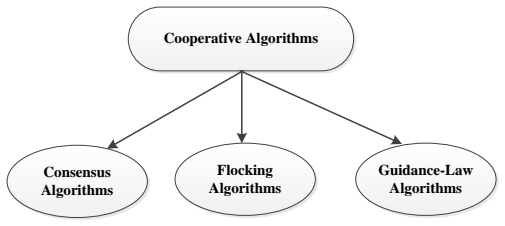
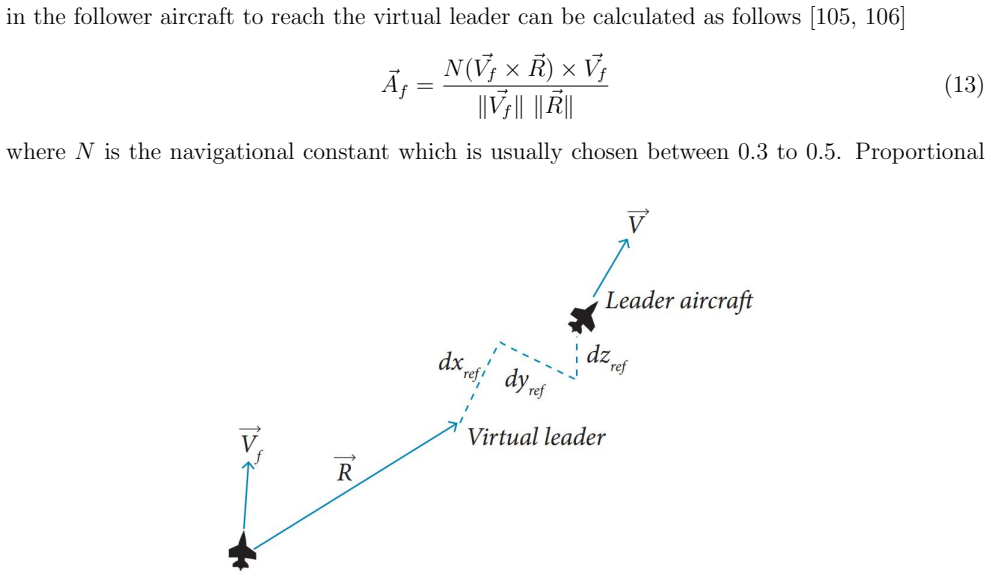
The carrying structure is the survey's classification scheme itself: consensus, flocking, and guidance-law algorithms, each tied to a mathematical core. For consensus, the core is graph-theoretic agreement, built from an adjacency matrix and Laplacian with the eigenvalue condition $0 = \lambda_1 < \lambda_2 \leq \dots \leq \lambda_N$ for connected graphs, together with the continuous-time law $\dot{x}_i(t) = -\sum_j a_{ij}(t)(x_i(t)-x_j(t))$. For flocking, the core is Reynolds' three behavioral rules—separation, alignment, cohesion—encoded in a second-order control law with a gradient-based term, a consensus term, and a navigational feedback term. For guidance-law control, the core is pure-pursuit geometry, where the follower's velocity is held parallel to the line of sight to a virtual leader ($\vec{V}_f \times \vec{R} = 0$). These three cores do the work of connecting each application area to a concrete control formulation.
What would settle it
A reader can settle the tutorial claim by checking the example adjacency matrix in Eq. (1) against the five-node graph in Figure 8 and then applying the Laplacian definition in Eq. (4): the printed matrix is not square for five nodes, and the off-diagonal rule as written cannot yield the symmetric, zero-row-sum Laplacian the text relies on. That inconsistency would be enough to show the simplified exposition is not a reliable self-contained account.
Extended reading notes
Core claim
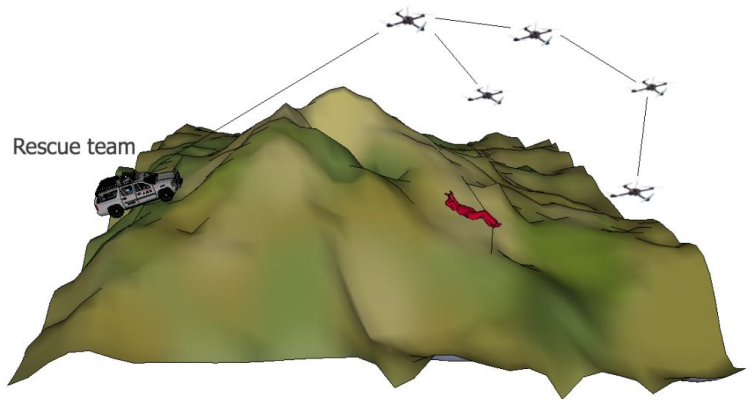
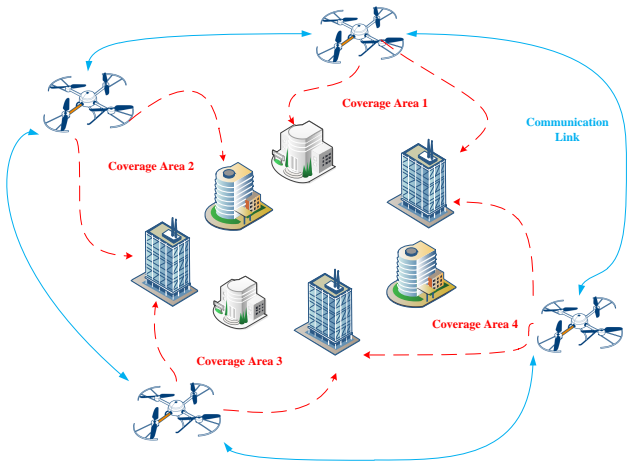
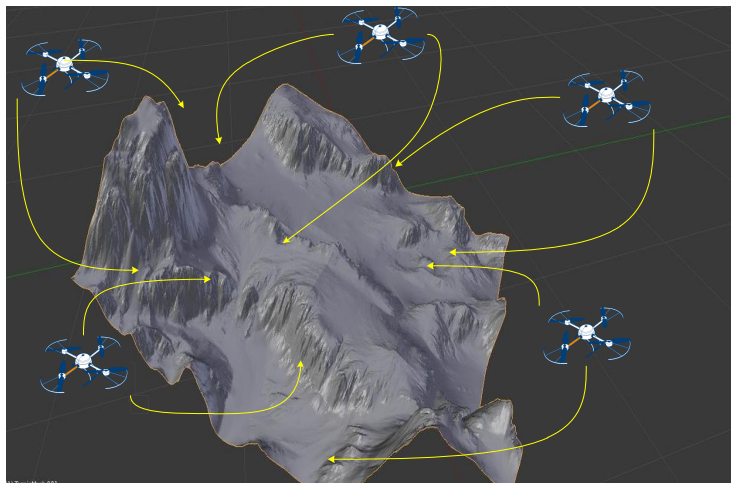
The central claim is that cooperative control of UAVs splits cleanly into consensus algorithms, flocking algorithms, and guidance-law-based formation control, and that the same set of applications—border patrol, search and rescue, surveillance, mapping, military operations—recurs across all three. Consensus methods let agents reach agreement on shared information through graph-theoretic updates; flocking methods enforce Reynolds' separation, alignment, and cohesion without a rigid formation shape; guidance-law methods make followers pursue a leader or virtual target using pure-pursuit or line-of-sight rules. The paper further claims that the main obstacle to real-world deployment is not any single algorithm but the combination of nonlinear UAV dynamics, collision avoidance, aerodynamic coupling, and communication-induced vulnerabilities such as denial-of-service and time-delay-switch attacks. On its own terms, the review establishes a map of the field and a set of design requirements that any cooperative controller must satisfy.
Load-bearing premise
The review's tutorial value rests on its simplified equations for consensus and flocking being a faithful representation of standard graph-theoretic control theory, since a reader who studies those equations should come away with the correct foundations.
Editorial extensions
If this is right
- Multi-UAV teams can shorten missions and cover more ground than single UAVs, but only if the controller handles communication loss, cyber-attacks, and fault propagation as first-class design constraints.
- Consensus control gives a principled way to make agents agree on shared states, and recent extensions reviewed here push it toward switching topologies, nonlinear agent dynamics, and actuator fault tolerance.
- Flocking control can keep a swarm coherent without a rigid formation, which suits surveillance and search tasks that require flexible shape changes, while semi-flocking variants trade cohesion for broader area coverage.
- Pure-pursuit guidance laws offer a simple, practical leader-follower formation method for fixed-wing aircraft, and the reviewed refinements combine them with dynamic inversion or PID loops to improve tracking.
- Aerodynamic coupling between closely flying UAVs is both a stability risk and a potential fuel-saving opportunity, depending on whether the vortex effects are modeled or ignored.
Reading between the lines
- Applying the same three-family taxonomy to literature published after 2019 would probably require a fourth family for learning-based and data-driven cooperative controllers, which this snapshot does not cover.
- The paper's framing of communication as a vulnerability layer implies that security and fault tolerance should be co-designed with the coordination algorithm, not added as a separate module after the fact.
- A reader could use the survey's application-to-algorithm pairing as a template for evaluating new UAV missions: pick the mission type, identify its dominant challenge (time, coverage, deception, or mapping), then choose the algorithm family that addresses that constraint.
Signed reviews
Editorial analysis
A structured set of objections, weighed in public.
Referee Report
Summary. The manuscript is a survey of cooperative control for multi-UAV systems. It organizes the field into applications (search and rescue, surveillance, localization and mapping, military applications), challenges (communication and security, aerodynamic coupling, fault tolerance), and algorithm families (consensus, flocking, and guidance-law-based formation control). For each algorithm family the paper provides a short mathematical background and summarizes selected recent contributions, often with comments on advantages and disadvantages of the reviewed methods. The stated contribution is to provide an organized, accessible entry point to the multi-UAV cooperative-control literature, with the relevant mathematics simplified for readers.
Significance. If the presentation were technically clean, the survey would be useful as a compact orientation for graduate students and engineers entering multi-UAV control: it covers a broad set of applications, includes a substantial reference list, and gives an organized comparison of algorithm families. Its contribution is synthetic rather than empirical or theoretical, and it makes no new algorithmic claims. The tutorial material is the main content that can be independently checked, and that is where the current version fails: the graph-theoretic consensus primer in Section 4.1 contains concrete errors that would mislead precisely the readers the survey targets. I credit the authors for structuring a wide literature, for including practical guidance-law formulations, and for acknowledging limitations, but the tutorial promise needs repair before the survey is reliable.
major comments (3)
- [Section 4.1, Eq. (1)] The displayed adjacency matrix has four rows and five columns, while the text says it corresponds to the five-node undirected graph in Figure 8. As printed, the matrix cannot represent an undirected graph on nodes A-E: the row for node E is missing, and the fourth row has a nonzero diagonal entry. This invalidates the graph-theory example that the consensus tutorial is built on.
- [Section 4.1, Eq. (4)] The Laplacian definition is garbled. The diagonal case is effectively missing, since the condition j in N_i, i=j is not the standard definition l_ii = sum_{j != i} a_ij, and the off-diagonal case -a_ij is paired with an incomplete and incorrect condition. Because Eq. (3) defines the consensus dynamics in terms of this Laplacian, a reader cannot reconstruct a valid consensus model from the printed definitions.
- [Section 4.1, Eq. (5)] The eigenvalue ordering repeats lambda_2 and therefore does not state the standard ordering 0 = lambda_1 < lambda_2 <= ... <= lambda_N. The sentence just above also describes the nonzero eigenvalues as lying on the right side of the imaginary plane; for the symmetric Laplacian of a connected graph the accurate statement is that these eigenvalues are real and positive. Since the spectral argument underpins the consensus convergence claim, this confusion is load-bearing rather than merely typographical.
minor comments (6)
- [Section 4.1] The notation switches between N (number of graph nodes) and n (summation limits in Eqs. (2), (6), and (7)); please use one symbol consistently throughout the mathematical exposition.
- [Section 4.2, Eq. (10)] The definition of n_ij lacks parentheses around the numerator and contains 'q_j q_i' in the denominator; it should be n_ij = (q_j - q_i) / sqrt(1 + epsilon ||q_j - q_i||^2).
- [Section 4.3, Eq. (13)] The statement that the navigation constant N is 'usually chosen between 0.3 to 0.5' should be verified against the cited guidance-law references; standard treatments of proportional navigation typically quote N = 3-5, so this appears to be a typo.
- [Section 2.2] The name 'Bread et al.' should be 'Beard et al.'; the corresponding reference [28] is Beard et al.
- [Abstract and Section 5] The abstract repeats the sentence about challenges, and Section 5 says 'In this chapter' although the manuscript is a journal article; these should be cleaned up.
- [Bibliography] Several references, for example [91], lack complete volume and page information; since the survey's value depends on guiding readers to the literature, full citation details should be provided.
Circularity Check
No circularity: the review's organization and survey claims are supported by external literature; the §4.1 equation errors are correctness defects, not self-referential reductions.
full rationale
This paper is a literature review, not a derivation paper. Its central claim is organizational: it categorizes cooperative UAV applications, challenges, and algorithms and surveys recent studies. There is no fitted parameter later renamed as a prediction, no quantity defined in terms of the claimed output, and no uniqueness theorem invoked to force a choice. The authors' self-citations ([54]-[59]) appear in Section 3 to support the statement that cooperative UAVs are vulnerable to denial-of-service and time-delay-switch attacks; these are examples from the authors' own prior publications, but the review's classification of challenges does not depend on those citations in a way that would make the survey circular. The mathematical exposition in Section 4.1 contains apparent errors — Eq. (1) is a 4x5 matrix for the five-node graph of Figure 8, Eq. (4) omits the diagonal Laplacian case and garbles the off-diagonal condition, and Eq. (5) repeats λ2. These are correctness and quality defects in the tutorial content, not circular reductions: no result in the survey is equivalent by construction to an input assumption. Therefore the circularity score is 0.
Assumptions & free parameters
assumptions (4)
- standard math Standard graph-theoretic model of communication networks (undirected graphs with adjacency and Laplacian matrices)
- standard math Consensus convergence conditions for connected graphs (eigenvalue properties of Laplacian)
- standard math Reynolds flocking rules (separation, alignment, cohesion) and second-order agent dynamics
- domain assumption Assumption that the surveyed papers' reported results are accurate
Cite this review
Pith. "Pith review of Control of Cooperative Unmanned Aerial Vehicles: Review of Applications, Challenges, and Algorithms." pith.science (2026). https://pith.science/paper/BQDVVBUY
@misc{pith2026190802789,
  author       = {Pith},
  title        = {Pith review of: Control of Cooperative Unmanned Aerial Vehicles: Review of Applications, Challenges, and Algorithms},
  year         = {2026},
  howpublished = {\url{https://pith.science/paper/BQDVVBUY}},
  note         = {Machine review of arXiv:1908.02789}
}
read the original abstract
A system of cooperative unmanned aerial vehicles (UAVs) is a group of agents interacting with each other and the surrounding environment to achieve a specific task. In contrast with a single UAV, UAV swarms are expected to benefit efficiency, flexibility, accuracy, robustness, and reliability. However, the provision of external communications potentially exposes them to an additional layer of faults, failures, uncertainties, and cyber-attacks and can contribute to the propagation of error from one component to other components in a network. Also, other challenges such as complex nonlinear dynamic of UAVs, collision avoidance, velocity matching, and cohesion should be addressed adequately. The main applications of cooperative UAVs are border patrol; search and rescue; surveillance; mapping; military. Challenges to be addressed in decision and control in cooperative systems may include the complex nonlinear dynamic of UAVs, collision avoidance, velocity matching, and cohesion. In this paper, emerging topics in the field of cooperative UAVs control and their associated practical approaches are reviewed.
Figures
Figures from the paper (7 more)




Reference graph
Works this paper leans on
-
[1]
Supporting wilderness search and rescue with integrated intelligence: Autonomy and information at the right time and the right place.,
L. Lin, M. Roscheck, M. A. Goodrich, and B. S. Morse, “Supporting wilderness search and rescue with integrated intelligence: Autonomy and information at the right time and the right place.,” in AAAI, 2010
2010
-
[2]
Cooperative search by uav teams: A model predictive approach using dynamic graphs,
J. R. Riehl, G. E. Collins, and J. P. Hespanha, “Cooperative search by uav teams: A model predictive approach using dynamic graphs,” IEEE Transactions on Aerospace and Electronic Systems, vol. 47, no. 4, pp. 2637–2656, 2011
2011
-
[3]
Flight demonstrations of cooperative control for uav teams,
J. How, Y. Kuwata, and E. King, “Flight demonstrations of cooperative control for uav teams,” in AIAA 3rd” Unmanned Unlimited” Technical Conference, Workshop and Exhibit , p. 6490, 2004
2004
-
[4]
A q-learning approach to flocking with uavs in a stochastic environment,
S.-M. Hung and S. N. Givigi, “A q-learning approach to flocking with uavs in a stochastic environment,” IEEE transactions on cybernetics , vol. 47, no. 1, pp. 186–197, 2017
2017
-
[5]
Control of artificial swarms with dddas,
R. R. McCune and G. R. Madey, “Control of artificial swarms with dddas,” Procedia Computer Science, vol. 29, pp. 1171–1181, 2014
2014
-
[6]
Information consensus in multivehicle coopera- tive control,
W. Ren, R. W. Beard, and E. M. Atkins, “Information consensus in multivehicle coopera- tive control,” IEEE Control Systems , vol. 27, no. 2, pp. 71–82, 2007
2007
-
[7]
Rigid graph control architectures for autonomous formations,
B. D. Anderson, C. Yu, J. M. Hendrickx, et al. , “Rigid graph control architectures for autonomous formations,” IEEE Control Systems , vol. 28, no. 6, 2008
2008
-
[8]
An overview of consensus problems in constrained multi-agent coordination,
Q. Wang, H. Gao, F. Alsaadi, and T. Hayat, “An overview of consensus problems in constrained multi-agent coordination,” Systems Science & Control Engineering: An Open Access Journal, vol. 2, no. 1, pp. 275–284, 2014
2014
Show all 111 references
-
[9]
A survey of multi-agent formation control,
K.-K. Oh, M.-C. Park, and H.-S. Ahn, “A survey of multi-agent formation control,” Auto- matica, vol. 53, pp. 424–440, 2015. 27
2015
-
[10]
A survey on recent progress in control of swarm systems,
B. Zhu, L. Xie, D. Han, X. Meng, and R. Teo, “A survey on recent progress in control of swarm systems,” Science China Information Sciences , vol. 60, no. 7, p. 070201, 2017
2017
-
[11]
Search and tracking algorithms for swarms of robots: A survey,
M. Senanayake, I. Senthooran, J. C. Barca, H. Chung, J. Kamruzzaman, and M. Murshed, “Search and tracking algorithms for swarms of robots: A survey,”Robotics and Autonomous Systems, vol. 75, pp. 422–434, 2016
2016
-
[12]
Using a mini-uav to support wilderness search and rescue: Practices for human-robot teaming,
M. A. Goodrich, J. L. Cooper, J. A. Adams, C. Humphrey, R. Zeeman, and B. G. Buss, “Using a mini-uav to support wilderness search and rescue: Practices for human-robot teaming,” in Safety, Security and Rescue Robotics, 2007. SSRR 2007. IEEE International Workshop on , pp. 1–6,...
2007
-
[13]
Drones for cooperative search and rescue in post-disaster situation,
J. Q. Cui, S. K. Phang, K. Z. Ang, F. Wang, X. Dong, Y. Ke, S. Lai, K. Li, X. Li, F. Lin, et al. , “Drones for cooperative search and rescue in post-disaster situation,” in Cybernetics and Intelligent Systems (CIS) and IEEE Conference on Robotics, Automation and Mechatronics (...
2015
-
[14]
Control and design of multiple unmanned air vehicles for a persis- tent surveillance task,
N. Nigam and I. Kroo, “Control and design of multiple unmanned air vehicles for a persis- tent surveillance task,” in 12th AIAA/ISSMO Multidisciplinary Analysis and Optimization Conference, p. 5913, 2008
2008
-
[15]
Control of multiple uavs for persistent surveillance: algorithm and flight test results,
N. Nigam, S. Bieniawski, I. Kroo, and J. Vian, “Control of multiple uavs for persistent surveillance: algorithm and flight test results,” IEEE Transactions on Control Systems Technology, vol. 20, no. 5, pp. 1236–1251, 2012
2012
-
[16]
Multi-uav cooperative surveillance with spatio-temporal specifications,
A. Ahmadzadeh, A. Jadbabaie, V. Kumar, and G. J. Pappas, “Multi-uav cooperative surveillance with spatio-temporal specifications,” in Decision and Control, 2006 45th IEEE Conference on, pp. 5293–5298, IEEE, 2006
2006
-
[17]
Cooperative concurrent mapping and localization,
J. W. Fenwick, P. M. Newman, and J. J. Leonard, “Cooperative concurrent mapping and localization,” in Robotics and Automation, 2002. Proceedings. ICRA’02. IEEE Interna- tional Conference on , vol. 2, pp. 1810–1817, IEEE, 2002
2002
-
[18]
Uav photogrammetry for mapping and 3d modeling–current status and future perspectives,
F. Remondino, L. Barazzetti, F. Nex, M. Scaioni, and D. Sarazzi, “Uav photogrammetry for mapping and 3d modeling–current status and future perspectives,” International Archives of the Photogrammetry, Remote Sensing and Spatial Information Sciences , vol. 38, no. 1, p. C22, 2011
2011
-
[19]
Mini-uav-borne lidar for fine-scale mapping,
Y. Lin, J. Hyyppa, and A. Jaakkola, “Mini-uav-borne lidar for fine-scale mapping,” IEEE Geoscience and Remote Sensing Letters , vol. 8, no. 3, pp. 426–430, 2011
2011
-
[20]
Uav for mapping low altitude photogrammetric survey,
L. Zongjian, “Uav for mapping low altitude photogrammetric survey,” International Archives of Photogrammetry and Remote Sensing, Beijing, China , vol. 37, pp. 1183–1186, 2008. 28
2008
-
[21]
Cooperative electronic attack using unmanned air vehicles,
M. J. Mears, “Cooperative electronic attack using unmanned air vehicles,” in American Control Conference, 2005. Proceedings of the 2005 , pp. 3339–3347, IEEE, 2005
2005
-
[22]
Target distributing of multi-uavs cooperate attack and de- fend based on dpso algorithm,
Z. Junwei and Z. Jianjun, “Target distributing of multi-uavs cooperate attack and de- fend based on dpso algorithm,” in Intelligent Human-Machine Systems and Cybernetics (IHMSC), 2014 Sixth International Conference on , vol. 2, pp. 396–400, IEEE, 2014
2014
-
[23]
Cooperative control for ocean sampling: The glider coordinated control system,
D. A. Paley, F. Zhang, and N. E. Leonard, “Cooperative control for ocean sampling: The glider coordinated control system,” IEEE Transactions on Control Systems Technology , vol. 16, no. 4, pp. 735–744, 2008
2008
-
[24]
Supporting search and rescue operations with uavs,
S. Waharte and N. Trigoni, “Supporting search and rescue operations with uavs,” inEmerg- ing Security Technologies (EST), 2010 International Conference on , pp. 142–147, IEEE, 2010
2010
-
[25]
An autonomous multi-uav system for search and rescue,
J. Scherer, S. Yahyanejad, S. Hayat, E. Yanmaz, T. Andre, A. Khan, V. Vukadinovic, C. Bettstetter, H. Hellwagner, and B. Rinner, “An autonomous multi-uav system for search and rescue,” in Proceedings of the First Workshop on Micro Aerial Vehicle Networks, Sys- tems, and Applic...
2015
-
[26]
Distributed service-based cooperation in aerial/ground robot teams applied to fire detection and extinguishing missions,
A. Viguria, I. Maza, and A. Ollero, “Distributed service-based cooperation in aerial/ground robot teams applied to fire detection and extinguishing missions,” Advanced Robotics, vol. 24, no. 1-2, pp. 1–23, 2010
2010
-
[27]
Firemen monitoring with multiple uavs for search and rescue missions,
I. Maza, F. Caballero, J. Capitan, J. Martinez-de Dios, and A. Ollero, “Firemen monitoring with multiple uavs for search and rescue missions,” in Safety Security and Rescue Robotics (SSRR), 2010 IEEE International Workshop on , pp. 1–6, IEEE, 2010
2010
-
[28]
Decentralized cooperative aerial surveillance using fixed-wing miniature uavs,
R. W. Beard, T. W. McLain, D. B. Nelson, D. Kingston, and D. Johanson, “Decentralized cooperative aerial surveillance using fixed-wing miniature uavs,” Proceedings of the IEEE , vol. 94, no. 7, pp. 1306–1324, 2006
2006
-
[29]
Persistent surveillance using multiple unmanned air vehicles,
N. Nigam and I. Kroo, “Persistent surveillance using multiple unmanned air vehicles,” in Aerospace Conference, 2008 IEEE , pp. 1–14, IEEE, 2008
2008
-
[30]
Stabilization of collective motion in a time-invariant flow- field,
D. A. Paley and C. Peterson, “Stabilization of collective motion in a time-invariant flow- field,” Journal of Guidance, Control, and Dynamics , vol. 32, no. 3, pp. 771–779, 2009
2009
-
[31]
Real time multi-uav sim- ulator,
A. H. Goktogan, E. Nettleton, M. Ridley, and S. Sukkarieh, “Real time multi-uav sim- ulator,” in Robotics and Automation, 2003. Proceedings. ICRA’03. IEEE International Conference on, vol. 2, pp. 2720–2726, IEEE, 2003
2003
-
[32]
Towards multi-vehicle simultane- ous localisation and mapping,
S. B. Williams, G. Dissanayake, and H. Durrant-Whyte, “Towards multi-vehicle simultane- ous localisation and mapping,” in Robotics and Automation, 2002. Proceedings. ICRA’02. IEEE International Conference on , vol. 3, pp. 2743–2748, IEEE, 2002. 29
2002
-
[33]
Co-operative localisation and mapping for multiple uavs in unknown environments,
M. Bryson and S. Sukkarieh, “Co-operative localisation and mapping for multiple uavs in unknown environments,” in Aerospace Conference, 2007 IEEE , pp. 1–12, IEEE, 2007
2007
-
[34]
Low-cost multi-uav technologies for contour mapping of nuclear radiation field,
J. Han, Y. Xu, L. Di, and Y. Chen, “Low-cost multi-uav technologies for contour mapping of nuclear radiation field,” Journal of Intelligent & Robotic Systems , pp. 1–10, 2013
2013
-
[35]
Multi-agent control algo- rithms for chemical cloud detection and mapping using unmanned air vehicles,
M. A. Kovacina, D. Palmer, G. Yang, and R. Vaidyanathan, “Multi-agent control algo- rithms for chemical cloud detection and mapping using unmanned air vehicles,” in Intelli- gent Robots and Systems, 2002. IEEE/RSJ International Conference on , vol. 3, pp. 2782– 2788, IEEE, 2002
2002
-
[36]
Homing guidance law for cooperative attack of multiple missiles,
I.-S. Jeon, J.-I. Lee, and M.-J. Tahk, “Homing guidance law for cooperative attack of multiple missiles,” Journal of guidance, control, and dynamics , vol. 33, no. 1, pp. 275–280, 2010
2010
-
[37]
A novel integrated guidance and control system design in formation flight,
M. Sadeghi, A. Abaspour, and S. H. Sadati, “A novel integrated guidance and control system design in formation flight,” Journal of Aerospace Technology and Management , vol. 7, no. 4, pp. 432–442, 2015
2015
-
[38]
F/a-18 autonomous formation flight control system design,
E. Lavretsky, “F/a-18 autonomous formation flight control system design,” in AIAA Guid- ance, Navigation, and Control Conference and Exhibit , p. 4757, 2002
2002
-
[39]
Ballistic missile detection via micro-doppler frequency estimation from radar return,
L. Liu, D. McLernon, M. Ghogho, W. Hu, and J. Huang, “Ballistic missile detection via micro-doppler frequency estimation from radar return,” Digital Signal Processing , vol. 22, no. 1, pp. 87–95, 2012
2012
-
[40]
Radars for the detection and tracking of ballistic missiles, satellites, and planets,
M. L. Stone and G. P. Banner, “Radars for the detection and tracking of ballistic missiles, satellites, and planets,” Lincoln laboratory journal , vol. 12, no. 2, pp. 217–244, 2000
2000
-
[41]
A radar for unmanned air vehicles,
C. Schwartz, T. Bryant, J. Cosgrove, G. Morse, and J. Noonan, “A radar for unmanned air vehicles,” The Lincoln Laboratory Journal , vol. 3, no. 1, pp. 119–143, 1990
1990
-
[42]
Cooperative control of multi-missile systems,
Y. Wang, S. Dong, L. Ou, and L. Liu, “Cooperative control of multi-missile systems,” IET Control Theory & Applications , vol. 9, no. 3, pp. 441–446, 2014
2014
-
[43]
Cooperative control of uavs for search and coverage,
A. Ahmadzadeh, G. Buchman, P. Cheng, A. Jadbabaie, J. Keller, V. Kumar, and G. Pap- pas, “Cooperative control of uavs for search and coverage,” in Proceedings of the AUVSI conference on unmanned systems , vol. 2, 2006
2006
-
[44]
Recent research in cooperative control of multivehicle systems,
R. M. Murray, “Recent research in cooperative control of multivehicle systems,” Journal of Dynamic Systems, Measurement, and Control , vol. 129, no. 5, pp. 571–583, 2007. 30
2007
-
[45]
Cooperative radar jamming for groups of unmanned air vehicles,
J. Kim and J. P. Hespanha, “Cooperative radar jamming for groups of unmanned air vehicles,” in Decision and Control, 2004. CDC. 43rd IEEE Conference on , vol. 1, pp. 632– 637, IEEE, 2004
2004
-
[46]
Guidance law using augmented trajectory-reshaping command for salvo attack of multiple missiles,
J.-I. Lee, I.-S. Jeon, and M.-J. Tahk, “Guidance law using augmented trajectory-reshaping command for salvo attack of multiple missiles,” in UKACC International Control Confer- ence, pp. 766–771, 2006
2006
-
[47]
Impact-time-control guidance law for anti-ship mis- siles,
I.-S. Jeon, J.-I. Lee, and M.-J. Tahk, “Impact-time-control guidance law for anti-ship mis- siles,” IEEE Transactions on Control Systems Technology , vol. 14, no. 2, pp. 260–266, 2006
2006
-
[48]
Survey of important issues in uav communication networks,
L. Gupta, R. Jain, and G. Vaszkun, “Survey of important issues in uav communication networks,” IEEE Communications Surveys & Tutorials , vol. 18, no. 2, pp. 1123–1152, 2016
2016
-
[49]
An overview of emerg- ing results in cooperative uav control,
A. Ryan, M. Zennaro, A. Howell, R. Sengupta, and J. K. Hedrick, “An overview of emerg- ing results in cooperative uav control,” in Decision and Control, 2004. CDC. 43rd IEEE Conference on, vol. 1, pp. 602–607, IEEE, 2004
2004
-
[50]
Bio-inspired self-organising multi-robot pattern formation: A review,
H. Oh, A. R. Shirazi, C. Sun, and Y. Jin, “Bio-inspired self-organising multi-robot pattern formation: A review,” Robotics and Autonomous Systems , vol. 91, pp. 83–100, 2017
2017
-
[51]
F. L. Lewis, H. Zhang, K. Hengster-Movric, and A. Das, Cooperative control of multi-agent systems: optimal and adaptive design approaches . Springer Science & Business Media, 2013
2013
-
[52]
Distributed motion misbehavior detection in teams of heterogeneous aerial robots,
S. Martini, D. Di Baccio, F. A. Romero, A. V. Jim´ enez, L. Pallottino, G. Dini, and A. Ollero, “Distributed motion misbehavior detection in teams of heterogeneous aerial robots,” Robotics and Autonomous Systems , vol. 74, pp. 30–39, 2015
2015
-
[53]
Monitoring a robot swarm using a data- driven fault detection approach,
B. Khaldi, F. Harrou, F. Cherif, and Y. Sun, “Monitoring a robot swarm using a data- driven fault detection approach,” Robotics and Autonomous Systems , vol. 97, pp. 193–203, 2017
2017
-
[54]
Adaptive neu- ral network based fault detection design for unmanned quadrotor under faults and cyber attacks,
A. Abbaspour, M. Sanchez, A. Sargolzaei, K. Yen, and N. Sornkhampan, “Adaptive neu- ral network based fault detection design for unmanned quadrotor under faults and cyber attacks,” in 25th International Conference on Systems Engineering (ICSEng) , 2017
2017
-
[55]
Detection of fault data injection attack on uav using adaptive neural network,
A. Abbaspour, K. K. Yen, S. Noei, and A. Sargolzaei, “Detection of fault data injection attack on uav using adaptive neural network,” Procedia computer science, vol. 95, pp. 193– 200, 2016
2016
-
[56]
Preventing time-delay switch attack on load frequency control in distributed power systems,
A. Sargolzaei, K. K. Yen, and M. N. Abdelghani, “Preventing time-delay switch attack on load frequency control in distributed power systems,” IEEE Transactions on Smart Grid , vol. 7, no. 2, pp. 1176–1185, 2015. 31
2015
-
[57]
Delayed inputs attack on load frequency control in smart grid,
A. Sargolzaei, K. Yen, and M. N. Abdelghani, “Delayed inputs attack on load frequency control in smart grid,” in ISGT 2014 , pp. 1–5, IEEE, 2014
2014
-
[58]
Resilient design of networked control systems under time delay switch attacks, application in smart grid,
A. Sargolzaei, K. K. Yen, M. N. Abdelghani, S. Sargolzaei, and B. Carbunar, “Resilient design of networked control systems under time delay switch attacks, application in smart grid,” IEEE Access, vol. 5, pp. 15901–15912, 2017
2017
-
[59]
Security challenges of networked control systems,
A. Sargolzaei, A. Abbaspour, M. A. Al Faruque, A. S. Eddin, and K. Yen, “Security challenges of networked control systems,” in Sustainable interdependent networks , pp. 77– 95, Springer, 2018
2018
-
[60]
Dynamic and control issues of formation flight,
F. Giulietti, M. Innocenti, M. Napolitano, and L. Pollini, “Dynamic and control issues of formation flight,” Aerospace Science and Technology, vol. 9, no. 1, pp. 65–71, 2005
2005
-
[61]
Tight formation flight control based on h infinity ap- proach,
R. L. Pereira and K. H. Kienitz, “Tight formation flight control based on h infinity ap- proach,” in Control and Automation (MED), 2016 24th Mediterranean Conference on , pp. 268–274, IEEE, 2016
2016
-
[62]
Flight test techniques used to evaluate performance benefits during formation flight,
R. J. Ray, B. R. Cobleigh, M. J. Vachon, and C. StJohn, “Flight test techniques used to evaluate performance benefits during formation flight,” in NASA Conference publication , NASA; 1998, 2002
1998
-
[63]
A preliminary flight investigation of formation flight for drag reduction on the c-17 aircraft,
J. Pahle, D. Berger, M. W. Venti, J. J. Faber, C. Duggan, and K. Cardinal, “A preliminary flight investigation of formation flight for drag reduction on the c-17 aircraft,” 2012
2012
-
[64]
A neural adaptive approach for active fault-tolerant control design in uav,
A. Abbaspour, K. K. Yen, P. Forouzannezhad, and A. Sargolzaei, “A neural adaptive approach for active fault-tolerant control design in uav,” IEEE Transactions on Systems, Man, and Cybernetics: Systems , no. 99, pp. 1–11, 2018
2018
-
[65]
Neural adaptive observer- based sensor and actuator fault detection in nonlinear systems: Application in uav,
A. Abbaspour, P. Aboutalebi, K. K. Yen, and A. Sargolzaei, “Neural adaptive observer- based sensor and actuator fault detection in nonlinear systems: Application in uav,” ISA transactions, vol. 67, pp. 317–329, 2017
2017
-
[66]
Asymptotic agreement in distributed estimation,
V. Borkar and P. Varaiya, “Asymptotic agreement in distributed estimation,” IEEE Trans- actions on Automatic Control , vol. 27, no. 3, pp. 650–655, 1982
1982
-
[67]
Distributed asynchronous deterministic and stochastic gradient optimization algorithms,
J. Tsitsiklis, D. Bertsekas, and M. Athans, “Distributed asynchronous deterministic and stochastic gradient optimization algorithms,” IEEE transactions on automatic control , vol. 31, no. 9, pp. 803–812, 1986
1986
-
[68]
Coordination of groups of mobile autonomous agents using nearest neighbor rules,
A. Jadbabaie, J. Lin, and A. S. Morse, “Coordination of groups of mobile autonomous agents using nearest neighbor rules,” IEEE Transactions on automatic control , vol. 48, no. 6, pp. 988–1001, 2003. 32
2003
-
[69]
Consensus problems in networks of agents with switch- ing topology and time-delays,
R. Olfati-Saber and R. M. Murray, “Consensus problems in networks of agents with switch- ing topology and time-delays,” IEEE Transactions on automatic control , vol. 49, no. 9, pp. 1520–1533, 2004
2004
-
[70]
Novel type of phase transition in a system of self-driven particles,
T. Vicsek, A. Czir´ ok, E. Ben-Jacob, I. Cohen, and O. Shochet, “Novel type of phase transition in a system of self-driven particles,”Physical review letters, vol. 75, no. 6, p. 1226, 1995
1995
-
[71]
Consensus control for a class of networks of dynamic agents,
G. Xie and L. Wang, “Consensus control for a class of networks of dynamic agents,” International Journal of Robust and Nonlinear Control , vol. 17, no. 10-11, pp. 941–959, 2007
2007
-
[72]
Asynchronous consensus in continuous-time multi-agent systems with switching topology and time-varying delays,
F. Xiao and L. Wang, “Asynchronous consensus in continuous-time multi-agent systems with switching topology and time-varying delays,” IEEE Transactions on Automatic Con- trol, vol. 53, no. 8, pp. 1804–1816, 2008
2008
-
[73]
Event-triggered average consensus control for discrete-time multi- agent systems,
X. Chen and F. Hao, “Event-triggered average consensus control for discrete-time multi- agent systems,” IET Control Theory & Applications , vol. 6, no. 16, pp. 2493–2498, 2012
2012
-
[74]
Data-driven optimal consensus control for discrete-time multi-agent systems with unknown dynamics using reinforcement learning method,
H. Zhang, H. Jiang, Y. Luo, and G. Xiao, “Data-driven optimal consensus control for discrete-time multi-agent systems with unknown dynamics using reinforcement learning method,” IEEE Transactions on Industrial Electronics , vol. 64, no. 5, pp. 4091–4100, 2017
2017
-
[75]
Event-triggered consensus control for discrete- time stochastic multi-agent systems: the input-to-state stability in probability,
D. Ding, Z. Wang, B. Shen, and G. Wei, “Event-triggered consensus control for discrete- time stochastic multi-agent systems: the input-to-state stability in probability,” Automat- ica, vol. 62, pp. 284–291, 2015
2015
-
[76]
Collision-free formation and heading consensus of nonholonomic robots as a pose regulation problem,
J. Jin and N. Gans, “Collision-free formation and heading consensus of nonholonomic robots as a pose regulation problem,” Robotics and Autonomous Systems , vol. 95, pp. 25– 36, 2017
2017
-
[77]
Cyber-physical control of unmanned aerial vehicles,
M. Jamshidi, A. J. Betancourt, and J. Gomez, “Cyber-physical control of unmanned aerial vehicles,” Scientia Iranica, vol. 18, no. 3, pp. 663–668, 2011
2011
-
[78]
Average consensus over high-order multiagent systems,
H. Rezaee and F. Abdollahi, “Average consensus over high-order multiagent systems,” IEEE Transactions on Automatic Control , vol. 60, no. 11, pp. 3047–3052, 2015
2015
-
[79]
Unified generic geometric-decompositions for consensus or flocking systems of cooperative agents and fast recalculations of decomposed subsystems under topology- adjustments,
W. Li, “Unified generic geometric-decompositions for consensus or flocking systems of cooperative agents and fast recalculations of decomposed subsystems under topology- adjustments,” IEEE transactions on cybernetics , vol. 46, no. 6, pp. 1463–1470, 2016
2016
-
[80]
Distributed-observer-based cooperative control for synchronization of linear discrete-time multi-agent systems,
H. Liang, H. Zhang, and Z. Wang, “Distributed-observer-based cooperative control for synchronization of linear discrete-time multi-agent systems,” ISA transactions , vol. 59, pp. 72–78, 2015. 33
2015
-
[81]
Formation control and collision avoidance for multi- agent systems based on position estimation,
Y. Xia, X. Na, Z. Sun, and J. Chen, “Formation control and collision avoidance for multi- agent systems based on position estimation,” ISA transactions, vol. 61, pp. 287–296, 2016
2016
-
[82]
Multi-formation control of nonlinear leader-following multi-agent systems,
T. Han, Z.-H. Guan, M. Chi, B. Hu, T. Li, and X.-H. Zhang, “Multi-formation control of nonlinear leader-following multi-agent systems,” ISA transactions, vol. 69, pp. 140–147, 2017
2017
-
[83]
Multiconsensus of second order multiagent systems with directed topologies,
G.-S. Han, Z.-H. Guan, X.-M. Cheng, Y. Wu, and F. Liu, “Multiconsensus of second order multiagent systems with directed topologies,” International Journal of Control, Automa- tion and Systems , vol. 11, no. 6, pp. 1122–1127, 2013
2013
-
[84]
Sur- rounding control of nonlinear multi-agent systems with non-identical agents.,
S. Shoja, M. Baradarannia, F. Hashemzadeh, M. Badamchizadeh, and P. Bagheri, “Sur- rounding control of nonlinear multi-agent systems with non-identical agents.,” ISA trans- actions, vol. 70, p. 219, 2017
2017
-
[85]
Finite-time synchronization for second-order nonlinear multi-agent system via pinning exponent sliding mode control,
H. Hou and Q. Zhang, “Finite-time synchronization for second-order nonlinear multi-agent system via pinning exponent sliding mode control,” ISA transactions, vol. 65, pp. 96–108, 2016
2016
-
[86]
Adaptive fuzzy wavelet network control of second order multi-agent systems with unknown nonlinear dynamics,
M. Taheri, F. Sheikholeslam, M. Najafi, and M. Zekri, “Adaptive fuzzy wavelet network control of second order multi-agent systems with unknown nonlinear dynamics,”ISA trans- actions, vol. 69, pp. 89–101, 2017
2017
-
[87]
Adaptive cooperative tracking control of higher-order nonlinear systems with unknown dynamics,
H. Zhang and F. L. Lewis, “Adaptive cooperative tracking control of higher-order nonlinear systems with unknown dynamics,” Automatica, vol. 48, no. 7, pp. 1432–1439, 2012
2012
-
[88]
Neuro-adaptive cooperative tracking control of unknown higher-order affine nonlinear systems,
S. El-Ferik, A. Qureshi, and F. L. Lewis, “Neuro-adaptive cooperative tracking control of unknown higher-order affine nonlinear systems,” Automatica, vol. 50, no. 3, pp. 798–808, 2014
2014
-
[89]
A distributed control reconfiguration and ac- commodation for consensus achievement of multiagent systems subject to actuator faults,
Z. Gallehdari, N. Meskin, and K. Khorasani, “A distributed control reconfiguration and ac- commodation for consensus achievement of multiagent systems subject to actuator faults,” IEEE Transactions on Control Systems Technology , vol. 24, no. 6, pp. 2031–2047, 2016
2016
-
[90]
Distributed reconfigurable control strategies for switching topology networked multi-agent systems.,
Z. Gallehdari, N. Meskin, and K. Khorasani, “Distributed reconfigurable control strategies for switching topology networked multi-agent systems.,” ISA transactions, 2017
2017
-
[91]
Distributed fault-tolerant time-varying formation control for high-order linear multi-agent systems with actuator failures.,
Y. Hua, X. Dong, Q. Li, and Z. Ren, “Distributed fault-tolerant time-varying formation control for high-order linear multi-agent systems with actuator failures.,”ISA transactions, 2017
2017
-
[92]
Distributed adaptive formation control for linear swarm systems with time-varying formation and switching topologies,
R. Wang, X. Dong, Q. Li, and Z. Ren, “Distributed adaptive formation control for linear swarm systems with time-varying formation and switching topologies,”IEEE Access, vol. 4, pp. 8995–9004, 2016. 34
2016
-
[93]
Distributed adaptive asymptotically consensus tracking control of uncertain euler-lagrange systems under directed graph condition.,
W. Wang, C. Wen, J. Huang, and H. Fan, “Distributed adaptive asymptotically consensus tracking control of uncertain euler-lagrange systems under directed graph condition.,” ISA transactions, vol. 71, no. Pt 1, p. 121, 2017
2017
-
[94]
Flocks, herds and schools: A distributed behavioral model,
C. W. Reynolds, “Flocks, herds and schools: A distributed behavioral model,” ACM SIG- GRAPH computer graphics , vol. 21, no. 4, pp. 25–34, 1987
1987
-
[95]
Distributed geodesic control laws for flocking of non- holonomic agents,
N. Moshtagh and A. Jadbabaie, “Distributed geodesic control laws for flocking of non- holonomic agents,” IEEE Transactions on Automatic Control , vol. 52, no. 4, pp. 681–686, 2007
2007
-
[96]
Flocking for multi-agent dynamic systems: Algorithms and theory,
R. Olfati-Saber, “Flocking for multi-agent dynamic systems: Algorithms and theory,” IEEE Transactions on automatic control , vol. 51, no. 3, pp. 401–420, 2006
2006
-
[97]
Flocking of multiple unmanned aerial vehicles by lqr control,
O. Saif, I. Fantoni, and A. Zavala-Rio, “Flocking of multiple unmanned aerial vehicles by lqr control,” in Unmanned Aircraft Systems (ICUAS), 2014 International Conference on , pp. 222–228, IEEE, 2014
2014
-
[98]
Semi-flocking algorithm for motion control of mobile sensors in large-scale surveillance systems,
S. H. Semnani and O. A. Basir, “Semi-flocking algorithm for motion control of mobile sensors in large-scale surveillance systems,” IEEE transactions on cybernetics , vol. 45, no. 1, pp. 129–137, 2015
2015
-
[99]
Uav flocking with wind gusts: Adaptive topology and model reduction,
A. Chapman and M. Mesbahi, “Uav flocking with wind gusts: Adaptive topology and model reduction,” in American Control Conference (ACC), 2011 , pp. 1045–1050, IEEE, 2011
2011
-
[100]
Flocking in fixed and switching networks,
H. G. Tanner, A. Jadbabaie, and G. J. Pappas, “Flocking in fixed and switching networks,” IEEE Transactions on Automatic control , vol. 52, no. 5, pp. 863–868, 2007
2007
-
[101]
Flocking with fixed-wing uavs for dis- tributed sensing: A stochastic optimal control approach,
S. A. Quintero, G. E. Collins, and J. P. Hespanha, “Flocking with fixed-wing uavs for dis- tributed sensing: A stochastic optimal control approach,” in American Control Conference (ACC), 2013, pp. 2025–2031, IEEE, 2013
2013
-
[102]
Multiagent flocking under general communication rule,
S. Martin, A. Girard, A. Fazeli, and A. Jadbabaie, “Multiagent flocking under general communication rule,” IEEE Transactions on Control of Network Systems , vol. 1, no. 2, pp. 155–166, 2014
2014
-
[103]
A review of guidance laws applicable to unmanned underwater vehicles,
W. Naeem, R. Sutton, S. Ahmad, and R. Burns, “A review of guidance laws applicable to unmanned underwater vehicles,” the Journal of Navigation , vol. 56, no. 1, pp. 15–29, 2003
2003
-
[104]
Lin, Modern navigation, guidance, and control processing , vol
C.-F. Lin, Modern navigation, guidance, and control processing , vol. 2. Prentice Hall En- glewood Cliffs, 1991. 35
1991
-
[105]
N. A. Shneydor, Missile guidance and pursuit: kinematics, dynamics and control . Elsevier, 1998
1998
-
[106]
Advanced pure pur- suit guidance via sliding mode approach for chase uav,
T. Yamasaki, K. Enomoto, H. Takano, Y. Baba, and S. Balakrishnan, “Advanced pure pur- suit guidance via sliding mode approach for chase uav,” in Proceedings of AIAA Guidance, Navigation and Control Conference, AIAA , vol. 6298, p. 2009, 2009
2009
-
[107]
Design and flight testing evaluation of formation control laws,
Y. Gu, B. Seanor, G. Campa, M. R. Napolitano, L. Rowe, S. Gururajan, and S. Wan, “Design and flight testing evaluation of formation control laws,” IEEE Transactions on Control Systems Technology, vol. 14, no. 6, pp. 1105–1112, 2006
2006
-
[108]
Cooperative control of multiple uavs for moving source seeking,
S. Zhu, D. Wang, and C. B. Low, “Cooperative control of multiple uavs for moving source seeking,” Journal of Intelligent & Robotic Systems , vol. 74, no. 1-2, pp. 333–346, 2014
2014
-
[109]
Lateral guidance and control of uavs using second-order sliding modes,
S. U. Ali, R. Samar, M. Z. Shah, A. I. Bhatti, K. Munawar, and U. M. Al-Sggaf, “Lateral guidance and control of uavs using second-order sliding modes,” Aerospace Science and Technology, vol. 49, pp. 88–100, 2016
2016
-
[110]
Cooperative uav formation flying with obsta- cle/collision avoidance,
X. Wang, V. Yadav, and S. Balakrishnan, “Cooperative uav formation flying with obsta- cle/collision avoidance,” IEEE Transactions on control systems technology , vol. 15, no. 4, pp. 672–679, 2007
2007
-
[111]
Straight line path following for formations of underactuated marine surface vessels,
E. Børhaug, A. Pavlov, E. Panteley, and K. Y. Pettersen, “Straight line path following for formations of underactuated marine surface vessels,” IEEE Transactions on Control Systems Technology, vol. 19, no. 3, pp. 493–506, 2011. 36
2011
Reviewed August 14, 2026 · model on record in the stance chip above.
Discussion (0). Continue with ORCID to comment.