Flatness, Menger curvature, and parametrization
Pith reviewed 2026-06-30 11:07 UTC · model grok-4.3
The pith
On linearly locally contractible manifolds, beta numbers are quantitatively comparable to theta numbers, so finite Menger p-energy above m(m+2) yields C^{1,α} regularity.
A machine-rendered reading of the paper's core claim, the machinery that carries it, and where it could break.
Core claim
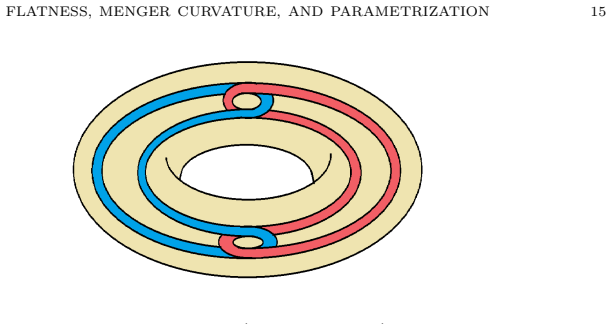
On LLC manifolds the beta numbers that measure unilateral flatness are comparable, with constants depending only on the LLC data, to the theta numbers that measure bilateral flatness. Consequently any compact LLC m-manifold M inside R^n whose Menger p-energy is finite for some p > m(m+2) is a C^{1,α} manifold. For each n ≥ 3 there exist LLC n-spheres in R^{n+1} whose Menger p-energy remains finite for every p < m(m+2) yet which are not quasisymmetrically equivalent to the standard n-sphere.
What carries the argument
The quantitative comparability between beta numbers (unilateral flatness) and theta numbers (bilateral flatness) that holds precisely when the manifold is linearly locally contractible.
If this is right
- Energy conditions that previously controlled only one-sided flatness now control two-sided flatness on LLC sets.
- Menger p-energy above the threshold m(m+2) becomes a sufficient condition for C^{1,α} parametrization of compact LLC manifolds.
- The exponent m(m+2) is the smallest number with this property inside the LLC class.
- Quasisymmetric equivalence to the standard sphere can fail for LLC spheres whose Menger energy is finite but subcritical.
Where Pith is reading between the lines
- The same comparability may let other curvature-type energies be upgraded to regularity statements once the LLC hypothesis is in place.
- Without the LLC assumption the beta-theta link can fail, so the regularity conclusion cannot be expected to hold for arbitrary sets of finite Menger energy.
- The explicit counterexamples below the threshold suggest that any attempt to lower the exponent must drop the LLC hypothesis or accept weaker conclusions such as rectifiability instead of C^{1,α}.
Load-bearing premise
The manifolds must be linearly locally contractible.
What would settle it
A linearly locally contractible manifold on which the ratio of beta numbers to theta numbers becomes arbitrarily large on some scales, or a compact LLC m-manifold with finite Menger energy for p > m(m+2) that fails to be C^{1,α}.
Figures
read the original abstract
We show that on linearly locally contractible (LLC) manifolds, the beta numbers (which describe unilateral flatness) are comparable to the theta numbers (which describe bilateral flatness), quantitatively. As an application, we show that if $M\subset\mathbb{R}^n$ is a compact LLC $m$-manifold with finite Menger $p$-energy for some $p>m(m+2)$, then $M$ is in fact a $C^{1,\alpha}$ manifold. We also show that the bound $m(m+2)$ is critical by constructing, for each $n\geq 3$, an LLC $n$-sphere in $\mathbb{R}^{n+1}$ that has finite Menger $p$-energy for every $p<m(m+2)$ but is not even quasisymmetrically equivalent to the standard $n$-sphere.
Editorial analysis
A structured set of objections, weighed in public.
Referee Report
Summary. The manuscript proves that on linearly locally contractible (LLC) manifolds the beta numbers (unilateral flatness) are quantitatively comparable to the theta numbers (bilateral flatness). As an application it shows that any compact LLC m-manifold M ⊂ R^n with finite Menger p-energy for p > m(m+2) is a C^{1,α} manifold. It also constructs, for each n ≥ 3, an LLC n-sphere in R^{n+1} possessing finite Menger p-energy for every p < m(m+2) yet not quasisymmetrically equivalent to the standard sphere, establishing sharpness of the exponent.
Significance. The quantitative beta–theta comparability on the LLC class supplies a new tool linking unilateral and bilateral flatness measures. The regularity theorem converts a natural energy finiteness condition into C^{1,α} regularity, while the matching counterexample demonstrates that the threshold m(m+2) cannot be improved. These results, if the proofs are correct, would be a solid contribution to metric geometry and geometric measure theory.
minor comments (2)
- [Abstract] The abstract states that M is a C^{1,α} manifold but does not record the dependence of α on m, n, p or the LLC constants; adding this dependence (even if only qualitative) would clarify the result.
- [Introduction] Notation for the Menger p-energy is introduced without an explicit formula; a displayed definition early in the introduction would aid readers.
Simulated Author's Rebuttal
We thank the referee for the positive assessment of the manuscript, the recognition of the beta-theta comparability result on LLC manifolds, and the recommendation for minor revision. No specific major comments were provided in the report.
Circularity Check
No significant circularity
full rationale
The derivation chain rests on external, standard definitions of LLC manifolds, beta numbers (unilateral flatness), theta numbers (bilateral flatness), and Menger p-energy. The central comparability result, the regularity application for p > m(m+2), and the sharpness counterexample are stated as theorems and constructions that do not reduce any quantity to a fitted parameter, self-definition, or load-bearing self-citation. The LLC hypothesis is explicitly required and retained consistently across positive and negative results, with no equations or steps shown to be equivalent to their inputs by construction.
Axiom & Free-Parameter Ledger
axioms (1)
- domain assumption The manifold is linearly locally contractible (LLC)
Reference graph
Works this paper leans on
-
[1]
Quasiconformal planes with bi- L ipschitz pieces and extensions of almost affine maps
Jonas Azzam, Matthew Badger, and Tatiana Toro. Quasiconformal planes with bi- L ipschitz pieces and extensions of almost affine maps. Adv. Math. , 275:195--259, 2015
2015
-
[2]
Beurling and L
A. Beurling and L. Ahlfors. The boundary correspondence under quasiconformal mappings. Acta Math. , 96:125--142, 1956
1956
-
[3]
Gill, Steffen Rohde, and Tatiana Toro
Matthew Badger, James T. Gill, Steffen Rohde, and Tatiana Toro. Quasisymmetry and rectifiability of quasispheres. Trans. Amer. Math. Soc. , 366(3):1413--1431, 2014
2014
-
[4]
The quasiconformal J acobian problem
Mario Bonk, Juha Heinonen, and Eero Saksman. The quasiconformal J acobian problem. In In the tradition of A hlfors and B ers, III , volume 355 of Contemp. Math. , pages 77--96. Amer. Math. Soc., Providence, RI, 2004
2004
-
[5]
R. H. Bing. A homeomorphism between the 3 -sphere and the sum of two solid horned spheres. Ann. of Math. (2) , 56:354--362, 1952
1952
-
[6]
Christopher J. Bishop. A quasisymmetric surface with no rectifiable curves. Proc. Amer. Math. Soc. , 127(7):2035--2040, 1999
2035
-
[7]
Quasisymmetric parametrizations of two-dimensional metric spheres
Mario Bonk and Bruce Kleiner. Quasisymmetric parametrizations of two-dimensional metric spheres. Invent. Math. , 150(1):127--183, 2002
2002
-
[8]
Bi- L ipschitz parameterization of surfaces
Mario Bonk and Urs Lang. Bi- L ipschitz parameterization of surfaces. Math. Ann. , 327(1):135--169, 2003
2003
-
[9]
Blankinship
William A. Blankinship. Generalization of a construction of A ntoine. Ann. of Math. (2) , 53:276--297, 1951
1951
-
[10]
K. Borsuk. On some metrizations of the hyperspace of compact sets. Fund. Math. , 41:168--202, 1955
1955
-
[11]
Glen E. Bredon. Sheaf theory , volume 170 of Graduate Texts in Mathematics . Springer-Verlag, New York, second edition, 1997
1997
-
[12]
Guy C. David. Bi- L ipschitz pieces between manifolds. Rev. Mat. Iberoam. , 32(1):175--218, 2016
2016
-
[13]
Asymptotically optimally doubling measures and R eifenberg flat sets with vanishing constant
Guy David, Carlos Kenig, and Tatiana Toro. Asymptotically optimally doubling measures and R eifenberg flat sets with vanishing constant. Comm. Pure Appl. Math. , 54(4):385--449, 2001
2001
-
[14]
David and S
G. David and S. Semmes. Analysis of and on uniformly rectifiable sets , volume 38 of Mathematical Surveys and Monographs . American Mathematical Society, Providence, RI, 1993
1993
-
[15]
Fractured fractals and broken dreams , volume 7 of Oxford Lecture Series in Mathematics and its Applications
Guy David and Stephen Semmes. Fractured fractals and broken dreams , volume 7 of Oxford Lecture Series in Mathematics and its Applications . The Clarendon Press, Oxford University Press, New York, 1997. Self-similar geometry through metric and measure
1997
-
[16]
David and T
G. David and T. Toro. Reifenberg flat metric spaces, snowballs, and embeddings. Math. Ann. , 315(4):641--710, 1999
1999
-
[17]
Reifenberg parameterizations for sets with holes , volume 215
Guy David and Tatiana Toro. Reifenberg parameterizations for sets with holes , volume 215. 2012
2012
-
[18]
Joseph H. G. Fu. Bi- L ipschitz rough normal coordinates for surfaces with an L^1 curvature bound. Indiana Univ. Math. J. , 47(2):439--453, 1998
1998
-
[19]
Lectures on analysis on metric spaces
Juha Heinonen. Lectures on analysis on metric spaces . Universitext. Springer-Verlag, New York, 2001
2001
-
[20]
Flat forms, bi- L ipschitz parameterizations, and smoothability of manifolds
Juha Heinonen and Stephen Keith. Flat forms, bi- L ipschitz parameterizations, and smoothability of manifolds. Publ. Math. Inst. Hautes \'Etudes Sci. , (113):1--37, 2011
2011
-
[21]
Quasicircles and bounded turning circles modulo bi- L ipschitz maps
David Herron and Daniel Meyer. Quasicircles and bounded turning circles modulo bi- L ipschitz maps. Rev. Mat. Iberoam. , 28(3):603--630, 2012
2012
-
[22]
On the locally branched E uclidean metric gauge
Juha Heinonen and Dennis Sullivan. On the locally branched E uclidean metric gauge. Duke Math. J. , 114(1):15--41, 2002
2002
-
[23]
Quasisymmetric nonparametrization and spaces associated with the W hitehead continuum
Juha Heinonen and Jang-Mei Wu. Quasisymmetric nonparametrization and spaces associated with the W hitehead continuum. Geom. Topol. , 14(2):773--798, 2010
2010
-
[24]
Peter W. Jones. Rectifiable sets and the traveling salesman problem. Invent. Math. , 102(1):1--15, 1990
1990
-
[25]
Lower bounds for codimension-1 measure in metric manifolds
Kyle Kinneberg. Lower bounds for codimension-1 measure in metric manifolds. Rev. Mat. Iberoam. , 34(3):1103--1118, 2018
2018
-
[26]
Geometric S obolev-like embedding using high-dimensional M enger-like curvature
S awomir Kolasi\' n ski. Geometric S obolev-like embedding using high-dimensional M enger-like curvature. Trans. Amer. Math. Soc. , 367(2):775--811, 2015
2015
-
[27]
J. C. L\'eger. Menger curvature and rectifiability. Ann. of Math. (2) , 149(3):831--869, 1999
1999
-
[28]
Lewis and Andrew Vogel
John L. Lewis and Andrew Vogel. On pseudospheres that are quasispheres. Rev. Mat. Iberoamericana , 17(2):221--255, 2001
2001
-
[29]
Tyler Whitehouse
Gilad Lerman and J. Tyler Whitehouse. High-dimensional M enger-type curvatures. P art I : G eometric multipoles and multiscale inequalities. Rev. Mat. Iberoam. , 27(2):493--555, 2011
2011
-
[30]
Area minimizing discs in metric spaces
Alexander Lytchak and Stefan Wenger. Area minimizing discs in metric spaces. Arch. Ration. Mech. Anal. , 223(3):1123--1182, 2017
2017
-
[31]
Snowballs are quasiballs
Daniel Meyer. Snowballs are quasiballs. Trans. Amer. Math. Soc. , 362(3):1247--1300, 2010
2010
-
[32]
M \"u ller and V
S. M \"u ller and V. S ver \'a k. On surfaces of finite total curvature. J. Differential Geom. , 42(2):229--258, 1995
1995
-
[33]
Mackay and Jeremy T
John M. Mackay and Jeremy T. Tyson. Conformal dimension , volume 54 of University Lecture Series . American Mathematical Society, Providence, RI, 2010. Theory and application
2010
-
[34]
Mattila and M
P. Mattila and M. Vuorinen. Linear approximation property, M inkowski dimension, and quasiconformal spheres. J. London Math. Soc. (2) , 42(2):249--266, 1990
1990
-
[35]
Cinqui \`e me compl \'e ment \`a l'analysis situs
Henri Poincar \'e . Cinqui \`e me compl \'e ment \`a l'analysis situs. Rend. Circ. Mat. Palermo , 18:45--110, 1904
1904
-
[36]
Flatness properties of quasispheres
Istv\'an Prause. Flatness properties of quasispheres. Comput. Methods Funct. Theory , 7(2):527--541, 2007
2007
-
[37]
Quasiconformal non-parametrizability of almost smooth spheres
Pekka Pankka and Vyron Vellis. Quasiconformal non-parametrizability of almost smooth spheres. Selecta Math. (N.S.) , 23(2):1121--1151, 2017
2017
-
[38]
Geometry and quasisymmetric parametrization of S emmes spaces
Pekka Pankka and Jang-Mei Wu. Geometry and quasisymmetric parametrization of S emmes spaces. Rev. Mat. Iberoam. , 30(3):893--960, 2014
2014
-
[39]
Uniformization of two-dimensional metric surfaces
Kai Rajala. Uniformization of two-dimensional metric surfaces. Invent. Math. , 207(3):1301--1375, 2017
2017
-
[40]
E. R. Reifenberg. Solution of the P lateau P roblem for m -dimensional surfaces of varying topological type. Acta Math. , 104:1--92, 1960
1960
-
[41]
Bi- L ipschitz embedding of the generalized G rushin plane into E uclidean spaces
Matthew Romney and Vyron Vellis. Bi- L ipschitz embedding of the generalized G rushin plane into E uclidean spaces. Math. Res. Lett. , 24(4):1177--1203, 2017
2017
-
[42]
Good metric spaces without good parameterizations
Stephen Semmes. Good metric spaces without good parameterizations. Rev. Mat. Iberoamericana , 12(1):187--275, 1996
1996
-
[43]
Surfaces with generalized second fundamental form in L^2 are L ipschitz manifolds
Tatiana Toro. Surfaces with generalized second fundamental form in L^2 are L ipschitz manifolds. J. Differential Geom. , 39(1):65--101, 1994
1994
-
[44]
Geometric conditions and existence of bi- L ipschitz parameterizations
Tatiana Toro. Geometric conditions and existence of bi- L ipschitz parameterizations. Duke Math. J. , 77(1):193--227, 1995
1995
-
[45]
a is \"a l \
P. Tukia and J. V \"a is \"a l \"a . Quasisymmetric embeddings of metric spaces. Ann. Acad. Sci. Fenn. Ser. A I Math. , 5(1):97--114, 1980
1980
-
[46]
Weak chord-arc curves and double-dome quasisymmetric spheres
Vyron Vellis. Weak chord-arc curves and double-dome quasisymmetric spheres. Anal. Geom. Metr. Spaces , 4:54--67, 2016
2016
-
[47]
Vellis and J.-M
V. Vellis and J.-M. Wu. Quasisymmetric spheres constructed over quasidisks. Trans. Amer. Math. Soc. , 368:5727--5751, 2016
2016
-
[48]
Bilipschitz embedding of G rushin plane in R^3
Jang-Mei Wu. Bilipschitz embedding of G rushin plane in R^3 . Ann. Sc. Norm. Super. Pisa Cl. Sci. (5) , 14(2):633--644, 2015
2015
-
[49]
Geometry of G rushin spaces
Jang-Mei Wu. Geometry of G rushin spaces. Illinois J. Math. , 59(1):21--41, 2015
2015
discussion (0)
Sign in with ORCID, Apple, or X to comment. Anyone can read and Pith papers without signing in.