REVIEW 5 major objections 5 minor 29 references
Macroeconomic Foundation of Monetary Accounting by Diagrams of Categorical Universals
T0 review · 5 major / 5 minor · reviewed 2026-08-15 · deepseek-v4-flash
Pith's one-line read This paper argues that macro-accounting consistency can be lifted from micro double-entry books by categorical universal constructions, making a five-agent loan-based monetary economy stable.
desk verdict A candid, code-backed categorical re-labeling of a five-agent monetary accounting simulation; the claimed 'foundation' outruns the evidence, but the translation work is genuine and worth a referee's time. read the letter →
The pith
A machine-rendered reading of the paper's core claim, the machinery that carries it, and where it could break.
The reading
What carries the argument
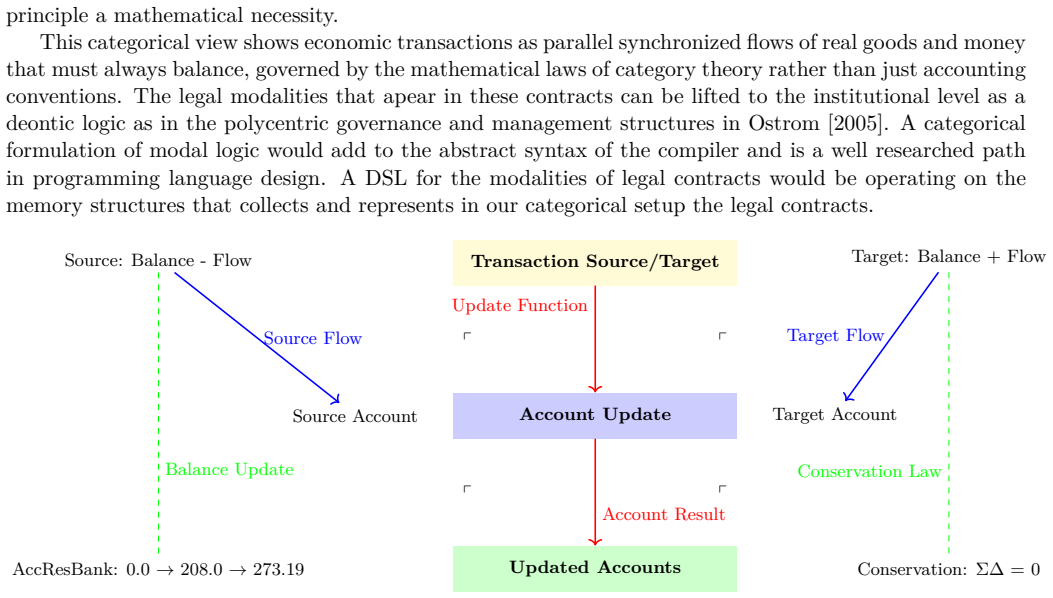
The central object is the category of the economy, whose objects are accounts with non-negative balances and whose morphisms are flows. The machinery that carries the argument is a stack of categorical tools: functors transform values between nominal and real categories, natural transformations represent evolution from period to period, an endofunctor advances the whole economic state in time, and universal constructions do the work: pullbacks (limits) verify that a proposed booking or investment satisfies all constraints before it is executed, and pushouts (colimits) combine individual flows into aggregate market magnitudes such as demand and updated account balances. The eight macro bookings are typed as morphisms in the product category of real and nominal flow categories, with the bank appearing as a mediating functor that factors payment flows.
What would settle it
Run the same five-agent simulation with a different parameter set, for example $\sigma_C=50$ for the investment sigmoid or initial endowments $\nu_l=50$, $\nu_r=200$, and check whether the five invariance conditions stay at zero and all account balances remain bounded over a thousand periods; any nonzero invariance or unbounded account would show that the categorical construction does not by itself guarantee consistency and stability.
Extended reading notes
Core claim
The central claim is that micro-accounting consistency can be lifted to the macroeconomic level through categorical universals: pullbacks (limits) validate constraints such as loan contracts, booking validity, price and investment decisions, while pushouts (colimits) compute aggregated flows such as demand, production, and account updates. The period-to-period dynamics is the categorical evolution of the whole economy, implemented by an endofunctor on the category of accounts; the eight macro bookings are typed as morphisms in the product of real and nominal account categories, with real and nominal flows moving in opposite directions. The economic assertion embedded in this structure is that the bank's loan and repayment bookings are the core of the system, synchronising temporally desynchronised payments, and that the accounting for a division-of-labor economy organised this way is consistent and stable: the invariance conditions—each agent's bank balance, the company's loan account, and the macroeconomic bank balance—remain satisfied in every simulated period.
Load-bearing premise
The result depends on the assumption that the hand-picked 22 parameters—especially the sigmoid investment response and the fixed constant endowments of labor and resources—are representative enough that the demonstrated stability of one configuration carries over to other configurations, an assumption the authors themselves flag as not yet supported by a sensitivity analysis.
Editorial extensions
If this is right
- A consistency-by-construction DSL for macroeconomic accounting would make a national accounting system verifiable: the five invariance conditions become type-level constraints rather than checks performed after the fact.
- The constructions compose, so adding a central bank, a government, or extra sectors should only require adding accounts, bookings, and invariances as new functorial layers rather than rewriting the whole system.
- If money is typed as a loan-repayment device, the temporal consistency of the economy lives at the macro level: loan creation and repayment bookings carry the intertemporal structure, and the 'debit equals credit' rule of micro double-entry is its local projection.
- Consistent and stable macro accounting is claimed as a prerequisite for risk and GDP sharing, so the same categorical framework could be the common skeleton for social-sharing mechanisms and monetary accounting.
Reading between the lines
- The categorical formulation suggests a proof route the paper leaves open: if the pullback validation maps are total and the pushout account updates are monotone, convergence of the whole system might be derived without numerical simulation.
- A natural stress test is parameter sensitivity: the paper states that a careful sensitivity analysis is still needed, and such an analysis could turn the one demonstrated stable configuration into a region of stability, or reveal phase boundaries.
- Because the eight bookings are typed as morphisms in a product of real and nominal categories, the same template could describe interbank liquidity pooling or a digital ledger where double-entry consistency is replaced by a pair of opposing flows in a product category.
- If the stability claim holds beyond the five-agent case, the categorical stack is effectively a blueprint for verified simulations of whole economies that can be extended sector by sector.
Signed reviews
Editorial analysis
A structured set of objections, weighed in public.
Referee Report
Summary. The paper proposes a category-theoretic reformulation of the Monetary Macroeconomic Accounting Theory (MoMaT) of Menéndez and Winschel. It models a five-agent economy (labor, resource owners, company, capitalist, bank) with twenty accounts and eight macroeconomic bookings, and presents three Julia implementations—a recursive program, a categorically typed recursive program, and a categorical program—that all generate the same simulated time series. The authors claim that lifting micro double-entry accounting consistency to the macro level via functors, natural transformations, pullbacks, and pushouts yields a consistent and stable monetary accounting system for a division-of-labor economy. The paper includes many commutative and string diagrams, a list of twenty-two parameters, and explicit acknowledgments that categorical stability proofs and verification of the universal properties are left for future research.
Significance. If the central claim were established, the paper would offer a compositional, typed foundation for monetary macroeconomic accounting, potentially enabling digital twins of national accounting systems and a principled DSL for quadruple-entry bookkeeping. The concrete strengths are the reproducible numerical implementation, the explicit invariance checks that produce zero residuals, and the honest statement of limitations, including the absence of sensitivity analysis. However, the load-bearing claim that universal constructions guarantee consistency and stability is not proven: the categorical constructions are asserted rather than verified, and the simulations demonstrate only that the categorical program reproduces the recursive program's numbers. The significance is thus conditional: the paper is a useful interdisciplinary mapping exercise, but it does not yet deliver the foundational result promised in the abstract.
major comments (5)
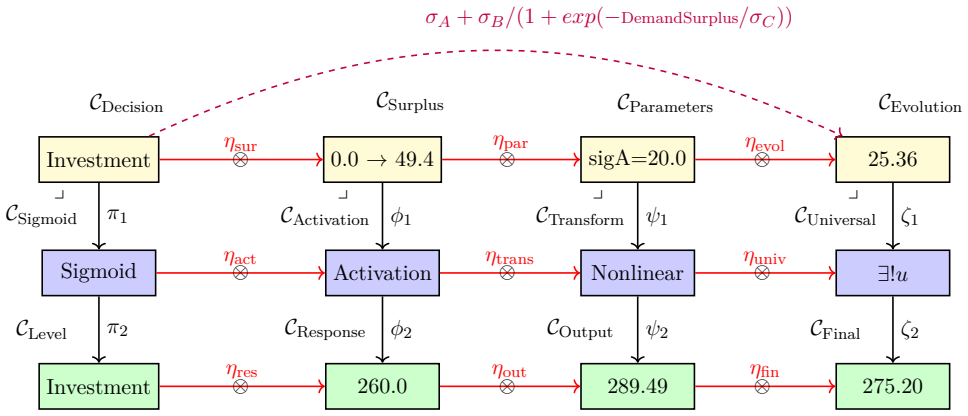
- [§4.5.1, Definition 4.13, Eq. (57)] The investment validation construction is called a pullback, but the definition only provides a threshold function Pullback_Investment(i,c) returning 1 if i ≤ c + CreditLimit and 0 otherwise; no commutative square, no cone over the claimed base, and no unique mediating morphism are constructed or checked. Since this is the central example of a universal construction enforcing constraints, the universal property is asserted, not demonstrated, and the subsequent claims about 'validation' do not follow from category theory.
- [§4.2–§4.5, Eqs. (32), (33), (37), (51)-(53)] The diagrams labeled as pushouts and pullbacks relabel ordinary arithmetic operations: aggregate demand is a sum (Eq. 32), production is a Cobb-Douglas evaluation (Eq. 33), price formation is a ratio plus markup (Eq. 37), and dividend payment is a max-plus expression (Eqs. 51-53). In none of these cases is the defining universal property of a colimit or limit verified, such as existence and uniqueness of the mediating morphism for arbitrary competing cones or cocones. Because the categorical program returns exactly the same simulated data as the recursive program, the simulations provide no evidence that the universal constructions add consistency or stability guarantees beyond the explicit recursive equations.
- [Definition 2.4 and §2.2, Fig. 2.2] The claim that the monetary accounting system is 'consistent and stable' rests on simulations for a single hand-picked parameter set (e.g., σ_A=20, σ_B=480, σ_C=200, ν_l=ν_r=100), and the paper itself states that this is 'just one set of parameters where stability is demonstrated to be reached' and that a careful sensitivity analysis is needed. No stability proof is provided, so the asymptotic or robust stability of the model class is not established; the text's own admission undermines the generality of the stability claim in the abstract.
- [§3.2, Definition 3.2; §3.3, Definition 3.3] The functors F_price and F_flow are claimed to preserve composition and identity, and η_time is claimed to be a natural transformation, but the underlying categories C_acc, C_flow, and C_pars are not defined with explicit morphism sets, identities, and composition rules. Without these data, the functoriality equations and naturality squares cannot be checked; the examples in the text only show value assignments on objects, not structure preservation. This is load-bearing because the paper's 'lifting' argument depends on these functoriality and naturality claims.
- [§1 (Introduction) and §5 (Conclusion)] The paper explicitly defers the needed proofs: 'Categorical stability proofs and proofs of the universal construction by verifying the universal constructions used in this paper are left for future research. The proofs so far are the numerical simulations.' In view of this admission, the abstract's statement that 'we show that the accounting for macroeconomies ... can be consistent and stable' outruns the evidence presented. The authors should either supply the missing verification for at least the principal pullback and pushout constructions and a stability argument, or substantially reframe the contribution as a categorical DSL mapping with stability observed numerically for one parameter configuration.
minor comments (5)
- [Throughout] There are numerous typos and informal formulations that should be corrected before publication, including 'Paccioli' for Pacioli, 'bancrupt' for bankrupt, 'weired' for weird, 'Lapalcian daemons' for Laplace's demons, and the nonstandard phrase 'DemandSruplus' in Figure 4.31.
- [Equation (16)] The price formation rule mixes mathematical notation with program pseudocode ('GoodPrice=30.0 int 0' and 'If DemandSurplus > 0.0'); this should be rewritten as a piecewise-defined function with clear cases.
- [Figure 2.1] The figure shows question marks for some bookings, but the text does not explain what the question marks denote or how they are resolved; a short caption note would help the reader.
- [Definition 2.2 and Table 1] The account typing table and the categorical booking types in Table 1 are not cross-referenced consistently with the notation in equations (1)-(3); the repeated use of labels like ■□ and □■ without a legend makes the presentation hard to follow.
- [Appendix A.1] The appendix gives standard categorical definitions, but it does not define the specific categories C_acc, C_flow, C_pars rigorously enough to support the functor and natural transformation claims made in the main text; adding explicit object and morphism sets would strengthen the paper.
Circularity Check
Categorical universals are asserted rather than verified; the paper's own text defers the stability proofs and relies on simulations with hand-chosen parameters, while the pushout/pullback labels re-express the recursive equations.
-
fitted input called prediction
[Section 1, Introduction and Definition 2.4]
"The simulated data shows stable convergence of the monetary systems, it is not a Ponzi scheme, neither in need to be stabilised by governmental debt policies (especially by unsustainable ones). Categorical stability proofs and proofs of the universal construction by verifying the universal constructions used in this paper are left for future research. We are focused in this paper to map the economics concepts to the categorical ones. The proofs so far are the numerical simulations, to be taken as constructive witnesses of the soundness of the categorical constructions."
The advertised guarantee that universal constructions lift micro-consistency to macro stability is explicitly deferred. The only offered evidence is a numerical simulation whose parameters (sigma_A=20, sigma_B=480, sigma_C=200, nu_l=nu_r=100) were hand-chosen; Definition 2.4 admits these are 'just one set of parameters where stability is demonstrated to be reached'. Thus the 'stable convergence' claimed as a result is an artifact of the chosen simulation inputs, not an independent consequence of the categorical machinery.
-
renaming known result
[Section 4.2.2, Eq. (32); cf. Section 4.3.3, Eq. (37)]
"PushoutDemand : R_{\ge 0} \times R_{\ge 0} \times R_{\ge 0} \rightarrow R_{\ge 0}, PushoutDemand(c_r,c_l,c_c) = c_r + c_l + c_c"
The demand 'pushout' is defined as ordinary addition of the three consumption flows, and the price 'pullback' is defined as the same ratio-plus-markup formula from the recursive program (FPriceFormation(d,q,m)=d/q+m). No universal property is proven for either construction. The categorical derivation therefore reduces by construction to the recursive equations it claims to lift, so the 'universal' label adds no new inferential content.
1 more flagged steps
-
renaming known result
[Section 4.5.1, Definition 4.13]
"PullbackInvestment : R_{>0} \times R_{\ge 0} \rightarrow \{0,1\}, PullbackInvestment(i,c) = { 1 if i <= c + CreditLimit, 0 otherwise }"
This is a threshold test, not a verified limit construction. The paper labels it a pullback and says the pullback 'ensures' validation, but existence and uniqueness of the mediating morphism for arbitrary cones—the defining property of a pullback—is never exhibited. The 'universal construction' is a renamed conditional from the recursive program, so any validation property it claims is identical to the program's own check.
full rationale
The paper is self-aware about its main gap: it states that categorical stability proofs and verification of the universal constructions are left for future research and that the proofs so far are the numerical simulations. Those simulations, however, are run with a hand-picked parameter set, as conceded in Definition 2.4. Moreover, the paper repeatedly defines categorical constructions as the same arithmetic expressions used in the recursive program—demand as a sum, price as a ratio plus markup, investment validation as a threshold check—without proving the universal properties. When all three implementations are said to produce the same simulated data, the categorical formulation is a faithful wrapper rather than an independent derivation of macro-level stability. The recursive model itself may be a coherent computational exercise, and the self-citations to the authors' earlier MoMaT papers are not in themselves circular, but the central claim that universal constructions guarantee consistency and stability is not established beyond the fitted simulation. This is partial circularity: the predicted stability is a property of the chosen model inputs, not a consequence independently derived from categorical universals.
Assumptions & free parameters
free parameters (11)
- Sigmoid investment parameters sigma_A, sigma_B, sigma_C =
20.0, 480.0, 200.0
- Consumption ratios rho_r, rho_l, rho_c =
0.8, 0.95, 0.6
- Investment allocation lambda =
0.8
- Markup mu and windfall omega =
0.5, 0.5
- Dividend rates delta_c, delta_b =
0.15, 0.4
- Production parameters alpha, gamma =
0.42, 0.75
- Decay parameters beta_l, beta_r, beta_c =
0.95, 0.7, 0.6
- Endowments: nu_l, nu_r, initial ComLab, ComRes =
100, 100, 110, 20
- Memory length tau =
10
- Initial good price p0 =
30.0
- CreditLimit in investment validation =
not specified
assumptions (4)
- domain assumption Accounts and flows form a category C_Economy with identities and composition (Def. 3.1).
- ad hoc to paper Fprice and Fflow are functors preserving composition and identity (Def. 3.2).
- ad hoc to paper The diagrams labeled pullbacks and pushouts satisfy the universal property of limits and colimits (Sections 4.5.1-4.5.2).
- domain assumption Finite numerical simulations over the chosen parameter set are constructive witnesses of long-run consistency and stability.
invented entities (2)
-
CEconomy, the category of the economy
-
Temporal endofunctor and natural transformation eta_time: Ft to Ft+1
Cite this review
Pith. "Pith review of Macroeconomic Foundation of Monetary Accounting by Diagrams of Categorical Universals." pith.science (2026). https://pith.science/paper/BQINL2LB
@misc{pith2026250814132,
  author       = {Pith},
  title        = {Pith review of: Macroeconomic Foundation of Monetary Accounting by Diagrams of Categorical Universals},
  year         = {2026},
  howpublished = {\url{https://pith.science/paper/BQINL2LB}},
  note         = {Machine review of arXiv:2508.14132}
}
read the original abstract
We present a category theoretical formulation of the Monetary Macroeconomic Accounting Theory (MoMaT) of Men\'endez and Winschel [2025]. We take macroeconomic (national) accounting systems to be composed from microeconomic double-entry systems with real and monetary units of accounts. Category theory is the compositional grammar and module system of mathematics which we use to lift micro accounting consistency to the macro level. The main function of money in MoMaT is for the repayment of loans and not for the exchange of goods, bridging the desynchronisation of input and output payments of producers. Accordingly, temporal accounting consistency is at the macroeconomic level. We show that the accounting for macroeconomies organised by a division of labor can be consistent and stable as a prerequisite for risk and GDP sharing of societies. We exemplify the theory by five sectoral agents of Labor and Resource owners, a Company as the productive sector, a Capitalist for profits, and a Bank as the financial sector providing loans to synchronise the micro and the macro levels of an economy. The dynamics is described by eight sectoral macroeconomic bookings in each period demonstrating stable convergence of the MoMaT in numerical simulations. The categorical program implements a consistent evolution of hierarchical loan repayment contracts by an endofunctor. The universal constructions of a limit verify all constraints as the sectoral investment and learning function at the macroeconomic level. The dual colimit computes the aggregated informations at the macro level as usual in the mathematics of transitions from local to global structures. We use visual diagrams to make complex economic relationships intuitive. This paper is meant to map economic to categorical concepts to enable interdisciplinary collaboration for digital twins of monetary accounting systems.
Figures


Figures from the paper (56 more)






Reference graph
Works this paper leans on
-
[1]
A categorical semantics of quantum protocols
Samson Abramsky and Bob Coecke. A categorical semantics of quantum protocols. Proceedings of the 19th Annual IEEE Symposium on Logic in Computer Science (LICS), 2004. doi:10.1109/LICS.2004.1319636
arXiv 2004
-
[2]
Coalgebraic analysis of subgame-perfect equilibria in infinite games without discounting
Samson Abramsky and Viktor Winschel. Coalgebraic analysis of subgame-perfect equilibria in infinite games without discounting. Mathematical Structures in Computer Science, 27 0 (5): 0 751--761, 2015. ISSN 0960-1295, 1469-8072. doi:10.1017/s0960129515000365
-
[3]
Baez, Fabio Gadducci, and Viktor Winschel
Samson Abramsky, John C. Baez, Fabio Gadducci, and Viktor Winschel. Categorical methods at the crossroads (dagstuhl perspectives workshop 14182), 2014. URL https://drops.dagstuhl.de/entities/document/10.4230/DagRep.4.4.49
-
[4]
Coalgebraic semantics of reflexive economics (dagstuhl seminar 15042), 2015
Samson Abramsky, Alexander Kurz, Pierre Lescanne, and Viktor Winschel. Coalgebraic semantics of reflexive economics (dagstuhl seminar 15042), 2015. URL https://drops.dagstuhl.de/entities/document/10.4230/DagRep.5.1.197
-
[5]
Picturing Quantum Processes: A First Course in Quantum Theory and Diagrammatic Reasoning
Bob Coecke and Aleks Kissinger. Picturing Quantum Processes: A First Course in Quantum Theory and Diagrammatic Reasoning. Cambridge University Press, Cambridge, UK, 2017. ISBN 978-1-107-10422-8
work page 2017
-
[6]
Ehresmann and Jean-Paul Vanbremeersch
Andrée C. Ehresmann and Jean-Paul Vanbremeersch. Memory Evolutive Systems; Hierarchy, Emergence, Cognition. Elsevier Science, 2007. ISBN 9780444560919
work page 2007
-
[7]
AutoBayes : a system for generating data analysis programs from statistical models
Bernd Fischer and Johann Schumann. AutoBayes : a system for generating data analysis programs from statistical models. 13 0 (3): 0 508, 483, 2003
work page 2003
-
[8]
Brendan Fong, David I. Spivak, and Rémy Tuyéras. Backprop as functor: A compositional perspective on supervised learning, 2019. URL http://arxiv.org/abs/1711.10455
arXiv 2019
Show all 29 references
-
[9]
The entropy law and the economic process
Nicholas Georgescu-Roegen. The entropy law and the economic process. Harvard University Press, 1971. ISBN 978-0-674-25780-1
1971
-
[10]
Compositional game theory
Neil Ghani, Jules Hedges, Viktor Winschel, and Philipp Zahn. Compositional game theory. In Proceedings of the 33rd Annual ACM / IEEE Symposium on Logic in Computer Science , pages 472--481. ACM , 2018. doi:10.1145/3209108.3209165. URL https://dl.acm.org/doi/10.1145/3209108.3209165
2018
-
[11]
A categorical approach to probability theory
Mich \`e le Giry. A categorical approach to probability theory. In Categorical Aspects of Topology and Analysis, pages 68--85. Springer, 1982. doi:10.1007/BFb0092872
1982 doi
-
[12]
Uncertainty quantification and global sensitivity analysis for economic models
Daniel Harenberg, Stefano Marelli, Bruno Sudret, and Viktor Winschel. Uncertainty quantification and global sensitivity analysis for economic models. Quantitative Economics, 10 0 (1): 0 1--41, 2019. ISSN 1759-7323. doi:10.3982/qe866. URL http://qeconomics.org/ojs/index.php/qe/...
2019 doi
-
[13]
Likelihood approximation by numerical integration on sparse grids
Florian Heiss and Viktor Winschel. Likelihood approximation by numerical integration on sparse grids. Journal of Econometrics, 144 0 (1): 0 62--80, 2008. ISSN 0304-4076. doi:10.1016/j.jeconom.2007.12.004. URL https://linkinghub.elsevier.com/retrieve/pii/S0304407607002552. Publ...
2008 doi
-
[14]
System of National Accounts 2008
International Monetary Fund , Organization for Economic Cooperation and Development , United Nations , European Commission , and World Bank . System of National Accounts 2008. International Monetary Fund, 2009. ISBN 978-92-1-161522-7
2008
-
[15]
Sabadini, and R
Piergiulio Katis, N. Sabadini, and R. F. C. Walters. On partita doppia, 2008. URL http://arxiv.org/abs/0803.2429
2008 arXiv
-
[16]
Economic Theories and Their Relational Structures: A Model-theoretic Characterization
Erwin Klein. Economic Theories and Their Relational Structures: A Model-theoretic Characterization. Palgrave Macmillan, 1998. ISBN 0-333-68792-2. URL https://www.google.de/books/edition/Economic_Theories_and_their_Relational_S/XH-GDAAAQBAJ?hl=en&gbpv=0
1998
-
[17]
Die Organisationsstrukturen des Kreditgeldkapitalismus oder Theorie der bootstrap-Ökonomie: ein Beitrag zur Rekonstruktion der deutschen Nationalökonomie
Renée Menéndez. Die Organisationsstrukturen des Kreditgeldkapitalismus oder Theorie der bootstrap-Ökonomie: ein Beitrag zur Rekonstruktion der deutschen Nationalökonomie. phdthesis, Free University of Berlin, 1989. URL https://stabikat.de/Record/275143929?sid=8100118
1989
-
[18]
Theorie des Kapitalismus als Sozialwissenschaft: Prolegomena zu einer sozialen Zinstheorie
Renée Menéndez. Theorie des Kapitalismus als Sozialwissenschaft: Prolegomena zu einer sozialen Zinstheorie. Number Bd. 179 in Politikwissenschaft. Lit, 2010. ISBN 978-3-643-10901-9
2010
-
[19]
Monetary macro accounting theory, 2025
Renée Menéndez and Viktor Winschel. Monetary macro accounting theory, 2025. URL https://arxiv.org/abs/2506.21651
2025 arXiv
-
[20]
Understanding Institutional Diversity
Elinor Ostrom. Understanding Institutional Diversity. Princeton University Press, Princeton, New Jersey, 2005. ISBN 9780691122380. doi:10.1515/9781400831739
2005 doi
-
[21]
Categorical data structures for technical computing
Evan Patterson, Owen Lynch, and James Fairbanks. Categorical data structures for technical computing. Compositionality, 4 0 (5), 2022. doi:10.32408/compositionality-4-5
2022 doi
-
[22]
Algebraic Models for Accounting Systems
Salvador Cruz Rambaud, José García Pérez, Robert A Nehmer, and Derek J S Robinson. Algebraic Models for Accounting Systems. World Scientific, 2010. ISBN 978-981-4287-11-1. URL https://books.google.de/books?id=6tZpDQAAQBAJ
2010
-
[23]
J. J. M. M. Rutten. Universal coalgebra: a theory of systems. Theoretical Computer Science, 249 0 (1): 0 3--80, 2000. ISSN 0304-3975. doi:https://doi.org/10.1016/S0304-3975(00)00056-6. URL https://www.sciencedirect.com/science/article/pii/S0304397500000566
2000 doi
-
[24]
The Composable Enterprise: Agile, Flexible, Innovative: A Gamechanger for Organisations, Digitisation and Business Software
August-Wilhelm Scheer. The Composable Enterprise: Agile, Flexible, Innovative: A Gamechanger for Organisations, Digitisation and Business Software. Springer Fachmedien Wiesbaden, 2024. ISBN 978-3-658-43088-7 978-3-658-43089-4. doi:10.1007/978-3-658-43089-4. URL https://link.sp...
2024 doi
-
[25]
A survey of graphical languages for monoidal categories
Peter Selinger. A survey of graphical languages for monoidal categories. 2009. URL http://arxiv.org/abs/0908.3347
2009 arXiv
-
[26]
A survey of graphical languages for monoidal categories
Peter Selinger. A survey of graphical languages for monoidal categories. New Structures for Physics, 813: 0 289--355, 2011. doi:10.1007/978-3-642-12821-9_4
2011 doi
-
[27]
Jan C. Willems. The behavioral approach to open and interconnected systems. 27 0 (6): 0 46--99, 2007. ISSN 1941-000X. doi:10.1109/MCS.2007.906923. URL https://ieeexplore.ieee.org/document/4384643. Conference Name: IEEE Control Systems Magazine
2007
-
[28]
The Empirical Analysis of Exchange Rate Regimes and Nonlinear Structural Econometrics
Viktor Winschel. The Empirical Analysis of Exchange Rate Regimes and Nonlinear Structural Econometrics. phdthesis, University of Mannheim, 2005
2005
-
[29]
Solving, estimating, and selecting nonlinear dynamic models without the curse of dimensionality
Viktor Winschel and Markus Krätzig. Solving, estimating, and selecting nonlinear dynamic models without the curse of dimensionality. Econometrica, 78 0 (2): 0 803--821, 2010. ISSN 0012-9682. doi:10.3982/ecta6297. URL http://doi.wiley.com/10.3982/ECTA6297. Publisher: The Econom...
2010 doi
Reviewed August 15, 2026 · model on record in the stance chip above.
Discussion (0). Continue with ORCID to comment.