REVIEW 5 major objections 6 minor 40 references
Efficient Multi-user Offloading of Personalized Diffusion Models: A DRL-Convex Hybrid Solution
T0 review · 5 major / 6 minor · reviewed 2026-08-12 · deepseek-v4-flash
Pith's one-line read This paper claims that multi-user personalized diffusion inference can be offloaded in near real time by decomposing a joint offload-and-split decision into a DRL layer and a convex split-point layer.
desk verdict The DRL-convex decomposition is smart and the problem is new, but the objective rests on a fitted cluster-level PAI that may not be the metric actually optimized once split points diverge. read the letter →
The pith
A machine-rendered reading of the paper's core claim, the machinery that carries it, and where it could break.
The reading
What carries the argument
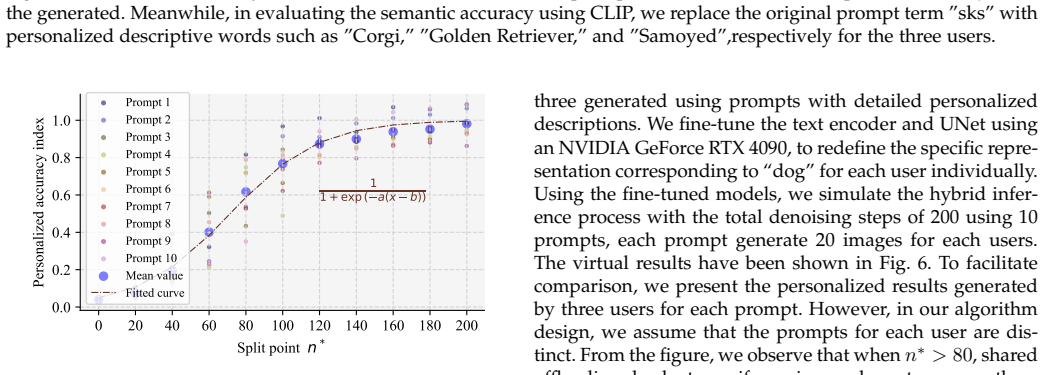
The machinery is the Personalized Accuracy Index (PAI), a product of CLIP-based prompt-image similarity and a sigmoid-modulated LPIPS personalization score, summarized by the fitted function $F(n^*) = 1/(1+\exp(-a_F(n^*-b_F)))$ with $a_F = 0.0413$ and $b_F = 71.44$, plus a linear model $L_e(b,G) = k_e(b/G) + h_e$ for the latency of one batched edge denoising step. These two empirical curves make the inner split-point problem concave, so each user's split point can be computed by a scalar equation root, and they feed the MDP reward that the DRL agent uses to learn grant/deny policies. The outer-inner nesting, with request handling dominant over split-point selection, is what converts an extended GQAP into a tractable decision sequence.
What would settle it
Measure PAI for a number of users and prompts (different subjects, breeds, styles, and devices) across split points from 80 to 200 and compare with the fitted curve $F(n^*) = 1/(1+\exp(-0.0413(n^*-71.44)))$; if the measured curve shifts or flattens for any group, the convexity premise breaks and the claimed optimal split points would need re-derivation, while large across-user variation would falsify the single-curve assumption.
Extended reading notes
Core claim
On the paper's own terms, the central discovery is that the coupled choice of offload requests and split points for a cluster of users can be recast as a nested optimization: once the binary grant/deny decisions are fixed, each user's optimal split point is found by a concave maximization whose solution depends only on that user's device speed, preference weight, and the edge server's batch latency. Because the personalized accuracy index follows an S-shaped curve that the paper fits as a sigmoid with parameters aF=0.0413 and bF=71.44, the objective is strictly concave on the legal split range, so the inner problem has a unique optimum. The outer grant/deny problem is then treated as a sequential Markov decision process and solved with a DQN using prioritized experience replay, cyclic state shifting, and reward backpropagation. Simulations with three DreamBooth-finetuned personalized models and a cluster-wide model show the hybrid solver outperforming all-offload, fixed-split, local-only, branch-and-bound, and genetic-heuristic baselines in average objective value, with complexity O(I).
Load-bearing premise
Everything rests on one fitted sigmoid curve, trained on three users' dog photos, standing in for every user's personalization-accuracy behavior; if that curve is wrong for a user or prompt, the "optimal" split points and rewards are optimal only for the curve, not for the real system.
Editorial extensions
If this is right
- An edge server with a single trained Q-network can serve a varying number of users with heterogeneous local GPUs without re-solving the combinatorial problem at decision time.
- The per-user split point becomes an online by-product of the grant/deny choice, so users receive individualized latency-accuracy trade-offs rather than a fixed offload depth.
- The complexity comparison implies the scheme scales to user sets where branch-and-bound becomes prohibitive; the stated cost is O(I) against O(2^{2I}) for branch-and-bound.
- Because only the cluster-wide model is stored at the edge, the approach directly addresses the storage burden of replicating each user's personalized model on the server.
Reading between the lines
- Beyond the paper, the same split-point optimizer would apply to any personalization task whose PAI curve is sigmoidal, so faces, styles, and other subjects might reuse the machinery after a one-time fit.
- A testable extension is to replace the single fitted sigmoid with per-user or per-cluster PAI curves and check whether convexity still holds; the paper's claims would weaken if curves vary strongly across users.
- The reward-backpropagation design suggests the DRL layer could be retrained online as the user population shifts, an adaptive variant the paper itself does not evaluate.
Editorial analysis
A structured set of objections, weighed in public.
Referee Report
Summary. The paper proposes an edge-assisted offloading framework for personalized diffusion models. A cluster-wide model at the edge performs the initial denoising steps for multiple users in batches, while each user's local personalized model completes the remaining steps, with a per-user split point. The joint problem of selecting which requests to grant and choosing split points is formulated as an extended Generalized Quadratic Assignment Problem, proven NP-hard, and solved by a DRL-convex hybrid: DQN with prioritized experience replay decides grant/deny sequentially, while convex optimization determines each granted user's split point. The paper reports O(I) decision complexity and simulation improvements over baselines, and provides code, data, and models.
Significance. The system model is timely, and the decomposition into an outer DRL problem and an inner convex split-point selection is an interesting way to make a hard combinatorial problem tractable at scale. The NP-hardness reduction and the O(I) inference complexity are useful contributions, as is the public release of code and fine-tuned models. However, the current evidence does not establish optimality with respect to the stated Personalized Accuracy Index: the same sigmoid F(n*) fitted from a three-user dog experiment drives the split-point optimizer, the DRL reward, and the evaluation, and the additive per-user objective is not derived from the pairwise LPIPS-based PAI. With a corrected and externally validated accuracy model, the framework could be a solid contribution; in its present form the quantitative claims are only about a fitted surrogate.
major comments (5)
- [§3.4.2, §4 (P1), §5.2 (P2)] The objective is not consistent with the defined metric. Eq. (1) defines PAI as κ·E_i[CLIP]·σ_P(LPIPS) with LPIPS = E_{i<i'}[LPIPS(m_i,m_i')], a cluster-level pairwise quantity. Yet (P1) maximizes Σ_i α_i F(n*_i) − L_i, and (P2) optimizes each granted user's n*_i separately using the same univariate sigmoid F. Section 6.1 fits F to mean PAI values from experiments in which all users share one split point (Fig. 7). If F is the cluster-level PAI, the additive sum is not the same metric; if F is intended to be per-user, it is not derived from Eq. (1), and the pairwise LPIPS term depends on all users' split points, not only n_i. Since the hybrid inference in Fig. 2 allows different n*_i across users, the optimization and the reward (21) can maximize a function that differs from the stated PAI.
- [Eq. (21)] The reward function double-counts the PAI term. With γ=1, the cumulative return over an episode is Σ_t α_t F(n*_t) + [Σ_i α_i F(n*_i) − Σ_i L_i] = 2Σ_i α_i F(n*_i) − Σ_i L_i, whereas the (P1) objective is Σ_i α_i F(n*_i) − Σ_i L_i. The final-step reward as written includes all PAI terms on top of the immediate PAI rewards collected at earlier steps. Unless the final reward is meant to be the difference between the total objective and the sum of previous PAI rewards, the DRL agent maximizes a different functional from (P1); if it is meant to be that difference, the formula should be written accordingly and used in training and evaluation.
- [§6.1, Fig. 7, §6.3] The fitted PAI curve is the single empirical pillar of the paper, but it comes from one small experiment: three users, one dog-personalization cluster, 10 prompts, 20 images per prompt, with no error bars, no confidence intervals, and no held-out validation. The same curve (aF=0.0413, bF=71.44) is used in the convex split-point optimizer (§5.2), the DRL reward (21), and every performance comparison in §6.3, and the threshold N̂=80 is also selected from the same data. As a result, the reported gains and optimality are with respect to this self-defined surrogate; the paper does not demonstrate that decisions optimized for this F remain near-optimal for the actual PAI of Eq. (1) on other clusters, prompt sets, or user numbers.
- [§5.2, Proposition 2] The proof of concavity relies on the assertion that 'we can select an appropriate value of N̂ to ensure F(n*_i)>0.5' on [N̂,N]. In the paper, N̂=80 is chosen in §6.1 from visual inspection before or independently of the fit, and no condition on (aF,bF,N̂) is stated or verified beyond the single fitted curve. Since the closed-form split-point solution and the reward both depend on this concavity, the paper should state the required inequality as a condition and provide a sensitivity analysis over the fitted parameters.
- [§6.3, Fig. 11c, Table 2] The comparison against Branch & Bound is not apples-to-apples: the B&B-based ILP baseline omits split-point optimization 'for simplicity,' while the proposed DRL-convex method includes it. The observed superiority of the proposed method over B&B may therefore reflect the additional split-point optimization rather than the quality of the DRL request-handling policy. The B&B baseline should be given the same inner split-point optimizer, or all methods should fix n* identically, before drawing conclusions about optimality.
minor comments (6)
- [Fig. 6] The label 'P13N (LPIPS)' appears to be a rendering corruption; it should read something like 'P (LPIPS)'.
- [Figs. 7–11] Several figures contain '/uni0000...' glyph artifacts in axis labels and legends; the figures need to be regenerated with proper fonts.
- [Throughout] Typos: 'spilt point' in the constraint C3 description, 'the the similarity' in §3.4.2, and 'with with respect to user count' in §6.3 should be corrected.
- [Eq. (1) and §6.2.1] The symbol κ is used both as the multiplicative constant 3 in Eq. (1) and as the factor 0.05 in the α_i sampling interval in §6.2.1; please disambiguate these two uses.
- [§5.2, Remark 1] The sentence about increasing 'the exponent of the total latency term' is unclear and should be rewritten.
- [Fig. 9(c)] The learning curve for the specific-application model is reported from a single seed; multiple seeds or confidence bands would make the convergence claim more robust.
Circularity Check
Performance evaluation is partially closed loop: the fitted PAI sigmoid serves as both the optimization objective and the reported accuracy metric.
-
fitted input called prediction
[Sec. 6.1 (PAI fitting), Sec. 6.2.1 (simulation setup), Sec. 4 (P1), Sec. 5.2 (P2), Eq. (21)]
"We then apply a sigmoid fitting to these scatter points, with parameters aF = 0.0413 and bF = 71.44. ... the determination of inference latency and PAI is based on empirical functions derived from actual experiments, as shown in Figs. 3 and 7."
The same sigmoid F, fitted to PAI measurements from a three-user dog experiment, is the accuracy term in the P1 objective (αiF(n*i) − Li), in the convex split-point solver P2, and in the DRL reward (21). Section 6.2.1 then states that simulation PAI values are computed from the empirical function of Fig. 7, i.e., from this same fitted F. Consequently, the average PAI and overall performance reported in Figs. 10 and 11 are evaluations of the fitted curve that the optimizer maximizes, not independent measurements of personalized accuracy. Any policy that drives n* toward the high-F region reports high PAI by construction; the reported accuracy advantage is therefore statistically forced by the fit rather than validated on held-out users, prompts, or models.
full rationale
The core optimization problem is well posed and the DRL-convex versus Branch-and-Bound and heuristic comparisons are genuine computations on the stated objective, so the algorithmic contribution is not vacuous. No load-bearing self-citation was found: the related-work citations to [18] and [19] are background, and the NP-hardness argument relies on standard external GQAP results [33]-[35]. However, the accuracy dimension of the objective reduces to a single sigmoid F fitted in one cluster scenario, and the same fitted function is used to compute PAI in the simulation evaluation. That makes the claimed real-world accuracy improvement partially circular, even though the latency model and optimization mechanics are independent. The paper itself acknowledges in the conclusion that 'the relationship between cluster-wide model generalization and individual users' final PAI remain unexplored,' which underscores that the per-user PAI predictions are not externally validated. There is also a metric misspecification: Eq. (1) defines PAI using pairwise LPIPS over all users, while P1 optimizes an additive sum of per-user F(n*i); this is a correctness concern rather than circularity, but it reinforces that the evaluated PAI is the fitted surrogate, not the stated cluster-level metric.
Assumptions & free parameters
free parameters (5)
- aF =
0.0413
- bF =
71.44
- PAI constants a, b, kappa =
a=30, b=0.1, kappa=3
- N_hat =
80
- Edge latency coefficients ke, he and local latency coefficients ki, hi =
Measured per GPU (Fig. 3)
assumptions (5)
- domain assumption The personalized accuracy index F(n*) is a universal sigmoid function of split point with parameters fitted once from one experiment and valid for all users and prompts.
- domain assumption Latency per denoising step at the edge is linear in batch size with fixed offset, and the batch size equals the number of granted users for the whole offloading period.
- domain assumption The initial denoising steps contain minimal personalized information, so offloading them to a shared cluster model does not destroy personalization until a threshold.
- domain assumption Dreambooth fine-tuning of cluster-wide and user models yields models compatible with the hybrid inference split.
- ad hoc to paper DQN with prioritized experience replay converges to a near-optimal policy for the proposed MDP.
Cite this review
Pith. "Pith review of Efficient Multi-user Offloading of Personalized Diffusion Models: A DRL-Convex Hybrid Solution." pith.science (2026). https://pith.science/paper/BQTAG2A3
@misc{pith2026241115781,
  author       = {Pith},
  title        = {Pith review of: Efficient Multi-user Offloading of Personalized Diffusion Models: A DRL-Convex Hybrid Solution},
  year         = {2026},
  howpublished = {\url{https://pith.science/paper/BQTAG2A3}},
  note         = {Machine review of arXiv:2411.15781}
}
read the original abstract
With the impressive generative capabilities of diffusion models, personalized content synthesis has emerged as the most highly anticipated. However, the large model sizes and iterative nature of inference make it difficult to deploy personalized diffusion models broadly on local devices with varying computational power. To this end, we propose a novel framework for efficient multi-user offloading of personalized diffusion models, given a variable number of users, diverse user computational capabilities, and fluctuating available computational resources on the edge server. To enhance computational efficiency and reduce storage burden on edge servers, we first propose a tailored multi-user hybrid inference manner, where the inference process for each user is split into two phases with an optimizable split point. The initial phase of inference is processed on a cluster-wide model using batching techniques, generating low-level semantic information corresponding to each user's prompt. Then, the users employ their own personalized model to add further details in the later inference phase. Given the constraints on edge server computational resources and users' preferences for low latency and high accuracy, we model the joint optimization of each user's offloading request handling and split point as an extension of the Generalized Quadratic Assignment Problem (GQAP). Our objective is to maximize a comprehensive metric that accounts for both latency and accuracy across all users. To tackle this NP-hard problem, we transform the GQAP into an adaptive decision sequence, model it as a Markov decision process, and develop a hybrid solution combining deep reinforcement learning with convex optimization techniques. Simulation results validate the effectiveness of our framework, demonstrating superior optimality and low complexity compared to traditional methods.
Figures


Figures from the paper (8 more)




Reference graph
Works this paper leans on
-
[1]
High-resolution image synthesis with latent diffusion models,
R. Rombach, A. Blattmann, D. Lorenz, P . Esser, and B. Ommer, “High-resolution image synthesis with latent diffusion models,” in Proceedings of the IEEE/CVF conference on computer vision and pattern recognition, 2022, pp. 10 684–10 695
2022
-
[2]
Denoising diffusion probabilistic models,
J. Ho, A. Jain, and P . Abbeel, “Denoising diffusion probabilistic models,” Advances in neural information processing systems , vol. 33, pp. 6840–6851, 2020
2020
-
[3]
Diffusion models in vision: A survey,
F.-A. Croitoru, V . Hondru, R. T. Ionescu, and M. Shah, “Diffusion models in vision: A survey,” IEEE Transactions on Pattern Analysis and Machine Intelligence, vol. 45, no. 9, pp. 10 850–10 869, 2023
work page 2023
-
[4]
Rethinking generative semantic communica- tion for multi-user systems with multi-modal llm,
W. Yang, Z. Xiong, S. Mao, T. Q. Quek, P . Zhang, M. Debbah, and R. Tafazolli, “Rethinking generative semantic communica- tion for multi-user systems with multi-modal llm,” arXiv preprint arXiv:2408.08765, 2024
arXiv 2024
-
[5]
Diffusion models in medical imaging: A comprehensive survey,
A. Kazerouni, E. K. Aghdam, M. Heidari, R. Azad, M. Fayyaz, I. Hacihaliloglu, and D. Merhof, “Diffusion models in medical imaging: A comprehensive survey,” Medical image analysis, vol. 88, p. 102846, 2023
work page 2023
-
[6]
A survey on personalized content synthesis with diffusion models,
X. Zhang, X.-Y. Wei, W. Zhang, J. Wu, Z. Zhang, Z. Lei, and Q. Li, “A survey on personalized content synthesis with diffusion models,” arXiv preprint arXiv:2405.05538, 2024
arXiv 2024
-
[7]
Denoising diffusion implicit models,
J. Song, C. Meng, and S. Ermon, “Denoising diffusion implicit models,” International Conference on Learning Representations, 2021
2021
-
[8]
Diffusion probabilistic model made slim,
X. Yang, D. Zhou, J. Feng, and X. Wang, “Diffusion probabilistic model made slim,” in Proceedings of the IEEE/CVF Conference on computer vision and pattern recognition, 2023, pp. 22 552–22 562
work page 2023
Show all 40 references
-
[9]
Structural pruning for diffusion models,
G. Fang, X. Ma, and X. Wang, “Structural pruning for diffusion models,” in Advances in Neural Information Processing Systems, 2023
2023
-
[10]
Q-diffusion: Quantizing diffusion models,
X. Li, Y. Liu, L. Lian, H. Yang, Z. Dong, D. Kang, S. Zhang, and K. Keutzer, “Q-diffusion: Quantizing diffusion models,” in Proceedings of the IEEE/CVF International Conference on Computer Vision (ICCV), October 2023, pp. 17 535–17 545
2023
-
[11]
OMS-DPM: Opti- mizing the model schedule for diffusion probabilistic models,
E. Liu, X. Ning, Z. Lin, H. Yang, and Y. Wang, “OMS-DPM: Opti- mizing the model schedule for diffusion probabilistic models,” in Proceedings of the 40th International Conference on Machine Learning . PMLR, 2023, pp. 21 915–21 936
2023
-
[12]
Exploring collaborative distributed diffusion- based ai-generated content (aigc) in wireless networks,
H. Du, R. Zhang, D. Niyato, J. Kang, Z. Xiong, D. I. Kim, X. Shen, and H. V . Poor, “Exploring collaborative distributed diffusion- based ai-generated content (aigc) in wireless networks,” IEEE Network, vol. 38, no. 3, pp. 178–186, 2024
2024
-
[13]
Hybrid sd: Edge-cloud collaborative inference for stable diffusion models,
C. Yan, S. Liu, H. Liu, X. Peng, X. Wang, F. Chen, L. Fu, and X. Mei, “Hybrid sd: Edge-cloud collaborative inference for stable diffusion models,” arXiv preprint arXiv:2408.06646, 2024
2024 arXiv
-
[14]
All are worth words: A vit backbone for diffusion models,
F. Bao, S. Nie, K. Xue, Y. Cao, C. Li, H. Su, and J. Zhu, “All are worth words: A vit backbone for diffusion models,” in Proceedings of the IEEE/CVF conference on computer vision and pattern recognition, 2023, pp. 22 669–22 679
2023
-
[15]
ediff-i: Text-to-image diffusion models with an ensemble of expert denoisers,
Y. Balaji, S. Nah, X. Huang, A. Vahdat, J. Song, Q. Zhang, K. Kreis, M. Aittala, T. Aila, S. Laine et al., “ediff-i: Text-to-image diffusion models with an ensemble of expert denoisers,” arXiv preprint arXiv:2211.01324, 2022
2022 arXiv
-
[16]
OMS-DPM: Optimizing the model schedule for diffusion probabilistic models,
E. Liu, X. Ning, Z. Lin, H. Yang, and Y. Wang, “OMS-DPM: Optimizing the model schedule for diffusion probabilistic models,” in Proceedings of the 40th International Conference on Machine Learning , ser. Proceedings of Machine Learning Research, A. Krause, E. Brunskill, K. Cho,...
2023
-
[17]
Denoising diffusion step-aware models,
S. Yang, Y. Chen, L. Wang, S. Liu, and Y.-C. Chen, “Denoising diffusion step-aware models,” in The Twelfth International Conference on Learning Representations (ICLR) , 2024. [Online]. Available: https://openreview.net/forum?id=c43FGk8Pcg
2024
-
[18]
Exploring collaborative distributed diffusion- based ai-generated content (aigc) in wireless networks,
H. Du, R. Zhang, D. Niyato, J. Kang, Z. Xiong, D. I. Kim, X. S. Shen, and H. V . Poor, “Exploring collaborative distributed diffusion- based ai-generated content (aigc) in wireless networks,” IEEE Network, 2023
2023
-
[19]
Gai-iov: Bridging generative ai and vehicular networks for ubiquitous edge intelligence,
G. Xie, Z. Xiong, X. Zhang, R. Xie, S. Guo, M. Guizani, and H. V . Poor, “Gai-iov: Bridging generative ai and vehicular networks for ubiquitous edge intelligence,” IEEE Transactions on Wireless Communications, 2024
2024
-
[20]
Prioritized assignment with task dependency in collaborative mobile edge computing,
Q. Cai, Y. Zhou, L. Liu, Y. Qi, and J. Shi, “Prioritized assignment with task dependency in collaborative mobile edge computing,” IEEE Transactions on Mobile Computing , vol. 23, no. 12, pp. 13 505– 13 521, 2024
2024
-
[21]
Resource allocation for multiuser edge inference with batching and early exiting,
Z. Liu, Q. Lan, and K. Huang, “Resource allocation for multiuser edge inference with batching and early exiting,” IEEE Journal on Selected Areas in Communications, vol. 41, no. 4, pp. 1186–1200, 2023
2023
-
[22]
Video offloading in mobile edge computing: Dealing with uncertainty,
W. Ma and L. Mashayekhy, “Video offloading in mobile edge computing: Dealing with uncertainty,” IEEE Transactions on Mobile Computing, vol. 23, no. 11, pp. 10 251–10 264, 2024
2024
-
[23]
Quadratic assignment problem variants: A survey and an effective parallel memetic iterated tabu search,
A. Silva, L. C. Coelho, and M. Darvish, “Quadratic assignment problem variants: A survey and an effective parallel memetic iterated tabu search,” European Journal of Operational Research , vol. 292, no. 3, pp. 1066–1084, 2021
2021
-
[24]
Converting the 0-1 polynomial pro- gramming problem to a 0-1 linear program,
F. Glover and E. Woolsey, “Converting the 0-1 polynomial pro- gramming problem to a 0-1 linear program,” Operations research, vol. 22, no. 1, pp. 180–182, 1974
1974
-
[25]
Reformulation-linearization techniques for discrete optimization problems,
H. D. Sherali and W. P . Adams, “Reformulation-linearization techniques for discrete optimization problems,” Handbook of Com- binatorial Optimization: Volume1–3, pp. 479–532, 1998
1998
-
[26]
Algo- rithms for the generalized quadratic assignment problem combin- ing lagrangean decomposition and the reformulation-linearization technique,
A. A. Pessoa, P . M. Hahn, M. Guignard, and Y.-R. Zhu, “Algo- rithms for the generalized quadratic assignment problem combin- ing lagrangean decomposition and the reformulation-linearization technique,” European Journal of Operational Research, vol. 206, no. 1, pp. 54–63, 2010
2010
-
[27]
Learning combinatorial optimization algorithms over graphs,
E. Khalil, H. Dai, Y. Zhang, B. Dilkina, and L. Song, “Learning combinatorial optimization algorithms over graphs,” Advances in neural information processing systems, vol. 30, 2017
2017
-
[28]
Combinatorial optimization by graph pointer networks and hierarchical rein- forcement learning,
Q. Ma, S. Ge, D. He, D. Thaker, and I. Drori, “Combinatorial optimization by graph pointer networks and hierarchical rein- forcement learning,” in AAAI Workshop on Deep Learning on Graphs: Methodologies and Applications, 2020
2020
-
[29]
Combining reinforcement learning and constraint programming for combinatorial optimization,
Q. Cappart, T. Moisan, L.-M. Rousseau, I. Pr ´emont-Schwarz, and A. A. Cire, “Combining reinforcement learning and constraint programming for combinatorial optimization,” in Proceedings of the AAAI Conference on Artificial Intelligence, vol. 35, no. 5, 2021, pp. 3677–3687
2021
-
[30]
On the difficulty of generalizing re- inforcement learning framework for combinatorial optimization,
M. Pashazadeh and K. Wu, “On the difficulty of generalizing re- inforcement learning framework for combinatorial optimization,” arXiv preprint arXiv:2108.03713, 2021
2021 arXiv
-
[31]
Solving the quadratic assign- ment problem using deep reinforcement learning,
P . S. Bagga and A. Delarue, “Solving the quadratic assign- ment problem using deep reinforcement learning,” arXiv preprint arXiv:2310.01604, 2023
2023 arXiv
-
[32]
Bk-sdm: A lightweight, fast, and cheap version of stable diffusion,
B.-K. Kim, H.-K. Song, T. Castells, and S. Choi, “Bk-sdm: A lightweight, fast, and cheap version of stable diffusion,” arXiv preprint arXiv:2305.15798, 2023
2023 arXiv
-
[33]
Some remarks on quadratic programming with 0-1 variables,
P . L. Hammer and A. A. Rubin, “Some remarks on quadratic programming with 0-1 variables,” Revue fran¸ caise d’informatique et de recherche op´ erationnelle. S´ erie verte, vol. 4, no. V3, pp. 67–79, 1970
1970
-
[34]
A multiplier adjustment method for the generalized assignment problem,
M. L. Fisher, R. Jaikumar, and L. N. Van Wassenhove, “A multiplier adjustment method for the generalized assignment problem,” Management science, vol. 32, no. 9, pp. 1095–1103, 1986
1986
-
[35]
P-complete approximation problems,
S. Sahni and T. Gonzalez, “P-complete approximation problems,” Journal of the ACM (JACM), vol. 23, no. 3, pp. 555–565, 1976
1976
-
[36]
Human-level control through deep reinforcement learning,
V . Mnih, K. Kavukcuoglu, D. Silver, A. A. Rusu, J. Veness, M. G. Bellemare, A. Graves, M. Riedmiller, A. K. Fidjeland, G. Ostrovski 17 et al., “Human-level control through deep reinforcement learning,” nature, vol. 518, no. 7540, pp. 529–533, 2015
2015
-
[37]
Boltzmann exploration done right,
N. Cesa-Bianchi, C. Gentile, G. Lugosi, and G. Neu, “Boltzmann exploration done right,” Advances in neural information processing systems, vol. 30, 2017
2017
-
[38]
Prioritized experience replay,
T. Schaul, “Prioritized experience replay,” arXiv preprint arXiv:1511.05952, 2015
2015 arXiv
-
[39]
Dreambooth: Fine tuning text-to-image diffusion models for subject-driven generation,
N. Ruiz, Y. Li, V . Jampani, Y. Pritch, M. Rubinstein, and K. Aber- man, “Dreambooth: Fine tuning text-to-image diffusion models for subject-driven generation,” in Proceedings of the IEEE/CVF con- ference on computer vision and pattern recognition , 2023, pp. 22 500– 22 510. W...
2023
-
[1990]
He is cur- rently a Distinguished Professor with the College of Information and Communication Engineering, Sungkyunkwan University, Suwon, South Korea
He was a Tenured Professor with the School of Engineering Science, Simon Fraser University, Burnaby, BC, Canada. He is cur- rently a Distinguished Professor with the College of Information and Communication Engineering, Sungkyunkwan University, Suwon, South Korea. He is a Fell...
2014
Reviewed August 12, 2026 · model on record in the stance chip above.
Discussion (0). Continue with ORCID to comment.