REVIEW 3 major objections 5 minor 51 references
Measurement of the W boson decay branching fraction ratio $\mathcal{B}$(W $\to$ cq) / $\mathcal{B}$(W $\to$ $\mathrm{q\bar{q}'}$) in proton-proton collisions at $\sqrt{s}$ = 13 TeV
T0 review · 3 major / 5 minor · reviewed 2026-08-11 · deepseek-v4-flash
Pith's one-line read The W boson's charm branching fraction ratio is measured to 0.489 ± 0.020, a 4% precision that agrees with the Standard Model.
desk verdict Most precise R_c^W to date, with a reasonable but under-validated OS=SS background subtraction; deserves refereeing and likely publication after adding a control-region check. read the letter →
The pith
A machine-rendered reading of the paper's core claim, the machinery that carries it, and where it could break.
The reading
What carries the argument
The central quantity is R_c^W, which by Eq. (1) equals (|Vcd|^2 + |Vcs|^2 + |Vcb|^2) divided by the sum of the squared magnitudes of all CKM elements in the first two rows; under unitarity this ratio is 1/2. The analysis is carried by the muon-based charm tag, selecting a non-isolated muon with 5 < pT < 25 GeV inside one of the two jets from the hadronically decaying W boson, which exploits the roughly 9% semileptonic branching fraction of charm hadrons. The dominant charge-symmetric background is estimated from data using the assumption that opposite-sign (OS) and same-sign (SS) event rates are equal for backgrounds, so the observed SS sample directly models the OS background; simulation then contributes only about 3% of the charm-tagged background prediction. A counting fit to four event categories (prompt electron or muon, charm-tagged or not) extracts R_c^W with the signal and background yields modeled by the combination of OS−SS subtracted simulation and SS data.
What would settle it
In a control sample enriched in the charge-symmetric backgrounds, such as dileptonic top-quark-pair events with one muon inside a jet, count opposite-sign and same-sign events after the same jet and lepton requirements; if the measured OS/SS ratio differs from unity by more than about 1.6%, the OS=SS assumption fails and the reported background subtraction would be biased at the level of the total uncertainty.
Extended reading notes
Core claim
The central claim is that R_c^W = 0.489 ± 0.005 (stat) ± 0.019 (syst) in proton-proton collisions at √s = 13 TeV, making it the most precise determination of this quantity to date and twice as precise as the previous world average of 0.49 ± 0.04. Assuming CKM unitarity, the expected value is 0.5, and the measurement agrees with it within the total uncertainty of 0.020. Combining R_c^W with a measured value of the sum of the squared CKM elements in the first two rows (1.984 ± 0.021) gives a second-row sum of 0.970 ± 0.041, and using world-average values of |Vcd| and |Vcb| gives |Vcs| = 0.959 ± 0.021. The paper concludes that the measurement is limited by systematic uncertainty in the charm-tagging efficiency and that it provides a consistency test of CKM unitarity from hadronic W decays.
Load-bearing premise
The entire background-subtraction strategy assumes that the number of background events with a muon in the tagged jet having opposite charge to the prompt lepton equals the number with the same charge; if this OS=SS symmetry is violated, the data-driven background estimate is biased and R_c^W shifts by an amount that could exceed the quoted systematic uncertainty.
Editorial extensions
If this is right
- The measured value 0.489 ± 0.020 is consistent with the Standard Model prediction of 1/2, so the weak interaction's universality in the quark sector holds at the 4% precision level.
- Combined with the independently measured leptonic W branching fractions, the paper derives a sum of squared CKM elements in the second row of 0.970 ± 0.041, an additional consistency check of CKM unitarity.
- The derived |Vcs| = 0.959 ± 0.021 is an independent determination from hadronic W decays that does not rely on charm-meson decay measurements.
- The charm-tagged sample has 97% purity, demonstrating that muon-in-jet tagging is a viable percent-level tool for charm measurements in hadron-collider final states.
- The dominant systematic is the charm-tagging calibration, so better external measurements of charm fragmentation fractions and semileptonic branching fractions would reduce the uncertainty in future determinations.
Reading between the lines
- If this level of precision is combined with future data from the same collisions, the second-row CKM sum could be pushed below 2%, at which point it would become one of the sharper probes of deviations from the Standard Model.
- A direct experimental test of the OS=SS symmetry in a dedicated control region, for example using dileptonic top-pair events, would validate the dominant systematic from first principles rather than relying on the physics argument given in the paper.
- Applying the same muon-tag method but using electrons inside jets could roughly double the charm-tagged sample; the gain in statistics would only matter once the electron-related backgrounds are brought under control, and it could test the charm-tagging systematics independently.
- Because the ratio is sensitive to the charm-quark couplings of the W boson, a future measurement that diverges from 1/2 would be hard to explain by QCD effects and would point toward non-unitarity or new physics in the W-c vertex.
Editorial analysis
A structured set of objections, weighed in public.
Referee Report
Summary. The manuscript reports a measurement of R_c^W = B(W→cq)/B(W→qq') using 138 fb^-1 of 13 TeV CMS pp collision data. Events are selected with one isolated lepton, at least four jets, two b-tagged jets, and a charm tag defined by a nonisolated muon within one of the two W-candidate jets. The dominant backgrounds are estimated with a data-driven opposite-sign/same-sign (OS/SS) subtraction, in which the SS data sample is used to model charge-symmetric backgrounds in the OS sample. A counting fit to four categories (lepton flavor × charm tag) yields R_c^W = 0.489 ± 0.005 (stat) ± 0.019 (syst), with a total uncertainty of ±0.020, consistent with the standard model prediction of 1/2 and with previous LEP measurements. From this result the authors derive a value of the second-row CKM sum, 0.970 ± 0.041, and |Vcs| = 0.959 ± 0.021.
Significance. If the result holds, this is the most precise measurement of R_c^W to date, with a 4% relative uncertainty that is twice as good as the current world average. It provides an independent test of CKM unitarity and an independent determination of |Vcs| from hadronic W decays. The paper is careful in several respects: the systematic uncertainty table is detailed, the four-category counting fit is clearly described, the muon-in-jet charm tagging efficiency is calibrated using b-jet data, and the post-fit control distributions are shown. The main unresolved issue is the validation of the OS=SS symmetry assumption that underlies the background subtraction; because this assumption is load-bearing for the central value, the paper should be revised to address it explicitly before acceptance.
major comments (3)
- [§4.1 and §5, Table 1] The OS=SS symmetry assumption is not validated, and it is load-bearing for the central result. The SS data sample contains 4097 events and is used as the prediction for the dominant backgrounds in the 17,973-event OS charm-tagged sample. If the true OS/SS ratio for the summed backgrounds is r rather than 1, the inferred W→cq signal yield changes by approximately (r-1)×4097/13165 ≈ 0.31×(r-1), and R_c^W shifts by a comparable relative amount. A 10% violation of the symmetry would therefore produce a bias comparable to the quoted total uncertainty of 0.020. The only quantitative check reported, that “SS data and MC yields differ by approximately 10%,” concerns the absolute normalization of the SS prediction, not the OS/SS ratio. The 1.6% “SS data statistical uncertainty” in Table 1 is the Poisson uncertainty of the 4097-event sample and does not cover a systematic violation of the symmetry. Please provide a control-region validation of OS=SS, for example using a b-jet-enriched sample with the same muon-in-jet tag, or explicitly assign a systematic uncertainty for possible OS=SS breaking.
- [§4.1, paragraph on charge-symmetric backgrounds] The statement that “in most of the backgrounds, the number of OS events is the same as the number of events for which the charges . . . are the same” should be made quantitative. Which backgrounds are treated as charge-symmetric, and what fraction of the charm-tagged background do they constitute after the full selection? Without this information, a reader cannot judge how large a violation of the symmetry would be needed to affect the result, nor whether the backgrounds that are omitted from the symmetry assumption are indeed negligible.
- [§6, fit description] The description of the fit would benefit from a more explicit statement of how R_c^W is identified. As written, the global normalization of the combined W→cq + W→uq contribution is a free parameter, and the W→cq and W→uq predictions are varied anticorrelatedly. It would be helpful to state that R_c^W is determined by the ratio of c-tagged to untagged W→qq' yields after the fit, and that the global normalization cancels to first order in that ratio. This is likely implicit, but making it explicit would strengthen the paper and rule out any impression that the result is an absolute cross-section measurement.
minor comments (5)
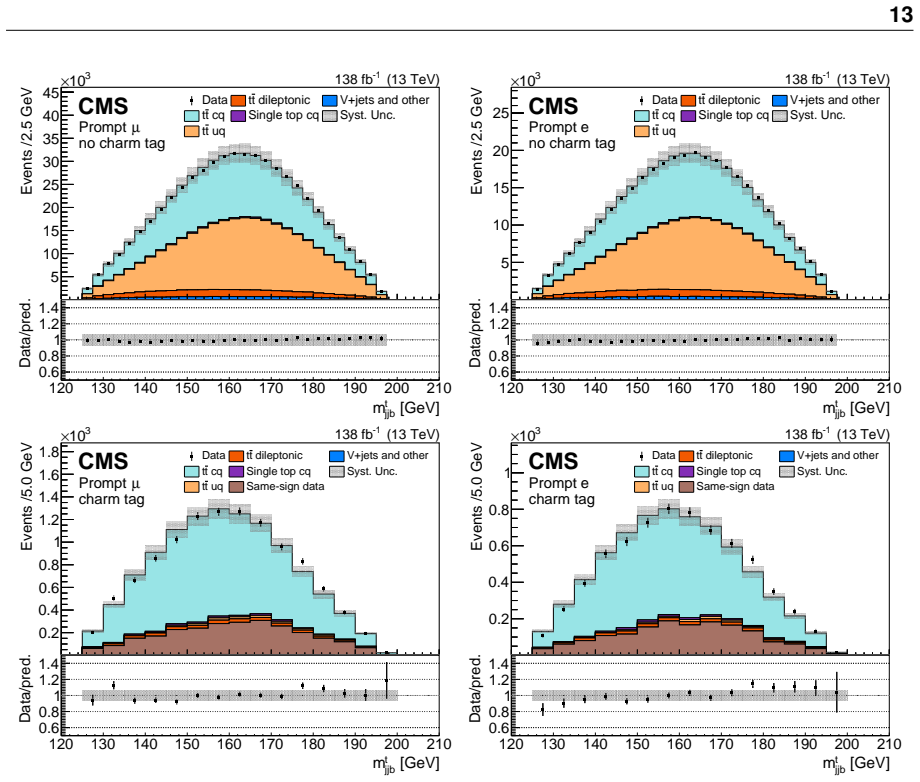
- [§4.1 and Figures 1, 3, 4] The ratio panels in the figures show data-to-prediction agreement visually, but no quantitative goodness-of-fit values are given. Adding chi-square per number of bins (or a similar summary) would help the reader assess the agreement.
- [§5, Table 1] The row labeled “SS data statistical uncertainty” is listed as a systematic uncertainty. Consider renaming it to make clear that it is the statistical uncertainty of the SS data sample propagated as a systematic, and note that it does not cover a possible OS=SS asymmetry.
- [§4.1, paragraph beginning “In most of the backgrounds”] The phrase “in most of the backgrounds” is vague. Specify the relevant background processes and, if possible, give the fraction of the charm-tagged OS sample that is estimated from SS data after all selection criteria.
- [§6, sentence beginning “The observed data yields entering the fit”] This sentence is slightly confusing because the SS data enter the fit as part of the prediction as well. Rewording to distinguish the observed OS event counts from the SS-data component of the prediction would improve clarity.
- [Various] There are minor typographical and formatting issues, such as inconsistent spacing in “p_T^miss” and the reference formatting for Ref. [46]. These do not affect the physics content.
Circularity Check
No circularity: R_c^W is extracted from observed event counts in four categories with independently calibrated efficiencies and external CKM inputs; no fitted parameter is renamed as a prediction.
full rationale
The central quantity R_c^W is obtained from a counting fit to four exclusive categories (prompt muon/electron by charm-tag presence) using observed OS data and predictions built from OS-SS-subtracted simulation plus SS data for charge-symmetric backgrounds. The SS data are an independent same-sign control sample; they do not encode the fitted R_c^W value, so the background estimate is data-driven rather than self-referential. The charm-tagging efficiency is calibrated using muons in b jets from the same l+jets selection, but this calibrates an auxiliary muon-identification correction factor and is not tuned to the target ratio or to the SM prediction. The muon-rate correction in c-hadron decays is fixed to external fragmentation-fraction and branching-fraction measurements, not to the final result. The CKM interpretation uses Eq. (1) with world-average |Vcd|, |Vcb| and the CMS leptonic W branching-fraction measurement as inputs; these are external to the fitted value. Self-citations to previous CMS publications (e.g., refs. [6-9], [51]) concern detector performance, method development, or independent W/BF measurements; none is used as an unverified uniqueness theorem or as a forbidden-alternative argument. The OS=SS assumption used for the dominant charm-tag background is an experimental approximation and, if broken, would contribute a systematic bias, but it is not circular: it does not make the prediction equal to the input by construction. No step in the derivation reduces to its own inputs, so the paper is self-contained against external benchmarks for the purpose of circularity.
Assumptions & free parameters
free parameters (1)
- Global normalization of semileptonic tt (W to cq + W to uq) signal
assumptions (4)
- domain assumption OS=SS charge symmetry for background processes
- domain assumption Muon-in-jet identification scale factor measured in b jets is applicable to c jets
- domain assumption POWHEG + PYTHIA simulation correctly models ttbar and single-top kinematics after reweighting
- domain assumption External charm fragmentation fractions and semileptonic branching fractions are accurate
Cite this review
Pith. "Pith review of Measurement of the W boson decay branching fraction ratio $\mathcal{B}$(W $\to$ cq) / $\mathcal{B}$(W $\to$ $\mathrm{q\bar{q}'}$) in proton-proton collisions at $\sqrt{s}$ = 13 TeV." pith.science (2026). https://pith.science/paper/BRFFSUXF
@misc{pith2026241216296,
  author       = {Pith},
  title        = {Pith review of: Measurement of the W boson decay branching fraction ratio $\mathcalB$(W $\to$ cq) / $\mathcalB$(W $\to$ $\mathrmq\barq'$) in proton-proton collisions at $\sqrts$ = 13 TeV},
  year         = {2026},
  howpublished = {\url{https://pith.science/paper/BRFFSUXF}},
  note         = {Machine review of arXiv:2412.16296}
}
abstract
The most precise measurement to date of the W boson hadronic decay branching fraction ratio $R_\mathrm{c}^\mathrm{W}$ = $\mathcal{B}$(W $\to$ cq) / $\mathcal{B}$(W $\to$ $\mathrm{q\bar{q}'}$) is presented. The measurement is based on a sample of proton-proton collision data from the CERN LHC collected by the CMS experiment at a center-of-mass energy of 13 TeV in 2016-2018 with an integrated luminosity of 138 fb$^{-1}$. The large cross section of top quark-antiquark production at the LHC offers a sizable high-purity sample of W bosons suitable for this measurement. Events with one charged lepton (electron or muon) and at least four jets, two tagged as bottom quark jets, are analyzed. Charm jets are tagged using the presence of a muon inside the jet. The result, $R_\mathrm{c}^\mathrm{W}$ = 0.489 $\pm$ 0.020, is consistent with the standard model prediction and is twice as precise as the current world-average value.
Figures


Figures from the paper (1 more)
Reference graph
Works this paper leans on
-
[1]
Unitary symmetry and leptonic decays
N. Cabibbo, “Unitary symmetry and leptonic decays”, Phys. Rev. Lett. 10 (1963) 531, doi:10.1103/PhysRevLett.10.531
-
[2]
CP violation in the renormalizable theory of weak interaction
M. Kobayashi and T. Maskawa, “CP violation in the renormalizable theory of weak interaction”, Prog. Theor. Phys. 49 (1973) 652, doi:10.1143/PTP.49.652
-
[3]
Particle Data Group, S. Navas et al., “Review of particle physics”, Phys. Rev. D 110 (2024) 030001, doi:10.1103/PhysRevD.110.030001
-
[4]
A direct measurement of |Vcs | in hadronic W decays using a charm tag
ALEPH Collaboration, “A direct measurement of |Vcs | in hadronic W decays using a charm tag”, Phys. Lett. B 465 (1999) 349, doi:10.1016/S0370-2693(99)01088-6
-
[5]
A Measurement of the Rate of Charm Production in W Decays
OPAL Collaboration, “A measurement of the rate of charm production in W decays”, Phys. Lett. B 490 (2000) 71, doi:10.1016/S0370-2693(00)00971-0, arXiv:hep-ex/0009020
work page Pith review arXiv 2000
-
[6]
Measurement of associated Z + charm production in proton-proton collisions at $\sqrt{s} = $ 8 TeV
CMS Collaboration, “Measurement of associated Z + charm production in proton-proton collisions at √s = 8 TeV”, Eur. Phys. J. C 78 (2018) 287, doi:10.1140/epjc/s10052-018-5752-x , arXiv:1711.02143
work page Pith review arXiv 2018
-
[7]
Measurement of associated W + charm production in pp collisions at √s = 7 TeV
CMS Collaboration, “Measurement of associated W + charm production in pp collisions at √s = 7 TeV”, JHEP 02 (2014) 013, doi:10.1007/JHEP02(2014)013, arXiv:1310.1138
arXiv 2014
-
[8]
CMS Collaboration, “Measurements of the production of a W boson in association with a charm quark in proton-proton collisions at √s = 8 TeV”, Eur. Phys. J. C 82 (2022) 1094, doi:10.1140/epjc/s10052-022-10897-7 , arXiv:2112.00895
work page Pith review arXiv 2022
Show all 51 references
-
[9]
Measurements of the production cross section for a W boson in association with a charm quark in proton-proton collisions at √s = 13 TeV
CMS Collaboration, “Measurements of the production cross section for a W boson in association with a charm quark in proton-proton collisions at √s = 13 TeV”, Eur. Phys. J. C 84 (2024) 27, doi:10.1140/epjc/s10052-023-12258-4 , arXiv:2308.02285v2
2024 arXiv
-
[10]
The CMS experiment at the CERN LHC
CMS Collaboration, “The CMS experiment at the CERN LHC”, JINST 3 (2008) S08004, doi:10.1088/1748-0221/3/08/S08004
2008 doi
-
[11]
Performance of the CMS Level-1 trigger in proton-proton collisions at √s = 13 TeV
CMS Collaboration, “Performance of the CMS Level-1 trigger in proton-proton collisions at √s = 13 TeV”, JINST 15 (2020) P10017, doi:10.1088/1748-0221/15/10/P10017, arXiv:2006.10165
2020 arXiv
-
[12]
The CMS trigger system
CMS Collaboration, “The CMS trigger system”, JINST 12 (2017) P01020, doi:10.1088/1748-0221/12/01/P01020, arXiv:1609.02366
2017 arXiv
-
[13]
Particle-flow reconstruction and global event description with the CMS detector
CMS Collaboration, “Particle-flow reconstruction and global event description with the CMS detector”, JINST 12 (2017) P10003, doi:10.1088/1748-0221/12/10/P10003, arXiv:1706.04965
2017 arXiv
-
[14]
Electron and photon reconstruction and identification with the CMS experiment at the CERN LHC
CMS Collaboration, “Electron and photon reconstruction and identification with the CMS experiment at the CERN LHC”, JINST 16 (2021) P05014, doi:10.1088/1748-0221/16/05/P05014, arXiv:2012.06888
2021 arXiv
-
[15]
Performance of the CMS muon detector and muon reconstruction with proton-proton collisions at √s = 13 TeV
CMS Collaboration, “Performance of the CMS muon detector and muon reconstruction with proton-proton collisions at √s = 13 TeV”, JINST 13 (2018) P06015, doi:10.1088/1748-0221/13/06/P06015, arXiv:1804.04528. References 15
2018 arXiv
-
[16]
Technical proposal for the phase-II upgrade of the Compact Muon Solenoid
CMS Collaboration, “Technical proposal for the phase-II upgrade of the Compact Muon Solenoid”. CMS Technical Proposal, 2015. CERN-LHCC-2015-010, CMS-TDR-15-02. http://cds.cern.ch/record/2020886
2015
-
[17]
The anti-kT jet clustering algorithm
M. Cacciari, G. P . Salam, and G. Soyez, “The anti-kT jet clustering algorithm”, JHEP 04 (2008) 063, doi:10.1088/1126-6708/2008/04/063, arXiv:0802.1189
2008 arXiv
-
[18]
FastJet user manual
M. Cacciari, G. P . Salam, and G. Soyez, “FastJet user manual”, Eur. Phys. J. C 72 (2012) 1896, doi:10.1140/epjc/s10052-012-1896-2 , arXiv:1111.6097
2012 arXiv
-
[19]
Pileup mitigation at CMS in 13 TeV data
CMS Collaboration, “Pileup mitigation at CMS in 13 TeV data”, JINST 15 (2020) P09018, doi:10.1088/1748-0221/15/09/p09018, arXiv:2003.00503
2020 arXiv
-
[20]
Jet energy scale and resolution in the CMS experiment in pp collisions at 8 TeV
CMS Collaboration, “Jet energy scale and resolution in the CMS experiment in pp collisions at 8 TeV”, JINST 12 (2017) P02014, doi:10.1088/1748-0221/12/02/P02014, arXiv:1607.03663
2017 arXiv
-
[21]
Performance of missing transverse momentum reconstruction in proton-proton collisions at √s = 13 TeV using the CMS detector
CMS Collaboration, “Performance of missing transverse momentum reconstruction in proton-proton collisions at √s = 13 TeV using the CMS detector”, JINST 14 (2019) P07004, doi:10.1088/1748-0221/14/07/P07004, arXiv:1903.06078
2019 arXiv
-
[22]
Measurement of the inclusive W and Z production cross sections in pp collisions at √s = 7 TeV
CMS Collaboration, “Measurement of the inclusive W and Z production cross sections in pp collisions at √s = 7 TeV”, JHEP 10 (2011) 132, doi:10.1007/JHEP10(2011)132, arXiv:1107.4789
2011 arXiv
-
[23]
A new method for combining NLO QCD with shower Monte Carlo algorithms
P . Nason, “A new method for combining NLO QCD with shower Monte Carlo algorithms”, JHEP 11 (2004) 40, doi:10.1088/1126-6708/2004/11/040, arXiv:hep-ph/0409146
2004 arXiv
-
[24]
Matching NLO QCD computations with parton shower simulations: the POWHEG method
S. Frixione, P . Nason, and C. Oleari, “Matching NLO QCD computations with parton shower simulations: the POWHEG method”, JHEP 11 (2007) 70, doi:10.1088/1126-6708/2007/11/070, arXiv:0709.2092
2007 arXiv
-
[25]
A general framework for implementing NLO calculations in shower Monte Carlo programs: the POWHEG BOX
S. Alioli, P . Nason, C. Oleari, and E. Re, “A general framework for implementing NLO calculations in shower Monte Carlo programs: the POWHEG BOX”, JHEP 06 (2010) 043, doi:10.1007/JHEP06(2010)043, arXiv:1002.2581
2010 arXiv
-
[26]
The automated computation of tree-level and next-to-leading order differential cross sections, and their matching to parton shower simulations
J. Alwall et al., “The automated computation of tree-level and next-to-leading order differential cross sections, and their matching to parton shower simulations”, JHEP 07 (2014) 079, doi:10.1007/JHEP07(2014)079, arXiv:1405.0301
2014 arXiv
-
[27]
An Introduction to PYTHIA 8.2
T. Sj ¨ostrand et al., “An Introduction to PYTHIA 8.2”, Comput. Phys. Commun. 191 (2015) 159, doi:10.1016/j.cpc.2015.01.024, arXiv:1410.3012
2015 arXiv
-
[28]
Parton distributions from high-precision collider data
NNPDF Collaboration, “Parton distributions from high-precision collider data”, Eur. Phys. J. C 77 (2017) 663, doi:10.1140/epjc/s10052-017-5199-5 , arXiv:1706.00428
2017 arXiv
-
[29]
Extraction and validation of a new set of CMS P YTHIA 8 tunes from underlying-event measurements
CMS Collaboration, “Extraction and validation of a new set of CMS P YTHIA 8 tunes from underlying-event measurements”, Eur. Phys. J. C 80 (2020) 4, doi:10.1140/epjc/s10052-019-7499-4 , arXiv:1903.12179
2020 arXiv
-
[30]
G EANT 4–a simulation toolkit
GEANT4 Collaboration, “G EANT 4–a simulation toolkit”, Nucl. Instrum. Meth. A 506 (2003) 250, doi:10.1016/S0168-9002(03)01368-8. 16
2003 doi
-
[31]
Identification of heavy-flavour jets with the CMS detector in pp collisions at 13 TeV
CMS Collaboration, “Identification of heavy-flavour jets with the CMS detector in pp collisions at 13 TeV”, JINST 13 (2018) P05011, doi:10.1088/1748-0221/13/05/P05011, arXiv:1712.07158
2018 arXiv
-
[32]
Jet flavour classification using DeepJet
E. Bols et al., “Jet flavour classification using DeepJet”, JINST 15 (2020) P12012, doi:10.1088/1748-0221/15/12/P12012, arXiv:2008.10519
2020 arXiv
-
[33]
Combined analysis of charm-quark fragmentation-fraction measurements
M. Lisovyi, A. Verbytskyi, and O. Zenaiev, “Combined analysis of charm-quark fragmentation-fraction measurements”, Eur. Phys. J. C 76 (2016) 397, doi:10.1140/epjc/s10052-016-4246-y , arXiv:1509.01061
2016 arXiv
-
[34]
Performance of the DeepJet b tagging algorithm using 41.9/fb of data from proton-proton collisions at 13 TeV with Phase 1 CMS detector
CMS Collaboration, “Performance of the DeepJet b tagging algorithm using 41.9/fb of data from proton-proton collisions at 13 TeV with Phase 1 CMS detector”, CMS Detector Performance Summary CMS-DP-2018-058, 2018
2018
-
[35]
Measurement of the inelastic proton-proton cross section at √s = 13 TeV
CMS Collaboration, “Measurement of the inelastic proton-proton cross section at √s = 13 TeV”, JHEP 07 (2018) 161, doi:10.1007/JHEP07(2018)161, arXiv:1802.02613
2018 arXiv
-
[36]
Precision luminosity measurement in proton-proton collisions at√s = 13 TeV in 2015 and 2016 at CMS
CMS Collaboration, “Precision luminosity measurement in proton-proton collisions at√s = 13 TeV in 2015 and 2016 at CMS”, Eur. Phys. J. C 81 (2021) 800, doi:10.1140/epjc/s10052-021-09538-2 , arXiv:2104.01927
2021 arXiv
-
[37]
CMS luminosity measurement for the 2017 data-taking period at√s = 13 TeV
CMS Collaboration, “CMS luminosity measurement for the 2017 data-taking period at√s = 13 TeV”. CMS Physics Analysis Summary, 2018. CMS-PAS-LUM-17-004. https://cds.cern.ch/record/2621960/
2017
-
[38]
CMS luminosity measurement for the 2018 data-taking period at√s = 13 TeV
CMS Collaboration, “CMS luminosity measurement for the 2018 data-taking period at√s = 13 TeV”. CMS Physics Analysis Summary, 2019. CMS-PAS-LUM-18-002. https://cds.cern.ch/record/2676164/
2018
-
[39]
Top++: A program for the calculation of the top-pair cross-section at hadron colliders
M. Czakon and A. Mitov, “Top++: A program for the calculation of the top-pair cross-section at hadron colliders”, Comput. Phys. Commun. 185 (2014) 2930, doi:10.1016/j.cpc.2014.06.021, arXiv:1112.5675
2014 arXiv
-
[40]
Single-top-quark production in the t-channel at NNLO
J. Campbell, T. Neumann, and Z. Sullivan, “Single-top-quark production in the t-channel at NNLO”, JHEP 02 (2021) 040, doi:10.1007/JHEP02(2021)040, arXiv:2012.01574
2021 arXiv
-
[41]
Higher-order corrections for tW production at high-energy hadron colliders
N. Kidonakis and N. Yamanaka, “Higher-order corrections for tW production at high-energy hadron colliders”, JHEP 05 (2021) 278, doi:10.1007/JHEP05(2021)278, arXiv:2102.11300
2021 arXiv
-
[42]
Measurement of the inclusive cross sections for W and Z boson production in proton-proton collisions at √s = 5.02 and 13 TeV
CMS Collaboration, “Measurement of the inclusive cross sections for W and Z boson production in proton-proton collisions at √s = 5.02 and 13 TeV”, 2024. arXiv:2408.03744. Submitted to JHEP
2024 arXiv
-
[43]
W+W− boson pair production in proton-proton collisions at√s = 13 TeV
CMS Collaboration, “ W+W− boson pair production in proton-proton collisions at√s = 13 TeV”, Phys. Rev. D 102 (2020) 092001, doi:10.1103/PhysRevD.102.092001, arXiv:2009.00119
2020 arXiv
-
[44]
Measurements of pp → ZZ production cross sections and constraints on anomalous triple gauge couplings at √s = 13 TeV
CMS Collaboration, “Measurements of pp → ZZ production cross sections and constraints on anomalous triple gauge couplings at √s = 13 TeV”, Eur. Phys. J. C 81 (2021) 200, doi:10.1140/epjc/s10052-020-08817-8 , arXiv:2009.01186. References 17
2021 arXiv
-
[45]
Measurement of the inclusive and differential WZ production cross sections, polarization angles, and triple gauge couplings in pp collisions at √s = 13 TeV
CMS Collaboration, “Measurement of the inclusive and differential WZ production cross sections, polarization angles, and triple gauge couplings in pp collisions at √s = 13 TeV”, JHEP 07 (2022) 32, doi:10.1007/JHEP07(2022)032, arXiv:2110.11231
2022 arXiv
-
[46]
Measurement of differential cross sections for top quark pair production using the lepton + jets final state in proton-proton collisions at 13 tev
CMS Collaboration Collaboration, “Measurement of differential cross sections for top quark pair production using the lepton + jets final state in proton-proton collisions at 13 tev”, Phys. Rev. D 95 (May, 2017) 092001, doi:10.1103/PhysRevD.95.092001, arXiv:1610.04191v2
2017 arXiv
-
[47]
A measurement of D meson production in Z0 hadronic decays
DELPHI Collaboration, “A measurement of D meson production in Z0 hadronic decays”, Z. Phys. C 59 (1993) 533, doi:10.1007/BF01562545
1993 doi
-
[48]
A measurement of the production of D∗± mesons on the Z0 resonance
OPAL Collaboration, “A measurement of the production of D∗± mesons on the Z0 resonance”, Z. Phys. C 67 (1995) 27, doi:10.1007/BF01564819
1995 doi
-
[49]
Study of charm production in Z decays
ALEPH Collaboration, “Study of charm production in Z decays”, Eur. Phys. J. C 16 (2000) 597, doi:10.1007/s100520000421, arXiv:hep-ex/9909032
2000 arXiv
-
[50]
The CMS statistical analysis and combination tool: C OMBINE
CMS Collaboration, “The CMS statistical analysis and combination tool: C OMBINE ”, Comput. Softw. Big Sci. 8 (2024) 19, doi:10.1007/s41781-024-00121-4 , arXiv:2404.06614
2024 arXiv
-
[51]
Precision measurement of the W boson decay branching fractions in proton-proton collisions at √s = 13 TeV
CMS Collaboration, “Precision measurement of the W boson decay branching fractions in proton-proton collisions at √s = 13 TeV”, Phys. Rev. D 105 (2022) 072008, doi:10.1103/PhysRevD.105.072008, arXiv:2201.07861. 18 19 A The CMS Collaboration Yerevan Physics Institute, Yerevan, ...
2022 arXiv
Reviewed August 11, 2026 · model on record in the stance chip above.
Discussion (0). Continue with ORCID to comment.