A Fast-Convergence Resolution of the Stochastic Eigenproblem Using Halley's Method and the Spectral-Chaos Approach
Pith reviewed 2026-06-26 01:10 UTC · model grok-4.3
The pith
Halley's method with spectral-chaos expansions solves stochastic eigenvalue problems at cubic convergence that cannot be exceeded.
A machine-rendered reading of the paper's core claim, the machinery that carries it, and where it could break.
Core claim
The novel spectral-chaos method employing Halley's method achieves maximal convergence in solving stochastic eigenvalue problems since its rate cannot be further improved using a higher-order Householder method due to the quadratic nature of the resulting system of equations. A tensorial approach handles the dimensional multiplicity, with error analysis highlighting benefits when eigenvector components are nearly known.
What carries the argument
Halley's method applied to the polynomial-chaos discretized stochastic eigenproblem, combined with a tensorial representation to manage multiplicity.
If this is right
- The method attains cubic convergence for stochastic eigenproblems.
- Error bounds improve when eigenvector components are known approximately in advance.
- The tensorial approach renders the otherwise intractable high-dimensional system solvable.
- Computational cost is explicitly derived and compared to alternatives.
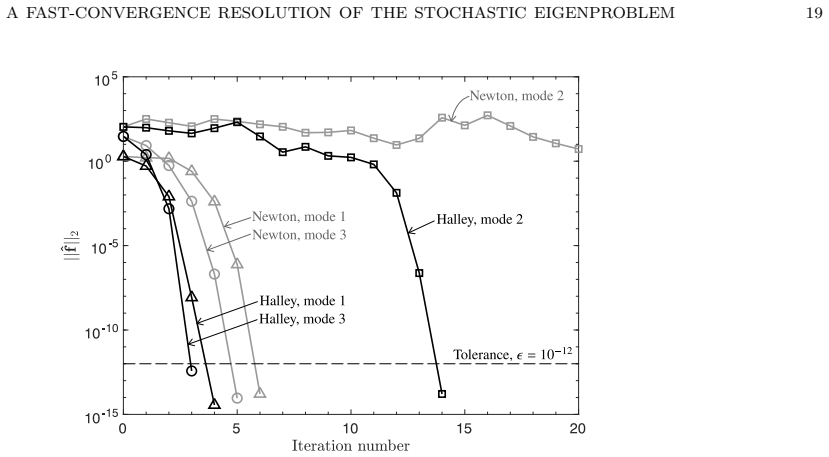
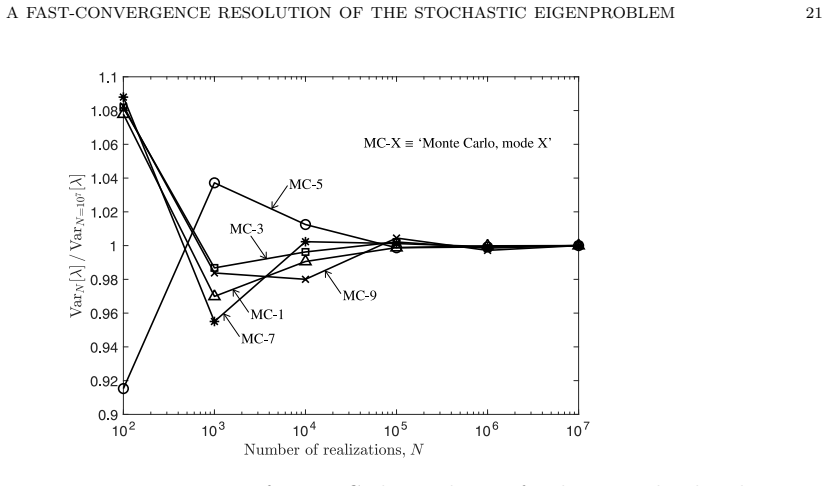
- Superior performance over Newton's method and Monte Carlo is demonstrated in case studies.
Where Pith is reading between the lines
- Similar quadratic structures in other stochastic problems may also cap convergence at cubic order.
- The requirement for good initial guesses suggests hybrid methods that combine sampling for initialization with this iteration.
- Extensions to nonlinear eigenproblems could be explored if the quadratic character persists.
- The approach may scale better than sampling methods for moderate stochastic dimensions.
Load-bearing premise
The claimed practical advantage and error bounds hold primarily when the eigenvector components are nearly known in advance.
What would settle it
An experiment where eigenvector initial guesses are inaccurate and the observed convergence rate is less than cubic, or where a fourth-order method achieves faster convergence despite the quadratic equations.
Figures
read the original abstract
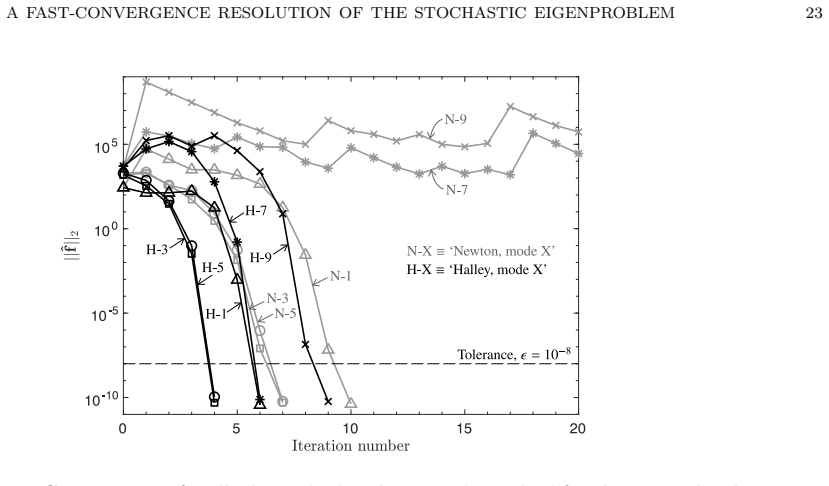
Solving stochastic eigenvalue problems has long been essential for informed decision-making, advancing scientific knowledge, and ensuring the reliability of engineering designs and applications. This paper underscores the need to continue enhancing existing numerical methods for solving the stochastic eigenproblem in order to improve convergence rates, computational efficiency, and robustness. Specifically, we propose a novel spectral-chaos method for solving the stochastic (linear) eigenvalue problem, employing Halley's method as the root-finding algorithm to leverage its cubic convergence properties. Our method achieves maximal convergence in solving stochastic eigenvalue problems since its rate cannot be further improved using a higher-order Householder method due to the quadratic nature of the resulting system of equations. Additionally, due to the complexity of the resulting system of equations, a tensorial approach was developed to tackle the challenges associated with the dimensional multiplicity of the stochastic eigenvalue problem, without which the solution would have been intractable. The method is derived rigorously, with a detailed error analysis that highlights the benefit of using our approach when the eigenvector components are nearly known, the computational cost of the method is also rigorously presented, and an illustrative example is provided to demonstrate the implementation of the method. Subsequently, a case study is demoed to analyze the results and validate the advantages of using Halley's method over Newton's method and Monte Carlo simulations.
Editorial analysis
A structured set of objections, weighed in public.
Referee Report
Summary. The manuscript proposes a spectral-chaos method for the stochastic linear eigenvalue problem that employs Halley's method as the root finder, claiming cubic convergence that is maximal because the quadratic structure of the resulting system precludes improvement by any higher-order Householder iteration. It supplies a rigorous derivation, an error analysis that emphasizes practical benefit when eigenvector components are nearly known, a computational-cost analysis, an illustrative example, and a case study comparing performance against Newton's method and Monte Carlo simulation. A tensorial formulation is introduced to manage the dimensional multiplicity of the stochastic problem.
Significance. If the convergence-order claim and associated error bounds hold, the method would constitute a concrete advance in the numerical treatment of stochastic eigenproblems by delivering higher-order convergence at manageable cost. The explicit tensorial handling of the high-dimensional system and the provision of both error analysis and computational complexity are positive features that strengthen the contribution.
major comments (1)
- [Abstract and derivation section] Abstract and the section deriving the iteration (likely §3–4): the central assertion that 'its rate cannot be further improved using a higher-order Householder method due to the quadratic nature of the resulting system of equations' is load-bearing for the claimed superiority. When the underlying map is quadratic, all derivatives of order three and higher vanish identically; the standard asymptotic error expansion for Householder methods then implies that the actual order attained by Halley's method may exceed the nominal cubic rate. Explicit computation of the leading error term for the specific iteration map derived in the paper is required to confirm or refute the maximality claim.
minor comments (2)
- [Abstract] The abstract contains no equations, notation, or quantitative statements, which is atypical for a math.NA manuscript and hinders immediate assessment of the technical contribution.
- [Introduction and §2] Notation for the stochastic eigenproblem (e.g., the precise definition of the random matrix and the chaos expansion) should be introduced earlier and used consistently in the error-analysis section.
Simulated Author's Rebuttal
We thank the referee for the careful reading and the insightful comment on the convergence-order claim. We address the point below and will revise the manuscript to strengthen the presentation.
read point-by-point responses
-
Referee: [Abstract and derivation section] Abstract and the section deriving the iteration (likely §3–4): the central assertion that 'its rate cannot be further improved using a higher-order Householder method due to the quadratic nature of the resulting system of equations' is load-bearing for the claimed superiority. When the underlying map is quadratic, all derivatives of order three and higher vanish identically; the standard asymptotic error expansion for Householder methods then implies that the actual order attained by Halley's method may exceed the nominal cubic rate. Explicit computation of the leading error term for the specific iteration map derived in the paper is required to confirm or refute the maximality claim.
Authors: We agree that an explicit computation of the leading error term is the most direct way to substantiate the maximality claim. While the quadratic character of the residual map implies that all derivatives of order three and higher of the iteration function vanish identically, we will add, in the revised manuscript, the full asymptotic error expansion for the specific Halley iteration map derived in §§3–4. This calculation will either confirm that the leading term is precisely cubic or reveal a higher order, thereby clarifying whether the claimed maximality holds. We view this addition as a useful clarification rather than a change to the method itself. revision: yes
Circularity Check
No circularity; convergence claim rests on asserted mathematical structure of quadratic system rather than self-referential reduction
full rationale
The abstract and description present the maximal-convergence claim as following from the quadratic nature of the resulting system of equations after applying the spectral-chaos approach, together with a claimed rigorous derivation and error analysis. No equations, fitted parameters, or self-citations are exhibited that reduce a prediction or uniqueness result to the paper's own inputs by construction. The skeptic concern identifies a potential gap in verifying the order claim for quadratic maps, but that is a question of correctness of the error analysis, not circularity. The paper's central steps (Halley's method on the stochastic eigenproblem, tensorial handling of multiplicity) are described as independently derived. This matches the default expectation of no significant circularity.
Axiom & Free-Parameter Ledger
Reference graph
Works this paper leans on
-
[1]
3, 562–591
S Adhikari and MI Friswell,Random matrix eigenvalue problems in structural dynamics, International Journal for Numerical Methods in Engineering69(2007), no. 3, 562–591
2007
-
[2]
Atish Agarwala and Jeffrey Pennington,High dimensional analysis reveals conservative sharpening and a stochastic edge of stability, arXiv preprint arXiv:2404.19261 (2024)
arXiv 2024
-
[3]
6, 2165–2214
Muhannad Aldosary, Jinsheng Wang, and Chenfeng Li,Structural reliability and stochastic finite element methods: State-of-the-art review and evidence-based comparison, Engineering Computations35(2018), no. 6, 2165–2214
2018
-
[4]
1, 1376479
AM Algelany and MA El-Shorbagy,Chaotic enhanced genetic algorithm for solving the nonlinear system of equations, Computational Intelligence and Neuroscience2022(2022), no. 1, 1376479
2022
-
[5]
Carlos Conceição António and Luísa Natália Hoffbauer,Reliability-based design optimization and uncertainty quan- tification for optimal conditions of composite structures with non-linear behavior, Engineering Structures153(2017), 479–490
2017
-
[6]
5, 352–376
Maarten Arnst, Roger Ghanem, Eric Phipps, and John Red-Horse,Reduced chaos expansions with random coeffi- cientsin reduced-dimensional stochastic modeling of coupled problems, International Journal for Numerical Methods in Engineering97(2014), no. 5, 352–376
2014
-
[7]
20, Springer, 2010
Zhidong Bai and Jack W Silverstein,Spectral analysis of large dimensional random matrices, vol. 20, Springer, 2010
2010
-
[8]
Mario Basto, Teresa Abreu, Viriato Semiao, and Francisco L Calheiros,Convergence and dynamics of structurally identical root finding methods, Applied Numerical Mathematics120(2017), 257–269
2017
-
[9]
Katherine A Bold, Yu Zou, Ioannis G Kevrekidis, and Michael A Henson,Heterogeneous cell population dynamics: Equation-free uncertainty quantification computations, arXiv preprint q-bio/0611001 (2006)
Pith/arXiv arXiv 2006
-
[10]
A Charalampopoulos and T Sapsis,Uncertainty quantification of turbulent systems via physically consistent and data-informed reduced-order models, Physics of Fluids34(2022), no. 7
2022
-
[11]
Alicia Cordero, Higinio Ramos, and Juan R Torregrosa,Some variants of Halley’s method with memory and their applications for solving several chemical problems, Journal of Mathematical Chemistry58(2020), 751–774
2020
-
[12]
Romain Couillet and Zhenyu Liao,Random matrix methods for machine learning, Cambridge University Press, 2022
2022
-
[13]
Chen Ding,Advanced sampling and surrogate modeling for uncertainty propagation in structural and network systems, (2025)
2025
-
[14]
Xiaoping Du,Uncertainty quantification for machine learning-based prediction: A polynomial chaos expansion ap- proach for joint model and input uncertainty propagation, arXiv preprint arXiv:2507.14782 (2025)
arXiv 2025
-
[15]
Thomas F Eibert, Yvonne Weitsch, Huanlei Chen, and Michael E Gruber,Solving periodic eigenproblems by solving corresponding excitation problems in the domain of the eigenvalue, ProgressInElectromagneticsResearch126(2012), 65–84
2012
-
[16]
thesis, Purdue University Graduate School, 2021
Hugo Esquivel,Efficient spectral-chaos methods for uncertainty quantification in long-time response of stochastic dynamical systems, Ph.D. thesis, Purdue University Graduate School, 2021. A F AST-CONVERGENCE RESOLUTION OF THE STOCHASTIC EIGENPROBLEM 27
2021
-
[17]
5, 6654–6675
Rodrigo G Eustaquio, Ademir A Ribeiro, and Miguel A Dumett,A new class of root-finding methods in R n: the inexact tensor-free Chebyshev–Halley class, Computational and Applied Mathematics37(2018), no. 5, 6654–6675
2018
-
[18]
Anna-SimoneFrank, AlexanderSikorski, andSusannaRöblitz,Spectral clustering of Markov chain transition matrices with complex eigenvalues, Journal of Computational and Applied Mathematics444(2024), 115791
2024
-
[19]
Benjamin Fröhlich, Dominik Hose, Oliver Dieterich, Michael Hanss, and Peter Eberhard,Uncertainty quantification of large-scale dynamical systems using parametric model order reduction, Mechanical Systems and Signal Processing 171(2022), 108855
2022
-
[20]
R Ghanem and J Red-Horse,Polynomial chaos: modeling, estimation, and approximation, Handbook of uncertainty quantification1(2017), 3
2017
-
[21]
4, 486–504
Roger Ghanem and Debraj Ghosh,Efficient characterization of the random eigenvalue problem in a polynomial chaos decomposition, International Journal for Numerical Methods in Engineering72(2007), no. 4, 486–504
2007
-
[22]
Kongjing Gu, Liang Yan, Xiang Li, Xiaojun Duan, and Jingjie Liang,Change point detection in multi-agent systems based on higher-order features, Chaos: An Interdisciplinary Journal of Nonlinear Science32(2022), no. 11
2022
-
[23]
3, 450–478
Bin Huang, Heng Zhang, and Kok-Kwang Phoon,Homotopy approach for random eigenvalue problem, International Journal for Numerical Methods in Engineering113(2018), no. 3, 450–478
2018
-
[24]
Nikhil Iyengar and Dimitri Mavris,Polynomial chaos kriging models for uncertainty quantification in high-speed flow applications, Journal of Aircraft (2025), 1–18
2025
-
[25]
2, 97–109
Farhan Khan,Optimization techniques in applied mathematics: From physics simulations to real-world problems, Frontiers in Applied Physics and Mathematics1(2024), no. 2, 97–109
2024
-
[26]
Ioannis A Kougioumtzoglou, Ioannis Petromichelakis, and Apostolos F Psaros,Sparse representations and com- pressive sampling approaches in engineering mechanics: A review of theoretical concepts and diverse applications, Probabilistic Engineering Mechanics61(2020), 103082
2020
-
[27]
Jeffery J Leader,Numerical analysis and scientific computation, Chapman and Hall/CRC, 2022
2022
-
[28]
thesis, UNSW Sydney, 2009
Merrill Cheng Wei Lee,Stochastic analysis and robust design of stiffened composite structures, Ph.D. thesis, UNSW Sydney, 2009
2009
-
[29]
Jie Li and Jianbing Chen,Stochastic dynamics of structures, John Wiley & Sons, 2009
2009
-
[30]
thesis, Carleton University, 2023
Steffan Lloyd,Precision robotic machining: Modelling and control innovations for improved performance, Ph.D. thesis, Carleton University, 2023
2023
-
[31]
5, 2768–2780
Steffan Lloyd, Rishad A Irani, and Mojtaba Ahmadi,Fast and robust inverse kinematics of serial robots using halley’s method, IEEE Transactions on Robotics38(2022), no. 5, 2768–2780
2022
-
[32]
6, 1439–1473
Martin Lotz and Vanni Noferini,Weak condition numbers, with an application to singular polynomial eigenproblems, Foundations of Computational Mathematics20(2020), no. 6, 1439–1473
2020
-
[33]
Fei Lu, Matthias Morzfeld, Xuemin Tu, and Alexandre J Chorin,Limitations of polynomial chaos expansions in the bayesian solution of inverse problems, Journal of Computational Physics282(2015), 138–147
2015
-
[34]
1, 20–36
Alice Lucas, Michael Iliadis, Rafael Molina, and Aggelos K Katsaggelos,Using deep neural networks for inverse problems in imaging: beyond analytical methods, IEEE Signal Processing Magazine35(2018), no. 1, 20–36
2018
-
[35]
11, 849–873
Hermann G Matthies,Stochastic finite elements: Computational approaches to stochastic partial differential equations, ZAMM-Journal of Applied Mathematics and Mechanics/Zeitschrift für Angewandte Mathematik und Mechanik: Applied Mathematics and Mechanics88(2008), no. 11, 849–873
2008
-
[36]
3, 035009
Anibal M Medina-Mardones, Fernando E Rosas, Sebastián E Rodríguez, and Rodrigo Cofré,Hyperharmonic analysis for the study of high-order information-theoretic signals, Journal of Physics: Complexity2(2021), no. 3, 035009
2021
-
[37]
Changhong Mou, Nan Chen, and Traian Iliescu,An efficient data-driven multiscale stochastic reduced order modeling framework for complex systems, Journal of Computational Physics493(2023), 112450
2023
-
[38]
eu, 2013
Boris Obsieger,Numerical methods i-basis and fundamentals, university-books. eu, 2013
2013
-
[39]
SE Pryse and Sondipon Adhikari,Neumann enriched polynomial chaos approach for stochastic finite element prob- lems, Probabilistic Engineering Mechanics66(2021), 103157
2021
-
[40]
2, e202100008
Lars Ruthotto and Eldad Haber,An introduction to deep generative modeling, GAMM-Mitteilungen44(2021), no. 2, e202100008
2021
-
[41]
Maxi San Miguel and Raul Toral,Stochastic effects in physical systems, Instabilities and nonequilibrium structures VI, Springer, 2000, pp. 35–127. 28 A F AST-CONVERGENCE RESOLUTION OF THE STOCHASTIC EIGENPROBLEM
2000
-
[42]
24, Springer Science & Business Media, 2005
Christian A Schenk and Gerhart I Schuëller,Uncertainty assessment of large finite element systems, vol. 24, Springer Science & Business Media, 2005
2005
-
[43]
26, Princeton University Press, 2009
Emil Simiu,Chaotic transitions in deterministic and stochastic dynamical systems: applications of melnikov processes in engineering, physics, and neuroscience, vol. 26, Princeton University Press, 2009
2009
-
[44]
6, 69–85
Mathukumalli Vidyasagar,Statistical learning theory and randomized algorithms for control, IEEE Control Systems Magazine18(1998), no. 6, 69–85
1998
-
[45]
1, 837–858
Liqun Wang and Guolai Yang,An interval uncertainty propagation method using polynomial chaos expansion and its application in complicated multibody dynamic systems, Nonlinear Dynamics105(2021), no. 1, 837–858. A F AST-CONVERGENCE RESOLUTION OF THE STOCHASTIC EIGENPROBLEM 29 Appendix A In this section, we derive the derivative ofFwith respect tof= (g,h). S...
2021
discussion (0)
Sign in with ORCID, Apple, or X to comment. Anyone can read and Pith papers without signing in.