REVIEW 2 major objections 6 minor 176 references
How massive and clumpy must a quasar wind be to create emission line blueshifts?
T0 review · 2 major / 6 minor · reviewed 2026-07-31 · grok-4.5
Pith's one-line read Blueshifted C IV lines in quasars require wind mass-loss rates ~50 times the accretion rate unless the wind is strongly clumped.
desk verdict Clean, useful mass-loading floor for C IV blueshifts; the ~50 is real order-of-magnitude work with one soft calibration step. read the letter →
The pith
A machine-rendered reading of the paper's core claim, the machinery that carries it, and where it could break.
The reading
What carries the argument
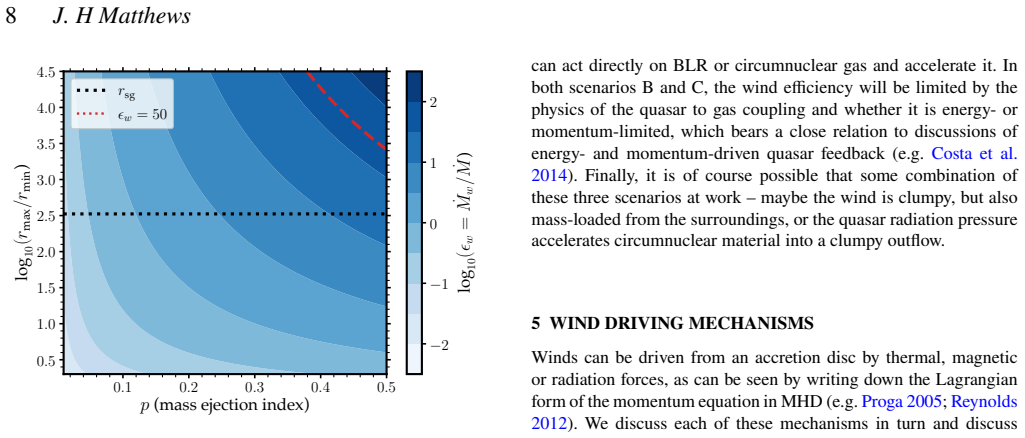
The mass-loading parameter ϵ_w = Ṁ_w/Ṁ together with the volume filling factor f_V. Steady mass continuity at the ionization parameter and attenuation where C IV forms (log ξ ~ 2, f_att ~ 0.1) forces ϵ_w/f_V ~ 50; a grid of 2D Monte Carlo wind models recovers the same threshold for large blueshifts.
What would settle it
Show that smooth winds with ϵ_w ~ 1 still produce strong C IV blueshifts in full radiation-hydrodynamic models, or obtain multi-line density and ionization diagnostics in high-blueshift quasars that cannot be met by ϵ_w/f_V ≳ 50 for any plausible SED and geometry.
Extended reading notes
Core claim
For blueshifted C IV λ1550 emission to form in a quasar wind, the outflow must carry a mass-loss rate of order 50 f_V times the accretion rate, where f_V ≤ 1 is the volume filling factor. That threshold disfavours line formation in a smooth disc wind and leaves two viable pictures: a clumpy wind supplied by the disc, or ambient mass swept up by a less massive MHD or radiatively driven wind.
Load-bearing premise
The blueshifted line forms in gas whose density is set by continuous wind mass flow at a fixed ionization state, not by scattering or by gas whose density is controlled by something other than the wind’s mass flux.
Editorial extensions
If this is right
- Smooth, unclumped disc winds are disfavoured as the direct site of C IV blueshift formation.
- If the disc supplies the mass, the required clumping factors are comparable to those inferred in hot-star winds.
- If ambient gas supplies the mass, MHD or radiative winds can still drive the flow without extreme clumping.
- Outflow power scales as v_∞²; at BAL speeds ~10,000 km/s the kinetic luminosity can reach levels relevant for AGN feedback.
- A physical link between emission-line blueshifts and BALs would jointly constrain terminal velocity and feedback efficiency.
Reading between the lines
- The numerical match to stellar-wind clumping factors is a concrete hint that line-driving microphysics may operate in a similar regime in quasars.
- Mapping an observational proxy for ϵ_w/f_V across Eddington ratio and black-hole mass would test whether the strongest blueshifts track the highest mass loading.
- If independent density diagnostics settle near 10^12–10^14 cm^-3 at small radii with only modest attenuation, the mass-budget tension becomes sharper and more model-independent.
Editorial analysis
A structured set of objections, weighed in public.
Referee Report
Summary. The paper asks what mass-loading a quasar wind must have if blueshifted C IV λ1550 emission forms in it. The argument proceeds in two steps. First, a quasi-spherical steady-wind model combined with the ionization parameter at which C IV forms efficiently yields a simple expression (eqs. 1–12) for the wind efficiency ε_w ≡ Ṁ_w/Ṁ in terms of ξ, v_w, f_att, f_ion, Ω and the volume filling factor f_V, giving ε_w/f_V ∼ 50 for characteristic values (log ξ ∼ 2, f_att ∼ 0.1, v_w ∼ 3000 km/s). Second, a grid of 200 Sirocco Monte Carlo radiative transfer simulations of a Shlosman & Vitello biconical disc wind is used to check the analytic estimate: the C IV-luminosity-weighted medians of ξ and f_att (log ξ = 1.88, f_att = 0.086) fall close to the adopted values, and the characteristic poloidal velocity of the line-forming gas (v_50) correlates with ε_w/f_V (Spearman 0.64), with strong blueshifts at 10° inclination confined to ε_w/f_V ≳ 50–100. The paper concludes that smooth disc winds are disfavoured as the site of C IV blueshift formation, and discusses clumpy winds, swept-up mass, driving mechanisms, and feedback implications.
Significance. If the result holds, it is a useful and falsifiable constraint on a long-standing phenomenological picture: C IV blueshifts are widely interpreted as wind signatures, and this paper converts that interpretation into a quantitative mass-loading requirement with an explicit, transparent analytic chain (eq. 12) that can in principle be evaluated object-by-object from observables. The strengths are real: the derivation is parameterised rather than fitted, the fudge factors (ξ, f_att) are checked a posteriori against full 2D MCRT photoionization calculations rather than assumed, a 200-model simulation grid plus a 40-model alternative-SED control grid tests the analytic scaling, and the paper is unusually candid about its caveats (single SED, single-inclination checks, clumping physics not modelled). The consistency with the classic Drew & Giddings (1982) BAL estimates and with the independent line-ratio estimate of §2.3 (factor ~3) adds robustness. The work will be of clear interest to the quasar BLR, disc wind, and feedback communities.
major comments (2)
- [§3.2.2, Fig. 4] The numerical calibration that turns the analytic estimate into the headline 'ε_w/f_V ∼ 50' rests on v_50, the C IV-luminosity-weighted median poloidal velocity, as a proxy for the observable blueshift (eq. 17). The tie between v_50 and the actual spectral blueshift is established only at a single inclination: 'We have verified that v_50 correlates well with C IV blueshift at an inclination of 10°' — with no correlation coefficient, scatter, or figure shown. This is load-bearing because the same section (and M23) stresses that the emergent spectra are 'very sensitive to both inclination and the exact kinematic parameters chosen', and quasars are observed over a range of inclinations, many of them far from 10°. Since §3 states that spectra were already computed 'at a range of viewing angles', this should be straightforward to remedy: please show the v_50–blueshift correlation (with a quot
- [§3.2.2, Fig. 4] Relatedly, the inference direction needs care. v_50 is a property of the emitting gas; a blueshift is a property of the escaping line profile and requires asymmetric escape (suppression of the red wing by the disc or far side of the bicone). A model can have high v_50 yet a symmetric profile at inclinations where both cones are visible, and absorption can in principle manufacture asymmetry at lower v_50. Fig. 4 also shows roughly two decades of scatter in v_50 at fixed ε_w/f_V, driven by the nuisance parameters (θ_min, R_v, r_min, α). The '∼50' threshold is therefore a statistical statement about the ensemble at 10°, not a per-object condition. The paper should (i) state this explicitly in the abstract/conclusions, and (ii) identify which nuisance parameters move a model across the threshold at fixed ε_w/f_V, so readers can judge how robust the threshold is to geometry choices within the
minor comments (6)
- [§2.3 and Fig. 5 caption] Two cross-reference errors: the text 'we hereafter focus on the ionization parameter estimate from equation 3' and the Fig. 5 caption 'ε_w = 50 from equation 3' both point to eq. (3), which is the definition of ε_w; the intended references are presumably eqs. (10)/(12).
- [§4 and §6] Scenario A is described as 'clumpy with f_V ∼ 10–50' and in §6 as 'a clumpy disc wind with f_V ≈ 50'; since f_V ≤ 1 is the volume filling factor, these should read f_V^{-1} ∼ 10–50 (clumping factor). As written the statements are contradictory with the definition.
- [§3.1] Please clarify how clumping is implemented in Sirocco for the grid runs: is microclumping assumed (clumps optically thin, inter-clump medium void), and if so, how would porosity (optically thick clumps) change f_att and the line escape, and hence the ε_w/f_V calibration? A sentence on the wind-grid resolution and convergence at f_V = 10^{-3} (density enhancement ×1000 per cell) would also help.
- [§3.2.2] 83/200 models survive the L_CIV and EW cuts. Please state where the excluded models lie in ε_w/f_V: if many high-ε_w/f_V models are excluded only for falling below the luminosity threshold, the fraction of the parameter space capable of producing observable blueshifts is relevant to the population-level claim in the abstract.
- [General] Typos: 'ionizaton' (§1), 'very energies' (§2.2, missing word), 'non-neglible' (§2.4), 'radaitive' (§3.2.1), 'wherea' for 'whereas' (Fig. 2 caption), 'it the flow can easily be over-ionized' (§5.3), 'some combination of these three scenarios at work' (§4, missing 'is').
- [Data availability] Given that the central calibration is the 200-model grid underlying Figs. 3–4, 'data available on reasonable request' is weaker than ideal. Depositing the per-model catalogue (input parameters, v_50, blueshift, EW at each computed inclination) would make the key figure reproducible and the threshold independently checkable.
Circularity Check
No significant circularity: mass-loading bound follows from continuity plus ionization, with numerics as an independent consistency check rather than a tautology.
full rationale
The central claim (ε_w/f_V ∼ 50 for blueshifted C IV) is obtained from mass continuity (eqs. 1–2, 5) combined with the definition of the ionization parameter (eqs. 6–7), yielding the explicit efficiency formula (eq. 10) and the numerical estimate (eq. 12). Characteristic ξ and f_att are estimated from Cloudy ion/emissivity curves and from luminosity-weighted medians in the new Sirocco grid (Fig. 3: log ξ ≈ 1.88, f_att ≈ 0.086), then inserted as physical inputs; they are not defined in terms of the target mass-loading. The 2D grid (Fig. 4) varies Ṁ_w and f_V among other parameters and asks which models produce high v_50 / blueshift potential—an independent relaxation of the quasi-spherical assumptions, not a fit-to-data prediction. Self-citations to M20/M23 supply geometry, SED, and prior spectral context but do not force the factor ∼50; the analytic structure stands without them, and the paper notes consistency with external work (e.g. Drew & Giddings 1982; Ponti et al. 2012). The parenthetical that Sirocco medians “were in fact used to inform” the adopted log ξ ∼ 2 is presentational reverse-ordering, not a definitional reduction of the result. Methodological concerns about v_50 as a blueshift proxy are correctness issues, not circularity. Score 1 for that mild a-posteriori tuning of the characteristic ξ only.
Assumptions & free parameters
free parameters (7)
- characteristic ionization parameter ξ =
∼100 erg cm s^-1 (log ξ ∼ 2)
- attenuation factor f_att =
∼0.1
- ionizing luminosity fraction f_ion =
∼0.25 (fiducial)
- covering factor Ω/π =
∼1
- characteristic wind speed v_w in analytic estimate =
3000 km s^-1
- Sirocco wind nuisance parameters (θ_min, R_v, r_min, α) =
sampled ranges in §3.1
- radiative efficiency η =
1/12
assumptions (5)
- domain assumption Steady-state mass continuity relates n_H to Ṁ_w, v_w, Ω, and f_V (eqs. 1–2).
- domain assumption C IV λ1550 blueshifts are produced in outflowing gas (wind), not primarily by scattering in a non-outflowing BLR.
- domain assumption A single characteristic Hydrogen ionization parameter (plus f_att) adequately locates the C IV formation zone for order-of-magnitude mass-loading.
- ad hoc to paper Monte Carlo radiative transfer with the Shlosman & Vitello bicone and the M20 SED is a sufficient 2D test of the analytic mass-loading requirement.
- domain assumption Photoionization equilibrium and standard atomic rates as implemented in Cloudy and Sirocco govern ion fractions.
invented entities (1)
-
wind efficiency / mass-loading parameter ϵ_w ≡ Ṁ_w / Ṁ
independent evidence
Cite this review
Pith. "Pith review of How massive and clumpy must a quasar wind be to create emission line blueshifts?." pith.science (2026). https://pith.science/paper/BSGA6OVT
@misc{pith2026260725035,
  author       = {Pith},
  title        = {Pith review of: How massive and clumpy must a quasar wind be to create emission line blueshifts?},
  year         = {2026},
  howpublished = {\url{https://pith.science/paper/BSGA6OVT}},
  note         = {Machine review of arXiv:2607.25035}
}
abstract
Blue asymmetries (``Blueshifts'') in the C IV 1550A emission line are common in luminous quasars. If they are formed in winds, how much energy, momentum and mass do those winds transport? We address this question by considering how much mass must be supplied through the line-forming region to maintain a given density and ionization state. Using a combination of 1D analytic and 2D numerical models, we find that for blueshifted C IV lines to form in a wind, the wind must have mass outflow rates of $\sim 50 f_V$ times the accretion rate, where $f_V \leq 1$ is the volume filling factor accounting for clumping. Our results therefore disfavour line formation in a smooth disc wind and point towards one of two scenarios: either the wind is clumpy, with required clumping factors suggestively close to those in hot star winds; alternatively, if the mass is instead swept up from the ambient medium, the wind need not be clumpy and MHD and radiative winds can provide the original source of momentum and energy. The power of the outflow depends on the square of the terminal velocity of the flow, $v_\infty$. If the wind is also the BAL outflow, with $v_\infty \sim10,000~{\rm km~s}^{-1}$, the wind power is significant and important for feedback. There are various caveats which moderate our conclusions, motivating i) a better theoretical understanding of wind driving and clump formation physics and ii) improved observational constraints on the physical conditions where the lines are formed.
Figures


Figures from the paper (3 more)


Reference graph
Works this paper leans on
-
[1]
Fender, R. P. and Belloni, T. M. and Gallo, E. , journal =. Towards a unified model for black hole. 2004 , doi =
2004
-
[2]
A unified accretion-ejection paradigm for black hole X-ray binaries. II. Observational signatures of jet-emitting disks. , keywords =. doi:10.1051/0004-6361/201732069 , archivePrefix =. 1803.04335 , primaryClass =
-
[3]
A unified accretion-ejection paradigm for black hole X-ray binaries. VI. Radiative efficiency and radio-X-ray correlation during four outbursts from GX 339-4. , keywords =. doi:10.1051/0004-6361/202141375 , archivePrefix =. 2109.13592 , primaryClass =
-
[4]
Testing the two-corona scenario
NuSTAR/XMM-Newton monitoring of the Seyfert 1 galaxy HE 1143-1810. Testing the two-corona scenario. , keywords =. doi:10.1051/0004-6361/201936486 , archivePrefix =. 1912.08720 , primaryClass =
arXiv 1912
-
[5]
A unified accretion-ejection paradigm for black hole X-ray binaries. IV. Replication of the 2010-2011 activity cycle of GX 339-4. , keywords =. doi:10.1051/0004-6361/201935060 , archivePrefix =. 1905.05057 , primaryClass =
arXiv 2010
-
[6]
A unified accretion-ejection paradigm for black hole X-ray binaries. III. Spectral signatures of hybrid disk configurations. , keywords =. doi:10.1051/0004-6361/201833124 , archivePrefix =. 1805.12407 , primaryClass =
-
[7]
The role of the disc magnetization on the hysteresis behaviour of X-ray binaries. , keywords =. doi:10.1111/j.1745-3933.2008.00439.x , archivePrefix =. 0712.3388 , primaryClass =
arXiv 2008
-
[8]
A unified accretion-ejection paradigm for black hole X-ray binaries. I. The dynamical constituents. , keywords =. doi:10.1051/0004-6361:20052689 , archivePrefix =. astro-ph/0511123 , primaryClass =
Show all 176 references
-
[9]
Line and continuum emission from the outer regions of accretion discs in active galactic nuclei. II. Radial structure of the disc. , keywords =
-
[10]
Magnetic outflows from turbulent accretion disks. I. Vertical structure and secular evolution. , keywords =. doi:10.1051/0004-6361/202039322 , archivePrefix =. 2011.14782 , primaryClass =
2011 arXiv
-
[11]
, keywords =
Influence of the turbulent magnetic pressure on isothermal jet emitting disks. , keywords =. doi:10.1051/0004-6361/202450501 , archivePrefix =. 2412.06999 , primaryClass =
-
[12]
, keywords =
A diagnostic kit for optical emission lines shaped by accretion disc winds. , keywords =. doi:10.1093/mnras/staf1450 , archivePrefix =. 2509.02858 , primaryClass =
-
[13]
and Fender, R
Ponti, G. and Fender, R. P. and Begelman, M. C. and Dunn, R. J. H. and Neilsen, J. and Coriat, M. , journal =. Ubiquitous equatorial accretion disc winds in black hole soft states , volume =. 2012 , doi =
2012
-
[14]
and Hewett, Paul C
Rankine, Amy L. and Hewett, Paul C. and Banerji, Manda and Richards, Gordon T. , journal =. 2020 , abstract =. doi:10.1093/mnras/staa130 , issn =
2020 doi
-
[15]
2023 , doi =
, month = jul, number =. 2023 , doi =
2023
-
[16]
2024 , doi =
, month = jan, pages =. 2024 , doi =
2024
-
[17]
2026 , doi =
, month = mar, number =. 2026 , doi =
2026
-
[18]
The many routes to
Morganti, Raffaella , journal =. The many routes to. 2017 , abstract =. doi:10.3389/fspas.2017.00042 , url =
2017
-
[19]
, journal =
Silk, Joseph and Rees, Martin J. , journal =. Quasars and galaxy formation , volume =. 1998 , abstract =
1998
-
[20]
, journal =
King, A. , journal =. Black. 2003 , doi =
2003
-
[21]
Energy input from quasars regulates the growth and activity of black holes and their host galaxies , volume =
Di Matteo, Tiziana and Springel, Volker and Hernquist, Lars , journal =. Energy input from quasars regulates the growth and activity of black holes and their host galaxies , volume =. 2005 , abstract =. doi:10.1038/nature03335 , issn =
2005 doi
-
[22]
Hopkins, P. F. and Elvis, M. , journal =. Quasar feedback: more bang for your buck , volume =. 2010 , doi =
2010
-
[23]
, journal =
Costa, Tiago and Sijacki, Debora and Haehnelt, Martin G. , journal =. Feedback from active galactic nuclei: energy- versus momentum-driving , volume =. 2014 , abstract =. doi:10.1093/mnras/stu1632 , issn =
2014 doi
-
[24]
Harrison, C. M. and Costa, T. and Tadhunter, C. N. and Flütsch, A. and Kakkad, D. and Perna, M. and Vietri, G. , journal =. 2018 , abstract =. doi:10.1038/s41550-018-0403-6 , issn =
2018 doi
-
[25]
and Reeves, James and Kriss, Gerard and Guainazzi, Matteo and Smith, Randall and Veilleux, Sylvain and Proga, Daniel , journal =
Laha, Sibasish and Reynolds, Christopher S. and Reeves, James and Kriss, Gerard and Guainazzi, Matteo and Smith, Randall and Veilleux, Sylvain and Proga, Daniel , journal =. Ionized outflows from active galactic nuclei as the essential elements of feedback , volume =. 2021 , a...
2021 doi
-
[26]
Heap, S. R. and Boggess, A. and Holm, A. and Klinglesmith, D. A. and Sparks, W. and West, D. and Wu, C. C. and Boksenberg, A. and Willis, A. and Wilson, R. and Macchetto, F. and Selvelli, P. O. and Stickland, D. and Greenstein, J. L. and Hutchings, J. B. and Underhill, A. B. a...
1978 doi
-
[27]
Greenstein, J. L. and Oke, J. B. , journal =. 1982 , doi =
1982
-
[28]
Cordova, F. A. and Mason, K. O. , journal =. High-velocity winds from a dwarf nova during outburst , volume =. 1982 , doi =
1982
-
[29]
and Honeycutt, R
Kafka, S. and Honeycutt, R. K. , journal =. Detecting. 2004 , abstract =. doi:10.1086/424618 , issn =
2004 doi
-
[30]
2003 , doi =
, month = feb, pages =. 2003 , doi =
2003
-
[31]
and Casares, J
Muñoz-Darias, T. and Casares, J. and Mata Sánchez, D. and Fender, R. P. and Armas Padilla, M. and Linares, M. and Ponti, G. and Charles, P. A. and Mooley, K. P. and Rodriguez, J. , journal =. Regulation of black-hole accretion by a disk wind during a violent outburst of. 2016 , doi =
2016
-
[32]
2023 , doi =
, month = nov, number =. 2023 , doi =
2023
-
[33]
2022 , doi =
, month = mar, number =. 2022 , doi =
2022
-
[34]
2026 , doi =
arXiv e-prints , month = mar, pages =. 2026 , doi =
2026
-
[35]
, month = mar, pages =
-
[36]
1996 , doi =
, month = jan, pages =. 1996 , doi =
1996
-
[37]
and Long, Knox S
Milliner, Kelly and Matthews, James H. and Long, Knox S. and Hartmann, Lee , journal =. Disc wind models for. 2019 , abstract =. doi:10.1093/mnras/sty3197 , issn =
2019 doi
-
[38]
2003 , doi =
, month = apr, number =. 2003 , doi =
2003
-
[39]
Weymann, R. J. and Morris, S. L. and Foltz, C. B. and Hewett, P. C. , journal =. Comparisons of the emission-line and continuum properties of broad absorption line and normal quasi-stellar objects , volume =. 1991 , doi =
1991
-
[40]
Pounds, K. A. and Reeves, J. N. and King, A. R. and Page, K. L. and O'Brien, P. T. and Turner, M. J. L. , journal =. A high-velocity ionized outflow and. 2003 , abstract =. doi:10.1046/j.1365-8711.2003.07006.x , issn =
2003
-
[41]
and Tombesi, Francesco and Braito, Valentina and Turner, T
Gofford, Jason and Reeves, James N. and Tombesi, Francesco and Braito, Valentina and Turner, T. Jane and Miller, Lance and Cappi, Massimo , journal =. The. 2013 , abstract =. doi:10.1093/mnras/sts481 , issn =
2013 doi
-
[42]
and Cappi, M
Tombesi, F. and Cappi, M. and Reeves, J. N. and Nemmen, R. S. and Braito, V. and Gaspari, M. and Reynolds, C. S. , journal =. Unification of. 2013 , abstract =. doi:10.1093/mnras/sts692 , url =
2013 doi
-
[43]
and Chakravorty, Susmita and Kembhavi, Ajit K
Laha, Sibasish and Guainazzi, Matteo and Dewangan, Gulab C. and Chakravorty, Susmita and Kembhavi, Ajit K. , journal =. Warm absorbers in. 2014 , abstract =. doi:10.1093/mnras/stu669 , issn =
2014 doi
-
[44]
Gaskell, C. M. , journal =. A redshift difference between high and low ionization emission-line regions in. 1982 , abstract =. doi:10.1086/160481 , issn =
1982 doi
-
[45]
Wilkes, B. J. , journal =. Studies of broad emission line profiles in. 1984 , abstract =. doi:10.1093/mnras/207.1.73 , issn =
1984 doi
-
[46]
and Kruczek, Nicholas E
Richards, Gordon T. and Kruczek, Nicholas E. and Gallagher, S. C. and Hall, Patrick B. and Hewett, Paul C. and Leighly, Karen M. and Deo, Rajesh P. and Kratzer, Rachael M. and Shen, Yue , journal =. Unification of. 2011 , abstract =. doi:10.1088/0004-6256/141/5/167 , issn =
2011 doi
-
[47]
and Matthews, James H
Rankine, Amy L. and Matthews, James H. and Hewett, Paul C. and Banerji, Manda and Morabito, Leah K. and Richards, Gordon T. , journal =. Placing. 2021 , abstract =. doi:10.1093/mnras/stab302 , issn =
2021 doi
-
[48]
and McCaffrey, Trevor V
Richards, Gordon T. and McCaffrey, Trevor V. and Kimball, Amy and Rankine, Amy L. and Matthews, James H. and Hewett, Paul C. and Rivera, Angelica B. , journal =. Probing the. 2021 , abstract =. doi:10.3847/1538-3881/ac283b , issn =
2021 doi
-
[49]
Petley, J. W. and Morabito, L. K. and Alexander, D. M. and Rankine, A. L. and Fawcett, V. A. and Rosario, D. J. and Matthews, J. H. and Shimwell, T. M. and Drabent, A. , journal =. Connecting radio emission to. 2022 , abstract =. doi:10.1093/mnras/stac2067 , issn =
2022 doi
-
[50]
and Vanden Berk, Daniel E
Richards, Gordon T. and Vanden Berk, Daniel E. and Reichard, Timothy A. and Hall, Patrick B. and Schneider, Donald P. and SubbaRao, Mark and Thakar, Anirudda R. and York, Donald G. , journal =. Broad. 2002 , abstract =. doi:10.1086/341167 , issn =
2002 doi
-
[51]
and King, Anthea L
Yong, Suk Yee and Webster, Rachel L. and King, Anthea L. and Bate, Nicholas F. and O’Dowd, Matthew J. and Labrie, Kathleen , journal =. The. 2017 , abstract =. doi:10.1017/pasa.2017.37 , issn =
2017 doi
-
[52]
2023 , doi =
, month = dec, number =. 2023 , doi =
2023
-
[53]
Martin and Goosmann, René W
Gaskell, C. Martin and Goosmann, René W. , journal =. The case for inflow of the broad-line region of active galactic nuclei , volume =. 2016 , abstract =. doi:10.1007/s10509-015-2648-1 , issn =
2016 doi
-
[54]
2019 , doi =
, month = oct, pages =. 2019 , doi =
2019
-
[55]
, journal =
Reynolds, Christopher S. , journal =. Constraints on. 2012 , abstract =. doi:10.1088/2041-8205/759/1/L15 , issn =
2012 doi
-
[56]
and Strauss, Michael A
Richards, Gordon T. and Strauss, Michael A. and Fan, Xiaohui and Hall, Patrick B. and Jester, Sebastian and Schneider, Donald P. and Vanden Berk, Daniel E. and Stoughton, Chris and Anderson, Scott F. and Brunner, Robert J. and Gray, Jim and Gunn, James E. and Ivezić, Željko an...
2006
-
[57]
and Knigge, Christian and Higginbottom, Nick and Long, Knox S
Matthews, James H. and Knigge, Christian and Higginbottom, Nick and Long, Knox S. and Sim, Stuart A. and Mangham, Samuel W. and Parkinson, Edward J. and Hewitt, Henrietta A. , journal =. Stratified disc wind models for the. 2020 , abstract =. doi:10.1093/mnras/staa136 , issn =
2020 doi
-
[58]
2018 , doi =
, month = oct, number =. 2018 , doi =
2018
-
[59]
Bruce and Tucker, Wallace H
Tarter, C. Bruce and Tucker, Wallace H. and Salpeter, Edwin E. , journal =. The. 1969 , abstract =. doi:10.1086/150026 , issn =
1969 doi
-
[60]
and Ferland, Gary J
Temple, Matthew J. and Ferland, Gary J. and Rankine, Amy L. and Chatzikos, Marios and Hewett, Paul C. , journal =. High-ionization emission-line ratios from quasar broad-line regions: metallicity or density? , volume =. 2021 , abstract =. doi:10.1093/mnras/stab1610 , issn =
2021 doi
- [61]
-
[62]
Korista, Kirk and Baldwin, Jack and Ferland, Gary and Verner, Dima , journal =. An. 1997 , abstract =. doi:10.1086/312966 , url =
1997 doi
-
[63]
Emmering, R. T. and Blandford, R. D. and Shlosman, I. , journal =. Magnetic acceleration of broad emission-line clouds in active galactic nuclei , volume =. 1992 , doi =
1992
-
[64]
and Chiang, J
Murray, N. and Chiang, J. and Grossman, S. A. and Voit, G. M. , journal =. Accretion. 1995 , doi =
1995
-
[65]
, journal =
Elvis, M. , journal =. A. 2000 , doi =
2000
-
[66]
Sim, S. A. and Long, K. S. and Miller, L. and Turner, T. J. , journal =. Multidimensional modelling of. 2008 , abstract =. doi:10.1111/j.1365-2966.2008.13466.x , url =
2008
-
[67]
The Physical Properties of Low-redshift FeLoBAL Quasars. III. The Location and Geometry of the Outflows. , keywords =. doi:10.3847/1538-4357/ac854c , archivePrefix =. 2208.02834 , primaryClass =
-
[68]
, keywords =
Discovery of a Remarkably Powerful Broad Absorption-line Quasar Outflow in SDSS J135246.37+423923.5. , keywords =. doi:10.3847/1538-4357/ab6f72 , archivePrefix =. 2001.07347 , primaryClass =
2001 arXiv
-
[69]
The Physical Properties of Low-redshift FeLoBAL Quasars. II. The Rest-frame Optical Emission Line Properties. , keywords =. doi:10.3847/1538-4357/ac7e50 , archivePrefix =. 2205.12946 , primaryClass =
-
[70]
, keywords =
The critical role of clumping in line-driven disc winds. , keywords =. doi:10.1093/mnras/staf2183 , archivePrefix =. 2512.05029 , primaryClass =
-
[71]
, year = 2024, month = sep, volume =
Attenuation from the optical to the extreme ultraviolet by dust associated with broad absorption line quasars: The driving force for outflows. , year = 2024, month = sep, volume =. doi:10.1093/mnras/stae1886 , adsurl =
2024 doi
-
[72]
HST/COS Observations of Quasar Outflows in the 500-1050 A Rest Frame. I. The Most Energetic Outflows in the Universe and Other Discoveries. , keywords =. doi:10.3847/1538-4365/ab66af , archivePrefix =. 2003.08688 , primaryClass =
2003 arXiv
-
[73]
, keywords =
An energetic absorption outflow in QSO J1402+2330: Analysis of DESI observations. , keywords =. doi:10.1051/0004-6361/202453384 , archivePrefix =. 2501.18034 , primaryClass =
-
[74]
, keywords =
Physical characterization of the FeLoBAL outflow in SDSS J0932+0840: Analysis of VLT/UVES observations. , keywords =. doi:10.1051/0004-6361/202452735 , archivePrefix =. 2412.06929 , primaryClass =
-
[75]
, keywords =
Evidence that 50\. , keywords =. doi:10.3847/1538-4357/aab494 , archivePrefix =. 1805.01543 , primaryClass =
-
[76]
, keywords =
Large-scale outflow in quasar LBQS J1206+1052: HST/COS observations. , keywords =. doi:10.1093/mnras/stv1979 , adsurl =
-
[77]
, keywords =
Major Contributor to AGN Feedback: VLT X-shooter Observations of S IV BALQSO Outflows. , keywords =. doi:10.1088/0004-637X/762/1/49 , archivePrefix =. 1211.6250 , primaryClass =
-
[78]
, keywords =
An evaluation of spherically symmetric wind models for broad absorption line QSOs. , keywords =. doi:10.1093/mnras/201.1.27 , adsurl =
-
[79]
, keywords =
Optical spectroscopy of two broad absorption line QSOs and implications for spherical symmetric absorbing wind models. , keywords =. doi:10.1093/mnras/211.4.813 , adsurl =
-
[80]
, keywords =
Monte Carlo radiation hydrodynamic simulations of line-driven disc winds: relaxing the isothermal approximation. , keywords =. doi:10.1093/mnras/staf1101 , archivePrefix =. 2507.05085 , primaryClass =
-
[81]
, keywords =
State-of-the-art simulations of line-driven accretion disc winds: realistic radiation hydrodynamics leads to weaker outflows. , keywords =. doi:10.1093/mnras/stad3830 , archivePrefix =. 2312.06042 , primaryClass =
-
[82]
, keywords =
Resonance Line Profile Calculations Based on Hydrodynamical Models of Cataclysmic Variable Winds. , keywords =. doi:10.1086/340339 , archivePrefix =. astro-ph/0202384 , primaryClass =
-
[83]
, keywords =
Radiation-driven winds from luminous accretion discs. , keywords =. doi:10.1046/j.1365-8711.1998.01337.x , archivePrefix =. astro-ph/9710305 , primaryClass =
1998
-
[84]
, keywords =
Line-driven disc wind in near-Eddington active galactic nuclei: decrease of mass accretion rate due to powerful outflow. , keywords =. doi:10.1093/mnras/staa948 , archivePrefix =. 1811.01966 , primaryClass =
-
[85]
Effects of photoionization
Time-dependent AGN disc winds - II. Effects of photoionization. , keywords =. doi:10.1093/mnras/staf898 , archivePrefix =. 2504.00117 , primaryClass =
-
[86]
X-ray irradiation
Time-dependent AGN disc winds - I. X-ray irradiation. , keywords =. doi:10.1093/mnras/stae1159 , archivePrefix =. 2310.18557 , primaryClass =
-
[87]
The Physical Properties of Low-redshift FeLoBAL Quasars. I. Spectral-synthesis Analysis of the Broad Absorption-line (BAL) Outflows Using SimBAL. , keywords =. doi:10.3847/1538-4357/ac61d9 , archivePrefix =. 2203.11964 , primaryClass =
-
[88]
, keywords =
The obscured growth of massive black holes. , keywords =. doi:10.1046/j.1365-8711.1999.03017.x , archivePrefix =. astro-ph/9908064 , primaryClass =
1999
-
[89]
, keywords =
Modelling feedback from stars and black holes in galaxy mergers. , keywords =. doi:10.1111/j.1365-2966.2005.09238.x , archivePrefix =. astro-ph/0411108 , primaryClass =
2005
-
[90]
, keywords =
A unified model for AGN feedback in cosmological simulations of structure formation. , keywords =. doi:10.1111/j.1365-2966.2007.12153.x , archivePrefix =. 0705.2238 , primaryClass =
2007
-
[91]
, keywords =
The Illustris simulation: the evolving population of black holes across cosmic time. , keywords =. doi:10.1093/mnras/stv1340 , archivePrefix =. 1408.6842 , primaryClass =
-
[92]
Sim, S. A. and Proga, D. and Miller, L. and Long, K. S. and Turner, T. J. , journal =. Multidimensional modelling of. 2010 , abstract =. doi:10.1111/j.1365-2966.2010.17215.x , issn =
2010
-
[93]
The origin of ultrafast outflows in
Hagino, Kouichi and Odaka, Hirokazu and Done, Chris and Gandhi, Poshak and Watanabe, Shin and Sako, Masao and Takahashi, Tadayuki , journal =. The origin of ultrafast outflows in. 2015 , abstract =. doi:10.1093/mnras/stu2095 , language =
2015 doi
-
[94]
and Vitello, P
Shlosman, I. and Vitello, P. , journal =. Winds from accretion disks -. 1993 , doi =
1993
-
[95]
and Knigge, C
Higginbottom, N. and Knigge, C. and Long, K. S. and Sim, S. A. and Matthews, J. H. , journal =. A simple disc wind model for broad absorption line quasars , volume =. 2013 , abstract =. doi:10.1093/mnras/stt1658 , issn =
2013 doi
-
[96]
Monte Carlo transition probabilities. II. , keywords =. doi:10.1051/0004-6361:20030357 , archivePrefix =. astro-ph/0303202 , primaryClass =
-
[97]
and King, Anthea L
Yong, Suk Yee and Webster, Rachel L. and King, Anthea L. , journal =. Black. 2016 , abstract =. doi:10.1017/pasa.2016.8 , issn =
2016 doi
-
[98]
Matthews, J. H. and Knigge, C. and Long, K. S. and Sim, S. A. and Higginbottom, N. and Mangham, S. W. , journal =. Testing quasar unification: radiative transfer in clumpy winds , volume =. 2016 , abstract =. doi:10.1093/mnras/stw323 , issn =
2016 doi
-
[99]
, keywords =
Very High Density Clumps and Outflowing Winds in QSO Broad-Line Regions. , keywords =. doi:10.1086/177093 , adsurl =
-
[100]
Hubble Space Telescope STIS Ultraviolet Spectral Evidence of Outflow in Extreme Narrow-Line Seyfert 1 Galaxies. II. Modeling and Interpretation. , keywords =. doi:10.1086/422089 , archivePrefix =. astro-ph/0402452 , primaryClass =
-
[101]
Hubble Space Telescope STIS Ultraviolet Spectral Evidence of Outflow in Extreme Narrow-Line Seyfert 1 Galaxies. I. Data and Analysis. , keywords =. doi:10.1086/422088 , archivePrefix =. astro-ph/0402453 , primaryClass =
-
[102]
, keywords =
C IV wind properties of the SDSS-V X-ray selected quasars: strong optical-to-UV emission is key regardless of X-ray strength. , keywords =. doi:10.1093/mnras/stag734 , archivePrefix =. 2603.15075 , primaryClass =
-
[103]
, keywords =
X-ray selected broad absorption line quasars in SDSS-V: BALs and non-BALs span the same range of X-ray properties. , keywords =. doi:10.1093/mnras/staf1352 , archivePrefix =. 2508.13682 , primaryClass =
-
[104]
, keywords =
The X-ray properties of the most luminous quasars with strong emission-line outflows. , keywords =. doi:10.1051/0004-6361/202555381 , archivePrefix =. 2602.06793 , primaryClass =
-
[105]
, keywords =
Absorption lines from magnetically driven winds in X-ray binaries. , keywords =. doi:10.1051/0004-6361/201527163 , archivePrefix =. 1512.09149 , primaryClass =
-
[106]
doi:10.1109/MCSE.2007.55 , journal =
2007 doi
-
[107]
arXiv , author =:1705.10877 , journal =
-
[108]
arXiv , author =:1307.6212 , journal =
doi:10.1051/0004-6361/201322068 , eid =. arXiv , author =:1307.6212 , journal =
-
[109]
arXiv , author =:1801.02634 , journal =
doi:10.3847/1538-3881/aabc4f , eid =. arXiv , author =:1801.02634 , journal =
-
[110]
The Open Journal of Astrophysics , keywords =
Zooming In On The Multi-Phase Structure of Magnetically-Dominated Quasar Disks: Radiation From Torus to ISCO Across Accretion Rates. The Open Journal of Astrophysics , keywords =. doi:10.33232/001c.137296 , archivePrefix =. 2502.05268 , primaryClass =
-
[111]
Fagg and George Bosilca and Thara Angskun and Jack J
Edgar Gabriel and Graham E. Fagg and George Bosilca and Thara Angskun and Jack J. Dongarra and Jeffrey M. Squyres and Vishal Sahay and Prabhanjan Kambadur and Brian Barrett and Andrew Lumsdaine and Ralph H. Castain and David J. Daniel and Richard L. Graham and Timothy S. Wooda...
-
[112]
et al , biburl =
Galassi, M. et al , biburl =. GNU Scientific Library Reference Manual , url =
-
[113]
The Open Journal of Astrophysics , keywords =
Multi-Phase Thermal Structure & The Origin of the Broad-Line Region, Torus, and Corona in Magnetically-Dominated Accretion Disks. The Open Journal of Astrophysics , keywords =. doi:10.33232/001c.137969 , archivePrefix =. 2407.00160 , primaryClass =
-
[114]
, keywords =
X-Ray Insights into Interpreting C IV Blueshifts and Optical/Ultraviolet Continua. , keywords =. doi:10.1086/426913 , archivePrefix =. astro-ph/0410641 , primaryClass =
-
[115]
, keywords =
The correlations between optical/UV broad lines and X-ray emission for a large sample of quasars. , keywords =. doi:10.1093/mnras/stz3433 , archivePrefix =. 1912.02189 , primaryClass =
1912 arXiv
-
[116]
Long, K. S. and Knigge, C. , journal =. Modeling the. 2002 , doi =
2002
-
[117]
2025 , doi =
, month = jan, number =. 2025 , doi =
2025
-
[118]
2016 , doi =
, month = sep, number =. 2016 , doi =
2016
-
[119]
Chajet, L. S. and Hall, P. B. , journal =. Magnetohydrodynamic disc winds and linewidth distributions , volume =. 2013 , abstract =. doi:10.1093/mnras/sts580 , url =
2013 doi
-
[120]
Chajet, L. S. and Hall, P. B. , journal =. Magnetohydrodynamic disc winds and line width distributions -. 2017 , abstract =. doi:10.1093/mnras/stw2626 , url =
2017 doi
-
[121]
, booktitle =
Proga, D. , booktitle =. Theory of
-
[122]
Begelman, M. C. and McKee, C. F. and Shields, G. A. , journal =. Compton heated winds and coronae above accretion disks. 1983 , doi =
1983
-
[123]
Woods, D. T. and Klein, R. I. and Castor, J. I. and McKee, C. F. and Bell, J. B. , journal =. X-. 1996 , doi =
1996
-
[124]
and Matthews, James H
Higginbottom, Nick and Knigge, Christian and Long, Knox S. and Matthews, James H. and Parkinson, Edward J. , journal =. The luminosity dependence of thermally driven disc winds in low-mass. 2019 , abstract =. doi:10.1093/mnras/stz310 , issn =
2019 doi
-
[125]
and Kallman, T
Proga, D. and Kallman, T. R. , journal =. On the. 2002 , doi =
2002
-
[126]
Thermal winds in stellar mass black hole and neutron star binary systems , volume =
Done, Chris and Tomaru, Ryota and Takahashi, Tadayuki , journal =. Thermal winds in stellar mass black hole and neutron star binary systems , volume =. 2018 , abstract =. doi:10.1093/mnras/stx2400 , language =
2018 doi
-
[127]
The thermal-radiative wind in low mass
Tomaru, Ryota and Done, Chris and Ohsuga, Ken and Nomura, Mariko and Takahashi, Tadayuki , journal =. The thermal-radiative wind in low mass. 2019 , abstract =
2019
-
[128]
Blandford, R. D. and Payne, D. G. , journal =. Hydromagnetic flows from accretion disks and the production of radio jets. , volume =. 1982 , abstract =. doi:10.1093/mnras/199.4.883 , url =
1982 doi
-
[129]
Pudritz, R. E. and Ouyed, R. and Fendt, Ch. and Brandenburg, A. , month = jan, note =. Disk. 2007 , abstract =
2007
-
[130]
and Blair, William P
Knigge, Christian and Long, Knox S. and Blair, William P. and Wade, Richard A. , journal =. Disks,. 1997 , abstract =. doi:10.1086/303607 , issn =
1997 doi
-
[131]
2010 , doi =
, month = mar, number =. 2010 , doi =
2010
-
[132]
2013 , doi =
Bulletin of the Astronomical Society of India , month = mar, number =. 2013 , doi =
2013
-
[133]
Morabito, L. K. and Matthews, J. H. and Best, P. N. and Gürkan, G. and Jarvis, M. J. and Prandoni, I. and Duncan, K. J. and Hardcastle, M. J. and Kunert-Bajraszewska, M. and Mechev, A. P. and Mooney, S. and Sabater, J. and Röttgering, H. J. A. and Shimwell, T. W. and Smith, D....
2019 doi
-
[134]
Lucy, L. B. and Solomon, P. M. , journal =. Mass. 1970 , doi =
1970
-
[135]
Castor, J. I. and Abbott, D. C. and Klein, R. I. , journal =. Radiation-driven winds in. 1975 , doi =
1975
-
[136]
Lamers, H. J. G. L. M. and Cassinelli, J. P. , month = jun, title =
-
[137]
Owocki, S. P. and Rybicki, G. B. , journal =. Instabilities in line-driven stellar winds. 1984 , doi =
1984
-
[138]
and Stone, J
Proga, D. and Stone, J. M. and Kallman, T. R. , journal =. Dynamics of. 2000 , doi =
2000
-
[139]
and Kallman, T
Proga, D. and Kallman, T. R. , journal =. Dynamics of. 2004 , doi =
2004
-
[140]
and Matthews, James H
Higginbottom, Nick and Proga, Daniel and Knigge, Christian and Long, Knox S. and Matthews, James H. and Sim, Stuart A. , journal =. Line-driven. 2014 , abstract =. doi:10.1088/0004-637X/789/1/19 , issn =
2014 doi
-
[141]
A global view of the inner accretion/ejection flow around super massive black holes: radiation driven accretion disk winds in a physical context , year =
Giustini, Margherita and Proga, Daniel , journal =. A global view of the inner accretion/ejection flow around super massive black holes: radiation driven accretion disk winds in a physical context , year =
-
[142]
and Zycki, Piotr T
Czerny, Bozena and Modzelewska, Justyna and Petrogalli, Francesco and Pych, Wojtek and Adhikari, Tek P. and Zycki, Piotr T. and Hryniewicz, Krzysztof and Krupa, Magdalena and Kurcz, Agnieszka and Nikolajuk, Marek , journal =. The dust origin of the. 2014 , abstract =. doi:10.1...
2014 doi
-
[143]
2017 , doi =
, month = sep, number =. 2017 , doi =
2017
-
[144]
Dust inflated accretion disc as the origin of the broad line region in active galactic nuclei , volume =
Baskin, Alexei and Laor, Ari , journal =. Dust inflated accretion disc as the origin of the broad line region in active galactic nuclei , volume =. 2018 , abstract =. doi:10.1093/mnras/stx2850 , issn =
2018 doi
-
[145]
2021 , doi =
, month = oct, number =. 2021 , doi =
2021
-
[146]
2024 , doi =
Universe , month = jan, number =. 2024 , doi =
2024
-
[147]
2023 , doi =
, month = jul, pages =. 2023 , doi =
2023
-
[148]
2024 , doi =
, month = oct, number =. 2024 , doi =
2024
-
[149]
2007 , doi =
, month = may, number =. 2007 , doi =
2007
-
[150]
2012 , doi =
, month = oct, number =. 2012 , doi =
2012
-
[151]
2016 , doi =
, month = jul, number =. 2016 , doi =
2016
-
[152]
2019 , abstract =
Williamson, David and Hönig, Sebastian and Venanzi, Marta , journal =. 2019 , abstract =. doi:10.3847/1538-4357/ab17d5 , issn =
2019 doi
-
[153]
2020 , doi =
, month = sep, number =. 2020 , doi =
2020
-
[154]
1987 , doi =
, month = sep, pages =. 1987 , doi =
1987
-
[155]
2015 , doi =
, month = aug, pages =. 2015 , doi =
2015
-
[156]
2022 , doi =
, month = nov, number =. 2022 , doi =
2022
-
[157]
and Chartas, G
Hamann, F. and Chartas, G. and McGraw, S. and Rodriguez Hidalgo, P. and Shields, J. and Capellupo, D. and Charlton, J. and Eracleous, M. , journal =. Extreme-velocity quasar outflows and the role of. 2013 , abstract =. doi:10.1093/mnras/stt1231 , url =
2013 doi
-
[158]
Reeves, J. N. and O'Brien, P. T. and Ward, M. J. , journal =. A. 2003 , abstract =. doi:10.1086/378218 , url =
2003 doi
-
[159]
1986 , doi =
, month = apr, pages =. 1986 , doi =
1986
-
[160]
2020 , doi =
, month = apr, number =. 2020 , doi =
2020
-
[161]
2022 , doi =
, month = jun, number =. 2022 , doi =
2022
-
[162]
MacGregor, K. B. and Hartmann, L. and Raymond, J. C. , journal =. Radiative amplification of sound waves in the winds of. 1979 , doi =
1979
-
[163]
1980 , doi =
, month = nov, pages =. 1980 , doi =
1980
-
[164]
Owocki, S. P. and Castor, J. I. and Rybicki, G. B. , journal =. Time-dependent models of radiatively driven stellar winds. 1988 , doi =
1988
-
[165]
2019 , doi =
, month = nov, pages =. 2019 , doi =
2019
-
[166]
2021 , doi =
, month = jun, number =. 2021 , doi =
2021
-
[167]
Elvis, Martin , journal =. Quasar. 2017 , abstract =. doi:10.3847/1538-4357/aa82b6 , issn =
2017 doi
-
[168]
Waters, Tim and Li, Hui , journal =. The. 2019 , abstract =
2019
-
[169]
, month = aug, pages =
-
[170]
Moffat, A. F. J. and Robert, C. , journal =. Clumping and mass loss in hot star winds , volume =. 1994 , doi =
1994
-
[171]
Lépine, Sébastien and Moffat, Anthony F. J. , journal =. 2008 , abstract =. doi:10.1088/0004-6256/136/2/548 , issn =
2008 doi
-
[172]
2002 , doi =
, month = nov, number =. 2002 , doi =
2002
-
[173]
2003 , doi =
, month = oct, number =. 2003 , doi =
2003
-
[174]
2003 , doi =
, month = may, number =. 2003 , doi =
2003
-
[175]
2011 , doi =
, month = nov, pages =. 2011 , doi =
2011
-
[176]
2024 , doi =
, month = oct, pages =. 2024 , doi =
2024
Reviewed July 31, 2026 · model on record in the stance chip above.
Discussion (0). Continue with ORCID to comment.