An adaptive Dual-Primal Isogeometric Tearing and Interconnecting (IETI-DP) method for solving the biharmonic equation over planar multi-patch geometries
Pith reviewed 2026-06-27 21:05 UTC · model grok-4.3
The pith
An adaptive IETI-DP method enforces C1 continuity via Lagrange multipliers and achieves optimal convergence for the biharmonic equation on G1 multi-patch domains using hierarchical B-splines.
A machine-rendered reading of the paper's core claim, the machinery that carries it, and where it could break.
Core claim
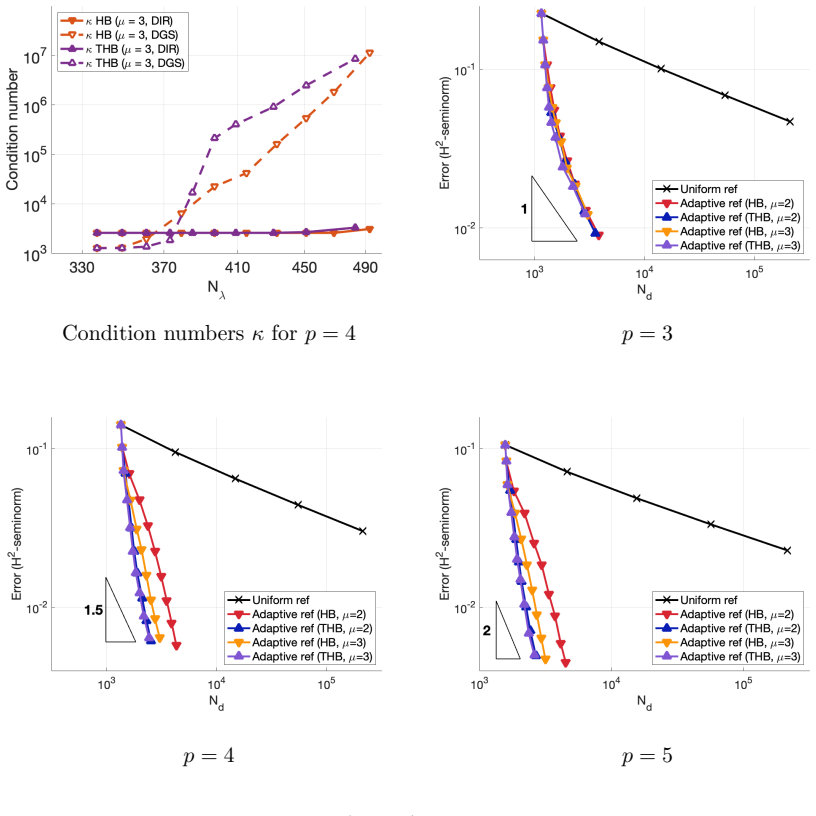
The authors present a novel adaptive IETI-DP method for the biharmonic equation over analysis-suitable G1 multi-patch geometries with extraordinary vertices. The method uses Lagrange multipliers to enforce C1-smoothness across interfaces, solves the resulting saddle point problem by first addressing a small problem for the multipliers and then local problems on patches, employs diagonal scaling for local preconditioning and a suitable preconditioner for multipliers, and uses truncated hierarchical B-splines for adaptive refinement, showing optimal convergence and good preconditioner performance in tests.
What carries the argument
The IETI-DP formulation that decomposes the domain into patches, enforces C1 continuity with Lagrange multipliers in a dual-primal setting, and pairs it with truncated hierarchical B-splines for adaptive discretization and refinement on individual patches.
If this is right
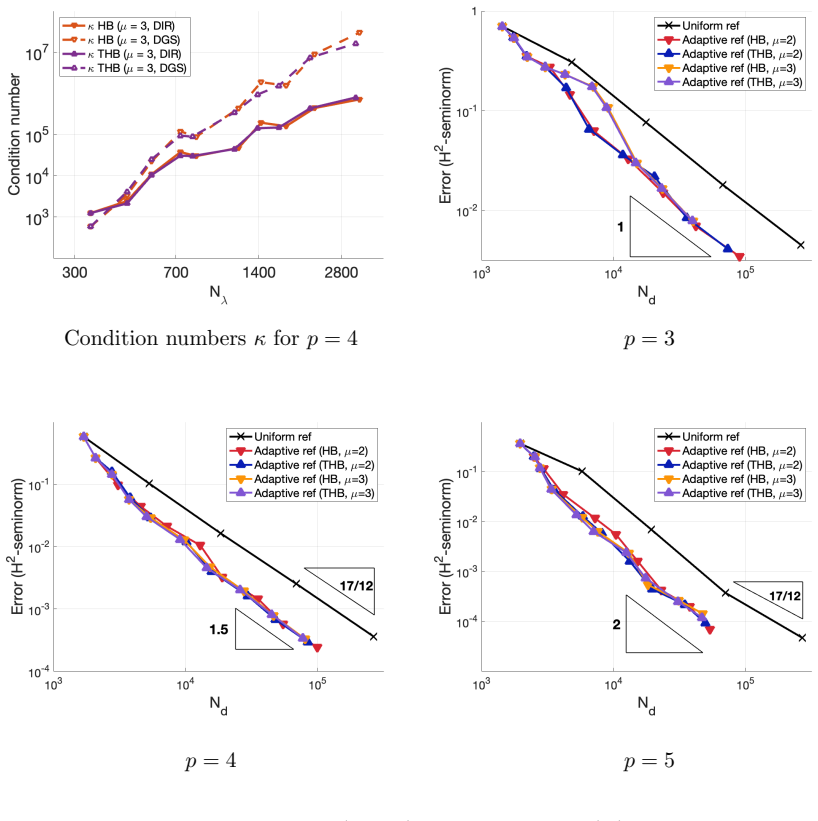
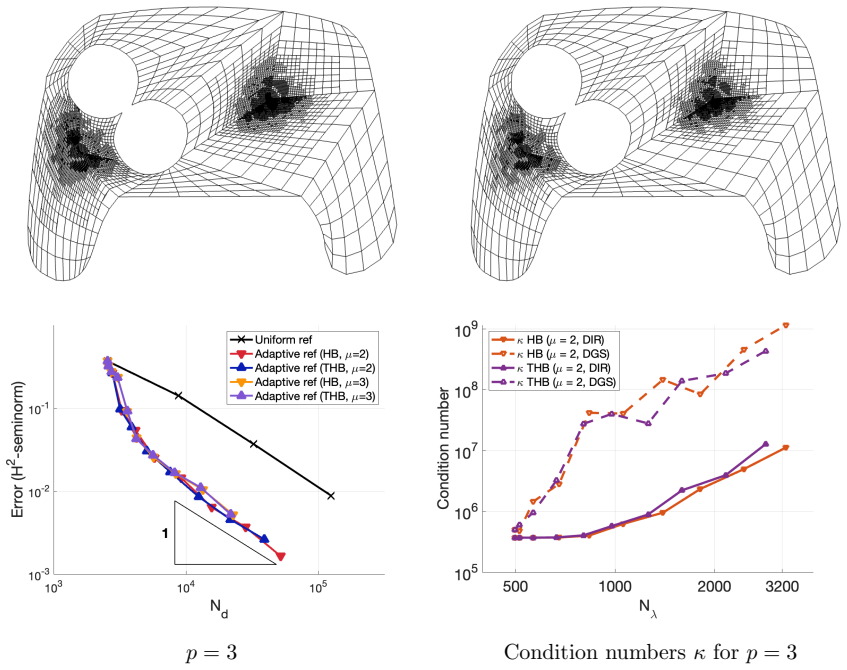
- Optimal convergence rates are attained when the adaptive refinement strategy based on truncated hierarchical B-splines is applied to the local patch problems.
- The custom preconditioner for the Lagrange-multiplier problem keeps the number of iterations stable across successive refinement levels.
- The dual-primal decomposition allows the local patch solves to be performed independently and in parallel after the small multiplier problem is solved.
- The method extends to multi-patch geometries containing extraordinary vertices while preserving the required global smoothness.
Where Pith is reading between the lines
- The same IETI-DP structure could be reused for other fourth-order elliptic problems that require C1 continuity on multi-patch domains.
- Combining the approach with different spline bases or three-dimensional geometries would be a direct next step that preserves the existing dual-primal and adaptive machinery.
- The observed separation into a cheap global multiplier solve and cheap local solves suggests the method scales favorably for very large numbers of patches.
Load-bearing premise
The multi-patch domains are parametrized by analysis-suitable G1 geometries that permit the chosen Lagrange-multiplier conditions to enforce the required C1 continuity across patch interfaces.
What would settle it
Numerical experiments on the presented test cases in which the observed convergence rates under adaptive hierarchical refinement fall below the expected optimal order, or in which the iteration count for the multiplier problem grows markedly with refinement level, would show the central claims do not hold.
Figures
read the original abstract
We present a novel adaptive isogeometric method for solving the biharmonic equation over planar multi-patch domains with possibly extraordinary vertices, parametrized by analysis-suitable G^1 multi-patch geometries. The proposed technique relies on the concept of Dual-Primal Isogeometric Tearing and Interconnecting (IETI-DP), which enforces the required C^1-smoothness of the solution across a common edge of two neighboring patches by imposing appropriate continuity conditions by means of Lagrange multipliers. The resulting saddle point problem is solved using a dual-primal formulation, first by a small linear problem for the Lagrange multipliers and then by local, parallelizable linear problems on the individual patches for the coefficients of the numerical solution. While for the local problems on the single patches standard diagonally scaling is used as preconditioner, a suitable preconditioner for the problem of finding the Lagrange multipliers is introduced. To perform adaptive refinement, the solution of the biharmonic equation on the single patches of the multi-patch domain is discretized by employing (truncated) hierarchical B-splines, and an appropriate refinement strategy of the underlying mesh is presented. Finally, the potential of the developed adaptive IETI-DP method for solving the biharmonic equation over planar multi-patch geometries is numerically tested on the basis of several numerical examples. Thereby, the numerical results show on the one hand optimal convergence behavior with respect to adaptive refinement, and on the other hand a good performance of the proposed preconditioner for the linear problem of determining the Lagrange multipliers.
Editorial analysis
A structured set of objections, weighed in public.
Referee Report
Summary. The paper presents an adaptive Dual-Primal Isogeometric Tearing and Interconnecting (IETI-DP) method for the biharmonic equation on planar multi-patch domains parametrized by analysis-suitable G¹ geometries (including those with extraordinary vertices). It enforces C¹ continuity across patch interfaces via Lagrange multipliers in a saddle-point formulation, solves the dual problem for multipliers followed by local patch problems, introduces a preconditioner for the multiplier system alongside diagonal scaling for locals, employs truncated hierarchical B-splines with a presented refinement strategy for adaptivity on individual patches, and reports numerical examples demonstrating optimal convergence rates under adaptive refinement together with good performance of the proposed preconditioner.
Significance. If the geometric hypotheses hold, the work supplies a scalable, parallelizable domain-decomposition approach that combines IETI-DP with hierarchical B-spline adaptivity for fourth-order problems on complex multi-patch CAD geometries; the numerical demonstration of optimal rates and an effective multiplier preconditioner is a concrete strength for isogeometric analysis applications.
major comments (1)
- [Abstract; method description (continuity conditions and numerical examples)] The central numerical claims rest on the assumption that the chosen Lagrange-multiplier conditions enforce C¹ continuity (including at extraordinary vertices) precisely when the multi-patch parametrizations are analysis-suitable G¹. The manuscript should contain an explicit verification—e.g., by checking the required linear dependence relations among basis functions or by reference to a dedicated section on the test geometries—that the domains used in the numerical examples satisfy these conditions; without it the reported convergence rates and preconditioner performance apply only to a possibly non-conforming discrete space.
minor comments (1)
- [Abstract] The abstract states that 'standard diagonally scaling is used as preconditioner' for the local problems; a brief sentence clarifying whether this is applied to the stiffness matrices after static condensation or to the full local systems would improve clarity.
Simulated Author's Rebuttal
We thank the referee for the thorough review and constructive feedback. We address the single major comment below and will revise the manuscript accordingly.
read point-by-point responses
-
Referee: [Abstract; method description (continuity conditions and numerical examples)] The central numerical claims rest on the assumption that the chosen Lagrange-multiplier conditions enforce C¹ continuity (including at extraordinary vertices) precisely when the multi-patch parametrizations are analysis-suitable G¹. The manuscript should contain an explicit verification—e.g., by checking the required linear dependence relations among basis functions or by reference to a dedicated section on the test geometries—that the domains used in the numerical examples satisfy these conditions; without it the reported convergence rates and preconditioner performance apply only to a possibly non-conforming discrete space.
Authors: We agree that an explicit verification of the analysis-suitable G¹ conditions for the numerical test geometries would improve clarity and confirm that the discrete spaces are conforming. In the revised manuscript we will add a dedicated subsection (placed after the description of the test geometries) that verifies the required linear dependence relations among basis functions at all patch interfaces, including at extraordinary vertices. This verification will be performed for each example by direct inspection of the given parametrizations and will reference the geometric hypotheses stated in the method section. revision: yes
Circularity Check
No significant circularity; derivation and validation remain independent
full rationale
The paper extends the established IETI-DP framework to the biharmonic equation on analysis-suitable G¹ multi-patch domains by imposing C¹ continuity via Lagrange multipliers on a saddle-point system, then applies standard diagonal scaling for local patch problems and a custom preconditioner for the multiplier problem. Adaptive refinement uses truncated hierarchical B-splines with a standard marking strategy. None of these steps reduce by the paper's own equations to a self-definition, a fitted input renamed as prediction, or a load-bearing self-citation chain; the numerical tests report observed convergence rates and iteration counts on concrete geometries, which constitute independent empirical evidence rather than tautological outputs. The geometric hypothesis on G¹ parametrizations is an explicit modeling assumption, not a derived claim that collapses into the method itself.
Axiom & Free-Parameter Ledger
axioms (2)
- domain assumption The multi-patch domains admit analysis-suitable G1 parametrizations allowing C1 continuity to be enforced via the chosen Lagrange multiplier conditions.
- domain assumption Standard diagonally scaling preconditioning is effective for the local patch problems.
Reference graph
Works this paper leans on
-
[1]
Antolin, A
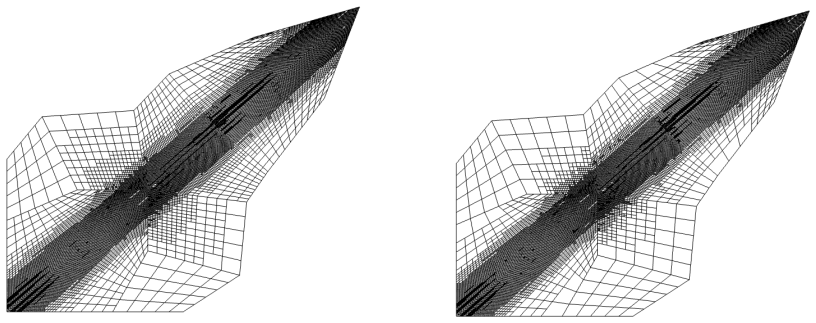
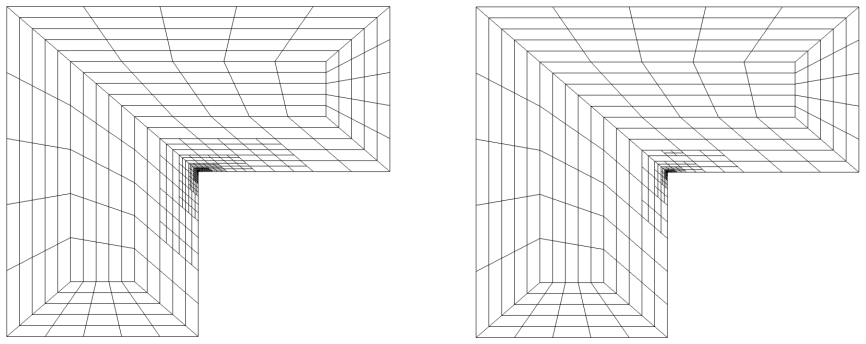
P. Antolin, A. Buffa, and L. Coradello. A hierarchical approach to the a posteriori error estimation of isogeometric Kirchhoff plates and Kirchhoff–Love shells.Comput. Methods 29 Figure 10: Example 4. The admissible meshes forµ= 3 after six levels of adaptive refinement when using hierarchical B-splines forp= 4 (left), and truncated hierarchical B-splines...
2020
-
[2]
J. Arf, M. Reichle, S. Klinkel, and B. Simeon. Scaled boundary isogeometric analysis withC 1 coupling for Kirchhoff plate theory.Comput. Methods Appl. Mech. Engrg., 415:116198, 2023
2023
-
[3]
R. E. Bank and R. K. Smith. A posteriori error estimates based on hierarchical bases. SIAM J. Numer. Anal., 30(4):921–935, 1993
1993
-
[4]
Beir˜ ao da Veiga, L
L. Beir˜ ao da Veiga, L. F. Pavarino, S. Scacchi, O. B. Widlund, and S. Zampini. Isogeomet- ric BDDC preconditioners with deluxe scaling.SIAM J. Sci. Comput., 36(3):1118–a113, 2014
2014
-
[5]
Beir˜ ao da Veiga, L
L. Beir˜ ao da Veiga, L. F. Pavarino, S. Scacchi, O. B. Widlund, and S. Zampini. Adaptive 30 selection of primal constraints for isogeometric BDDC deluxe preconditioners.SIAM J. Sci. Comput., 39(1):281–302, 2017
2017
-
[6]
A. Benvenuti, G. Loli, G. Sangalli, and T. Takacs. Isogeometric multi-patchC 1-mortar coupling for the biharmonic equation.arXiv, 2303.07255, 2023
-
[7]
Birner, B
K. Birner, B. J¨ uttler, and A. Mantzaflaris. Bases and dimensions ofC 1-smooth isogeo- metric splines on volumetric two-patch domains.Graphical Models, 99:46 – 56, 2018
2018
-
[8]
Birner, B
K. Birner, B. J¨ uttler, and A. Mantzaflaris. Approximation power ofC 1-smooth isogeo- metric splines on volumetric two-patch domains. InIsogeometric Analysis and Applica- tions 2018, pages 27–38. Springer, LNCSE, 2021
2018
-
[9]
Birner and M
K. Birner and M. Kapl. The space ofC 1-smooth isogeometric spline functions on trilin- early parameterized volumetric two-patch domains.Comput. Aided Geom. Des., 70:16– 30, 2019
2019
-
[10]
Bouclier, J
R. Bouclier, J. C. Passieux, and M. Sala¨ un. Development of a new, more regular, mortar method for the coupling of NURBS subdomains within a NURBS patch: Application to a non-intrusive local enrichment of NURBS patches.Comput. Methods Appl. Mech. Engrg., 316:123–150, 2017
2017
-
[11]
Bracco, A
C. Bracco, A. Farahat, C. Giannelli, M. Kapl, and R. V´ azquez. Adaptive methods with C1 splines for multi-patch surfaces and shells.Comput. Methods Appl. Mech. Engrg., 431:117287, 2024
2024
-
[12]
Bracco, C
C. Bracco, C. Giannelli, M. Kapl, and R. V´ azquez. Isogeometric analysis withC1 hierar- chical functions on planar two-patch geometries.Comput. Math. Appl., 80(11):2538–2562, 2020
2020
-
[13]
Bracco, C
C. Bracco, C. Giannelli, M. Kapl, and R. V´ azquez. Adaptive isogeometric methods withC 1 (truncated) hierarchical splines on planar multi-patch domains.Math. Models Methods Appl. Sci., 33(9):1829–1874, 2023
2023
-
[14]
Bracco, C
C. Bracco, C. Giannelli, A. Reali, M. Torre, and R. V´ azquez. Adaptive isogeometric phase-field modeling of the Cahn–Hilliard equation: Suitably graded hierarchical refine- ment and coarsening on multi-patch geometries.Comput. Methods Appl. Mech. Engrg., 417:116355, 2023
2023
-
[15]
Buffa, G
A. Buffa, G. Gantner, C. Giannelli, D. Praetorius, and R. V´ azquez. Mathematical foundations of adaptive isogeometric analysis.Arch. Comput. Methods Eng., 29:4479– 4555, 2022
2022
-
[16]
Buffa and C
A. Buffa and C. Giannelli. Adaptive isogeometric methods with hierarchical splines: error estimator and convergence.Math. Models Methods Appl. Sci., 26(1):1–25, 2016
2016
-
[17]
A. B¨ unger, T.-C. Riemer, and M. Stoll. IETI-based low-rank method for PDE- constrained optimization.arXiv, 2405.06458, 2024
-
[18]
Casquero, X
H. Casquero, X. Wei, D. Toshniwal, A. Li, T.J.R Hughes, J. Kiendl, and Y. J. Zhang. Seamless integration of design and Kirchhoff–Love shell analysis using analysis-suitable unstructured T-splines.Comput. Methods Appl. Mech. Engrg., 360:112765, 2020. 31
2020
-
[19]
C. L. Chan, C. Anitescu, and T. Rabczuk. Isogeometric analysis with strong multipatch C1-coupling.Comput. Aided Geom. Design, 62:294–310, 2018
2018
-
[20]
C. L. Chan, C. Anitescu, and T. Rabczuk. Strong multipatch C 1-coupling for isogeomet- ric analysis on 2D and 3D domains.Comput. Methods Appl. Mech. Engrg., 357:112599, 2019
2019
-
[21]
Collin, G
A. Collin, G. Sangalli, and T. Takacs. Analysis-suitable G 1 multi-patch parametrizations for C1 isogeometric spaces.Comput. Aided Geom. Des., 47:93 – 113, 2016
2016
-
[22]
Coradello, P
L. Coradello, P. Antolin, R. V´ azquez, and A. Buffa. Adaptive isogeometric analysis on two-dimensional trimmed domains based on a hierarchical approach.Comput. Methods Appl. Mech. Engrg., 364:112925, 2020
2020
-
[23]
Dittmann, S
M. Dittmann, S. Schuß, B. Wohlmuth, and C. Hesch. WeakC n coupling for multipatch isogeometric analysis in solid mechanics.Int. J. Numer. Methods Eng., 118(11):678–699, 2019
2019
-
[24]
C. R. Dohrmann. A preconditioner for substructuring based on constrained energy min- imization.SIAM J. Sci. Comput., 25(1):246–258, 2003
2003
-
[25]
D¨ orfler
W. D¨ orfler. A convergent adaptive algorithm for Poisson’s equation.SIAM J. Numer. Anal., 33(3):1106–1124, 1996
1996
-
[26]
Farahat, B
A. Farahat, B. J¨ uttler, M. Kapl, and T. Takacs. Isogeometric analysis withC 1-smooth functions over multi-patch surfaces.Comput. Methods Appl. Mech. Engrg., 403:115706, 2023
2023
-
[27]
Farahat, M
A. Farahat, M. Kapl, A. Kosmaˇ c, and V. Vitrih. A locally based construction of analysis- suitableG 1 multi-patch spline surfaces.Comput. Math. Appl., 168:46–57, 2024
2024
-
[28]
Farhat, M
C. Farhat, M. Lesoinne, P. LeTallec, K. Pierson, and D. Rixen. FETI-DP: a dual–primal unified FETI method—part I: A faster alternative to the two-level FETI method.Int. J. Numer. Methods Eng., 50(7):1523–1544, 2001
2001
-
[29]
Farhat and J
C. Farhat and J. Mandel. The two-level FETI method for static and dynamic plate problems Part I: An optimal iterative solver for biharmonic systems.Comput. Methods Appl. Mech. Engrg., 155(1):129–151, 1998
1998
-
[30]
Farhat and F.-X
C. Farhat and F.-X. Roux. A method of finite element tearing and interconnecting and its parallel solution algorithm.Int. J. Numer. Methods Eng., 32(6):1205–1227, 1991
1991
-
[31]
Giannelli, B
C. Giannelli, B. J¨ uttler, and H. Speleers. THB-splines: The truncated basis for hierar- chical splines.Computer Aided Geometric Design, 29(7):485–498, 2012
2012
-
[32]
Gomez, V
H. Gomez, V. M Calo, Y. Bazilevs, and T. J.R. Hughes. Isogeometric analysis of the Cahn–Hilliard phase-field model.Comput. Methods Appl. Mech. Engrg., 197(49):4333– 4352, 2008
2008
-
[33]
Gomez and X
H. Gomez and X. Nogueira. An unconditionally energy-stable method for the phase field crystal equation.Comput. Methods Appl. Mech. Engrg., 249 – 252:52 – 61, 2012. 32
2012
-
[34]
Grisvard.Singularities in boundary value problems, volume 22 ofRech
P. Grisvard.Singularities in boundary value problems, volume 22 ofRech. Math. Appl. Paris: Masson; Berlin: Springer-Verlag, 1992
1992
-
[35]
F. Hasanova, S. Takacs, and T. Takacs. Robust approximation error estimates for analysis-suitableG 1 isogeometric multi-patch discretizations.arXiv, 2605.13270, 2026
work page internal anchor Pith review Pith/arXiv arXiv 2026
-
[36]
Hofer and U
C. Hofer and U. Langer. Dual-primal isogeometric tearing and interconnecting solvers for multipatch dG-Iga equations.Comput. Methods Appl. Mech. Eng., 316:2–21, 2017
2017
-
[37]
T. J. R. Hughes, J. A. Cottrell, and Y. Bazilevs. Isogeometric analysis: CAD, finite elements, NURBS, exact geometry and mesh refinement.Comput. Methods Appl. Mech. Engrg., 194(39-41):4135–4195, 2005
2005
-
[38]
M. Kapl, A. Kosmaˇ c, and V. Vitrih. Isogeometric collocation for solving the bihar- monic equation over planar multi-patch domains.Comput. Methods Appl. Mech. Engrg., 424:116882, 2024
2024
-
[39]
M. Kapl, A. Kosmaˇ c, and V. Vitrih. ACs-smooth mixed degree and regularity isogeomet- ric spline space over planar multi-patch domains.J. Comput. Appl. Math., 473:116836, 2026
2026
-
[40]
M. Kapl, A. Kosmaˇ c, and V. Vitrih. Isogeometric collocation with smooth mixed degree splines over planar multi-patch domains.J. Comput. Appl. Math., 210:89–112, 2026
2026
-
[41]
M. Kapl, A. Kosmaˇ c, and V. Vitrih. An isogeometric tearing and interconnecting (IETI) method for solving high order partial differential equations over planar multi-patch ge- ometries.Comput. Methods Appl. Mech. Engrg., 452:118769, 2026
2026
-
[42]
M. Kapl, G. Sangalli, and T. Takacs. Construction of analysis-suitable G 1 planar multi- patch parameterizations.Comput.-Aided Des., 97:41–55, 2018
2018
-
[43]
M. Kapl, G. Sangalli, and T. Takacs. Isogeometric analysis with C1 functions on unstruc- tured quadrilateral meshes.The SMAI journal of computational mathematics, 5:67–86, 2019
2019
-
[44]
M. Kapl, G. Sangalli, and T. Takacs. An isogeometric C 1 subspace on unstructured multi-patch planar domains.Comput. Aided Geom. Des., 69:55–75, 2019
2019
-
[45]
Kapl and V
M. Kapl and V. Vitrih. Space of C 2-smooth geometrically continuous isogeometric func- tions on planar multi-patch geometries: Dimension and numerical experiments.Comput. Math. Appl., 73(10):2319–2338, 2017
2017
-
[46]
Kapl and V
M. Kapl and V. Vitrih. Dimension and basis construction forC 2-smooth isogeometric spline spaces over bilinear-likeG 2 two-patch parameterizations.J. Comput. Appl. Math., 335:289–311, 2018
2018
-
[47]
Kapl and V
M. Kapl and V. Vitrih. Solving the triharmonic equation over multi-patch planar domains using isogeometric analysis.J. Comput. Appl. Math., 358:385–404, 2019
2019
-
[48]
Kapl and V
M. Kapl and V. Vitrih. Isogeometric collocation on planar multi-patch domains.Comput. Methods Appl. Mech. Engrg., 360:112684, 2020. 33
2020
-
[49]
Kapl and V
M. Kapl and V. Vitrih.C s-smooth isogeometric spline spaces over planar multi-patch parameterizations.Adv. Comput. Math., 47:47, 2021
2021
-
[50]
Kapl and V
M. Kapl and V. Vitrih.C 1 isogeometric spline space for trilinearly parameterized multi- patch volumes.Comput. Math. Appl., 117:53–68, 2022
2022
-
[51]
Karˇ ciauskas and J
K. Karˇ ciauskas and J. Peters. RefinableG1 functions onG 1 free-form surfaces.Comput. Aided Geom. Des., 54:61–73, 2017
2017
-
[52]
Karˇ ciauskas and J
K. Karˇ ciauskas and J. Peters. Refinable bi-quartics for design and analysis.Comput.- Aided Des., pages 204–214, 2018
2018
-
[53]
Kiendl, K.-U
J. Kiendl, K.-U. Bletzinger, J. Linhard, and R. W¨ uchner. Isogeometric shell analysis with Kirchhoff-Love elements.Comput. Methods Appl. Mech. Engrg., 198(49):3902–3914, 2009
2009
-
[54]
Klawonn and O
A. Klawonn and O. B. Widlund. A domain decomposition method with lagrange mul- tipliers and inexact solvers for linear elasticity.SIAM Journal on Scientific Computing, 22(4):1199–1219, 2000
2000
-
[55]
Klawonn and O
A. Klawonn and O. B. Widlund. Dual-primal feti methods for linear elasticity.Commu- nications on Pure and Applied Mathematics, 59(11):1523–1572, 2006
2006
-
[56]
S. K. Kleiss, C. Pechstein, B. J¨ uttler, and S. Tomar. IETI – isogeometric tearing and interconnecting.Comput. Methods Appl. Mech. Engrg., 247-248:201–215, 2012
2012
-
[57]
R. Kraft. Adaptive and linearly independent multilevel B-splines. InSurface fitting and multiresolution methods. Vol. 2 of the proceedings of the 3rd international conference on Curves and surfaces, held in Chamonix-Mont-Blanc, France, June 27–July 3, 1996, pages 209–218. Nashville, TN: Vanderbilt University Press, 1997
1996
-
[58]
Mandel and C
J. Mandel and C. R. Dohrmann. Convergence of a balancing domain decomposition by constraints and energy minimization.Numerical Linear Algebra with Applications, 10(7):639–659, 2003
2003
-
[59]
Mandel, C
J. Mandel, C. R. Dohrmann, and R. Tezaur. An algebraic theory for primal and dual substructuring methods by constraints.Appl. Numer. Math., 54(2):167—-193, 2005
2005
-
[60]
Marsala, A
M. Marsala, A. Mantzaflaris, and B. Mourrain.G 1 spline functions for point cloud fitting. Applied Mathematics and Computation, 460:128279, 2024
2024
-
[61]
D. Miao, Z. Zou, M. A. Scott, M. J. Borden, and D. C. Thomas. Isogeometric B´ ezier dual mortaring: the Kirchhoff-Love shell problem.Comput. Methods Appl. Mech. Eng., 382:113873, 2021
2021
-
[62]
Montardini, G
M. Montardini, G. Sangalli, R. Schneckenleitner, S. Takacs, and M. Tani. A IETI-DP method for discontinuous Galerkin discretizations in isogeometric analysis with inexact local solvers.Math. Models Methods Appl. Sci., 33(10):2085–2111, 2023
2085
-
[63]
Mourrain, R
B. Mourrain, R. Vidunas, and N. Villamizar. Dimension and bases for geometrically continuous splines on surfaces of arbitrary topology.Comput. Aided Geom. Des., 45:108 – 133, 2016. 34
2016
-
[64]
Nguyen and J
T. Nguyen and J. Peters. RefinableC 1 spline elements for irregular quad layout.Comput. Aided Geom. Des., 43:123–130, 2016
2016
-
[65]
Niiranen, J
J. Niiranen, J. Kiendl, A. H. Niemi, and A. Reali. Isogeometric analysis for sixth-order boundary value problems of gradient-elastic Kirchhoff plates.Comput. Methods Appl. Mech. Engrg., 316:328–348, 2017
2017
-
[66]
M. F. M. Reichle, J. Arf, B. Simeon, and S. Klinkel. Smooth multi-patch scaled boundary isogeometric analysis for Kirchhoff–Love shells.Meccanica, 58(8):1693–1716, 2023
2023
-
[67]
U. Reif. A refinable space of smooth spline surfaces of arbitrary topological genus.Journal of Approximation Theory, 90(2):174–199, 1997
1997
-
[68]
Schillinger, J
D. Schillinger, J. A. Evans, A. Reali, M. A. Scott, and T. J. R. Hughes. Isogeometric collocation: Cost comparison with Galerkin methods and extension to adaptive hierarchi- cal NURBS discretizations.Computer Methods in Applied Mechanics and Engineering, 267:170–232, 2013
2013
-
[69]
Schuß, M
S. Schuß, M. Dittmann, B. Wohlmuth, S. Klinkel, and C. Hesch. Multi-patch isogeometric analysis for Kirchhoff–Love shell elements.Comput. Methods Appl. Mech. Engrg., 349:91– 116, 2019
2019
-
[70]
Scott, R.N
M.A. Scott, R.N. Simpson, J.A. Evans, S. Lipton, S.P.A. Bordas, T.J.R. Hughes, and T.W. Sederberg. Isogeometric boundary element analysis using unstructured t-splines. Comp. Methods Appl. Mech. Engrg., 254:197–221, 2013
2013
-
[71]
Sogn and S
J. Sogn and S. Takacs. Stable discretizations and IETI-DP solvers for the Stokes system in multi-patch IgA.ESAIM, Math. Model. Numer. Anal., 57(2):921–952, 2023
2023
-
[72]
Sogn and S
J. Sogn and S. Takacs. Isogeometric tearing and interconnecting solvers for linear elas- ticity in multi-patch isogeometric analysis with theory for two dimensional domains. Comput. Methods Appl. Mech. Engrg., 418:116482, 2024
2024
- [73]
-
[74]
Toshniwal, H
D. Toshniwal, H. Speleers, and T. J. R. Hughes. Smooth cubic spline spaces on unstruc- tured quadrilateral meshes with particular emphasis on extraordinary points: Geometric design and isogeometric analysis considerations.Comput. Methods Appl. Mech. Engrg., 327:411–458, 2017
2017
-
[75]
C. V. Verhoosel, M. A. Scott, T. J. R. Hughes, and R. de Borst. An isogeometric analysis approach to gradient damage models.Internat. J. Numer. Methods Engrg., 86(1):115– 134, 2011
2011
-
[76]
X. Wei. THU-splines: Highly localized refinement on smooth unstructured splines. In Carla Manni and Hendrik Speleers, editors,Geometric Challenges in Isogeometric Anal- ysis, pages 305–332, Cham, 2022. Springer International Publishing
2022
-
[77]
Wei, X Li, K
X. Wei, X Li, K. Qian, T. J. R Hughes, Y. J Zhang, and H. Casquero. Analysis-suitable unstructured T-splines: Multiple extraordinary points per face.Comput. Methods Appl. Mech. Engrg., 391:114494, 2022. 35
2022
-
[78]
X. Wei, Y. Zhang, L. Liu, and T. J. R. Hughes. Truncated T-splines: Fundamentals and methods.Comput. Methods Appl. Mech. Engrg., 316:349–372, 2017
2017
-
[79]
O. B. Widlund, S. Zampini, S. Scacchi, and L. F. Pavarino. Block FETI-DP/BDDC preconditioners for mixed isogeometric discretizations of three-dimensional almost in- compressible elasticity.Math. Comput., 90(330):1773–1797, 2021
2021
-
[80]
Wen. Z., Md. S. Faruque, X. Li, X. Wei, and H. Casquero. Isogeometric analysis using G-spline surfaces with arbitrary unstructured quadrilateral layout.Comput. Methods Appl. Mech. Engrg., 408:115965, 2023. 36
2023
discussion (0)
Sign in with ORCID, Apple, or X to comment. Anyone can read and Pith papers without signing in.