REVIEW 1 major objections 4 minor 18 references
Analysis of Intelligent Vehicular Relaying in Urban 5G+ Millimeter-Wave Cellular Deployments
T0 review · 1 major / 4 minor · reviewed 2026-08-14 · deepseek-v4-flash
Pith's one-line read This paper develops an analytical framework showing that vehicular mmWave relaying can more than double mean spectral efficiency in dense urban street deployments when users can select the best link.
desk verdict Solid baseline and conservative relaying framework, but a load-bearing hop-bottleneck error in the aggressive strategy inflates the headline gain. read the letter →
The pith
A machine-rendered reading of the paper's core claim, the machinery that carries it, and where it could break.
The reading
What carries the argument
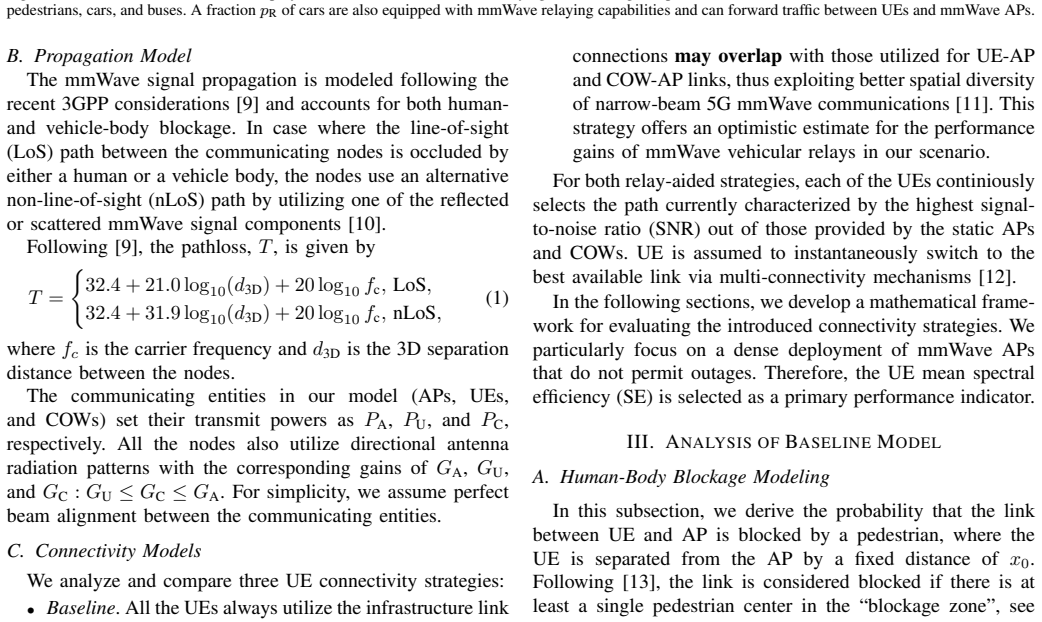
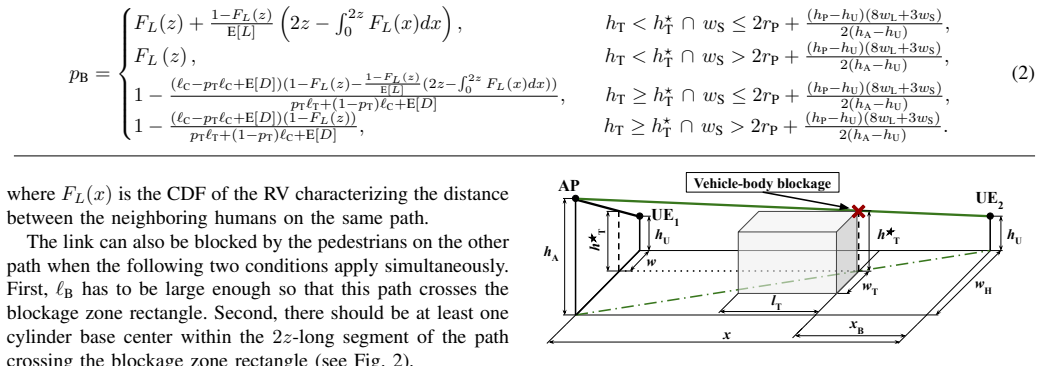
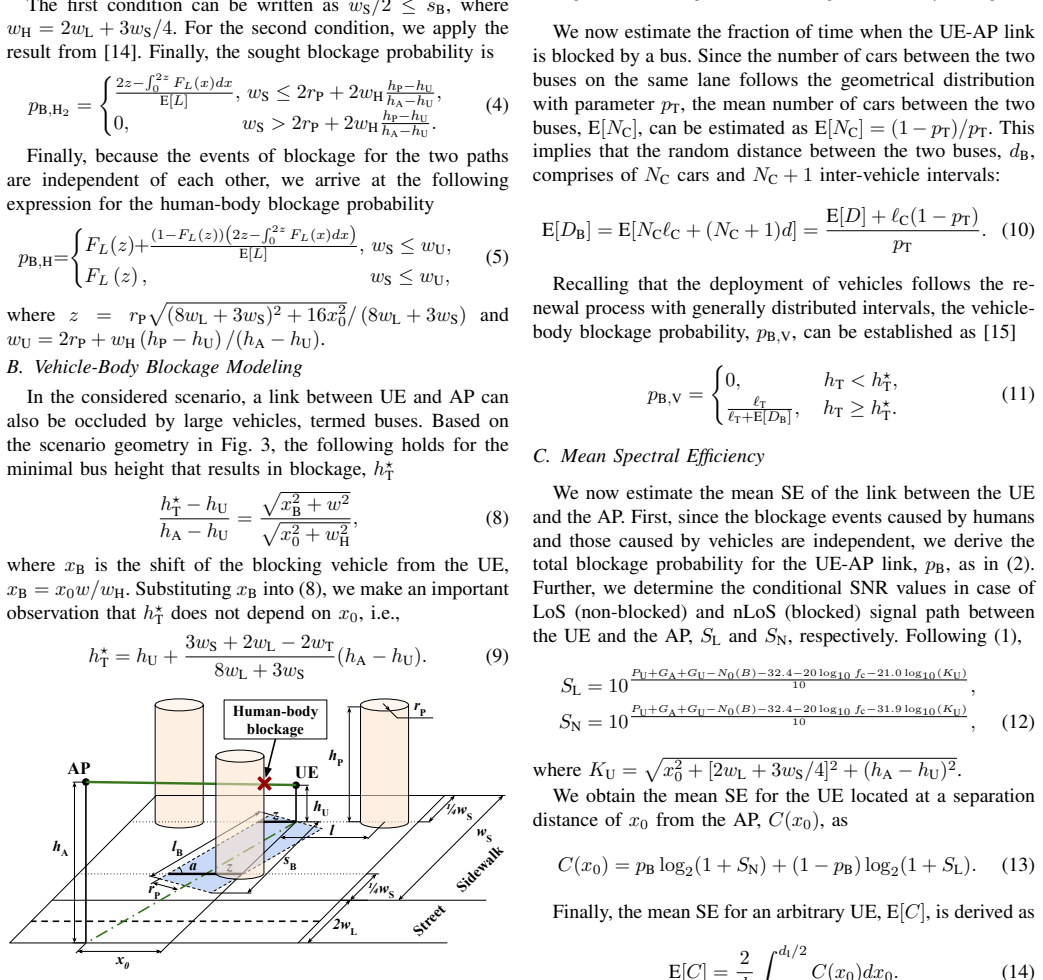
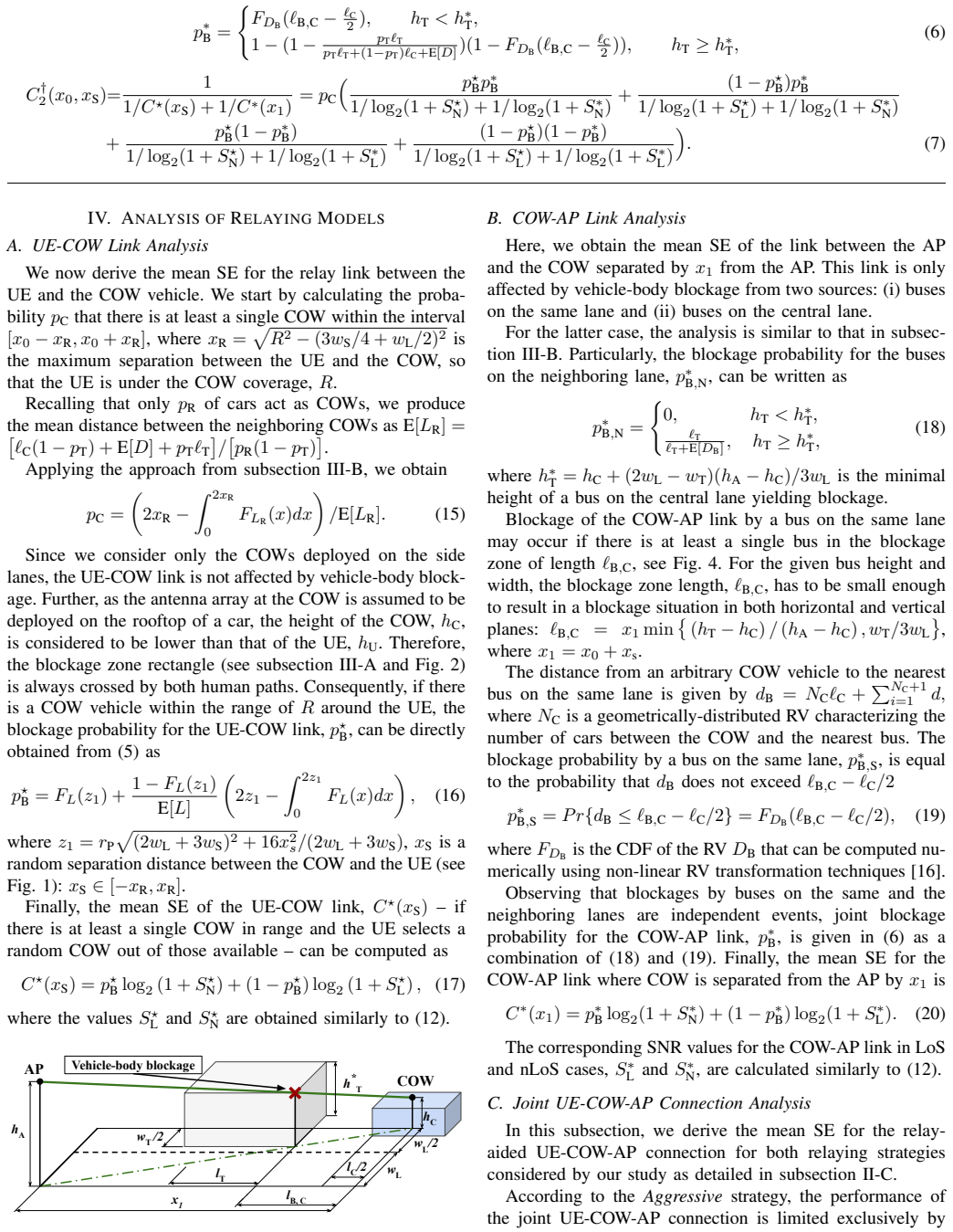
The machinery is a sequence of blockage-probability formulas for the three links in the system, user to base station, user to relay car, and relay car to base station, computed with renewal theory over random pedestrian spacings and random car or bus spacings. Human-body blockage is treated as a pedestrian path crossing a rectangular blockage zone; vehicle blockage depends on whether a bus is tall enough to occlude the line of sight, with a critical height that turns out not to depend on user position. These probabilities feed mean spectral efficiency expressions built from 3GPP pathloss and directional antenna gains; for the two-hop relay path, the Aggressive strategy uses the relay-to-base link's efficiency directly, while the Conservative strategy combines the two hop efficiencies harmonically. The user's final efficiency is the maximum of the direct and relayed values, and the paper verifies the closed-form analysis against a simulation that relaxes three geometric assumptions.
What would settle it
Run a 28 GHz street-deployment field trial or detailed simulator that keeps the same geometry and traffic densities but models finite beam training, imperfect alignment, and handover latency; if relay-aided mean spectral efficiency no longer exceeds the direct-to-base baseline by roughly a factor of two for the Aggressive strategy, the paper's headline quantitative claim would be refuted.
Extended reading notes
Core claim
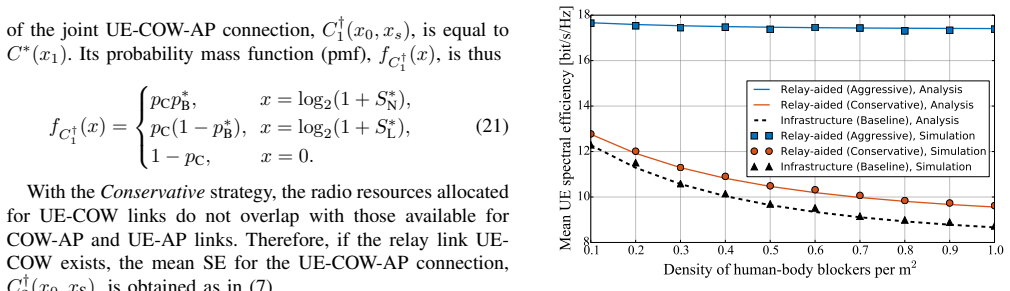
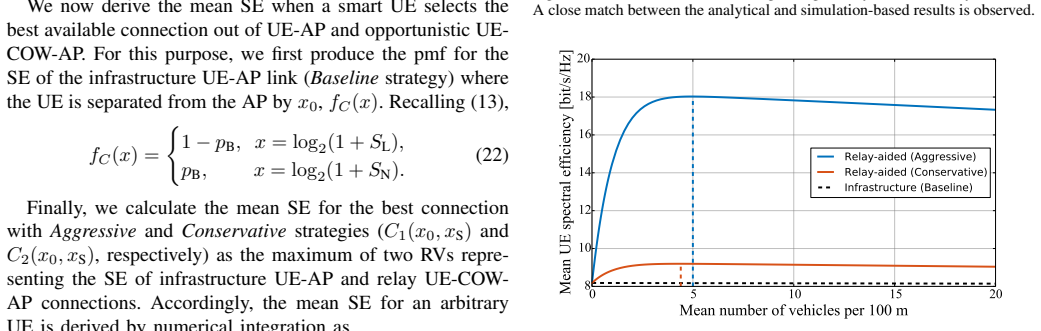
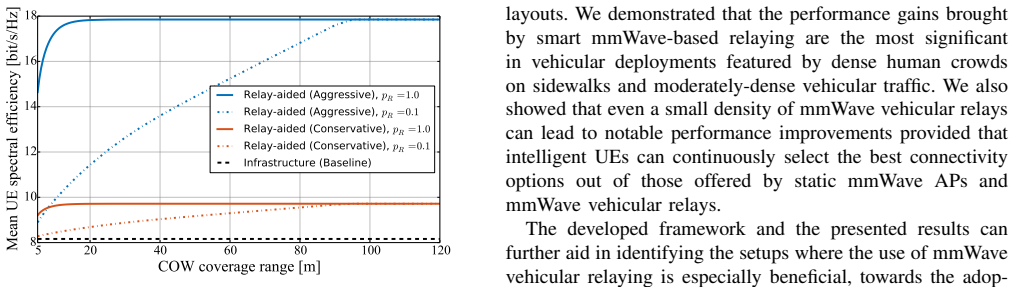
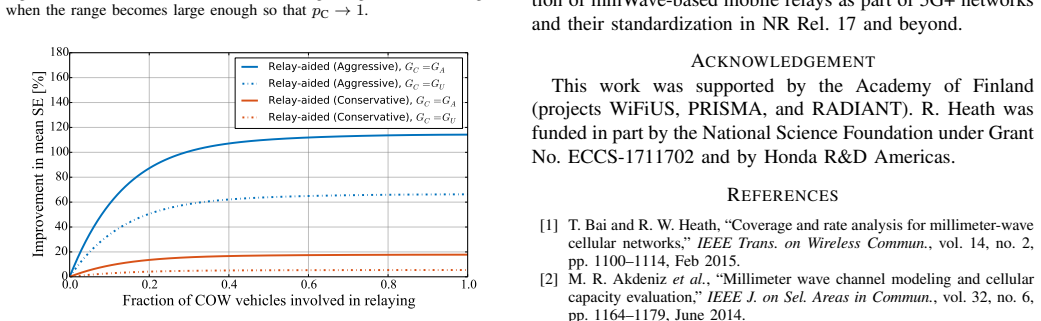
The paper's central claim is that intelligent users who continuously select the strongest available link, direct to a static mmWave access point or through a relay-equipped car, can more than double their mean spectral efficiency in a street canyon with dense human crowds and moderate vehicular traffic. The quantitative support is a comparison of three connectivity strategies: a baseline that ignores relays, a Conservative relay strategy that avoids any resource overlap between hops, and an Aggressive relay strategy that reuses radio resources across hops. In the modeled 28 GHz deployment with base stations 300 m apart, the Aggressive strategy raises mean UE spectral efficiency to about 17-18 bits/s/Hz, a 70-120% improvement over baseline, while the Conservative strategy manages only an 8-12% gain. The paper further identifies the conditions where relaying pays off most: dense pedestrian sidewalks, a medium density of vehicles, and relay coverage ranges large enough that a relay is nearly always present, after which further increases in relay fraction or coverage range add little.
Load-bearing premise
The central premise is that every communicating pair has ideally aligned beams and that a user can switch instantly to whichever link, direct or relayed, is strongest, so the reported gains assume away beam-training time, misalignment, and handover latency.
Editorial extensions
If this is right
- Deploying vehicular relays pays off mainly in pedestrian-dense street canyons, where human-body blockage is the dominant impairment of direct mmWave links.
- Relay gains are non-monotonic in vehicle density: too few vehicles means too few relays, while too many vehicles introduces vehicle-body blockage, with the best returns at roughly 3-5 vehicles per 100 m.
- Equipping more than about 40% of vehicles as relays yields little additional mean spectral efficiency, so network operators can cap relay participation without losing most of the benefit.
- Even a 10% fraction of relay-equipped vehicles captures most of the Aggressive-strategy gain, so a small fleet of specially equipped vehicles could provide most of the improvement.
- The choice between Conservative and Aggressive relaying changes the outcome substantially: resource reuse across hops is what unlocks the two-fold gain, while disjoint resource allocation limits gains to under 15%.
Reading between the lines
- Because the model assumes perfect beam alignment and instantaneous link switching, the practical gain in a deployed system will be lower; the next step is to add beam-training time, misalignment statistics, and handover latency to the same analysis and see how much of the two-fold gain survives.
- The renewal-theoretic blockage analysis could be extended to moving relays by treating a relay's position relative to a user as time-varying, allowing estimates of how often the best-link switch occurs and how long a user stays in a relay's coverage.
- The saturation near 40% relay penetration suggests an economically useful design rule: recruit only a bounded share of vehicles as relays, which limits incentives, energy budgets, and radio-resource overhead for participating vehicles.
- The Aggressive strategy's gain rests on spatial isolation of narrow beams; a testable extension is to replace the perfect-alignment assumption with actual beam-sweeping protocols and verify the two-fold gain in an interference-aware system-level simulation.
Signed reviews
Editorial analysis
A structured set of objections, weighed in public.
Referee Report
Summary. The paper develops an analytical framework for evaluating the spectral efficiency of mmWave vehicular relaying in a dense urban street deployment. It considers three connectivity strategies: a baseline with direct UE-AP links, a conservative relay strategy with orthogonal resource allocation for the two hops, and an aggressive relay strategy that allows overlapping resources. Using stochastic geometry, renewal theory, and 3GPP-compatible pathloss/blockage models, the authors derive closed-form expressions for the mean UE spectral efficiency and validate them via Monte Carlo simulation that relaxes several idealized geometry assumptions. The central quantitative claim is that aggressive vehicular relaying yields a more than two-fold increase in spectral efficiency in street deployments with dense pedestrian crowds and moderate vehicle density, with gains up to 120% depending on the fraction of vehicles acting as relays.
Significance. If correct, the framework would be a useful tool for 3GPP Rel-17 and beyond studies on mobile mmWave relaying, providing parameter-free, analytically tractable predictions. The paper is careful to derive blockage probabilities from first principles and to cross-check the analytical results with simulations that relax three major geometry assumptions. The parameters are taken from standards and prior measurement studies, with no free parameters fitted to the target output. The identification of regimes where relaying is most beneficial (medium vehicle density, high human density) is a concrete, falsifiable prediction. However, the validity of the central quantitative claim depends on a modeling step in the aggressive relay analysis that is questionable and is not independently validated by the simulation.
major comments (1)
- [IV-C, Eq. (21)] The Aggressive-relay joint SE is set to C†1(x0,xS)=C∗(x1), i.e., the COW-AP link alone, based on the assertion that the joint connection is 'limited exclusively by the mean SE of the COW-AP link.' This is not a consequence of the system model. For a relayed flow with overlapping radio resources, the end-to-end rate cannot exceed the weaker of the two hops, so the joint SE should be min{C⋆(xS), C∗(x1)} (or an explicit two-hop SINR expression), unless the paper proves that C⋆(xS)≥C∗(x1) for all relevant parameters. No such proof is provided. In fact, because the COW antenna height hC is below the UE height hU, the UE-COW link has a non-negligible human-blockage probability p⋆B given by Eq. (16); at the paper's dense-pedestrian operating point (1 human/m², Fig. 5) p⋆B can be large, so the UE-COW hop is a plausible bottleneck. The Conservative branch (Eq. (7)) correctly uses the harmonic combination of the two hop SEs, so the asymmetry is internal. The Monte Carlo validation in Fig. 5 does not resolve this point, because the simulation is described as relaxing geometry assumptions (pedestrian placement, vehicle centering, vehicle side blockage) rather than implementing an independent two-hop rate model; it can reproduce the same modeling choice. This omission directly inflates the Aggressive curves in Figs. 5–8 and the headline 'more than two-fold increase' claim in Section I. The authors should either derive the joint SE with the UE-COW hop explicitly included, or establish conditions under which the COW-AP link is always the bottleneck, and then revisit the numerical results and conclusions accordingly.
minor comments (4)
- [III-C, Eq. (5)] Both branches of Eq. (5) are written with the condition wS≤wU; the second branch should read wS>wU.
- [V, Fig. 5] The simulation curves are shown without error bars or a statement of the number of Monte Carlo runs; a confidence interval would strengthen the validation claim.
- [II-C, IV-C] The text uses 'Agressive' (misspelled) in several places, including a subsection heading; it should be 'Aggressive'.
- [II-C] The assumption that the UE 'instantaneously switches to the best available link via multi-connectivity mechanisms' is optimistic; a brief discussion of how finite switching latency and beam training overhead would affect the reported gains would be helpful.
Circularity Check
No circularity: the SE derivations are self-contained analytical constructs, and the Aggressive-relay assumption in Eq. (21) is an explicit modeling choice, not a fitted input or self-citation chain.
full rationale
The paper's mean spectral efficiency expressions are derived analytically from the stated geometry, renewal-theory blockage models, and the 3GPP TR 38.901 pathloss formula. No parameter is fitted to the SE values being predicted: the scenario inputs (heights, densities, transmit powers, antenna gains) are taken from standards and external measurement literature, and the analytical results are compared against a simulation that relaxes three geometric assumptions rather than being calibrated to the target curves. The self-references in the paper, namely Petrov et al. for blockage-zone and interference modeling and Gapeyenko et al. for the analytical representation of the 3GPP channel model, supply modeling conventions and are not invoked as uniqueness theorems or as the sole justification of the central relaying gain. The potentially questionable step is the Aggressive-strategy statement in Section IV-C that the joint UE-COW-AP connection is 'limited exclusively by the mean SE of the COW-AP link,' with Eq. (21) setting C dagger_1(x0,xS) = C*(x1). That is an explicit assumption about how overlapped radio resources behave, not a parameter fitted to the output or a conclusion obtained by circular reasoning. Whether it understates the UE-COW hop and inflates the two-fold gain is a question of model validity and realism, not of circularity under the definitions used here. The claimed 'more than two-fold increase' is a numerical consequence of the derived equations at the chosen operating point, not an input assumed in advance. Accordingly, no circular step can be identified, and the appropriate finding is a score of 0.
Assumptions & free parameters
assumptions (6)
- standard math Renewal theory (Cox and Kingman) for random pedestrian and vehicle spacing
- domain assumption 3GPP TR 38.901 LoS/nLoS pathloss model
- domain assumption Independence of human-body and vehicle-body blockage events
- domain assumption Perfect beam alignment between all communicating nodes
- domain assumption Instantaneous best-link switching with zero overhead
- domain assumption Independence of bus blockages on same and neighboring lanes for COW-AP link
Cite this review
Pith. "Pith review of Analysis of Intelligent Vehicular Relaying in Urban 5G+ Millimeter-Wave Cellular Deployments." pith.science (2026). https://pith.science/paper/BTGFBZAQ
@misc{pith2026190805946,
  author       = {Pith},
  title        = {Pith review of: Analysis of Intelligent Vehicular Relaying in Urban 5G+ Millimeter-Wave Cellular Deployments},
  year         = {2026},
  howpublished = {\url{https://pith.science/paper/BTGFBZAQ}},
  note         = {Machine review of arXiv:1908.05946}
}
read the original abstract
The capability of smarter networked devices to dynamically select appropriate radio connectivity options is especially important in the emerging millimeter-wave (mmWave) systems to mitigate abrupt link blockage in complex environments. To enrich the levels of diversity, mobile mmWave relays can be employed for improved connection reliability. These are considered by 3GPP for on-demand densification on top of the static mmWave infrastructure. However, performance dynamics of mobile mmWave relaying is not nearly well explored, especially in realistic conditions, such as urban vehicular scenarios. In this paper, we develop a mathematical framework for the performance evaluation of mmWave vehicular relaying in a typical street deployment. We analyze and compare alternative connectivity strategies by quantifying the performance gains made available to smart devices in the presence of mmWave relays. We identify situations where the use of mmWave vehicular relaying is particularly beneficial. Our methodology and results can support further standardization and deployment of mmWave relaying in more intelligent 5G+ "all-mmWave" cellular networks.
Figures

Figures from the paper (6 more)
Reference graph
Works this paper leans on
-
[1]
Coverage and rate analysis for millimeter-wave cellular networks,
T. Bai and R. W. Heath, “Coverage and rate analysis for millimeter-wave cellular networks,” IEEE Trans. on Wireless Commun. , vol. 14, no. 2, pp. 1100–1114, Feb 2015
work page 2015
-
[2]
Millimeter wave channel modeling and cellular capacity evaluation,
M. R. Akdeniz et al., “Millimeter wave channel modeling and cellular capacity evaluation,” IEEE J. on Sel. Areas in Commun. , vol. 32, no. 6, pp. 1164–1179, June 2014
work page 2014
-
[3]
5G 3GPP-like channel models for outdoor urban microcellular and macrocellular environments,
K. Haneda et al. , “5G 3GPP-like channel models for outdoor urban microcellular and macrocellular environments,” in Proc. of IEEE VTC- Spring, May 2016
work page 2016
-
[4]
Coverage in dense millimeter wave cellular networks,
T. Bai and R. W. Heath, “Coverage in dense millimeter wave cellular networks,” in Proc. of Asilomar Conference on Signals, Systems and Computers, November 2013
work page 2013
-
[5]
On the performance of relay aided millimeter wave networks,
S. Biswas, S. Vuppala, J. Xue, and T. Ratnarajah, “On the performance of relay aided millimeter wave networks,” IEEE J. of Sel. Topics in Signal Proc., vol. 10, no. 3, pp. 576–588, April 2016
work page 2016
-
[6]
Relay when blocked: A hop-by-hop mmWave cooperative transmission protocol,
H. Ding, D. B. da Costa, J. Coon, and Y . Chen, “Relay when blocked: A hop-by-hop mmWave cooperative transmission protocol,” IEEE Com- munications Letters, vol. 22, no. 9, pp. 1894–1897, September 2018
work page 2018
-
[7]
Study on integrated access and backhaul (Release 15),
3GPP, “Study on integrated access and backhaul (Release 15),” 3GPP TR 38.874 V16.0.0, January 2019
work page 2019
-
[8]
3GPP, “List of work items,” https://www.3gpp.org/DynaReport/WI- List.htm, July 2019, [Online: Accessed 16-August-2019]
work page 2019
Show all 18 references
-
[9]
Study on channel model for frequencies from 0.5 to 100 GHz (Release 14),
3GPP, “Study on channel model for frequencies from 0.5 to 100 GHz (Release 14),” 3GPP TR 38.901 V15.0.0, June 2018
2018
-
[10]
An analytical representation of the 3GPP 3D channel model parameters for mmWave bands,
M. Gapeyenko et al. , “An analytical representation of the 3GPP 3D channel model parameters for mmWave bands,” in Proc. of the 2nd ACM Workshop on Millimeter Wave Networks and Sensing Systems (mmNets’18) in conjunction with ACM MobiCom , October 2018
2018
-
[11]
Interference and SINR in millimeter wave and terahertz communication systems with blocking and directional antennas,
V . Petrov et al., “Interference and SINR in millimeter wave and terahertz communication systems with blocking and directional antennas,” IEEE Trans. on Wireless Commun., vol. 16, no. 3, pp. 791–808, March 2017
2017
-
[12]
An efficient uplink multi-connectivity scheme for 5G millimeter-wave control plane applications,
M. Giordani, M. Mezzavilla, S. Rangan, and M. Zorzi, “An efficient uplink multi-connectivity scheme for 5G millimeter-wave control plane applications,” IEEE Trans. on Wireless Commun. , vol. 17, no. 10, pp. 6806–6821, October 2018
2018
-
[13]
Dynamic multi-connectivity performance in ultra- dense urban mmWave deployments,
V . Petrov et al. , “Dynamic multi-connectivity performance in ultra- dense urban mmWave deployments,”IEEE J. on Sel. Areas in Commun., vol. 35, no. 9, pp. 2038–2055, September 2017
2017
-
[14]
D. R. Cox, Renewal theory. Methuen and Co ltd., 1970
1970
-
[15]
J. F. C. Kingman, Poisson processes. Wiley Online Library, 1993
1993
-
[16]
S. M. Ross, Introduction to probability models. Academic press, 2014
2014
-
[17]
5G cellular User Equipment: From theory to practical hardware design,
Y . Huo, X. Dong, and W. Xu, “5G cellular User Equipment: From theory to practical hardware design,” IEEE Access, vol. 5, July 2017
2017
-
[18]
Vehicle volume distributions by classifi- cation,
M. Hallenbeck and B. Smith, “Vehicle volume distributions by classifi- cation,” Washington State Transportation Center Report, July 1997
1997
Reviewed August 14, 2026 · model on record in the stance chip above.
Discussion (0). Continue with ORCID to comment.