Unique ergodicity of branched covers of translation surfaces
Pith reviewed 2026-06-28 03:22 UTC · model grok-4.3
The pith
For uniquely ergodic translation surfaces, almost every slit produces a uniquely ergodic branched N-cover.
A machine-rendered reading of the paper's core claim, the machinery that carries it, and where it could break.
Core claim
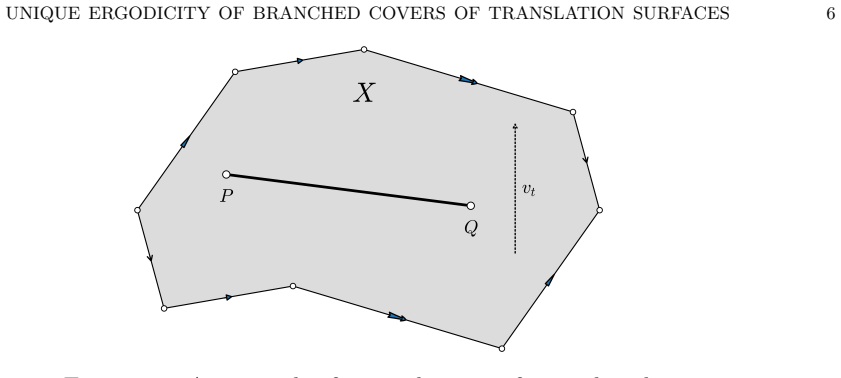
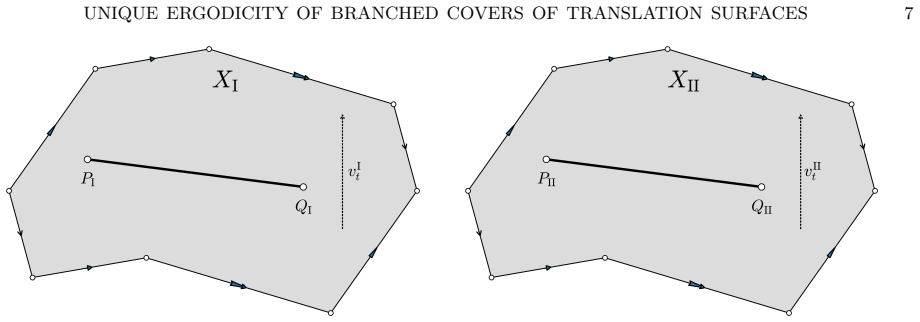
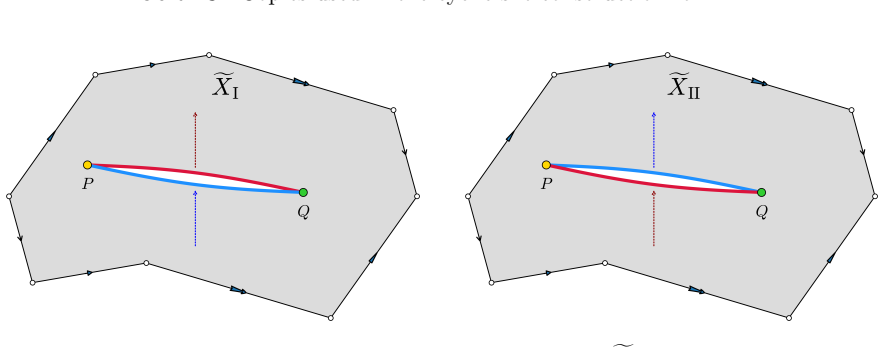
Let X be a finite-area translation surface with uniquely ergodic vertical flow. For a slit joining nonsingular points, the branched N-cover is formed by gluing N copies crosswise. The vertical flow on this cover is uniquely ergodic whenever, along a subsequence of Teichmüller times, one endpoint sits in an embedded disk of radius bounded below by a positive constant that excludes the other endpoint. When X obeys a uniform positive lower bound on such radii along a subsequence, the criterion applies to almost every choice of slit endpoint. Cylinder decompositions of g_t X that contain pipe cylinders ensure the required radius bound.
What carries the argument
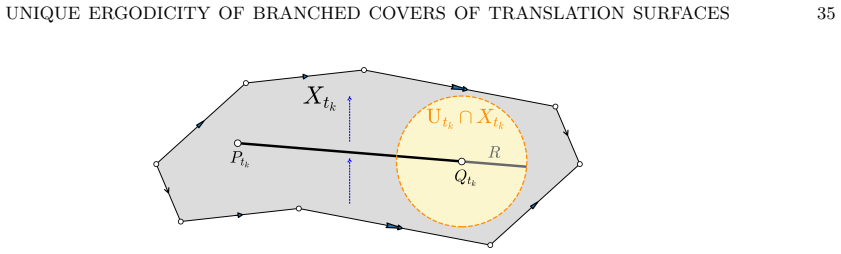
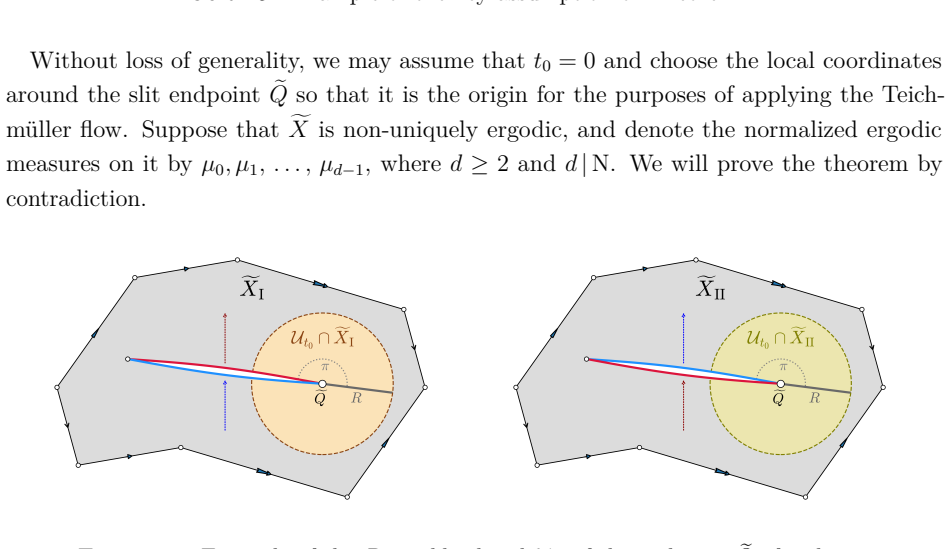
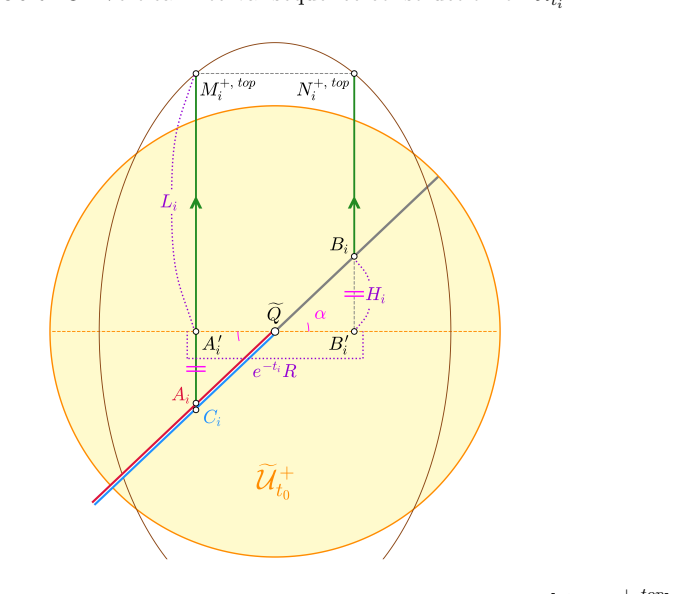
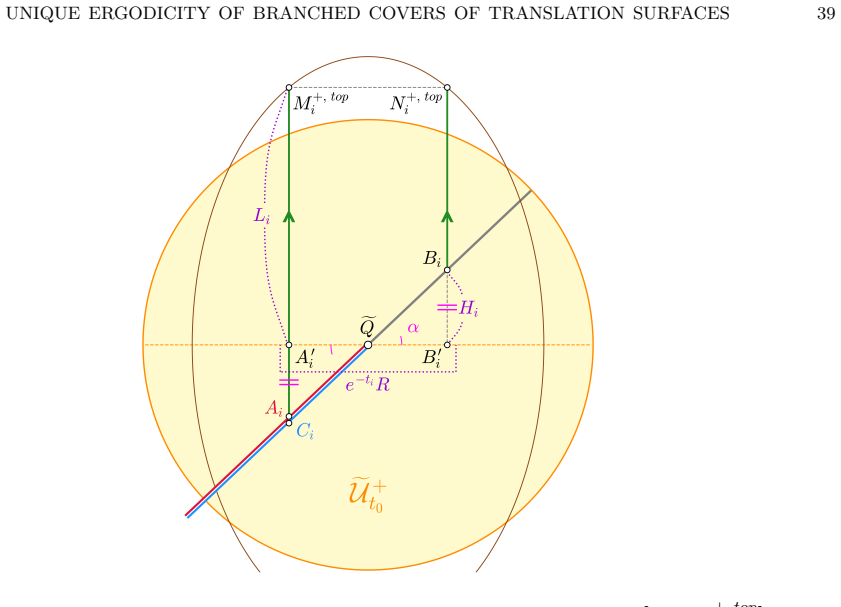
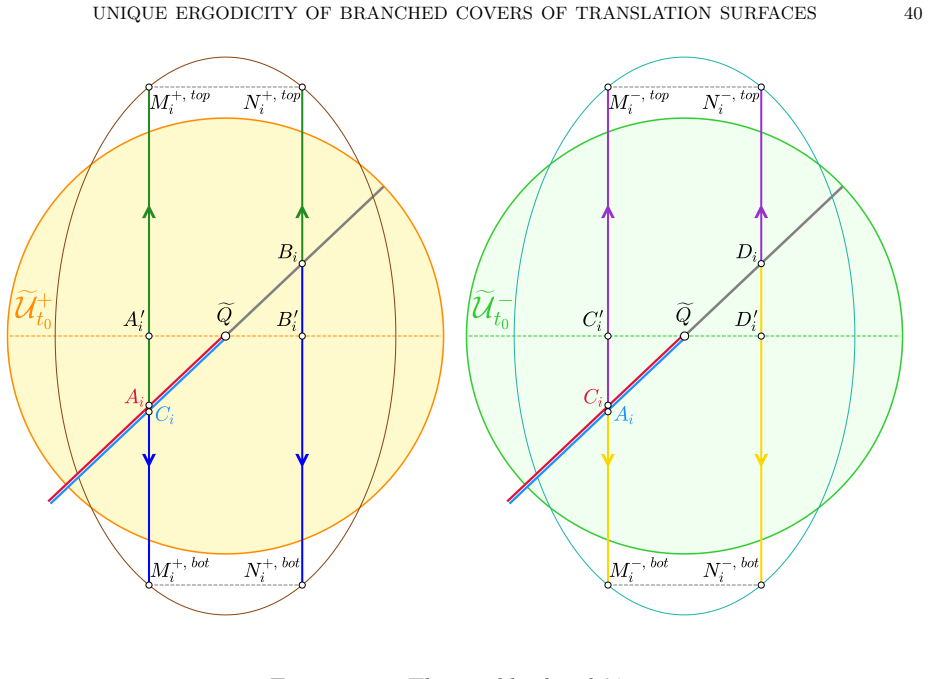
The geometric criterion that requires one slit endpoint to remain inside embedded disks of uniformly positive radius excluding the other endpoint along a Teichmüller subsequence.
If this is right
- Almost every branched N-cover of any uniquely ergodic base is itself uniquely ergodic.
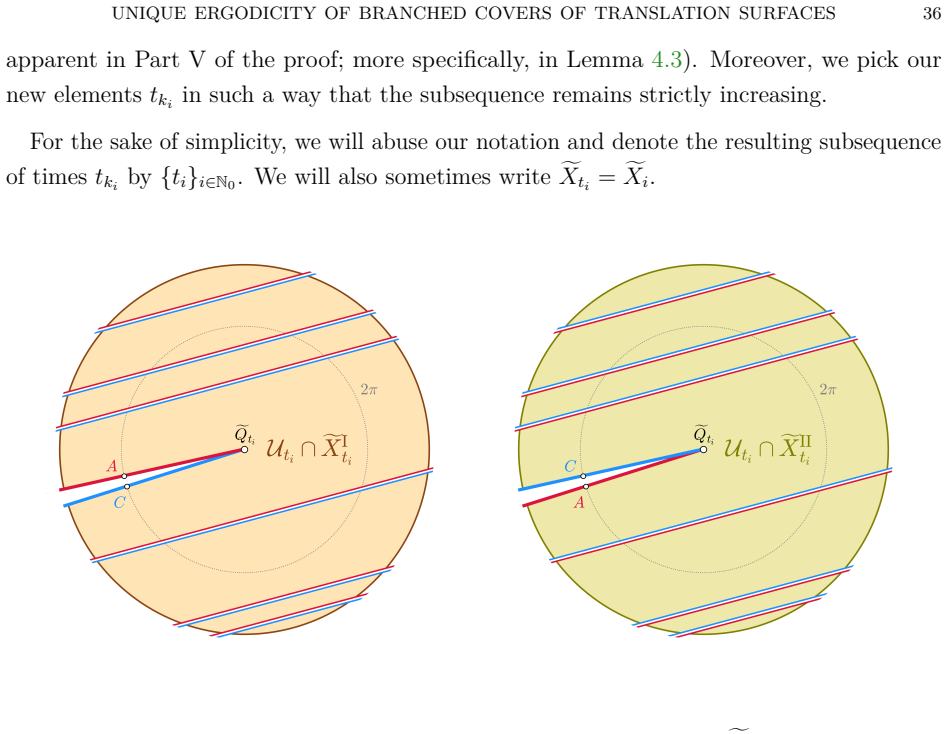
- The geometric criterion transfers unique ergodicity from base to cover using the cover's cyclic symmetry and analysis of generic points.
- Existence of pipe cylinders in the cylinder decomposition of g_t X produces the uniform embedded-radius lower bound.
- The criterion applies whenever the base satisfies the uniform-radius hypothesis on its Teichmüller orbit.
Where Pith is reading between the lines
- The same radius-separation idea might be tested on non-cyclic covers or on other flows such as the horizontal flow.
- If many known uniquely ergodic surfaces satisfy the pipe-cylinder condition, then the set of uniquely ergodic branched covers would be dense in a natural parameter space.
- The result suggests examining whether unique ergodicity is preserved or destroyed under finite branched covers for surfaces that are not uniquely ergodic.
Load-bearing premise
The base surface admits a subsequence of its Teichmüller orbit along which the embedded radius around one slit endpoint stays uniformly bounded away from zero and away from the other endpoint.
What would settle it
A concrete counterexample would be a uniquely ergodic surface X together with a positive Lebesgue measure set of slit endpoints for which the embedded radius around the chosen endpoint tends to zero along every Teichmüller subsequence, yet the branched cover still fails to be uniquely ergodic.
Figures
read the original abstract
Let $X$ be a finite-area translation surface whose vertical flow is uniquely ergodic. Given a slit joining two nonsingular points of $X$, one can form a branched cyclic cover by gluing $\mathrm{N}$ copies of $X$ crosswise along the slit. We study when the vertical flow on the resulting cover is uniquely ergodic. We first prove a geometric criterion for unique ergodicity of the branched cover. We show that if, for a sequence of times along the Teichm\"uller geodesic, one endpoint of the slit is contained in embedded Euclidean disks of uniformly positive radius that avoid the other endpoint, then the branched cover is uniquely ergodic. The proof uses the special symmetry of the cover together with an analysis of forward and backward generic points for the vertical flow. We then show that this criterion applies for Lebesgue-almost every choice of slit endpoint under a natural geometric hypothesis on the Teichm\"uller orbit of $X$, namely a uniform lower bound for the embedded radius along a subsequence. Finally, we give sufficient conditions for such a lower bound in terms of the cylinder geometry of $g_tX$, introducing the notion of pipe cylinders and proving that embedded disks of definite size must exist. As a consequence, for the class of uniquely ergodic translation surfaces, almost every slit produces a uniquely ergodic branched $\mathrm{N}$-cover.
Editorial analysis
A structured set of objections, weighed in public.
Referee Report
Summary. The paper proves a geometric criterion for unique ergodicity of branched cyclic N-covers of a translation surface X (with uniquely ergodic vertical flow) using symmetry of the cover and analysis of forward/backward generic points for the vertical flow. The criterion holds for Lebesgue-almost every slit endpoint provided there is a subsequence along the Teichmüller geodesic where one endpoint lies in embedded disks of uniform positive radius avoiding the other endpoint. Sufficient conditions for this embedded-radius bound are derived from the existence of 'pipe cylinders' in the cylinder decomposition of g_t X. The paper concludes that the result therefore holds for the entire class of uniquely ergodic translation surfaces.
Significance. If the central claims hold, the work supplies a new geometric criterion and the notion of pipe cylinders that link cylinder geometry directly to ergodicity of covers, advancing the study of unique ergodicity in Teichmüller dynamics. The direct geometric argument (relying on symmetry and generic points rather than parameter fitting) is a strength. The result, if complete, would enlarge the known examples of uniquely ergodic surfaces obtained via branched covers.
major comments (2)
- [Abstract] Abstract (final sentence) and the section deriving the consequence: the claim that the a.e.-slit conclusion holds for every uniquely ergodic X is load-bearing for the main result, yet the argument only establishes the required embedded-radius subsequence bound under the sufficient condition of pipe cylinders in the cylinder decomposition of g_t X. No proof is given that every UE surface necessarily admits pipe cylinders (or an equivalent positive lower bound on embedded radius along some subsequence), so the universal statement does not follow from the preceding sufficient conditions.
- [Geometric criterion section] Section introducing the geometric criterion: the criterion invokes embedded disks of radius ≥ r > 0 that avoid the other endpoint; the handling of how this interacts with the branched-cover singularities and the vertical flow on the cover needs explicit verification that the generic-point argument remains valid when the slit endpoints approach singularities along the orbit.
minor comments (2)
- Notation for the Teichmüller geodesic flow (g_t) and the embedded radius should be defined once and used consistently; a short table of symbols would improve readability.
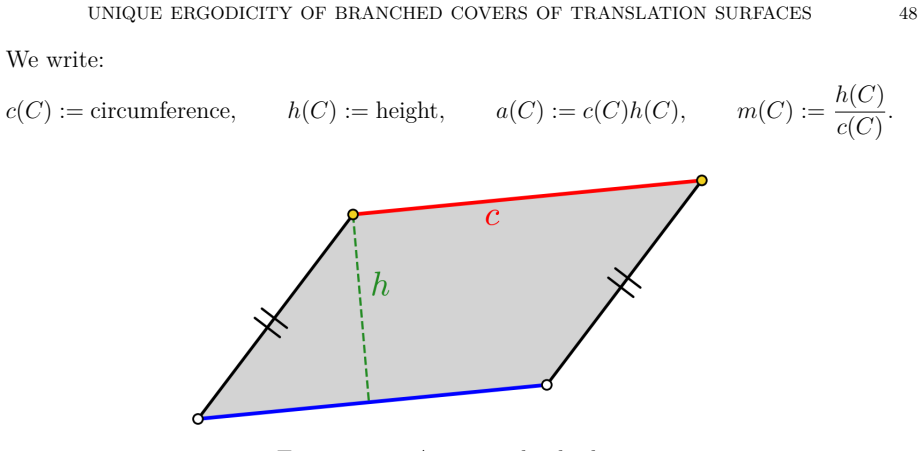
- The definition of pipe cylinders could include a diagram or explicit coordinate description to clarify the 'pipe' geometry relative to standard cylinder decompositions.
Simulated Author's Rebuttal
We thank the referee for the careful reading and constructive major comments. We respond point by point below.
read point-by-point responses
-
Referee: [Abstract] Abstract (final sentence) and the section deriving the consequence: the claim that the a.e.-slit conclusion holds for every uniquely ergodic X is load-bearing for the main result, yet the argument only establishes the required embedded-radius subsequence bound under the sufficient condition of pipe cylinders in the cylinder decomposition of g_t X. No proof is given that every UE surface necessarily admits pipe cylinders (or an equivalent positive lower bound on embedded radius along some subsequence), so the universal statement does not follow from the preceding sufficient conditions.
Authors: The referee correctly notes that the embedded-radius bound is established only under the sufficient condition of pipe cylinders, while the abstract and concluding section state the result for the entire class of uniquely ergodic surfaces. The manuscript does not contain a proof that every UE surface admits pipe cylinders (or an equivalent bound). We will revise the abstract, introduction, and final section to restrict the consequence to surfaces satisfying the pipe-cylinder hypothesis (or equivalent geometric condition), and we will add a remark clarifying the scope of the result. revision: yes
-
Referee: [Geometric criterion section] Section introducing the geometric criterion: the criterion invokes embedded disks of radius ≥ r > 0 that avoid the other endpoint; the handling of how this interacts with the branched-cover singularities and the vertical flow on the cover needs explicit verification that the generic-point argument remains valid when the slit endpoints approach singularities along the orbit.
Authors: We agree that the interaction with singularities requires explicit verification. In the revised manuscript we will add a short subsection (or paragraph) in the geometric criterion section that confirms the forward/backward generic-point sets retain full measure when endpoints approach singularities. The argument will use that singularities form a finite set of measure zero, that the vertical flow on the cover is still well-defined away from the finite branch points, and that the symmetry of the cyclic cover preserves the ergodicity properties used in the generic-point analysis. revision: yes
Circularity Check
No circularity; direct geometric argument with independent steps
full rationale
The derivation proceeds by proving a geometric criterion (embedded-radius subsequence condition implies UE of the cover), showing the criterion holds a.e. under an external hypothesis on the base orbit, then supplying sufficient cylinder conditions (pipe cylinders) for that hypothesis. The final consequence for all UE surfaces is asserted after these steps. None of the enumerated circularity patterns apply: no self-definitional equations, no parameters fitted to data then relabeled as predictions, no load-bearing self-citations, no imported uniqueness theorems, and no ansatz smuggled via citation. The argument is self-contained against external benchmarks in Teichmüller dynamics and cylinder decompositions.
Axiom & Free-Parameter Ledger
axioms (1)
- standard math Standard properties of translation surfaces, Teichmuller geodesic flow, and unique ergodicity for vertical flows
Reference graph
Works this paper leans on
-
[1]
Aggarwal, Amol , title =. Geom. Funct. Anal. , volume =. 2019 , doi =
2019
-
[2]
Aggarwal, Amol , title =. J. Amer. Math. Soc. , volume =. 2020 , doi =
2020
-
[3]
Duke Math
Apisa, Paul , title =. Duke Math. J. , volume =. 2018 , doi =
2018
-
[4]
2024 , publisher =
Apisa, Paul and Wright, Alex , title =. 2024 , publisher =
2024
-
[5]
and Chaika, Jon , title =
Athreya, Jayadev S. and Chaika, Jon , title =. Geometry & Topology , volume =. 2015 , doi =
2015
-
[6]
and Forni, Giovanni , title =
Athreya, Jayadev S. and Forni, Giovanni , title =. Duke Mathematical Journal , volume =. 2008 , doi =
2008
-
[7]
and Masur, Howard , title =
Athreya, Jayadev S. and Masur, Howard , title =. 2024 , isbn =
2024
-
[8]
Symplectic and isometric
Avila, Artur and Eskin, Alex and M. Symplectic and isometric. J. Reine Angew. Math. , volume =. 2017 , doi =
2017
-
[9]
Acta Mathematica , volume =
Avila, Artur and Viana, Marcelo , title =. Acta Mathematica , volume =. 2007 , publisher =
2007
-
[10]
Baldi, Gregorio and Urbanik, David , title =. 2024 , doi =. 2406.16628 , archiveprefix =
-
[11]
2025 , note =
Baron, Polina , title =. 2025 , note =
2025
-
[12]
Compactification of strata of
Bainbridge, Matt and Chen, Dawei and Gendron, Quentin and Grushevsky, Samuel and M. Compactification of strata of. Duke Math. J. , volume =. 2018 , doi =
2018
-
[13]
2025 , note =
Baron, Polina and Chaika, Jon and Shuvaeva, Elizaveta , title =. 2025 , note =
2025
-
[14]
Random Walks on Reductive Groups , series =
Benoist, Yves and Quint, Jean-Fran. Random Walks on Reductive Groups , series =. 2016 , publisher =. doi:10.1007/978-3-319-47721-3 , mrnumber =
-
[15]
, title =
Boshernitzan, Michael D. , title =. Ergodic Theory Dynam. Systems , volume =. 1992 , doi =
1992
-
[16]
Brown, Aaron and Eskin, Alex and Filip, Simion and Rodriguez Hertz, Federico , title =. 2025 , month =. doi:10.48550/arXiv.2502.14042 , eprint =
-
[17]
, title =
Bufetov, Alexander I. , title =. Annals of Mathematics , volume =. 2014 , doi =
2014
-
[18]
Journal of Modern Dynamics , volume =
Chaika, Jon and Masur, Howard , title =. Journal of Modern Dynamics , volume =. 2015 , doi =
2015
-
[19]
Inventiones mathematicae , volume =
Chaika, Jon and Masur, Howard , title =. Inventiones mathematicae , volume =. 2020 , doi =
2020
-
[20]
Forum of Mathematics, Pi , volume =
Chaika, Jon and Weiss, Barak , title =. Forum of Mathematics, Pi , volume =. 2024 , doi =
2024
-
[21]
Chen, Dawei and M. Masur--. Duke Math. J. , volume =. 2023 , doi =
2023
-
[22]
Chen, Dawei and M. Masur--. Invent. Math. , volume =. 2020 , doi =
2020
-
[23]
Annals of Mathematics , volume =
Cheung, Yitwah , title =. Annals of Mathematics , volume =. 2003 , doi =
2003
-
[24]
Unique Ergodicity of Translation Flows , booktitle =
Cheung, Yitwah and Eskin, Alex , editor =. Unique Ergodicity of Translation Flows , booktitle =. 2007 , publisher =
2007
-
[25]
2007 , eprint =
Cheung, Yitwah and Eskin, Alex , title =. 2007 , eprint =
2007
-
[26]
Ergodic Theory and Dynamical Systems , volume =
Cheung, Yitwah and Hubert, Pascal and Masur, Howard , title =. Ergodic Theory and Dynamical Systems , volume =. 2008 , doi =
2008
-
[27]
Cheung, Yitwah and Hubert, Pascal and Masur, Howard , title =. Invent. Math. , volume =. 2011 , doi =
2011
-
[28]
Israel Journal of Mathematics , volume =
Cheung, Yitwah and Masur, Howard , title =. Israel Journal of Mathematics , volume =. 2006 , issn =. doi:10.1007/BF02771972 , mrnumber =
-
[29]
Ergodic Theory and Dynamical Systems , volume =
Cheung, Yitwah and Masur, Howard , title =. Ergodic Theory and Dynamical Systems , volume =. 2006 , doi =
2006
-
[30]
Bulletin of the London Mathematical Society , volume =
Dozier, Benjamin , title =. Bulletin of the London Mathematical Society , volume =. doi:10.1112/blms.70153 , year =
-
[31]
Eskin, Alex and Mirzakhani, Maryam , title =. Publ. Math. Inst. Hautes \'Etudes Sci. , volume =. 2018 , issn =
2018
-
[32]
Eskin, Alex and Mirzakhani, Maryam and Mohammadi, Amir , title =. Ann. of Math. (2) , volume =. 2015 , doi =
2015
-
[33]
The algebraic hull of the Kontsevich-Zorich cocycle
Eskin, Alex and Filip, Simion and Wright, Alex , title =. Annals of Mathematics , volume =. 2018 , doi =. 1702.02074 , archiveprefix =
work page internal anchor Pith review Pith/arXiv arXiv 2018
-
[34]
Publications Math
Eskin, Alex and Kontsevich, Maxim and Zorich, Anton , title =. Publications Math. 2014 , doi =
2014
-
[35]
Filip, Simion , title =. Invent. Math. , volume =. 2016 , doi =
2016
-
[36]
Ergodic Theory and Dynamical Systems , volume =
Filip, Simion , title =. Ergodic Theory and Dynamical Systems , volume =. 2019 , doi =
2019
-
[37]
EMS Surveys in Mathematical Sciences , volume =
Filip, Simion , title =. EMS Surveys in Mathematical Sciences , volume =
-
[38]
Annals of Mathematics , volume =
Filip, Simion , title =. Annals of Mathematics , volume =. 2016 , doi =
2016
-
[39]
Journal of Modern Dynamics , volume =
Forni, Giovanni and Matheus, Carlos , title =. Journal of Modern Dynamics , volume =. 2014 , doi =
2014
-
[40]
Forni, Giovanni , title =. Ann. of Math. (2) , volume =. 2002 , doi =
2002
-
[41]
Journal of the European Mathematical Society , volume =
Forni, Giovanni , title =. Journal of the European Mathematical Society , volume =. 2022 , doi =
2022
-
[42]
Ergodic Theory and Dynamical Systems , volume =
Forni, Giovanni and Matheus, Carlos and Zorich, Anton , title =. Ergodic Theory and Dynamical Systems , volume =. 2014 , doi =
2014
-
[43]
On Ergodicity of Foliations on
Fr. On Ergodicity of Foliations on. Commun. Math. Phys. , volume =. 2018 , doi =
2018
-
[44]
Chapter 12 Random walks on groups and random transformations , series =
Furman, Alex , editor =. Chapter 12 Random walks on groups and random transformations , series =. 2002 , publisher =
2002
-
[45]
Hubert, Pascal and Leli\`evre, Samuel and Troubetzkoy, Serge , title =. J. Reine Angew. Math. , volume =. 2011 , doi =
2011
-
[46]
, title =
Hubert, Pascal and Schmidt, Thomas A. , title =. Bulletin de la Soci. 2012 , doi =
2012
-
[47]
, title =
Kaimanovich, Vadim A. , title =. Journal of Soviet Mathematics , volume =
-
[48]
2021 , publisher =
Kallenberg, Olav , title =. 2021 , publisher =
2021
-
[49]
, title =
Katok, Anatole B. , title =. Soviet Math. Dokl. , volume =. 1973 , mrnumber =
1973
-
[50]
Mathematische Zeitschrift , volume =
Keane, Michael , title =. Mathematische Zeitschrift , volume =. 1975 , doi =
1975
-
[51]
Israel Journal of Mathematics , volume =
Keane, Michael , title =. Israel Journal of Mathematics , volume =. 1977 , doi =
1977
-
[52]
Kerckhoff, Steven and Masur, Howard and Smillie, John , title =. Ann. of Math. (2) , volume =. 1986 , doi =
1986
-
[53]
and Newton, Dan , title =
Keynes, Harvey B. and Newton, Dan , title =. Mathematische Zeitschrift , volume =. 1976 , doi =
1976
-
[54]
Inventiones mathematicae , volume =
Kontsevich, Maxim and Zorich, Anton , title =. Inventiones mathematicae , volume =
-
[55]
Positivity of the exponent for stationary sequences of matrices , booktitle =
Ledrappier, Fran. Positivity of the exponent for stationary sequences of matrices , booktitle =. 1986 , publisher =
1986
-
[56]
Diophantine approximations for translation surfaces and planar resonant sets , journal =
Marchese, Luca and Trevi. Diophantine approximations for translation surfaces and planar resonant sets , journal =. 2018 , doi =
2018
-
[57]
Surveys in Geometry I , pages =
Massart, Daniel , title =. Surveys in Geometry I , pages =
-
[58]
Chapter 13 Rational billiards and flat structures , series =
Masur, Howard and Tabachnikov, Serge , editor =. Chapter 13 Rational billiards and flat structures , series =. 2002 , publisher =
2002
-
[59]
Masur, Howard , title =. Ann. of Math. (2) , volume =. 1982 , doi =
1982
-
[60]
Ergodic Theory Dynam
Masur, Howard , title =. Ergodic Theory Dynam. Systems , volume =. 1990 , doi =
1990
-
[61]
Duke Math
Masur, Howard , title =. Duke Math. J. , volume =. 1992 , doi =
1992
-
[62]
Masur, Howard and Smillie, John , title =. Ann. of Math. (2) , volume =. 1991 , doi =
1991
-
[63]
Matheus, Carlos , title =
-
[64]
Matheus Silva Santos, Carlos , title =
-
[65]
, title =
McMullen, Curtis T. , title =. Journal of the American Mathematical Society , volume =. 2003 , doi =
2003
-
[66]
, title =
McMullen, Curtis T. , title =. Ann. of Math. (2) , volume =. 2007 , doi =
2007
-
[67]
Mirzakhani, Maryam and Wright, Alex , title =. Invent. Math. , volume =. 2017 , doi =
2017
-
[68]
2017 , publisher =
Carlson, James and Müller-Stach, Stefan and Peters, Chris , title =. 2017 , publisher =
2017
-
[69]
1977 , publisher =
Raghunathan, Madabusi Santanam , title =. 1977 , publisher =
1977
-
[70]
Sataev, E. A. , title =. Mathematics of the USSR-Izvestija , volume =. 1975 , doi =
1975
-
[71]
Smith, M. E. , title =. 2017 , eprint =
2017
-
[72]
2012 , school =
Trevi\ no, Rodrigo , title =. 2012 , school =
2012
-
[73]
On the ergodicity of flat surfaces of finite area , journal =
Trevi. On the ergodicity of flat surfaces of finite area , journal =. 2014 , doi =
2014
-
[74]
, title =
Veech, William A. , title =. Inventiones mathematicae , volume =. 1989 , doi =
1989
-
[75]
, title =
Veech, William A. , title =. Transactions of the American Mathematical Society , volume =. 1969 , doi =
1969
-
[76]
, title =
Veech, William A. , title =. Ann. of Math. (2) , volume =. 1982 , doi =
1982
-
[77]
, title =
Veech, William A. , title =. Ergodic Theory Dynam. Systems , volume =. 1987 , doi =
1987
-
[78]
2014 , eprint=
Translation surfaces and their orbit closures: An introduction for a broad audience , author=. 2014 , eprint=
2014
-
[79]
Wright, Alex , title =. Geom. Topol. , volume =. 2014 , issn =. doi:10.2140/gt.2014.18.1323 , mrnumber =
-
[80]
Wright, Alex , title =. Geom. Topol. , volume =. 2015 , doi =
2015
discussion (0)
Sign in with ORCID, Apple, or X to comment. Anyone can read and Pith papers without signing in.