Quantitative Einstein relation for reversible diffusions in a random environment
Pith reviewed 2026-06-29 20:20 UTC · model grok-4.3
The pith
Reversible diffusions in random environments obey the Einstein relation at an explicit algebraic rate.
A machine-rendered reading of the paper's core claim, the machinery that carries it, and where it could break.
Core claim
The Einstein relation describes the response of a diffusing particle to a small constant external force. It states that, as the force tends to zero, the ratio of the limiting velocity to the force magnitude converges to the diffusivity matrix of the unforced particle, evaluated in the force direction. Gantert, Mathieu, and Piatnitski (2012) proved this identity for reversible diffusions in random environments. We prove a quantitative version, with an explicit quenched algebraic rate.
What carries the argument
The 2012 Gantert-Mathieu-Piatnitski identity, which equates the Einstein ratio to the diffusivity and is here given an explicit algebraic error bound in the quenched sense.
If this is right
- The velocity response to a small force is approximated by diffusivity times force with an explicit power-law error.
- The approximation holds almost surely for each environment rather than only in expectation.
- The result applies directly to the reversible setting required by the underlying 2012 identity.
- Algebraic decay supplies a concrete rate at which the limiting law becomes accurate for small forces.
Where Pith is reading between the lines
- The explicit rate could be used to choose a practical nonzero force value in numerical studies of transport without incurring uncontrolled approximation error.
- Similar quantification might be attempted in non-reversible settings once an analogue of the 2012 identity is available.
- The quenched algebraic control may help analyse effective diffusivities in physical models of heterogeneous materials where the environment is fixed but unknown.
Load-bearing premise
The diffusions must be reversible so that the 2012 identity applies and can be quantified.
What would settle it
A simulation in a concrete reversible random environment where the observed error in the Einstein ratio decays slower than any positive power of the force magnitude would falsify the algebraic rate claim.
Figures
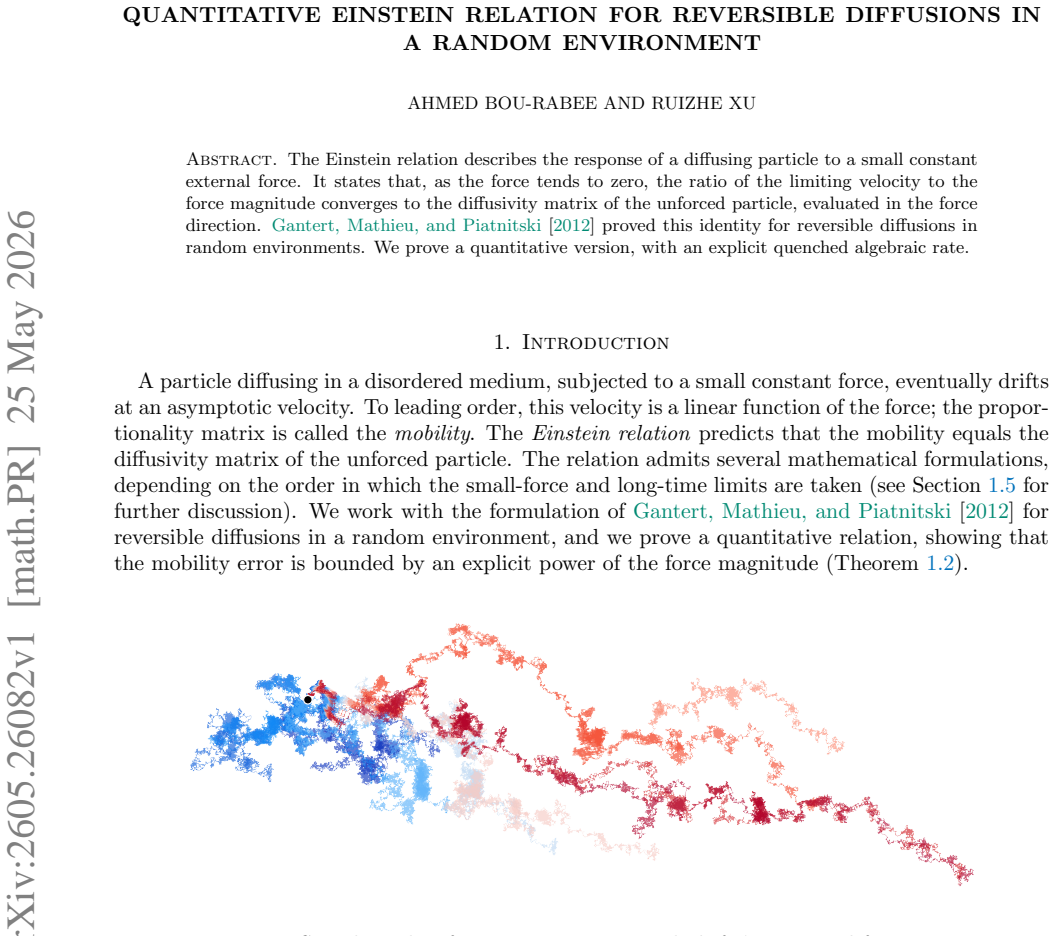
read the original abstract
The Einstein relation describes the response of a diffusing particle to a small constant external force. It states that, as the force tends to zero, the ratio of the limiting velocity to the force magnitude converges to the diffusivity matrix of the unforced particle, evaluated in the force direction. Gantert, Mathieu, and Piatnitski (2012) proved this identity for reversible diffusions in random environments. We prove a quantitative version, with an explicit quenched algebraic rate.
Editorial analysis
A structured set of objections, weighed in public.
Referee Report
Summary. The manuscript proves a quantitative version of the Einstein relation for reversible diffusions in a random environment. It extends the 2012 identity of Gantert, Mathieu, and Piatnitski by establishing that the ratio of limiting velocity to applied force converges to the diffusivity matrix (in the force direction) with an explicit quenched algebraic rate as the force tends to zero.
Significance. If the result holds, the explicit quenched algebraic rate constitutes a meaningful quantitative strengthening of an established identity in stochastic homogenization and random media. The work directly invokes the reversible setting to apply the 2012 result without introducing new free parameters or ad-hoc quantities, and the provision of an explicit rate is a clear technical advance that could support error estimates in applications.
minor comments (2)
- [Abstract] Abstract: the specific algebraic rate (e.g., the exponent or the dependence on the environment) is not stated, which would allow readers to gauge the strength of the quantitative improvement immediately.
- [Introduction] The manuscript would benefit from a short remark in the introduction clarifying how the quenched rate is obtained from the 2012 identity (e.g., which estimates are upgraded to quantitative form).
Simulated Author's Rebuttal
We thank the referee for their positive evaluation of the manuscript and for recommending acceptance. The report accurately captures the contribution as a quantitative strengthening of the Gantert–Mathieu–Piatnitski identity with an explicit quenched algebraic rate.
Circularity Check
No significant circularity; extends external 2012 result
full rationale
The paper's central claim is a quantitative extension (explicit quenched algebraic rate) of the Einstein relation identity proved by Gantert, Mathieu, and Piatnitski (2012) for reversible diffusions in random environments. The abstract and description align the setting exactly with the conditions needed to invoke that external result. No self-citations, fitted inputs renamed as predictions, self-definitional steps, or ansatzes smuggled via prior author work are present in the provided text. The derivation chain rests on the independent 2012 identity rather than reducing to inputs defined inside this paper. This is the most common honest non-finding.
Axiom & Free-Parameter Ledger
axioms (1)
- domain assumption Reversible diffusions in random environments satisfy the qualitative Einstein relation of Gantert, Mathieu, and Piatnitski (2012)
Reference graph
Works this paper leans on
-
[1]
Elliptic regularity and quantitative homogenization on percolation clusters
Scott Armstrong and Paul Dario. Elliptic regularity and quantitative homogenization on percolation clusters. Commun. Pure Appl. Math., 71 0 (9): 0 1717--1849, 2018. ISSN 0010-3640; 1097-0312/e. doi:10.1002/cpa.21726
-
[2]
Quantitative hydrodynamic limits of the L angevin dynamics for gradient interface models
Scott Armstrong and Paul Dario. Quantitative hydrodynamic limits of the L angevin dynamics for gradient interface models. Electron. J. Probab., 29: 0 1--93, 2024. doi:10.1214/23-EJP1072
-
[3]
Elliptic homogenization from qualitative to quantitative, 2022
Scott Armstrong and Tuomo Kuusi. Elliptic homogenization from qualitative to quantitative, 2022. URL https://arxiv.org/abs/2210.06488
-
[4]
Renormalization group and elliptic homogenization in high contrast
Scott Armstrong and Tuomo Kuusi. Renormalization group and elliptic homogenization in high contrast. Invent. Math., 242 0 (3): 0 895--1086, 2025 a . doi:10.1007/s00222-025-01370-9
-
[5]
A coarse-graining theory for elliptic operators and homogenization in high contrast, 2025 b
Scott Armstrong and Tuomo Kuusi. A coarse-graining theory for elliptic operators and homogenization in high contrast, 2025 b . URL https://arxiv.org/abs/2509.24887
-
[6]
Scott Armstrong and Charles K. Smart. Quantitative stochastic homogenization of convex integral functionals. Ann. Sci. \'Ec. Norm. Sup\'er. (4), 49 0 (2): 0 423--481, 2016. doi:10.24033/asens.2287
-
[7]
C^2 regularity of the surface tension for the interface model
Scott Armstrong and Wei Wu. C^2 regularity of the surface tension for the interface model. Comm. Pure Appl. Math., 75 0 (2): 0 349--421, 2022. doi:10.1002/cpa.22031
-
[8]
Mesoscopic higher regularity and subadditivity in elliptic homogenization
Scott Armstrong, Tuomo Kuusi, and Jean-Christophe Mourrat. Mesoscopic higher regularity and subadditivity in elliptic homogenization. Comm. Math. Phys., 347 0 (2): 0 315--361, 2016. ISSN 0010-3616. doi:10.1007/s00220-016-2663-2. URL https://doi.org/10.1007/s00220-016-2663-2
-
[9]
The additive structure of elliptic homogenization
Scott Armstrong, Tuomo Kuusi, and Jean-Christophe Mourrat. The additive structure of elliptic homogenization. Invent. Math., 208 0 (3): 0 999--1154, 2017. ISSN 0020-9910. doi:10.1007/s00222-016-0702-4. URL https://doi.org/10.1007/s00222-016-0702-4
-
[10]
Scott Armstrong, Tuomo Kuusi, and Jean-Christophe Mourrat. Quantitative Stochastic Homogenization and Large-Scale Regularity, volume 352 of Grundlehren der mathematischen Wissenschaften. Springer, Cham, 2019. doi:10.1007/978-3-030-15545-2
-
[11]
Scott Armstrong, Ahmed Bou-Rabee, and Tuomo Kuusi. Superdiffusive central limit theorem for a B rownian particle in a critically-correlated incompressible random drift, 2024. URL https://arxiv.org/abs/2404.01115
-
[12]
Superdiffusion and anomalous regularization in self-similar random incompressible flows, 2026
Scott Armstrong, Ahmed Bou-Rabee, and Tuomo Kuusi. Superdiffusion and anomalous regularization in self-similar random incompressible flows, 2026. URL https://arxiv.org/abs/2601.22142
-
[13]
Donald G. Aronson. Bounds for the fundamental solution of a parabolic equation. Bull. Amer. Math. Soc., 73 0 (6): 0 890--896, 1967. doi:10.1090/S0002-9904-1967-11830-5
-
[14]
E instein relation for biased random walk on G alton-- W atson trees
G\'erard Ben Arous, Yueyun Hu, Stefano Olla, and Ofer Zeitouni. E instein relation for biased random walk on G alton-- W atson trees. Ann. Inst. Henri Poincar\'e Probab. Stat., 49 0 (3): 0 698--721, 2013. doi:10.1214/12-AIHP486
-
[15]
Quantitative homogenization for the critical long-range random conductance model
Ahmed Bou-Rabee and Paul Dario. Quantitative homogenization for the critical long-range random conductance model, 2026. URL https://arxiv.org/abs/2604.21143
work page internal anchor Pith review Pith/arXiv arXiv 2026
-
[16]
Rigidity of harmonic functions on the supercritical percolation cluster
Ahmed Bou-Rabee, William Cooperman, and Paul Dario. Rigidity of harmonic functions on the supercritical percolation cluster. Trans. Amer. Math. Soc., 378 0 (6): 0 3823--3896, 2025. doi:10.1090/tran/9264. URL https://doi.org/10.1090/tran/9264
-
[17]
Herbert B. Callen and Theodore A. Welton. Irreversibility and generalized noise. Phys. Rev., 83 0 (1): 0 34--40, 1951. doi:10.1103/PhysRev.83.34
-
[18]
David Campos and Alejandro F. Ram\' rez. Asymptotic expansion of the invariant measure for ballistic random walk in the low disorder regime. Ann. Probab., 45 0 (6B): 0 4675--4699, 2017. doi:10.1214/17-AOP1175
-
[19]
Optimal corrector estimates on percolation cluster
Paul Dario. Optimal corrector estimates on percolation cluster. Ann. Appl. Probab., 31 0 (1): 0 377--431, 2021. ISSN 1050-5164. doi:10.1214/20-aap1593. URL https://doi.org/10.1214/20-aap1593
-
[20]
Quantitative homogenization of the parabolic and elliptic G reen's functions on percolation clusters
Paul Dario and Chenlin Gu. Quantitative homogenization of the parabolic and elliptic G reen's functions on percolation clusters. Ann. Probab., 49 0 (2): 0 556--636, 2021. ISSN 0091-1798. doi:10.1214/20-aop1456. URL https://doi.org/10.1214/20-aop1456
-
[21]
Massless phases for the V illain model in d 3
Paul Dario and Wei Wu. Massless phases for the V illain model in d 3 . Ast\'erisque, 447, 2024. doi:10.24033/ast.1220
-
[22]
Diffusive decay of the environment viewed by the particle
Paul de Buyer and Jean-Christophe Mourrat. Diffusive decay of the environment viewed by the particle. Electron. Commun. Probab., 20 0 (23): 0 1--12, 2015. doi:10.1214/ECP.v20-3998
-
[23]
Ferrari, Sheldon Goldstein, and W
Anna De Masi, Pablo A. Ferrari, Sheldon Goldstein, and W. David Wick. An invariance principle for reversible M arkov processes. A pplications to random motions in random environments. J. Statist. Phys., 55 0 (3-4): 0 787--855, 1989. doi:10.1007/BF01041608
-
[24]
Markovian perturbation, response and fluctuation dissipation theorem
Amir Dembo and Jean-Dominique Deuschel. Markovian perturbation, response and fluctuation dissipation theorem. Ann. Inst. Henri Poincar\'e Probab. Stat., 46 0 (3): 0 822--852, 2010. doi:10.1214/10-AIHP370
-
[25]
Regularity of biased 1 D random walks in random environment
Alessandra Faggionato and Michele Salvi. Regularity of biased 1 D random walks in random environment. ALEA Lat. Am. J. Probab. Math. Stat., 16 0 (2): 0 1213--1248, 2019. doi:10.30757/ALEA.v16-46
-
[26]
Scaling limit of the complex mobility matrix for the random conductance model on T ^d_n , 2025
Alessandra Faggionato and Michele Salvi. Scaling limit of the complex mobility matrix for the random conductance model on T ^d_n , 2025. URL https://arxiv.org/abs/2512.15506
-
[27]
E instein relation and linear response in one-dimensional M ott variable-range hopping
Alessandra Faggionato, Nina Gantert, and Michele Salvi. E instein relation and linear response in one-dimensional M ott variable-range hopping. Ann. Inst. Henri Poincar\'e Probab. Stat., 55 0 (3): 0 1477--1508, 2019. doi:10.1214/18-AIHP925
-
[28]
Ferrari, Sheldon Goldstein, and Joel L
Pablo A. Ferrari, Sheldon Goldstein, and Joel L. Lebowitz. Diffusion, mobility and the E instein relation. In J \'o zsef Fritz, Arthur Jaffe, and Domokos Sz \'a sz, editors, Statistical Physics and Dynamical Systems: Rigorous Results, volume 10 of Progress in Physics, pages 405--441. Birkh\"auser, Boston, 1985. doi:10.1007/978-1-4899-6653-7_22
-
[29]
Quantitative homogenization and hydrodynamic limit of nongradient exclusion process
Tadahisa Funaki, Chenlin Gu, and Han Wang. Quantitative homogenization and hydrodynamic limit of nongradient exclusion process. Comm. Pure Appl. Math., 79 0 (7): 0 1562--1672, 2026. doi:10.1002/cpa.70034
-
[30]
Giovanni P. Galdi. An Introduction to the Mathematical Theory of the Navier--Stokes Equations: Steady-State Problems. Springer Monographs in Mathematics. Springer, New York, second edition, 2011. doi:10.1007/978-0-387-09620-9
-
[31]
Einstein relation for reversible diffusions in a random environment
Nina Gantert, Pierre Mathieu, and Andrey Piatnitski. Einstein relation for reversible diffusions in a random environment. Comm. Pure Appl. Math., 65 0 (2): 0 187--228, 2012. ISSN 0010-3640,1097-0312. doi:10.1002/cpa.20389. URL https://doi.org/10.1002/cpa.20389
-
[32]
Einstein relation and steady states for the random conductance model
Nina Gantert, Xiaoqin Guo, and Jan Nagel. Einstein relation and steady states for the random conductance model. Ann. Probab., 45 0 (4): 0 2533--2567, 2017. doi:10.1214/16-AOP1119
-
[33]
Einstein relation for random walk in a one-dimensional percolation model
Nina Gantert, Matthias Meiners, and Sebastian M\"uller. Einstein relation for random walk in a one-dimensional percolation model. J. Stat. Phys., 176 0 (4): 0 737--772, 2019. doi:10.1007/s10955-019-02319-y
-
[34]
Quantitative homogenization of interacting particle systems
Arianna Giunti, Chenlin Gu, and Jean-Christophe Mourrat. Quantitative homogenization of interacting particle systems. Ann. Probab., 50 0 (5): 0 1885--1946, 2022. doi:10.1214/22-AOP1573
-
[35]
Smoothness of the diffusion coefficients for particle systems in continuous space
Arianna Giunti, Chenlin Gu, Jean-Christophe Mourrat, and Maximilian Nitzschner. Smoothness of the diffusion coefficients for particle systems in continuous space. Commun. Contemp. Math., 25 0 (3): 0 Paper No. 2250027, 60, 2023. ISSN 0219-1997,1793-6683. doi:10.1142/S0219199722500274. URL https://doi.org/10.1142/S0219199722500274
-
[36]
An optimal variance estimate in stochastic homogenization of discrete elliptic equations
Antoine Gloria and Felix Otto. An optimal variance estimate in stochastic homogenization of discrete elliptic equations. Ann. Probab., 39 0 (3): 0 779--856, 2011. doi:10.1214/10-AOP571
-
[37]
A regularity theory for random elliptic operators
Antoine Gloria, Stefan Neukamm, and Felix Otto. A regularity theory for random elliptic operators. Milan J. Math., 88 0 (1): 0 99--170, 2020. ISSN 1424-9286. doi:10.1007/s00032-020-00309-4. URL https://doi.org/10.1007/s00032-020-00309-4
-
[38]
An efficient algorithm for solving elliptic problems on percolation clusters
Chenlin Gu. An efficient algorithm for solving elliptic problems on percolation clusters. The Annals of Applied Probability, 32 0 (4): 0 2755--2810, 2022. doi:10.1214/21-AAP1748
-
[39]
Coupling between brownian motion and random walks on the infinite percolation cluster
Chenlin Gu, Zhonggen Su, and Ruizhe Xu. Coupling between brownian motion and random walks on the infinite percolation cluster. Probability Theory and Related Fields, 2025. doi:10.1007/s00440-025-01403-7. URL https://doi.org/10.1007/s00440-025-01403-7
-
[40]
E instein relation for random walks in random environment
Xiaoqin Guo. E instein relation for random walks in random environment. Ann. Probab., 44 0 (1): 0 324--359, 2016. doi:10.1214/14-AOP975
-
[41]
Elliptic partial differential equations, volume 1 of Courant Lecture Notes in Mathematics
Qing Han and Fanghua Lin. Elliptic partial differential equations, volume 1 of Courant Lecture Notes in Mathematics. American Mathematical Society, Providence, RI, second edition, 2011. ISBN 978-0-8218-5313-9. doi:10.1090/cln/001. URL https://doi.org/10.1090/cln/001
-
[42]
Claude Kipnis and S. R. S. Varadhan. Central limit theorem for additive functionals of reversible markov processes and applications to simple exclusions. Comm. Math. Phys., 104 0 (1): 0 1--19, 1986. doi:10.1007/BF01210789
-
[43]
The existence of a steady state for a perturbed symmetric random walk on a random lattice
Tomasz Komorowski and Grzegorz Krupa. The existence of a steady state for a perturbed symmetric random walk on a random lattice. Probab. Math. Statist., 24 0 (1): 0 121--144, 2004. URL https://www.math.uni.wroc.pl/ pms/publicationsArticle.php?nr=24.1&nrA=7&ppB=121&ppE=144
2004
-
[44]
On mobility and E instein relation for tracers in time-mixing random environments
Tomasz Komorowski and Stefano Olla. On mobility and E instein relation for tracers in time-mixing random environments. J. Statist. Phys., 118 0 (3-4): 0 407--435, 2005 a . doi:10.1007/s10955-004-8815-3
-
[45]
E instein relation for random walks in random environments
Tomasz Komorowski and Stefano Olla. E instein relation for random walks in random environments. Stochastic Process. Appl., 115 0 (8): 0 1279--1301, 2005 b . doi:10.1016/j.spa.2005.03.009
-
[46]
Sergei M. Kozlov. The method of averaging and walks in inhomogeneous environments. Russian Math. Surveys, 40 0 (2): 0 73--145, 1985. ISSN 0036-0279. doi:10.1070/RM1985v040n02ABEH003558
-
[47]
E instein relation for reversible random walks in random environment on Z
Hoang-Chuong Lam and J\'er\^ome Depauw. E instein relation for reversible random walks in random environment on Z . Stochastic Process. Appl., 126 0 (4): 0 983--996, 2016. doi:10.1016/j.spa.2015.10.007
-
[48]
Claudio Landim, Stefano Olla, and Sergio B. Volchan. Driven tracer particle in one-dimensional symmetric simple exclusion. Comm. Math. Phys., 192 0 (2): 0 287--307, 1998. doi:10.1007/s002200050300
-
[49]
Joel L. Lebowitz and Hermann Rost. The E instein relation for the displacement of a test particle in a random environment. Stochastic Process. Appl., 54 0 (2): 0 183--196, 1994. doi:10.1016/0304-4149(94)00015-8
-
[50]
Joel L. Lebowitz and Herbert Spohn. Steady state self-diffusion at low density. J. Statist. Phys., 29 0 (1): 0 39--55, 1982. doi:10.1007/BF01008247
-
[51]
Einstein relation for a tagged particle in simple exclusion processes
Michail Loulakis. Einstein relation for a tagged particle in simple exclusion processes. Comm. Math. Phys., 229 0 (2): 0 347--367, 2002. doi:10.1007/s00220-002-0692-5
-
[52]
Michail Loulakis. Mobility and E instein relation for a tagged particle in asymmetric mean zero random walk with simple exclusion. Ann. Inst. H. Poincar\'e Probab. Statist., 41 0 (2): 0 237--254, 2005. doi:10.1016/j.anihpb.2004.07.001
-
[53]
Pierre Mathieu and Andrey Piatnitski. Steady states, fluctuation-dissipation theorems and homogenization for reversible diffusions in a random environment. Arch. Ration. Mech. Anal., 230 0 (1): 0 277--320, 2018. ISSN 0003-9527,1432-0673. doi:10.1007/s00205-018-1245-1. URL https://doi.org/10.1007/s00205-018-1245-1
-
[54]
Variance decay for functionals of the environment viewed by the particle
Jean-Christophe Mourrat. Variance decay for functionals of the environment viewed by the particle. Ann. Inst. Henri Poincar\'e Probab. Stat., 47 0 (1): 0 294--327, 2011. ISSN 0246-0203. doi:10.1214/10-AIHP375. URL http://dx.doi.org/10.1214/10-AIHP375
-
[55]
Thermal agitation of electric charge in conductors
Harry Nyquist. Thermal agitation of electric charge in conductors. Phys. Rev., 32 0 (1): 0 110--113, 1928. doi:10.1103/PhysRev.32.110
-
[56]
Reciprocal relations in irreversible processes
Lars Onsager. Reciprocal relations in irreversible processes. I . Phys. Rev., 37 0 (4): 0 405--426, 1931 a . doi:10.1103/PhysRev.37.405
-
[57]
Reciprocal relations in irreversible processes
Lars Onsager. Reciprocal relations in irreversible processes. II . Phys. Rev., 38 0 (12): 0 2265--2279, 1931 b . doi:10.1103/PhysRev.38.2265
-
[58]
Papanicolaou and S
George C. Papanicolaou and S. R. S. Varadhan. Diffusions with random coefficients. In Statistics and probability: essays in honor of C . R . R ao , pages 547--552. North-Holland, Amsterdam, 1982. URL https://mathscinet.ams.org/mathscinet-getitem?mr=659505
1982
-
[59]
On ballistic diffusions in random environment
Lian Shen. On ballistic diffusions in random environment. Ann. Inst. H. Poincar\'e Probab. Statist. , 39 0 (5): 0 839--876, 2003. ISSN 0246-0203. doi:10.1016/S0246-0203(03)00027-X. URL https://doi.org/10.1016/S0246-0203(03)00027-X
-
[60]
Addendum to `` O n ballistic diffusions in random environment''
Lian Shen. Addendum to `` O n ballistic diffusions in random environment''. Ann. Inst. H. Poincar\'e Probab. Statist., 40 0 (3): 0 385--386, 2004. doi:10.1016/S0246-0203(04)00011-1
discussion (0)
Sign in with ORCID, Apple, or X to comment. Anyone can read and Pith papers without signing in.