REVIEW 4 major objections 4 minor 61 references
Energetic spectra from semi-implicit particle-in-cell simulations of magnetic reconnection
T0 review · 4 major / 4 minor · reviewed 2026-08-04 · deepseek-v4-flash
Pith's one-line read Semi-implicit particle-in-cell simulations reproduce relativistic magnetic reconnection spectra at up to 256 times lower computational cost than explicit codes.
desk verdict RelSIM reproduces tearing growth rates and, plausibly, reconnection spectra at much lower cost, but the nonlinear spectral claims rest on coarse resolution and an unverified heating assumption—worth refereeing, not accepting on faith. read the letter →
The pith
A machine-rendered reading of the paper's core claim, the machinery that carries it, and where it could break.
The reading
What carries the argument
The load-bearing element is the semi-implicit field solver with a mass-matrix formulation, which updates the electromagnetic fields implicitly while pushing particles explicitly. In the nonrelativistic limit this solver conserves energy to machine precision, and in the relativistic case it keeps energy errors much smaller than explicit schemes, allowing time steps and cell sizes that violate the usual kinetic-resolution constraints. Because the numerical heating that destroys long explicit-PIC simulations is largely absent, the simulation can follow reconnection for many light-crossing times with a grid that only resolves the background inertial lengths, not the Larmor radii.
What would settle it
Measure the ion temperature in the reconnection exhaust after one light crossing time; if it has not risen to the background Alfvén speed, the Larmor-radius resolution assumption fails and the measured spectrum is suspect. Alternatively, run the same nonlinear case with a grid that resolves the background electron Larmor radius from the start and compare the electron power-law index and cutoff with the coarse-grid run.
Extended reading notes
Core claim
The central claim is that a semi-implicit, energy-conserving field update permits fully kinetic, relativistic particle-in-cell simulations of magnetic reconnection with substantially reduced spatial and temporal resolution, without changing the physics of the tearing instability or the accelerated-particle spectra. In the linear regime, measured growth rates agree with relativistic tearing theory once the resolution is adequately coarse but not too coarse. In the nonlinear regime, the electron and ion spectra form power laws whose index and high-energy cutoff match previous explicit simulations: the index is approximately −1.35 independent of system size at high magnetization, hardening at l
Load-bearing premise
The physical fidelity rests on the assumption that the thin, high-density current sheet is rapidly replaced by lower-density background plasma and that the heated plasma quickly reaches temperatures high enough for its Larmor radius to be resolved by the coarse grid; if that heating does not occur fast enough, the acceleration spectra could be numerical artifacts.
Editorial extensions
If this is right
- Relativistic reconnection simulations can now be run for system sizes and durations relevant to astrophysical sources such as AGN coronae, where proton acceleration to high energies is required.
- The power-law index and cutoff scalings established in explicit codes are confirmed in a code with different numerical dissipation, strengthening the case that these spectral features are physical.
- The computational saving grows in 3D because the resolution reduction applies in each dimension, so fully 3D kinetic studies of reconnection become feasible at much lower cost.
- The method could be combined with GPU acceleration to explore parameter spaces (magnetization, system size) that were previously out of reach.
Reading between the lines
- If the energy-conserving property holds for longer runs, the method may be suited to studying stochastic acceleration and turbulence effects on spectra, which need even longer integration times than pure reconnection.
- The authors' assumption that the transient current sheet is quickly replaced by lower-density plasma suggests a design rule for minimum resolution: it may be tied to the background plasma state rather than the initial sheet, which is testable in future studies.
- A direct comparison of the current results with explicit simulations that resolve the electron skin depth from the start would distinguish physical spectral slopes from under-resolution artifacts; if the spectra differ, the reduced-resolution results should be treated cautiously.
Signed reviews
Editorial analysis
A structured set of objections, weighed in public.
Referee Report
Summary. The paper validates the relativistic semi-implicit PIC method RelSIM on the tearing instability and relativistic magnetic reconnection in pair-ion plasmas, and uses it to compute non-thermal particle spectra. In the linear regime, RelSIM growth rates are benchmarked against analytic tearing theory (Zelenyi & Krasnosel'skikh with the Hoshino correction) and against explicit OSIRIS simulations, with resolution and particle-number scans and energy-conservation errors tabulated. In the nonlinear regime, RelSIM runs with reduced spatial resolution are compared to published explicit-PIC spectral results (Guo et al. 2016; Werner et al. 2015), reporting power-law slopes and cutoffs as a function of system size and magnetization, plus one 3D run. The paper claims up to a 256x computational saving over OSIRIS for the same energy-conservation accuracy. The manuscript includes a data-availability statement, input files on Zenodo, and a code-availability statement for OSIRIS and RelSIM.
Significance. If the central claim holds, the paper is significant: it would demonstrate that a semi-implicit, energy-conserving relativistic PIC scheme can reproduce kinetic reconnection acceleration physics at substantially reduced resolution, thereby extending the reach of first-principles simulations toward astrophysical scales. The validation strategy is mostly sound and creditably external: comparison to independent analytic theory and to the explicit OSIRIS code, plus documented energy conservation and open data. The linear-regime resolution study is a genuine strength. However, the nonlinear spectral conclusions rest on an unverified assumption about self-heating resolving kinetic scales, and on fits without uncertainty estimates; these need to be addressed before the main claim is fully supported.
major comments (4)
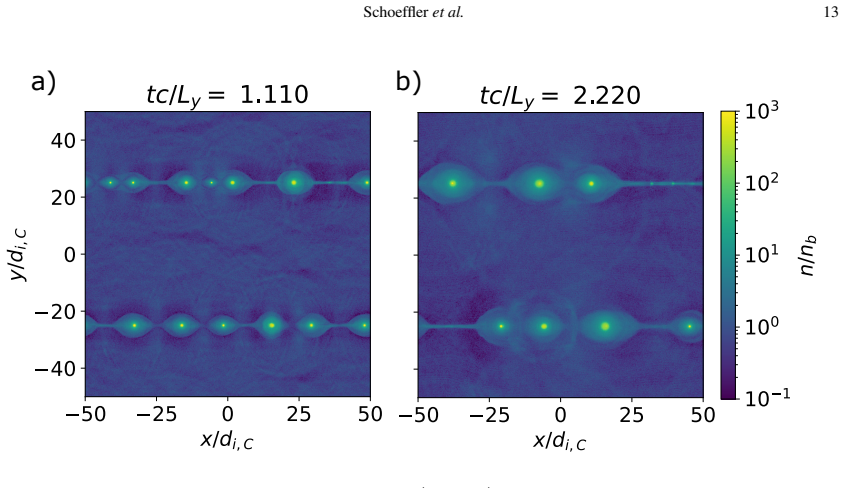
- [Sec. 3.2, Sec. 4.2, Figs. 5, 7, 9] The nonlinear runs do not resolve the initial kinetic scales: dx=1.6 d_e,C = 3.34 a and dx=166 rho_0e = 8.35 rho_Le,R, so the initial Harris half-thickness and background electron Larmor radius are unresolved. The paper's justification is that the initial current sheet is transient and that 'if we assume that the typical temperature reaches the point where the ions move at the background Alfven speed, the Larmor radius is well resolved'. No measurement of the time-dependent temperature, and no nonlinear resolution or particle-number convergence test, is provided. The linear resolution scan in Sec. 4.1 (dx/a from 0.125 to 1) does not cover the nonlinear regime, where dx/a=3.34. Since the central claim is that the power-law spectra in Figs. 5, 7, and 9 match explicit-PIC results, the possibility that these spectra are numerical artifacts needs to be excluded. I recommend adding at least on
- [Sec. 3.2 vs. Table 2] There is an internal inconsistency in the mass ratio: Sec. 3.2 states m_i/m_e=100 for the nonlinear runs, while Table 2 lists m_i/m_e=10 for all six nonlinear simulations. This is not a cosmetic issue: the comparison to Guo et al. 2016 [23] is valid only if the same mass-ratio regime is simulated, and the inertial-length ratios quoted in Sec. 3.2 (e.g., dx=0.16 d_i,C) are only consistent with m_i/m_e=100, not 10. The authors must clarify which value was actually used and correct the table or text accordingly. If the runs used m_i/m_e=10, the comparison to [23] is invalid and the spectral claims need to be re-evaluated.
- [Sec. 4.2, Figs. 5, 7, 9] The spectral power-law indices are quoted without any fitting procedure or uncertainty: e.g., alpha=-1.35 for the fiducial case, and alpha=-1.5, -1.35, -1.10 for sigma_ci=10, 100, 1000. No fit ranges, goodness-of-fit measures, or error bars are given, and the cutoff values u_max/c sigma_ce=0.4, 0.6, 0.7, 0.5, 0.1 are presented as exact numbers. Because the paper's main physical conclusion is that these slopes and cutoffs 'match' previous explicit studies, the fits must be quantified. I ask for the fit method, the chosen fitting intervals, and uncertainties (or at least a table of the fitted parameters) for each spectrum.
- [Sec. 4.2, Fig. 11, Sec. 5] The 3D claim is based on a single simulation run with one set of parameters (L_y/d_i,C=50, sigma_ci=100) and no variation of L_z, and no convergence check in the z direction. The text itself acknowledges in Sec. 5 that 'a more careful study is still needed' and that future work should check the z extent and instabilities. I agree with that caveat, but the Conclusion currently states that 'the same results are possible using fully 3D kinetic simulations' as if established. Please either soften this claim or add supporting evidence (e.g., a second 3D run at a different magnetization or system size).
minor comments (4)
- [Sec. 1] Typo: 'NCG 1068' should be 'NGC 1068'.
- [Sec. 3.2] The conversion dx=1.6 d_e,C = 0.37 d_e,R appears numerically inconsistent: with Gamma_T=20, d_e,R = sqrt(20) d_e,C, so dx = 0.36 d_e,R, not 0.37. Please check and correct.
- [Sec. 4.2] Typo: 'Lorenz factor' should be 'Lorentz factor'.
- [Figures and captions] Several figure captions have formatting artifacts, e.g., 'd)c)' in Figs. 1 and 2, and stray '1 2' in the Fig. 6 caption. Also, the axis label in Figs. 7 and 9 alternates between 'proper speed' and 'normalized momentum' for the same quantity; please make it consistent.
Circularity Check
No significant circularity: linear and nonlinear claims are anchored by independent analytic theory, explicit OSIRIS simulations, and published explicit-PIC spectra.
full rationale
The paper's two central claims are validated against external benchmarks. For the linear tearing instability, RelSIM growth rates are compared with the independent analytical predictions of Zelenyi & Krasnosel'skikh [16] as corrected by Hoshino [33], and with explicit OSIRIS simulations [50]; the measured rates in Table 1 and the resolution scans in Fig. 3 are reported as data, not fitted to force agreement. For the nonlinear reconnection spectra, the authors explicitly compare with published explicit-PIC studies [23,40], using parameter values taken from those studies but reading off the spectral slopes and cutoffs from the simulations rather than tuning them. The self-citations to the RelSIM method paper [43] and to the authors' earlier OSIRIS tearing study [19] are not load-bearing in a circular sense: [43] describes the code under test, and [19] provides analysis conventions, while the actual validation is against independent theory and an unrelated explicit code. The unresolved-Larmor-radius assumption in Sec. 3.2 is a physical-fidelity risk and would be a correctness concern, but it is not a circular reduction of a prediction to an input. No equation is defined in terms of the quantity it is claimed to predict, and no fitted parameter is renamed as a prediction. Accordingly, no circular step is present; the paper is self-contained against external benchmarks.
Assumptions & free parameters
assumptions (5)
- domain assumption The relativistic Harris equilibrium (double current sheet) with counter-drifting Maxwell-Juttner distributions is a valid kinetic equilibrium.
- standard math The analytical tearing growth rate from Zelenyi and Krasnosel'skikh [16] with the Hoshino [33] correction, Eq. (12), applies to the simulated relativistic electron/proton regime.
- domain assumption Energy conservation of RelSIM at the chosen resolutions is sufficient that particle acceleration is not dominated by numerical heating.
- ad hoc to paper The unresolved initial Larmor radii become resolved once the plasma heats to the background Alfven speed, making kinetic acceleration physical.
- domain assumption Periodic boundary conditions and the lack of a guide field do not qualitatively change the spectral slopes compared to previous explicit studies.
Cite this review
Pith. "Pith review of Energetic spectra from semi-implicit particle-in-cell simulations of magnetic reconnection." pith.science (2026). https://pith.science/paper/BVBDI6R5
@misc{pith2026250911100,
  author       = {Pith},
  title        = {Pith review of: Energetic spectra from semi-implicit particle-in-cell simulations of magnetic reconnection},
  year         = {2026},
  howpublished = {\url{https://pith.science/paper/BVBDI6R5}},
  note         = {Machine review of arXiv:2509.11100}
}
read the original abstract
Astrophysical observations suggest that magnetic reconnection in relativistic plasmas plays an important role in the acceleration of energetic particles. Modeling this accurately requires numerical schemes capable of addressing large scales and realistic magnetic field configurations without sacrificing the kinetic description needed to model particle acceleration self-consistently. We demonstrate the computational advantage of the relativistic semi-implicit method (RelSIM), which allows for reduced resolution while avoiding the numerical instabilities typically affecting standard explicit methods, helping to bridge the gap between macroscopic and kinetic scales. Two- and three-dimensional semi-implicit particle-in-cell simulations explore the linear tearing instability and the nonlinear development of reconnection and subsequent particle acceleration starting from a relativistic Harris equilibrium with no guide field. The simulations show that particle acceleration in the context of magnetic reconnection leads to energetic power-law spectra with cutoff energies, consistent with previous work done using explicit methods, but are obtained with a considerably reduced resolution.
Figures


Figures from the paper (14 more)




Reference graph
Works this paper leans on
-
[23]
F. Guoet al.,Efficient production of high-energy nonthermal particles during magnetic reconnection in a magnet- ically dominated ion–electron plasma, The Astrophysical Journal Letters818(2016) L9
2016
-
[1]
Harrisonet al.,Agn outflows and feedback twenty years on, Nature Astronomy2(2018) 198
C. Harrisonet al.,Agn outflows and feedback twenty years on, Nature Astronomy2(2018) 198. 20 semi-implicit PIC simulations of magnetic reconnection a) c) d)b) electrons ions Fig. 11.Spectra (top) and slope of the spectra (bottom) as a function of the proper speed u/cof the electron (left) and ion (right) distributions of the background population for seve...
2018
-
[2]
Ulrich, L
M.-H. Ulrich, L. Maraschi, and C. M. Urry,Variability of active galactic nuclei, Annual Review of Astronomy and Astrophysics35(1997) 445
1997
-
[3]
G. a. Fossati, L. Maraschi, A. Celotti, A. Comastri, and G. Ghisellini,A unifying view of the spectral energy distributions of blazars, Monthly Notices of the Royal Astronomical Society299(1998) 433
1998
-
[4]
Costamanteet al.,Extreme synchrotron bl lac objects-stretching the blazar sequence, Astronomy & Astro- physics371(2001) 512
L. Costamanteet al.,Extreme synchrotron bl lac objects-stretching the blazar sequence, Astronomy & Astro- physics371(2001) 512
2001
-
[5]
IceCube Collaboration,Evidence for neutrino emission from the nearby active galaxy NGC 1068, Science378 (2022) 538 [2211.09972]
arXiv 2022
-
[6]
Inoue, D
Y . Inoue, D. Khangulyan, and A. Doi,On the origin of high-energy neutrinos from ngc 1068: The role of nonther- mal coronal activity, The Astrophysical Journal Letters891(2020) L33. Schoeffleret al.21
2020
-
[7]
Kheirandish, K
A. Kheirandish, K. Murase, and S. S. Kimura,High-energy neutrinos from magnetized coronae of active galactic nuclei and prospects for identification of seyfert galaxies and quasars in neutrino telescopes, The Astrophysical Journal922(2021) 45
2021
Show all 61 references
-
[8]
Eichmann, F
B. Eichmann, F. Oikonomou, S. Salvatore, R.-J. Dettmar, and J. B. Tjus,Solving the multimessenger puzzle of the agn-starburst composite galaxy ngc 1068, The Astrophysical Journal939(2022) 43
2022
-
[9]
Biskamp,Magnetic reconnection in plasmas, Astrophysics and Space Science242(1996) 165
D. Biskamp,Magnetic reconnection in plasmas, Astrophysics and Space Science242(1996) 165
1996
-
[10]
L. M. Zelenyi, J. G. Lominadze, and A. L. Taktakishvili,Generation of the energetic proton and elec- tron bursts in planetary magnetotails, Journal of Geophysical Research: Space Physics95(1990) 3883 [https://agupubs.onlinelibrary.wiley.com/doi/pdf/10.1029/JA095iA04p03883]
1990 doi
-
[11]
E. G. Zweibel and M. Yamada,Magnetic reconnection in astrophysical and laboratory plasmas, Annual review of astronomy and astrophysics47(2009) 291
2009
-
[12]
Yamada, R
M. Yamada, R. Kulsrud, and H. Ji,Magnetic reconnection, Reviews of modern physics82(2010) 603
2010
-
[13]
Pucciet al.,Applications of fast magnetic reconnection models to the atmospheres of the sun and protoplanetary disks, The Astrophysical Journal970(2024) 87
F. Pucciet al.,Applications of fast magnetic reconnection models to the atmospheres of the sun and protoplanetary disks, The Astrophysical Journal970(2024) 87
2024
-
[14]
Burch and R
J. Burch and R. Nakamura,Magnetic reconnection in space: an introduction, Space Science Reviews221(2025) 19
2025
-
[15]
H. P. Furth, J. Killeen, and M. N. Rosenbluth,Finite-Resistivity Instabilities of a Sheet Pinch, The Physics of Fluids 6(1963) 459 [https://pubs.aip.org/aip/pfl/article-pdf/6/4/459/12485401/459 1 online.pdf]
1963
-
[16]
L. M. Zelenyi and V . V . Krasnosel’skikh,Relativistic modes of tearing instability in a background plasma., Astron. Zh.56(1979) 819
1979
-
[17]
Ji and W
H. Ji and W. Daughton,Phase diagram for magnetic reconnection in heliophysical, astrophysical, and laboratory plasmas, Physics of Plasmas18(2011)
2011
-
[18]
Pucci and M
F. Pucci and M. Velli,Reconnection of quasi-singular current sheets: the “ideal” tearing mode, The Astrophysical Journal Letters780(2013) L19
2013
-
[19]
Schoeffler, B
K. Schoeffler, B. Eichmann, F. Pucci, and M. Innocenti,Particle-in-cell simulations of the tearing instability for relativistic pair plasmas, Journal of Plasma Physics91(2025) E42
2025
-
[20]
Drake, M
J. Drake, M. Swisdak, H. Che, and M. Shay,Electron acceleration from contracting magnetic islands during reconnection, Nature443(2006) 553
2006
-
[21]
Sironi and A
L. Sironi and A. Spitkovsky,Relativistic reconnection: An efficient source of non-thermal particles, The Astro- physical Journal Letters783(2014) L21
2014
-
[22]
Guo, Y .-H
F. Guo, Y .-H. Liu, W. Daughton, and H. Li,Particle acceleration and plasma dynamics during magnetic recon- nection in the magnetically dominated regime, The Astrophysical Journal806(2015) 167
2015
-
[24]
G. R. Werner and D. A. Uzdensky,Nonthermal particle acceleration in 3d relativistic magnetic reconnection in pair plasma, The Astrophysical Journal Letters843(2017) L27
2017
-
[25]
G. R. Werner, D. A. Uzdensky, M. C. Begelman, B. Cerutti, and K. Nalewajko,Non-thermal particle acceleration in collisionless relativistic electron–proton reconnection, Monthly Notices of the Royal Astronomical Society473 (2017) 4840 [https://academic.oup.com/mnras/article-pdf...
2017
-
[26]
Petropoulou and L
M. Petropoulou and L. Sironi,The steady growth of the high-energy spectral cut-off in relativistic magnetic re- connection, Monthly Notices of the Royal Astronomical Society481(2018) 5687
2018
-
[27]
Petropoulou, D
M. Petropoulou, D. Giannios, and L. Sironi,Blazar flares powered by plasmoids in relativistic reconnection, Monthly Notices of the Royal Astronomical Society462(2016) 3325
2016
-
[28]
Bromberg, C
O. Bromberg, C. B. Singh, J. Davelaar, and A. A. Philippov,Kink instability: evolution and energy dissipation in relativistic force-free nonrotating jets, The Astrophysical Journal884(2019) 39
2019
-
[29]
T. E. Medina-Torrej ´onet al.,Particle acceleration by relativistic magnetic reconnection driven by kink instability turbulence in poynting flux–dominated jets, The Astrophysical Journal908(2021) 193
2021
-
[30]
Sironi, D
L. Sironi, D. Giannios, and M. Petropoulou,Plasmoids in relativistic reconnection, from birth to adult- hood: first they grow, then they go, Monthly Notices of the Royal Astronomical Society462(2016) 48 [https://academic.oup.com/mnras/article-pdf/462/1/48/18755738/stw1620.pdf]
2016
-
[31]
E. P. Alves, J. Zrake, and F. Fiuza,Efficient nonthermal particle acceleration by the kink instability in relativistic jets, Physical review letters121(2018) 245101. 22 semi-implicit PIC simulations of magnetic reconnection
2018
-
[32]
Petropoulou, L
M. Petropoulou, L. Sironi, A. Spitkovsky, and D. Giannios,Relativistic magnetic reconnection in electron– positron–proton plasmas: implications for jets of active galactic nuclei, The Astrophysical Journal880(2019) 37
2019
-
[33]
Hoshino,Stabilization of Magnetic Reconnection in the Relativistic Current Sheet, Astr
M. Hoshino,Stabilization of Magnetic Reconnection in the Relativistic Current Sheet, Astr. Phys. Jour.900(2020) 66 [2006.15501]
2020 arXiv
-
[34]
in prep
M. Wilbertet al., “in prep.” 2025
2025
-
[35]
Vu and J
H. Vu and J. Brackbill,Celest1d: an implicit, fully kinetic model for low-frequency, electromagnetic plasma simulation, Computer physics communications69(1992) 253
1992
-
[36]
Lapenta, J
G. Lapenta, J. Brackbill, and P. Ricci,Kinetic approach to microscopic-macroscopic coupling in space and labo- ratory plasmas, Physics of plasmas13(2006)
2006
-
[37]
Ricci, J
P. Ricci, J. Brackbill, W. Daughton, and G. Lapenta,Collisionless magnetic reconnection in the presence of a guide field, Physics of plasmas11(2004) 4102
2004
-
[38]
Innocenti, M
M. Innocenti, M. Goldman, D. Newman, S. Markidis, and G. Lapenta,Evidence of magnetic field switch-off in collisionless magnetic reconnection, The Astrophysical Journal Letters810(2015) L19
2015
-
[39]
Lapenta, S
G. Lapenta, S. Markidis, M. V . Goldman, and D. L. Newman,Secondary reconnection sites in reconnection- generated flux ropes and reconnection fronts, Nature Physics11(2015) 690
2015
-
[40]
G. R. Werner, D. A. Uzdensky, B. Cerutti, K. Nalewajko, and M. C. Begelman,The extent of power-law energy spectra in collisionless relativistic magnetic reconnection in pair plasmas, The Astrophysical Journal Letters816 (2015) L8
2015
-
[41]
Bacchini, G
F. Bacchini, G. R. Werner, C. Granier, and J. V os,Three-dimensional dynamics of strongly magnetized ion– electron relativistic reconnection, ApJL (2025)
2025
-
[42]
G. R. Werner and D. A. Uzdensky,Electron and proton energization in 3d reconnecting current sheets in semirel- ativistic plasma with guide magnetic field, The Astrophysical Journal Letters964(2024) L21
2024
-
[43]
Bacchini,RelSIM: A Relativistic Semi-implicit Method for Particle-in-Cell Simulations, The Astrophysical Journal Supplement Series268(2023) 60
F. Bacchini,RelSIM: A Relativistic Semi-implicit Method for Particle-in-Cell Simulations, The Astrophysical Journal Supplement Series268(2023) 60
2023
-
[44]
Lapenta,Exactly energy conserving semi-implicit particle in cell formulation, Journal of Computational Physics334(2017) 349
G. Lapenta,Exactly energy conserving semi-implicit particle in cell formulation, Journal of Computational Physics334(2017) 349
2017
-
[45]
Lapenta, D
G. Lapenta, D. Gonzalez-Herrero, and E. Boella,Multiple-scale kinetic simulations with the energy conserving semi-implicit particle in cell method, Journal of Plasma Physics83(2017) 705830205
2017
-
[46]
Gonzalez-Herrero, E
D. Gonzalez-Herrero, E. Boella, and G. Lapenta,Performance analysis and implementation details of the energy conserving semi-implicit method code (ecsim), Computer Physics Communications229(2018) 162
2018
-
[47]
Gonzalez-Herrero, A
D. Gonzalez-Herrero, A. Micera, E. Boella, J. Park, and G. Lapenta,Ecsim-cyl: Energy conserving semi-implicit particle in cell simulation in axially symmetric cylindrical coordinates, Computer Physics Communications236 (2019) 153
2019
-
[48]
Lapenta,Advances in the implementation of the exactly energy conserving semi-implicit (ecsim) particle-in-cell method, Physics5, 1(2023)
G. Lapenta,Advances in the implementation of the exactly energy conserving semi-implicit (ecsim) particle-in-cell method, Physics5, 1(2023)
2023
-
[49]
Croonen, L
J. Croonen, L. Pezzini, F. Bacchini, and G. Lapenta,An exactly energy-conserving electromagnetic particle-in-cell method in curvilinear coordinates, The Astrophysical Journal Supplement Series271(2024) 63
2024
-
[50]
R. A. Fonsecaet al.,Osiris: A three-dimensional, fully relativistic particle in cell code for modeling plasma based accelerators, inProceedings of the International Conference on Computational Science-Part III, ICCS ’02, (Berlin, Heidelberg), p. 342–351, Springer-Verlag, 2002
2002
-
[51]
Villasenor and O
J. Villasenor and O. Buneman,Rigorous charge conservation for local electromagnetic field solvers, Computer Physics Communications69(1992) 306
1992
-
[52]
J. G. Kirk and O. Skjæraasen,Dissipation in poynting-flux-dominated flows: Theσ-problem of the crab pulsar wind, Astr. Phys. Jour.591(2003) 366
2003
-
[53]
L. M. Zeleny and A. L. Taktakishvili,A kinetic theory of the magnetic islands merging instability, Plasma Physics and Controlled Fusion30(1988) 663
1988
-
[54]
Shuklaet al.,Accelerating the particle-in-cell code ecsim with openacc, tech
N. Shuklaet al.,Accelerating the particle-in-cell code ecsim with openacc, tech. rep., Platform for Advanced Scientific Computing Conference, Windisch, Switzerland, June, 2025
2025
-
[55]
Eichmann, F
B. Eichmann, F. Oikonomou, S. Salvatore, R.-J. Dettmar, and J. B. Tjus,Solving the Multimessenger Puzzle of the AGN-starburst Composite Galaxy NGC 1068, The Astrophysical Journal939(2022) 43 [2207.00102]. Schoeffleret al.23
2022 arXiv
-
[56]
Frommet al.,Impact of non-thermal particles on the spectral and structural properties of m87, Astronomy & Astrophysics660(2022)
C. Frommet al.,Impact of non-thermal particles on the spectral and structural properties of m87, Astronomy & Astrophysics660(2022)
2022
-
[57]
Olivares, H ´ector R., Mo´scibrodzka, Monika A., and Porth, Oliver,General relativistic hydrodynamic simulations of perturbed transonic accretion, A&A678(2023) A141
2023
-
[58]
D. F. G. Fiorillo, M. Petropoulou, L. Comisso, E. Peretti, and L. Sironi,Tev neutrinos and hard x-rays from relativistic reconnection in the corona of ngc 1068, The Astrophysical Journal Letters961(2024) L14
2024
-
[59]
Mbarek, A
R. Mbarek, A. Philippov, A. Chernoglazov, A. Levinson, and R. Mushotzky,Interplay between accelerated pro- tons, x rays and neutrinos in the corona of ngc 1068: Constraints from kinetic plasma simulations, Phys. Rev. D 109(2024) L101306
2024
-
[60]
D. Ball, L. Sironi, and F. ¨Ozel,Electron and proton acceleration in trans-relativistic magnetic reconnection: Dependence on plasma beta and magnetization, The Astrophysical Journal862(2018) 80
2018
-
[61]
EN- ERGY
C. Meringolo, A. Cruz-Osorio, L. Rezzolla, and S. Servidio,Microphysical plasma relations from special- relativistic turbulence, The Astrophysical Journal944(2023) 122. Funding This work is supported by the German Science Foundation DFG within the Collaborative Research Center...
2023
Reviewed August 4, 2026 · model on record in the stance chip above.
Discussion (0). Continue with ORCID to comment.