REVIEW 3 major objections 3 minor 1 references
Plasma-photonic spatiotemporal synchronization of relativistic electron and laser beams
T0 review · 3 major / 3 minor · reviewed 2026-08-14 · deepseek-v4-flash
Pith's one-line read The paper claims that the amplified visible afterglow of a laser-generated plasma filament can measure, in a single setup, both the spatial alignment (to 4.1 µm) and the time of arrival (to 55 fs, or 16 fs with electro-optic calibration)…
desk verdict A genuinely new plasma-afterglow overlap diagnostic, but the quantitative accuracies rest on an unverified linear response and a simulation-set timing zero. read the letter →
The pith
A machine-rendered reading of the paper's core claim, the machinery that carries it, and where it could break.
The reading
What carries the argument
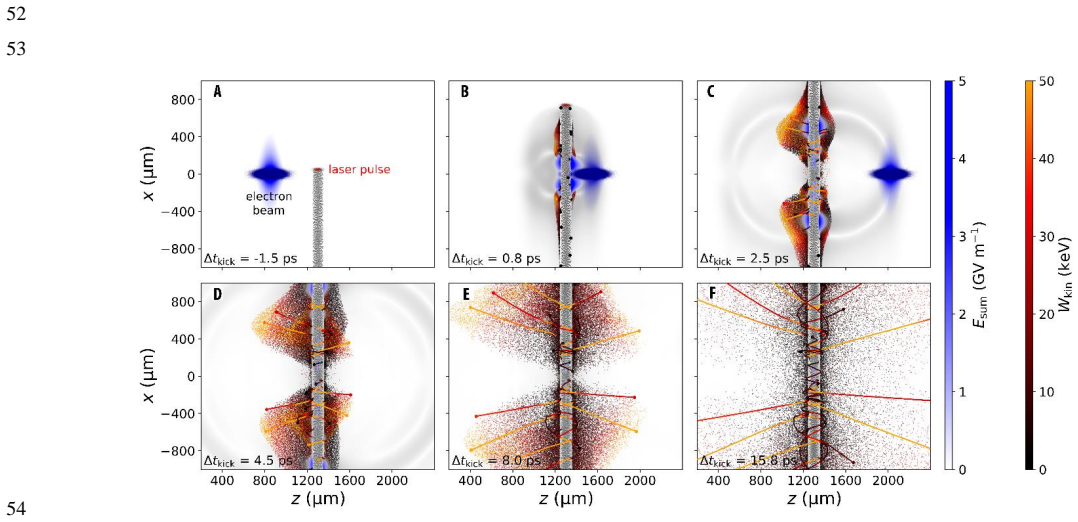
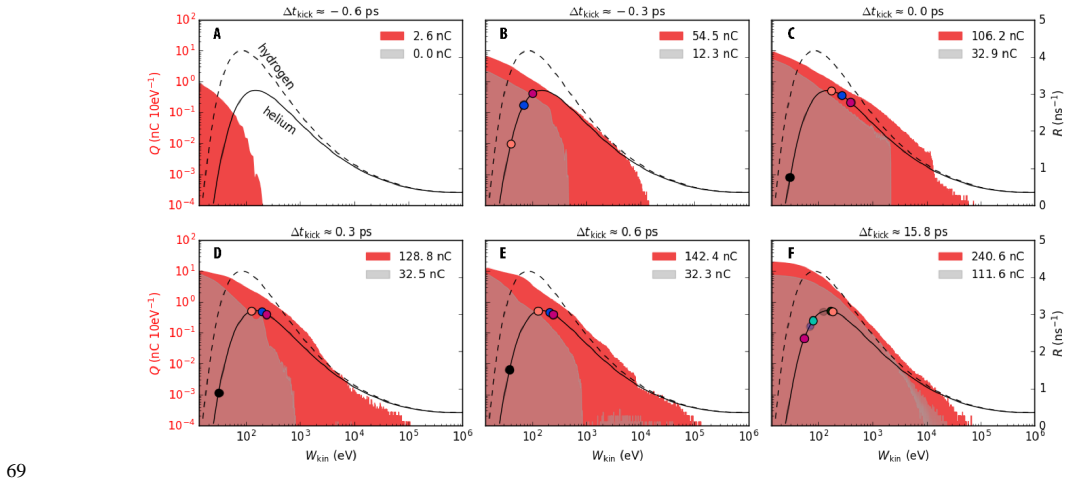
The central object is the amplified plasma afterglow, specifically the integrated emission of the helium recombination line near 587 nm, imaged on a CCD over microsecond-millimetre scales. The argument is carried by treating this afterglow amplification as a linear gauge of the energy transferred from the electron beam into the seed plasma; under that assumption the afterglow image is effectively the overlap integral of the beam's radial electric field with the plasma volume, mapped into a slow visible signal. The supporting machinery is a set of 3D particle-in-cell simulations that compute the transferred energy for each spatial offset and time delay, producing curves whose shapes match the measured Gaussian and sigmoid scans.
What would settle it
Measure the afterglow amplification while scanning the electron-bunch charge at fixed spatial and temporal overlap, and compare the resulting yield to the simulated energy transfer: if the afterglow does not follow the same scaling, the linear gauge relation—and with it the reported 4.1 µm and 55 fs accuracies—would not hold in that regime.
Extended reading notes
Core claim
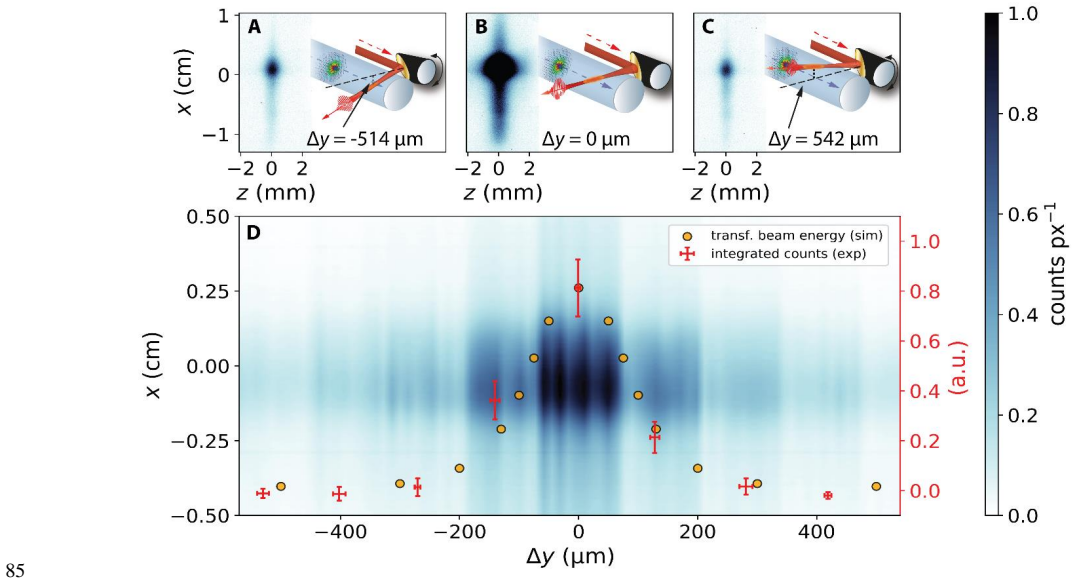
The paper's central claim is that the plasma afterglow amplification observed at the helium line near 587 nm is a faithful, quantitative record of the spatiotemporal overlap between a relativistic electron beam and a laser-generated plasma filament. The amplification factor—the integrated afterglow with the beam present divided by the laser-only afterglow—scales linearly with the energy transferred from the beam's transverse electric field into the plasma, as established by comparing experimental scans to 3D particle-in-cell simulations. In the spatial mode, scanning the beam axis across the filament yields a Gaussian afterglow profile whose peak locates optimal alignment to 4.1 µm; in the temporal mode, scanning the relative delay yields a sigmoid edge whose steep quasi-linear region locates the time of arrival to 55 fs per shot, or 16 fs after applying electro-optic time stamps to correct the measured 109 fs r.m.s. shot-to-shot jitter. The plasma dynamics that carry this information are electron heating by the beam field, anharmonic oscillations of expelled electrons, impact ionization of the ambient gas, and eventual recombination into the afterglow emission.
Load-bearing premise
The accuracies quoted for the method rest on the assumption that the afterglow amplification is a linear function of the energy the electron beam deposits into the plasma; the authors verify this only by matching the shape of their scans to simulated energy-transfer curves and state explicitly that the linear relation must still be verified in other regimes.
Editorial extensions
If this is right
- A single plasma filament can synchronize and align high-intensity beams at the interaction point without intercepting them, so the diagnostic survives focal intensities that would damage solid screens or crystals.
- The method is a standalone all-optical TOA diagnostic that gives absolute timing at the interaction point; with an independent electro-optic measurement of jitter, its shot-to-shot precision reaches 16 fs.
- Placing several plasma filaments side by side would let one electron-bunch shot be sampled in multiple diagnostic modes, separating beam duration, size, and charge effects from the synchronization signal.
- Simulations indicate that shorter, narrower electron bunches of next-generation accelerators would steepen the temporal transition by about a factor of four, improving the achievable resolution accordingly.
- The same plasma-based readout can be applied in pump-probe experiments, seeded free-electron lasers, inverse Compton sources, plasma accelerators, and laser-beam experiments probing quantum electrodynamics.
Reading between the lines
- Beyond the paper, the linearity assumption could be checked directly by measuring afterglow amplification while scanning electron-beam charge at fixed overlap; if the yield follows the simulated energy-transfer scaling, the gauge-curve method would be validated independently of geometry scans.
- The same mechanism might serve as a single-shot bunch-length or beam-size monitor in the laser-early mode, since the afterglow transition width is expected to narrow with shorter, narrower beams; systematic calibration against a known beam would quantify this.
- If the afterglow were imaged with time resolution instead of integrated, the separate energy-conversion stages—heating, impact ionization, recombination—could be isolated, turning the diagnostic into a probe of plasma relaxation dynamics and possibly extending the linear range.
- At facilities with much lower inherent timing jitter than the 109 fs r.m.s. seen here, the method could plausibly reach sub-femtosecond and sub-micrometre accuracy, but that extrapolation is not demonstrated by the paper.
Editorial analysis
A structured set of objections, weighed in public.
Referee Report
Summary. The paper reports a plasma-based diagnostic that uses amplified plasma afterglow light to measure spatial alignment and time-of-arrival between an intense relativistic electron beam and a laser-generated plasma filament. Experiments at SLAC FACET show that the integrated afterglow signal follows a Gaussian profile in transverse offset (σ_y = 64.8 µm) and a sigmoidal transition in relative delay (~315 fs r.m.s.), and the authors derive shot-to-shot accuracies of 4.1 µm for alignment and 55 fs (16 fs with electro-optic sampling calibration) for timing. Three-dimensional particle-in-cell simulations reproduce the shapes of both scans and relate the signal to the energy transferred by the electron beam into the plasma. The paper also discusses extensions, including electron-beam duration and radius diagnostics and composite multi-filament measurements.
Significance. If the quantitative claims hold, this is a useful diagnostic contribution: it offers simultaneous spatial and temporal overlap measurement at the beam-plasma interaction point without intercepting the beams, which is not available from conventional diagnostics that must be placed away from focus or operate at reduced intensity. The work combines an experimental demonstration at a major facility (FACET) with 3D PIC simulations, and it is commendable that the authors explicitly benchmark against an independent electro-optic sampling diagnostic and state the main limitation (the unverified linear relation between transferred energy and afterglow amplification). The reported accuracies (4.1 µm, 55/16 fs) are modest compared to some dedicated timing diagnostics but are notable because they are obtained in a single, plasma-based, damage-tolerant setup directly at the interaction region. The paper is therefore of clear interest to the plasma acceleration and ultrafast-beam communities, provided the calibration assumptions are strengthened or the claims appropriately qualified.
major comments (3)
- [Data analysis / Discussion, Fig. 4 and Fig. 5] The quantitative accuracy claims (4.1 µm alignment, 55/16 fs timing) are obtained by error propagation through the detector functions f(y)-1 and s(t)-1, which assumes that the measured afterglow amplification is a known, monotone (in practice linear) function of the energy transferred from the beam into the plasma. The paper itself states in the Discussion: 'One must still verify that the linear relation between initially transferred energy and plasma afterglow amplification holds in these regimes.' Shape agreement alone between the experimental scans and the PIC-computed energy-transfer curves is not sufficient evidence for linearity, because any monotone nonlinear response would also produce a bell-shaped alignment scan and a sigmoidal timing scan. This matters directly for the quoted widths and slopes: a nonlinear transfer function changes the effective width of the fitted curves and hence the derived accuracies. The authors should either provide an independent calibration of the afterglow response (e.g., by varying beam charge, beam energy, or plasma density over a range that changes the transferred energy) or explicitly report how the inferred widths and accuracies change under plausible nonlinear response models.
- [Methods, PIC simulations section] The absolute timing axis of the temporal scan is not independently measured: the paper states 'the measured integrated counts in Fig. 4 D are shifted on the TOA axis such that the curve agrees with the simulated data.' Consequently, the position of the sigmoid transition and the statement that the plasma afterglow provides 'absolute TOA measurements at the interaction point' are calibrated to the PIC simulation, not to an absolute experimental clock. The shot-to-shot relative accuracy (55 fs raw, 16 fs with EOS) is not affected by this shift, but the absolute-time interpretation is. The authors should state this limitation clearly in the Results or Discussion, or provide an independent absolute timing calibration.
- [Experimental measurements / Fig. 4, Fig. 5] The paper claims that the method 'can measure both temporal and spatial overlap ... directly at their interaction point,' but the spatial scan and the temporal scan are performed in separate series of shots, and the spatial scan is analyzed after subtracting a second Gaussian component attributed to OAP aberration. The subtraction step, described only briefly in the Data analysis section, changes the shape of the detector function used for the 4.1 µm accuracy estimate. If the aberration correction is not independently validated, it could bias the fitted peak position or width. Please provide the uncorrected fits and the aberration model, or state explicitly how the subtraction affects the accuracy estimate.
minor comments (3)
- [Data analysis and PIC simulations] There are cross-reference errors: the 'delay scan in Fig. 4' should presumably refer to Fig. 5, the 'alignment scan in Fig. 5' should presumably refer to Fig. 4, and there is a duplicated word in 'the measured integrated counts in in Fig. 4 D.' Please correct the figure references.
- [References] Reference 6 contains 'rom' instead of 'from'; Reference 16 contains 'Electon' instead of 'Electron'; Reference 35 contains 'el.' instead of 'et al.' and would benefit from the year of publication. Please proofread all references.
- [Introduction / Discussion] The abstract and introduction state that the method offers 'absolute TOA measurements at the interaction point'; in light of the simulation-shifted timing axis and the unverified linear-response assumption, this should be qualified or reworded in the abstract as well as the Discussion.
Circularity Check
No significant circularity: the central observable is directly measured, the PIC simulation provides an independent energy-transfer calculation, and the paper explicitly flags the linear-response assumption as unverified rather than deriving it from itself.
full rationale
The central claim is an experimental demonstration: the integrated plasma afterglow intensity is directly imaged, and the alignment and timing scans are raw data fitted with Gaussian and sigmoid detector functions. The quoted accuracies (4.1 um, 55 fs, 16 fs) are error-propagation precision estimates through those fitted functions, not quantities obtained by plugging the fitted parameters back into the same equations as predictions. The PIC simulations compute a different quantity, the total energy transferred from the electron beam into the plasma, from a first-principles model, and the paper explicitly identifies the conversion from that transferred energy to detectable afterglow photon yield as an assumption: 'One must still verify that the linear relation between initially transferred energy and plasma afterglow amplification holds in these regimes.' That is an honest validation caveat, not a circular reduction. The admitted horizontal shift of the measured timing data onto the simulated TOA axis ('the measured integrated counts ... are shifted on the TOA axis such that the curve agrees with the simulated data') is an absolute-time calibration, since EOS time stamps do not provide absolute timing; it makes the reported agreement partly constructed but does not make the measured signal identical to the simulation input. Self-citations (VSim, the plasma photocathode experiment, and the Xi thesis for the EOS jitter benchmark) are used for code, context, and an independent diagnostic measurement, and none carries the load of the central claim. No step reduces, by construction or by self-citation chain, to its own inputs.
Assumptions & free parameters
free parameters (3)
- Absolute delay offset for temporal scan =
not stated in text (horizontal shift to align measured timing curve with PIC simulation)
- Sigmoid fit parameters (a, t0, k) for temporal transition =
not tabulated in text
- Bi-Gaussian fit parameters (a1,b1,c1,a2,b2,c2) for alignment scan =
not tabulated in text
assumptions (4)
- domain assumption The linear relation between transferred energy and afterglow amplification holds in the explored regime.
- domain assumption The electron beam itself does not cause significant plasma generation in the neutral gas (field below tunnel ionization threshold and impact ionization negligible).
- domain assumption EOS time stamps provide an accurate relative TOA jitter measurement for each shot.
- domain assumption PIC simulation (VSim) accurately captures the energy transfer from beam to plasma with the stated 3 micrometre grid and envelope laser model.
Cite this review
Pith. "Pith review of Plasma-photonic spatiotemporal synchronization of relativistic electron and laser beams." pith.science (2026). https://pith.science/paper/BWJ27BF3
@misc{pith2026190809263,
  author       = {Pith},
  title        = {Pith review of: Plasma-photonic spatiotemporal synchronization of relativistic electron and laser beams},
  year         = {2026},
  howpublished = {\url{https://pith.science/paper/BWJ27BF3}},
  note         = {Machine review of arXiv:1908.09263}
}
read the original abstract
Modern particle accelerators and their applications increasingly rely on precisely coordinated interactions of intense charged particle and laser beams. Femtosecond-scale synchronization alongside micrometre-scale spatial precision are essential e.g. for pump-probe experiments, seeding and diagnostics of advanced light sources and for plasma-based accelerators. State-of-the-art temporal or spatial diagnostics typically operate with low-intensity beams to avoid material damage at high intensity. As such, we present a plasma-based approach, which allows measurement of both temporal and spatial overlap of high-intensity beams directly at their interaction point. It exploits amplification of plasma afterglow arising from the passage of an electron beam through a laser-generated plasma filament. The corresponding photon yield carries the spatiotemporal signature of the femtosecond-scale dynamics, yet can be observed as a visible light signal on microsecond-millimetre scales.
Figures
Figures from the paper (1 more)

Reference graph
Works this paper leans on
-
[1]
8 Radiabeam Technologies, Santa Monica, CA 90404, USA
Colorado, USA. 8 Radiabeam Technologies, Santa Monica, CA 90404, USA. 9 RadiaSoft LLC, Boulder, CO 80301, USA. 10 Tech-X UK Ltd., Daresbury, UK. Page 2 of 20 11 Tech-X Corporation, Boulder, USA. Abstract Modern particle accelerators and their applications increasingly rely on precisely coordinated interactions of intense charged particle and laser beams. ...
work page 2015
Reviewed August 14, 2026 · model on record in the stance chip above.
Discussion (0). Continue with ORCID to comment.